
In This Article
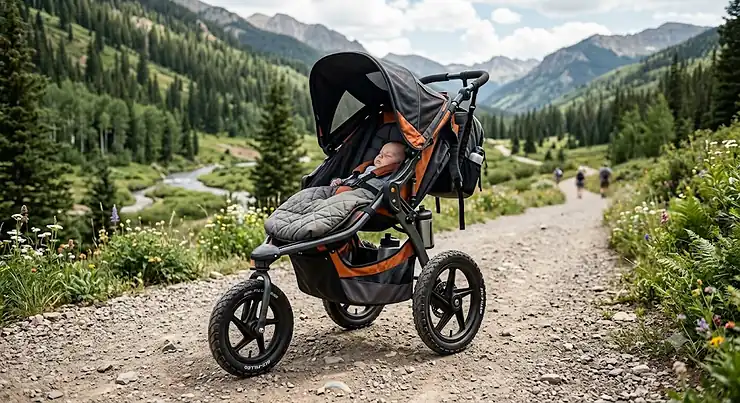
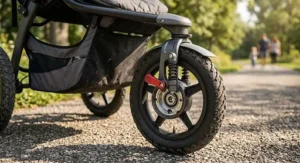
Somewhere between the third cracked sidewalk slab and the second time your toddler yelped “bumpy!” from the back seat, you start googling stroller wheels at 11 p.m. That’s normal. A stroller with air filled tires is a stroller whose wheels use a rubber tire filled with pressurized air, much like a bicycle tire, rather than a solid foam or plastic wheel — and that single design choice changes how every crack, root, and pothole feels to the tiny human strapped inside. The tradeoff is real, though: air holds shock better, but it can also go flat, which is exactly why so many parents end up hunting for both the smoothest ride and the least maintenance headache in the same afternoon.
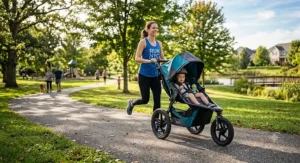
This guide skips the marketing copy and goes straight to what actually matters: real products, real specs translated into plain English, and honest trade-offs pulled from spec sheets and aggregated owner feedback. We looked at everything from budget-friendly three-wheelers under $250 to serious running rigs pushing past $700, so whether you’re outfitting a first stroller or upgrading because your current one rattles like a shopping cart with a bad wheel, there’s a lane here for you. According to Nemours KidsHealth, newborns need to be able to recline nearly flat and ride in a stroller with a reliable harness system regardless of tire type — a reminder that tires are only one piece of a bigger safety picture.
We’ll walk through seven real models, a side-by-side comparison table, honest performance commentary, and the practical stuff nobody tells you at the store — like how to actually patch a flat, when foam-fill tires make more sense than air, and which mistakes send people back to the return line. Let’s get into it.
Quick Comparison Table
Before the deep dive, here’s the bird’s-eye view. Every model below genuinely uses air-filled tires (we’ll flag the one foam-fill exception separately later), and prices reflect general market ranges rather than a snapshot that’ll be outdated by next week.
| Stroller | Tire Setup | Approx. Weight | Price Range | Best For |
|---|---|---|---|---|
| Thule Urban Glide 3 | 16″ rear / 12″ front air-filled | 26.2 lbs | $500-600 range | Daily runners wanting the lightest build |
| BOB Revolution Flex 3.0 | Large air-filled, all-terrain | 28.5 lbs | $600-700 range | Trail walkers and serious off-roaders |
| Bumbleride Speed | 16″ rear / 12″ front air-filled | ~27 lbs | $750-850 range | Distance runners, eco-conscious buyers |
| Bumbleride Indie | 12″ air-filled (x3) | ~24 lbs | $500-600 range | Newborns through toddlerhood, non-jogging use |
| Joovy Zoom 360 Ultralight | 16″ rear / 12.5″ front air-filled | 26.25 lbs | $300-350 range | Budget-conscious joggers |
| hauck Rapid 3 Air | 3 pneumatic tires | Lightweight class | $150-220 range | Tight budgets, in-town-and-park use |
| Jeep Classic Jogging Stroller | 12″ front / 16″ rear air-filled | ~25-26 lbs | $180-250 range | First stroller on a budget |
Looking at the spread, there’s a clean line between the sub-$250 entry point and the $500-plus performance tier, with the Joovy sitting almost alone in the reasonable middle ground. If your main goal is simply smoother pushing on sidewalks and light trails, don’t assume you need to spend premium money — the hauck and Jeep options genuinely deliver pneumatic comfort at a fraction of the cost, just with fewer bells and lower long-term durability ceilings.
💬 Already have a favorite? Jump straight to its full breakdown below — or keep scrolling for the honest comparison you actually came here for.
Top 7 Stroller With Air Filled Tires Picks: Expert Analysis
Here’s where the spec sheets get translated into “what does this actually mean for my Tuesday morning walk.” We picked a genuine mix — budget, mid-range, and premium — plus a couple of lesser-hyped options that punch above their price tag.
1. Thule Urban Glide 3 — lightest full-size jogger on the market
The Urban Glide 3 opens the list because it does the seemingly impossible: it’s the lightest stroller in this roundup at 26.2 pounds, yet it still rides on genuinely large air-filled tires instead of shrinking them down to save weight. The 16-inch rear wheels and 12-inch front wheel are paired with full suspension and a twist hand brake, meaning you get actual speed control on downhill sidewalks instead of just a foot pedal and hope. That combination of low weight and big air volume is the real engineering trick here — most brands sacrifice one for the other.
Based on the spec comparison, this is the pick for parents who want one stroller that pulls double duty as a genuine jogging rig and a daily walker without feeling like hauling a wheelbarrow. Reviewers who’ve logged serious mileage on it consistently describe the ride as smooth and stable at both walking and running pace, with the front wheel tracking straight even without locking it. A common critique in aggregated feedback is that the storage basket caps out around 15 pounds, and the wide rear track can feel bulky moving through narrow store aisles or subway turnstiles.
Pros:
- ✅ Lightest full-size air-tire jogger in its class
- ✅ Twist hand brake for real downhill speed control
- ✅ One-handed compact fold that self-stands
Cons:
- ❌ Storage basket limited to about 15 lbs
- ❌ Wide footprint struggles in narrow indoor spaces
At a price generally landing in the $500-600 range, the Thule Urban Glide 3 earns its premium tag through weight savings and ride quality rather than flashy extras — a legitimate value pick if daily comfort outweighs bargain hunting.
2. BOB Revolution Flex 3.0 — built for real off-road mileage
If the Thule is the lightweight all-rounder, the BOB Revolution Flex 3.0 is the workhorse that doesn’t pretend to be dainty. At 28.5 pounds with a child capacity up to 75 pounds, air-filled tires, and genuine suspension, this stroller is engineered for gravel paths, packed dirt, and cracked suburban sidewalks that would rattle lighter joggers apart. The 9-position adjustable handlebar matters more than it sounds — it means two parents of very different heights can actually both push comfortably without hunching.
What most buyers overlook about this model is the sheer longevity built into that 75-pound weight limit; kids typically age out of most strollers well before they outgrow this one, which changes the long-term cost math significantly. Reviewers with years of ownership describe the ride quality as exceptionally smooth on rough terrain, occasionally comparing it favorably to far pricier options. The honest trade-off is the fold: it requires two hands, the stroller doesn’t self-stand once folded, and it’s bulky enough that many owners remove the wheels just to fit it in a sedan trunk.
Pros:
- ✅ 75-lb child capacity outlasts most competing strollers
- ✅ 9-position handlebar fits parents of different heights
- ✅ Suspension genuinely handles gravel and packed dirt trails
Cons:
- ❌ Two-hand fold, and it won’t self-stand
- ❌ Foot brake only — no hand brake for hills
Priced generally in the $600-700 range, the BOB Revolution Flex 3.0 is the pick for families who actually live near trails or broken pavement, not just aspirational trail-runners who’ll use it twice a year.
3. Bumbleride Speed — three-mode steering for serious runners
The Bumbleride Speed leans hard into its name. Its signature feature is Speed3 Steering — a front wheel that toggles between full 360-degree swivel for casual strolling, partial swivel for jogging, and a fully locked mode for genuine running speed. Paired with 16-inch rear and 12-inch front air-filled tires and all-wheel suspension, it’s built specifically for parents who run regularly rather than occasionally jog around the block.
Here’s what the spec sheet won’t tell you outright: that steering flexibility means you’re not locked into one riding mode the way you are with simpler front-wheel-lock designs, which matters if your routine swings between neighborhood errands and structured training runs. The eco-conscious build — recycled PET fabric, a natural cork handlebar, PFAS-free materials — adds genuine differentiation rather than greenwashing, since it’s paired with real functional upgrades, not just marketing language. The main drawback readers should weigh is straightforward: this is a premium-tier price for a stroller whose specialized running features go underused if most of your outings are just walks to the coffee shop.
Pros:
- ✅ Three-mode Speed3 Steering for walk, jog, or run
- ✅ Recycled, PFAS-free eco-conscious materials throughout
- ✅ All-wheel suspension smooths uneven running routes
Cons:
- ❌ Premium price nears the top of this list
- ❌ Overkill if you rarely run or jog with it
Expect a price generally in the $750-850 range, positioning the Bumbleride Speed as the specialist’s choice — brilliant for committed runners, less justifiable for casual walkers who’d get similar comfort from a cheaper all-terrain model.
4. Bumbleride Indie — newborn-ready lay-flat seat, all-terrain build
Not every parent wants a running stroller, and the Bumbleride Indie is proof that air-filled tires aren’t only a jogger’s feature. This is an all-terrain daily stroller with three 12-inch air-filled tires and all-wheel suspension, built around a lay-flat seat that’s usable from birth without extra attachments. That’s a meaningfully different use case than the jogging-focused entries on this list — it’s aimed at parents who want a smooth, cushioned ride for everyday walks, not race-pace performance.
The practical upshot of the lay-flat design is that you skip buying a separate bassinet for the first few months, which is a real cost saving most spec sheets bury in the fine print. Aggregated owner feedback highlights the compact footprint compared to full-size joggers, making it noticeably easier to maneuver through doorways and store aisles. On the flip side, the front wheel needs to be manually locked for rougher terrain, and this isn’t the stroller to reach for if actual running is part of your routine — the smaller wheel diameter and lighter suspension tuning aren’t built for that pace.
Pros:
- ✅ Lay-flat seat usable from birth, no bassinet needed
- ✅ Compact footprint versus full-size jogging strollers
- ✅ All-wheel suspension smooths daily sidewalk and park terrain
Cons:
- ❌ Not built for genuine running or race pace
- ❌ Front wheel needs manual locking on rough ground
Generally priced in the $500-600 range, the Bumbleride Indie makes sense for parents who want the cushioned ride of air tires without paying for jogging-specific hardware they’ll never use.
5. Joovy Zoom 360 Ultralight — jogger performance without the jogger price
The Joovy Zoom 360 Ultralight occupies genuinely rare territory: a real jogging-capable stroller with 16-inch rear and 12.5-inch front air-filled tires, priced well under the premium tier. At just over 26 pounds, it’s competitive on weight with far pricier models, and Joovy includes an actual tire pump in the box — a small detail that saves a trip to the bike shop the first time you need to top off pressure.
Based on the spec comparison, what you’re sacrificing to hit this price point is refinement rather than core function: the front wheel switch requires kneeling down to flip rather than a quicker mechanism, and the handlebar height isn’t adjustable, which matters more if you and a co-parent have a significant height difference. Reviewers consistently note the wheel connections show slightly more wobble than pricier competitors, though the ride itself remains smooth on pavement and light gravel. For casual joggers and fitness-minded parents who don’t need race-level polish, this remains one of the better value plays in the category.
Pros:
- ✅ Genuine jogger-grade air tires at a mid-range price
- ✅ Includes a tire pump in the box
- ✅ Compact one-hand fold with quick-release rear wheels
Cons:
- ❌ Handlebar height isn’t adjustable
- ❌ Wheel connections show more wobble than pricier rivals
Typically priced in the $300-350 range, the Joovy Zoom 360 Ultralight is the sensible middle path for anyone who wants real pneumatic performance without a four-figure receipt.
6. hauck Rapid 3 Air — lightest pneumatic option under $250
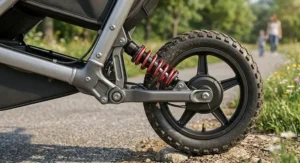
At the budget end, the hauck Rapid 3 Air proves that pneumatic tires aren’t reserved for premium strollers. It runs on three pneumatic tires with rear suspension and a six-position height-adjustable handle, built into a lightweight three-wheel frame that folds with one hand. This is squarely an in-town-and-park stroller rather than a trail or running rig, but it delivers genuine shock absorption for everyday cracked pavement.
What most buyers overlook here is how much the six-position handle adjustment matters at this price — plenty of budget strollers skip adjustable handles entirely, forcing taller or shorter parents into an awkward hunch. Aggregated owner reviews frequently praise the value-for-money angle, describing it as sturdy and easy to control despite the low price, though some owners have raised questions about inner-tube durability over extended use, which is a fair trade-off to expect at this tier. The build quality overall reflects its budget positioning — this isn’t a stroller built to survive years of daily trail mileage.
Pros:
- ✅ Genuine pneumatic tires well under $250
- ✅ Six-position adjustable handle, rare at this price
- ✅ Lightweight, one-hand fold for quick errands
Cons:
- ❌ Build quality reflects its budget-tier positioning
- ❌ Some owner reports flag inner-tube durability concerns
With pricing generally in the $150-220 range, the hauck Rapid 3 Air is a smart entry point for parents who want a stroller with pump up tires without committing premium-tier money to a first stroller.
7. Jeep Classic Jogging Stroller — cheapest true air-tire entry point
Rounding out the list, the Jeep Classic Jogging Stroller by Delta Children answers a simple question: what’s the least you can spend and still get legitimate air-filled tires? At around 25-26 pounds with a 12-inch front swivel-lock wheel and 16-inch rear wheels, it’s JPMA certified and built to meet applicable ASTM and CPSC standards — not just a bargain-bin frame with tires bolted on.
Here’s what the spec sheet won’t tell you but reviewers note: the swing-away child tray and 5-point harness are genuinely convenient touches you don’t always find at this price, and the tires themselves are replaceable rather than fused to a plastic hub, meaning a flat doesn’t mean a dead stroller. Owner feedback aggregated across retail sites frequently mentions the ride feeling surprisingly capable across mixed terrain for the price, alongside recurring comments about limited storage space — realistically enough for a small diaper bag, not a grocery run. Some long-term owners also report occasional inner-tube issues, which tracks with what you’d expect from budget-tier pneumatic hardware.
Pros:
- ✅ JPMA certified, meets applicable ASTM and CPSC standards
- ✅ Swing-away tray and 5-point harness at a low price
- ✅ Tires are replaceable, not fused to the frame
Cons:
- ❌ Storage space fits little beyond a small diaper bag
- ❌ Some owners report occasional inner-tube issues
Generally priced in the $180-250 range, the Jeep Classic Jogging Stroller is the honest budget champion of this list — not flashy, but a real stroller with air filled tires that won’t bankrupt a baby registry.
Practical Usage Guide: Setup, First 30 Days & Maintenance
Getting a stroller with air filled tires home is only step one — the first month is where most avoidable problems happen. Start by checking tire pressure against the PSI printed on the tire sidewall before the first outing; factory-shipped tires are frequently underinflated, and a soft tire feels sluggish and wears unevenly. Most brands include or recommend a standard bike pump with a Presta or Schrader valve adapter, so confirm which valve type your model uses before you’re stranded at a gas station with the wrong nozzle.
During the first 30 days, the most common mistake is ignoring the quick-release wheel mechanism until it jams from disuse — pop the rear wheels off and back on once during setup so you know how it works before you actually need to fold the stroller into a small trunk. Wipe down the tire tread after muddy or gravel outings, since debris lodged in the tread can work its way into the inner tube over time. Once a month, give every tire a gentle squeeze test; if it feels noticeably softer than the others, top it off before it becomes a slow leak you only notice mid-walk. A quick 60-second pressure check before heading out becomes second nature fast, and it’s the single habit that prevents the majority of flat-tire frustration down the line.
✨ Don’t Miss These Exclusive Deals!
🔍 Take your stroller with air filled tires search to the next level — click through to check current pricing and availability on today’s top picks before they sell out.
Real-World Scenarios: Matching a Stroller to Your Life
Consider three genuinely different households. First, a suburban couple with a driveway, a garage, and a neighborhood full of cracked, root-buckled sidewalks — for them, the BOB Revolution Flex 3.0’s suspension and 75-pound capacity make sense as a long-haul investment they won’t outgrow. Second, a city-dwelling new parent in a walk-up apartment with a narrow entryway and a stroller that needs to fit past a coffee shop’s tight door frame — here, the Thule Urban Glide 3’s low weight and compact fold solve a real daily friction point that trail capability wouldn’t.
Third, imagine a budget-conscious family expecting their first child, wanting something serviceable for park visits and errands without financing a premium jogger they might use twice a month — the Jeep Classic Jogging Stroller or hauck Rapid 3 Air both deliver genuine pneumatic comfort without the four-figure commitment. None of these households are wrong; they’re just optimizing for different frequency-of-use and terrain realities. The honest takeaway is that “best” always depends on where you’ll actually push the thing, not which model has the flashiest spec sheet.
Buyer’s Decision Framework
If you’re still torn, run through this quick priority checklist before clicking “buy.”
- If your neighborhood has consistently rough sidewalks or gravel trails, choose a full-suspension jogger like the BOB Revolution Flex 3.0 or Thule Urban Glide 3, because their tire size and suspension tuning are built specifically for that terrain.
- If you live in a tight urban space with narrow doorways or public transit, choose the lightest, most compact-folding option — the Thule Urban Glide 3 or Bumbleride Indie — because weight and fold size solve your actual daily pain point.
- If budget is the deciding factor and you mainly need smoother pavement pushing, choose the hauck Rapid 3 Air or Jeep Classic Jogging Stroller, because they deliver genuine pneumatic comfort without premium pricing.
- If you’re a newborn parent who wants to skip a separate bassinet purchase, choose the Bumbleride Indie for its lay-flat seat usable from birth.
- If actual running performance matters more than anything else, choose the Bumbleride Speed for its dedicated three-mode steering system.
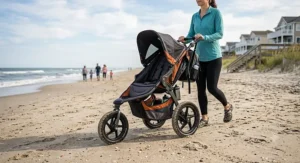
How to Choose a Stroller With Air Filled Tires
- Match tire size to terrain. Larger 16-inch rear tires handle gravel and dirt better than smaller wheels, which are optimized for smooth pavement.
- Check the child weight capacity against your timeline. A higher limit, like the BOB’s 75 pounds, means fewer stroller upgrades as your child grows.
- Confirm the fold size against your car trunk. Some premium joggers require removing wheels to fit in smaller sedans — measure before you buy.
- Decide if you need a hand brake. Hilly routes benefit enormously from a hand brake over a foot-pedal-only design.
- Factor in maintenance tolerance. If you dread the idea of ever patching a tire, weigh a foam-fill alternative against the smoother ride air tires provide.
- Look for certification marks. JPMA certification and compliance with ASTM F833 signal the stroller has been independently tested against U.S. safety standards.
- Price against actual use frequency. A premium running stroller only pays for itself if you’re genuinely running with it multiple times a week.
Common Mistakes When Buying a Pneumatic Tire Stroller
The single most common mistake is buying based on wheel size alone without checking suspension quality — a large air-filled tire on a stroller with no suspension tuning still transmits plenty of jolt to the seat. A close second is skipping the pressure check at purchase; a brand-new stroller with underinflated tires feels sluggish and can make an otherwise excellent model seem disappointing right out of the box. Parents also frequently underestimate storage capacity, assuming “large basket” claims translate to grocery-run capability, when many jogging-focused models cap out around 10-15 pounds by design, since extra weight in the basket can affect handling at speed.
Another frequent misstep is ignoring valve type compatibility — Presta valves (common on performance models) need a different pump head than Schrader valves (more common on budget models), and discovering the mismatch at a gas station air pump is a frustrating first-week surprise. Finally, some buyers assume all “air-filled” claims mean the same thing; a few budget listings use the term loosely for foam-filled or “forever-air” tires that don’t actually require a pump, so always confirm in the spec sheet whether you’re buying a true pneumatic tire or a maintenance-free alternative.
Air Tire Baby Stroller vs Foam Fill Stroller: Which Wins?
This is the debate every stroller shopper eventually runs into, and it’s worth settling with real trade-offs instead of vague marketing language. An air tire baby stroller uses a pressurized rubber tire — genuinely comparable to a bicycle tire — that flexes and absorbs shock as it rolls, which is why the ride feels noticeably smoother over cracked pavement, gravel, or grass. The catch is maintenance: air tires need occasional pressure checks and can be punctured, requiring a patch kit or tube replacement.
Foam-fill (sometimes marketed as “forever-air” or “flat-free”) tires solve the puncture problem entirely, since there’s no air chamber to lose pressure or puncture. The trade-off shows up in ride quality: independent testing comparing a foam-core model against a comparable air-tire stroller on identical gravel paths measured roughly 15% more vibration transferred to the handlebar with the foam-fill design — noticeable to a sensitive rider, though a well-padded seat can mask some of that difference for the child. The honest verdict: if you value zero-maintenance convenience above all else and mostly stick to smooth sidewalks, foam-fill is a reasonable trade. If ride smoothness across varied terrain is the priority — and you’re not intimidated by an occasional five-minute pump-up — air-filled tires remain the better physical performer.
| Feature | Air-Filled Tires | Foam-Fill Tires |
|---|---|---|
| Ride smoothness on rough terrain | Excellent | Good, noticeably firmer |
| Puncture risk | Yes, patchable | None |
| Maintenance needed | Occasional pressure checks | Essentially none |
| Best For | Trails, gravel, cracked sidewalks | Low-maintenance city sidewalks |
The takeaway from this comparison is straightforward: air-filled tires win on comfort, foam-fill wins on convenience, and the right call depends entirely on how bumpy your daily route actually is and how much you dread a maintenance task once every few months.
What to Expect: Real-World Performance on Different Terrain
Specs on a page don’t tell you what an air tire stroller smoother ride actually feels like from behind the handlebar, so here’s the translation. On smooth pavement, the difference between air-filled and foam-fill tires is subtle — both roll fine. The gap widens dramatically on gravel, packed dirt, or a sidewalk with root-buckled slabs, where air-filled tires flex around the obstacle instead of transmitting the jolt straight up through the frame. Parents who switch from a solid-wheel stroller to an air-tire model consistently describe the change as immediately noticeable, particularly for a sleeping baby who stays asleep over bumps that would’ve jolted them awake before.
Cold weather is worth a quick mention too, since tire pressure drops slightly in colder temperatures — the same physics that make car tire lights blink on in winter. A tire that felt perfectly firm in September might need a top-off by December, so a seasonal pressure check is a smart habit rather than a paranoid one. On sand or deep mud, even air-filled tires meet their match; wider tread and lower pressure help marginally, but no stroller in this roundup is built as a true sand vehicle, and pushing hard through soft terrain will fatigue you and the frame regardless of tire type.
Stroller Tire Puncture Fix: A Step-by-Step Repair Guide
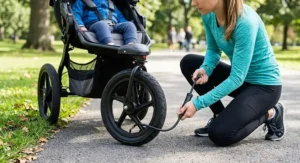
A flat tire doesn’t have to mean an emergency stroller replacement, and fixing one is genuinely a 20-minute driveway job. First, remove the affected wheel from the stroller frame (most quick-release systems pop off with a button press), then separate the tire from the rim using tire levers rather than a screwdriver, which can gouge the rubber. Pull out the inner tube, inflate it slightly, and submerge it in a sink or bucket of water — the puncture reveals itself as a stream of bubbles, which you can mark with a pen before drying the tube off.
From there, a standard glueless bicycle patch kit works fine: scuff the area around the puncture with the included scuffer, apply the patch, and press firmly for a secure seal. Reinsert the tube into the tire, carefully avoiding pinching it between the tire bead and the rim, then reinflate to the PSI printed on the tire’s sidewall and reattach the wheel. For anyone who’d rather prevent flats altogether, a bicycle tube sealant like Slime can be added to the inner tube, sealing small punctures up to a few millimeters automatically before they ever go flat — a smart upgrade if your regular route includes gravel, thorny park paths, or a driveway that’s seen better days.
Long-Term Cost & Maintenance
The sticker price is only the opening chapter of stroller ownership cost. A budget model at $180-250 might need a $10-15 patch kit or a $20-30 replacement inner tube once or twice over its lifespan — a manageable expense that still keeps total cost well below a premium alternative. A premium model at $600-850 theoretically needs the same occasional tube replacement, but the sturdier build and higher child-weight capacity often mean it survives multiple children or years longer, which changes the cost-per-use math in its favor over a long enough timeline.
Where costs sneak up is in accessories: car seat adapters, weather shields, and replacement canopy fabric are frequently sold separately and can add $30-80 depending on the brand. Bearings and axles on any stroller wear down eventually regardless of tire type, and a squeaky wheel after heavy use is usually a lubrication fix rather than a full wheel replacement. Calculated over three to four years of regular use, most air-tire strollers in this roundup land in a similar cost-per-month range once you account for durability differences — meaning the “cheaper” option isn’t always the better long-term value once wear and accessory costs are factored in.
Safety, Regulations & Compliance Guide
In the United States, strollers are regulated as durable infant products, and the Consumer Product Safety Commission requires that carriages and strollers meet the mandatory ASTM F833 standard, covering stability, brakes, restraint systems, folding mechanisms, and wheel attachment. When shopping, look for JPMA certification, which confirms independent lab testing against these federal and voluntary benchmarks rather than a manufacturer’s self-reported claim.
Tire-specific safety considerations are straightforward but easy to overlook: always inflate to the PSI printed on the tire sidewall rather than guessing, since overinflation can cause a blowout and underinflation increases puncture risk and handling instability. Check the front wheel lock mechanism before any faster-paced walk or jog, since an unlocked swivel wheel at speed is a leading cause of tip-overs in jogging-style strollers. Regardless of tire type, a properly adjusted 5-point harness remains the single most important safety feature on any stroller, and it’s worth checking the fit every few months as your child grows.
FAQ
❓ Are strollers with air filled tires worth it?
❓ How often do you need to pump up stroller tires?
❓ Can air filled stroller tires go flat?
❓ What is the best stroller with rubber tires for city use?
❓ Do air tire strollers need special maintenance?
Conclusion
There’s no single best stroller with air filled tires — there’s only the best one for the terrain you’ll actually push it over, the budget you’re comfortable with, and how much maintenance tolerance you’re willing to build into your routine. A family navigating broken suburban sidewalks daily has different needs than a city parent squeezing through a narrow apartment hallway, and both are perfectly valid reasons to land on different models from this list.
What stays consistent across every price point is this: air-filled tires deliver a smoother, more forgiving ride than solid alternatives, at the cost of occasional, genuinely manageable maintenance. Whether you land on the budget-friendly Jeep Classic, the do-it-all Thule Urban Glide 3, or the trail-ready BOB Revolution Flex 3.0, you’re choosing comfort for the smallest passenger in your life — and that’s worth a little extra homework before you buy.
✨ Don’t Miss These Exclusive Deals!
🔍 Take your search for the perfect stroller with air filled tires to the next level with these carefully selected picks. Click through to check current pricing and availability before your favorite sells out!
Recommended for You
- Stroller for Hiking Trails: 7 Best Picks for 2026
- Best Stroller for Beach in 2026: 7 Sand-Ready Picks That Won’t Fail You
- Jogging Stroller for Infant: 7 Top Picks Parents Trust in 2026
Disclaimer: This article contains affiliate links. As an Amazon Associate, I earn from qualifying purchases. If you purchase products through these links, we may earn a small commission at no additional cost to you.
✨ Found this helpful? Share it with your friends! 💬🤗
