
In This Article
When you’re juggling two little ones, double stroller car seat safety becomes your top priority. I’ll never forget the first time I tried installing two car seats on a double stroller—let’s just say it took three YouTube videos, two cups of coffee, and a minor existential crisis before I figured it out. But here’s the thing: in 2023, 43% of children killed in car crashes were unrestrained, making proper installation crucial.
The landscape of double stroller car seat safety has transformed dramatically in 2026. With new federal safety standards taking effect and innovative attachment systems hitting the market, parents have more choices than ever—but also more confusion. This comprehensive guide cuts through the noise to deliver what you actually need: tested products, clear installation steps, and real-world safety tips from experts and parents who’ve been there.
Whether you’re expecting twins, have an infant and toddler, or planning ahead for a second child, understanding how to install car seat on double stroller correctly can literally save lives. Let’s dive into the seven best options that combine safety, convenience, and peace of mind for your growing family. 🚼👶
Quick Comparison Table
| Product | Price Range | Car Seat Capacity | Weight Limit | Best For |
|---|---|---|---|---|
| UPPAbaby Vista V3 | $1,000-$1,300 | 2 infant car seats | 50 lbs per seat | Premium features & luxury |
| Graco Ready2Grow LX 2.0 | $200-$300 | 2 infant car seats | 50 lbs front / 40 lbs rear | Versatility & budget |
| Baby Trend Sit N Stand + 2 Car Seats | $250-$350 | 2 infant car seats (included) | 40 lbs front / 35 lbs per car seat | Complete travel system |
| BOB Revolution Flex 3.0 Duallie | $650-$850 | 1 infant car seat (adapter sold separately) | 50 lbs per seat | Active families & jogging |
| Mockingbird Single-to-Double 3.0 | $395-$495 | 2 car seats (40+ compatible models) | 50 lbs single / 45 lbs per seat double | Modern design & value |
| Joovy Twin Roo+ | $180-$250 | 2 infant car seats (23 compatible models) | 35 lbs per seat | Twins from birth |
| Evenflo Pivot Xpand | $300-$450 | 2 infant car seats | 55 lbs per seat | Tool-free conversion |
💬 Just one click – help others make better buying decisions too! 😊
Top 7 Double Stroller Car Seat Safety Systems: Expert Analysis
1. UPPAbaby Vista V3 – The Gold Standard for Growing Families
The UPPAbaby Vista V3 represents the pinnacle of double stroller car seat safety with its innovative direct-attach system that eliminates adapters entirely. This 2026 model features enhanced FlexRide suspension, all-weather comfort seating, and the ability to accommodate two infant car seats, two bassinets, or any combination you can imagine.
Key Specifications:
- 30+ configurations for ultimate flexibility
- Compatible with UPPAbaby Mesa V3, Mesa V2, and Aria infant car seats (no adapters needed)
- Enhanced suspension system for smoother rides
- 30 lb storage basket capacity
Price Range: $1,000-$1,300 (stroller only)
Customer Feedback: Parents rave about the intuitive setup and premium build quality. One verified buyer noted, “The magnetic harness buckle is genius—no more wrestling with a wiggly toddler while holding an infant.”
✅ Pros:
- No adapters required for UPPAbaby car seats
- Exceptional build quality and materials
- Grows from birth to three children
- Smooth maneuverability even fully loaded
❌ Cons:
- Premium price point
- Heavy at 27.3 lbs (single mode)
Safety Features: The Vista V3’s direct-attach system for car seats eliminates potential installation errors that can occur with adapter-based systems. The reinforced frame provides stability even with two car seats attached, meeting all federal safety standards.
2. Graco Ready2Grow LX 2.0 – Versatile Safety on a Budget
The Graco Ready2Grow LX 2.0 offers exceptional value with multiple seating configurations and compatibility with all Graco infant car seats. This tandem stroller accepts two car seats simultaneously, making it ideal for twins or siblings close in age.
Key Specifications:
- Accepts 2 Graco infant car seats at once (adapters included)
- Bench seat and standing platform options
- One-step self-standing fold
- Full-sized canopies with sun protection
Price Range: $200-$300
Customer Feedback: Users appreciate the versatility, with one parent sharing, “We use it with two car seats for twins, then switched to a seat plus standing platform for our toddler and newborn. It’s been perfect through every stage.”
✅ Pros:
- Compatible with all Graco infant car seats
- Multiple configuration options (seats, bench, standing platform)
- Affordable price point
- Large storage basket
❌ Cons:
- Heavier than expected (approximately 28 lbs)
- Front seat canopy difficult to use with car seat adapter
3. Baby Trend Sit N Stand Double + 2 Car Seats – Complete Travel System Value
The Baby Trend Sit N Stand Double comes as a complete 3-piece set including two EZ-Lift Plus infant car seats, making it the ultimate turnkey solution for safe car seat attachment double stroller needs. Both front and rear seats accept the included Baby Trend infant car seats with secure click-in functionality.
Key Specifications:
- Includes 2 EZ-Lift Plus infant car seats with bases
- 5-point safety harness on both car seats
- EPS energy-absorbing foam in car seats
- Tandem design with standing platform option
Price Range: $250-$350 (complete system)
Customer Feedback: Parents love the all-in-one convenience. “Everything works together perfectly right out of the box. No hunting for compatible car seats or adapters,” one satisfied customer reported.
✅ Pros:
- Complete system—no additional purchases needed
- Car seats include 5-point harness and safety features
- Standing platform for older sibling
- Budget-friendly complete package
❌ Cons:
- Car seat weight limit only 35 lbs
- Stroller is bulkier than some competitors
Safety Highlight: The included EZ-Lift Plus car seats feature height-adjustable backs and 1-hand adjustment, meeting all federal safety standards for crash protection.
4. BOB Revolution Flex 3.0 Duallie – Safety Meets Performance
The BOB Revolution Flex 3.0 Duallie is engineered for active families who refuse to compromise on safety. While it accepts only one infant car seat with an adapter (sold separately), its side-by-side design and mountain bike-style suspension make it exceptional for families transitioning from infant to toddler stages.
Key Specifications:
- Compatible with BOB, Britax, Chicco, and Graco car seats (with adapter)
- 50 lb weight capacity per seat
- Mountain bike-style suspension system
- UPF 50+ canopies with peek windows
Price Range: $650-$850
Customer Feedback: Active parents consistently praise the smooth ride: “We jog three times a week with our twins. The suspension handles trails like a dream, and the car seat adapter makes it easy for our infant to join.”
✅ Pros:
- Superior suspension and ride quality
- Accommodates one car seat plus toddler seat
- Excellent maneuverability for a double stroller
- Fits through standard doorways (30.5″ width)
❌ Cons:
- Only one car seat attachment available
- Adapter sold separately
- Premium pricing
Important Safety Note: Do not jog with an infant car seat attached—this is for walking only until baby reaches 8-12 months.
5. Mockingbird Single-to-Double 3.0 – Modern Safety & Style
The Mockingbird Single-to-Double 3.0 launched in 2026 with innovative safety features including the exclusive LegShade UPF 50+ coverage and magnetic harness buckle. Compatible with 40+ infant car seat models, it offers premium features at a mid-range price.
Key Specifications:
- Compatible with 40+ car seat brands (adapter sold separately)
- 44 possible configurations
- Magnetic buckle system for easy securing
- FullShade sun protection system
Price Range: $395 (stroller) + $50 (car seat adapter) + $225 (2nd seat kit)
Customer Feedback: Recent reviews highlight the 3.0’s improvements: “The magnetic buckle is a game-changer, and the leg shade keeps our baby comfortable even on surprise sunny days.”
✅ Pros:
- Works with major car seat brands (Chicco, Graco, UPPAbaby, Britax, Nuna)
- Premium features at competitive price
- All-wheel suspension
- 30-day home trial
❌ Cons:
- Car seat adapter sold separately
- 2nd seat kit adds $225 to cost
- Heavier when fully loaded
Safety Innovation: The new magnetic buckle system reduces buckling time and frustration, ensuring children are properly secured every time.
6. Joovy Twin Roo+ – Dedicated Twin Safety Solution
The Joovy Twin Roo+ is a purpose-built car seat frame stroller designed specifically for twins. Its unique sideways mounting system provides easy access to both babies and creates a more compact wheelbase than traditional tandem designs.
Key Specifications:
- Compatible with 23 major car seat models
- Sideways car seat mounting (babies face same or opposite directions)
- 70 lb total weight capacity (35 lbs per seat)
- Parent tray holds 4 beverages
Price Range: $180-$250 (frame only, adapters sold separately)
Customer Feedback: Twin parents consistently rate this their favorite: “Being able to access both babies without moving the stroller or other car seat is invaluable. Setup took 5 minutes.”
✅ Pros:
- Ideal for twins from birth
- Compact design fits through doorways (26″ width)
- One-hand fold
- Large storage basket
❌ Cons:
- Adapters sold separately (add $40-50)
- Frame-only design (no toddler seat option)
- Limited to infant car seat stage
Safety Advantage: The sideways mounting eliminates the handle-interference issues common in tandem frame strollers, allowing secure attachment and easy removal.
7. Evenflo Pivot Xpand – Tool-Free Safety Expansion
The Evenflo Pivot Xpand revolutionizes proper car seat installation stroller systems with its tool-free slide-and-lock expansion. It grows from single to double in seconds, accepting two Evenflo LiteMax or SafeMax infant car seats without adapters.
Key Specifications:
- 22+ configurations
- Slide-and-lock system (no tools required)
- Compatible with Evenflo LiteMax and SafeMax car seats
- Extra-large expandable storage basket (2+ feet)
Price Range: $300-$450 (travel system includes car seat)
Customer Feedback: Parents appreciate the simplicity: “Converting from single to double takes literally 10 seconds. No tools, no frustration, just slide and click.”
✅ Pros:
- Tool-free conversion from single to double
- Works with Evenflo car seats (no adapters)
- Self-standing fold
- 55 lb capacity per seat
❌ Cons:
- Limited to Evenflo car seats only
- Some reports of plastic components feeling less premium
- Heavier at 30 lbs
Safety Design: The integrated mounting system eliminates the risk of incorrect adapter installation, a common source of car seat safety issues.
Understanding Double Stroller Car Seat Safety: What You Must Know
When you’re working with double stroller car seat safety, you’re essentially managing two critical safety systems simultaneously. Each car seat must be properly secured to the stroller frame, and each child must be correctly harnessed within their seat. Let’s break down what makes a system truly safe.
The New 2026 Federal Safety Standards
Starting December 5, 2026, all car seats sold in the U.S. must meet new Federal Motor Vehicle Safety Standard (FMVSS) 213a, which includes enhanced side-impact protection testing. This regulation represents a major advancement in child passenger safety, addressing one of the most dangerous crash types.
Side-impact collisions are particularly hazardous because there’s less protective structure between the child and the point of impact. The new standard includes a sled test simulating a 30 mph side-impact crash involving two vehicles, ensuring car seats can restrain children, prevent harmful head contact with vehicle doors, and reduce crash forces to the chest.
What This Means for You: If you’re purchasing a car seat after December 5, 2026, it will automatically meet these enhanced standards. Existing car seats remain safe to use if they haven’t expired, are correctly installed, and haven’t been recalled.
Critical Components of Safe Car Seat Attachment Double Stroller Systems
A truly safe system requires three elements working in harmony:
1. Secure Frame Connection The car seat must lock firmly to the stroller frame with no wiggle room. Movement should not exceed 1 inch side-to-side or front-to-back. This same principle that applies to vehicle installation transfers to stroller mounting.
2. Compatible Products Always verify that your specific car seat model is approved for use with your stroller. Manufacturers maintain compatibility lists for good reason—using unapproved combinations can void warranties and compromise safety.
3. Proper Harness Adjustment The car seat harness must fit snugly on your child, with the chest clip at armpit level and straps lying flat without twists. You should only be able to fit two fingers between the harness and your child’s collarbone.
Why Installation Errors Are More Dangerous Than You Think
Here’s a sobering truth: NHTSA safety engineers emphasize that improper use is a more significant safety concern than differences in crash test performance results. Even the safest car seat becomes ineffective if installed incorrectly.
Common installation mistakes with double strollers include:
- Not engaging both sides of the adapter click
- Forgetting to lock the adapter in place
- Using incompatible adapters from different brands
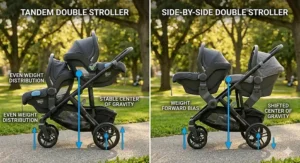
- Overloading one side of a tandem stroller
- Failing to engage the stroller brake when loading/unloading
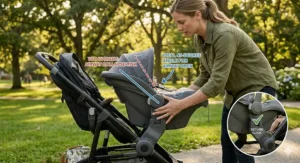
How to Install Car Seat on Double Stroller: The Complete Safety Checklist
Proper installation isn’t complicated, but it requires attention to detail. Follow this comprehensive car seat stroller safety tips checklist every single time:
Pre-Installation Preparation
Step 1: Verify Compatibility Check your stroller manufacturer’s website for the official compatibility list. Don’t rely on “it should fit” assumptions. Download the instruction manual for your specific car seat and stroller combination.
Step 2: Gather Required Components
- Car seat(s)
- Stroller frame
- Adapter bars (if required)
- Instruction manuals for all components
- Good lighting and workspace
Step 3: Inspect Equipment Examine adapter bars for cracks, check click mechanisms for smooth operation, and ensure all moving parts function properly. Any damage warrants immediate replacement.
Installation Process
Step 4: Position the Stroller Place the stroller on level ground and engage the parking brake. Open to full operating position and ensure the frame is locked.
Step 5: Install Adapters (If Required)
- Click adapter bars onto the stroller frame mount points
- Push down firmly until you hear/feel a definitive click on both sides
- Tug upward on each adapter to confirm secure attachment
- Check that adapters are level and aligned
Step 6: Mount the Car Seat
- Align car seat mounting brackets with adapter receptacles
- Lower car seat straight down (not at an angle)
- Push down firmly on both sides until you hear clicks
- The car seat should feel solid with no wobble
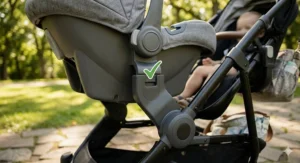
Step 7: Perform the Safety Check Grasp the car seat at the base and attempt to move it side-to-side and front-to-back. It should not move more than 1 inch in any direction. If it does, remove and reinstall.
Step 8: Verify Visual Indicators Many modern car seats feature indicator windows that change color when properly installed. Check these if available—red means incorrect, green means secure.
Post-Installation Verification
Step 9: Test the Release Mechanism Practice removing the car seat using the release handle while the stroller is empty. You should be able to remove it smoothly with one hand while supporting the seat with the other.
Step 10: Load Test With child secured in the car seat, take a short test walk. Listen for unusual sounds, watch for shifting, and pay attention to how the stroller handles. Any concerns warrant immediate re-inspection.
Special Considerations for Double Configurations
When installing two car seats on a double stroller, additional factors apply:
Weight Distribution: On tandem strollers, heavier loads go in the rear seat for stability. Side-by-side models should be balanced.
Sequential Installation: Install the rear car seat first on tandem models, as it’s harder to access once the front seat is in place.
Adapter Interference: Ensure adapters for one seat don’t interfere with those for the second seat. Some models require specific adapter positioning.
Car Seat Stroller Safety Tips: Expert Recommendations
Daily Safety Habits
Always Brake Before Loading: Engage the parking brake every time before placing or removing a car seat. Strollers can roll during the loading process, creating a tipping hazard.
Check Tightness Weekly: Adapter mechanisms can loosen with regular use. Make the 1-inch movement test part of your weekly routine.
Never Hang Heavy Bags on Handles: Even 5 lbs hanging from stroller handles can affect balance and create a tipping risk with car seats attached.
Environmental Considerations
Temperature Awareness: Metal adapter components can become extremely hot in summer sun. Touch-test before handling, especially if the stroller has been in a parked car or outside.
Weather Protection: Rain covers should allow air circulation to prevent carbon dioxide buildup. Never completely seal a car seat cover—babies need fresh air.
Surface Stability: Car seats raise the center of gravity. Be extra cautious on slopes, curbs, and uneven terrain.
Age and Stage Safety
Newborn to 3 Months: Keep the car seat in the most reclined position possible when attached to the stroller. Babies this young need maximum recline to protect their airways.
3-6 Months: As babies develop neck control, slight upright positioning becomes acceptable, but most car seats should remain in the reclined position until 6 months.
Beyond Car Seat Stage: Once babies outgrow infant car seats (typically 22-35 lbs depending on model), transition to the stroller’s toddler seat. Infant car seats are not designed for children who can sit independently.
Crash Test Double Stroller: What the Data Reveals
While strollers themselves don’t undergo crash testing (they’re not designed for use in vehicles), the car seats attached to them absolutely do. Understanding crash test double stroller safety means knowing what happens to car seats in various scenarios.
Federal Safety Standards Overview
Every car seat sold in the U.S. must pass Federal Motor Vehicle Safety Standard No. 213 crash testing. This includes:
- Frontal impact testing at 30 mph
- Side-impact testing (new for 2026)
- Rollover testing
- Temperature testing
Independent testing facilities like BabyGearLab go even further, conducting tests at higher speeds than federal requirements to differentiate performance among models.
What Makes a Car Seat Perform Well in Crashes
Energy-Absorbing Foam: EPS (expanded polystyrene) foam crushes during impact to dissipate energy away from the child’s body. Higher-quality seats use multiple densities of foam strategically placed.
Five-Point Harness Design: The harness distributes crash forces across the strongest parts of a child’s body—shoulders, hips, and between the legs. Proper harness adjustment is critical for this system to work.
Side-Impact Protection: Side impacts cause nearly as many fatalities and serious injuries for children under 12 as frontal crashes. Look for car seats with reinforced sidewalls and energy-absorbing headwings.
Stroller Stability During Sudden Stops
While the car seat provides crash protection in a vehicle, the stroller must remain stable during sudden stops or terrain changes. Quality double strollers feature:
- Low center of gravity design
- Wide wheelbase for stability
- Effective brake systems
- Reinforced frame joints
When a car seat (or two) is attached, the center of gravity rises. This is why premium models use aluminum frames and reinforced mounting points—they’re engineered to handle the additional height and weight.
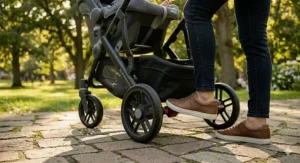
Safety Checklist Infant Stroller: Your Daily Verification Guide
Create this habit: every time you attach a car seat to your stroller, run through this 60-second safety checklist infant stroller inspection:
Visual Inspection (15 seconds)
✅ Stroller frame fully opened and locked
✅ Wheels straight and locked (if applicable)
✅ Brake engaged
✅ Adapters (if used) clicked in on both sides
✅ Car seat level (not tilted to one side)
Physical Check (20 seconds)
✅ Grasp car seat base and test 1-inch movement rule
✅ Verify both sides of car seat are equally secured
✅ Check that car seat release handle works smoothly
✅ Confirm nothing is trapped or pinched in mechanisms
Harness Verification (15 seconds)
✅ Harness straps lie flat with no twists
✅ Chest clip at armpit level
✅ Harness snug (2-finger test at collarbone)
✅ Buckle fully latched with audible click
Environmental Scan (10 seconds)
✅ No hazards in travel path
✅ Weather-appropriate coverage in place
✅ Storage basket not overloaded (affects balance)
✅ Nothing hanging from handles
This systematic approach takes less than a minute but dramatically reduces the risk of oversight errors. Consider it your pre-flight checklist—just as pilots never skip their checks, you shouldn’t skip yours.
Proper Car Seat Installation Stroller: Common Mistakes to Avoid
Even experienced parents make these mistakes. Here’s what to watch for:
Mistake #1: Assuming Universal Compatibility
The Problem: Not all car seats fit all strollers, even with adapters. Manufacturers specify compatibility for safety reasons—car seat bases vary in width, mounting bracket position, and weight.
The Solution: Always verify your exact car seat model number against the stroller’s compatibility list. Don’t rely on general brand compatibility (“works with Chicco seats”). You need model-specific confirmation.
Mistake #2: Skipping the Adapter Lock
The Problem: Many adapter systems have a two-step process: clicking into place, then engaging a secondary lock. It’s easy to miss that second step.
The Solution: Read your manual to understand your specific locking mechanism. Some systems have visual indicators (red/green windows), audible clicks, or tactile feedback. Use all available cues.
Mistake #3: Overloading the Storage Basket
The Problem: That convenient storage basket seems perfect for heavy grocery bags, but overloading it raises the stroller’s center of gravity and can cause tipping, especially with car seats attached.
The Solution: Most baskets have weight limits (typically 20-30 lbs). Respect these limits and distribute weight evenly. Heavy items belong in a backpack worn by the adult, not in the basket.
Mistake #4: Using the Stroller Before Baby Can Support Their Head
The Problem: Some parents transition babies to the stroller seat too early, before adequate neck control develops (typically around 6 months). This is dangerous even with the seat reclined.
The Solution: Keep babies in the car seat attachment or bassinet until they demonstrate strong, consistent head and neck control. Your pediatrician can confirm readiness.
Mistake #5: Incorrect Harness Strap Height
The Problem: For rear-facing car seats, harness straps should be at or below shoulder level. As babies grow, parents sometimes forget to adjust strap height.
The Solution: Check harness height weekly during periods of rapid growth. If straps are above shoulders, move them to the next lower slot. Most car seats feature no-rethread harness systems that make adjustment easy.
Mistake #6: Not Registering the Car Seat
The Problem: Without registration, you won’t receive recall notices or safety updates for your car seat. Recalls are more common than you might think.
The Solution: Register your car seat online immediately after purchase. Update your address if you move. Check NHTSA’s website periodically for recall information.
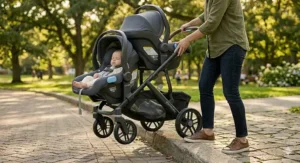
Choosing Between Travel Systems and Mix-and-Match Options
One of the biggest decisions in double stroller car seat safety involves whether to buy a complete travel system or build your own combination.
Complete Travel Systems: The Pros
Guaranteed Compatibility: Every component is designed to work together. No guesswork, no adapter hunting, no compatibility concerns.
Simplified Research: Instead of comparing 50 stroller models and 30 car seat models, you’re choosing from a smaller set of complete systems.
Often More Economical: Buying a bundled system typically costs less than purchasing components separately.
Examples:
- Baby Trend Sit N Stand + 2 Car Seats ($250-350)
- Evenflo Pivot Xpand Travel System ($300-450)
- Graco Modes Nest2Grow ($400-500)
Mix-and-Match Systems: The Pros
Flexibility: Choose the absolute best car seat for safety, then find a stroller that accepts it. Or vice versa.
Upgrade Path: Start with one brand’s car seat, then switch to a different brand’s seat for child #2 while keeping the same stroller.
Premium Options: Access high-end strollers that might not offer complete travel systems.
Examples:
- UPPAbaby Vista V3 (compatible with UPPAbaby, Chicco, Graco, Nuna, and others)
- Mockingbird Single-to-Double 3.0 (works with 40+ car seat models)
- BOB Revolution Flex 3.0 Duallie (compatible with most major brands via adapters)
Which Is Safer?
From a pure safety standpoint, both approaches can be equally safe if you:
- Verify compatibility carefully
- Use manufacturer-approved adapters (never third-party knockoffs)
- Install everything correctly
- Maintain equipment properly
The real determining factor is your commitment to proper installation and maintenance, not whether you bought a system or assembled your own.
Special Considerations for Twins vs. Siblings
Your double stroller car seat safety needs differ significantly depending on whether you have twins or siblings of different ages.
Twin-Specific Safety Considerations
Identical Weight Distribution: Twins develop at similar rates, so your stroller will maintain balanced weight on both sides throughout the car seat stage.
Simultaneous Needs: Both babies will likely need the car seat attachment at the same time and transition to toddler seats around the same time. This makes dedicated twin solutions like the Joovy Twin Roo+ particularly valuable.
Space Efficiency: Side-by-side models like the Twin Roo+ allow easier access to both babies, while tandem models are narrower for tight spaces. Consider your primary use environment.
Best Products for Twins:
- Joovy Twin Roo+ (dedicated frame for twins)
- BOB Revolution Flex 3.0 Duallie (one car seat + one toddler seat works during transition)
- UPPAbaby Vista V3 (accepts two bassinets or two car seats)
Sibling-Specific Safety Considerations
Mixed Seating Needs: Often you’ll need one car seat for the baby and one toddler seat for the older child, or a standing platform option.
Transitional Flexibility: The baby will eventually outgrow the car seat while the toddler is still using the stroller, so you need a system that adapts.
Different Weight Capacities: Your toddler might be 30 lbs while your infant is 10 lbs. Ensure the stroller can handle this imbalance safely.
Best Products for Siblings:
- Graco Ready2Grow LX 2.0 (car seat + toddler seat + standing option)
- Mockingbird Single-to-Double 3.0 (highly configurable)
- Baby Trend Sit N Stand (multiple configuration options)
Maintenance and Longevity: Keeping Your System Safe Over Time
A double stroller car seat system requires regular maintenance to remain safe. Here’s your maintenance schedule:
Weekly Checks
- Test brake function
- Verify all wheels spin freely
- Check for loose screws or bolts
- Inspect fabric for tears or excessive wear
- Test car seat adapter click mechanisms
Monthly Inspections
- Clean wheel axles and remove debris
- Lubricate moving parts (wheels, fold mechanisms) if recommended by manufacturer
- Inspect harness straps for fraying
- Check car seat for proper recline angle
- Verify storage basket attachment points
Quarterly Deep Maintenance
- Remove and wash all fabric components per manufacturer instructions
- Inspect frame for stress cracks (especially at joints)
- Check tire pressure (if pneumatic tires)
- Test all safety features thoroughly
- Review weight limits and ensure children still fit within specifications
Annual Review
- Check car seat expiration date (typically 6-10 years from manufacture)
- Reassess compatibility as children grow
- Consider whether your system still meets your family’s needs
- Look for any recall notices for all components
When to Replace Components
Car Seats Must Be Replaced If:
- Past expiration date
- Involved in any crash (even minor)
- Showing signs of stress or cracking
- Recalled without available remedy
- Missing parts or instructions
Strollers Should Be Replaced If:
- Frame shows cracks or excessive wear
- Wheels don’t roll smoothly or lock properly
- Brake system fails
- Fold mechanism becomes unreliable
- Cannot be cleaned adequately (mold, persistent stains)
FAQ: Double Stroller Car Seat Safety
❓ Can I use any car seat with any double stroller?
❓ How do I know if my car seat is installed correctly on the stroller?
❓ What's the weight limit for car seats on double strollers?
❓ Can I jog with two car seats attached to a double jogging stroller?
❓ Do I need to buy specific adapters for my car seat brand?
Conclusion: Your Family’s Safety Starts With Knowledge
Navigating double stroller car seat safety doesn’t have to feel overwhelming. Armed with the right information, a quality product, and proper installation techniques, you can confidently transport your little ones knowing they’re as safe as possible.
Remember these key takeaways:
🔒 Compatibility is non-negotiable – Always verify your specific car seat model works with your specific stroller model
🔧 Proper installation matters more than premium products – Installation errors are more dangerous than differences in crash test performance
📏 The 1-inch rule is your safety checkpoint – Car seats should not move more than 1 inch in any direction when properly installed
📅 New safety standards are raising the bar – All car seats sold after December 5, 2026, must meet enhanced side-impact protection requirements
✔️ Regular maintenance keeps systems safe – Weekly checks and monthly inspections prevent small issues from becoming safety hazards
Whether you choose the premium versatility of the UPPAbaby Vista V3, the budget-friendly completeness of the Baby Trend system, or the specialized twin efficiency of the Joovy Twin Roo+, the most important factor is your commitment to proper installation, regular maintenance, and following manufacturer guidelines.
Your babies are counting on you to get this right. With the knowledge you’ve gained from this guide, you’re ready to make an informed decision and use your chosen system safely for years to come. Here’s to smooth strolls and safe travels with your growing family! 🚼💙
Recommended for You
- 7 Best Graco Double Stroller Travel System Picks 2026
- 7 Best Convertible Double Stroller with Car Seat 2026
- 7 Best Double Snap and Go Stroller for Twins 2026
Disclaimer: This article contains affiliate links. If you purchase products through these links, we may earn a small commission at no additional cost to you.
✨ Found this helpful? Share it with your friends! 💬🤗
