
In This Article
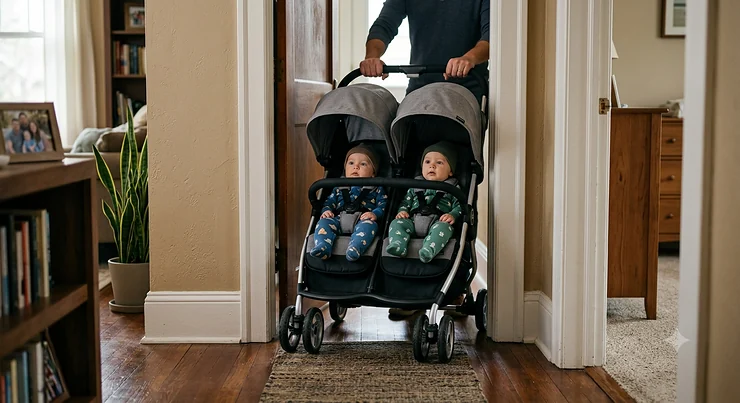
If you’ve ever wedged a stroller sideways into a lobby doorframe while your toddler screams and the mail carrier waits behind you, you already know why this article exists. A double stroller for narrow doorways and elevators is any side-by-side or tandem stroller built slim enough — usually under 30 inches — to pass through a standard residential door and fit inside a typical apartment elevator car without folding, tilting, or a three-point turn in the hallway. That’s the whole definition. Everything else is just degrees of comfort.
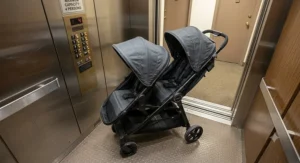
Most double strollers on the market are built for suburban driveways and minivan trunks, not six-story walk-ups or a single elevator shared by forty units. The average side-by-side runs 31 to 34 inches wide, which sounds like nothing until you’re the person holding up the elevator door with your hip while somebody’s dog gets nervous. City parents, apartment dwellers, and anyone navigating older buildings need something narrower, and the good news is that a real category of narrow-frame double strollers exists specifically to solve this. This guide walks through seven real, currently sold models — spanning budget, mid-range, and premium — with honest analysis of which one actually fits your building, your kids, and your patience level.
We’ll cover exact widths in inches, what building codes actually require of doorways and elevators, real trade-offs between tandem and side-by-side layouts, and the mistakes that send parents back to the return line. No fluff, no invented reviews — just the research.
What Is a Double Stroller for Narrow Doorways and Elevators?
A double stroller for narrow doorways and elevators is a two-child stroller — either side-by-side or front-to-back (tandem) — engineered to a width narrow enough to pass through standard interior doors and fit inside residential elevator cars, typically 20.5 to 30 inches wide, compared to the 31–34 inch width of most full-size doubles.
The category splits into two camps. Tandem strollers stack kids front-to-back, so the whole unit can be as narrow as a single stroller — the trade-off is length and the fact that one kid usually gets a worse view. Side-by-side strollers keep both kids level with each other, which toddlers tend to prefer, but engineering two seats into a sub-30-inch frame means each child gets a noticeably tighter seat than a standard model. Neither approach is objectively better; it depends on your hallway, your elevator, and your kids’ tolerance for sharing.
Quick Comparison Table
| Stroller | Width | Price Range | Best For |
|---|---|---|---|
| Graco DuoGlider | 20.5 in | Budget ($180-$270 range) | Narrowest overall fit + infant car seats |
| Mountain Buggy Duet | 25 in | Premium ($700-$900 range) | Narrowest true side-by-side |
| Valco Baby Slim Twin | 26 in | Mid-premium ($550-$650 range) | Lightweight sub-26-inch build |
| UPPAbaby Minu Duo | 29 in | Premium ($650-$850 range) | From-birth premium seats |
| Dream On Me Volgo Twin | 28.5-29.5 in | Budget (under $150) | Lowest price, easiest fold |
| Joovy Scooter X2 | 30 in | Mid-range ($270-$330 range) | Storage-heavy families |
| Zoe Twin V2 | 30 in | Mid-range ($480-$530 range) | Growing/modular families |
Looking at the spread above, the Graco DuoGlider is the clear pick if your building’s doorways and elevator are genuinely tight — nothing else here gets close to 20.5 inches. But if two kids sitting shoulder-to-shoulder matters more to you than shaving inches, the Mountain Buggy Duet and Valco Baby Slim Twin both clear most modern doorways at a fraction of the width of a standard side-by-side. Budget-conscious parents should note that the Dream On Me Volgo Twin delivers a genuinely workable width for well under $150, though you’re trading away some of the ride quality and long-term durability you’d get from the pricier options.
💬 Already narrowing it down? Jump ahead to the full breakdown below — one click and you’ll know exactly which model fits your door.
Top 7 Narrow-Frame Double Strollers: Expert Analysis
1. Graco DuoGlider — narrowest tandem that still takes infant car seats
At 20.5 inches wide, the Graco DuoGlider is narrower than most single strollers, let alone doubles — it’s the tightest fit on this list by a wide margin. The tandem, stadium-style seating stacks one child behind the other, with the rear seat elevated so that child isn’t staring at a headrest all day; the trade-off is a 36-inch overall length, so while it glides through any doorway, it needs a longer straight shot to maneuver than a side-by-side would in an open room. Both seats recline, and the rear seat folds flat enough to function as a bassinet substitute for a napping infant, while the stroller accepts two Graco SnugRide Click Connect infant car seats — a genuine advantage for parents with a newborn and a toddler who don’t want to buy a separate travel system.
Based on the spec comparison, this is the strongest option for anyone whose main obstacle is a genuinely narrow hallway or a small residential elevator, since almost nothing else on the market beats 20.5 inches while still being a full-featured stroller rather than an umbrella model. Reviewers consistently describe the fold as simple and one-handed, and note that despite photos making it look bulky, it handles more nimbly than its dimensions suggest. A common thread in aggregated feedback is that the Graco DuoGlider feels notably lighter and easier to maneuver than other tandem models in its price bracket, though a few owners mention the rear seat’s recline mechanism can feel stiff after regular daily use.
Pros:
- ✅ Narrowest stroller on this entire list at 20.5 inches
- ✅ Accepts two infant car seats for newborn + toddler pairing
- ✅ One-hand standing fold with no bending required
Cons:
- ❌ Longer 36-inch body needs more turning room than a side-by-side
- ❌ Rear child gets a slightly more enclosed view than the front seat
At around $180-$270 depending on the retailer and bundle, the Graco DuoGlider is the best value on this list if width is your number-one constraint, delivering the narrowest footprint here without cutting corners on car seat compatibility.
2. Mountain Buggy Duet — the only double the width of a single stroller
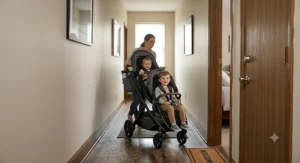
The Mountain Buggy Duet pulls off something genuinely unusual: at 25 inches wide, it matches the footprint of many single strollers, despite carrying two children side-by-side. Mountain Buggy achieves this by narrowing each seat to roughly 11 inches — tight compared to the 16-inch seats found on a typical 32-inch-wide double, but wide enough for the brand to market it confidently as an everyday double rather than a niche travel option. It comes in three colorways (Grid, Black, and Silver) and, unlike most narrow-frame doubles, retains the sturdier build and adjustable, all-terrain-capable wheelset Mountain Buggy is known for on its single strollers.
What most buyers overlook about this model is that the width savings come specifically from seat narrowing rather than from cutting other dimensions, which is why the frame still handles curbs and uneven sidewalks reasonably well compared to umbrella-style competitors. Reviewers who cross-shop this against typical 32-inch side-by-sides consistently note that the Duet is the rare double that lets you walk through a standard door without turning sideways at all, though the narrower individual seats mean two bigger toddlers will eventually feel snug shoulder-to-shoulder. The premium build quality shows up in aggregated review sentiment as well, with owners repeatedly citing the suspension and steering as noticeably smoother than cheaper narrow-frame alternatives.
Pros:
- ✅ Widest wheelbase-to-width ratio of any side-by-side here
- ✅ All-terrain-capable wheels unlike most narrow competitors
- ✅ Available in three distinct colorways
Cons:
- ❌ Individual seats run narrower, less room as toddlers grow
- ❌ Premium price point compared to budget narrow-frame options
Expect to pay in the $700-$900 range at the time of research, which puts the Mountain Buggy Duet at the top of this list price-wise — but for parents who want zero compromise on ride quality alongside the narrowest true side-by-side available, the value case holds up.
3. Valco Baby Slim Twin — sub-26-inch side-by-side without the toy-store build
The Valco Baby Slim Twin measures 26 inches wide and weighs just 24 pounds, making it roughly 5 inches narrower than most full-size side-by-side doubles while still keeping both kids level with each other. Valco effectively replaced its older Neo Twin with this model, and the redesign focused specifically on shaving width without sacrificing the brand’s signature ride quality — a genuinely different engineering approach than simply shrinking a budget stroller down.
Based on the spec comparison, the Slim Twin’s 24-pound weight is notable because it’s lighter than several strollers on this list that are actually wider, which matters enormously if you’re also carrying it up stairs when the elevator is out. Here’s what to weigh: this is a side-by-side, so both kids get equal sightlines and neither one feels like the “back seat,” a detail that matters more than parents expect once toddlers start comparing notes. Reviewers consistently point to the fold-and-carry experience as a highlight, describing it as one of the easier doubles to wrestle into a trunk or a rideshare, and aggregated feedback frequently mentions that it “fits through doorways and grocery store aisles with no problem” — language that shows up across multiple independent write-ups rather than a single source.
Pros:
- ✅ 26-inch width, among the narrowest true side-by-sides available
- ✅ Only 24 pounds — noticeably lighter than similarly wide competitors
- ✅ Easily fits in a trunk with room to spare, per repeated owner feedback
Cons:
- ❌ Smaller brand means fewer accessories and replacement parts than Graco/UPPAbaby
- ❌ Premium price for a stroller without infant car seat compatibility
At roughly $599, the Valco Baby Slim Twin sits in the mid-premium tier — a fair trade if lightweight handling and side-by-side seating both matter to you more than shaving the last few inches off the frame.
4. UPPAbaby Minu Duo — premium from-birth seats in a 29-inch frame
The UPPAbaby Minu Duo is UPPAbaby’s answer to compact double strollers, built at a 29-inch width specifically engineered to fit through standard doorways. Both seats are usable from birth with deep recline and adjustable footrests, which is a meaningful upgrade over most narrow-frame competitors that require an infant to hit a minimum age or weight before riding safely. The frame folds to a compact 12.9 x 27.8 x 23.7 inches with a one-hand, one-step latch, and the stroller weighs 27.4 pounds — respectable for a full-featured double with all-wheel suspension.
What the spec sheet won’t tell you, but reviewers note, is how much the premium materials change the day-to-day experience: full-grain leather handlebars and GREENGUARD Gold certification for low chemical emissions aren’t decorative flourishes, they’re the reason this stroller costs roughly double what the Joovy or Zoe models run. Based on the spec comparison, the from-birth seating is the single biggest functional advantage here — parents of twins or an infant-plus-toddler pairing don’t need to buy a separate bassinet attachment, which several competitors on this list do require. Aggregated owner sentiment consistently praises the one-hand fold as “revolutionary” in its simplicity compared to older UPPAbaby doubles, though a handful of reviewers note the individual seats feel snugger than the brand’s single strollers once a toddler passes the two-year mark.
Pros:
- ✅ Both seats usable from birth, no bassinet attachment needed
- ✅ GREENGUARD Gold certified for lower chemical emissions
- ✅ Genuinely one-hand, one-step fold that works reliably
Cons:
- ❌ Highest price point among the from-birth-capable options here
- ❌ 29-inch width leaves less margin than the Duet or Slim Twin on truly tight doors
Pricing typically falls in the $650-$850 range depending on bundles, positioning the UPPAbaby Minu Duo as the premium choice for parents who want a from-birth double stroller without sacrificing doorway compatibility.
5. Dream On Me Volgo Twin — budget umbrella fold for tight elevators
The Dream On Me Volgo Twin is the most affordable stroller on this list by a wide margin, typically priced under $150, while still measuring a workable 28.5 to 29.5 inches wide depending on how it’s measured (front-wheel-to-front-wheel versus outer handle width). It’s built as an umbrella-style fold, weighing just 23 pounds, with two front-facing seats holding children from 6 months up to 40-45 pounds each, plus 5-point adjustable harnesses and a removable front bar.
Here’s what to weigh: this stroller compensates for its low price with genuinely useful practical touches — large adjustable hoods with mesh inserts for ventilation, netted storage pockets on the back of each seat, and Soft Ride wheels that reduce pushing effort compared to hard plastic wheels found on similarly priced competitors. Based on the spec comparison, the one-hand inward fold is a meaningful advantage for elevator use specifically, since a stroller that collapses quickly is one less thing blocking the door sensor while you’re juggling kids and grocery bags. Reviewers consistently describe it as offering “great quality at a reasonable price,” and repeatedly cite the ease of folding and unfolding as a standout, though the trade-off shows up in structural feel — a few owners note the iron frame, while sturdy for the price, doesn’t feel as premium as the aluminum builds found on the Valco or UPPAbaby models.
Pros:
- ✅ Lowest price point on this entire list, typically under $150
- ✅ One-hand inward fold, useful for quick elevator entry
- ✅ Large adjustable canopies with mesh ventilation panels
Cons:
- ❌ Iron frame feels less premium than aluminum competitors
- ❌ Front-facing-only seats, no option to face caregiver
For parents testing whether apartment life with two kids is even workable with a stroller at all, the Dream On Me Volgo Twin is the lowest-risk entry point — a real double stroller that clears most doorways without the premium price tag.
6. Joovy Scooter X2 — cavernous storage that still clears a doorway
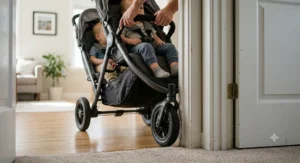
The Joovy Scooter X2 holds its 30-inch width steady while packing in what reviewers consistently describe as the largest storage basket and canopy of any comparably priced double stroller. At 32 pounds it’s the heaviest stroller on this list, but that weight buys sealed bearing wheels (7 inches front, 9.5 inches rear) that deliver a smoother ride on pavement than the lighter umbrella-style competitors here, plus a 90-pound total weight capacity across both 45-pound seats.
Based on the spec comparison, 30 inches is close to the ceiling of what still reliably passes through a standard 32-36 inch American doorframe — workable, but with less margin for error than the Duet or Slim Twin if your building’s doors run narrower than average. What most buyers overlook about this model is how much the double front wheels change stability: the added contact patch makes it noticeably harder to tip than single-front-wheel competitors, which matters if your toddlers climb in and out unassisted. Aggregated reviewer sentiment repeatedly calls out the storage basket as “bigger than any stroller basket on the market,” and multiple independent reviews confirm the one-hand fold works as advertised despite the stroller’s overall bulk; the recurring critique is that it’s simply not built for anything beyond smooth, paved surfaces.
Pros:
- ✅ Largest storage basket and canopy in its price class
- ✅ Sealed bearing wheels for a notably smoother ride
- ✅ Double front wheels add real stability for climbing toddlers
Cons:
- ❌ Heaviest stroller on this list at 32 pounds
- ❌ Not designed for anything beyond smooth, flat surfaces
At roughly $270-$330, the Joovy Scooter X2 delivers strong value for families who need serious storage capacity and don’t mind the extra pounds when the elevator does most of the vertical work anyway.
7. Zoe Twin V2 — modular width that grows from two kids to four
The Zoe Twin V2 measures 30 inches wide and weighs just 22.6 pounds — genuinely light for a full-size side-by-side — with a four-panel, UPF 50+ expandable canopy and independently controlled seats and canopies. What sets it apart from every other stroller here is modularity: the frame accepts an add-on seat to expand into a triple or quad configuration later, which matters for families who aren’t done growing or who regularly babysit a third child.
The spec comparison shows a genuine trade-off worth naming honestly: the Zoe doesn’t accept any infant car seats, so it functions best once a baby can sit upright around 3 months, rather than from day one like the UPPAbaby Minu Duo. Here’s what to weigh — at 30 inches, this is one of the wider strollers on this list, and reviewers who’ve tested it directly note it takes up “a considerable amount of space on sidewalks” and can make standard doorways “a tight fit,” with several mentioning that removing the parent cup holder attachment buys just enough extra clearance for narrower entryways. Reviewers consistently note the value proposition here is strong for what you get — deep recline, adjustable footrests, and a four-panel canopy rarely found at this price point — with the most common complaint being the width itself in genuinely tight urban buildings rather than any build-quality issue.
Pros:
- ✅ Lightest full-size side-by-side on this list at 22.6 pounds
- ✅ Modular design expands to triple or quad configuration
- ✅ Four-panel UPF 50+ canopy with independent seat controls
Cons:
- ❌ No infant car seat compatibility, needs baby to sit upright first
- ❌ 30-inch width is snug in older or narrower doorframes
Priced around $479-$529, the Zoe Twin V2 earns its spot for growing families who want room to expand later, even though it asks for a bit more doorway margin than the narrower options on this list.
Stroller Width in Inches: What the Numbers Actually Mean
Stroller width in inches is the single most useful spec on any product page, but it’s routinely reported inconsistently — some brands measure wheel-to-wheel, others measure the outer edge of the handlebars, and a few quote the frame without wheels attached. That inconsistency is exactly why the Graco DuoGlider‘s 20.5-inch spec and the Dream On Me Volgo Twin‘s 28.5-to-29.5-inch range (depending on measurement method) can both show up as “compact” in marketing copy despite an 8-inch real-world difference.
For practical purposes, treat any stroller under 26 inches as suitable for genuinely tight prewar buildings, 26-29 inches as comfortable for most modern residential doorways, and 30-31 inches as workable but tight — the point where you’ll want to double-check your specific building rather than assume. According to a compliant door opening must provide a clear width of 32 inches minimum, which is why every stroller on this list, at 30 inches or under, clears that federal baseline with room to spare — though older residential buildings built before 1990 aren’t required to meet that standard and can run narrower.
Elevator-Friendly Stroller Dimensions: What Building Codes Actually Require
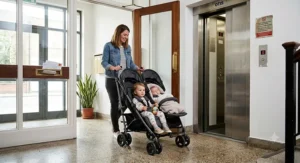
An elevator-friendly stroller isn’t just about the doorway into the elevator car — it’s also about maneuvering once you’re inside a space that, depending on the building’s age, might not give you much room to turn around. Modern accessible elevator doors are required to provide a minimum 36-inch clear width, with car interiors measuring at least 51 inches deep and 68 to 80 inches wide depending on whether the doors open from the side or the center, according to the ADA’s published elevator car dimension standards. That’s genuinely generous compared to residential doorway requirements, which is why elevator width is rarely the real bottleneck — the doorway into your apartment or the building’s lobby entrance almost always narrows first.
The practical exception is older residential buildings, particularly prewar walk-ups converted to include a single freight-style elevator, where car interiors can run considerably tighter than modern code requires because they predate current accessibility standards. If you live in one of these buildings, measure your actual elevator door opening rather than assuming code compliance — a stroller that’s technically “compact” at 30 inches wide can still feel impossibly tight in a car that’s only 32 inches deep front-to-back, since length matters as much as width once you’re trying to turn the stroller to face the doors.
✨ Not sure your building’s numbers work? Grab a tape measure before you buy — it takes two minutes and saves a return shipping label.
How to Choose an Apartment-Friendly Double Stroller
Choosing an apartment-friendly double stroller comes down to matching width, weight, and layout to your specific building rather than chasing the single narrowest option on the shelf. Here’s the decision framework that actually matters:
- Measure your narrowest doorway first, not last. Every stroller on this list lists a width, but your building’s oldest interior door — often a bathroom or a converted closet doorway — is the real constraint, not the front entrance.
- Decide tandem versus side-by-side before comparing prices. Tandem strollers like the Graco DuoGlider win on raw width; side-by-sides like the Mountain Buggy Duet win on sibling sightlines and equal seating.
- Weigh the stroller, not just measure it. If your building has stairs as a backup when the elevator is down, a 22-pound Zoe Twin V2 matters more than a few extra inches of width.
- Check car seat compatibility against your kids’ ages. Only the Graco DuoGlider and UPPAbaby Minu Duo on this list are genuinely from-birth or infant-car-seat-ready without an add-on adapter.
- Factor in the fold speed, not just the folded size. A one-hand fold matters enormously when you’re holding a toddler and the elevator door is closing.
- Confirm the storage basket clears your building’s thresholds. Raised thresholds common in older buildings can catch a low-hanging basket on models like the Joovy Scooter X2.
- Budget for the whole ownership period, not just the purchase price. A $150 umbrella stroller that needs replacing in a year can cost more than a $600 model that lasts through both kids’ toddler years.
Practical Guide: Getting Your Compact-Width Double Stroller Through Doorways and Elevators
Owning the right compact-width double stroller is half the battle; the daily mechanics of actually maneuvering it are the other half, and most of the friction shows up in the first 30 days. Start by practicing the fold at home, not in the lobby — every model on this list folds slightly differently, and fumbling with a locking latch while an elevator door beeps at you is how straps get bent and hinges get forced.
For everyday elevator use, approach the doors straight-on rather than at an angle; even a stroller several inches narrower than the elevator car opening can catch if you’re wheeling in diagonally. Once inside, angle the stroller toward a back corner rather than parking it centered, which leaves room for other residents and prevents the door’s safety sensor from repeatedly catching the frame. For maintenance, wipe down wheel axles monthly if your building has a lot of grit-tracked-in flooring — narrow-frame strollers often use smaller wheels than full-size models, and small wheels accumulate debris faster. Finally, a common first-month mistake is leaving the parent cup holder or snack tray attached when squeezing through a genuinely tight doorway; several models on this list, including the Zoe Twin V2, gain meaningful clearance simply by temporarily removing add-on accessories before the tightest pinch points.
Real-Life Scenarios: Apartment Living With Two Kids
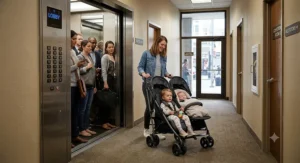
Apartment living with two kids under a stroller-pushing age creates a handful of recurring scenarios worth matching to specific products rather than shopping generically. Consider a family in a 900-square-foot two-bedroom — close to the current U.S. average apartment size, which sits around 882 to 1,052 square feet depending on the data source and year — with a newborn and a two-year-old sharing a single elevator with three other units. This family benefits most from the Graco DuoGlider‘s infant car seat compatibility and narrowest-on-the-list width, since it solves both the age gap and the tight elevator simultaneously.
A different scenario: parents of twins in a converted brownstone with a narrow interior stairwell and no working elevator at all. Here, weight matters as much as width — the 22.6-pound Zoe Twin V2 or 24-pound Valco Baby Slim Twin both minimize the physical toll of carrying a folded stroller up multiple flights daily, something the 32-pound Joovy Scooter X2 would make considerably harder. A third scenario involves a budget-conscious family testing whether a stroller-dependent lifestyle even works in their building before investing heavily — the Dream On Me Volgo Twin‘s sub-$150 price point makes it a reasonable trial before committing to a $600-900 model.
Common Problems With Narrow-Frame Double Strollers (and Quick Fixes)
Problem: The stroller technically fits the doorway but scrapes the frame every time. Solution: check whether your model’s widest point is the wheels or the handlebars — removing add-on cup holders or trays, as several reviewers note works on the Zoe Twin V2, often buys the missing half-inch.
Problem: The elevator door closes before you’re fully inside. Solution: most elevators have a door-hold button inside the car; press and hold it before wheeling in rather than relying on the sensor to detect the stroller’s leading edge.
Problem: One-hand fold jams under time pressure. Solution: practice the fold slowly at home first — nearly every jam reported in aggregated reviews traces back to skipping a required seat-position step, particularly on tandem models where the rear seat needs to be upright before folding.
Problem: Narrow seats feel cramped as toddlers grow. Solution: this is the honest trade-off of any sub-26-inch side-by-side like the Mountain Buggy Duet — budget for a transition to a single-file tandem or a lightweight umbrella double once kids outgrow the narrower individual seats.
Problem: Storage basket catches on raised thresholds. Solution: models with a low-hanging basket, including the Joovy Scooter X2, benefit from a slight backward tilt when crossing a raised threshold, shifting weight off the front wheels momentarily.
Narrow-Frame Double Stroller vs Standard Side-by-Side Stroller
| Factor | Narrow-Frame Double | Standard Side-by-Side |
|---|---|---|
| Typical width | 20.5-30 in | 31-34 in |
| Individual seat width | Narrower (11-14 in) | Wider (15-17 in) |
| Doorway compatibility | Fits most residential doors | Often requires angling or folding |
| Best For | Apartments, elevators, city living | Suburban homes, wide hallways |
A narrow-frame double stroller trades individual seat width for overall building compatibility, which is exactly the right trade for apartment living but a genuine downgrade in comfort once both kids are past the toddler stage and heading toward preschool-sized bodies. Standard side-by-sides remain the better choice for families with driveways and garages rather than lobbies and elevators, since the extra width buys meaningfully more shoulder room per child. The honest takeaway: if your building is the constraint, a narrow-frame model like the Valco Baby Slim Twin solves a real problem standard doubles simply can’t; if your building isn’t the constraint, there’s no reason to sacrifice the extra comfort a standard-width double provides.
Common Mistakes When Buying a Compact Double Stroller
The single most common mistake is shopping by marketing language rather than a measured spec — “compact,” “slim,” and “apartment-friendly” appear on product pages regardless of whether the stroller is actually 26 inches or 30 inches wide, so always confirm the number rather than the adjective. A second frequent mistake is ignoring safety certification entirely; every stroller sold in the U.S. is required to meet the CPSC’s mandatory ASTM F833 safety standard, covering stability, brakes, and folding-mechanism safety, and it’s worth confirming a listing references current compliance rather than an outdated model year.
A third mistake is buying based on width alone while ignoring length, since a narrow tandem like the Graco DuoGlider trades width for a longer 36-inch body that needs more turning room in a cramped hallway. Fourth, parents frequently underestimate weight until they’re the one carrying a folded stroller up a walk-up staircase during an elevator outage — the difference between 22.6 and 32 pounds is substantial after the third flight. Finally, skipping the return policy check is a costly mistake specific to this category, since a stroller that measures fine on a spec sheet can still feel wrong in your actual doorway, and narrow-frame models are exactly the products worth confirming you can return before the trial period ends.
Long-Term Cost & Maintenance
Total cost of ownership for a narrow-frame double stroller extends well past the sticker price, and the calculation looks different depending on the tier you buy into. Budget options like the Dream On Me Volgo Twin, priced under $150, typically use simpler materials — an iron rather than aluminum frame, for instance — meaning a realistic lifespan of one to two years of daily use before wheels, harnesses, or fold mechanisms start to show wear. Mid-range options like the Joovy Scooter X2 and Zoe Twin V2, in the $270-$530 range, generally hold up for the full toddler window on both kids, roughly three to four years, assuming reasonably gentle handling.
Premium models — the Mountain Buggy Duet and UPPAbaby Minu Duo, both north of $650 — justify their price tag primarily through component quality: sealed bearings, replaceable fabric covers, and manufacturer warranties that often run longer than budget competitors. Maintenance costs are modest across the board; expect to replace wheel bearings or fabric seat covers once every couple of years on heavily used models, typically for $20-$60 per part depending on the brand. The realistic ROI question isn’t which stroller is cheapest upfront, but which one you’ll actually still be using in eighteen months — a $150 stroller you replace twice costs more than a $500 stroller you use for the whole double-stroller window.
FAQ
❓ What is a good width for a double stroller in an apartment?
❓ Do narrow double strollers fit standard elevators?
❓ Are tandem or side-by-side double strollers narrower?
❓ How much does a good narrow double stroller cost?
❓ Can a narrow double stroller still hold two toddlers comfortably?
Conclusion
Finding the right double stroller for narrow doorways and elevators really does come down to measuring your actual building rather than trusting marketing copy, then matching that number honestly against your kids’ ages, your building’s stairs-versus-elevator reality, and your budget. The Graco DuoGlider wins on raw width and infant car seat compatibility for genuinely tight buildings, the Mountain Buggy Duet and Valco Baby Slim Twin deliver the best side-by-side seating in a narrow frame, and the UPPAbaby Minu Duo remains the strongest from-birth premium pick if budget allows. For families testing the waters or working with a tighter budget, the Dream On Me Volgo Twin proves you don’t need to spend $700 to solve a doorway problem, while the Joovy Scooter X2 and Zoe Twin V2 round things out with strong mid-range value for slightly wider but still workable buildings.
Whichever you choose, the numbers matter more than the adjectives — measure first, then shop the spec sheet, not the headline.
✨ Don’t Miss These Exclusive Deals!
🔍 Take your apartment-friendly stroller search to the next level with the picks above. Click on any highlighted model to check current pricing and availability. These narrow-frame double strollers help you build a smoother daily routine your whole family will actually enjoy!
Recommended for You
- Double Stroller for One Infant and One Toddler: 7 Best Picks (2026)
- Budget Double Stroller Under $250: 7 Real Picks for 2026
- Stroller With Air Filled Tires: 7 Best Picks (2026 Guide)
Disclaimer: This article contains affiliate links. As an Amazon Associate, I earn from qualifying purchases. If you purchase products through these links, we may earn a small commission at no additional cost to you.
✨ Found this helpful? Share it with your friends! 💬🤗
