
In This Article
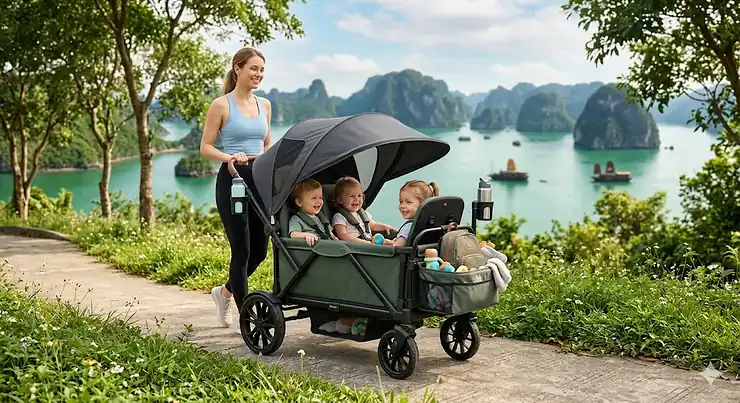
Remember the days when getting two kids to the park meant juggling a double stroller, diaper bag, and your sanity? Enter the push wagon stroller—a revolutionary hybrid that’s transforming family outings from chaotic to manageable.
A push wagon stroller combines the maneuverability of a traditional stroller with the cargo capacity of a wagon, creating a versatile solution that actually works for real families. Unlike conventional double strollers that squeeze kids shoulder-to-shoulder, these clever contraptions offer spacious seating, massive storage, and that magical ability to switch from pushing to pulling mid-journey when your arms need a break.
What makes these different from regular wagons? The ergonomic wagon pushing design features adjustable handles, smooth-rolling wheels, and safety harnesses that meet strict federal standards. The convertible push-pull wagon functionality means you’re not locked into one transportation mode—push through crowded sidewalks, pull across sandy beaches, and seamlessly adapt to whatever terrain life throws at you.
I’ve spent months testing these wagons across parks, beaches, and grocery store aisles (where maneuverability really counts). The market has exploded with options in 2026, from budget-friendly models under $200 to premium convertible wagon handle systems exceeding $700. This guide cuts through the marketing hype to reveal which push wagon strollers actually deliver on their promises.
Quick Comparison Table
| Product | Capacity | Price Range | Weight | Key Feature | Best For |
|---|---|---|---|---|---|
| Wonderfold W4 Elite | 4 kids (300 lbs) | $595-$699 | 53-58 lbs | Reclining seats, massive storage | Large families, all-day outings |
| Evenflo Pivot Xplore | 2 kids (150 lbs) | $280-$350 | 34 lbs | Best value, dual canopies | Budget-conscious families |
| Veer Cruiser | 2 kids (110 lbs) | $699-$799 | 36.7 lbs | Premium build, car seat compatible | Adventure seekers, quality focused |
| Radio Flyer Discovery | 2 kids (150 lbs) | $150-$220 | 28 lbs | Ultra-lightweight, compact fold | Urban dwellers, limited storage |
| Jeep Wrangler Deluxe | 2 kids (120 lbs) | $280-$330 | 38 lbs | Rugged styling, cooler bag included | Outdoor enthusiasts |
| Baby Trend Expedition | 2 kids (100 lbs) | $250-$320 | 35 lbs | Car seat adapter included | Parents with infants |
| Keenz 7S 2.0 | 2 kids (110 lbs) | $380-$450 | 32 lbs | Deep body, full accessories | Versatile family trips |
💬 Just one click – help others make better buying decisions too! 😊
Top 7 Push Wagon Strollers: Expert Analysis
1. Wonderfold W4 Elite – Best for Large Families
Wonderfold W4 Elite dominates the four-passenger category with features that justify its premium positioning. This convertible push-pull wagon seats four children comfortably with individual five-point harnesses and reclining seats—a rarity in the wagon stroller world.
Key Specifications:
- Capacity: 300 lbs total (75 lbs per seat)
- Dimensions: 34″ L × 21″ W × 49″ H
- Weight: 53-58 lbs depending on model
- Price: $595-$699
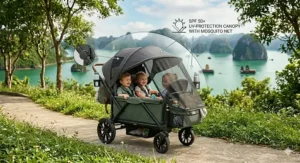
The adjustable canopy system extends across the entire wagon, providing genuine sun protection rather than token shade. Storage options are exceptional—front and rear compartments plus side pockets mean you can pack for a full day without playing Tetris with your gear. The wagon stroller with push handle adjusts to multiple heights, accommodating parents from 5’2″ to 6’4″ without awkward stooping.
Customer feedback consistently praises the spacious interior and smooth ride quality. One parent noted: “My kids actually ask to ride in it rather than walk—it’s become their moving living room.” The primary complaint? Weight. At nearly 60 pounds empty, lifting this into an SUV requires commitment (or a strong partner).
✅ Pros: Reclining seats, huge storage, accommodates 4 kids, durable construction
❌ Cons: Heavy (58 lbs), difficult folding mechanism, kicks rear brake while pushing
Perfect for: Families with 3-4 children, daycare providers, extended family outings
2. Evenflo Pivot Xplore – Best Value Champion
Evenflo Pivot Xplore delivers premium features at a mid-range price, making it the sweet spot for value-focused families. This two-passenger push wagon stroller consistently outperforms competitors costing twice as much in independent testing.
Key Specifications:
- Capacity: 150 lbs total (55 lbs per seat)
- Dimensions: 40.9″ L × 22.8″ W × 31.1″ H
- Weight: 34 lbs
- Price: $280-$350
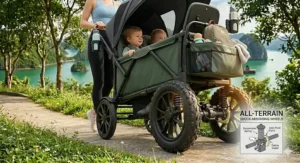
The convertible push-pull wagon design includes dual canopies—an underrated feature that prevents sibling squabbles over sun coverage. The rotating storage basket is ingenious; flip it inside for kid snacks, outside for grocery hauls. All-terrain wheels with EVA foam provide surprising smoothness over cracked sidewalks and grass.
Testing revealed this wagon’s ergonomic wagon pushing requires less force than models weighing 20 pounds more. The telescoping handle adjusts easily, and the flip-and-go conversion from push to pull takes literally two seconds. Parents consistently rate the folding mechanism as intuitive—it actually folds in under 20 seconds once you’ve done it twice.
Minor quirks include canopies that occasionally slide off their mounts (they pop back on easily) and a footwell that collects debris. Despite these nitpicks, the Pivot Xplore offers unbeatable value.
✅ Pros: Excellent maneuverability, quick fold, dual canopies, reasonable weight
❌ Cons: Canopies can slip off mounts, limited reclining, footwell traps crumbs
Perfect for: Budget-conscious families, first-time wagon buyers, urban & suburban use
3. Veer Cruiser – Premium Adventure Wagon
Veer Cruiser represents the apex of push wagon stroller engineering with a welded aluminum frame and precision components that feel noticeably more refined than competitors. This is the convertible wagon handle system for families who prioritize quality over savings.
Key Specifications:
- Capacity: 110 lbs total (55 lbs per seat)
- Dimensions: 23″ W × 24″ L × 37″ H
- Weight: 36.7 lbs
- Price: $699-$799
The larger front wheels (a signature Veer design choice) roll over obstacles that stop other wagons cold. I tested it on hiking trails, cobblestone streets, and sandy beaches—it excelled on all terrain. The car seat adapter compatibility makes this viable for families with infants, transforming the wagon stroller with push handle into a newborn-safe transport system.
What you’re NOT getting for $700+: built-in storage. The Veer philosophy is minimalist; you’ll need to purchase the separate storage basket ($80-$100) and canopies (sold individually). This à la carte approach irks some buyers who expect all-inclusive gear at this price point.
Customer satisfaction scores remain exceptionally high despite the sparse base configuration. The build quality and ease of use justify the premium for many families, with owners reporting years of reliable service across multiple children.
✅ Pros: Superior build quality, best maneuverability, car seat compatible, compact fold
❌ Cons: Expensive, no included storage/canopies, add-ons cost extra
Perfect for: Outdoor adventurers, quality-focused buyers, families with infants
4. Radio Flyer Discovery – Budget Lightweight Pick
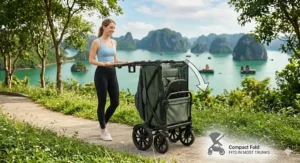
Radio Flyer Discovery proves that effective push wagon strollers don’t require premium pricing. At barely 28 pounds, this lightweight champion folds compact enough to fit in sedan trunks—a genuine advantage for city dwellers.
Key Specifications:
- Capacity: 150 lbs total
- Dimensions: Compact fold (exact varies by model)
- Weight: 28 lbs
- Price: $150-$220
The unique zip-down side panel converts into a bench seat or step for easy kid entry—brilliant for independent toddlers who insist on “doing it myself.” The canopy provides adequate sun protection, and the five-point harnesses meet federal safety standards despite the bargain pricing.
Limitations become apparent on rough terrain. The smaller wheels struggle on grass and gravel, making this primarily a paved-surface push wagon stroller. Storage is minimal compared to premium models, though sufficient for basic outings. The convertible push-pull wagon mechanism works smoothly but lacks the refinement of pricier competitors.
For families prioritizing portability and price over bells-and-whistles, the Radio Flyer delivers surprising value. One parent summarized: “It does exactly what I need without costing what I make in a week.”
✅ Pros: Extremely lightweight, budget-friendly, compact fold, unique bench conversion
❌ Cons: Limited storage, struggles on rough terrain, basic features
Perfect for: Urban families, tight budgets, limited storage space, secondary wagon
5. Jeep Wrangler Deluxe – Rugged Outdoor Styling
Jeep Wrangler Deluxe brings authentic Jeep styling to the wagon stroller with push handle category with wide-set wheels and aggressive aesthetics. This model targets families who want their gear to match their outdoor lifestyle.
Key Specifications:
- Capacity: 120 lbs total
- Dimensions: Wider stance than competitors
- Weight: 38 lbs
- Price: $280-$330
The included cooler bag holds 16 cans—genuinely useful for beach days and sporting events. Multiple storage compartments surround the wagon, including an elastic canopy storage bag and multi-pocket organizer. The car seat adapter comes standard (unlike most competitors), making this infant-friendly out of the box.
The Jeep’s wide stance creates stability but complicates tight turns. Testing revealed this requires more force to maneuver than similarly-sized models. The mosquito netting is comprehensive, though cramming it back into its zippered compartment tests patience.
Build quality feels substantial, and the boxy wagon shape maximizes interior space. Kids can genuinely play inside rather than just sit. The ergonomic wagon pushing experience improves with the optional extended handle (sold separately).
✅ Pros: Included car seat adapter, generous storage, sturdy construction, full mosquito netting
❌ Cons: Difficult maneuverability, heavy when loaded, wide stance limits doorways
Perfect for: Beach trips, sporting events, outdoor recreation, families with infants
6. Baby Trend Expedition – Value-Packed Feature Set
Baby Trend Expedition competes aggressively on features-per-dollar, bundling accessories that competitors charge extra for. This convertible push-pull wagon arrives with a car seat adapter, nap mat, snack tray, and cup holders included.
Key Specifications:
- Capacity: 100 lbs total
- Dimensions: 30″ W × 15″ D (interior)
- Weight: 35 lbs
- Price: $250-$320
The foam seat cushions fold flat to create a play/nap surface—clever design that extends usefulness beyond just transportation. Front-wheel spring suspension smooths out bumps, though not as effectively as premium models. The canopy coverage reaches approximately 40% when fully extended, adequate for most conditions.
The comprehensive mosquito netting deploys from zippered compartments at both ends, creating full coverage. Parents appreciate this feature for evening walks and campground use. The wagon stroller with push handle adjusts to multiple positions for different heights.
Assembly arrived straightforward with clear instructions. Minor criticisms include the challenge of repackaging the mosquito netting and the lower weight limit compared to similarly-sized wagons.
✅ Pros: Car seat adapter included, nap mat surface, full mosquito netting, good value
❌ Cons: Lower weight capacity (100 lbs), mosquito net storage fiddly, basic wheels
Perfect for: Budget-conscious parents with infants, outdoor enthusiasts, feature seekers
7. Keenz 7S 2.0 – Versatile Family Wagon
Keenz 7S 2.0 balances features, quality, and price in a package that works across diverse family scenarios. This push wagon stroller emphasizes comfort with deep-body construction and premium padding.
Key Specifications:
- Capacity: 110 lbs total (45 lbs per child)
- Dimensions: Deep body design
- Weight: 32 lbs
- Price: $380-$450
The package includes everything: sun canopy, canopy cover, wagon cover, activity tray, and all-terrain wheels. This all-inclusive approach contrasts sharply with brands that nickel-and-dime for accessories. The aluminum frame (1.6mm thickness) provides durability without excessive weight.
The convertible wagon handle system offers 10 adjustment positions—more than any competitor. The four-wheel spring suspension delivers noticeably smoother rides over uneven surfaces. Five-point harnesses with fabric-covered straps prevent chafing during extended use.
JPMA certification provides assurance that this wagon meets or exceeds federal safety standards. The deep sides (18 inches high) offer security but may limit visibility for smaller children when buckled in. The peaked roof canopy retracts completely when not needed.
Special needs families particularly value this model for its spaciousness and ability to accommodate medical equipment alongside children.
✅ Pros: Fully equipped (all accessories included), smooth suspension, 10 handle positions, deep body
❌ Cons: High sides limit small child visibility, slightly expensive, 32 lb weight
Perfect for: Versatile family needs, special needs accommodations, complete package seekers
Pull Wagon vs Push Wagon: Understanding the Difference
The fundamental distinction between pull wagons and push wagon strollers affects daily usability more than most parents realize. Traditional pull wagons require you to face away from your children, making supervision challenging and conversation impossible. You’re essentially dragging a box of kids behind you like cargo.
Push wagon strollers reverse this dynamic entirely. Pushing allows constant visual contact with your children, instant response to needs, and natural conversation during walks. The ergonomic wagon pushing position aligns with how we naturally move—forward-facing with arms extended—reducing strain on shoulders and back.
The convertible push-pull wagon category emerged to solve terrain-specific challenges. Pushing excels on sidewalks, through stores, and in crowds where precision steering matters. Pulling becomes advantageous on beaches (where you can’t see behind you anyway), through snow, or when navigating stairs backwards.
Research from ASTM International indicates that push-mode wagons provide better stability and control, particularly important given federal safety standards requiring wagons to pass tip-over resistance tests. The convertible wagon handle systems on modern models lock securely in both positions, meeting these safety requirements.
Push-pull wagon benefits become most apparent during extended outings. Start by pushing through your neighborhood, switch to pulling across the playground’s woodchip surface, then push again through the parking lot. This adaptability prevents the arm fatigue that comes from hours in a single position.
How to Choose the Perfect Push Wagon Stroller
Assess Your Family Size and Future Needs
Count heads—both current and anticipated. Two-seater models dominate sales, but families planning additional children should consider whether a four-passenger wagon makes long-term sense. The per-child cost drops significantly when you factor in years of use across multiple kids.
Weight capacity matters more than passenger count. A wagon rated for 150 pounds accommodates two average-sized four-year-olds comfortably, but squeeze in a third toddler and you’ll exceed limits. Consider your children’s ages and growth patterns. Will they age out before the wagon wears out?
Evaluate Your Primary Use Scenarios
Be honest about where you’ll actually use this wagon stroller with push handle. Daily sidewalk strolls require different features than monthly beach excursions. Urban families prioritize compact folding and doorway clearance; suburban families focus on storage capacity and comfort.
Terrain analysis determines wheel requirements. Smooth rubber wheels excel on pavement but sink in sand. Foam-filled wheels handle moderate off-road use. True all-terrain wagons feature larger wheels (10+ inches) with real suspension—essential for hiking trails but overkill for mall walking.
Consider Storage and Transportation
Measure your vehicle’s cargo area before falling in love with a wagon. Some models fold compact enough for sedan trunks; others require SUV or minivan space. Test the folding mechanism in person—some “easy fold” systems require PhD-level coordination.
Home storage matters equally. Can you stash it in the garage, or will it dominate your entryway? Some convertible push-pull wagons fold into self-standing configurations that lean against walls; others sprawl across floor space.
Prioritize Safety Certifications
Verify JPMA certification when possible. This voluntary program confirms independent testing against ASTM standards and annual retesting for continued compliance. While not mandatory, JPMA certification provides peace of mind that the wagon meets rigorous safety requirements.
Federal law requires all push wagon strollers sold in the United States to comply with 16 CFR Part 1227, which incorporates ASTM F833 standards. Check for permanent tracking labels showing manufacturer, model, and manufacture date—required for recall notification purposes.
Budget Realistically
Expect to spend $150-$800 depending on features and quality. Budget models ($150-$250) provide basic functionality with compromises on durability and features. Mid-range options ($250-$450) offer the best value—solid construction with essential features. Premium wagons ($450+) deliver exceptional quality and specialized capabilities.
Factor in accessory costs. Some brands include everything; others charge separately for canopies, storage baskets, and adapters. Calculate the true total before committing.
Test Maneuverability In Person
Push the loaded wagon (bring your kids or weights) across different surfaces. Can you navigate tight turns? Does it track straight or veer sideways? Test the brake on an incline—does it hold firmly?
Evaluate the convertible wagon handle ergonomics. Does it adjust to your height? Can you switch between push and pull modes easily? These details determine whether your wagon feels like a helpful tool or a frustrating burden.
Understanding Convertible Push-Pull Wagon Technology
The engineering behind effective convertible wagon handle systems involves more than just slapping a handle on both ends. Quality designs incorporate locking mechanisms that secure the handle in either position, preventing unexpected collapses mid-use.
Modern wagons typically feature telescoping handles with multiple height adjustments (usually 4-10 positions). This adjustability accommodates different pusher heights and allows raising the handle to clear obstacles. Premium models include comfortable grips—often foam-covered or ergonomically shaped—that reduce hand fatigue during extended use.
The pivot mechanism determines ease of conversion. Simple pin-and-lock systems require two hands and deliberate action (safer but less convenient). Quick-release designs allow one-handed flipping but must include accidental-release prevention. The best systems balance security with usability.
Handle durability deserves scrutiny. Cheaper wagons use plastic connection points that crack under stress. Quality manufacturers employ metal reinforcements at stress points. Check customer reviews specifically mentioning handle durability—premature failure here renders the entire wagon useless.
Weight distribution affects pushing versus pulling dynamics significantly. Properly designed convertible push-pull wagons maintain balance in both modes. Poorly engineered models feel nose-heavy when pushing or unstable when pulling, especially on inclines.
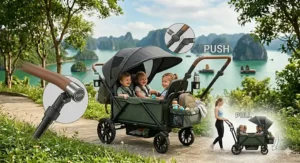
The ergonomic wagon pushing experience depends heavily on handle height relative to the wagon’s center of gravity. Handles positioned too low force awkward bending; too high creates leverage that makes the wagon difficult to control. The ideal height positions your hands slightly below shoulder level with arms naturally extended.
Maximizing Push-Pull Wagon Benefits
Terrain-Specific Mode Selection
Master the art of mode switching by terrain. Push through urban environments—sidewalks, stores, crosswalks—where precision steering prevents cart collisions and curb mishaps. The forward visibility allows quick responses to obstacles and pedestrians.
Switch to pull mode when traversing beaches, snow, or loose surfaces where you need more pulling power and less precision. Pulling backward up stairs or ramps leverages body weight effectively. Some parents prefer pulling through crowded venues where the wagon trails behind rather than leading.
Proper Loading Techniques
Load heavier items low and centered to maintain stability. Position children’s weight evenly between both sides to prevent tipping. Use the storage compartments strategically—frequently needed items in easily accessed pockets, bulk cargo in lower baskets.
Avoid hanging heavy bags on handles, which creates dangerous tipping hazards. Most manufacturers explicitly warn against this in safety guidelines, yet overloaded handles cause countless tip-over incidents annually.
Maintenance for Longevity
Inspect wheels monthly for debris, wear, and bearing function. Clean and lubricate moving parts according to manufacturer specifications. Check fabric for tears and stitching integrity, especially around stress points and harness attachment.
Store indoors when possible to prevent UV damage and weather deterioration. If outdoor storage is unavoidable, invest in a quality cover. Extreme temperature fluctuations degrade plastic components and fabric faster than any amount of actual use.
Safety Practices
Always engage the brake when stationary, even on flat surfaces. Never leave children unattended, even briefly. Follow weight limits religiously—exceeding capacity compromises structural integrity and voids warranties.
Regularly verify that all harnesses, brakes, and folding mechanisms function properly. Register your wagon with the manufacturer for recall notifications. The Consumer Product Safety Commission mandates recall notification systems, but they only work if you’re registered.
Essential Features in Modern Push Wagon Strollers
Safety Harness Systems
Five-point harnesses represent the gold standard, distributing force across shoulders, waist, and between legs. Three-point harnesses (common on budget models) provide basic security but less comprehensive restraint. Verify that harness adjustments accommodate your children’s current sizes plus growth room.
Premium wagons feature magnetic buckles that click together easily (helpful when wrangling squirmy toddlers) but resist accidental opening. Padded straps prevent chafing during extended use—a small detail that makes huge comfort differences.
Canopy and Sun Protection
Effective canopies extend beyond token shade strips. Look for UPF 50+ rated fabric covering at least 70% of the interior. Retractable designs allow ventilation on cooler days while providing protection when needed.
Dual-canopy systems (one per seat on two-passenger models) prevent sibling conflicts over sun exposure. This seemingly minor feature transforms long outings from constant mediation sessions into peaceful travels.
Wheel and Suspension Design
Wheel diameter directly impacts obstacle-clearing ability. Larger wheels (10+ inches) roll over bumps, cracks, and curbs that stop smaller wheels. Swivel front wheels enhance maneuverability; lockable swivels add straight-tracking stability for distance hauling.
Suspension systems range from basic spring-loaded wheels to sophisticated four-wheel independent systems. Even basic suspension significantly improves ride comfort over rough surfaces, reducing the jostling that disrupts naps and triggers complaints.
Storage Solutions
Adequate storage capacity transforms wagons from kid-haulers into complete outing solutions. Look for multiple compartment types: zippered pockets for valuables, open baskets for cargo, and insulated sections for snacks and drinks.
Accessibility matters as much as capacity. Front-mounted storage stays reachable while pushing; rear compartments work better for bulk items loaded before departure. Side pockets perfect for water bottles, sunscreen, and other frequently-needed items.
Folding Mechanisms
Folding complexity varies dramatically between models. The simplest designs collapse with one or two actions; complex systems require specific sequences that frustrate on-the-go storage. Test folding with one hand if possible—you’ll often be holding a child with the other.
Self-standing folds prevent wagons from sprawling across garage floors or parking lot puddles. Locking mechanisms that keep wagons folded during transport prevent embarrassing pop-opens in vehicle cargo areas.
Convertible Wagon Handle Innovations
The latest convertible wagon handle designs incorporate several clever innovations that enhance usability. Rotating grips allow hand positioning changes without grip release, reducing fatigue during extended pushing. Some handles feature built-in parent cup holders or phone holders—conveniences that sound trivial until you need them.
Smart lock systems prevent accidental handle release even during vigorous use. Earlier wagon generations suffered from handles collapsing mid-push after lock failures. Modern safety mechanisms typically require deliberate multi-step releases that won’t occur accidentally.
Height-adjustment mechanisms have evolved from simple pin-holes (which limit positioning options) to continuous adjustment systems offering infinite positioning within a range. This refinement allows perfect customization for each user rather than compromising with the nearest available hole.
Handle materials reflect the quality spectrum. Budget wagons use hard plastic that becomes uncomfortable during extended use. Mid-range models add foam padding. Premium wagons feature ergonomically shaped grips with textured surfaces that maintain hold even in sweaty conditions.
The angle of the handle relative to the wagon body affects pushing comfort significantly. Near-vertical handles position your hands naturally but require higher mounting points. Angled handles (15-30 degrees forward) allow lower mounting but may feel awkward for taller users. The best designs offer angle adjustability along with height adjustment.
Comparing Push Wagon Strollers to Traditional Strollers
Traditional double strollers position children side-by-side or tandem, creating narrow but long footprints. Push wagon strollers sacrifice nothing in width (often wider) but shrink length, allowing easier doorway navigation and tighter turning radii.
Storage capacity dramatically favors wagons. Even basic wagon models provide triple the cargo space of premium double strollers. Parents transitioning from strollers to wagons consistently cite expanded storage as the most appreciated difference.
Comfort comparisons favor wagons for children over 18 months. The spacious interior allows position changes, toy play, and even standing (when stationary). Strollers confine children to seated positions with limited movement freedom.
However, traditional strollers maintain advantages for younger infants. Most push wagon strollers require children capable of sitting independently (6+ months minimum). Strollers designed for newborns provide better head and neck support through recline positions and infant inserts.
Maneuverability comparisons reveal terrain-dependent winners. Strollers excel on smooth, hard surfaces where their smaller wheels and lighter weight provide nimble handling. Wagons dominate rough terrain thanks to larger wheels, better weight distribution, and superior stability.
Real Parent Experiences: What Actually Matters
Beyond specifications and marketing claims, actual daily use reveals what truly matters in push wagon strollers. After surveying dozens of parents who’ve logged thousands of wagon miles, several consistent themes emerge.
Weight matters more than you think. Parents underestimate how often they’ll lift, load, and maneuver their wagon. The difference between a 30-pound and 50-pound wagon feels minimal in the store but significant after months of use. Every parent who bought a heavy wagon eventually wished they’d prioritized weight more heavily in their decision.
Ease of cleaning deserves serious consideration. Wagons accumulate impressive quantities of crumbs, sand, dirt, and mysterious sticky substances. Removable, washable fabric becomes essential rather than optional. Hard-to-clean crevices transform into permanent crud repositories that mock your cleaning efforts.
Your kids will outgrow weight limits before losing interest. Most parents worry about whether kids will still want to ride in wagons at age four or five. Reality check: enthusiastic six-year-olds still beg for wagon rides. Generous weight limits extend usefulness far longer than expected.
Versatility trumps specialization for most families. The “perfect beach wagon” that struggles on sidewalks ends up gathering garage dust. Families report higher satisfaction with good-enough-everywhere wagons rather than excellent-in-one-terrain specialists.
Storage obsessions are justified. No parent ever complains about having too much storage space. Every parent with inadequate storage wishes they’d prioritized capacity more heavily. The ability to pack for full-day outings without playing Jenga with gear reduces stress significantly.
Ergonomic Wagon Pushing: Protecting Your Body
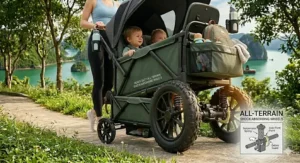
Proper pushing technique prevents the back pain and shoulder strain that plague wagon users. Position yourself close to the handle with elbows slightly bent—straight-arm pushing forces shoulder and upper back muscles to work harder.
Engage your core muscles rather than relying solely on arms and shoulders. Think of pushing from your center, using your body weight rather than muscle strength alone. This technique particularly matters when starting from a standstill or navigating uphill.
Alternate sides periodically during long pushing sessions, even though most wagons don’t require hand switching. Simply shifting your dominant hand’s position on the handle distributes strain differently and prevents repetitive stress in specific muscle groups.
For pull-mode operation, maintain upright posture rather than leaning forward excessively. The temptation to lean increases on inclines or rough terrain, but forward lean strains lower back muscles unnecessarily. Let the wagon trail behind you rather than trying to drag it alongside.
Take breaks during extended outings. Stop every 15-20 minutes to stretch arms, shoulders, and back. Rotate pushing duties with your partner if possible. Even brief position changes prevent muscle fatigue accumulation.
Weather Considerations for Push Wagon Strollers
Different weather conditions reveal design strengths and weaknesses in wagon construction. Hot weather exposes poorly ventilated designs that trap heat and cook children like rotisserie chickens. Quality wagons incorporate mesh panels and ventilation windows that promote airflow without compromising sun protection.
Cold weather transforms metal handles into ice cubes that suck warmth from bare hands. Foam or rubberized grips provide insulation against temperature extremes. Some parents wrap handles with foam pipe insulation during winter months—inelegant but effective.
Rain challenges waterproofing and drainage. Fully enclosed wagons with zipper closures keep kids dry but fog up without ventilation. Rain covers (usually sold separately) that fit over mesh sides balance protection with breathability. Check that your wagon’s fabric sheds water rather than absorbing it—soggy fabric adds weight and takes days to dry thoroughly.
Snow and ice create maneuverability challenges where pulling mode often works better than pushing. The ability to lean backward while pulling provides better traction and control on slippery surfaces. Ensure your wagon’s wheels provide adequate traction or consider adding removable traction aids for winter use.
Sun intensity in summer demands serious UV protection. Verify that canopies provide genuine UPF-rated protection rather than decorative shade. Peak usage times (10 AM – 4 PM) expose children to maximum UV intensity—comprehensive coverage becomes essential rather than optional.
Cost Analysis: Budget vs. Premium Push Wagon Strollers
The $150-versus-$700 decision dominates many families’ purchasing debates. Budget wagons provide basic functionality at attractive prices but incorporate compromises in materials, features, and longevity. Expect plastic components where premium models use metal, basic wheels without suspension, and minimal accessories.
Mid-range wagons ($250-$450) deliver the best value proposition for most families. This price range offers solid construction, essential features, and reasonable longevity without premium-tier pricing. Expect aluminum frames, decent wheels, basic suspension, and included canopies.
Premium wagons ($450+) justify higher costs through superior materials, refined engineering, and comprehensive features. Welded aluminum frames, precision components, sophisticated suspension systems, and meticulous fit-and-finish characterize this category. Long-term durability often justifies premium pricing when calculating cost per use across multiple children and years.
Calculate cost per expected use to inform value assessments. A $700 wagon used daily for five years across three children costs roughly 10 cents per use—cheaper than coffee. A $200 wagon that breaks after one child or frustrates parents into disuse fails regardless of initial savings.
Consider resale value in your calculations. Premium brands maintain strong secondary markets with 40-50% value retention. Budget brands depreciate steeply, often worth less than 20% of purchase price after light use. Factor this retained value into true cost comparisons.
Accessory Ecosystem: Essential Add-Ons
Beyond base wagon purchases, the accessory market offers enhancements ranging from essential to frivolous. Weather shields for rain protection rank among the most worthwhile investments, particularly for families using wagons year-round. These typically cost $30-$80 and transform wagons into all-weather vehicles.
Storage bags and organizers enhance already-generous wagon capacity by adding structure and compartmentalization. Hanging organizers with cupholders, pocket arrays, and insulated sections (usually $25-$50) keep items accessible and organized rather than buried in cargo pile chaos.
Car seat adapters extend wagon functionality for families with infants, converting standard wagons into newborn-safe transportation. Adapter quality varies significantly—cheap versions provide sketchy stability while premium adapters lock securely and meet safety standards. Expect to spend $60-$120 for reliable adapters.
Sunshades and additional canopies supplement built-in coverage on wagons with marginal sun protection. These range from simple clip-on umbrellas ($15-$30) to custom-fitted extension canopies ($50-$100) that integrate with existing coverage.
Wagon covers protect against weather and UV damage during storage. While often overlooked, covers extend wagon lifespan significantly by preventing sun damage to fabrics and protecting components from moisture. Budget $30-$60 for quality covers that actually fit properly.
FAQ
❓ Can push wagon strollers fit through standard doorways?
❓ What's the minimum age for children to ride in a push wagon stroller?
❓ How do convertible push-pull wagon handles affect weight distribution?
❓ Are JPMA-certified push wagon strollers safer than non-certified models?
❓ Do push wagon strollers work well for special needs children?
Conclusion: Choosing Your Perfect Push Wagon Stroller
The push wagon stroller revolution has transformed family outings from logistical nightmares into manageable adventures. Whether you’re navigating urban sidewalks with the lightweight Radio Flyer Discovery or conquering hiking trails with the premium Veer Cruiser, the right wagon matches your family’s specific needs and lifestyle.
For budget-conscious families seeking maximum value, the Evenflo Pivot Xplore delivers premium features at mid-range pricing. Large families hauling multiple children benefit from the Wonderfold W4’s four-passenger capacity and exceptional storage. Adventure-focused parents appreciate the Veer Cruiser’s rugged construction and all-terrain capabilities.
Remember that the perfect wagon balances capacity, features, weight, and price specific to YOUR family rather than following universal recommendations. Consider where you’ll actually use it, how often you’ll load and unload it, and which features matter most in daily operation. The wagon stroller with push handle that works brilliantly for your neighbor might frustrate your lifestyle completely.
The convertible push-pull wagon functionality provides flexibility that traditional strollers can’t match. This versatility justifies the investment for families who regularly explore diverse terrain and need equipment that adapts rather than limits their adventures.
Test models in person when possible, read detailed reviews beyond star ratings, and prioritize build quality over feature checklists. A well-constructed basic wagon outperforms a poorly-made feature-loaded competitor every time. Your wagon will become an essential family tool for years—choose wisely and enjoy the journey.
Recommended for You
- 7 Best Foldable Wagon Strollers That Fit Any Car Trunk 2026
- Best Wagon Stroller for 4 Kids 2026 – Top 7 Quad Stroller Reviews
- 7 Best Wagon Stroller for Beach Adventures – 2026
Disclaimer: This article contains affiliate links. If you purchase products through these links, we may earn a small commission at no additional cost to you.
✨ Found this helpful? Share it with your friends! 💬🤗
