
In This Article
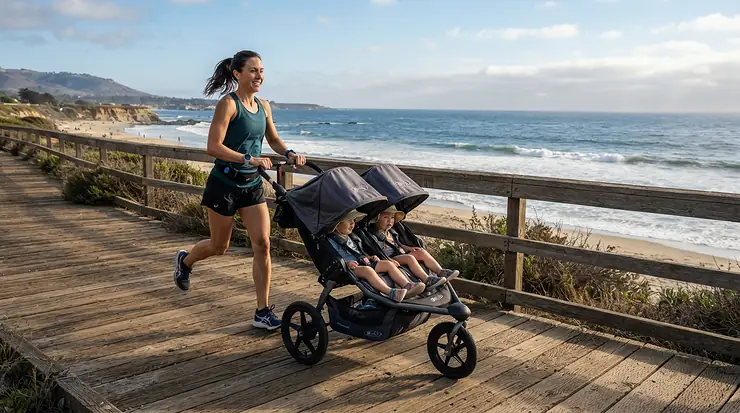
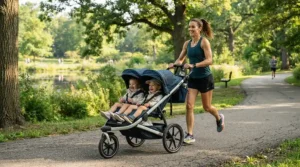
Running with one child in a stroller is a pleasant hobby. Running with two is closer to pushing a small, opinionated cart uphill while both passengers negotiate snack terms. The right twin jogging stroller for running with twins makes that cart feel manageable. The wrong one wobbles, veers into the curb, and leaves you nursing a sore shoulder.

Here’s the twist most shopping guides skip. Almost every side-by-side twin jogger on the market uses a locking swivel front wheel, not a truly fixed one. Fixed-wheel twin setups do exist, but they take a different route, and I’ll walk you through it. 🏃♀️
Everything below rests on real specs, aggregated reviewer and tester feedback, and honest reasoning about what the numbers mean on the road. It isn’t hands-on testing, and I won’t pretend otherwise.
What Is a Twin Jogging Stroller for Running with Twins?
A twin jogging stroller for running with twins is a two-seat, side-by-side stroller built for steady-pace running rather than casual strolling. It pairs large air-filled tires, a locking or fixed front wheel, a wrist strap, and a parking or hand brake with independent seats, so both children ride equally while the runner keeps control.
Wikipedia’s stroller overview places jogging models in their own category, separate from double, umbrella, and travel strollers. That’s a useful reminder that a stroller merely labeled “double” is a different animal.
Quick Comparison: Twin Jogging Strollers for Running with Twins at a Glance
| Model | Front wheel | Price range | Best For |
|---|---|---|---|
| BOB Revolution Flex 3.0 Duallie | Locking swivel with tracking knob | ~$750-$1,000 | Mixed-terrain runners |
| Thule Urban Glide 3 Double | Locking swivel, hand brake | ~$800-$950 | Smooth-riding walks and hikes |
| Thule Chariot Sport 2 Double | Fixed with jogging kit (sold separately) | Well above $1,000 | Multisport families |
| Bumbleride Indie Twin | Swivel with in-line lock | ~$1,000-$1,200 | Newborn-ready, light jogging |
| Baby Trend Expedition Double Jogger | Lockable swivel | ~$200-$400 | Budget beginners |
| Baby Trend Navigator Double Jogger | Two lockable front swivels | Budget tier | Two infant car seats |
| Thule Chariot Lite Double | Fixed with jogging kit (sold separately) | ~$1,000-$1,200 | Lightest fixed-wheel path |
Prices are approximate ranges at the time of research and may vary, so check current pricing. The pattern is clear: locking-swivel models dominate, and the two fixed-wheel options both come from the Chariot line and need an add-on kit. The cheapest option splits from the premium pack on build quality and running credentials, not on seat comfort. If you run regularly, the top rows justify their cost. If you jog a few times a month, the budget rows deserve a look.
💬 Just one click — help others make better buying decisions too!😊
Top 7 Twin Jogging Strollers for Running with Twins: Expert Analysis
1. BOB Revolution Flex 3.0 Duallie — the benchmark for mixed-terrain twin runs
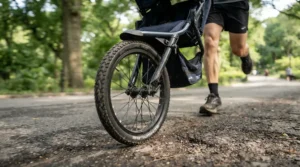
The BOB Revolution Flex 3.0 Duallie puts its shocks near the seating area, so the cushioning reaches your passengers, not just the frame. It weighs 33.1 lb, carries 50 lb per seat (100 lb total), and rolls on a 12″ front and two 16″ rear air-filled tires. In practice, that capacity lasts well past toddlerhood, and the big rear wheels shrug off cracked sidewalks and gravel that stop small-wheeled strollers.
The front wheel swivels or locks, and a tracking knob keeps it from drifting when locked. The handlebar has nine height positions, which matters if you and your running partner differ by six inches. BOB recommends waiting until eight months for jogging. Based on the spec comparison, this is the pick for runners who vary their routes.
Two caveats. It’s a locking-swivel design, not a fixed wheel, and braking comes from a foot pedal rather than a hand brake. Reviewers and testers routinely treat it as the benchmark for double joggers. The recurring gripes are the price and the weight, since at 33 lb it isn’t light.
Pros:
- ✅ Seat-mounted suspension for a smoother ride
- ✅ Tracking knob corrects drift with the wheel locked
- ✅ Nine-position handlebar fits most runners
Cons:
- ❌ Foot-pedal brake only, no hand brake
- ❌ Heavy and expensive versus budget joggers
Expect roughly $750-$1,000; verdict: pricey, but the reference point for the category.
2. Thule Urban Glide 3 Double — refined ride with a hand brake
The Thule Urban Glide 3 Double has a twist hand brake integrated into the handlebar, which is a real advantage on downhill stretches with two children aboard. It weighs 35.3 lb, carries 49 lb per child (100 lb total), and uses 16″ rear and 12″ front air-filled tires. The seats recline independently with built-in leg rests, so one child can nap while the other watches the scenery.
Here’s a crucial honesty check. Thule’s own U.S. FAQ says the single Urban Glide 3 is not designed for jogging and points runners to its dedicated Glide 3. BabyGearLab reports a “not suitable for running” warning in the Urban Glide 3 and Glide 2 safety sheets, yet many retailers market the double as run-ready. I couldn’t verify what the double’s manual says, so read it before running. Until then, treat it as a superb walking and hiking stroller.
Reviewer sentiment is split. One retailer reviewer runs with twins and praises the smoothness, while another tells shoppers to skip it for the BOB.
Pros:
- ✅ Integrated hand brake for hills
- ✅ Independent seats with stepless recline
- ✅ Easy one-hand fold that stands on its own
Cons:
- ❌ Running suitability needs manual verification
- ❌ Heavier than the BOB despite its sleek looks
Expect roughly $800-$950; verdict: excellent for everyday use, but confirm the running rating first.
3. Thule Chariot Sport 2 Double — the fixed-wheel route for serious runners
The Thule Chariot Sport 2 Double is a multisport trailer that becomes a runner’s stroller with a jogging kit. The kit adds a large front wheel held straight, and it costs roughly $120-$150 extra. Total capacity is about 99 lb (45 kg), the trailer has a hand brake, and the rear wheels have adjustable suspension. The small front wheels flip up out of the way for running or biking.
What does a fixed wheel mean in practice? Tracking stays dead straight over bumps, but you must tilt the front end up to turn. One running-focused review found it stays straight easily and that the hand brake works well, though two toddlers add serious weight. Another reviewer had a compatibility mix-up with the kit, and Thule’s parent guidance warns that kits are specific to single or double models. Check the model number before you buy.
Pros:
- ✅ True fixed front wheel with the kit
- ✅ Hand brake and adjustable rear suspension
- ✅ Doubles as a bike trailer and ski pulk
Cons:
- ❌ Jogging kit is an extra purchase
- ❌ Fixed wheel makes tight turns clumsy
Expect well above $1,000 before the kit; verdict: worth it only if you’ll use the multisport features.
4. Bumbleride Indie Twin — narrow, newborn-ready, gentle jogger
The Bumbleride Indie Twin measures about 29.5″ wide, so it slips through standard doorways more easily than many side-by-sides. It weighs 36 lb and carries 90 lb combined, on four 12″ air-filled tires with all-wheel suspension. It ships with a pump and a wrist strap, and the frame carries a lifetime warranty (fabric and tires get one year).
The front wheel swivels with an in-line lock, which the company describes as suited to “light jogging.” Babylist lists jogging at roughly nine months and up. Lucie’s List calls it not great for jogging, but praises its suspension and ease of pushing. Read that as a walking-first stroller that tolerates easy jogs, not a race machine. It also fits two infant car seats or bassinets, so it’s the most useful option for newborn twins.
Pros:
- ✅ Narrow frame fits standard doorways
- ✅ Newborn-ready with car seat or bassinet options
- ✅ Pump and wrist strap included
Cons:
- ❌ Reviewers question its running credentials
- ❌ Priciest of the swivel-wheel group
Expect roughly $1,000-$1,200; verdict: buy it for the first year and easy jogs, not for tempo runs.
5. Baby Trend Expedition Double Jogger — budget-friendly entry point
The Baby Trend Expedition Double Jogger is the affordable gateway. It uses bicycle-style 16″ rear and 12″ front pneumatic tires, a lockable front swivel, quick-release wheels, and a parent tray with two cup holders. Those bike-style tires do most of the work over sidewalks, and quick-release wheels help it fit in a smaller trunk.
Retail listings show around 4.5 stars across 500+ ratings, and parents praise easy pushing and value. Lucie’s List calls it an economy option for light jogs and warns of front-wheel wobble and eventual failure reported by some owners. One twin parent noted it can’t squeeze through a restaurant door. My read: it’s ideal for occasional runs on smooth pavement, but a heavy runner should budget for something sturdier.
Pros:
- ✅ Lowest price among the seven
- ✅ Real air-filled bike-style tires
- ✅ Parent tray with cup holders
Cons:
- ❌ Front-wheel wobble reported by some owners
- ❌ Not recommended for earnest running
Expect roughly $200-$400; verdict: strong value for casual joggers, weak for training.
6. Baby Trend Navigator Double Jogger — the only one taking two infant car seats
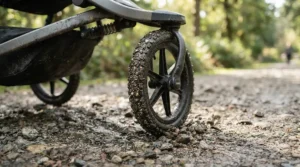
The Baby Trend Navigator Double Jogger accepts two Baby Trend infant car seats, so newborn twins can ride from day one. It carries 50 lb per seat (42″ height max), has bike-style tires, individual ratcheting canopies, and two lockable front swivel wheels. Some owners feel the dual wheels calm the wobble, though it’s a four-wheel design, not the classic three-wheel jogger layout.
BabyGearLab flagged a poorly accessible storage bin with a low 5 lb limit and noted the Navigator weighs about 10 lb more than the Expedition. The same tester also observed that jogging with children under eight months isn’t advised anyway, so the two-car-seat feature helps walks, not runs. It’s the right pick for parents who prioritize a newborn travel system on a budget.
Pros:
- ✅ Fits two Baby Trend infant car seats
- ✅ Two front wheels add steadiness
- ✅ Individual canopies for each child
Cons:
- ❌ Storage basket is hard to reach and weak
- ❌ Heavier than the Expedition
Expect a budget-tier price, generally under $400; verdict: a smart newborn-phase choice, less compelling for serious running.
7. Thule Chariot Lite Double — the lightest fixed-wheel path
The Thule Chariot Lite Double weighs about 27.5 lb as a stroller, carries 100 lb total, and is roughly 31.5″ wide. That’s easily the lightest of the seven, and a big deal when you’re lifting it into a trunk after a run. It ships as a stroller and bike trailer, and the jogger wheel is a separate purchase at roughly $120.
The catch: it’s pure spec-sheet logic until you add the wheel. One review noted the Lite technically calls for the jogging kit to run, and the reviewer described mostly pathway runs without it. The frame is a proven, high-quality build, but the fixed-wheel benefits only arrive after the extra purchase.
Pros:
- ✅ Lightest of the seven
- ✅ Fits through standard doorways
- ✅ Bike conversion kit included
Cons:
- ❌ Jogger wheel costs extra
- ❌ Fixed wheel limits tight-turn agility
Expect roughly $1,000-$1,200 plus the wheel; verdict: best for weight-conscious runners committed to the fixed-wheel style.
Top 7 Specs and Value at a Glance
| Model | Key spec that matters | Price range | Best For |
|---|---|---|---|
| BOB Revolution Flex 3.0 Duallie | Seat-mounted suspension, 33.1 lb | ~$750-$1,000 | Trail and mixed routes |
| Thule Urban Glide 3 Double | Integrated hand brake, 35.3 lb | ~$800-$950 | Walks and hikes |
| Thule Chariot Sport 2 Double | Fixed wheel via kit, adjustable suspension | $1,000+ | Multisport families |
| Bumbleride Indie Twin | 29.5″ wide, newborn-ready | ~$1,000-$1,200 | First-year flexibility |
| Baby Trend Expedition Double Jogger | Air tires at a budget price | ~$200-$400 | Occasional jogs |
| Baby Trend Navigator Double Jogger | Two infant car seats | Under ~$400 | Newborn travel system |
| Thule Chariot Lite Double | About 27.5 lb, fixed wheel via kit | ~$1,000-$1,200 | Weight-conscious runners |
Looking at the comparison above, the BOB Revolution Flex 3.0 Duallie delivers the best balance of proven running performance and everyday usability. If your priority is a fixed front wheel, the two Chariot models are the only real routes, and the Thule Chariot Lite Double wins on weight. Budget buyers should note that the Baby Trend Expedition Double Jogger trades long-term durability for its low price.
How to Choose a Twin Jogging Stroller for Running with Twins
- Confirm your children’s age and readiness. A pediatrician quoted by Healthline says jogging strollers are generally safe at 6 to 8 months, since most don’t recline fully. Always clear it with your own pediatrician first.
- Check weight limits per seat and total. Twins gain weight quickly. A 100 lb total capacity gives you years, while a 90 lb cap runs out sooner.
- Pick your wheel strategy. Decide between a locking swivel for versatility and a fixed wheel for tracking. We cover this trade-off below.
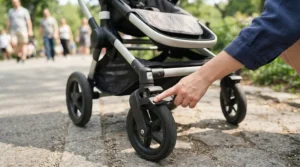
- Look for a hand brake and a wrist strap. A parking brake holds the stroller still; a hand brake controls speed on descents.
- Measure your doorways and trunk. Side-by-side frames run 29-32″ wide, and one twin parent reported that a jogger wouldn’t fit a restaurant door.
- Inspect the tires. Air-filled tires with a pump or a pump-friendly valve save money and ride better.
Follow the order above and your shortlist shrinks quickly. For most twin parents, the deciding factor ends up being width versus performance.
Side-by-Side Twin Jogging Stroller vs Tandem and Regular Strollers
A side-by-side twin jogging stroller gives both children an equal view and an equal seat, which tends to make twins happier and the push more balanced. Tandem (inline) models fit through any doorway but run longer and can be harder to steer, according to stroller comparison guides. Regular double strollers look similar but usually lack the wheels, brakes, and frame stiffness for running.
| Feature | Side-by-side jogger | Tandem stroller | Regular double |
|---|---|---|---|
| Ride balance | Even for both kids | Front seat gets the better view | Varies |
| Doorways | Wider, ~29-32″ | Narrow but long | Varies |
| Running suitability | Designed for it | Rarely designed for it | Not designed for it |
| Best For | Twins who run | Tight indoor spaces | Errands only |
The table shows why twin runners gravitate to side-by-side designs: equal seating, a lower center of gravity, and balanced steering. Tandems win only on doorway width. And a regular double isn’t a discount jogger; it’s a different tool for a different job.
Twin Running Stroller Stability: What Actually Keeps Two Kids Upright at Speed
Twin running stroller stability comes down to four things: wheelbase, wheel size, weight distribution, and the locked front wheel. A wide side-by-side frame sits lower and steadier than a tall tandem. Big air-filled tires smooth the bumps that would otherwise upset a small-wheeled stroller.
Load matters too. If one twin weighs noticeably more, the stroller will drift toward that side, so pair seat positions accordingly and expect to nudge the tracking. Skip hanging bags on the handlebar, since that shifts the center of gravity backward. Also remember the Baby Trend Navigator Double Jogger basket carries only about 5 lb, so don’t overload it.
Guides frequently warn that regular strollers shimmy at running speeds. That shimmy is exactly what a locked front wheel and proper tire pressure are meant to prevent. Slow down, check tire pressure, and build up distance gradually.
Twin Jogger with Fixed Front Wheel: Does One Even Exist?
A twin jogger with fixed front wheel is a rarer beast than shoppers expect. Lucie’s List reported that no fixed-wheel double joggers were on the market because BOB discontinued its fixed-wheel Ironman line, with the Thule Chariot line as the exception. Thule’s own guidance says a true running stroller uses a fixed front wheel.
The practical route is a Chariot with a jogging kit, which adds a 16″ front wheel held straight. The trade-off is turning: you tilt the stroller back to steer, and BabyGearLab found the Chariot Cross 2 harder to turn because of its size and fixed wheel. That’s fine on a bike path and awkward in a crowded sidewalk.
If you want a fixed wheel, the Thule Chariot Sport 2 Double and Thule Chariot Lite Double are the paths. Otherwise, a well-adjusted locking swivel, like the BOB Revolution Flex 3.0 Duallie offers, gets you most of the benefit.
Fixed vs Swivel Wheel: Which Should Twin Runners Choose?
The fixed vs swivel wheel debate is really about how you run. A USATF-certified coach quoted by Healthline says it’s safest to lock the front wheel when running, and that a traditional stroller without a fixed front wheel is hard to control at pace.
| Feature | Fixed wheel | Locking swivel |
|---|---|---|
| Tracking at speed | Straight by design | Straight when locked and tuned |
| Tight turns | Must tilt the stroller | Unlock and pivot |
| Curbs and doors | Slower | Easier |
| Best For | Long, straight routes | Mixed errands and runs |
A locking swivel gives you an errand stroller and a runner in one, which is why the BOB Revolution Flex 3.0 Duallie and Bumbleride Indie Twin offer it. Fixed wheels reward disciplined runners on open paths. If you’ll stop for coffee mid-run, choose the swivel and always lock it before you pick up speed.
Running Stroller Suspension: What Matters and What’s Marketing
Running stroller suspension smooths the ride, but the tires do most of the work. The BOB Revolution Flex 3.0 Duallie mounts shocks by the seating area, the Bumbleride Indie Twin advertises all-wheel suspension, and the Thule Chariot Sport 2 Double offers adjustable rear suspension. Adjustability is the interesting one: twins are heavy, and a spring tuned for one toddler can bottom out under two.
Here’s what to weigh. Suspension reduces fatigue for the children on long routes, so it matters most if your runs go beyond a few miles or onto trails. It doesn’t fix a wobbly front wheel, and it doesn’t replace a brake. On smooth pavement, big air-filled tires at the right pressure deliver most of the comfort. Treat suspension as a comfort upgrade, not a safety system.
Wrist Safety Strap: The Feature You Should Never Skip
A wrist safety strap is the tether that keeps a stroller from rolling away if your grip slips. With two children aboard, a runaway stroller is a serious risk on any slope or near a curb, so wear it every run.
The BOB Revolution Flex 3.0 Duallie includes a strap that also buckles the stroller closed when folded. The Bumbleride Indie Twin ships with one, and a retailer listing shows a strap with the Thule Urban Glide 3 Double. If your model lacks one, aftermarket straps exist.
Check the strap before each run. Make sure the loop fits comfortably over your wrist and the webbing isn’t frayed. Attach it before you release the brake. And use a hand brake for descents rather than relying on the strap alone.
✨ Ready to run with confidence?
🔍 Take your stroller runs to the next level with these carefully selected twin joggers. Click on any highlighted product to check current pricing and availability. The right setup will help you build a routine your whole family loves!

Your First 30 Days: Setup, Break-In, and Maintenance Checklist
The first month decides whether your stroller becomes a habit or a garage ornament. Here’s a practical plan Amazon listings won’t give you.
Week 1: Assembly and walks. Inflate the tires to the recommended pressure (the Bumbleride Indie Twin includes a pump). Adjust the tracking on the BOB Revolution Flex 3.0 Duallie until it rolls straight with the front wheel locked. Practice walking with both seats loaded.
Week 2: Empty runs. Run alone with the stroller before adding children, as one running site suggests. Learn how it feels to tilt, turn, and brake.
Weeks 3-4: Short, easy loops. Start with a mile or two on smooth pavement. Keep the front wheel locked and the wrist strap on.
Ongoing: Wipe down the front wheel assembly monthly, check tire pressure before every run, and inspect the harness and brake. Common first-30-day mistakes include forgetting to lock the front wheel, running with uneven child weights, and skipping the strap.
Real-World Scenarios: Three Twin-Running Families, Three Picks
These are illustrative profiles, not real people.
Profile A: The trail-loving couple. Ten-month-old twins, four-mile gravel loops three times a week, budget flexible. The BOB Revolution Flex 3.0 Duallie fits: big rear tires, seat-mounted suspension, and adjustable tracking. If they crave a fixed wheel, the Thule Chariot Lite Double with a jogging kit is the alternative.
Profile B: The urban 5K runner. Twin toddlers, smooth sidewalks, an apartment with tight doors, and errands in between. The Bumbleride Indie Twin is narrow and comfortable for the first year and gentle jogs. If she wants a hand brake for hills, she should check whether the Thule Urban Glide 3 Double manual approves running.
Profile C: The budget walker-jogger. Twins in the six-to-nine-month range, two easy miles twice a week. The Baby Trend Expedition Double Jogger covers this at a fraction of the cost. If newborns are involved, the Baby Trend Navigator Double Jogger handles the car-seat phase first.
Problem → Solution: Fixing the Most Common Twin-Running Headaches
Problem: The stroller drifts to one side. Solution: Check the tracking adjustment with the front wheel locked. The BOB Revolution Flex 3.0 Duallie has a dedicated knob for this. Also balance the children’s weight.
Problem: The front wheel shimmies. Solution: Lock it, check tire pressure, and slow down. If it persists on a Baby Trend Expedition Double Jogger, that’s a known complaint, so consider stepping up.
Problem: It won’t fit through doors. Solution: Measure first. The Bumbleride Indie Twin is about 29.5″ wide; wider frames can jam standard doors.
Problem: One twin sleeps while the other doesn’t. Solution: Choose independent recline and separate canopies, like those on the Thule Urban Glide 3 Double.
Problem: Hills feel scary. Solution: Use a hand brake where available, keep the strap on, and shorten your stride.
Common Mistakes When Buying a Twin Jogging Stroller
The biggest mistake is confusing “all-terrain” with “approved for running.” As the Thule Urban Glide 3 Double shows, marketing language and manual language can differ, so read the manual.
Another mistake is ignoring width. A frame that fits your car but not your front door becomes a garage resident.
Third, skipping registration. Every U.S. stroller falls under a mandatory federal standard, and the CPSC’s announcement confirms jogging strollers are within its scope. Registering your product lets the manufacturer reach you about recalls. Baby Trend’s own site notes it has had recalls over the years, so register anything you buy.
Fourth, overloading the basket or handlebar. Fifth, buying for newborns when jogging starts at six to eight months.
Long-Term Cost and Maintenance: What Twin Running Really Costs
Think in cost per run, not sticker price. If you pay around $900 for a stroller and use it three times a week for 18 months, that’s over 200 runs, or a few dollars each. A budget model that fails in a year can cost more per use.
Maintenance is modest but real: tire tubes, pump access, wheel cleaning, and harness checks. Warranty helps. The Bumbleride Indie Twin has a lifetime frame warranty with a one-year window on fabric, tires, and inner tubes, while Baby Trend Expedition Double Jogger owners report wobble issues that could shorten its life.
Resale also matters. Premium models like the BOB Revolution Flex 3.0 Duallie tend to hold value better, which softens the upfront cost. If you have a second child later, a good jogger keeps earning its keep.
FAQ
❓ Can newborn twins ride in a twin jogging stroller?
❓ What is the maximum weight for a twin jogging stroller?
❓ Do twin joggers fit through standard doorways?
❓ Is a twin jogging stroller worth the money?
❓ How often should I check the tires on a twin running stroller?
Conclusion
The best twin jogging stroller for running with twins is the one that matches how you actually run. For most families, the BOB Revolution Flex 3.0 Duallie is the safest all-around bet, thanks to its tracking knob, suspension, and 100 lb capacity. If you crave a fixed front wheel, the Thule Chariot Lite Double and Thule Chariot Sport 2 Double are the real routes, though they need a jogging kit. The Thule Urban Glide 3 Double is a joy to push, but verify its running rating in the manual first.
For newborn twins, the Bumbleride Indie Twin and Baby Trend Navigator Double Jogger ease the first months. And if budget rules, the Baby Trend Expedition Double Jogger gets you moving, with honest limits on how hard you can push it.
Whichever you choose, lock the front wheel, wear the wrist strap, check the tires, and get your pediatrician’s go-ahead. Twin running is hard work, but with the right stroller it becomes the best part of your week. 🏃♂️
Recommended for You
- Twin Travel Stroller With Included Travel Bag: 7 Best Picks (2026)
- Lightweight Twin Travel Stroller For Toddlers: 7 Best Picks (2026)
- Compact Twin Stroller For Cruise Vacations: 7 Best Picks 2026
Disclaimer: This article contains affiliate links. As an Amazon Associate, I earn from qualifying purchases. If you purchase products through these links, we may earn a small commission at no additional cost to you.
✨ Found this helpful? Share it with your friends! 💬🤗
