
In This Article
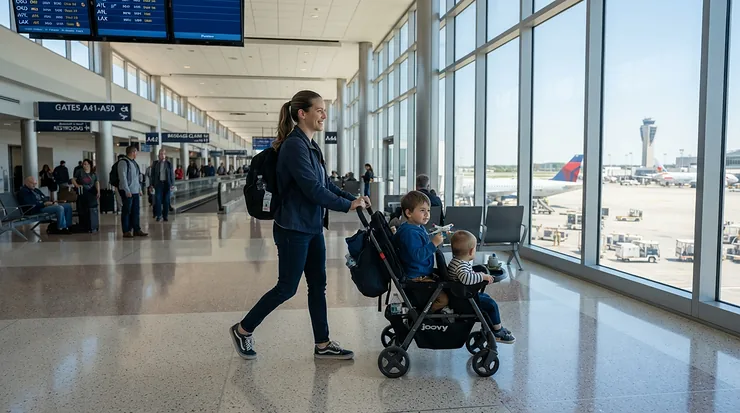
Anyone who has wrangled two carseats, a diaper bag, and a boarding pass through a crowded terminal knows the truth: the right twin travel stroller for airplane travel isn’t a luxury, it’s basically a third set of hands. A twin travel stroller for airplane travel is a side-by-side or tandem double stroller built light enough to push through security, narrow enough to clear a jet bridge, and collapsible enough to hand off at the gate without an engineering degree. Most parents don’t realize how much variation exists between models marketed as “travel-friendly” until they’re standing at the ticket counter watching a gate agent eye their 34-pound double stroller with visible skepticism.
This guide covers seven real, currently available twin strollers spanning budget, mid-range, and premium price points, based on manufacturer specifications, retailer data, and aggregated customer feedback gathered during research. We’ll walk through weight, folded dimensions, gate-check compatibility, and the everyday realities — tipping seats, sticky recline levers, basket capacity — that spec sheets tend to gloss over. Whether you’re planning your first flight with newborn twins or you’ve already lived through the chaos of a delayed connection with two toddlers in tow, the goal here is the same: help you pick a stroller you won’t regret at 6 a.m. in Concourse B.
We’ll also dig into the mechanics most articles skip — how gate-checking actually works, what determines whether your stroller can ride the jet bridge with you or gets diverted to the ticket counter, and how to protect an expensive frame from baggage-handler roulette. Let’s get into it.
Quick Comparison Table
| Stroller | Weight | Folded Size (L×W×H) | Price Range | Best For |
|---|---|---|---|---|
| UPPAbaby Minu Duo | 27.4 lbs | 12.9″ × 27.8″ × 23.7″ | $750-$900 | Premium newborn-ready travel |
| Valco Baby Snap Duo Trend | 24-26 lbs | 27.5″ × 29″ × 17.5″ | $700-$830 | Bassinet/car seat flexibility |
| Zoe Twinᵛ² | 19-23 lbs | 29″ × 9″ × 28″ | $450-$530 | Lightest true side-by-side |
| Mompush Lithe Double | 25.4 lbs | 28.9″ × 23.2″ × 13″ | $240-$290 | Best value with airless tires |
| Joovy Scooter X2 | 32 lbs | 29.5″ × 15″ × 38.3″ | $300-$330 | Storage-hungry families |
| Summer/Ingenuity 3Dlite Double | 21-22 lbs | 38.5″ × 13″ × 15.5″ | $130-$170 | Budget-first flyers |
| Dream On Me Volgo Twin | 23-26.5 lbs | 44″ × 14″ × 11″ | $110-$160 | Rock-bottom budget |
Looking at the spread, weight and folded width matter more than price for airplane suitability — the Zoe Twinᵛ² undercuts strollers costing twice as much, while the Joovy Scooter X2 trades portability for a genuinely massive storage basket. Every model listed keeps its open width under 30 inches, which matters more than most parents expect once you’re navigating a standard airport doorway or a narrow jet bridge. Budget doesn’t strictly track with travel-readiness here — the Mompush Lithe Double undercuts the Joovy Scooter X2 on both price and weight.
💬 Just one click — help other traveling twin parents make better decisions too!😊
Top 7 Twin Travel Strollers for Airplane Travel: Expert Analysis
1. UPPAbaby Minu Duo — travel bag damage-protection program
The standout here isn’t the spec sheet, it’s the safety net behind it: UPPAbaby backs its official travel bag with a repair guarantee, so damage sustained during gate-check transit while the stroller is bagged gets fixed rather than argued over with an airline claims department. At 27.4 lbs with a 27.8-inch width, the Minu Duo is built from a lightweight aluminum frame, and it folds to a compact 12.9″ x 27.8″ x 23.7″ package — narrow enough to clear a standard doorway and manageable enough to carry solo through a terminal.
Based on the spec comparison, this stroller is aimed at parents who want a true from-birth twin solution without a bulky travel system: both seats recline fully flat and accept UPPAbaby’s own infant car seats with adapters, so newborn twins aren’t stuck in an upright position for a long-haul flight. What most buyers overlook about this model is the hidden AirTag pocket — a small but genuinely useful feature once you’re relying on gate agents to reunite you with your stroller planeside. Verified aggregated feedback specifically on the Minu Duo’s real-world flight performance is thinner than for older UPPAbaby models, since it’s a newer release; what is consistently verifiable is the brand’s broader reputation for smooth-rolling wheels and a genuinely one-step fold mechanism.
Pros:
- ✅ Repair-backed travel bag program protects against gate-check damage
- ✅ Full recline and car seat compatibility from birth
- ✅ One-hand, one-step fold built for solo airport navigation
Cons:
- ❌ Heaviest frame on this list at 27.4 lbs
- ❌ Premium price puts it out of reach for occasional flyers
In the $750-$900 range depending on colorway, the Minu Duo earns its price tag through the damage-protection program alone if you fly more than once or twice a year.
2. Valco Baby Snap Duo Trend — dual bassinet and car seat flexibility
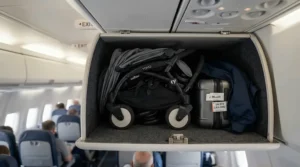
The standout feature is versatility at the newborn stage: this stroller accepts either one infant car seat or up to two bassinets, a combination almost no other double on this list offers at once. Unfolded, it measures roughly 29″ wide by 32″ long, and it weighs in around 24-26 lbs depending on the retailer’s measurement of accessories included — light enough that one parent can lift it into an overhead jet-bridge storage area during boarding delays.
Here’s what to weigh: the Snap Duo Trend’s “standing clean fold” mechanism tucks the seats inward before locking, which keeps grimy jet-bridge floors and tarmac dust off the fabric your kids’ faces will touch next — a small design choice that matters more on travel days than at the local park. Reviewers and rental-fleet operators consistently note the stroller earns Disney-park size approval, which is a reasonable proxy for “narrow enough to survive crowded, unpredictable spaces” more broadly, airports included. The recline is described as adjustable to essentially infinite positions rather than fixed stops, which reviewers frame as ideal for a sleeping infant mid-flight-transfer.
Pros:
- ✅ Compatible with two bassinets or one infant car seat
- ✅ Standing clean fold keeps seat fabric off dirty terminal floors
- ✅ Disney-park size approval signals strong doorway compatibility
Cons:
- ❌ Only one car seat adapter slot, not two
- ❌ Premium pricing rivals strollers with more travel-specific extras
Priced around $700-$830, this is the pick for families who need newborn-stage flexibility more than ultra-light weight.
3. Zoe Twinᵛ² — lightest true side-by-side on this list
The standout advantage is raw weight: at roughly 19-23 lbs depending on the exact generation, this is meaningfully lighter than every other side-by-side double covered here, which matters enormously the moment you’re lifting it into an overhead bin holding area or hoisting it up jet-bridge stairs during a ground-transport delay. The brand’s own materials specifically describe the fold as suited to gate-checking at the airport, and the stroller’s carrying strap can convert into a backpack-style carry, freeing up both hands for kids and carry-ons simultaneously.
Based on the spec comparison, the 165-degree recline sits just short of fully flat, so reviewers note it suits babies with decent neck control rather than very young newborns. Independent testing from BabyGearLab rated the Twin+ generation favorably on weight and folded size but flagged that the brakes require extra effort to engage and that maneuverability trails some pricier competitors — an honest trade-off for a stroller this light. What most buyers overlook is that the Twin expands into a trio or quad configuration with add-on seats sold separately, useful if your family grows or you’re traveling with a nanny share.
Pros:
- ✅ Among the lightest true side-by-side twin strollers available
- ✅ Backpack-style carry strap frees both hands in the terminal
- ✅ Expandable to trio or quad configuration with add-ons
Cons:
- ❌ Brakes need deliberate extra pressure to engage, per independent testing
- ❌ Recline stops short of fully flat, less ideal for newborns
At $450-$530, the Twinᵛ² delivers premium-adjacent portability at a mid-range price.
4. Mompush Lithe Double — best value with puncture-proof airless tires
The standout feature is the tire technology: airless, puncture-proof tires mean you’re never stranded with a flat in an unfamiliar city, and they pair with all-wheel suspension to smooth out uneven airport pavement and cobblestone destinations alike. At 25.4 lbs and a 30-inch width, it’s built from an all-aluminum frame, and Mompush markets it as Disney-size approved — again, a useful shorthand for airport-doorway compatibility.
What the spec sheet won’t tell you, but reviewers note, is how much trunk space this thing actually saves — one Babylist reviewer specifically compared it favorably against a Bugaboo Donkey, a Jeep double, and a Graco Ready2Grow, describing the Mompush as sturdier and easier to fold than all three while taking up roughly half the cargo space of a mid-size SUV trunk. Another aggregated review flagged that the smaller wheel diameter isn’t ideal for genuinely rough terrain, though both reviewers confirmed the seats comfortably held children across a wide age and weight range simultaneously, including one napping through the ride. The one-step standing fold with a built-in carry handle is a real advantage at a gate-check counter where you need speed, not fumbling.
Pros:
- ✅ Airless tires eliminate flat-tire risk entirely
- ✅ One-step standing fold is fast enough for gate-check lines
- ✅ Independent recline and adjustable leg rests on both seats
Cons:
- ❌ Smaller wheels struggle on genuinely rough or unpaved terrain
- ❌ Recline tops out around 145°, not a full flat position
At $240-$290, this is arguably the best value-to-feature ratio on the entire list.
5. Joovy Scooter X2 — most storage for families who overpack
The standout feature is sheer cargo capacity: independent testing describes the Joovy Scooter X2’s storage basket as among the largest measured in its category, a genuine advantage when you’re hauling diaper bags, snacks, and gate-checked carry-on overflow through a terminal. At roughly 32 lbs and 30 inches wide, it’s the heaviest stroller on this list, positioned as a middle ground between a bare-bones umbrella double and a full all-terrain side-by-side.
Here’s what to weigh: independent reviewers scored the Scooter X2 well on ease of use and gave it credit for individually reclining seats and a large peek-a-boo canopy window, but specifically flagged that the recline mechanism requires two hands and takes real effort to adjust — annoying mid-boarding-line, less so once you’re settled at your destination. Reviewers consistently note the value proposition: at roughly $300-$330, it undercuts comparable all-terrain doubles that run $650-plus while still including child trays and cup holders standard, rather than as costly add-ons. The trade-off for that storage and those trays is weight — this is not the stroller for someone optimizing purely for carry weight during a solo gate-check dash.
Pros:
- ✅ Largest storage basket among strollers tested in its category
- ✅ Includes child trays and cup holders standard, not as add-ons
- ✅ Strong value against pricier all-terrain double competitors
Cons:
- ❌ Heaviest stroller on this list at roughly 32 lbs
- ❌ Recline adjustment requires two hands and noticeable effort
At $300-$330, the Scooter X2 rewards families prioritizing storage over minimal weight.
6. Summer/Ingenuity 3Dlite Double — lightest budget pick under $170
The standout feature is the price-to-weight ratio: at under 22 lbs, this is one of the lightest double strollers at any price point, built on a durable aluminum frame rather than the heavier steel or iron frames common at this price. Folded dimensions of 38.5″ x 13″ x 15.5″ are longer than some competitors but genuinely slim, sliding into tight trunk spaces and overhead storage areas with room to spare.
Based on the spec comparison, each full-size seat offers a 4-position recline and a 5-point harness rated to 50 lbs, which is a notably high per-seat capacity for a stroller in this price bracket — practically speaking, that means it stays useful well past toddlerhood rather than becoming dead weight after year one. Aggregated retailer review sentiment describes the build as sturdy despite the low weight, highlights the wheels’ ability to maneuver through tight spaces, and calls out the compact fold and dual canopy shade as consistent strengths. What most buyers overlook is that anti-shock front wheels are a genuine functional feature here, not marketing filler — they measurably smooth out the seams and gaps common on airport moving walkways and uneven jet-bridge flooring.
Pros:
- ✅ Under-22-lb weight rivals strollers costing four times as much
- ✅ 50-lb per-seat capacity extends useful life well past toddlerhood
- ✅ Anti-shock front wheels smooth uneven airport surfaces
Cons:
- ❌ Folded length of 38.5″ is longer than most competitors here
- ❌ Basic fabric and hardware reflect the budget price point
At $130-$170, the 3Dlite Double is the strongest pick for infrequent flyers who don’t want to overspend.
7. Dream On Me Volgo Twin — rock-bottom budget entry point
The standout feature is simply the price: this is the least expensive twin stroller on the list by a wide margin, while still including a 5-point harness, a sturdy iron frame, and swiveling front wheels that lock for stability. At roughly 23-26.5 lbs depending on the retailer’s measurement and a 29-inch width, it’s genuinely competitive on portability despite costing a fraction of the premium options above.
What the spec sheet won’t tell you, but reviewers note, is that this iron-framed build trades some long-term durability for its low price — reasonable for a family that flies once or twice a year rather than every month. Aggregated retailer ratings sit around 4.3 out of 5 across more than 200 verified purchases, a meaningfully large sample size for a budget stroller, suggesting the core fold-and-push mechanics hold up for typical use. Reviewers consistently note the generous recline and mesh-ventilated canopies as standout comfort features at this price, though the stroller isn’t compatible with infant car seats, so it suits older infants and toddlers rather than newborns.
Pros:
- ✅ Lowest price point of any stroller on this list
- ✅ Strong aggregated rating across 200+ verified purchases
- ✅ Soft-ride wheels reduce pushing effort on smooth terminal floors
Cons:
- ❌ No infant car seat compatibility
- ❌ Iron frame adds bulk versus aluminum competitors at similar weight
At $110-$160, the Volgo Twin is the pick for budget-conscious parents flying with older infants or toddlers.
Practical Usage Guide: Prepping Your Gate-Check Twin Stroller for Flight Day
Getting a twin stroller ready for a flight starts well before you reach the airport. First, practice the fold at home — not once, but several times, ideally one-handed while holding something the size and weight of a toddler, because that’s exactly the scenario you’ll face at a crowded gate. If your stroller has a standing-lock fold like the Valco or Mompush, confirm the auto-lock actually engages; a stroller that pops back open mid-transfer to a gate agent creates delays you don’t want during boarding.
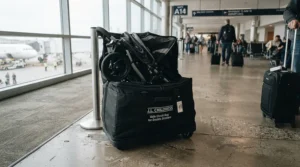
Second, remove anything loose before handing it off — cup holders, snack trays, toys clipped to the frame, and parent organizers should travel in your carry-on, not zip-tied to the stroller, since gate-check handling is not gentle and small accessories are the first casualties. Third, check your specific airline’s stroller weight threshold before you fly; some carriers require strollers over roughly 20 pounds to be checked at the ticket counter rather than gate-checked, which changes your entire airport routine since you’d need the stroller far earlier in your journey. Finally, snap a few photos of your stroller’s condition before handing it over — a two-minute habit that makes any damage claim dramatically easier to file and resolve.
Real-World Scenarios: Which Airplane-Friendly Twin Stroller Fits Your Family
If you’re flying with newborn twins for the first time and need full-flat recline plus car seat compatibility, the UPPAbaby Minu Duo or Valco Baby Snap Duo Trend make the most sense — both accommodate infant car seats or bassinets, which matters enormously when your babies can’t yet support their own heads through a long layover.
If you’re a budget-conscious family flying once a year to visit grandparents, the Summer/Ingenuity 3Dlite Double or Dream On Me Volgo Twin deliver real functionality without a four-figure investment, and their lighter weights mean less strain hauling them through unfamiliar terminals solo. If you’re juggling two active toddlers plus a mountain of carry-on gear, the Joovy Scooter X2‘s oversized basket and built-in trays reduce how much you’re carrying on your own body, even though the stroller itself weighs more. And if weight is your single biggest constraint — say, you’re navigating multiple connections without airport assistance — the Zoe Twinᵛ² or Mompush Lithe Double minimize what you’re physically lifting at every transfer point.
Problem → Solution: Common Gate-Check Twin Stroller Headaches
Problem: Your stroller comes back from cargo with a bent wheel or torn fabric. Solution: invest in a padded travel bag, even a universal one costing under $50, since bare frames absorb far more impact damage during loading than bagged ones, and airlines are more likely to honor damage claims when the item was properly protected.
Problem: You reach the gate and realize your stroller exceeds the airline’s free gate-check weight threshold. Solution: check your airline’s policy before departure day — several major U.S. carriers require strollers over roughly 20 pounds to be checked at the main ticket counter rather than the gate, so knowing this in advance lets you plan your terminal route accordingly.
Problem: The stroller won’t fold fast enough while a boarding line backs up behind you. Solution: practice the fold at home dozens of times until it’s muscle memory — the strollers on this list with standing-lock, one-step folds (Mompush, Valco) are specifically built for this exact pressure scenario.
Problem: You land and can’t locate your gate-checked stroller at the jet bridge. Solution: confirm before boarding whether your airline returns strollers planeside or routes them to baggage claim instead, since policies vary, and consider a stroller with a hidden AirTag pocket like the UPPAbaby Minu Duo for peace of mind.
How to Choose a Twin Travel Stroller for Airplane Travel
- Confirm your airline’s gate-check weight limit first. Some carriers cap free gate-check strollers around 20 pounds before requiring ticket-counter check-in, which should shape your shortlist immediately.
- Prioritize folded width under 30 inches. This clears the vast majority of jet bridges, lavatory doorways, and airport security lanes without a squeeze.
- Match recline to your children’s age. Newborns need near-flat recline; toddlers can manage upright seating for shorter connections.
- Weigh car seat compatibility against your itinerary. If you’re checking infant car seats separately anyway, a stroller without adapters saves weight and cost.
- Test the one-hand fold before you buy, not after. A slow or two-handed fold becomes a real liability holding up a boarding line.
- Consider a protective travel bag as part of the total cost. Bare-frame gate-checking meaningfully raises your odds of cosmetic or structural damage.
- Balance basket size against total carry weight. More storage is convenient until you’re the one lifting the loaded stroller up jet-bridge stairs during a ground delay.
Gate-Check Twin Stroller vs. Checking at the Ticket Counter
| Factor | Gate-Check Twin Stroller | Ticket-Counter Check |
|---|---|---|
| Weight limit | Often ~20 lbs or less per airline | Generally no weight cap |
| Stroller use in terminal | Full use through security to gate | None — you carry kids from check-in |
| Damage risk | Lower — handled more carefully, shorter transit | Higher — full cargo-hold journey |
| Retrieval | Often returned planeside at jet bridge | Baggage claim only |
| Best for | Strollers under ~20-25 lbs, most on this list | Heavier strollers or long layovers |
A gate-checked stroller gives you a working set of wheels for the entire terminal walk, which is invaluable with two small children and multiple bags, while ticket-counter checking sacrifices that convenience but sidesteps weight restrictions entirely. Given that most twin strollers weigh more than a typical single travel stroller, it’s worth confirming your specific airline’s cutoff — the TSA’s guidance for traveling with children doesn’t set stroller weight rules itself, since that’s an airline-level policy rather than a security-screening one. For most families on this list’s mid-weight and lightweight picks, gate-checking remains the more practical choice.
Jet Bridge Stroller Fit: What the Width Numbers Actually Mean
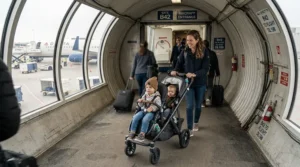
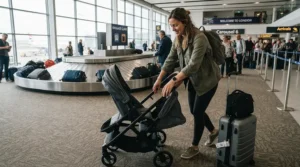
Every stroller in this guide lists an open width under 30 inches, and that number matters more than it might seem. Jet bridges, aircraft aisles, and airport security lanes were never designed around stroller dimensions specifically, but they generally track close to the accessibility standards used across public infrastructure — federal guidance sets minimum accessible doorway clearance at 32 inches of clear width, and most stroller manufacturers design travel models to comfortably clear that threshold with a few inches to spare.
Practically speaking, a stroller measuring 29-30 inches wide, like the Joovy Scooter X2 or Mompush Lithe Double, clears most standard doorways and jet-bridge ramps without needing to angle or squeeze through. The narrower the stroller, the more forgiving your margin becomes in tight, unpredictable spaces — jet bridges narrowed by maintenance equipment, temporary barriers, or a crush of fellow passengers during a delay. This is one area where the UPPAbaby Minu Duo’s 27.8-inch width and the Zoe Twinᵛ²’s narrow footprint genuinely earn their premium positioning: a couple of extra inches of clearance is easy to dismiss on a spec sheet and very noticeable when you’re navigating a bottlenecked gate area with two kids in tow.
Gate-Check Damage Protection: Reducing Risk Without a $900 Splurge
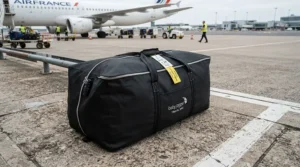
Not every family can justify an $800 stroller purely for its damage-protection program, and the good news is that meaningful protection doesn’t require a premium purchase. A padded universal gate-check bag, typically priced well under $50, meaningfully reduces cosmetic damage and dirt exposure during loading and cargo transit — gate check bags are specifically designed to shield strollers and car seats from dirt, rain, and rough handling in the cargo hold, and they’re compatible with virtually any stroller frame regardless of brand.
Beyond a bag, a few habits reduce risk further: remove detachable accessories before handing the stroller off, photograph its condition pre-flight, and confirm the fold is fully locked so baggage handlers aren’t wrestling with a partially collapsed frame. For families who fly frequently enough to justify it, the UPPAbaby Travel Safe Program remains the strongest built-in protection on this list, but a $30 padded bag paired with good habits closes most of that protection gap for a fraction of the cost — worth weighing against how many flights you’re actually taking per year. Stroller manufacturers must also meet baseline federal durability and hazard standards regardless of price point, since the Consumer Product Safety Commission’s mandatory stroller standard requires every stroller sold in the U.S. to pass structural, hinge, and wheel-detachment testing before it reaches shelves.
✨ Don’t Miss These Exclusive Deals!
🔍 Take your next family trip to the next level with a stroller built for airport life. Click on any highlighted pick above to check current pricing and availability — the right twin travel stroller turns a stressful gate-check scramble into a five-minute routine your whole family can handle.
Common Mistakes When Buying an Airplane-Friendly Twin Stroller
The most common mistake is shopping by weight alone without checking folded dimensions — a 22-pound stroller that folds into an awkward, bulky shape can be harder to manage at a gate than a slightly heavier one with a genuinely compact fold, like the Mompush Lithe Double’s 13-inch folded height. A second frequent error is skipping the airline’s specific gate-check weight policy entirely, only to discover at the counter that a 32-pound stroller like the Joovy Scooter X2 has to be checked far earlier in the journey than expected, changing the whole airport routine.
Parents also commonly underestimate recline needs, buying an upright-only budget model for a newborn who genuinely needs a near-flat seating position for a long flight. Another overlooked factor: basket capacity gets sacrificed for portability more than buyers expect, so families who overpack diaper bags and snacks should weigh that trade-off honestly rather than assuming every lightweight stroller offers equally generous storage. Finally, some buyers skip test-folding a stroller before purchase entirely, only to discover the mechanism requires real effort or two hands — a manageable inconvenience at home, a real problem holding up a boarding line.
Long-Term Cost & Maintenance of a Twin Stroller for Flying
| Price Tier | Example | Typical Lifespan | Notable Long-Term Cost |
|---|---|---|---|
| Budget | Dream On Me Volgo Twin | 1-2 years of frequent flying | Iron frame may show wear sooner |
| Mid-range | Mompush Lithe Double | 2-4 years | Airless tires reduce replacement costs |
| Premium | UPPAbaby Minu Duo | 4+ years, resale value | Travel bag program offsets repair costs |
Looking at total cost of ownership rather than sticker price alone changes the calculus considerably: a $130 budget stroller that needs replacing after eighteen months of heavy travel use may cost more over three years than a $500 mid-range model built to withstand repeated gate-checking. The Mompush Lithe Double’s airless, puncture-proof tires specifically eliminate a recurring cost most parents don’t anticipate — flat-tire replacement — while UPPAbaby’s damage-protection program can offset repair costs that would otherwise run into hundreds of dollars after a single rough cargo-hold trip.
Maintenance for any gate-checked twin stroller for flying should include a post-flight inspection of wheels, locking mechanisms, and fabric seams, since cargo handling is genuinely rougher than everyday sidewalk use. A quick wipe-down after each trip — particularly for fabric-heavy models like the Dream On Me Volgo Twin — keeps hand-washable linen-type materials from holding onto tarmac grime and airport grime long-term.
Frequently Asked Questions
❓ Can I gate-check a double stroller for free on most airlines?
❓ What's the best twin stroller for flying with newborn twins?
❓ How much does a good gate-check twin stroller weigh?
❓ Will my twin stroller get damaged during gate-check?
❓ Does a twin stroller fit through a standard jet bridge and doorway?
Conclusion
Choosing the right twin travel stroller for airplane travel comes down to matching real trade-offs to your actual trip pattern, not chasing the single “best” model on paper. Frequent flyers with newborn twins get the most value from the UPPAbaby Minu Duo’s damage-protection program or the Valco Baby Snap Duo Trend’s bassinet flexibility, while budget-conscious families flying occasionally do just as well with the Summer/Ingenuity 3Dlite Double or Dream On Me Volgo Twin. Families craving maximum storage should lean toward the Joovy Scooter X2, and anyone prioritizing sheer portability through crowded terminals should look hard at the Zoe Twinᵛ² or Mompush Lithe Double.
Whichever model you choose, the details covered here — airline-specific weight thresholds, jet-bridge width clearance, and simple damage-protection habits — matter as much as the stroller itself. A well-matched twin stroller turns one of travel’s most stressful logistics puzzles into a routine you and your kids can handle together, flight after flight.
Recommended for You
- 7 Best Infant Twin Strollers With Full Recline Seats (2026)
- Infant Twin Stroller For NICU Graduate Twins: 7 Best Picks (2026)
- Infant Twin Stroller Under $400: 7 Smart Picks For 2026
Disclaimer: This article contains affiliate links. As an Amazon Associate, I earn from qualifying purchases. If you purchase products through these links, we may earn a small commission at no additional cost to you.
✨ Found this helpful? Share it with your friends! 💬🤗
