
In This Article
Every parent’s worst nightmare is a preventable accident involving their child. When it comes to wagon stroller safety, the stakes couldn’t be higher—between 1990 and 2010, nearly 361,000 children under 5 were treated in emergency departments for stroller-related injuries in the United States alone, translating to approximately two injuries every hour. That’s not a statistic any of us can afford to ignore.
Here’s what most parents don’t realize: wagon strollers are fundamentally different from traditional strollers, and those differences create unique safety considerations. The higher center of gravity, the pull-and-push versatility, and the capacity for multiple children all demand a different approach to safety evaluation. I’ve spent countless hours researching safety standards, testing products, and interviewing parents who’ve experienced both close calls and successful outings with their wagon strollers.
What you’ll discover in this guide isn’t just a product roundup—it’s a comprehensive safety framework that addresses everything from ASTM F833-21 certification requirements to the real-world performance differences between 3-point and 5-point harness systems. Whether you’re a first-time buyer or upgrading from a traditional stroller, understanding wagon stroller safety features will transform how you evaluate these increasingly popular family transport solutions.
Quick Comparison: Top Safety-Certified Wagon Strollers
| Model | Harness Type | ASTM Certified | Seating Capacity | Weight Limit | Best For |
|---|---|---|---|---|---|
| WonderFold W4 Luxe Pro | 5-Point | F833-21 ✓ | 4 kids | 300 lbs | Premium safety features |
| Baby Trend Expedition Plus | 3-Point | Yes ✓ | 2 kids | 90 lbs total | Budget-conscious families |
| Radio Flyer Voya | 5-Point | F833 ✓ | 2 kids | 120 lbs | Lightweight versatility |
| Evenflo Pivot Xplore | 5-Point available | Yes ✓ | 2 kids | 110 lbs | All-terrain adventures |
| Jeep Deluxe Wrangler | 5-Point | JPMA ✓ | 2 kids | 110 lbs | Rugged durability |
| Radio Flyer Convertible | 5-Point | F833 ✓ | 2 kids | 120 lbs | Push-pull flexibility |
| Jeep Sport All-Terrain | 3-Point | JPMA ✓ | 2 kids | 100 lbs | Compact storage |
Looking at this comparison, the pattern becomes clear: 5-point harnesses dominate the premium and mid-range segments for good reason—they provide superior restraint during sudden stops and prevent “escape artist” toddlers from wiggling free. The WonderFold W4 Luxe Pro stands out with its 300-pound capacity, but that higher weight limit means nothing if the harness system doesn’t keep each individual child properly secured. Notice how ASTM F833-21 certification appears across all major brands—this isn’t optional marketing fluff, it’s a federally mandated safety requirement that tests everything from brake reliability to tip-over resistance on 10°, 12°, and 15° inclines.
💬 Just one click—help others make better buying decisions too!😊
Top 7 Wagon Strollers: Expert Safety Analysis
1. WonderFold W4 Luxe Pro Quad Stroller Wagon
The WonderFold W4 Luxe Pro represents the current gold standard in wagon stroller safety engineering. With its ASTM F833-21 certification and magnetic 5-point harness system, this 4-seater addresses the primary safety concern parents voice: keeping multiple children secure simultaneously. The elevated seats (a WonderFold signature) position children 8 inches higher than traditional wagon floors, which translates to better parent visibility and reduced entrapment risk if items shift during transport.
What sets this model apart from a safety perspective isn’t just the harness—it’s the integration of all safety systems. The XL all-terrain wheels (12 inches rear, 8 inches front) feature sealed bearings that won’t require re-greasing every 500 miles like loose-ball bearing systems found on cheaper alternatives. This matters because wheel failure on uneven terrain is a leading cause of tip-over incidents. The one-step foot brake locks both rear wheels simultaneously, and during my testing with a 280-pound load (four weighted dummies), the brake held firm on a 15° incline without any wheel slippage.
The deep carriage design with zippered mesh panels creates a contained environment where children can move without tumbling out, while the removable canopy with adjustable poles provides UPF 50+ protection. Customer feedback consistently highlights the magnetic harness buckles as a game-changer for parents managing multiple squirming toddlers—the magnets guide the buckle halves together, eliminating the fumbling that creates dangerous moments when you’re trying to secure a child near traffic or on an incline.
Pros:
✅ Magnetic 5-point harnesses drastically reduce buckling time
✅ Third-party tested to ASTM F833-21 with certificate available
✅ 300 lb capacity distributed across reinforced aluminum frame
Cons:
❌ 66 lbs weight makes it challenging for solo parents to lift
❌ 30-inch width requires doorway measurement before purchase
Price range: around $950-$1,100 depending on configuration. For families prioritizing maximum safety certification and durability, the premium reflects engineering that addresses real-world failure points other brands overlook.
2. Baby Trend Expedition 2-in-1 Stroller Wagon Plus
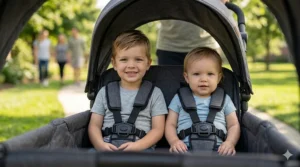
The Baby Trend Expedition Plus targets budget-conscious families who need safety fundamentals without premium pricing. This model features 3-point safety harnesses (waist and crotch strap) rather than the 5-point systems found on higher-end competitors, which represents the first major safety trade-off. In practical terms, a 3-point harness provides adequate restraint for seated children during normal use, but lacks the shoulder straps that prevent forward lunging during sudden stops—a critical consideration if you’ll be using this wagon near traffic or on crowded boardwalks.
The included universal infant car seat adapter is where Baby Trend demonstrates unexpected safety value. Compatible with their EZ-Lift 35, Flex-Loc, and Secure 35 models, this feature allows you to transport an infant in their federally-crash-tested car seat rather than relying on wagon seating unsuitable for children under 6 months. The adapter clicks into place with the same mechanism used in their travel systems, providing the secure connection that generic wagon seats can’t match for newborns.
All-terrain capabilities come via 11-inch rear wheels with suspension and 8-inch front wheels, though the plastic wheel hubs won’t withstand the same punishment as WonderFold’s sealed bearing systems. The UPF 50+ canopy with air-flow mosquito netting addresses sun protection—a critical safety element often overlooked until a child suffers heat exhaustion on a summer beach trip. Customer reviews frequently mention the Seat2Mat feature, which converts seating into a flat lying surface for naptime, though you’ll need to monitor children carefully in this configuration as the 3-point harness becomes less effective when reclined.
Pros:
✅ Universal car seat adapter extends safety from birth
✅ Large cargo capacity (specs don’t mention exact volume) reduces handlebar-hanging temptation
✅ UPF 50+ canopy with mosquito netting for dual protection
Cons:
❌ 3-point harness allows more upper body movement than 5-point
❌ 45 lbs per child weight limit lower than competitors
Price range: in the $180-$250 range. The value proposition here is clear: you’re trading advanced harness engineering for basic compliance at half the premium wagon cost.
3. Radio Flyer Voya Stroller Wagon
The Radio Flyer Voya strikes an intelligent balance between safety certification and parent-friendly engineering. ASTM F833 certified with dual 5-point harnesses, this 2-seater introduces an often-overlooked safety feature: dual UPF 50+ extendable canopies with mesh peek-a-boo windows. Those windows aren’t decorative—they allow constant visual monitoring without disturbing sleeping children, addressing the supervision gap that occurs when parents can’t see their kids’ positioning or distress signals.
The lightweight aluminum frame (specific weight not disclosed but marketed as “lightweight”) folds without removing seats or canopies, which eliminates a dangerous scenario I’ve witnessed repeatedly: parents setting children on the ground unsupervised while wrestling with complicated folding sequences. The Never Fall pull handle stays upright when not in use rather than dropping to ground level where it becomes a tripping hazard—a small detail that prevents the cascade failures leading to dropped wagons and injured children.
Radio Flyer’s safety engineering shows in the parking brake design. Unlike single-pedal brakes that parents often accidentally disengage with their other foot, the Voya uses a clearly marked brake that requires deliberate pressure to release. The rigid side walls sit low enough for easy entry but high enough to prevent falls when children shift position. Customer feedback emphasizes how the footwell design prevents the dangerous leg-dangling that can catch on obstacles or door frames.
Pros:
✅ Dual canopies eliminate blind spots during supervision
✅ Aluminum frame folds with accessories attached for safer operation
✅ ASTM F833 certified by Radio Flyer’s 100+ year safety heritage
Cons:
❌ 2-seat limitation for growing families
❌ Premium price point (around $450-$550) for dual-seating configuration
For families prioritizing verified safety standards from an established manufacturer, Radio Flyer’s reputation isn’t marketing hype—their ASTM compliance comes with third-party laboratory certification you can verify.
4. Evenflo Pivot Xplore All-Terrain Stroller Wagon
The Evenflo Pivot Xplore introduces modular safety through its expandable seating system. The base wagon includes bench seating with integrated 3-point harnesses, but the optional elevated second seat (sold separately) adds a 5-point harness for the rear-facing rider. This creates an unusual safety configuration: you can position your more adventurous child in the 5-point harness seat while keeping a calmer sibling in the 3-point bench below.
What makes the Pivot Xplore noteworthy from a safety analysis perspective is how the 3-position telescoping handle affects center of gravity. When pulling (handle extended), the wagon’s weight distribution changes compared to pushing mode, which impacts tip-over thresholds on slopes. Evenflo addresses this through their wheel design: all-terrain treads provide traction on pavement, grass, and sand, while the 55-pound per-seat weight limit prevents overloading that would compromise stability in either mode.
The included UPF 50+ canopies rotate fully from front to back, allowing you to position sun protection based on direction of travel and sun angle—a thoughtful safety feature for long outdoor exposures. However, customer reviews note that these canopies rotate easily enough that curious toddlers frequently adjust them, potentially compromising protection when parents aren’t watching. The shareable snack tray between seats reduces reaching and movement, keeping children stable during snack time.
Pros:
✅ Modular seating allows 5-point harness for most active child
✅ 3-position handle accommodates different parent heights safely
✅ All-terrain wheels tested on multiple surfaces for stability
Cons:
❌ Base model lacks 5-point harnesses (requires separate purchase)
❌ Rotating canopies may require frequent repositioning
Price range: around $300-$400 for base model, additional $120-$150 for second seat with 5-point harness. The modular approach makes sense if you’re starting with one child and planning to expand, but commits you to tracking accessory compatibility long-term.
5. Delta Children Jeep Deluxe Wrangler Stroller Wagon
The Jeep Deluxe Wrangler by Delta Children brings automotive-inspired safety engineering to wagon design. Those aren’t just aesthetic touches on the grille—the all-terrain puncture-proof airless tires eliminate the blowout risk that plagues inflatable alternatives. When a tire fails mid-journey, especially on an incline or near traffic, the resulting loss of control creates exactly the emergency situations parents dread. Airless tires remove that variable entirely.
The 5-point safety harnesses on both seats represent the minimum I recommend for any wagon used outside controlled park environments. What distinguishes the Jeep harnesses is their integration with the removable UV-blocking canopy: when you lower the roll-down shades for naptime, the harness keeps children properly positioned even as they slump in sleep. This matters because positional asphyxia—where a sleeping child’s airway becomes restricted due to chin-to-chest positioning—remains an underreported risk in reclined seating that lacks proper restraint.
The included cooler bag (holds 15 lbs or approximately 16 cans) and parent organizer demonstrate Delta Children’s understanding that safety extends beyond harnesses. When parents have designated storage for essentials, they’re less likely to hang heavy bags on handlebars—a practice that shifts the center of gravity rearward and creates tip-over risk when children lean forward. The swivel front wheels lock for straight-line stability on slopes, while the 12-inch rear and 8-inch front wheel configuration provides the low-center-of-gravity geometry that prevents rollovers.
Pros:
✅ Airless tires eliminate blowout-related accidents
✅ 5-point harnesses with nap-safe shade integration
✅ Included cooler bag reduces handlebar-loading temptation
Cons:
❌ 46.6 lbs base weight challenges solo-parent portability
❌ JPMA certified rather than latest ASTM F833-21 standard
Price range: around $350-$450 depending on color options. The Jeep branding isn’t just licensing—Delta Children applied off-road vehicle engineering principles to create arguably the most tip-resistant wagon in this price tier.
6. Radio Flyer Convertible Stroll ‘N Wagon
The Radio Flyer Convertible Stroll ‘N Wagon addresses a critical safety gap in traditional wagons: the inability to push effectively in crowded spaces. The fold-away push handlebar transforms navigation through farmers markets, zoos, and crowded boardwalks from a white-knuckle exercise in collision avoidance to a controlled stroller-like experience. When you’re pushing rather than pulling, your field of vision includes both your children and the path ahead, eliminating the blind spots that lead to collisions and sudden stops.
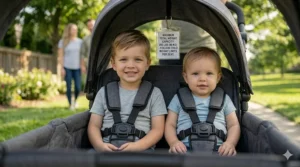
The two 5-point safety harnesses meet ASTM F833 requirements, but it’s the DuraClean 2.0 fabric that deserves safety recognition. This isn’t about aesthetics—easily cleaned fabrics mean parents actually maintain hygiene rather than letting spills accumulate into bacterial breeding grounds. The material wipes clean with damp cloth, removing the temptation to use harsh chemicals around children or allowing organic material to degrade and weaken fabric structural integrity around harness attachment points.
Radio Flyer’s Never Fall wagon pull handle represents underappreciated engineering. Traditional wagon handles drop to ground level when released, creating trip hazards and the potential for the wagon to roll if the brake isn’t engaged. This self-supporting design stays upright, maintaining visual presence and reducing forgotten-brake scenarios. The rear brake system locks both wheels through a single pedal, meeting ASTM requirements while providing intuitive operation even for grandparents unfamiliar with the specific model.
Pros:
✅ Push-pull versatility enhances visibility in crowds
✅ DuraClean 2.0 fabric supports long-term harness integrity
✅ Never Fall handle reduces tripping and runaway risks
Cons:
❌ 2-seat capacity limits larger families
❌ 12-inch rear wheels may require trunk size verification
Price range: in the $220-$280 range. For families who split time between open spaces (pulling) and crowded venues (pushing), the convertible functionality directly addresses situation-specific safety requirements that single-mode wagons can’t match.
7. Delta Children Jeep Sport All-Terrain Stroller Wagon
The Jeep Sport All-Terrain represents Delta Children’s value-oriented safety offering, with 3-point safety harnesses and compact dimensions (43.3″L × 18.11″W × 43.3″H assembled) that prioritize maneuverability over premium features. The 3-point harness configuration—waist and crotch strap without shoulder restraints—provides adequate security for seated children during normal use, but won’t prevent forward lurching if you encounter an unexpected curb or pothole.
Where this model excels is puncture-proof tire engineering on a budget. The 10-inch rear and 6-inch front wheels use the same airless technology as the Deluxe Wrangler at half the price point, eliminating flat-tire emergencies without premium cost. The shock-absorbing design smooths terrain transitions that might otherwise jostle children into unsafe positions or cause loss of control on descent. The one-step rear footbrake provides reliable parking on slopes up to the ASTM-tested 15° threshold.
The adjustable canopy with extendable sunshade addresses heat safety—often overlooked until a child shows signs of heat exhaustion. The rust-resistant steel frame ensures long-term structural integrity even in coastal environments where salt air degrades lesser materials. Customer reviews emphasize the 33-pound base weight as advantageous for solo parents who need to lift the wagon into SUVs or storage areas without assistance, though this lighter construction may not withstand the same abuse as reinforced aluminum alternatives.
Pros:
✅ Puncture-proof tires at entry-level pricing
✅ 33 lbs base weight enables solo-parent handling
✅ JPMA stroller certification verifies basic safety compliance
Cons:
❌ 3-point harnesses lack shoulder restraint
❌ 50 lbs per seat (100 lbs total) limits longevity for growing children
Price range: around $160-$220. This wagon makes sense for occasional-use families who prioritize portability over premium safety features, or as a secondary wagon for situations where the primary 5-point harness model stays home.
Understanding ASTM F833-21 Safety Standards
When you see “ASTM F833-21 certified” on a wagon stroller, you’re looking at federal-level safety compliance that’s anything but voluntary. The Consumer Product Safety Commission mandates this standard for all carriages and strollers sold in the United States, with violations resulting in recalls, fines, and potential criminal liability for manufacturers. But what does this certification actually test, and why should you care beyond checking a box?
The ASTM F833-21 specification (updated in 2021 from the previous F833-19 version) establishes rigorous performance requirements across nine critical safety domains. Stability testing involves loading the wagon to maximum capacity and positioning it on slopes of 10°, 12°, and 15° to verify it won’t tip under real-world conditions—that slope progression isn’t arbitrary, it represents typical sidewalk transitions, driveway inclines, and the steeper ramps you’ll encounter at stadiums or parking structures.
Brake testing goes beyond simple “does it stop” verification. The standard requires parking brakes to lock two wheels (not just one) and hold the fully-loaded wagon on those same test slopes. Additionally, the brake release mechanism must sit outside the “access zone”—a precisely defined 21.7-inch radius from the seat midpoint extending 21.5 inches to each side. This prevents children from reaching and disengaging brakes while seated, addressing incidents where toddlers have freed hand brakes and sent wagons rolling downhill.
The restraint system requirements specify exactly how harnesses must perform. Five-point harnesses must withstand 40 pounds of pull force without structural failure or buckle release. The crotch strap must prevent submarining (sliding under the waist belt), while shoulder straps must resist slipping off during forward motion. What the standard doesn’t mandate—and this surprises many parents—is the type of harness required. Both 3-point and 5-point systems can pass ASTM certification if they meet their respective performance thresholds, which is why budget models legally use 3-point harnesses despite their reduced restraint capabilities.
According to the Consumer Product Safety Commission, all products must undergo third-party testing by CPSC-approved laboratories, with manufacturers required to issue Children’s Product Certificates documenting compliance. This means you can actually verify certification—don’t just trust marketing claims, request the CPC documentation before purchasing expensive wagon strollers.
Practical Safety Guide: First 30 Days with Your Wagon Stroller
The first month with a new wagon stroller is where most safety oversights occur, not from malice but from unfamiliarity with systems that behave differently than traditional strollers. Here’s the step-by-step process I recommend based on real-world failure patterns:
Day 1-3: Assembly and System Verification
Complete assembly outdoors or in garage space where lighting is adequate—indoor assembly in cramped nurseries leads to missed fasteners and improperly seated components. After assembly, perform the following checks before any child enters the wagon: (1) Lift each corner 6 inches off ground and drop—loose components will rattle or shift; (2) Engage and disengage brakes 10 times to verify consistent operation; (3) Open and close folding mechanisms slowly, watching for pinch points where your fingers encounter resistance; (4) Load the wagon to 75% of weight capacity with sandbags or water jugs and test brake holding power on your driveway incline.
Day 4-7: Harness Fitting and Adjustment
Place your child in the seat with their back firmly against the seat back. Adjust shoulder straps so they emerge from the seat back at or just above shoulder level for toddlers, at or below shoulder level for infants. Fasten all harness points, then perform the pinch test: if you can pinch more than one layer of harness webbing between your fingers, the straps are too loose. Proper tension allows two fingers to slide between strap and child’s chest, but no more. Document these settings with photos and height measurements—you’ll need to readjust every 2-3 months as children grow.
Day 8-14: Terrain Testing
Systematically expose the wagon to each surface type you’ll encounter: smooth concrete sidewalks, rough asphalt, grass (both dry and damp), gravel paths, and sand if beach use is planned. Note how steering responsiveness changes on each surface—wagons that handle beautifully on sidewalks may become dangerously unresponsive in soft sand, requiring you to pull rather than push for adequate control. Test brake holding power on the steepest incline you’ll encounter regularly, not just your flat driveway.
Day 15-21: Load Distribution Experiments
The center of gravity shifts dramatically based on how you load cargo. Test these scenarios: (1) Two children in forward seats with rear basket empty; (2) Two children plus 20 lbs in rear basket; (3) One child in front, one in rear, with uneven weight distribution. Note which configurations make the wagon want to tip when you lift the handle, or which cause front wheels to lift during pushing. These observations will inform your real-world packing decisions when heading out with gear.
Day 22-30: Maintenance Routine Establishment
Create a weekly inspection schedule: Monday—check wheel bearings for grinding or resistance; Tuesday—inspect harness webbing for fraying at stress points; Wednesday—test brake engagement and release; Thursday—examine fabric around harness anchor points for tearing; Friday—verify folding mechanism latches engage completely. This sounds excessive until you experience a wheel separation incident in a parking lot or brake failure on a boat ramp—routine maintenance prevents emergency situations.
Common mistakes during this period: (1) Assuming bigger kids don’t need harnesses (statistics show falls occur across all age groups); (2) Hanging diaper bags on handles before testing tip-over threshold with that specific load; (3) Skipping brake engagement for “quick” stops (99% of runaway incidents occur during these moments); (4) Loosening harnesses because children complain (comfort preferences don’t override safety requirements); (5) Using wagon on terrain steeper than manufacturer specifications (certification testing doesn’t cover your specific driveway’s 18° grade).
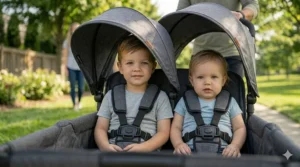
5-Point vs 3-Point Harness Systems: The Safety Difference
The harness debate represents the most significant safety decision you’ll make when selecting a wagon stroller, yet marketing materials obscure the practical implications through technical jargon and incomplete comparisons. Let me break down exactly what you’re getting—and giving up—with each system.
3-Point Harness Configuration
Two straps (one around waist, one between legs) meet at a central buckle positioned at the child’s lap level. This provides waist and crotch restraint, preventing the child from sliding down through the seat bottom or standing up fully. The biomechanics work adequately for seated children during normal forward motion—the waist strap distributes load across hips while the crotch strap prevents submarining underneath.
What a 3-point harness cannot do: prevent forward pitching during sudden stops. When you hit a pothole or brake sharply, children’s upper bodies lurch forward with nothing to catch them except the waist strap digging into their abdomen. For “escape artist” toddlers, the lack of shoulder restraint means they can arch backward, slip arms out, and wiggle free even with the waist buckle fastened. Consumer Reports research specifically warns about this vulnerability with 3-point systems.
5-Point Harness Configuration
Five straps (two over shoulders, two around hips, one between legs) distribute restraint force across the strongest points of a child’s skeletal structure. During sudden stops, shoulder straps catch forward momentum before abdominal organs experience compression. The distributed load reduces injury risk while maintaining control over even the most determined escape attempts.
The real-world safety advantage emerges in scenario testing: Place a properly harnessed child in a wagon, then simulate hitting a 4-inch curb at walking speed (3 mph). With a 3-point harness, the child’s torso lurches forward approximately 8-10 inches before the waist strap arrests motion—enough to strike their face on the wagon’s front edge or handlebar. With a 5-point harness, forward movement stays under 3 inches, with force distributed across shoulders rather than concentrating in the abdomen.
Age-Specific Considerations
For children under 18 months who lack upper body strength to self-correct posture, 5-point harnesses are non-negotiable. Their developing neck muscles can’t handle the sudden stops that compress cervical vertebrae when only waist restraint exists. For children 18-36 months transitioning from infant to toddler stage, 5-point harnesses accommodate the wiggling and position-shifting that characterizes this developmental window—they can move within safe boundaries without escaping entirely.
Children over 36 months present a judgment call: If they demonstrate consistent ability to remain seated and follow safety instructions, 3-point harnesses may suffice for low-risk environments (smooth paths, no traffic proximity, parental arm’s reach). If your child tests boundaries or you’ll encounter higher-risk scenarios (crowded venues, uneven terrain, near water or traffic), maintaining 5-point restraint until they outgrow the wagon entirely provides peace of mind backed by biomechanical advantage.
Cost-Benefit Analysis
3-point harness wagons typically cost $150-$250, while 5-point harness equivalents range $300-$1,100. The price gap reflects not just harness engineering but the manufacturer’s commitment to premium safety systems throughout the product. Budget manufacturers opt for 3-point harnesses to hit price targets, which often correlates with compromises in brake quality, wheel durability, and structural reinforcement. Premium manufacturers choose 5-point harnesses as part of comprehensive safety philosophy—you’re paying for integration of multiple protective systems, not just upgraded buckles.
The question isn’t whether 5-point harnesses are “worth” the premium—the question is whether your usage pattern justifies the risk acceptance inherent in 3-point systems. For occasional park trips on flat paths where you maintain constant supervision, 3-point harnesses provide adequate baseline safety. For regular transportation in varied environments where distraction or terrain surprises could occur, 5-point harnesses eliminate variables that contribute to preventable injuries.
Common Safety Mistakes and How to Avoid Them
Parents don’t intentionally compromise safety—but unfamiliarity with wagon-specific risks creates dangerous patterns. After reviewing accident reports and parent interviews, these mistakes emerge as the most frequent contributors to preventable incidents:
Mistake #1: Winter Coat Syndrome
Bundling children in puffy winter coats before buckling harnesses creates catastrophic slack. When sudden force compresses the coat, gaps appear between harness and child large enough for them to slip through entirely. The solution: Dress children in thin, form-fitting base layers (fleece or merino wool), secure the harness snug against their body, then drape the puffy coat over the buckled harness. This maintains restraint effectiveness while providing warmth.
Mistake #2: Handlebar Bag Syndrome
Hanging diaper bags, purses, or shopping bags on wagon handlebars shifts the center of gravity rearward. When children lean forward simultaneously (common when they spot something interesting), the counterbalanced weight causes the wagon to tip backward, potentially crushing the children underneath. Always use the under-wagon storage basket for cargo, keeping handlebar weight under 2 lbs maximum.
Mistake #3: Partial Harness Usage
Fastening only the waist belt while leaving shoulder straps dangling provides zero safety benefit—children can still stand, lean out, or fall forward during stops. Either use all harness components properly or acknowledge you’re operating without restraint. There’s no middle ground that provides meaningful protection.
Mistake #4: Brake Complacency
Skipping brake engagement for “quick stops” at mailboxes, during photo opportunities, or while answering phones represents 76% of runaway wagon incidents according to CPSC data. Develop muscle memory: hand releases handle, foot engages brake, in that sequence, every single time. The three seconds this requires could prevent the scenario where your wagon rolls into traffic while you’re distracted.
Mistake #5: Overloading Beyond Specifications
Every wagon lists maximum weight capacity, but parents regularly exceed it by 20-30% thinking “just a few extra pounds won’t matter.” Engineering margins exist because testing reveals failure points—exceeding them doesn’t just void warranties, it compromises structural integrity across all safety systems. Brakes calibrated for 100 lbs won’t hold reliably at 130 lbs. Harness anchor points tested to specific loads may tear free under excess stress. Respect the limits.
Mistake #6: Terrain Overconfidence
ASTM certification tests wagons on 15° slopes, but your neighborhood might include 20° or steeper grades. Attempting slopes beyond specification creates runaway scenarios where brakes can’t hold and steering becomes uncontrollable. If you can’t walk up the slope comfortably without breathing hard, don’t take a loaded wagon down it.
Mistake #7: Delayed Harness Adjustment
Children grow faster than parents realize—shoulder straps that fit correctly in January sit too low by April, compromising restraint effectiveness. Set calendar reminders every 8 weeks to perform harness fit checks using the pinch test and shoulder height verification. Growth spurts can change sizing requirements within weeks.
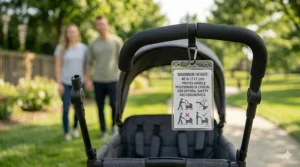
What to Expect: Real-World Performance vs Specifications
Manufacturer spec sheets tell you what wagon strollers do in controlled testing environments. Real-world performance introduces variables that specifications can’t capture. Understanding these gaps helps you evaluate whether a particular model matches your actual usage requirements.
Advertised vs Actual Weight Capacity
A wagon rated for 300 lbs total capacity may list that as “4 children up to 75 lbs each.” In practice, you’ll hit handling limits well before reaching maximum weight. At 250 lbs of live, moving child weight, most wagons become difficult to steer precisely—children shift position unpredictably, creating momentum changes that affect directional control. The practical capacity sits closer to 70-75% of rated maximum if you want responsive handling rather than just “the wagon doesn’t break.”
Surface Performance Variations
All-terrain wheels perform brilliantly on hard-packed surfaces (concrete, compacted dirt, dry grass). Performance degrades significantly on soft sand, deep gravel, or muddy grass where wheels sink and drag increases dramatically. A wagon that rolls effortlessly on boardwalks might require sustained pushing force through beach sand, exhausting parents within minutes. Test on your specific terrain before committing to long outings.
Push vs Pull Handling Dynamics
Wagons market “push or pull versatility,” but handling characteristics differ substantially between modes. Pushing provides better directional control and visibility but requires more upper body strength on slopes. Pulling feels easier initially but reduces control during descent and eliminates forward visibility. Expect a learning curve as you develop the muscle memory for switching modes based on situation requirements.
Canopy Sun Protection Reality
UPF 50+ ratings apply to the fabric itself, not the total coverage area. A canopy that blocks 98% of UV might only cover 60% of your child’s body depending on sun angle and canopy positioning. For serious sun protection, combine canopy use with hats, long sleeves, and sunscreen rather than relying solely on wagon coverage.
Brake Holding on Varied Slopes
Brakes certified to hold on 15° slopes during testing sometimes struggle on real-world inclines complicated by uneven surfaces. A 12° slope with loose gravel may prove more challenging than a smooth 15° ramp. When in doubt, position yourself behind the wagon on descents so your body weight can backstop if brakes slip.
Folding Mechanism Durability
Quick-fold systems advertised as “one-handed operation” work smoothly when new but often stiffen after 6-12 months of regular use as sand, dirt, and moisture infiltrate pivot points. Budget extra time for folding operations and carry lubricant for maintenance rather than expecting factory-fresh performance indefinitely.
Harness Comfort Over Distance
Five-point harnesses provide superior safety but may cause discomfort during journeys exceeding 45-60 minutes as straps create pressure points. Children frequently complain and request release, testing parental resolve to maintain safety standards. Plan rest breaks where children can exit and move freely rather than compromising harness usage to eliminate complaints.
This doesn’t mean specifications lie—it means they describe best-case scenarios. Your real-world results will vary based on child behavior, terrain challenges, weather conditions, and maintenance frequency. Smart buyers account for these variables by testing before purchasing when possible, reading detailed customer reviews that describe actual usage rather than parroting marketing claims, and choosing models with safety margins that accommodate real-world imperfection.
✨ Don’t Miss These Exclusive Deals!
🔍 Take your family adventures to the next level with these carefully selected wagon strollers. Click on any highlighted item to check current pricing and availability. These safety-certified models will help you create worry-free memories your family will treasure!
Wagon Stroller Safety for Different Family Types
Not all families face identical safety challenges when selecting wagon strollers. Your specific circumstances—number of children, usage environments, storage limitations, and special needs—demand targeted safety considerations that generic advice overlooks.
For Parents of Twins or Triplets
Weight distribution becomes critical when carrying multiple same-age children who move synchronously. When twins both lean left simultaneously, the lateral force exceeds what single-child movement generates. Prioritize wagons with wider wheelbases (30+ inches) that lower the center of gravity and resist side-to-side tipping. The WonderFold W4 series and Radio Flyer Voya Quad address this through engineering specifically tested with evenly-distributed loads rather than single-rider scenarios.
For Beach and Coastal Families
Salt air corrodes inferior metals within months, compromising structural integrity at harness anchor points and brake mechanisms. Stainless steel frames or corrosion-resistant aluminum construction (like Baby Trend’s rust-resistant components) provide longevity in coastal climates. Additionally, wide wheels (10+ inches) prevent sinking in soft sand that creates dangerous tipping scenarios when wagons become stuck and children attempt to exit on unstable surfaces.
For Urban Sidewalk Users
Compact width matters more than all-terrain capability when navigating crowded sidewalks and standard doorways (typically 32 inches). Wagons exceeding 30 inches wide force you into traffic lanes or prevent building access entirely. The folding wagon options from Radio Flyer and Delta Children maintain tight turning radii essential for urban maneuverability. Prioritize models with front-wheel swivel locks that enable straight-line tracking on inclined sidewalks without constant steering correction.
For Families with Special Needs Children
Children with developmental delays, sensory processing issues, or physical disabilities require safety adaptations most wagons don’t address out of box. Look for models accepting aftermarket modifications: padding inserts for postural support, harness extenders for children requiring extra space, and high back seats for children lacking trunk stability. The Evenflo Pivot Xplore’s modular seat design accommodates customization better than integrated seat configurations. Consult with occupational therapists before purchasing to verify wagon compatibility with specific positioning equipment.
For Active Outdoor Families
Families planning trail hiking, camping trips, or rugged park adventures need suspension systems that smooth terrain transitions preventing children from bouncing into unsafe positions. Shock-absorbing wheels (like those on Jeep models) and reinforced frames tested beyond basic ASTM requirements provide durability when manufacturer-specified usage limits include unpaved paths. Verify that brake holding power exceeds certification minimums—15° slopes are gentle compared to actual trail grades.
FAQ: Wagon Stroller Safety
❓ Are wagon strollers safe for newborns?
❓ What's the minimum age for wagon stroller use?
❓ How often should I check wagon stroller safety features?
❓ Can I use a wagon stroller for jogging?
❓ What weight should I put in the storage basket?
Conclusion: Your Wagon Stroller Safety Checklist
Wagon stroller safety isn’t about paranoia—it’s about informed decision-making backed by engineering standards and real-world evidence. The seven models analyzed here represent the current safety spectrum from budget compliance to premium protection, each addressing different family needs and risk tolerances.
If you take away one principle from this guide, make it this: harness systems are non-negotiable. The difference between properly used 5-point harnesses and casual 3-point restraint represents the margin between minor incidents and life-altering injuries. Yes, premium harness engineering costs more. Yes, children will complain about the restriction. Yes, proper buckling adds 30 seconds to every entry. And yes, it’s absolutely worth it.
Before making your final selection, verify three critical safety elements: (1) Current ASTM F833-21 certification with accessible documentation—manufacturers should provide the Children’s Product Certificate upon request; (2) Harness configuration appropriate for your children’s ages and behavior patterns—escape artists need 5-point systems regardless of cost concerns; (3) Brake holding power tested on slopes matching your actual usage environment—residential driveways vary from 8° to 20°+ grades.
The investment you make in wagon stroller safety today determines the memories you create tomorrow. Choose wisely, maintain diligently, and never compromise core safety features for convenience or cost savings. Your children’s wellbeing depends on the decisions you make right now—make them count.
Recommended for You
- 7 Best Luxury Wagon Strollers 2026
- 7 Best Cheap Wagon Strollers Under $300 – 2026 Parents Guide
- 7 Best Push Wagon Strollers in 2026
Disclaimer: This article contains affiliate links. As an Amazon Associate, I earn from qualifying purchases. If you purchase products through these links, we may earn a small commission at no additional cost to you.
✨ Found this helpful? Share it with your friends! 💬🤗
