
In This Article
Here’s what most twin parents don’t realize until they start shopping: the phrase “double infant jogging stroller” represents one of the most challenging product categories in baby gear. Why? Because true jogging strollers and newborn twins create a fundamental compatibility problem that manufacturers haven’t fully solved.
I’m going to be straight with you from the start—if you have newborn twins and expect to jog immediately, you’re going to face some hard choices. The American Academy of Pediatrics recommends waiting until babies are at least 6 months old before jogging with them, and here’s the kicker: almost no double jogging strollers accept two infant car seats simultaneously. Most accommodate just one car seat, meaning one twin rides in the seat while the other sits in a car seat carrier.
But don’t let that discourage you. What I’ve found after researching dozens of models and talking to parents who’ve actually logged miles with twins is that with the right stroller and a strategic approach, active parents can absolutely maintain their fitness routine. The key is understanding what “double infant jogging stroller” really means in practice—it’s about finding a versatile all-terrain stroller that grows with your twins from walking-only infancy to full jogging capability by their first birthday.
In this guide, I’ll walk you through 7 real strollers currently available on Amazon, explain exactly what each one can and cannot do with infants, and help you figure out which approach works best for your specific situation. Whether you’re a serious runner who needs premium suspension or a casual jogger looking for budget-friendly versatility, there’s a solution here that’ll work for your twin journey.
Quick Comparison Table: Top 7 Double Infant Jogging Strollers
| Stroller Model | Infant Car Seats | Jogging Age | Weight | Price Range | Best For |
|---|---|---|---|---|---|
| BOB Revolution Flex 3.0 Duallie | 1 seat | 8+ months | 33 lbs | $700-$800 | Serious runners |
| Thule Urban Glide 2 Double | 1 seat | 6+ months | 32.1 lbs | $650-$750 | Premium features |
| Baby Jogger City Mini GT2 Double | 1 seat | 6+ months | 31.8 lbs | $550-$650 | All-terrain versatility |
| Baby Jogger Summit X3 Double | 1 seat | 6+ months | 37.4 lbs | $600-$700 | Budget runners |
| Baby Trend Expedition Double | None | 6+ months | 38 lbs | $250-$350 | Tight budgets |
| Joovy Zoom X2 | None | 3+ months | 30 lbs | $400-$500 | Lightweight option |
| Graco DuoGlider (Transitional) | 2 seats | Not for jogging | 29.5 lbs | $180-$220 | Newborn twins (walking only) |
Looking at this comparison, the pattern becomes clear: if you want to jog with one infant in a car seat while the other rides in the regular seat (around 3-6 months for walking, 6-8+ months for jogging), the Thule Urban Glide 2 Double offers the best balance of weight, features, and infant compatibility. For serious runners willing to wait until both twins can sit unassisted, the BOB Revolution Flex 3.0 Duallie remains the gold standard. Budget-conscious families who need immediate newborn twin capability should start with the Graco DuoGlider for walking, then transition to a true jogger like the Baby Trend Expedition Double once babies hit 6+ months.
💬 Just one click — help others make better buying decisions too! 😊
Top 7 Double Infant Jogging Strollers — Expert Analysis
1. BOB Revolution Flex 3.0 Duallie — The Runner’s Gold Standard
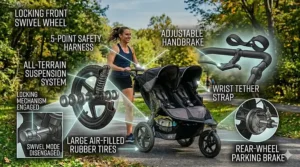
The BOB Revolution Flex 3.0 Duallie stands at the top of double jogging strollers for one simple reason: it’s the only one that genuinely feels built for running, not just labeled as capable of it. Modern jogging strollers evolved significantly from early baby carriages, with today’s performance models featuring specialized three-wheel designs and advanced suspension systems that make them distinctly different from traditional strollers. With its 16-inch air-filled tires and adjustable suspension that you can fine-tune from 1 to 5 based on terrain, this stroller glides over cracked sidewalks and gravel trails without transmitting every bump to your passengers.
The key specs tell part of the story—33 pounds of weight, 50-pound capacity per seat, and a width of 30.5 inches that fits through standard doorways. But what the spec sheet won’t tell you is how the handlebar adjusts from 31.5 to 49.3 inches with nine positions, meaning both a 5’2″ mom and a 6’4″ dad can run comfortably without developing lower back pain. The mountain bike-style hand brake gives you precise speed control on hills, something absent from cheaper models where you’re either locked or free-rolling with nothing in between.
Here’s the infant reality: the BOB accepts one infant car seat via adapters sold separately (around $60-$80 depending on your car seat brand—Britax, Chicco, Graco, Peg Perego, and others all work). You’ll walk with one baby in the car seat and one in the regular seat reclined back starting around 8 weeks per manufacturer guidelines, but you won’t actually jog until both twins hit 8 months minimum. That’s a long wait if you’re eager to run, but parents consistently report this stroller’s longevity—it works beautifully from 8 months to 50 pounds per child, which could mean using it for 4-5 years.
Customers praise the smooth push and the fact that it tracks straight even on crowned roads without constant correction. The storage basket holds 10 pounds, which sounds minimal until you realize the alternative is hanging bags off the handlebar and throwing off your center of gravity. Some parents note the fold, while improved from earlier versions, still takes up significant trunk space—this isn’t a travel stroller.
Pros:
✅ Superior suspension adjusts for different terrains and combined child weight
✅ Hand brake provides actual speed control, not just on/off locking
✅ Tracks straight during runs without constant steering corrections
Cons:
❌ Only accepts one infant car seat, not two
❌ Manufacturer recommends waiting until 8 months for jogging, longer than some competitors
Price range: Around $700-$800 — premium pricing for premium performance. If you’re logging 15+ miles per week with two kids in tow, the smooth ride and durability justify the investment versus replacing cheaper strollers that develop wheel wobble after 200 miles.
2. Thule Urban Glide 2 Double — Premium Features, Lighter Weight
The Thule Urban Glide 2 Double comes in 0.9 pounds lighter than the BOB while delivering 90% of the performance at a slightly lower price point. What makes this stroller distinctive is its attention to small details that matter during actual use—the twist hand brake sits at handlebar center where your hand naturally rests, the cargo basket features a zip-top cover that prevents items from bouncing out on rough terrain, and the magnetic peek-a-boo windows let you check on sleeping twins without the loud Velcro ripping sound that inevitably wakes them up.
At 32.1 pounds with a 30.5-inch width, this stroller matches the BOB’s doorway friendliness while shaving off nearly a pound. The 16-inch rear wheels and front swivel wheel (which locks for jogging) create a nimble feel that parents describe as easier to maneuver in tight spaces compared to the BOB’s slightly sluggish turning radius. The adjustable handlebar ranges from 31.9 to 42.5 inches—not quite as tall as the BOB’s maximum, but sufficient for most parents under 6’2″.
Like the BOB, the Thule accepts one infant car seat via adapters purchased separately. Thule also offers an infant insert accessory that creates a lie-flat surface for newborns without needing a car seat, though you’re still limited to walking speeds until babies develop head and neck control around 6 months. The manufacturer guidelines state 6+ months for jogging, which is two months earlier than BOB’s 8-month recommendation—though most pediatricians still suggest 8 months as the safer baseline.
The one-handed compact fold deserves mention because it actually works as advertised. Slide the release bar, twist, and the stroller collapses in half. For even more compact storage, the rear wheels pop off in seconds. This makes the Thule significantly more trunk-friendly than the BOB, a major consideration if you’re running from different trailheads or traveling.
Real-world feedback consistently highlights the smooth ride quality and the generous canopies that extend far enough to block sun at multiple angles. The rear mesh pocket and two mesh compartments inside each seat provide places for water bottles and snacks without needing to purchase additional accessories. However, some taller runners note the handlebar’s maximum height falls short of the BOB’s extended range, creating an uncomfortable forward lean during longer runs.
Pros:
✅ Nearly a pound lighter than BOB while maintaining similar performance
✅ True one-handed fold with removable wheels for compact storage
✅ Zip-top cargo basket prevents items from bouncing out on trails
Cons:
❌ Accepts only one infant car seat, limiting twin newborn use
❌ Handlebar maximum height may feel low for runners over 6’2″
Price range: In the $650-$750 range—about $50-$100 less than the BOB. This price difference narrows the choice: do you prioritize the BOB’s taller handlebar and slightly more refined suspension, or the Thule’s lighter weight and better fold?
3. Baby Jogger City Mini GT2 Double — All-Terrain Versatility
The Baby Jogger City Mini GT2 Double occupies an interesting middle ground—it’s technically an all-terrain stroller rather than a dedicated jogger, but its forever-air rubber tires (which never go flat), all-wheel suspension, and hand-operated parking brake make it capable of light jogging once babies reach appropriate age. For parents who want one stroller that handles urban sidewalks, park trails, and occasional 5K training runs without specializing in any single scenario, the City Mini GT2 Double hits that versatile sweet spot.
Weighing 31.8 pounds with a 29.5-inch width, this stroller actually sneaks through doorways more easily than the 30.5-inch BOB and Thule, which matters more than you’d think when navigating crowded coffee shops or narrow store aisles with two kids. The signature one-hand fold lives up to its reputation—lift the strap at seat center, and the stroller collapses into a relatively compact package that auto-locks. No bending down, no complicated sequences, no YouTube tutorial required.
The infant car seat situation mirrors the BOB and Thule: one adapter sold separately, one car seat at a time. Baby Jogger’s adapters work with their own City GO 2 infant seat plus Britax, Cybex, Graco, and Maxi-Cosi models. Each seat supports up to 50 pounds, and the near-flat recline means babies can nap comfortably even before they’re developmentally ready for jogging (which again, won’t happen until 6+ months minimum).
What distinguishes this from true jogging strollers is the lack of a hand brake for speed control—you get a hand-operated parking brake that locks the wheels completely, but there’s no modulated braking for downhill running. The suspension also doesn’t adjust like the BOB’s system. For casual joggers who run 5-10 miles per week on relatively flat, paved routes, these limitations won’t matter. For serious runners tackling hilly terrain or longer distances, the lack of fine-tuned control becomes noticeable.
Parents consistently mention the generous storage basket (holds up to 10 pounds per the manual, though many report successfully carrying more) and the UV 50+ canopy that extends to multiple positions. The adjustable handlebar helps, though its range doesn’t match the BOB or Thule’s extremes. The leatherette handle wraps and magnetic peek-a-boo windows add a premium feel at a mid-range price.
Pros:
✅ Slightly narrower at 29.5 inches makes navigating tight spaces easier
✅ True one-hand fold that actually works without practice
✅ Forever-air rubber tires eliminate flat tire maintenance
Cons:
❌ Lacks hand brake for speed control during downhill jogging
❌ Non-adjustable suspension limits terrain adaptability
Price range: Around $550-$650—about $100 less than the BOB and Thule while delivering most of the features casual joggers need. For families who prioritize all-around usability over pure jogging performance, this represents excellent value.
4. Baby Jogger Summit X3 Double — Performance on a Tighter Budget
The Baby Jogger Summit X3 Double delivers legitimate jogging capability at a price point roughly $50-$100 below the BOB Revolution Flex 3.0 Duallie. At 37.4 pounds, it’s notably heavier than its lighter competitors, but that weight comes with air-filled rubber tires, all-wheel suspension, and a hand-operated deceleration brake—features that separate real running strollers from marketing-labeled “joggers.”
The standout feature that saves parents money? This stroller works with Baby Jogger and Graco infant car seat adapters (sold separately) for one seat, following the same pattern as the BOB and Thule. However, Baby Jogger no longer manufactures the compact pram accessory that used to allow two infant setups, meaning you’re limited to the one-car-seat configuration like most competitors. Each seat accommodates up to 50 pounds and features near-flat recline positions with magnetic side vents for airflow—thoughtful details for longer outings where kids might nap.
The hand-operated brake deserves specific mention because it differs from the BOB’s mountain bike cable system. This uses a drum brake on the rear axle that you twist to slow down, which some parents find more intuitive than a brake lever. The front swivel wheel locks via a hand-operated switch at the handlebar, eliminating the need to bend down and manually engage a lock before transitioning from sidewalk to running mode.
Where this stroller compromises to hit its lower price point: the handlebar doesn’t adjust for height, sitting fixed at a position that works well for parents between 5’4″ and 6’0″ but may feel too low or too high outside that range. The suspension doesn’t adjust—you get what you get for all terrains and combined child weights. And the storage basket, while present, sits shallow enough that fitting a large diaper bag proves challenging.
Customer feedback splits into two camps. Parents who bought this as their primary runner and logged serious miles report it performs well but feels slightly less refined than the BOB—the push requires more effort on uneven terrain, and the brake modulation isn’t quite as smooth. Parents who bought it for occasional jogging with frequent all-around stroller use rate it highly for versatility and value. Neither group reports major durability concerns, which matters when you’re investing $600+ in equipment that needs to last through two kids growing from infancy to 50 pounds each.
Pros:
✅ Hand-operated front wheel lock means no bending during walk-to-run transitions
✅ Near-flat recline with magnetic vents keeps sleeping twins comfortable
✅ Drum brake system proves intuitive for first-time jogger stroller users
Cons:
❌ Fixed handlebar height won’t accommodate very short or tall parents comfortably
❌ Heavier at 37.4 pounds makes loading into vehicles more challenging
Price range: Around $600-$700—positioned as the “budget premium” option. You’re saving $100-$150 versus the top-tier models while still getting genuine jogging capability that cheaper strollers can’t deliver.
5. Baby Trend Expedition Double Jogger — The Budget-Friendly Entry Point
The Baby Trend Expedition Double Jogger sells for less than half the price of premium models like the BOB, and that aggressive pricing makes it the most popular double jogger on Amazon despite significant compromises. At around $250-$350, this stroller opens up jogging for families who can’t justify $700+ on a specialized stroller, though you’ll quickly understand why serious runners spend more.
Weighing approximately 38 pounds with composite (not air-filled) tires, the Expedition feels substantially heavier to push than its premium competitors despite similar weight specs. The difference lies in bearing quality and wheel design—composite tires don’t absorb terrain irregularities like air-filled versions, so every crack in the sidewalk translates directly to your arms. The front wheel swivels for maneuverability and locks for jogging, but the locking mechanism feels loose compared to more expensive models. Multiple parents report the wheel unlocking itself mid-run if you hit a substantial bump.
Here’s where the Expedition diverges from all previous strollers on this list: it doesn’t accommodate infant car seats via adapters. Baby Trend makes adapters for their single joggers, but the double version lacks the structural attachment points. This means you’re waiting until both twins can sit unassisted before using this stroller at all—typically 6+ months minimum, with most pediatricians recommending 8+ months before actual jogging.
The multi-position reclining seats with five-point harnesses provide basic safety and comfort. The parent tray includes two cup holders and a covered compartment for keys and phone. The large storage basket holds more items than the BOB or Thule’s baskets, which partially compensates for the lack of premium features. The ratcheting canopy adjusts to multiple positions, though the fabric quality feels thin compared to higher-priced competitors.
Real-world performance feedback centers on two themes: it works fine for casual jogging on smooth pavement at moderate speeds, but it struggles with challenging terrain, long distances, or fast paces. The composite tires develop flat spots over time, creating a bumpy ride that requires replacement if you plan to use this stroller for more than casual year-or-two use. The frame feels stable but not premium—some parents report creaking sounds developing after 6-12 months of regular use.
Pros:
✅ Significantly lower price opens jogging to budget-conscious families
✅ Larger storage basket accommodates bulky items easily
✅ Available in multiple color options at same price point
Cons:
❌ No infant car seat compatibility means waiting until 6-8 months minimum
❌ Composite tires create harsher ride and develop flat spots over time
Price range: Around $250-$350—the cheapest legitimate double jogger available, though the trade-offs become apparent quickly. This works best for casual joggers planning 5-10 miles per week on smooth pavement who need the lowest possible entry cost.
6. Joovy Zoom X2 — Lightweight Performance
The Joovy Zoom X2 targets a specific niche: parents who want legitimate jogging capability in a lighter package than the BOB or Thule, and who don’t need infant car seat compatibility because their twins are already 3+ months old and sitting well with head control. At just 30 pounds, it’s the lightest double jogger reviewed here, and that weight difference matters more than the 2-3 pound gap suggests when you’re lifting this in and out of a vehicle multiple times per week.
Built with aircraft-grade 6061 aluminum, the Zoom X2 features extra-large air-filled tires (larger than some competitors) that deliver a smooth ride over mixed terrain. The front wheel swivels for maneuverability and locks for jogging via an easy-access switch. The linked brake system engages both rear wheels simultaneously, though it lacks the modulated hand brake that premium joggers offer—you’re either braking or not, with no in-between control.
The manufacturer’s 3-month minimum age for use assumes babies have solid head and neck control, which typically develops between 4-6 months for most infants. The Zoom X2 offers no infant car seat adapters and no bassinet attachments—what you see is what you get with two regular seats that recline independently from upright to fully flat. Each seat supports up to 50 pounds, giving this stroller the same longevity as more expensive options once babies reach appropriate age.
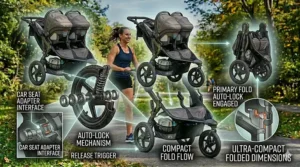
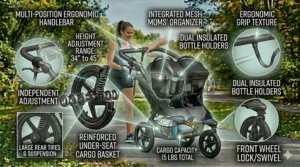
The one-handed fold collapses the stroller quickly, and the included parent organizer with cup holders and zippered storage provides convenience without purchasing accessories. The UPF 50+ canopies adjust independently, important when one twin wants to nap while the other wants full visibility. The air pump included in the box eliminates the need to find a compatible pump when tire pressure drops—a small detail that prevents frustration later.
Where the Zoom X2 stumbles: some parents report the parking brake doesn’t feel secure, occasionally giving way with a light bump despite appearing properly engaged. This raises safety concerns when parking on any incline. The 31.5-inch width fits through standard doorways, though just barely compared to the 29.5-inch City Mini GT2. And the absence of infant options means families with newborn twins need an entirely separate stroller solution for the first 3-6 months, adding to total equipment costs.
Pros:
✅ Lightest double jogger at 30 pounds reduces loading/unloading effort
✅ Aircraft-grade aluminum frame delivers durability without excess weight
✅ Includes air pump and parent organizer rather than selling as add-ons
Cons:
❌ Zero infant car seat compatibility limits use to 3-6+ months and up
❌ Parking brake reliability concerns reported by multiple users
Price range: Around $400-$500—positioned as the lightweight specialist. If you’re past the infant stage or willing to buy a separate stroller for months 0-6, this offers excellent jogging performance at mid-range pricing.
7. Graco DuoGlider — The Transitional Solution for Twin Infants
The Graco DuoGlider isn’t a jogging stroller, and I need to state that clearly upfront to avoid confusion. So why include it in a guide about double infant jogging strollers? Because it solves the biggest problem twin parents face: this tandem stroller accepts two Graco SnugRide infant car seats simultaneously via Click Connect attachments, giving you an actual solution for newborn twins while you wait for them to reach jogging age.
At 29.5 pounds with a 20.5-inch width, the DuoGlider maneuvers through doorways and narrow aisles more easily than any side-by-side stroller. The tandem stadium-style seating positions the rear seat slightly higher than the front, giving both children good sight lines. The rear seat reclines completely flat to accommodate a newborn in a car seat or a sleeping toddler, while the front seat offers multiple recline positions.
The infant car seat setup works exclusively with Graco SnugRide models—if you use Chicco, Britax, or other brands, you’ll need adapters that don’t work well or won’t fit this stroller at all. Assuming you have compatible Graco seats, the Click Connect system attaches car seats securely with an audible click that confirms proper engagement. You can configure this as two car seats, one car seat plus one toddler seat, or two toddler seats depending on your twins’ ages.
The one-hand standing fold collapses the stroller without requiring you to bend down—a significant advantage when you’re holding one baby while collapsing the stroller with your free hand. The extra-large storage basket accommodates a large diaper bag plus groceries, with easy access even when the rear seat is fully reclined. The parent tray includes two cup holders and covered storage; each seat features its own child tray with dual cup holders.
Here’s the strategic use case: buy the DuoGlider (around $180-$220) as your primary stroller for twins from birth through 6-8 months. Use it for all walking excursions, errands, and casual outings. When your twins hit 6-8 months and develop enough head/neck control for jogging, invest in one of the actual jogging strollers reviewed above. By that point, you’ll have a clearer sense of how much you’ll actually jog versus walk, making the $400-$800 jogging stroller investment more informed. Some families sell the DuoGlider at 8-12 months and recoup $100-$150 toward their jogger purchase.
Pros:
✅ Only stroller in this guide that accepts two infant car seats simultaneously
✅ Narrow 20.5-inch width navigates tight spaces easier than side-by-side models
✅ One-hand standing fold works while holding a baby
Cons:
❌ Not a jogging stroller despite appearing in jogging stroller searches
❌ Only works with Graco SnugRide car seats, limiting brand flexibility
Price range: Around $180-$220—by far the lowest price on this list. As a dedicated walking stroller for the 0-8 month period, this delivers excellent value before you transition to a true jogger.
The Twin Infant Jogging Reality: What the Marketing Won’t Tell You
Let me share something most stroller companies bury in fine print or relegate to FAQ sections: genuine double infant jogging strollers don’t exist in the form most twin parents imagine. When you search “double infant jogging stroller,” you’re picturing a stroller where you clip two infant car seats into a rugged frame and immediately start running 5Ks. That product doesn’t exist, and for good reason—it would be dangerously unsafe.
The American Academy of Pediatrics and most pediatricians recommend waiting until babies are at least 6 months old before jogging with them in any stroller, with 8 months being the more conservative guideline. Before that age, babies lack sufficient head and neck control to withstand the impact forces transmitted through even the best suspension systems. According to medical guidelines, babies should have good trunk and neck control before sitting in a jogging stroller, and running should be limited to smooth surfaces until the baby reaches 12 months old.
Here’s where the “double” aspect creates additional complications. Nearly every double jogging stroller—including the premium BOB, Thule, and Baby Jogger models—accepts only one infant car seat at maximum. The structural design of side-by-side joggers doesn’t accommodate two car seat adapters simultaneously because the mounting points would interfere with each other. This means even if you buy a $700 double jogger on day one, you can’t use it as intended with newborn twins.
So what do twin parents actually do? Three common strategies emerge from real-world experience:
Strategy 1: The Walking Phase (0-8 months). Buy a budget tandem stroller like the Graco DuoGlider ($180-$220) that accepts two infant car seats. Use this exclusively for walking—not jogging—during the first 6-8 months. Around month 6-8 when babies develop appropriate strength, either babywearing one twin while the other rides in a single jogger, or purchasing a double jogger and running only after both twins can sit unassisted in regular seats.
Strategy 2: The Babywearing Hybrid (3-8 months). Buy your intended double jogger immediately and walk with one baby in a car seat plus one in the regular seat reclined back (starting around 3-4 months when neck control develops). Supplement with a baby carrier for the second twin during the 3-8 month window. Once both twins hit 6-8 months, transition to both riding in the stroller seats while jogging.
Strategy 3: The Patience Plan (0-8 months). Postpone the jogging stroller purchase entirely. Use a budget double stroller for walking or maintain your pre-twin workout routine without jogging until twins reach 6-8 months. At that point, invest in your preferred double jogger knowing you’ll use it for its intended purpose immediately rather than as an expensive walking-only stroller for months.
None of these strategies is perfect, but understanding this reality before spending $700 on a stroller prevents disappointment. The marketing photos showing two infants in car seats inside jogging strollers? Look closely—those strollers are usually parked, not moving, because that configuration exists only for demonstration purposes.
How to Choose a Double Infant Jogging Stroller: 7 Critical Factors
Choosing a double jogging stroller requires balancing multiple factors that often conflict with each other. A stroller that excels at serious running might struggle with daily errands, while the most infant-friendly option might disappoint actual joggers. Here’s how to navigate these trade-offs:
1. Define Your Actual Running Volume and Terrain
Be honest with yourself about how much you’ll realistically run with twins in tow. If you’re currently logging 20+ miles weekly, you’ll likely drop to 10-15 miles initially as you adjust to pushing 30-40 pounds of children plus 30-35 pounds of stroller. That still qualifies as serious running that benefits from premium features like adjustable suspension, air-filled tires, and hand brakes.
If you’re running 5-10 miles weekly on paved paths, you don’t need $800 worth of features. The Baby Trend Expedition Double at $300 will handle smooth pavement fine, though it’ll feel harsher than premium options. For occasional runners who jog 1-2 times weekly mixed with mostly walking, prioritize all-around stroller features over pure jogging performance—the Baby Jogger City Mini GT2 Double becomes more logical than a specialized jogger.
Terrain matters more than many parents expect. Concrete bike paths with smooth surfaces forgive mediocre suspension and smaller wheels. Gravel trails, cracked sidewalks, or grass routes demand air-filled tires and quality suspension unless you want your arms absorbing every bump for miles. If you’re unsure about terrain, assume you’ll encounter rougher conditions than expected—it’s easier to tolerate a smooth-riding stroller on perfect pavement than to suffer through a harsh-riding stroller on imperfect surfaces.
2. Understand the Infant Car Seat Timing Reality
Stop searching for a double jogger that accepts two infant car seats—you’re wasting time looking for a product that doesn’t exist in any meaningful way. Instead, map out your timeline. When are your twins due? When do you realistically want to start running again (remembering most doctors recommend 12+ weeks postpartum for the mother’s recovery, separate from baby readiness)?
If you have newborn twins today and desperately want to run within 2-3 months, you need a bridging strategy. Consider buying a used Graco DuoGlider ($100-$150 secondhand) for the first 6 months purely for walking, then selling it for similar money and upgrading to a real jogger. Or plan to babywear one twin while jogging with a single stroller—this works better than it sounds if you invest in a quality structured carrier.
If your twins are already 3+ months old with good head control, or if you’re planning purchases for future use, the infant car seat limitation matters less. You’re closer to the 6-8 month threshold where babies can ride in regular stroller seats, making any of the top six joggers on this list viable immediately or within weeks.
3. Factor in Your Vehicle and Storage Situation
A 37-pound stroller that folds to 21,000 cubic inches sounds manageable until you try to fit it in a Honda Civic trunk alongside a diaper bag, groceries, and the random stuff that accumulates in any parent’s vehicle. Measure your trunk space before buying. Some joggers—particularly the Baby Jogger Summit X3 Double—fold awkwardly despite being technically compact, requiring you to angle them just right to close the trunk.
The Thule Urban Glide 2 Double and Joovy Zoom X2 both offer wheels that pop off in seconds, dramatically reducing folded dimensions. This sounds like a minor convenience until you’re doing it three times weekly to fit the stroller plus soccer gear or vacation luggage. If you frequently load/unload the stroller, removable wheels transform from “nice to have” to “essential.”
Garage storage presents different challenges. Side-by-side joggers are wide even when folded—expect 30+ inches—which means they won’t lean against a wall without protruding into walkways. If your garage is already packed, measure your available floor space. Some parents end up storing their jogger outside under a cover, which accelerates fabric fading and frame oxidation compared to indoor storage.
4. Height Compatibility for All Pushers
Handlebar adjustability matters more than first-time buyers realize. A fixed handlebar at 40 inches works fine for someone 5’8″ but creates back pain for a 6’3″ partner who’s hunched over for the entire run. The BOB Revolution Flex 3.0 Duallie’s nine-position handlebar extending to 49.3 inches accommodates virtually any height, while the Baby Jogger Summit X3 Double’s non-adjustable bar leaves tall and short parents compromising.
Test the stroller if possible before buying. If buying online, look for specific height feedback in reviews. Search for phrases like “I’m 6’2″ and…” or “as a 5’2″ mom…” to find reviewers matching your dimensions. A stroller that causes lower back discomfort on a 2-mile run will be intolerable on 5+ mile outings, and you won’t realize the problem until you’ve logged enough miles to pass the return window.
Don’t assume “adjustable” means “sufficient range.” Some strollers adjust from 36 to 42 inches—better than fixed, but still too short for anyone over 6 feet. Ideal range is 30-something inches minimum (for 5-foot-tall pushers) to 45+ inches maximum (for 6-foot-plus pushers). This spread ensures anyone in your family can run comfortably.
5. Weight Distribution and Pushing Effort
A heavier stroller isn’t necessarily harder to push—poor design and cheap bearings create more resistance than a few extra pounds. The 33-pound BOB often pushes easier than the 30-pound budget options because quality wheel bearings and proper weight distribution matter more than raw weight.
Pay attention to where weight sits in the stroller frame. Back-heavy designs (like some reviews mention about the Summit X3) feel tippy when both seats recline, forcing you to maintain constant forward pressure on the handlebar. Center-balanced designs track naturally with minimal handlebar pressure, letting you maintain better running form.
The “pushing effort” factor becomes obvious when you test joggers side-by-side, but it’s invisible when buying online. Here’s a proxy: look for reviews mentioning “effortless,” “smooth push,” or “tracks straight” versus “requires constant steering correction” or “feels heavy.” The BOB and Thule consistently receive “smooth push” feedback; the Baby Trend gets mixed reviews with many mentioning “takes effort on anything but perfect pavement.”
6. Long-Term Cost Calculation
The $250 Baby Trend looks like a steal compared to the $750 Thule until you factor in replacement costs and resale value. Budget strollers depreciate faster and often need replacement after 1-2 years of regular use, while premium joggers routinely sell for 50-60% of original price after 3-4 years of hard use.
Run the math: $750 Thule used regularly for 4 years, then sold for $400 = $350 net cost over 4 years = $87.50 per year. $250 Baby Trend used for 2 years, no resale value after showing wear = $125 per year. The premium stroller costs less annually while delivering better performance throughout ownership.
This calculation assumes you’ll use the stroller enough to justify ownership. If you’re uncertain whether you’ll stick with running, or if you plan to use the jogger once weekly for one year then stop, the cheap option makes sense. You’re not running it into the ground, and you’re not looking for resale value.
7. Accessory Ecosystem and Compatibility
Some strollers work with universal accessories; others require brand-specific add-ons that may or may not be available years later. The BOB and Thule have thriving accessory markets with weather shields, parent consoles, and car seat adapters readily available. Baby Jogger’s adapter selection is good but slightly more limited. Budget brands like Baby Trend often have accessories that go out of stock or get discontinued.
Consider which car seats you already own or plan to buy. If you’re committed to Chicco KeyFit 30, verify the jogging stroller you want has a compatible adapter currently in production. Parents get frustrated when they buy a stroller assuming adapters exist, only to discover their car seat brand isn’t supported or the adapter was discontinued.
Real-World Scenarios: Matching Stroller to Your Situation
Scenario 1: Sarah, First-Time Twin Mom, Moderate Runner (15 miles/week pre-twins)
Sarah ran 15 miles weekly before pregnancy—three 5-mile runs at conversational pace. She wants to maintain fitness but recognizes she won’t return to pre-twin volume for 6-12 months minimum. Her twins are due in July, and she plans to resume running in October (around 12 weeks postpartum, 16 weeks for babies).
Best choice: Start with a borrowed or used Graco DuoGlider for August-October walking. In November when twins are 4 months old, purchase the Thule Urban Glide 2 Double. Use one car seat plus one regular seat reclined for walking until January when twins hit 6 months. Begin light jogging at 6 months, working up to full running by 8 months. The Thule’s lighter weight (32 pounds) makes it easier to manage solo when Sarah’s partner isn’t available to help load the stroller. The one-handed fold means she can hold one baby while collapsing it after runs.
The $650 Thule investment makes sense because Sarah will run consistently enough to appreciate the smooth ride and quality construction over cheaper options. In 3-4 years when the twins outgrow the stroller, selling it for $350-$400 recoups most of the premium paid over budget models.
Scenario 2: Marcus and James, Serious Runners (30+ miles/week each), Twins Age 9 Months
Marcus and James are training for a half marathon and need a stroller that can handle serious mileage on varied terrain including gravel trails and hilly routes. Their twins are already 9 months old with excellent head and neck control, so infant car seat compatibility is irrelevant.
Best choice: BOB Revolution Flex 3.0 Duallie, no question. At 30+ weekly miles pushing two kids, they’ll feel every limitation of cheaper strollers. The adjustable suspension lets them tune the ride for the 35-pound twins plus stroller weight. The handlebar extension accommodates their 6’1″ and 6’2″ heights without creating back problems. The hand brake provides essential speed control on the downhill sections of their training routes. They plan to use this stroller for at least 3 years as they continue training through multiple race seasons.
The $750 price point represents $250 annually over 3 years of hard use—reasonable for equipment that prevents injury and maintains training consistency. They’ll skip the Graco DuoGlider entirely since their twins are past the infant seat phase.
Scenario 3: Rachel, Casual Jogger (5 miles/week), Budget-Conscious, Twins Age 3 Months
Rachel jogs occasionally for fitness but isn’t training for races. She runs 5 miles total weekly, usually two 2-2.5 mile sessions. Her twins are 3 months old and showing good head control. Money is tight after twin-related expenses, and she needs to minimize stroller costs.
Best choice: Wait until twins reach 6 months, then buy the Baby Trend Expedition Double. At $300, it delivers adequate performance for casual jogging on paved paths without the $700+ premium stroller investment. The lack of infant car seat compatibility doesn’t matter since she’s waiting until 6 months anyway per pediatrician recommendation. For the 3-6 month gap, she borrows a regular double stroller from a friend for walking or uses the single stroller she already owns plus babywearing for one twin.
In 2-3 years when her twins outgrow jogging strollers, the Expedition will have minimal resale value, but its $300 cost is low enough that she’s okay with that outcome. The money saved versus premium options ($400-$500) can go toward other twin essentials.
Double Infant Jogging Stroller Safety: What Every Parent Must Know
Safety goes beyond “buckle them in and run.” Here’s what actually matters for twin jogging:
Age and Development Milestones Trump Product Marketing
Stroller manufacturers list minimum ages that represent legal liability protection, not necessarily optimal safety. According to safety experts and the Consumer Product Safety Commission, jogging strollers are unsafe for newborns because they typically don’t recline fully, and babies need proper muscle development to sit up and hold their heads steady. When a stroller says “suitable from 6 months,” that assumes average development. If your twins were premature or show slower physical development, that 6-month minimum might need to be 8-9 months. Conversely, some 6-month-olds with excellent trunk control can handle jogging earlier than weaker 8-month-olds.
The key indicators: Can each baby sit unsupported for 5+ minutes without toppling? When you place them in the stroller seat fully reclined and hit a bump, do their heads remain steady or wobble? Can they hold their heads up consistently when you carry them upright? If you’re answering “yes” to these questions by 6 months, jogging becomes reasonable. If these aren’t rock-solid “yes” answers at 8 months, keep walking and reassess at 9-10 months.
Remember the distinction between walking with a stroller versus jogging. Walking with a 4-month-old in a car seat attached to a jogger is fine—the car seat provides full head/neck support, and walking creates minimal impact. Jogging with that same setup is dangerous because even in a car seat, the cumulative impact from thousands of footstrikes over a 30-minute run stresses an infant’s developing spine and neck muscles.
Terrain and Speed Moderation
Start conservatively when you begin jogging with your twins. Even if you ran 8-minute miles pre-pregnancy, start at 11-12 minute pace for the first month. The slower pace reduces impact forces transmitted through the stroller to your babies’ bodies. Stick to smooth paved paths initially—save gravel trails and uneven terrain for when your twins are 10-12 months old with stronger core muscles.
Watch your twins’ reactions during and after runs. If they seem fussy, tired, or irritable following stroller runs but happy after walks, you’re pushing too hard too fast. Some babies love the motion and fall asleep; others tolerate it but need gradual adaptation. There’s no universal timeline—let your specific twins’ responses guide you.
Equipment Maintenance Prevents Accidents
A double jogging stroller carries 60-100 pounds of children at speeds up to 8-10 mph. Equipment failure at that weight and speed creates serious injury risk. Check these items every 2-3 weeks:
- Tire pressure (air-filled tires should match the PSI printed on sidewall—usually 30-40 PSI)
- Brake function (parking brake should lock wheels completely; hand brake should modulate smoothly)
- Harness buckles (press the release button 10 times—if it’s sticky or fails to release cleanly, replace it)
- Wheel attachment (spin each wheel and listen for grinding sounds indicating bearing wear)
- Frame integrity (look for cracks, especially near high-stress points like the handlebar attachment)
The front swivel wheel lock deserves special attention. Before every run, verify it’s fully engaged. A loose front wheel that swivels unexpectedly during a run can send the stroller off-course, potentially into traffic or off a curb. The lock should click audibly and show visual confirmation (most have a red vs. green indicator).
Parking and Brake Safety
Never park a loaded stroller without engaging the brake, even on flat surfaces. Vibration from passing traffic or wind can set a free-rolling stroller in motion. On any incline, park perpendicular to the slope rather than facing up or down—this orientation prevents roll-away if the brake fails. Some joggers (particularly the Joovy Zoom X2 based on customer reports) have brakes that appear engaged but can give way with a bump. With these models, extra caution matters—chock a wheel with a rock or other object when parking on slopes.
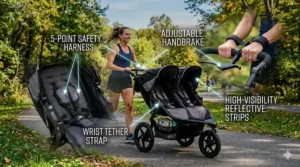
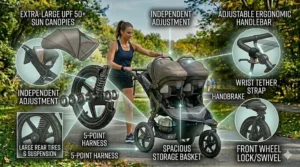
The wrist strap that comes with most joggers isn’t optional. Loop it around your wrist before every run. If you trip or lose grip on the handlebar, the strap prevents the stroller from rolling away into danger. Yes, it feels unnecessary 99% of the time. That 1% scenario where it prevents disaster makes it non-negotiable.
Weather Considerations
Heat affects babies more severely than adults. On days above 80°F, run early morning or evening when temperatures drop. Keep runs shorter—30 minutes maximum—and check on your twins every 10 minutes by feel (touch their cheeks and neck to verify they’re not overheating). The canopies on joggers provide shade but also trap heat, creating a greenhouse effect. Some parents run with canopies partially open on hot days to increase airflow, though this reduces sun protection.
Cold weather below 40°F requires bundling babies warmly, but avoid over-bundling that restricts movement or makes them sweat. The motion of running keeps you warm; your babies are stationary and need more insulation. Weather shields (clear plastic covers that zip over the stroller opening) protect from wind and light rain but again trap heat, requiring vigilance about overheating even in cool weather.
Frequently Asked Questions
❓ When can twins use a jogging stroller together?
❓ Can you jog with newborn twins in a double stroller?
❓ Which double jogging stroller accepts two infant car seats?
❓ How much should I spend on a double jogging stroller?
❓ What's the difference between a double jogging stroller and a regular double stroller?
Conclusion: Making Your Double Infant Jogging Stroller Decision
If you’ve read this far, you’re probably still processing the reality that “double infant jogging stroller” doesn’t mean what you initially thought it meant. That’s okay—most twin parents go through the same realization when they start serious research. The marketing images showing two car seats in a side-by-side jogger create expectations that real products don’t fulfill.
Here’s what actually matters: choosing a stroller that works for your specific timeline and priorities. If your twins are newborns and you desperately want to start running in 2-3 months, you need a two-stroller strategy: something like the Graco DuoGlider ($180) for walking now, transitioning to a real jogger like the Thule Urban Glide 2 Double ($650) once babies hit 6 months. If your twins are already 4-6 months old, you’re close enough to jogging age that buying your end-state jogger immediately makes sense.
For serious runners who’ll log 15+ weekly miles pushing twins through varied terrain for 3-4 years, the BOB Revolution Flex 3.0 Duallie justifies its $750 price through superior suspension, build quality, and resale value. For casual joggers running 5-10 miles weekly on smooth paths, the Baby Trend Expedition Double at $300 delivers adequate performance without premium costs. For families wanting one stroller that handles urban errands plus occasional weekend runs, the Baby Jogger City Mini GT2 Double ($600) splits the difference with its all-terrain versatility.
What doesn’t work: expecting a single stroller to perfectly handle newborn twins, daily errands, and serious jogging from day one. That product doesn’t exist. But accepting the limitations and planning accordingly—whether through staged purchases, babywearing one twin during transition months, or patiently waiting until 6-8 months—gets you to the same endpoint: regularly running with your twins in a stroller that suits your actual needs.
The best double infant jogging stroller is the one you’ll actually use consistently for years, not the one with the most features or the lowest price. If you’re uncertain between options, start with questions about your situation: How often will I realistically run? What’s my budget including potential resale value? Am I willing to buy a temporary solution for ages 0-6 months? Your answers narrow the choices quickly.
One final thought: whatever you choose, remember that running with twins in a stroller will be harder than running solo, at least initially. You’ll be slower, more tired, and frequently frustrated by logistics. That’s normal. Give yourself 4-6 weeks to adapt to pushing the extra weight and adjusting your stride to accommodate the stroller. Most parents who push through the awkward adaptation phase discover that running with their twins becomes one of their favorite activities—different from solo running, but rewarding in new ways when your kids laugh at birds, point at dogs, and eventually ask “Can we run faster, Mommy?”
Recommended for You
- 7 Best BOB Double Jogging Strollers 2026
- 7 Best Everyday Jogging Strollers for Active Parents (2026 Guide)
- 7 Best Trail Running Strollers That Actually Work (2026 Guide)
Disclaimer: This article contains affiliate links. As an Amazon Associate, I earn from qualifying purchases. If you purchase products through these links, we may earn a small commission at no additional cost to you.
✨ Found this helpful? Share it with your friends! 💬🤗
