
In This Article
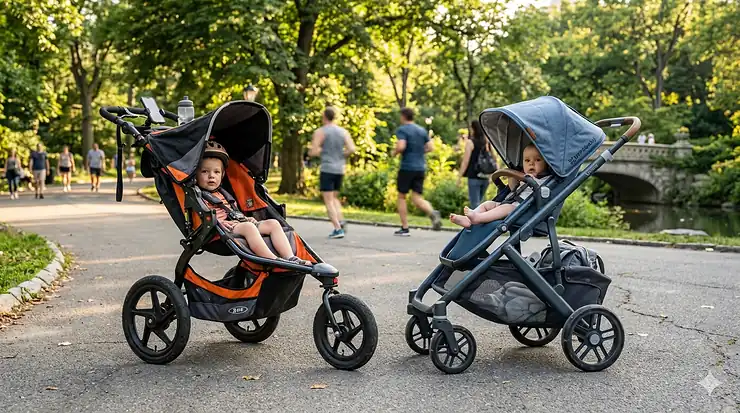
Choosing between a jogging stroller vs regular stroller isn’t just about picking wheels and fabric—it’s about matching your family’s lifestyle with the right engineering. I’ve watched countless parents make this decision, and the stakes are higher than most realize. The difference between jogging and regular stroller extends far beyond the price tag, touching everything from your baby’s spinal development to whether you’ll actually maintain your fitness routine after parenthood.
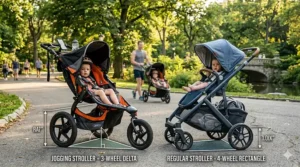
Here’s what most buying guides won’t tell you: regular strollers are engineered for controlled, lower-speed environments like shopping malls and sidewalks. Their four-wheel design and lightweight frames prioritize compactness and maneuverability in tight spaces. Jogging strollers, on the other hand, are built with three oversized air-filled tires, advanced suspension systems, and lockable front wheels specifically engineered to handle the repetitive impact forces of running—forces that can reach 2-3 times your body weight with each stride. According to the American Academy of Pediatrics, babies need sufficient head and neck control before experiencing these higher-impact movements, which typically develops around 6-8 months of age.
The real question isn’t which stroller is “better”—it’s which one aligns with how you’ll actually use it. If you’re planning to run 3-4 times weekly on varied terrain, a regular stroller will leave you frustrated and potentially compromise your child’s safety. But if your routine involves urban errands, public transportation, and occasional park walks, a bulky jogging stroller might gather dust while adding unnecessary complexity to your daily life. Let’s break down exactly what separates these two categories so you can invest wisely.
Quick Comparison: Jogging vs Regular Strollers at a Glance
| Feature | Jogging Stroller | Regular Stroller | Winner For |
|---|---|---|---|
| Wheel Configuration | 3 large air-filled tires (16″ rear) | 4 smaller foam/plastic wheels | Speed vs. Tight spaces |
| Suspension System | Mountain bike-style shock absorption | Minimal or none | Terrain handling |
| Front Wheel | Lockable swivel (must lock for running) | Fixed swivel | Running vs. Shopping |
| Weight | 25-30 lbs average | 15-22 lbs average | Portability |
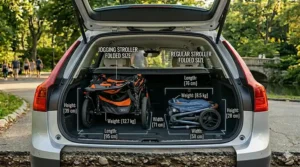
| Folded Size | Bulkier (even when folded) | Compact, car-friendly | Storage |
| Safety Features | Hand brake, wrist strap, 5-point harness | 5-point harness, foot brake | High-speed control |
| Price Range | $200-$600+ | $100-$500+ | Budget flexibility |
| Best For | Runners, trail users, uneven terrain | City life, travel, errands | Lifestyle match |
Looking at this comparison, the engineering philosophy becomes clear. Jogging strollers sacrifice portability for performance—that 28-pound BOB Revolution Flex 3.0 with its massive wheelbase isn’t a design flaw; it’s physics. The larger contact patch and lower center of gravity prevent tip-overs when you’re hitting 7-minute-mile pace on gravel trails. Regular strollers like the 18-pound Mockingbird prioritize everyday convenience, folding down to fit in a Toyota Corolla trunk and navigating Costco aisles without clipping endcaps. Neither approach is wrong; they’re solving different problems. If you run regularly or live somewhere with terrible sidewalks, those extra 10 pounds buy you stability that could prevent injury. If you’re navigating subway stairs or fitting gear into a compact car, that lightweight regular stroller becomes non-negotiable.
💬 Just one click — help others make better buying decisions too! 😊
Top 7 Strollers: Expert Analysis for Runners and Everyday Parents
1. BOB Gear Revolution Flex 3.0 – The Gold Standard for Serious Runners
The BOB Revolution Flex 3.0 remains the benchmark that every other jogging stroller tries to beat, and after hundreds of parent-hours of testing, it’s earned that reputation. The mountain bike-style suspension isn’t marketing fluff—it’s a genuine dual-spring system that absorbs trail roots and sidewalk cracks before they reach your child. Paired with 16-inch rear tires inflated to 30 PSI, you get traction on gravel that four-wheel strollers simply can’t match.
What makes this model exceptional is the adjustable handlebar (9 positions from 39″ to 50″ high), which means both 5’2″ and 6’4″ parents can run without hunching over. The front wheel tracking adjustment—a simple dial near the wheel hub—compensates for uneven sidewalk camber that would otherwise pull cheaper strollers left or right. In real-world terms, this means you’re not constantly course-correcting during a 5K loop. The 75-pound weight capacity extends usability well past toddler years, something budget joggers with 40-pound limits can’t match.
Parents consistently praise the smooth ride quality even at 8-minute-mile pace, with one verified purchaser noting their 18-month-old slept through an entire half-marathon training run. The storage basket actually fits a full diaper bag plus running jacket, and the compression fold (though not one-handed) reduces bulk enough for most SUV trunks.
Pros:
✅ Superior suspension absorbs terrain better than any competitor
✅ 75 lb capacity means years of use (most cap at 40-50 lbs)
✅ Adjustable handlebar fits parents from 5’2″ to 6’4″
Cons:
❌ No hand brake (foot brake only)—challenging on steep descents
❌ 28.5 lb weight makes solo car loading difficult
Price & Value: Typically in the $400-$500 range, which positions it as a mid-premium investment. The extended weight limit and proven durability justify the cost if you’re running 2+ times weekly. Check current pricing as seasonal sales often drop it into the $350-$400 sweet spot.
2. Thule Urban Glide 3 – Sleek Scandinavian Engineering with a Caveat
The Thule Urban Glide 3 brings Swedish design aesthetics to the jogging stroller category, with an integrated twist hand brake, one-handed fold mechanism, and aluminum frame that weighs just 25.3 pounds—lighter than most competitors. The 16-inch pneumatic rear tires and adjustable suspension deliver smooth rides across gravel trails and city streets alike. The magnetic peek-a-boo window is genuinely useful for checking on your child without breaking stride or making noise.
Here’s the complexity parents need to know: Thule’s own safety documentation states this stroller is “not suitable for running” to meet EU regulatory requirements, though the company confirms it’s designed for jogging in North America. This regulatory nuance doesn’t change the engineering—the hand brake provides downhill speed control that the BOB lacks, and the front wheel locks securely for high-speed stability. The upright seating position (new in the Glide 3) addresses the previous model’s main weakness.
What runners appreciate most is the narrow handlebar ergonomics that naturally encourage single-handed pushing, freeing one hand for water bottle access. The cargo basket includes a zip-top cover preventing items from bouncing out on rough terrain. The 49-pound weight capacity is lower than BOB’s 75 pounds, limiting longevity for larger children.
Pros:
✅ Integrated hand brake for superior downhill control
✅ One-handed fold (easiest in class)
✅ Lighter weight (25.3 lbs) than BOB
Cons:
❌ Lower 49 lb weight limit reduces years of use
❌ EU safety labeling creates confusion (though US-approved for jogging)
Price & Value: Positioned in the $500-$600 range, making it the premium option in this comparison. You’re paying for Scandinavian engineering and that hand brake system. Worth it for hilly terrain runners who value the one-handed fold for urban living.
3. Baby Trend Expedition Jogger – Budget Performance That Surprises
The Baby Trend Expedition Jogger has quietly dominated Amazon’s bestseller rankings by delivering 80% of premium stroller performance at 40% of the cost. Don’t let the budget positioning fool you—the steel frame construction and inflatable 12-inch pneumatic tires create a legitimately smooth ride that handles gravel paths and cracked sidewalks far better than its price suggests. The swiveling front wheel locks for running, and the multi-position reclining seat accommodates everything from infant car seat compatibility to toddler naptime.
What makes this model stand out in the budget category is the parent convenience features: dual cupholders, a covered storage basket that actually fits a full diaper bag, and a pivoting child tray with its own cupholder. These aren’t groundbreaking innovations, but they’re details that $500 strollers sometimes overlook. The tether strap—a crucial safety feature that prevents runaway strollers if you stumble—comes standard, not as an afterthought.
Customer feedback consistently highlights the “super smooth ride” quality, with parents noting their toddlers fall asleep within 10 minutes of pushing. The trade-offs appear in long-term durability rather than immediate performance—the fabric shows wear faster than premium models, and the wheel bearings may need replacement after heavy use. For parents who run recreationally 1-2 times weekly rather than marathon training, this represents exceptional value.
Pros:
✅ Around $130-$160 range (often $100+ cheaper than mid-range alternatives)
✅ Genuinely smooth ride quality for the price point
✅ Car seat compatible (accepts major Graco models)
Cons:
❌ Fabric durability lower than premium options
❌ Heavier than expected for budget category (~26 lbs)
Price & Value: In the $120-$160 range depending on color options. This hits the sweet spot for parents who want jogging capability without premium investment. Best value if you’re unsure about long-term running commitment.
4. Graco FastAction Jogger LX – Travel System Versatility Meets Running Performance
The Graco FastAction Jogger LX bridges the gap between travel system convenience and legitimate jogging performance—a combination that’s harder to execute than it sounds. The one-handed fold mechanism operates smoothly even with a child in your other arm, collapsing the 29-pound frame into a package that actually fits sedan trunks. The air-filled rubber tires (not cheap plastic) provide suspension that handles everything from mall floors to park trails.
What separates this from other travel systems is the Click Connect technology, which allows instant attachment of compatible Graco infant car seats without adapters. For parents bringing newborns home from the hospital, this eliminates the 6-month waiting period before jogging—you can walk with the car seat installed, then transition to running once your baby reaches appropriate developmental milestones. The multi-position reclining seat works from 3 months onward without the car seat.
The parent tray includes two deep cupholders that actually secure water bottles during running (not a given in this category), plus a covered storage compartment for phone and keys. The child tray features a covered cup holder and snack tray. After months of testing, the frame shows no flex or wobble even on rough terrain. The main limitation is weight—at 29 pounds, this isn’t a lightweight option despite the compact fold.
Pros:
✅ One-handed fold simplifies car transitions
✅ Car seat compatibility from birth (no adapter needed)
✅ Air-filled tires provide legitimate suspension
Cons:
❌ 29 lbs makes it heavier than pure joggers
❌ Bulkier folded footprint than advertised
Price & Value: Typically $200-$280 range. Excellent value for parents wanting both travel system functionality and jogging capability in a single purchase rather than buying separate strollers.
5. Mockingbird Single-to-Double Stroller 3.0 – Regular Stroller Excellence for Urban Parents
The Mockingbird Single-to-Double 3.0 isn’t a jogging stroller—it’s what you choose when everyday versatility matters more than running performance. This modular system starts as a sleek single stroller and expands to accommodate a second child with a separately purchased seat, making it ideal for growing families. The four-wheel design with lockable swivel front wheels navigates grocery store aisles and crowded sidewalks with precision that three-wheel joggers can’t match.
What makes the Mockingbird exceptional in the regular stroller category is the premium features at a mid-range price. The UPF 50+ canopy extends to full coverage, the bassinet option (sold separately) allows newborn use from day one, and the reversible seat lets your child face forward for exploration or backward for parent interaction. The all-terrain wheels—larger than typical city strollers but smaller than jogging strollers—handle cracked sidewalks and gravel paths adequately, though you wouldn’t want to actually run with it.
Parents consistently praise the smooth push quality and the massive storage basket that fits full grocery hauls. The one-handed fold collapses to a standing position, and at 22 pounds, it’s manageable for solo car loading. The trade-off? This stroller excels at daily errands and urban life but lacks the suspension and stability for actual jogging. Attempting to run with it would void the warranty and potentially compromise safety.
Pros:
✅ Converts single-to-double with add-on seat (saves buying second stroller)
✅ Reversible seat for parent/forward facing
✅ 22 lbs—lighter than any jogging option
Cons:
❌ NOT suitable for running (despite wheel size)
❌ Premium features require additional purchases (bassinet, second seat)
Price & Value: In the $350-$450 range for the base single configuration. When compared to UPPAbaby Vista ($900+), this delivers 85% of the functionality at half the cost. Best for urban families prioritizing everyday convenience over fitness activities.
6. UPPAbaby Vista V2 – Luxury Regular Stroller for Discerning Parents
The UPPAbaby Vista V2 represents the pinnacle of regular stroller engineering, with leather handlebar accents, a reversible toddler seat, and build quality that justifies its luxury positioning. The four-wheel independent suspension actually absorbs bumps despite being a regular stroller—not jogging-level performance, but noticeably smoother than budget alternatives. The expandable system accommodates up to three children simultaneously with the right configuration (bassinet + toddler seat + riding board).
What you’re paying for extends beyond aesthetics. The bassinet provides a genuinely flat sleeping surface approved for overnight sleep, making this a nursery bassinet replacement. The toddler seat reclines to near-flat positions with one hand, and the massive storage basket (30-pound capacity) swallows diaper bags, groceries, and jackets without affecting stability. The telescoping handlebar adjusts for parent height, and the no-rethread harness resizes without removing the child.
Customer feedback emphasizes longevity—parents report using Vista strollers for 5+ years across multiple children with minimal wear. The leather handlebar doesn’t crack or peel like cheaper vinyl, and the aluminum frame maintains rigidity through years of use. The limitation is obvious: at 27 pounds without accessories, this isn’t a lightweight travel option, and the folded size requires SUV-sized trunks.
Pros:
✅ Premium materials (leather accents, aluminum frame)
✅ Bassinet approved for overnight sleep (replaces nursery bassinet)
✅ Expandable to accommodate three children
Cons:
❌ 27 lbs base weight (heavier than most regular strollers)
❌ Premium pricing ($800-$900+ range)
Price & Value: In the $850-$950 range, positioning it firmly in luxury territory. Worth it for parents prioritizing durability across multiple children and premium aesthetics. Not suitable for running despite robust construction.
7. Joolz Hub2 – Mid-Size Regular Stroller with European Refinement
The Joolz Hub2 brings Dutch engineering sensibility to the mid-size stroller category, balancing compact dimensions with full-featured performance. The near-flat recline allows newborn use without a bassinet (though car seat adapters are available separately), and the one-handed fold mechanism includes an integrated carry strap for public transportation navigation. At 23 pounds, it splits the difference between ultra-light travel strollers and bulky full-size options.
What distinguishes the Hub2 is the sustainability commitment—eco-conscious materials throughout, responsible packaging, and Joolz’s lifetime warranty that’s among the industry’s most comprehensive. The four-wheel design with front swivel locks includes puncture-proof EVA foam tires that never need inflation, eliminating the maintenance headaches of pneumatic options. The adjustable handlebar and generous storage basket make this viable for everything from coffee shop outings to airport navigation.
European parents have trusted Joolz for years, and the brand is gaining traction in North America for good reason. The ride quality on smooth surfaces matches premium competitors, though the EVA foam tires can’t absorb rough terrain like air-filled alternatives. The compact fold suits urban apartments and small car trunks, making this ideal for families who prioritize portability and environmental responsibility over specialized performance like jogging.
Pros:
✅ Lifetime warranty (industry-leading commitment)
✅ Eco-conscious materials and sustainable manufacturing
✅ Puncture-proof EVA foam tires (maintenance-free)
Cons:
❌ Foam tires provide less cushioning than air-filled options
❌ Mid-range pricing ($400-$500) without premium features
Price & Value: Typically $450-$550 depending on configuration. Best for environmentally-conscious urban families who want quality without luxury pricing. Not suitable for running but handles city life exceptionally well.
Real-World Scenario Guide: Which Stroller Fits Your Lifestyle?
The Committed Runner Parent
You’re logging 15-20 miles weekly across varied terrain, treating fitness as non-negotiable self-care. Your child’s jogging stroller becomes your training partner, not a novelty purchase.
Choose: BOB Revolution Flex 3.0 or Thule Urban Glide 3. The superior suspension systems handle trail roots and gravel that would rattle budget options, and the extended weight capacities mean years of use. If you run hills regularly, the Thule’s hand brake justifies the premium. If you’re primarily flat terrain, save money with the BOB.
The Urban Errand Runner
Your “running” consists of brisk 2-mile neighborhood loops 2-3 times monthly, but daily life involves subway stairs, tight grocery aisles, and frequent car transfers.
Choose: Graco FastAction Jogger LX. You get legitimate jogging capability for occasional fitness, but the compact fold and lighter weight (relative to BOB) makes everyday use tolerable. The car seat compatibility solves newborn transportation without buying separate strollers.
The Growing Family Planner
You have one child now but anticipate a second within 2-3 years. Running isn’t your priority; managing multiple kids across errands and outings is.
hoose: Mockingbird Single-to-Double 3.0. The expandability saves you from buying a double stroller later, and the $350-$450 base price plus $150 second seat still costs less than premium singles. The urban-focused design handles daily life better than any jogging option.
The Luxury-Minded Parent
Budget isn’t the primary constraint; you want the best-engineered option that’ll last through multiple children with premium aesthetics. Occasional fitness walks matter, but running isn’t your focus.
Choose: UPPAbaby Vista V2. The bassinet-to-toddler versatility, premium materials, and three-child capacity justify the $900 investment. This becomes your primary baby transport solution for 5+ years.
The Budget-Conscious Fitness Enthusiast
You want jogging capability without $500 commitment, knowing you might not maintain running long-term.
Choose: Baby Trend Expedition Jogger. At $130-$160, you get 80% of premium performance. If running becomes habit, upgrade later. If it doesn’t, you haven’t over-invested in specialized equipment.
Can You Run with Regular Stroller? The Engineering Reality
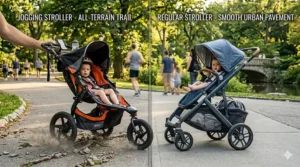
The short answer: No, and attempting it could injure your child or damage the stroller. Here’s why the engineering matters more than marketing categories. Regular strollers use smaller wheels (typically 6-8 inches) with minimal suspension because they’re designed for controlled walking speeds on smooth surfaces. When you run, each footstrike generates impact forces 2-3 times your body weight—forces that translate directly through the stroller frame to your child if proper suspension doesn’t absorb them.
The American Academy of Pediatrics emphasizes that infants need stable, supportive environments during movement activities. A regular stroller’s four-wheel design with swiveling front wheels becomes unstable at running speeds, creating tip-over risk that jogging strollers’ three-wheel locked configuration specifically prevents. The narrower wheelbase and lighter frame that make regular strollers easy to maneuver in stores become liabilities when you’re moving at 7-8 mph pace.
Beyond safety concerns, regular strollers simply aren’t built for running stresses. The wheel bearings wear out rapidly under repetitive high-speed use, the frame joints loosen from vibration, and most manufacturers void warranties for jogging use. I’ve seen parents attempt running with lightweight umbrella strollers—the front wheels shimmy violently within weeks, creating a genuinely dangerous situation. If you want to run with your child, invest in proper equipment. If you won’t run regularly, don’t waste money on a jogging stroller you’ll rarely use for its intended purpose.
Do I Need a Jogging Stroller? The Honest Assessment
Buy a jogging stroller if you’ll legitimately run with it 2+ times weekly. The specialized engineering—three large pneumatic tires, front wheel lock, advanced suspension, hand brakes on premium models—exists because running with a child creates specific mechanical demands that regular strollers can’t safely handle. If you’re marathon training, doing trail runs, or treating fitness as a consistent priority, the $300-$600 investment pays dividends in safety and usability.
Skip the jogging stroller if your primary use case involves errands, urban transportation, and occasional park walks. Regular strollers excel at these tasks with lighter weight, more compact folds, and better maneuverability in tight spaces. Many parents buy jogging strollers assuming they’ll run more than they actually do—the bulky storage footprint and extra weight become daily frustrations while the running capability sits unused.
Consider this test: Look at your calendar for the past month. How many times did you intentionally exercise outdoors? If the answer is fewer than 8 times, a jogging stroller will likely gather dust. Be honest about your lifestyle. There’s no shame in prioritizing a great regular stroller that matches your actual routine over aspirational fitness equipment. Conversely, if you’re genuinely committed to maintaining running fitness through parenthood, the jogging stroller becomes one of your most-used baby items—worth every dollar and storage inch.
Jogging Stroller Safety Features: What Actually Matters
1. Front Wheel Lock Mechanism
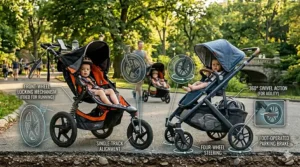
The lockable front wheel isn’t optional—it’s the single most critical safety feature differentiating jogging from regular strollers. When unlocked, the swivel function allows easy navigation at walking speeds. But at running pace, that same swivel creates dangerous instability. The wheel must lock into forward-facing position before every run. Look for locks that engage positively with an audible click, not friction-based systems that can slip loose mid-run.
2. Five-Point Harness System
All quality strollers include five-point harnesses (over shoulders, around hips, between legs), but jogging models need extra security. The shoulder straps should adjust without re-threading, and the buckle mechanism must be single-action for parent use but impossible for toddlers to release. Magnetic buckles (like on the Thule Urban Glide 3) simplify one-handed operation while maintaining security.
3. Wrist Strap Tether
If you stumble while running, this simple strap prevents the stroller from rolling away downhill or into traffic. It’s a $5 component that could prevent tragedy. Every jogging stroller should include one; verify it’s rated for the stroller’s loaded weight (child + cargo). Attach it to your wrist before every run, not to the handlebar where it provides zero protection.
4. Hand Brake (Premium Feature)
Not all jogging strollers include hand brakes, but if you run on hills, this upgrade becomes essential. Foot brakes work fine for stopping, but controlling speed on long descents while maintaining running form requires hand operation. The Thule’s integrated twist brake allows gradual deceleration without jerky stops that wake sleeping babies or throw off your stride.
5. Pneumatic Tires with Proper Inflation
Under-inflated tires reduce stability and increase rolling resistance, making pushing harder and handling less predictable. Check manufacturer specifications (usually 25-35 PSI depending on model) and inspect tire pressure before each run. Keep a bicycle pump handy—this maintenance takes 60 seconds but dramatically affects safety and performance.
Jogging Stroller Worth It? Long-Term Value Analysis
Let’s break down the real cost per use over a typical jogging stroller lifespan. Assume you purchase a mid-range model like the BOB Revolution Flex 3.0 for $450, use it regularly from when your child is 8 months until 4 years old (approximately 42 months), running 3 times weekly. That’s roughly 540 runs total.
Cost per run: $450 ÷ 540 = $0.83 per use
Now compare that to gym childcare at typical rates ($5-$8 per hour) for the same 540 sessions: $2,700-$4,320 over the same period. The jogging stroller pays for itself after just 60-90 gym visits, breaking even within the first year for regular runners. Beyond the financial math, there’s the intangible value of exercising with your child versus separation—many parents find the bonding time irreplaceable.
For casual runners (1 time weekly or less), the math shifts. At 50 annual uses across 3.5 years, you’re looking at 175 total uses at $2.57 each—still reasonable, but only if you’ll actually use it. Storage footprint becomes a larger consideration when the stroller sits idle most weeks. In this scenario, consider budget options like the Baby Trend Expedition ($130-$160) that minimize upfront investment if running becomes sporadic.
The resale market for quality jogging strollers remains strong—well-maintained BOB and Thule models commonly sell for 50-60% of original price after several years of use, recouping significant investment. Regular strollers depreciate faster due to higher replacement rates and less brand loyalty.
When to Use Jogging Stroller vs Regular Stroller
Use Jogging Stroller For:
🏃♂️ Running & Fitness: Obviously the primary use case—any activity where you’re moving faster than brisk walking pace
🥾 Trail & Hiking: The large pneumatic tires and suspension handle roots, rocks, and uneven terrain that regular strollers can’t
🌳 Parks & Nature: Even casual walks on gravel paths benefit from the smoother ride quality
❄️ Winter/Snow: The larger wheels provide better traction and don’t sink into slush like small plastic wheels
Use Regular Stroller For:
🛒 Shopping & Errands: Tighter turning radius and lighter weight make stores and malls significantly easier
✈️ Travel: Compact fold and lighter weight simplify airport navigation and car trunk storage
🚇 Public Transportation: Regular strollers fold smaller and weigh less for subway stairs and bus boarding
🏙️ Urban Navigation: Narrower profile fits crowded sidewalks and tight restaurant spaces better
Universal Truth:
Neither stroller type serves all situations perfectly. Many active families eventually own both—a jogging stroller for fitness and trail activities, a lightweight regular stroller for daily errands. If budget allows only one purchase, choose based on your most frequent use case, not aspirational activities. The $500 jogging stroller gathering dust while you struggle loading a 30-pound behemoth into your sedan for grocery runs represents poor resource allocation.
Common Mistakes When Choosing Between Jogging and Regular Strollers
Mistake #1: Buying a Jogging Stroller Before Your Baby Is Ready
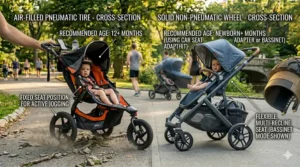
The AAP recommends waiting until babies are 6-8 months old with full head and neck control before jogging. Yet parents frequently purchase jogging strollers immediately after birth, then feel pressured to “get their money’s worth” by using them prematurely. Even with car seat adapters, the bouncing motion of running can stress developing neck muscles. Save the jogging for when it’s developmentally appropriate—use a regular stroller or baby carrier for the first 6 months.
Mistake #2: Assuming “All-Terrain” Means “Jogging-Capable”
Marketing terminology confuses parents constantly. Strollers labeled “all-terrain” often have larger wheels than standard models but lack the engineering for actual running. The Thule Urban Glide 3 situation exemplifies this—excellent all-terrain stroller, but regulatory disclaimers create confusion about jogging suitability. Always verify three-wheel configuration, front wheel lock, and manufacturer jogging approval before assuming capability.
Mistake #3: Prioritizing Features Over Actual Use Patterns
That reversible seat and bassinet attachment look incredible in the showroom, but if you’ll actually use the stroller primarily for running, those features become expensive dead weight. Similarly, buying the lightest possible regular stroller sounds smart until you realize your neighborhood’s cracked sidewalks create a miserable ride without suspension. List your top 3 actual use cases and choose features that serve those scenarios, not theoretical situations.
Mistake #4: Ignoring Folded Storage Dimensions
Stroller specifications list folded dimensions in fine print, but this measurement determines whether the stroller lives in your car trunk or forces you to remove it after every outing. Measure your trunk space before purchasing—many jogging strollers won’t fit in sedan trunks even when folded. If you’re parking in a garage or have dedicated closet space, this matters less. If the stroller needs car storage, those extra 4 inches in length can be deal-breakers.
Mistake #5: Buying Based on Resale Value Instead of Fit
Premium brands like BOB and UPPAbaby maintain strong resale markets, leading some parents to buy them primarily as future flip opportunities. This logic fails if the stroller doesn’t match your lifestyle during ownership—using a bulky jogging stroller for daily errands because “it holds value” creates years of frustration. Choose based on present needs, and treat resale value as a bonus, not a primary selection criterion.
Difference Between Jogging and Regular Stroller: Technical Deep Dive
Wheel Configuration Science
Three-wheel jogging strollers aren’t just trendy—they’re physics. The triangular footprint creates inherent stability when the front wheel locks forward. Four-wheel regular strollers gain maneuverability from the rectangular wheelbase but sacrifice high-speed stability. When you’re running, lateral forces during turns would flip a regular stroller. The jogging stroller’s wider rear track (often 24+ inches between wheels) prevents this.
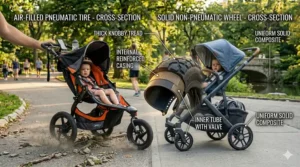
Wheel size matters exponentially. A 16-inch pneumatic tire contacts more ground surface area than an 8-inch plastic wheel, distributing impact forces across larger patches and reducing vibration transfer. The larger diameter also rolls over obstacles—think cracks, sticks, curbs—that smaller wheels collide with or get stuck in. This is why jogging strollers can handle trail running while regular strollers struggle with shopping cart ramps.
Suspension System Engineering
Premium jogging strollers use spring-loaded or elastomer suspension at the rear axle, similar to mountain bikes. When you hit a bump, the suspension compresses, absorbing impact before it reaches the frame and child seat. Regular strollers typically have no suspension or minimal padding—acceptable at 2 mph walking pace but uncomfortable at 6-7 mph running pace. The difference isn’t subtle; it’s the distinction between a smooth Lexus ride and a jarring truck bed.
Frame Geometry & Materials
Jogging stroller frames use aluminum or steel tubing with triangulated bracing—the same structural principles as bicycle frames. This creates rigidity that prevents flexing under running loads while minimizing weight. Regular stroller frames prioritize fold compactness, often using plastic joints and thinner tubes that would fatigue under repetitive running stresses. You can literally see regular stroller frames flex side-to-side when pushed hard; jogging frames don’t budge.
Weight Distribution
Jogging strollers position the child’s weight low and centered between the large rear wheels. Regular strollers place children higher (easier loading/unloading) and further back (better trunk access). High center of gravity becomes dangerous at speed—tip-over risk increases exponentially. The low-slung jogging design feels “planted” during fast cornering in ways regular strollers never achieve.
Maintenance & Long-Term Ownership Differences
Jogging Stroller Maintenance Requirements
Monthly Tasks:
🔧 Check tire pressure (25-35 PSI typical)—underinflation increases pushing effort by 30% and accelerates tire wear
🔧 Inspect wheel bearings for smooth spinning—gritty feeling indicates bearing replacement needed
🔧 Verify front wheel lock engages fully—partial lock can disengage mid-run
Seasonal Tasks:
🔧 Deep clean fabric with mild soap (sweat and dirt accumulation)
🔧 Lubricate moving joints and fold hinges with silicone spray
🔧 Tighten all frame bolts—vibration loosens connections over time
Common Replacement Parts (2-3 years heavy use):
🔧 Tires/tubes (punctures from thorns, glass; tread wear from pavement)
🔧 Wheel bearings (300-500 miles of running typical lifespan)
🔧 Brake pads if hand-brake equipped
Regular Stroller Maintenance Requirements
Monthly Tasks:
🔧 Wipe down frame and fabric (food spills, dirt)
🔧 Check harness buckle operation
🔧 Test brake engagement on both wheels
Seasonal Tasks:
🔧 Machine wash fabric components (most modern strollers have removable fabric)
🔧 Inspect plastic wheels for cracks
🔧 Verify fold mechanism operates smoothly
Common Issues (2-3 years):
🔧 Worn fabric (less durable than jogging stroller materials)
🔧 Jammed fold mechanisms (plastic components fatigue)
🔧 Wobbly wheels (plastic bearings wear faster than steel)
The maintenance difference reflects use intensity. Jogging strollers endure mechanical stresses similar to bicycles—regular bearing replacement and tire maintenance are expected. Regular strollers face different wear patterns: more fold cycles, more food debris, more indoor/outdoor transitions. Budget more time for jogging stroller mechanical upkeep, more time for regular stroller cleaning.
FAQ: Your Jogging vs Regular Stroller Questions Answered
❓ How fast can you run with a jogging stroller safely?
❓ Can you use a jogging stroller as an everyday stroller?
❓ What age baby can ride in jogging stroller for running?
❓ Are jogging stroller wheels interchangeable with regular stroller wheels?
❓ Do double jogging strollers handle differently than single models?
Conclusion: Making Your Final Decision
The jogging stroller vs regular stroller debate ultimately resolves through honest lifestyle assessment. If running represents genuine commitment—not just aspiration—and you’ll use the stroller 2+ times weekly for fitness activities, invest in quality jogging equipment like the BOB Revolution Flex 3.0 or Thule Urban Glide 3. The specialized engineering justifies the premium, and the safety features become non-negotiable at running speeds. Your child’s developing neck and spine deserve proper impact absorption that only true jogging strollers provide.
For urban families prioritizing daily convenience, public transportation, and errand efficiency, regular strollers like the Mockingbird Single-to-Double 3.0 or UPPAbaby Vista V2 deliver superior everyday performance. The lighter weight, more compact fold, and better maneuverability in stores create smoother daily routines that jogging strollers can’t match. Don’t force yourself into bulky specialized equipment based on theoretical fitness goals—choose tools that serve your actual life.
The financially savvy approach? Budget options like the Baby Trend Expedition Jogger ($130-$160) let you test running commitment without major investment. If jogging becomes habit, upgrade later with your regular stroller as backup for errands. If running fades, you haven’t sunk $500 into garage-dwelling equipment. Many active families eventually own both stroller types, using each for its engineered purpose rather than forcing compromise. That’s not wasteful—it’s recognizing that different tools solve different problems, and trying to make one stroller serve all roles typically leaves you frustrated with all activities.
Start with your most frequent use case: If that’s running or trail hiking, buy the jogging stroller first. If it’s shopping and urban navigation, buy the regular stroller. Let actual usage patterns—not marketing or peer pressure—guide your decision. The right stroller disappears into your routine as a reliable tool; the wrong one becomes a daily frustration you resent pushing. Choose wisely, and your stroller becomes the enabler of adventures rather than an obstacle to overcome.
Recommended for You
- 7 Best Jogging Strollers for Active Parents (2026 Guide)
- 7 Best Wagon Stroller Safety Features You Need in 2026
- 7 Best Luxury Wagon Strollers 2026
Disclaimer: This article contains affiliate links. As an Amazon Associate, I earn from qualifying purchases. If you purchase products through these links, we may earn a small commission at no additional cost to you.
✨ Found this helpful? Share it with your friends! 💬🤗
