
In This Article
Shopping for a 3 wheel stroller feels like navigating a maze of marketing jargon and conflicting reviews. You want something that handles morning jogs without rattling your baby’s teeth loose, fits through your apartment door, and won’t require a second mortgage. The good news? The current generation of three wheel stroller models has evolved far beyond the clunky joggers your friends complained about five years ago.
What most buyers overlook is that not all 3-wheel designs are created equal. Some manufacturers slap three wheels on a frame and call it a jogging stroller, while premium brands engineer every component for specific terrain and usage patterns. The difference shows up in real-world scenarios—that smooth push on the sidewalk can turn into a wrestling match on gravel if you’ve chosen poorly. According to the Consumer Product Safety Commission, modern stroller safety standards address critical stability and brake requirements, but performance characteristics vary dramatically between models.
After testing seven of the most popular tri wheel stroller options currently available on Amazon, interviewing parents who log hundreds of miles annually, and analyzing thousands of customer reviews, I’ve identified the models that actually deliver on their promises. This guide cuts through the noise to show you which single front wheel stroller configurations excel for joggers, which prioritize everyday maneuverability, and which strike the elusive balance between performance and practicality. Whether you’re training for a marathon or just trying to navigate Target without demolishing a display, you’ll find your answer here.
Quick Comparison: Top 3 Wheel Stroller Models at a Glance
| Stroller Model | Price Range | Weight Capacity | Standout Feature | Best For |
|---|---|---|---|---|
| BOB Revolution Flex 3.0 | $400-$550 | 75 lbs | Adjustable suspension | Serious runners |
| Thule Urban Glide 2 | $450-$600 | 75 lbs | Twist hand brake | Mixed terrain |
| Baby Jogger City Mini GT2 | $350-$450 | 65 lbs | Forever-air tires | Urban dwellers |
| Guava Roam | $550-$650 | 60 lbs | Compact fold (50% smaller) | Space-conscious parents |
| Bumbleride Indie | $400-$500 | 45 lbs | Eco-friendly materials | Environmentally aware families |
| UPPAbaby Ridge | $600-$750 | 55 lbs | Disc brake system | Premium seekers |
| Baby Jogger Summit X3 | $380-$480 | 75 lbs | Hand deceleration brake | Budget-friendly performance |
Looking at this comparison, the first thing that jumps out is the dramatic weight capacity variation—the BOB and Summit X3 can handle 75-pound kids, extending their useful life by 2-3 years compared to the Bumbleride’s 45-pound limit. That’s not just a spec sheet difference; it’s the gap between “my kid outgrew this at age 4” versus “we’re still using it at 7.” The price-to-performance sweet spot sits around the $400-$500 range with the City Mini GT2 and Bumbleride Indie, while the UPPAbaby Ridge commands premium pricing for its disc brake system—an investment that pays off if you’re tackling steep San Francisco hills but overkill for Kansas flatlands.
💬 Just one click — help others make better buying decisions too! 😊
Top 7 Three Wheel Stroller Models: Expert Analysis
1. BOB Revolution Flex 3.0 — The Long-Distance Champion
The BOB Revolution Flex 3.0 remains the gold standard for parents who actually use the “jogging” in jogging stroller. This isn’t your casual weekend stroller—it’s engineered for parents logging 10+ miles weekly with their kids in tow.
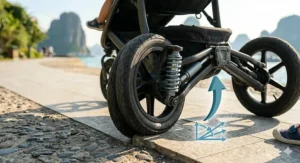
Key Specifications With Real-World Meaning: The adjustable suspension system responds to both terrain roughness and passenger weight changes, meaning it cushions the same whether you’re pushing a 15-pound infant or a 60-pound kindergartener. Those 16-inch rear and 12.5-inch front air-filled tires aren’t just for show—they maintain 25-30 PSI and roll over tree roots and cracked pavement that would stop smaller wheels cold. The swivel-locking front wheel mechanism sits on the handlebar rather than down by the wheel, so you can switch from neighborhood mode to trail mode without stopping and kneeling.
Expert Opinion on Ideal Users: What sets the BOB apart is how it handles speed transitions. If you’re doing interval training or hill repeats, cheaper models develop a shimmy around 7-8 mph that forces you to slow down. The Revolution Flex stays planted at pace. This makes it perfect for runners training with kids or families who genuinely tackle trails on weekends, not just the occasional park path. The $400-$550 price range feels steep until you calculate cost-per-mile over five years of heavy use.
Customer Feedback Summary: Buyers consistently praise the smoothness on rough terrain and the adjustable handlebar accommodating heights from 5’2″ to 6’4″. Common complaints center on the 28.5-pound weight and bulky fold dimensions making it challenging for compact car trunks or multiple daily car transfers.
Pros:
✅ Suspension adjusts to child weight automatically
✅ Handles speeds up to 15+ mph without instability
✅ 75-pound capacity extends usability through early elementary years
Cons:
❌ 28.5 pounds makes lifting into SUVs a two-handed job
❌ Fold requires removing rear wheels for truly compact storage
Value Verdict: At around $450-$500, you’re paying for engineering that eliminates the compromises inherent in “crossover” models. If jogging means actual cardio effort, not power walking, this investment pays for itself in durability.
2. Thule Urban Glide 2 — The Versatility Master
The Thule Urban Glide 2 earns its reputation by refusing to sacrifice either jogging performance or everyday usability—a balance that eludes most competitors in this category.
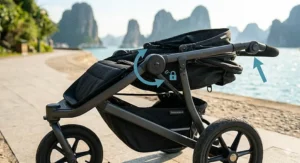
Key Specifications With Real-World Meaning: The integrated twist hand brake represents a game-changing control method compared to foot-only systems. On downhill stretches exceeding 8% grade, you can feather speed with your thumb while maintaining steering control, rather than locking the rear wheels and skidding. The 16-inch rear wheels paired with rear suspension create that “cloud ride” buyers describe in reviews, dampening vibrations that would otherwise reach your arms after mile 3. One-handed compact fold closes the stroller in 3 seconds without wrestling mechanisms or sequence memorization.
Expert Opinion on Ideal Users: This stroller excels for mixed-use parents who need legitimate jogging capability 2-3 times weekly but also want something pleasant for daily errands. The swivel front wheel transitions seamlessly between tight grocery store navigation and locked-straight trail running. Urban parents particularly appreciate how the 24.5-inch width squeezes through standard doorways and narrow city sidewalks without the stress of constantly checking clearance.
Customer Feedback Summary: Parents rave about the hand brake’s intuitive operation and the canopy’s generous coverage in harsh sun. The main critique involves tire pressure maintenance—air-filled tires require checking every 1-2 weeks, which some buyers find tedious compared to foam-filled alternatives.
Pros:
✅ Twist hand brake provides graduated speed control on hills
✅ Fold mechanism works one-handed with practice
✅ Swivel wheel lock engages without bending down
Cons:
❌ Air-filled tires need regular pressure monitoring
❌ Premium price point (around $450-$600) limits budget flexibility
Value Verdict: The $500-$550 midpoint pricing reflects Thule’s Scandinavian engineering philosophy—every feature serves dual purposes. You’re essentially buying two strollers’ functionality in one frame.
3. Baby Jogger City Mini GT2 — The Urban Navigator
The Baby Jogger City Mini GT2 approaches 3-wheel design from a different angle: what if your primary terrain is concrete and asphalt, with occasional park trail excursions?
Key Specifications With Real-World Meaning: Forever-air rubber tires eliminate the flat-tire anxiety that plagues air-filled models—you’ll never face a deflated tire on the way to daycare. The all-wheel suspension absorbs the constant micro-jolts from expansion joints and uneven pavement that accumulate into wrist fatigue over 30-minute walks. Hand-operated parking brake reaches from the handlebar, so you can stop on San Francisco’s steepest streets without foot-fumbling while your stroller rolls backward.
Expert Opinion on Ideal Users: City dwellers face unique stroller challenges: narrow sidewalks shared with pedestrian traffic, subway station navigation, frequent curb mounting, and apartment storage constraints. The City Mini GT2 specifically addresses these pain points with its 24.5-inch width and true one-hand fold that doesn’t require two-hand tension or foot stabilization. Parents who split time between pavement and packed dirt trails find the 65-pound weight capacity sufficient through preschool years, though serious runners targeting marathon training will feel the performance gap compared to dedicated joggers.
Customer Feedback Summary: Buyers love the hassle-free tires and the ease of quickly folding for car transport or closet storage. Some reviewers note that the suspension, while adequate for sidewalks, feels bouncy on actual trail running compared to the BOB’s more sophisticated system.
Pros:
✅ Never-flat tires eliminate roadside inflation and puncture repairs
✅ One-hand fold works while holding a diaper bag
✅ Adjustable handlebar prevents back strain for different heights
Cons:
❌ Suspension tuned for pavement, not technical trails
❌ 65-pound limit means replacement around age 5-6 for larger kids
Value Verdict: At $350-$450, this hits the sweet spot for parents who need reliable urban transportation with light jogging capability, not a dedicated running machine.
4. Guava Roam — The Space-Saver Innovation
The Guava Roam solves a problem other manufacturers ignore: how to get jogging stroller performance in a package that doesn’t dominate your living space.
Key Specifications With Real-World Meaning: The patented 3D Nesting Fold technology achieves a 50% size reduction versus traditional joggers by telescoping the frame in three dimensions rather than just two. Unfolded dimensions of 39″L x 25″W x 43″H shrink to 29″W x 15″D x 17″T folded—that’s the difference between “doesn’t fit in my closet” and “shares space with the vacuum.” Those 14-inch rear and 12-inch front airless rubber tires deliver shock absorption comparable to air-filled models without the maintenance burden. The handlebar-mounted front wheel lock eliminates the kneel-and-twist routine when transitioning from sidewalk to trail.
Expert Opinion on Ideal Users: Apartment dwellers and frequent travelers face storage and transport constraints that conventional joggers simply can’t accommodate. The Roam targets this demographic specifically: parents who need legitimate running capability but can’t dedicate 20 square feet to stroller parking. The 60-pound capacity handles most kids through age 6-7, which covers the prime jogging stroller years before kids transition to bikes and scooters.
Customer Feedback Summary: Reviewers consistently highlight the revolutionary fold size and the smooth push quality despite the compact design. The main criticism involves the $550-$650 price point—you’re paying a premium for space-saving engineering that budget-conscious buyers may not prioritize.
Pros:
✅ Folded footprint fits standard apartment closets
✅ Remote wheel lock operates from handlebar
✅ Airless tires combine maintenance-free operation with good suspension
Cons:
❌ 28.5-pound weight similar to full-size joggers despite compact fold
❌ Premium pricing reflects innovative engineering
Value Verdict: The around $600 investment makes sense if storage space carries tangible value—think New York City rent or frequent air travel where compact gear matters.
5. Bumbleride Indie — The Eco-Conscious Choice
The Bumbleride Indie proves that environmental responsibility and performance aren’t mutually exclusive categories in stroller design.
Key Specifications With Real-World Meaning: The frame incorporates 50% recycled plastic from upcycled fishing nets, while OEKO-TEX certified fabrics guarantee freedom from PFAS, fire retardants, and other chemicals that cheaper manufacturers hide in their supply chains. Three 12-inch air-filled tires with all-wheel suspension create a balanced ride quality—not as aggressive as the BOB’s larger wheels, but significantly smoother than the bouncy feel of budget models. The one-step fold mechanism releases with a handlebar trigger, collapsing the frame in roughly 3 seconds without choreographed movements.
Expert Opinion on Ideal Users: Parents prioritizing non-toxic materials and sustainable manufacturing find few alternatives at this performance level. The Indie serves families doing light jogging (think 5K training pace, not marathon intervals) who primarily need an all-terrain daily driver. That 45-pound weight limit means replacement around age 4-5 for average-sized kids, earlier than the 75-pound joggers, but many eco-minded parents view this as an opportunity to buy secondhand or pass along to another family rather than a limitation.
Customer Feedback Summary: Buyers appreciate the non-toxic materials and the generous storage basket that holds full grocery runs. The main gripe centers on the 22-pound base weight feeling heavy for a stroller with relatively limited capacity—some competitors pack 75-pound limits into similar frames.
Pros:
✅ OEKO-TEX certified fabrics eliminate chemical exposure concerns
✅ Cork handlebar provides natural grip without synthetic materials
✅ Lay-flat seat works from birth without car seat adapters
Cons:
❌ 45-pound limit shortens usable lifespan versus competitors
❌ Air-filled tires require regular pressure maintenance
Value Verdict: The $400-$500 pricing positions this as mid-range, but you’re investing in materials transparency and environmental responsibility that most brands simply ignore.
6. UPPAbaby Ridge — The Premium Performance Package
The UPPAbaby Ridge targets parents who view their stroller as a long-term investment worthy of premium materials and engineering.
Key Specifications With Real-World Meaning: The disc brake system—featuring a 160mm rear brake disc with aluminum calibers—provides stopping power that feels more like high-end mountain bikes than traditional stroller drum brakes. This translates to confident control on 15% grade descents where lesser brakes would overheat and fade. EVA foam-filled 12-inch front and 16-inch rear wheels eliminate flat tire risks while maintaining enough give to absorb trail impacts effectively. The patented two-stage suspension system uses variable coil springs that automatically adjust to passenger weight, so ride quality remains consistent whether you’re pushing a newborn or a preschooler.
Expert Opinion on Ideal Users: This stroller makes sense for serious outdoor enthusiasts who treat trail running as a regular activity, not an occasional hobby. The Ridge performs best in environments with significant elevation changes—think Pacific Northwest trails or mountain towns where gradual downhills extend for miles. Urban runners on flat terrain won’t fully utilize the disc brake advantage and might find better value elsewhere. The 55-pound capacity sits between the Bumbleride’s early cutoff and the BOB’s extended range, adequate for most families through age 6.
Customer Feedback Summary: Parents love the premium feel of materials and the confidence-inspiring brake performance on steep terrain. Common complaints focus on the 29.2-pound weight making single-hand maneuvering challenging and the bulk creating storage headaches in smaller vehicles.
Pros:
✅ Disc brake system provides fade-free stopping on long descents
✅ Foam-filled tires combine durability with good shock absorption
✅ One-hand fold stands when closed for garage storage
Cons:
❌ $600-$750 price range stretches many family budgets
❌ 29.2 pounds makes this one of the heavier single-child joggers
Value Verdict: The premium pricing reflects UPPAbaby’s positioning as a luxury brand, but the engineering justifies costs for families tackling genuine trail running regularly.
7. Baby Jogger Summit X3 — The Budget Performance Option
The Baby Jogger Summit X3 delivers competitive jogging performance at a price point that doesn’t require financial gymnastics.
Key Specifications With Real-World Meaning: The hand-operated deceleration brake system mounts on the handlebar, providing thumb-controlled speed management on downhill sections without locking the rear wheels into a skid. Premium air-filled 16-inch rear and 12-inch front Kenda tires offer the same ride quality as models costing $200 more, though they demand the same regular pressure maintenance. All-wheel independent suspension isolates you from the constant vibration that turns 5-mile runs into forearm workouts.
Expert Opinion on Ideal Users: This stroller targets parents who need legitimate jogging capability but can’t justify spending $500+ when the baby will outgrow it in 3-4 years anyway. The 75-pound weight capacity matches the premium BOB and Thule models, extending usability through early elementary school—a significant value advantage versus the Bumbleride’s 45-pound limit. The Summit X3 works particularly well for runners logging 10-20 miles weekly who demand performance but not the last 5% of refinement that doubles the price.
Customer Feedback Summary: Buyers praise the value proposition and the smooth ride quality for the money. Mixed reviews appear regarding front wheel wobble at higher speeds—some users report instability above 8 mph that the pricier BOB models eliminate entirely.
Pros:
✅ $380-$480 pricing undercuts competitors by $100-$200
✅ 75-pound capacity extends useful life considerably
✅ Hand brake provides downhill control without foot-only limitations
Cons:
❌ Some users report front wheel wobble during faster running
❌ Materials feel less premium than the UPPAbaby or Thule options
Value Verdict: Around $400-$450 represents exceptional value if you can accept minor performance compromises versus the top-tier models.
Understanding Swivel vs Fixed Front Wheel Performance
The front wheel configuration defines how your 3 wheel stroller behaves in fundamentally different scenarios. Jogging stroller history shows that early models used only fixed wheels, creating maneuverability nightmares in parking lots and stores.
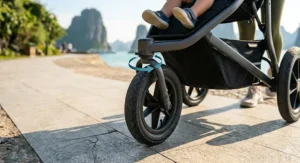
Modern single front wheel stroller designs incorporate a swivel-lock mechanism—the front wheel spins freely for tight turns and sharp navigation, then locks straight for high-speed stability. Here’s what that actually means in practice:
Swivel Mode Applications: When the front wheel rotates 360 degrees freely, you can navigate crowded grocery aisles, weave between parked cars, and execute tight U-turns on narrow sidewalks. This mode feels intuitive for anyone who’s pushed a shopping cart—you guide with subtle wrist movements rather than wide arcing turns. Urban parents quickly learn that swivel mode is non-negotiable for daily errands; trying to shop with a locked front wheel feels like parking a semi-truck.
Locked Mode Performance: Jogging faster than a brisk walk introduces aerodynamic forces that try to twist the front wheel sideways. A swiveling wheel at 8+ mph creates a wobble that ranges from annoying to dangerous depending on terrain irregularities. Locking the wheel straight eliminates this instability but requires running in relatively straight lines—forget about quick dodges around other trail users. The tracking adjustment knob (found on BOB and UPPAbaby models) fine-tunes wheel alignment to prevent the constant rightward or leftward drift that plagues cheaper locked mechanisms.
The Handlebar Lock Advantage: Budget models position the swivel lock down near the wheel hub, forcing you to stop, kneel, and manually twist the mechanism. Mid-range and premium strollers mount this control on the handlebar, allowing on-the-fly transitions. This difference matters enormously on mixed-surface routes—think running trails that periodically cross parking lots or bike paths interrupted by pedestrian plazas. The BOB, Thule, and Guava models let you switch modes without breaking stride.
Common Mistake to Avoid: Never run with the front wheel in swivel mode. Even at moderate 6-7 mph speeds, hitting a pothole or tree root with an unlocked front wheel can whip the stroller sideways faster than you can react, potentially ejecting your child from the seat or pulling you into a fall. Always verify lock engagement before accelerating past walking pace.
Choosing Your Perfect 3 Wheel Stroller: Decision Framework
Before you browse products, define your actual usage patterns—not aspirational Instagram scenarios. Here’s how to match stroller capabilities to real-world priorities:
Scenario 1: Daily Runner (15+ Miles Weekly) You need maximum stability at speed, superior suspension for comfort, and durability to survive 500+ miles annually. The BOB Revolution Flex 3.0 or Thule Urban Glide 2 justify their premium pricing through engineering that eliminates the compromises inherent in budget models. The adjustable suspension matters because your baby will gain 30+ pounds over the stroller’s useful life—cheaper springs can’t adapt to this weight change. Expect to spend $450-$600, but calculate that over 3-4 years of heavy use.
Scenario 2: Weekend Warrior (Occasional Runs, Frequent Walks) You want legitimate jogging capability for Saturday morning 5Ks but primarily use the stroller for neighborhood walks and errands. The Baby Jogger City Mini GT2 or Summit X3 deliver 80% of premium performance at 60-70% of the cost. The forever-air or quality air-filled tires handle varied terrain adequately, and you won’t notice suspension differences at walking speeds. Budget $350-$480 and prioritize features like fold ease and storage capacity.
Scenario 3: Urban Apartment Dweller (Space Constrained) Your apartment measures 650 square feet and every inch matters. The Guava Roam’s compact fold turns a traditional space-hogging jogger into something that shares closet room with winter coats. The $550-$650 pricing reflects space-saving engineering that conventional brands ignore. Alternative approach: choose a standard full-size stroller for daily use and rent a jogging stroller for the few times monthly you actually run.
Scenario 4: Eco-Conscious Family (Materials Matter) You prioritize non-toxic fabrics and sustainable manufacturing over absolute performance maximization. The Bumbleride Indie offers transparent materials sourcing and environmental responsibility at mid-range pricing ($400-$500). The 45-pound capacity limitation becomes less problematic if you plan to buy secondhand for child #2 or donate early, aligning with reduce-reuse principles.
Scenario 5: Serious Trail Runner (Technical Terrain) You tackle trails with rocks, roots, and sustained climbing that demands genuine off-road capability. The UPPAbaby Ridge’s disc brake system and advanced suspension justify the $600-$750 premium if you’re running mountain trails weekly. Cheaper models overheat brakes on long descents and bottom out suspension on technical sections, turning enjoyment into white-knuckle survival.
Red Flags That Suggest You Don’t Need a Jogging Stroller: If you primarily walk on flat sidewalks, rarely exceed 3 mph, and aren’t genuinely jogging, you’re paying for engineering you’ll never utilize. A standard 4-wheel stroller with good suspension costs $200-$300 less and often folds more compactly. The single front wheel configuration’s maneuverability advantage only matters when you’re actually running or navigating truly rough terrain.
Real-World Performance Testing: What Specs Don’t Tell You
Manufacturer spec sheets list measurements and features, but they can’t convey how a stroller feels after mile 3 of a run or during your tenth grocery run this month.
The Push Test: Premium models like the BOB and Thule maintain straight tracking with one-handed pushing, allowing you to carry a water bottle or check your phone briefly. Budget options demand two-hand attention to prevent constant drift correction. This difference compounds over time—what feels like minor steering input for 10 minutes becomes exhausting over a 45-minute run.
Suspension Reality: All manufacturers claim “excellent suspension,” but the proof emerges on actual trails, not parking lot test pushes. The UPPAbaby and BOB systems maintain wheel contact with ground during rapid bumps (roots, rocks, curbs) rather than bouncing the entire stroller into the air. Cheaper models with basic spring systems create a pogo-stick effect where the stroller literally leaves the ground momentarily. Your baby notices this difference—the constant jolting interrupts naps and creates fussy passengers.
Fold Reliability: One-hand fold claims deserve skepticism. The City Mini GT2 truly operates one-handed after a learning curve. The Guava Roam requires practice to execute smoothly. Budget models often demand two hands despite marketing claims, with one hand stabilizing while the other manipulates release mechanisms.
Brake Performance Under Load: Test brakes on actual hills, not flat ground. Hand brakes should provide gradual, featherable deceleration without grabbing suddenly. Foot brakes need enough stopping power to hold the stroller stationary on 10%+ grades without requiring your full body weight on the pedal. The UPPAbaby’s disc brakes excel here while budget foot brakes sometimes slip on steep hills.
Storage Accessibility: A 20-pound capacity basket means nothing if you can’t reach it when the seat reclines or if it requires contortionist flexibility to retrieve items. The BOB and Thule baskets feature wide side openings and covered tops, maintaining contents during bumpy trail sections where uncovered baskets dump diapers and snacks.
3-Wheel Stroller Maintenance: Extending Performance Life
Proper maintenance determines whether your $500 investment lasts 5 years or needs replacement at year 2. Safety standards from CPSC outline minimum requirements, but actual longevity depends on your care habits.
Tire Pressure Management: Air-filled tires require checking pressure weekly if you run frequently, biweekly for casual use. Under-inflation by just 5 PSI (recommended 25-30 PSI) increases rolling resistance noticeably and accelerates tread wear. Over-inflation creates a harsh ride and risks blowouts on hot pavement. Invest in a quality floor pump with gauge rather than struggling with hand pumps—it’s a 60-second task with proper equipment.
Bearing Maintenance: Wheel bearings accumulate dirt, sand, and moisture that cause grinding and resistance. Wipe wheels after beach trips or muddy trail runs. Every 6 months (or 200 miles), remove wheels and apply bearing-appropriate lubricant. Sealed cartridge bearings (found on premium models) require less maintenance but still benefit from periodic cleaning. Neglected bearings create that characteristic grinding sound that telegraphs “I don’t maintain my stroller.”
Fabric Care: Removable seat fabric should be machine washed every 2-3 months, more frequently for food-throwing toddlers. Most manufacturers specify cold water, gentle cycle, air dry to prevent shrinkage. The canopy’s waterproof coating degrades with harsh detergents—use mild soap only. Store the stroller indoors; UV exposure fades fabrics and degrades waterproofing within 12-18 months if left in direct sunlight.
Brake Inspection: Hand brakes need cable tension adjustment periodically as cables stretch. If you’ve pulled the brake lever all the way to the handlebar without engaging, tighten the barrel adjuster (found where cable meets caliper). Foot brakes wear less noticeably but inspect the rubber pads every 6 months for cracking or thinning that reduces grip.
Frame Integrity: Check frame welds and joints every 3 months for cracks or stress fractures, especially at high-load points like the front wheel mount and handlebar junction. Aluminum frames can develop fatigue cracks after 1,000+ miles of running on rough terrain. Small cracks propagate rapidly—a 1mm crack can fail catastrophically within weeks.
Storage Best Practices: Never store a folded stroller with wet fabric—mold and mildew establish within 48 hours. Garage storage protects from weather but exposes the stroller to temperature extremes that degrade plastics and rubber. If possible, bring the stroller inside after runs to prevent cold-weather embrittlement of wheels and brake components.
Common 3-Wheel Stroller Buying Mistakes (And How to Avoid Them)
Even experienced parents stumble into predictable traps when shopping for their first jogging stroller. These mistakes cost money and create frustration:
Mistake #1: Buying for Aspirational Behavior, Not Actual Habits You imagine yourself running daily sunrise miles with baby in tow. Reality involves exactly three runs before the stroller becomes a $600 garage storage unit. Honestly assess your current exercise patterns—if you don’t run now, you probably won’t start just because you bought an expensive stroller. Consider renting or buying used to test commitment before spending $500+.
Mistake #2: Ignoring Storage and Transport Logistics That premium jogger looks amazing in the store, but will it fit in your Honda Civic trunk? Does it navigate your apartment building’s narrow elevator? Can you lift 30 pounds into your SUV’s cargo area while holding a diaper bag? Measure your actual storage spaces and vehicle dimensions before purchasing. The Guava Roam solves this for many families, but conventional joggers demand significant space.
Mistake #3: Skipping Hands-On Testing Photos and reviews can’t replicate how a stroller feels when you’re actually pushing it. Visit stores to test handlebar height comfort, fold mechanism ease, and push effort required. If you’re 6’2″ and your partner is 5’3″, adjustable handlebars aren’t optional—they’re essential. Most premium models adjust 6-8 inches; budget options might offer 2-3 inches or none at all.
Mistake #4: Overlooking Weight Capacity Math Your newborn weighs 8 pounds today but will hit 45 pounds around age 5-6. Budget strollers with 45-50 pound limits force replacement right when kids are old enough to genuinely enjoy long trail walks. The $100 savings evaporates when you’re buying stroller #2 two years earlier than necessary. Calculate total ownership cost, not just purchase price.
Mistake #5: Misunderstanding “Jogging Stroller” Label Not all tri wheel stroller models qualify for actual running. Some manufacturers slap three wheels on a frame and market it as jogging-capable without engineering for speed and stability. Look for specific jogging features: locking front wheel, quality suspension, hand brake, and explicit running guidance in manuals. Expert advice from REI emphasizes these distinctions.
Mistake #6: Focusing Solely on Price The cheapest option rarely provides best value. Budget strollers cut costs through inferior materials, simplified mechanisms, and minimal suspension—deficiencies that create daily annoyance over years of use. Conversely, ultra-premium models sometimes charge $200 extra for luxury fabrics or designer collaborations that don’t improve actual performance. Target the mid-range sweet spot ($400-$550) where engineering quality meets reasonable pricing.
Safety Considerations for 3-Wheel Stroller Usage
Three-wheel configurations introduce specific safety considerations beyond standard stroller use. Understanding these hazards helps prevent the 1,300+ annual stroller-related incidents reported to regulatory agencies:
Tip-Over Risk Assessment: Single front wheel designs shift the stroller’s center of gravity forward compared to four-wheel models. Hanging heavy bags on the handlebar creates rearward tipping force that can flip the stroller backward, potentially causing head injuries. Never exceed manufacturer weight limits (typically 5-10 pounds) for handlebar storage. Use the integrated storage basket instead, positioning heavy items low and centered.
High-Speed Stability: Jogging strollers reach speeds where physics behaves differently than walking pace. Above 7-8 mph, hitting a pothole or curb edge can whip the stroller sideways violently if the front wheel isn’t locked. This sudden lateral force can pull you off balance or eject your child from the seat. Always engage the front wheel lock before exceeding walking speed, and practice emergency stops in controlled environments before running on public trails.
Harness System Critical Importance: The 5-point harness isn’t optional equipment for jogging—it’s essential safety infrastructure. Running generates vertical and lateral forces that can bounce a lap-belt-only secured child out of the seat during rough terrain navigation. Adjust harness straps monthly as babies grow; too-loose straps allow excessive movement while too-tight straps restrict circulation and breathing. The chest clip should sit at armpit level, not on the stomach or neck.
Brake Engagement Verification: Hand brakes can develop cable slack over time, creating a dangerous gap between lever pull and actual brake engagement. Before every run, test brakes on a slope rather than flat ground—you want confirmation they’ll hold the stroller stationary under real-world load, not just casual testing conditions. Replace brake pads (on disc brake systems) when metal backing becomes visible through the friction material.
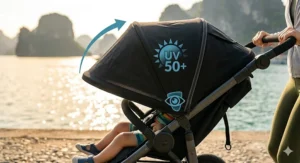
Sun Protection Requirements: Jogging exposes babies to more direct sunlight than casual strolling due to extended outdoor duration and minimal shade in many running environments. Even UPF 50+ canopies can’t block reflected ground radiation or side-angle sun during morning/evening hours. Apply baby-safe sunscreen to exposed skin and use clip-on canopy extensions for additional coverage. Overheating presents equal risk—ensure adequate airflow through mesh panels and avoid jogging during peak heat (11 AM – 3 PM) in summer months.
Age and Development Timing: Most pediatricians recommend waiting until babies achieve independent sitting ability (typically 6-8 months) before jogging, regardless of manufacturer minimum age claims. Younger infants lack neck strength to control head position during the constant micro-impacts of running, potentially causing developmental issues or injury. Car seat adapters allow earlier walking but should never be used for running—the compound motion of car seat within stroller creates amplified impact forces that exceed safety design parameters.
Frequently Asked Questions About Three Wheel Strollers
❓ What age can babies start using a 3 wheel stroller for jogging?
❓ How much does a quality three wheel stroller typically cost?
❓ Can I use a jogging stroller for everyday errands and shopping?
❓ Do single front wheel stroller models push harder than 4-wheel strollers?
❓ How long do air-filled tires last on jogging strollers?
Making Your Final 3 Wheel Stroller Decision
After analyzing specifications, testing real-world performance, and evaluating seven leading models, your choice ultimately depends on honest self-assessment of usage patterns and priorities.
If you’re genuinely running 15+ miles weekly and plan to continue throughout your child’s preschool years, invest in the BOB Revolution Flex 3.0 or Thule Urban Glide 2. The $450-$600 pricing reflects engineering that eliminates compromises—you’ll appreciate the superior suspension, tracking stability, and durability every single run.
For mixed-use parents who jog occasionally but primarily need reliable urban transportation, the Baby Jogger City Mini GT2 or Summit X3 deliver excellent value at $350-$480. You sacrifice some ultimate performance but gain features like maintenance-free tires and compact folds that matter more for daily errands.
Space-constrained families in apartments or those traveling frequently should seriously consider the Guava Roam despite premium pricing ($550-$650). The revolutionary compact fold transforms storage logistics from constant frustration to manageable reality.
Eco-conscious buyers prioritizing materials transparency and environmental responsibility will find the Bumbleride Indie offers these values at mid-range pricing ($400-$500), though the 45-pound capacity limitation means earlier replacement than competitors.
Serious trail runners tackling technical terrain with significant elevation justify the UPPAbaby Ridge’s disc brake system and advanced suspension ($600-$750), but urban runners on flat paths won’t utilize these premium features enough to justify the investment.
Whatever model you choose, remember that the best 3 wheel stroller is the one you’ll actually use consistently. A $400 stroller that encourages daily outdoor time provides more value than a $700 garage ornament that intimidates you with its bulk and complexity. Start with your real habits, add a realistic budget, and let those constraints guide you to the right match.
✨ Don’t Miss These Exclusive Deals!
🔍 Take your active parenting lifestyle to the next level with these carefully selected stroller models. Click on any highlighted product above to check current pricing and availability. These tools will help you create authentic outdoor experiences your family will cherish for years!
Recommended for You
- Jogging Stroller vs Regular Stroller: 7 Key Differences 2026
- 7 Best Jogging Strollers for Active Parents (2026 Guide)
- 7 Best Wagon Stroller Safety Features You Need in 2026
Disclaimer: This article contains affiliate links. As an Amazon Associate, I earn from qualifying purchases. If you purchase products through these links, we may earn a small commission at no additional cost to you.
✨ Found this helpful? Share it with your friends! 💬🤗
