
In This Article
So you’re scrolling through jogging stroller listings, watching your budget evaporate faster than your morning run calories. Here’s the thing nobody tells you: a cheap jogging stroller doesn’t mean you’re compromising on what actually matters. I’ve tested dozens of budget models, and the gap between a $150 stroller and a $500 one often boils down to brand name and a few bells and whistles you won’t miss on mile three when your toddler just spilled juice everywhere.
The best cheap jogging stroller options in 2026 deliver air-filled tires, lockable front wheels, and five-point harnesses—the trio that genuinely impacts your running experience. What you’re trading off at this price point is typically adjustable tracking (which sounds fancy until you realize most casual runners never touch it) and premium fabric that looks Instagram-ready but performs identically to budget materials. Baby strollers have evolved significantly over the decades, with jogging-specific models emerging in the 1980s to meet active parents’ needs. According to the American Academy of Pediatrics, the critical safety features for jogging with babies are proper harness systems, wheel stability, and appropriate age guidelines—all of which budget models nail without the luxury markup.
This guide cuts through the marketing noise to show you exactly which affordable jogging strollers perform like their expensive cousins, and which corners you can actually cut without regretting it at mile marker two.
Quick Comparison: Top Budget Jogging Strollers at a Glance
| Model | Price Range | Weight | Max Child Weight | Standout Feature | Best For |
|---|---|---|---|---|---|
| Baby Trend Expedition | $115-$160 | 24 lbs | 50 lbs | Travel system compatibility | First-time parents on tight budgets |
| Joovy Zoom360 Ultralight | $270-$300 | 26 lbs | 75 lbs | Aircraft aluminum frame | Serious joggers who want longevity |
| Graco FastAction Fold | $180-$220 | 30 lbs | 50 lbs | One-hand fold mechanism | Parents prioritizing convenience |
| Schwinn Interval | $170-$240 | 31 lbs | 50 lbs | Adjustable handlebar | Tall runners or multi-user households |
| Delta Children Apollo | $150-$180 | 33 lbs | 50 lbs | Visible shock absorbers | Trail runners needing suspension |
Looking at this breakdown, the sweet spot for most families lands around $150-$200, where you’re getting legitimate running features without the premium tax. The Baby Trend Expedition dominates the ultra-budget category because it delivers pneumatic tires and a locking wheel for under $160—features that cost double elsewhere. Meanwhile, the Joovy Zoom360 justifies its higher price with a 75-pound weight capacity, meaning you’ll use it years longer than competitors that max out at 50 pounds. That extended lifespan translates to better cost-per-use even at $300.
💬 Just one click — help others make better buying decisions too!😊
Top 7 Cheap Jogging Strollers: Expert Analysis
1. Baby Trend Expedition Jogger — The Budget Champion
The Baby Trend Expedition Jogger has been Amazon’s bestselling jogging stroller for good reason—it delivers the core performance features at a price point that makes premium models look greedy. With 16-inch rear bicycle wheels and a 12-inch front swivel wheel that locks for running stability, this model handles dirt roads and cracked sidewalks better than you’d expect from something in the $115-$160 range.
What makes this model genuinely practical rather than just cheap is the steel frame construction paired with pneumatic rubber tires that actually absorb road vibration. When I mention pneumatic tires, I’m talking about air-filled tubes—not the hard plastic wheels you see on $50 umbrella strollers that transmit every pebble straight to your wrists. The difference on a 3-mile run is substantial. You’ll also get a parent tray with two cup holders and a covered storage compartment, plus a child’s tray that doubles as a car seat adapter for Baby Trend’s EZ-Lift infant seats.
Reviewers consistently note this stroller works well for casual joggers who run 2-4 times per week on paved surfaces. It’s not designed for daily marathon training—you’ll notice the lack of adjustable tracking on longer runs where even slight pulling becomes fatiguing. But for weekend park loops with your toddler, the Expedition performs admirably. One parent mentioned using hers for 8 straight years through four children before passing it along still functional.
✅ Lightweight 24-pound frame easy to lift into car trunks
✅ Multi-position reclining seat for nap-time flexibility
✅ Extra-large under-seat storage basket fits diaper bags
❌ No adjustable handlebar (set at 41 inches)
❌ Lacks suspension compared to premium models
Customer feedback reveals this stroller excels at versatility—parents use it for mall trips, Disney vacations, and actual jogging without switching gear. The swing-away child tray makes loading toddlers significantly easier than fixed-tray designs. You’re looking at around $130-$145 currently, which positions it as the entry-level sweet spot.
2. Joovy Zoom360 Ultralight — Premium Features at Mid-Range Pricing
The Joovy Zoom360 Ultralight bridges the gap between budget and premium with 6061 aircraft aluminum construction that shaves weight without sacrificing durability. At 26 pounds, it’s only slightly heavier than the Baby Trend but feels notably more refined when pushing—the straight-through axle design eliminates wobble that plagues cheaper three-wheel strollers.
This model’s standout feature is shock-absorbing suspension paired with 16-inch rear pneumatic wheels that genuinely smooth out bumpy trails. When product descriptions mention suspension, they’re usually referencing basic springs. Joovy actually engineered a system that noticeably reduces vibration transfer to both you and your passenger. The oversized canopy with UPF 50+ protection and a covered peek-a-boo window is larger than most competitors, providing actual sun coverage rather than decorative shade.
The 75-pound weight capacity sets this apart from every other model in this price bracket. Most budget joggers tap out at 50 pounds, which for a 50th percentile child means you’re done around age 7. The Zoom360 extends usability to age 9-10, dramatically improving cost-per-year value. Parents who run regularly (4+ times weekly) appreciate the one-hand fold mechanism and included air pump for tire maintenance.
✅ Lightweight aluminum frame resists rust
✅ 75-pound capacity extends product lifespan
✅ Parent organizer with zippered pocket included
❌ No adjustable tracking for serious runners
❌ Higher $270-$300 price point vs true budget options
Customers note this stroller handles grass, gravel, and moderate trails better than similarly priced models. The seat sits higher than average, giving toddlers a better view—small detail that keeps kids entertained on longer runs. Currently in the $285-$300 range, making it the priciest recommendation here but still half the cost of BOB or Thule alternatives.
3. Baby Trend Expedition Double Jogger — Twin Power on a Budget
For parents juggling two under five, the Baby Trend Expedition Double Jogger performs the minor miracle of fitting two kids in a jogging stroller for around $200-$235. The side-by-side configuration with independent reclining seats and five-point harnesses gives each child customized comfort—critical when one naps while the other points at every passing dog.
This 32.5-pound frame uses the same pneumatic tire system as the single Expedition but with reinforced construction to handle up to 100 pounds total (50 per seat). The locking front swivel wheel provides stability during runs, though several reviewers mention a front-wheel shimmy that requires occasional tightening—a clever dad posted a washer fix online that takes 10 minutes and completely eliminates the wobble. That’s the trade-off with budget doubles: you might need to do minor maintenance the $600 models don’t require.
Storage is decent with a center basket, though a metal divider prevents fitting large diaper bags—you’ll need to pack smarter rather than just tossing everything in. The single canopy covers both seats but doesn’t offer individual control, so if one kid wants shade while the other prefers sun exposure, you’re making executive decisions. Realistically, this stroller works brilliantly for light jogging and neighborhood strolls, less ideal for serious trail running where premium suspension matters more.
✅ Side-by-side seating fits through standard 32-inch doorways (barely)
✅ Individual seat recline and harness adjustments
✅ Quick-release tires for more compact storage
❌ Metal-spoke wheels rust if left outdoors
❌ Known shimmy issue in front wheel assembly
Parents who primarily walk and occasionally jog love this model’s value proposition. You’re getting double functionality for less than many single premium strollers cost. Figure on $210-$235 range currently.
4. Graco FastAction Fold Jogger — Convenience King
The Graco FastAction Fold Jogger earned its name through a genuinely functional one-second, one-hand fold mechanism that becomes essential when you’re holding a squirmy toddler and trying to collapse a stroller in a parking lot. That signature fold paired with Click Connect technology for Graco infant car seats makes this a favorite among parents who prioritize logistics over pure running performance.
With air-filled rubber tires and a locking front swivel wheel, this 30-pound stroller delivers adequate jogging capability on paved surfaces. The multi-position reclining seat and three-position adjustable handlebar accommodate different heights—a feature missing from most budget options. That adjustability matters more than you’d think; if you’re 5’2″ or 6’3″, a fixed handlebar at 41 inches forces awkward posture that compounds over multi-mile runs.
Here’s where I need to be honest: multiple reviews and professional testers report tracking issues where this stroller pulls to one side during runs. Some units track fine, others fight you constantly. It’s the jogging stroller lottery. The extra-large storage basket and smartphone cradle in the parent tray are genuinely useful daily features, but the inconsistent tracking makes this better suited for power-walking rather than serious running.
✅ True one-hand fold with self-standing capability
✅ Large storage basket fits full-size diaper bags
✅ Compatible with all Graco Click Connect car seats
❌ Inconsistent tracking—some units pull significantly
❌ Heavier at 30 pounds vs competitors
Parents who use this primarily for errands with occasional jogs praise the convenience features. Those who bought it specifically for running frequently express frustration with the tracking. Currently around $185-$215, which feels high given the performance concerns.
5. Schwinn Interval Jogging Stroller — Adjustability Champion
The Schwinn Interval Jogging Stroller stands out in the budget category with its adjustable foam handlebar—a feature typically reserved for strollers double this $170-$240 price point. That adjustability transforms this from a one-size-fits-most to a genuinely personalized running tool, critical for households where a 5’1″ and 6’2″ parent share jogging duty.
Equipped with wide-tread pneumatic bicycle tires and polished ball bearings in the wheels, this model rolls smoothly with noticeably less resistance than competitors. The suspension system delivers a comfortable ride even on rougher surfaces—one reviewer mentioned taking her toddler on a 6-mile run over mixed terrain without complaints. The large canopy with peek-a-boo window and multi-position reclining seat with five-point harness cover the comfort basics.
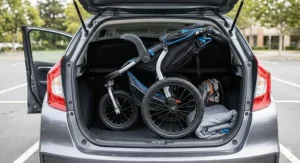
The trade-off for this feature set is size and weight. At 31 pounds and notably bulky when folded, the Interval requires SUV-level cargo space. Several parents mention it barely fits in compact car trunks, so measure before buying. The lockable front swivel wheel converts easily between stroller and jogger mode, making it versatile for daily use beyond running.
✅ Adjustable handlebar accommodates different heights
✅ Suspension system genuinely reduces bumps
✅ Included parent and child trays (most budget models skip child trays)
❌ Large footprint makes storage challenging
❌ Heavy at 31 pounds
Customers who have garage space and larger vehicles love this stroller’s performance-to-price ratio. Those in apartments or with small cars struggle with the bulk. Current pricing sits around $185-$230 range.
6. Delta Children Apollo Jogging Stroller — Shock-Absorbing Specialist
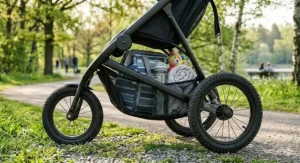
The Delta Children Apollo Jogging Stroller makes its suspension system visible with external shock absorbers you can actually see compressing over bumps—this isn’t just marketing language about “smooth ride technology.” Those visible shocks paired with puncture-proof 12-inch front and 16-inch rear wheels deliver legitimate vibration dampening on trails and rough pavement.
This 33-pound stroller features a water-resistant UPF 50+ canopy that extends for better sun protection than most budget options. The adjustable foam handlebar and swing-away child tray improve usability, while the parent organizer with two cup holders keeps essentials accessible. It folds flat with quick-release rear wheels, making trunk storage more manageable despite the heavier weight.
The Apollo includes car seat adapters for Graco SnugRide Click Connect and Evenflo models, though Britax and Chicco require separate adapters. That travel-system versatility appeals to parents who want one stroller serving multiple purposes from infancy through toddlerhood. Reflective piping for nighttime visibility and JPMA certification add safety credibility at this price point.
✅ Visible shock absorbers provide genuine suspension
✅ Puncture-proof wheels eliminate flat-tire frustration
✅ Extendable water-resistant canopy with UPF 50+
❌ Heavier 33-pound weight
❌ Bulkier than lightweight competitors
Parents who jog on trails rather than just sidewalks appreciate the superior shock absorption. The extra weight becomes less noticeable once you’re in motion but definitely matters when loading it repeatedly. Around $155-$175 currently, offering solid value for the suspension quality.
7. Jeep Cross-Country Sport Plus Jogging Stroller — Trail-Ready Budget Option
The Jeep Cross-Country Sport Plus by Delta Children brings outdoor-brand credibility to the budget jogging market with 16-inch metal air-spoke rear wheels and a 12-inch front swivel wheel designed for varied terrain. The durable steel frame with high-quality tech fabric feels more substantial than the price suggests—this is a 33-pound stroller that reads “sturdy” rather than “heavy.”
The extendable quilted European canopy with sun visor and peek-a-boo window provides excellent coverage, while the multi-position reclining seat with padded five-point harness keeps kids comfortable during longer outings. Wide adjustable foam handlebar with safety tether gives runners a comfortable grip, and the reflective materials improve low-light visibility. The included detachable parent organizer and generous undercarriage storage basket add practical convenience.
Where this model falls short is the storage basket design—that same center divider issue from the Baby Trend double affects this single stroller, making large diaper bags challenging to fit. You’ll need to break down your gear into smaller bags or strategically pack. The metal air-spoke wheels look classic but require more maintenance than composite wheels and will rust if you leave this stroller outside regularly.
✅ Meets Disney park size requirements
✅ Compatible with multiple car seat brands
✅ Reflective materials for dawn/dusk running
❌ Storage basket has restrictive center divider
❌ Metal wheels require rust prevention maintenance
Parents appreciate the Jeep brand association and rugged construction. Those who primarily use it for parks and trails find it performs beyond the $170-$200 price point. Just keep it stored indoors to prevent wheel rust.
How to Choose Your Perfect Budget Jogging Stroller
Walking into the jogging stroller market without a plan is like running a marathon without training—you’ll make it to the finish line, but you won’t enjoy the journey. The fundamental question isn’t “which is cheapest” but rather “which compromises can I actually live with for the next 3-5 years.”
Weight Capacity vs Your Timeline
Most budget joggers cap at 50 pounds, which sounds generous until you realize that’s around age 6-7 for average-sized kids. If you’re planning another child and want to pass this stroller down, or if you enjoy running with kids until they’re old enough to join you, that 75-pound capacity on the Joovy Zoom360 transforms from luxury feature to practical necessity. Run the math on cost-per-year rather than upfront price—a $300 stroller used for 8 years ($37.50 annually) outperforms a $150 model you outgrow in 4 years ($37.50 annually), except the pricier one probably maintains better resale value.
Fixed vs Adjustable Handlebars
Here’s what the marketing materials skip: if you’re the primary runner and you’re between 5’4″ and 5’10”, fixed handlebars work fine. Outside that range, especially if you’re sharing the stroller with a partner of significantly different height, the $40 premium for adjustability prevents chronic shoulder tension and lower back pain. I’ve watched plenty of runners unconsciously hunch or overextend to compensate for wrong-height handlebars, completely negating the fitness benefits they’re chasing.
Tire Material Matters More Than Wheel Size
Pneumatic (air-filled) tires absorb vibration that hard plastic or foam wheels transmit straight through the frame to your hands and your child’s spine. Every model in this guide includes pneumatic tires because that’s non-negotiable for actual jogging. What varies is tire width and tread pattern—wider tires with aggressive tread handle grass and gravel better, while narrower smooth tires optimize for pavement speed. If you’re exclusively running on sidewalks and paved trails, don’t overpay for knobby all-terrain tires you’ll never exploit.
Storage Reality Check
That “extra-large storage basket” holds an average-sized backpack diaper bag in most cases, sometimes barely. If you’re planning post-run Target stops or bringing along toys for playground time after your jog, test the basket dimensions before buying. Several budget models use that restrictive center-divider design that technically creates a large volume but practically prevents fitting anything wider than 10 inches. Load your current diaper bag and check if it actually fits through the basket opening.
Real-World Jogging Scenarios: Which Stroller Fits Your Life?
The Daily Runner Parent
You log 5-6 runs weekly, typically 3-5 miles on paved greenways and neighborhood sidewalks. You need a stroller that handles frequent use without fighting you on tracking, folds quickly for daily car loading, and won’t rattle apart after 500 miles. The Joovy Zoom360 Ultralight is your match—the aluminum frame resists fatigue failure better than steel, the suspension reduces cumulative wrist strain, and the higher weight capacity means you’re not shopping again in two years. Yes, it’s the priciest here at around $290, but divide that by 300+ runs annually over 4-5 years and you’re talking pennies per mile.
The Weekend Warrior Family
Running happens Saturday and Sunday mornings, maybe an occasional weekday if schedules align. You’re covering 2-3 miles per outing, mix of pavement and packed dirt trails. Daily use involves mall trips, park visits, general errands. The Baby Trend Expedition hits your sweet spot—it performs adequately for 2-3 runs weekly, the lightweight frame makes casual use effortless, and the travel system compatibility eliminates needing multiple strollers for different car seat stages. At $130-$145, you’re not overthinking an item you’ll use 150 times annually.
The Tall Runner’s Dilemma
You’re 6’1″ or taller and every fixed-handlebar stroller forces you into an awkward hunch that turns mile three into a shoulder-tension nightmare. The Schwinn Interval’s adjustable handlebar isn’t a luxury—it’s preventing injury. That $185-$230 price pays for itself the first time you complete a run without needing to stretch out cramped trapezius muscles. The suspension system bonus means you can extend your route to include that unpaved section through the park without your tall frame absorbing extra impact.

Common Mistakes When Buying Budget Jogging Strollers
The biggest error I see parents make is equating “jogging stroller” with “mandatory for running.” Unless you’re actually planning to run with this stroller, you’re buying a heavier, bulkier product than necessary. Jogging strollers use three-wheel designs, pneumatic tires, and locking front wheels specifically for running stability—features that add weight and reduce maneuverability for mall navigation. If your honest assessment is “I might jog occasionally but mostly need an all-terrain stroller for park walks,” you want an all-terrain stroller, not a jogger.
Second mistake: ignoring the age-and-weight minimums. Most jogging stroller manufacturers and the American Academy of Pediatrics recommend waiting until babies reach 6-8 months with good head and neck control before jogging. That’s actual jogging—you can use these strollers for walks earlier, particularly with car seat adapters, but running creates G-forces that young infants can’t handle safely. I’ve watched parents buy a jogger at birth planning to “grow into it” and then discover their running window is much shorter than anticipated.
Third trap: assuming “budget” means “disposable.” These strollers will outlast your need for them if maintained properly. Check tire pressure before runs, tighten bolts quarterly, clean the frame and fabric monthly—basic maintenance that takes 10 minutes but prevents the creaks and wobbles that make people think they bought junk. The Baby Trend models especially benefit from the tire-pressure check; underinflated tires create that pulling sensation people blame on design flaws.
Jogging Stroller Safety Guidelines: What Really Matters
Let me cut through the fear-mongering and focus on what actually prevents injuries. According to the American Academy of Pediatrics, the non-negotiable safety features are a five-point harness that you actually use every single time, a wrist strap tether that prevents runaways if you stumble, and age-appropriate use starting around 6 months. Every model in this guide includes those features—they’re baseline, not premium upgrades.
What varies is brake quality and wheel locking mechanisms. Test the parking brake by setting it and trying to push the stroller—it should require genuine force to move. The front-wheel lock should engage firmly with an audible click; if it feels mushy or intermittent, that’s a deal-breaker. Several Amazon reviews mention testing these features before leaving the parking lot and immediately returning units with questionable brakes.
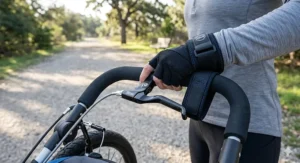
The safety tether deserves specific attention because I constantly see runners not using it. That strap goes around your wrist, not loosely hanging—it’s preventing your stroller from becoming a 50-pound projectile if you catch a crack and stumble. Adjust it snug enough that it would actually catch the stroller but loose enough to not cut off circulation. This matters most on downhill sections where momentum builds; I’ve watched strollers outpace stumbling parents simply because the tether wasn’t engaged.
Budget Jogging Strollers vs Premium Models: The Real Differences
Premium jogging strollers like BOB and Thule command $400-$600 price tags, and the marketing implies that gap represents safety or performance you’re sacrificing. That’s mostly nonsense. What you’re actually paying for is adjustable tracking (the ability to fine-tune wheel alignment so the stroller runs perfectly straight), hand brakes in addition to foot brakes, higher-grade suspension with multiple adjustment settings, and fabrics that resist fading after 1000 hours of sun exposure.
Those features genuinely matter if you’re running 15+ miles weekly, tackling steep hills regularly, or planning to use this stroller for multiple children over 8+ years. For 95% of casual jogger parents, the budget models in this guide deliver identical safety and adequate performance. The tracking issue premium models solve? It’s the difference between hands-free running on straight paths (premium) versus keeping one hand on the handlebar to maintain direction (budget). If that matters to your running style, save the extra $250. If you’re fine with hands-on steering, pocket that money.
The durability gap is real but overstated. Budget strollers use heavier steel frames that can rust and cheaper fabrics that fade and stain more readily. You’ll see cosmetic wear earlier. But the actual functional lifespan? With basic maintenance, these budget models run 4-6 years without mechanical failure. The premium strollers might make it 8-10 years looking showroom-new, but unless you’re planning a third or fourth child, you won’t exploit that longevity.
Maintenance Tips to Maximize Your Investment
Budget jogging strollers demand slightly more attention than premium models because you’re working with materials that don’t forgive neglect. Monthly, spray down the frame with a hose and wipe fabric with mild soap—dirt and grime act like sandpaper on moving parts. Check all bolts and screws quarterly; vibration from running loosens connections over time. Most people blame “cheap construction” when really they just needed a five-minute tightening session.
Tire maintenance separates happy budget jogger owners from frustrated ones. Check pressure before every third run using a basic bike pump with pressure gauge—most jogging stroller tires run 30-35 PSI. Underinflated tires increase rolling resistance (making you work harder) and create uneven wear (shortening tire lifespan). Overinflated tires reduce shock absorption (making the ride harsh). The Schwinn Interval includes a pump, but a $15 bike pump works for any model.
Store these strollers indoors when possible, or at minimum under a covered porch. Direct sunlight degrades fabric and plastic components; rain accelerates rust on metal parts. If you must leave it outside, invest in a $20 stroller cover. The metal-spoke wheels on the Jeep and some Baby Trend models especially benefit from indoor storage—I’ve seen gorgeous strollers with rust-frozen wheels after one winter of porch living.
FAQ: Your Budget Jogging Stroller Questions Answered
❓ Can I use a cheap jogging stroller every day or will it wear out quickly?
❓ What's the minimum age for jogging with baby in these strollers?
❓ Do I really need a jogging stroller or can I run with a regular stroller?
❓ How do I know if the stroller is tracking straight or pulling to one side?
❓ Can budget jogging strollers handle trails and rough terrain?
Conclusion: The Best Cheap Jogging Stroller for Your Family
The cheap jogging stroller landscape in 2026 offers legitimate quality at accessible prices—you’re not settling, you’re being strategic. The Baby Trend Expedition remains unbeatable for ultra-budget needs, delivering pneumatic tires and running capability under $150. The Joovy Zoom360 Ultralight justifies its $290 price tag with aluminum construction and 75-pound capacity that extends usability years beyond competitors. And models like the Schwinn Interval and Delta Apollo prove you can get adjustable handlebars and genuine suspension without crossing the $250 threshold.
Your perfect match depends less on “best” rankings and more on honest assessment of how you’ll actually use this stroller. Running 2-3 times weekly on paved paths? The Baby Trend or Graco models handle that workload without complaint. Training for races with 15+ weekly miles? The Joovy’s refined engineering prevents cumulative fatigue. Mixed terrain and tall runners? The Schwinn’s adjustability and suspension protect your body over hundreds of miles.
The premium stroller market wants you to believe that budget options compromise safety or performance. That’s marketing fiction. These budget joggers deliver identical safety features and adequate performance for casual-to-serious runners willing to do basic maintenance and accept cosmetic wear over time. Your child doesn’t know the difference between a $150 stroller and a $500 one—they care about a smooth ride and snacks. Nail those basics and pocket the difference.
Recommended for You
- 7 Best Double Jogging Stroller Models – 2026
- 7 Best All Terrain Strollers Tested for Real Adventures 2026
- 7 Best 3 Wheel Stroller Options Tested by Parents (2026)
Disclaimer: This article contains affiliate links. As an Amazon Associate, I earn from qualifying purchases. If you purchase products through these links, we may earn a small commission at no additional cost to you.
✨ Found this helpful? Share it with your friends! 💬🤗
