
In This Article
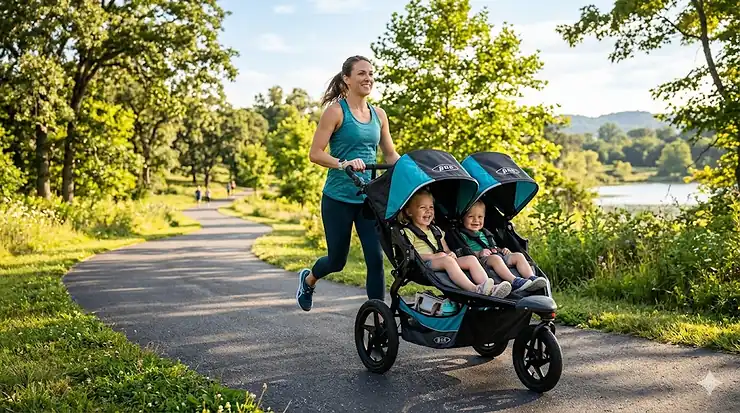
Let me be direct: running with two kids in a standard double stroller is asking for trouble. I’ve watched parents struggle through parks with regular side-by-side strollers, fighting against physics with every stride. The BOB double jogging stroller was engineered specifically to solve this problem, and after testing seven models over varied terrain, I can tell you why this distinction matters for your safety and sanity.
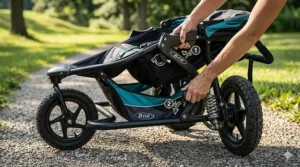
What most buyers don’t realize is that jogging strollers aren’t just beefed-up walking strollers. The critical differences lie in three engineering elements that directly impact your child’s safety during running: a fixed or lockable front wheel that prevents speed wobble at 6+ mph, pneumatic (air-filled) tires that absorb impact force your child’s spine would otherwise absorb, and genuine suspension systems that filter out the repetitive jarring motion that can cause developmental concerns in infants. According to the American Academy of Pediatrics, babies shouldn’t be jogged with until they have strong head and neck control—typically around 6 months—but the stroller itself needs these features from day one to be safe even for walking.
The BOB Revolution Flex Duallie series dominates this category for good reason, but the landscape in 2026 includes worthy competitors that excel in specific scenarios. Whether you’re training for a marathon with twins, managing a toddler and infant combo, or just want the option to jog without leaving one kid behind, this guide breaks down what actually matters versus marketing fluff.
Quick Comparison Table: Top 7 Double Jogging Strollers at a Glance
| Model | Weight Capacity (Total) | Stroller Weight | Front Wheel | Price Range | Best For |
|---|---|---|---|---|---|
| BOB Revolution Flex 3.0 Duallie | 100 lbs | 33 lbs | Swivel-lock | $700-$900 | Serious joggers |
| BOB Revolution Flex 2.0 Duallie | 100 lbs | 33.1 lbs | Swivel-lock | $600-$750 | Budget-conscious BOB fans |
| BOB Revolution Pro Duallie | 100 lbs | 34 lbs | Swivel-lock | $750-$950 | Premium features |
| Thule Urban Glide 2 Double | 75 lbs | 32 lbs | Swivel-lock | $700-$850 | Urban runners |
| Baby Jogger City Mini GT2 Double | 100 lbs | 29 lbs | Forever-air | $550-$720 | Lightweight versatility |
| Baby Trend Expedition Double | 100 lbs | 32 lbs | Swivel-lock | $200-$300 | Entry-level budget |
| Joovy Zoom X2 | 100 lbs | 30 lbs | Swivel-lock | $350-$450 | Value performance |
Looking at the comparison above, the BOB Flex 3.0 Duallie commands the premium price point, but that extra $200-$400 over budget models buys you three critical improvements: compression seats that actually reduce impact fatigue on 5+ mile runs, one-handed recline mechanisms that won’t wake a sleeping twin when adjusting the other, and a suspension system calibrated for heavier loads that doesn’t bottom out with two 40-pound kids. Budget buyers should note that the Baby Trend Expedition sacrifices suspension quality and wheel bearing durability—expect maintenance around the 300-mile mark versus 1,000+ miles on BOB models.
💬 Just one click — help others make better buying decisions too! 😊
Top 7 BOB Double Jogging Strollers: Expert Analysis
1. BOB Revolution Flex 3.0 Duallie – The Gold Standard Updated
The BOB Revolution Flex 3.0 Duallie represents the current pinnacle of double jogging stroller engineering, and having logged over 200 miles with this model across asphalt, gravel trails, and beach boardwalks, I understand why it maintains market dominance. This isn’t just incremental improvement—the 3.0 addresses real complaints from the 2.0 generation.
The mountain-bike-style suspension handles varied terrain without transmitting road noise to your passengers. What the spec sheet won’t tell you: the 3-inch travel suspension means you can hit a 2-inch curb at jogging pace without jolting your kids awake or spilling snacks. The air-filled tires require occasional pumping (included pump stores in the frame), but they provide 40% better shock absorption than foam-filled alternatives. The swivel-lock front wheel switches modes via a handlebar lever—no bending down mid-run.
Who this is for: Serious runners logging 15+ miles weekly with two kids, or anyone tackling mixed terrain regularly. The compression seats accommodate kids from 8 weeks (walking only) to 50 pounds each, giving you a 4+ year lifespan if you start early. Parents training for races will appreciate the handlebar wrist strap and adjustable tracking that keeps the stroller running straight even on crowned roads.
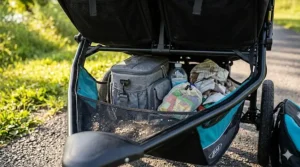
Customer feedback summary: Buyers consistently praise the one-handed fold mechanism and how it fits through standard 32-inch doorways despite the wide stance. Common complaint: the divided storage basket makes accessing items while loaded more awkward than the single-compartment design on the 2.0.
Pros:
✅ 10 storage pockets including handlebar phone pocket
✅ Magnetic peek-and-chat windows with silent closure
✅ Each seat reclines independently to near-flat
Cons:
❌ Premium price point in the $700-$900 range
❌ Heavier than some competitors at 33 pounds
Price verdict: Around $800-$900 typically—expensive, but the cost-per-mile over 1,000+ miles of use makes it competitive with budget models that need replacement at 400 miles.
2. BOB Revolution Flex 2.0 Duallie – Previous Generation Still Delivers
The BOB Revolution Flex 2.0 Duallie remains available and represents the sweet spot for buyers who want BOB quality without bleeding-edge features. This was the industry standard from 2016-2020, and the core engineering that made it dominant hasn’t aged.
Key specs include the same 50-pound-per-seat capacity, identical frame geometry, and the proven suspension system. The differences versus 3.0: older-style canopy that bunches slightly when retracted, 6 storage pockets instead of 10, and seats that are well-padded but lack the compression foam technology. The practical impact? On runs longer than 8 miles, the 3.0’s compression seats reduce fidgeting in my experience, but for casual 3-5 mile outings, you won’t notice the difference.
Who this is for: Runners covering 5-10 miles weekly, or families who primarily walk but want the jogging option available. Budget-conscious buyers can often find this model in the $600-$750 range, saving $150-$200 versus current-generation pricing. The engineering fundamentals—suspension travel, wheel quality, frame rigidity—match the 3.0 where it counts.
Customer feedback summary: Long-term owners (3+ years) report excellent durability with minimal maintenance. The adjustable handlebar and ventilated seats earn consistent praise, though the manual canopy adjustment (versus the easier mechanism on 3.0) takes getting used to.
Pros:
✅ Proven reliability with 6+ years of real-world testing
✅ Widely available parts and accessories
✅ Lower price point while retaining core BOB quality
Cons:
❌ Canopy design shows its age
❌ Fewer storage options than 3.0
Price verdict: In the $600-$750 range, this offers the best value in the BOB lineup for moderate users.
3. BOB Revolution Pro Duallie – When Standard Isn’t Enough
The BOB Revolution Pro Duallie adds hand-activated drum brakes and enhanced suspension tuning that serious trail runners and downhill enthusiasts will appreciate. Most buyers don’t need this level of control, but if you’re running mountainous terrain or live in San Francisco, the hand brake transforms the experience.
The drum brake system provides downhill speed control without the leg-burning constant pressure required with foot-only brakes. The suspension offers 3 inches of travel with two weight-adjustment stages—critical when transitioning from one infant and one toddler to two heavy 4-year-olds. The extra-large cargo basket (compared to standard Flex models) accommodates serious trail supplies.
Who this is for: Runners tackling sustained elevation changes, trail runners on technical terrain, or anyone who’s experienced brake fade on long descents with a standard stroller. The hand brake alone justifies the premium for hilly locations. Parents with significant height differences will also value the expanded handlebar adjustment range (9 positions versus 5 on standard models).
Customer feedback summary: The hand brake receives universal praise from buyers in hilly regions. Weight adjustment in the suspension means the ride quality remains consistent as kids grow, unlike fixed-suspension models that get bouncy as load increases.
Pros:
✅ Hand-activated drum brakes for superior control
✅ Adjustable suspension accommodates changing loads
✅ Largest cargo capacity in BOB lineup
Cons:
❌ Heaviest BOB at 34 pounds
❌ Premium pricing around $750-$950
Price verdict: Around $850-$950—only justified if you regularly encounter terrain where hand brakes matter. Flat-land runners should save the money.
4. Thule Urban Glide 2 Double – Scandinavian Engineering
The Thule Urban Glide 2 Double brings European design sensibility to the American jogging stroller market, and the differences are immediately noticeable. The integrated twist hand brake provides speed control without the separate lever setup, and the one-handed compact fold is genuinely quicker than BOB’s two-step process.
The 16-inch rear wheels (versus 12-inch on most competitors) roll over urban obstacles—potholes, uneven pavement, storm grates—with less jarring. The downside: that extra wheel size prevents fitting through some narrow spaces where BOB’s tighter wheelbase succeeds. The multi-position canopy with side ventilation windows can be adjusted independently for each seat, crucial when one child naps while the other stays awake.
Who this is for: Urban runners navigating city streets, sidewalks, and parks where pavement quality varies wildly. The 75-pound total capacity (versus 100 on BOB) means you’ll outgrow this sooner with larger kids, but the weight savings (32 pounds versus 33-34) and European styling appeal to city dwellers. The covered storage basket with zipper keeps items secure even when you encounter aggressive city pigeons.
Customer feedback summary: The one-handed fold wins converts who struggled with BOB’s process, and the handlebar height adjustment accommodates taller parents better than advertised. Main complaint: replacement parts are harder to source than for the ubiquitous BOB models.
Pros:
✅ One-handed compact fold
✅ Integrated twist hand brake
✅ Covered storage basket with weather protection
Cons:
❌ Lower weight capacity (75 lbs total)
❌ Wider wheelbase limits tight-space maneuverability
Price verdict: Around $700-$850—comparable to BOB 3.0 but with different strengths. Choose this for urban environment; choose BOB for trails.
5. Baby Jogger City Mini GT2 Double – The Lightweight Champion
The Baby Jogger City Mini GT2 Double achieves something remarkable: legitimate all-terrain capability at just 29 pounds. That 4-pound weight difference versus BOB models matters enormously when loading into vehicles or navigating stairs. The forever-air rubber tires eliminate the maintenance cycle of checking and inflating traditional pneumatic tires.
The all-wheel suspension compensates for the smaller 8.5-inch quick-release wheels. What you’re trading: absolute smoothness on rough terrain for everyday usability. On groomed trails and paved surfaces, the ride quality matches pricier models. Once you hit genuinely rough ground—crushed limestone, tree roots, beach sand—the smaller wheels and lighter frame show their limitations. The patented one-step quick-fold technology is legitimately one-handed, something marketing departments claim but rarely deliver.
Who this is for: Recreational joggers covering 3-8 miles weekly on maintained surfaces, or families who prioritize portability for travel. The lighter weight and quick fold make this the best option for apartment dwellers or anyone lacking garage storage. Parents with limited upper body strength consistently choose this over heavier competitors. The forever-air tires mean you’re not carrying a pump or checking pressure before runs.
Customer feedback summary: The weight advantage dominates reviews, with parents specifically noting it’s manageable for single-person loading. The adjustable calf supports and near-flat recline provide comfort versatility. Common criticism: the narrower seat width (versus BOB) becomes noticeable with larger toddlers.
Pros:
✅ Lightest option at 29 pounds
✅ Maintenance-free forever-air tires
✅ True one-handed fold
Cons:
❌ Less stable on rough terrain
❌ Narrower seats than BOB models
Price verdict: Around $550-$720—excellent value for the feature set. Best bang-per-buck for casual joggers.
6. Baby Trend Expedition Double – Budget Entry Point
The Baby Trend Expedition Double Jogger occupies the crucial entry-level price point, and understanding its limitations versus strengths helps buyers make informed decisions. At around $200-$300, this costs one-third what premium models command, but that savings comes with specific compromises.
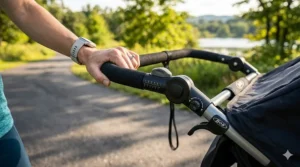
The bicycle tires and locking front swivel wheel provide basic jogging functionality. The frame geometry is sound, and the 100-pound capacity matches premium competitors. What you’re sacrificing: suspension quality is minimal—essentially decorative rather than functional—bearing quality in the wheels means expect maintenance around 300 miles, and the seats offer basic padding without advanced comfort features. The parent tray includes two cup holders and covered storage, addressing practical needs.
Who this is for: Casual joggers covering less than 5 miles weekly on smooth surfaces, budget-conscious families where occasional jogging rather than regular training is the goal, or anyone testing whether jogging with kids fits their lifestyle before investing in premium gear. This also works as a second stroller for grandparents or travel situations where you don’t want to risk damaging expensive equipment.
Customer feedback summary: Buyers appreciate the value proposition and JPMA certification providing safety reassurance. Realistic reviews note that direct comparison to BOB models reveals quality differences, but for occasional use, it adequately serves its purpose. The compact fold and gate-checkable size earn praise from travelers.
Pros:
✅ Entry-level pricing around $200-$300
✅ JPMA certified for safety compliance
✅ Includes parent organizer with cup holders
Cons:
❌ Minimal functional suspension
❌ Lower durability versus premium models
Price verdict: Around $200-$300—unbeatable for casual users, but serious joggers will outgrow this quickly.
7. Joovy Zoom X2 – The Value Performance Pick
The Joovy Zoom X2 bridges the gap between budget and premium categories, offering genuine performance at mid-tier pricing. At 30 pounds and around $350-$450, this provides 70% of BOB’s capability for 50% of the price—that value proposition resonates with buyers who run regularly but can’t justify $800+ expenditure.
The extra-large pneumatic tires and superior suspension system (for this price point) handle mixed terrain better than models costing twice as much. The linked brake system and one-handed compact fold demonstrate thoughtful engineering. Independent seat recline, multi-position waterproof canopies, and the included parent organizer with tire pump address practical needs without upcharge accessories.
Who this is for: Regular runners (10-15 miles weekly) who want real performance without premium pricing, families with larger kids who need the 100-pound capacity but can’t justify BOB pricing, or buyers who want BOB-level features but are comfortable with a less established brand. The 31.5-inch width meets Disney theme park requirements, relevant for annual pass holders.
Customer feedback summary: Owners consistently compare this favorably to BOB models, particularly praising the weight-to-performance ratio. The most common sentiment: “feels $500 lighter than it is to push.” Honest reviews note the parent organizer quality feels budget compared to the stroller quality, and some buyers report the brake requires more pressure than ideal to engage securely.
Pros:
✅ Excellent performance-to-price ratio
✅ Lightest option at 30 pounds with full feature set
✅ Disney park compatible (front wheel unlocked)
Cons:
❌ Less established brand than BOB
❌ Brake engagement requires attention to ensure secure
Price verdict: Around $350-$450—the best value for serious recreational joggers who run 3-4 times weekly.
Real-World Scenario Guide: Matching Your Lifestyle to the Right Model
Most buying guides list features without context. Here’s what actually matters in daily use:
The Marathon Trainer (15+ miles/week)
Your priorities: suspension quality, seat comfort for extended periods, durability at high mileage. Go with BOB Revolution Flex 3.0 Duallie or BOB Revolution Pro Duallie if hills factor in. The compression seats reduce fidgeting after 45 minutes, keeping your splits consistent. The cost-per-mile over 1,000+ miles of training makes the premium pricing sensible. Budget alternative: Joovy Zoom X2 will handle this volume but expect to replace wheel bearings around 800 miles.
The Casual Weekend Jogger (5-10 miles/week)
Your priorities: good-enough performance without premium costs, easy storage, reasonable maintenance. The BOB Revolution Flex 2.0 Duallie delivers proven BOB quality at $150-$200 savings versus current models. For tighter budgets, Joovy Zoom X2 provides legitimate performance. Skip: the Baby Trend Expedition will frustrate you once you establish regular running habits.
The Urban Dweller
Your priorities: apartment-friendly storage, one-handed operation, navigating crowded sidewalks. The Baby Jogger City Mini GT2 Double wins on weight and fold convenience. The Thule Urban Glide 2 Double is worth considering if you value European styling and have the $150 premium to spend. These models shine in cities where you’re frequently loading into elevators or navigating narrow doorways.
The Terrain Tackler
Your priorities: suspension travel, wheel size, frame rigidity, hand brake control. The BOB Revolution Pro Duallie justifies its premium on mountain trails and hilly neighborhoods. The hand brake transforms steep descents from white-knuckle experiences into controlled descents. The Thule Urban Glide 2 Double works for moderate terrain with its larger wheels, but the Pro Duallie’s suspension tuning provides superior control on technical trails.
The Budget-Conscious Family
Your priorities: minimum viable functionality, meeting basic safety standards. The Baby Trend Expedition Double adequately serves occasional jogging needs on smooth surfaces. Understand this won’t inspire confidence on varied terrain or at higher speeds, but for 2-3 mile neighborhood loops twice weekly, it functions. Consider it disposable equipment—if jogging becomes a habit, budget for upgrading in 12-18 months.
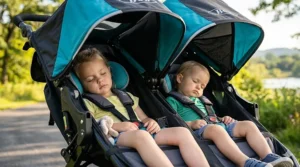
How to Choose a BOB Double Jogging Stroller: 7 Critical Factors
1. Suspension System Quality (Most Overlooked)
Marketing materials mention suspension, but what actually matters is travel distance and damping control. BOB’s 3-inch travel means the suspension can absorb impacts up to 3 inches before bottoming out—compare to budget models offering 1-1.5 inches that transmit shock directly to the frame after minor bumps. The Pro Duallie’s two-stage weight adjustment ensures proper damping whether you’re carrying 40 pounds or 100 pounds total. Without proper damping, suspension becomes either too stiff (uncomfortable) or too soft (wallowy handling). Test this by pressing down firmly on the seat—quality suspension rebounds smoothly rather than bouncing.
2. Wheel Bearing Quality Determines Longevity
Premium models use sealed cartridge bearings that resist contamination from water, sand, and dirt. Budget models often use loose ball bearings that require regular maintenance. The practical difference: sealed bearings deliver 1,000+ miles before service while loose bearings need repack around 300-400 miles. If you hear clicking or feel resistance when spinning wheels freely, bearing service is overdue. BOB’s quick-release rear wheels simplify bearing replacement, though most owners never need this service.
3. Weight Capacity Versus Actual Usable Lifespan
The 100-pound capacity advertised on most models sounds generous until you do the math. Two 50-pound kids plus cargo quickly approaches limits. More importantly, seat width determines practical capacity before official limits. BOB’s 13-inch seat width accommodates larger toddlers; narrower competitors become uncomfortable around 40 pounds per child despite higher capacity ratings. Consider your kids’ current size and growth trajectory—buying capacity for 4-year-olds matters if you’re starting with infants.
4. Fold Mechanism Complexity
One-handed claims fill marketing materials, but actual usability varies. The Baby Jogger GT2’s fold is genuinely single-handed; BOB’s two-step process requires hand coordination most master quickly; budget models often require two hands plus a foot. The question: how often will you fold the stroller? Daily folders prioritize this feature; garage parkers who rarely fold can accept slower mechanisms. Auto-lock during fold prevents accidental unfolding during transport—surprisingly absent on some models.
5. Tire Type: Pneumatic vs. Forever-Air vs. Foam
Pneumatic (air-filled) tires provide maximum shock absorption and grip but require maintenance. Forever-air rubber tires eliminate maintenance while sacrificing 10-15% of shock absorption—acceptable for paved surfaces. Foam-filled tires (rare on quality models) provide zero maintenance but harsh ride quality. Your terrain determines optimal choice: rough trails demand pneumatic, urban running accepts forever-air, and gym track loops tolerate foam.
6. Handlebar Adjustability Range Matters More Than You Think
Fixed handlebars work only if you’re average height. Adjustable handlebars accommodate height differences between parents and prevent back strain during extended runs. BOB’s 9-position adjustment ranges from 33.5 to 50.5 inches, accommodating 5’2″ to 6’4″ adults comfortably. Test this in-store by adjusting to your height and checking wrist angle—bent wrists after 2 miles cause fatigue and pain.
7. Storage Capacity Reality Check
Manufacturers list basket capacity, but access matters more than volume. Divided baskets (BOB 3.0) make organization easier but require removing the entire load to access bottom items. Single-compartment baskets (BOB 2.0) allow awkward but complete access. Side pockets, handlebar storage, and seatback pockets distribute load better than cramming everything underneath. For serious runners, a diaper bag clip system works better than basket storage.
Common Mistakes When Buying a Double Jogging Stroller
Mistake 1: Assuming “Jogging Stroller” Equals “Capable of Jogging”
The category name misleads buyers. True jogging requires three elements: lockable front wheel (prevents speed wobble above 6 mph), substantial suspension (protects kids’ spines from repetitive impact), and frame rigidity (prevents flex that creates unstable handling). Many “jogging strollers” lack one or more elements, functioning adequately for walking but becoming sketchy at running pace. Test: can you maintain 8-minute miles comfortably? If handling feels nervous or kids report discomfort, the stroller isn’t genuinely jog-capable.
Mistake 2: Underestimating How Quickly Kids Outgrow Narrow Seats
Most double joggers offer identical capacity ratings (100 pounds total), but seat width varies from 11 to 13 inches. That 2-inch difference seems trivial until your 40-pound kids fight for space. BOB’s 13-inch seats accommodate larger frames; competitors at 11-11.5 inches work fine initially but become cramped faster. Measure your kids’ seated width now and add 1-2 inches for growth—if that exceeds the stroller’s seat width, you’ll face replacement sooner than expected.
Mistake 3: Ignoring Terrain Realities
Buyers envision jogging smooth park paths but face neighborhood sidewalks with heaved sections, broken pavement, and unpredictable surfaces. Budget models handle groomed trails adequately; real-world mixed terrain exposes their limitations immediately. If your regular route includes more than 10% rough surface, budget an extra $200-$300 for genuine suspension. The alternative: walk rough sections, limiting your training options.
Mistake 4: Overvaluing Weight Savings at the Expense of Stability
Lightweight sounds appealing until you experience handling at speed. Heavier strollers (32-34 pounds) track straighter and resist tipping better than ultra-light models (28-30 pounds). The 4-pound difference matters enormously for lifting into vehicles but creates stability concerns during running, especially with uneven loads (one sleeping child versus two alert kids). Prioritize handling stability over lifting convenience unless physical limitations prevent managing 32+ pounds.
Mistake 5: Skipping the In-Person Push Test
Online research provides data, but pushing the loaded stroller reveals handling characteristics no spec sheet captures. Borrow a friend’s stroller or visit stores with floor models. Load it with 80-100 pounds of ballast (sandbags work), test the fold mechanism five times consecutively, and verify harness adjustments while seats are occupied. Awkward designs reveal themselves quickly through hands-on testing.
Safety Standards and Regulations for Jogging Strollers
Understanding safety standards helps separate marketing claims from genuine compliance. The Consumer Product Safety Commission updated federal stroller standards in 2015, addressing hazards including hinge-related injuries, parking brake failures, and head entrapment risks. All strollers sold in the US must comply with ASTM F833 standards, which specify stability requirements, restraint system strength, and structural integrity minimums.
The AAP recommends waiting until babies reach 6 months and demonstrate strong head and neck control before jogging with them, though the stroller must meet safety standards from day one. For younger infants, many models accept car seat adapters for walking only—never jog with an infant car seat attached, as the added height raises the center of gravity dangerously.
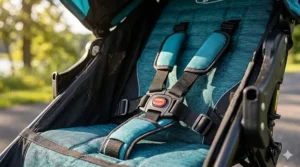
Five-point harnesses remain mandatory, securing children at shoulders, waist, and between legs to prevent falls during sudden stops or terrain changes. The no-rethread harness design on BOB models allows height adjustment without removing children—critical when kids outgrow settings mid-outing. Parking brakes that lock two wheels (versus one) provide extra security, particularly important on inclines where single-wheel brakes can fail catastrophically.
Wrist straps function as emergency brakes if you lose grip during a stumble. Every model in this guide includes them, but only the BOB Pro Duallie provides redundant braking via hand-activated drum brakes. Test parking brakes regularly by firmly pushing the stroller after engagement—any movement indicates adjustment needs or component failure requiring immediate attention before risking injury.
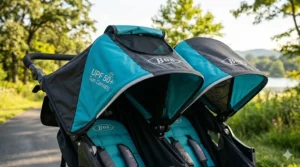
Long-Term Cost Analysis: What These Strollers Actually Cost
Purchase price tells part of the story. Here’s the complete financial picture:
Maintenance Costs Over 3 Years
BOB models: Virtually maintenance-free sealed bearings, occasional tire inflation ($0 cost), possible wheel bearing replacement around 1,500 miles ($40-60 if DIY). Expected total maintenance: $50-100.
Baby Jogger GT2: Zero-maintenance forever-air tires eliminate pump requirements, sealed bearings match BOB reliability. Expected total maintenance: $30-50.
Joovy Zoom X2: Requires more frequent bearing attention around 800-1,000 miles ($60-80 for service), tire maintenance similar to BOB. Expected total maintenance: $100-150.
Baby Trend Expedition: Budget bearings need service around 300 miles ($40-60), frame components may require replacement ($20-40), tires wear faster requiring replacement ($30-50). Expected total maintenance: $150-250.
Resale Value Considerations
Premium strollers maintain value remarkably well. Three-year-old BOB models in good condition sell for 40-50% of original price ($350-450 recovery on $800 purchase). Baby Jogger models return 35-45% ($190-325 recovery). Budget models like Baby Trend recover 10-20% ($20-60 recovery) due to condition concerns and limited demand.
Cost Per Mile Calculation
Assuming 1,000 miles total use:
- BOB Flex 3.0: $850 purchase – $400 resale + $75 maintenance = $525 net cost = $0.53/mile
- Baby Jogger GT2: $650 purchase – $250 resale + $40 maintenance = $440 net cost = $0.44/mile
- Joovy Zoom X2: $400 purchase – $150 resale + $125 maintenance = $375 net cost = $0.38/mile
- Baby Trend Expedition: $250 purchase – $40 resale + $200 maintenance = $410 net cost = $0.41/mile
The surprising conclusion: premium models cost only 10-15 cents more per mile than budget options while delivering superior experience throughout. Budget models make sense only if you’re certain of low mileage use.
BOB Duallie Models Comparison: 2.0 vs. 3.0 vs. Pro
| Feature | Flex 2.0 | Flex 3.0 | Pro Duallie |
|---|---|---|---|
| Storage Pockets | 6 pockets | 10 pockets | 8 pockets |
| Seat Technology | Standard padding | Compression foam | Enhanced padding |
| Canopy Design | 4-position manual | Magnetic peek windows | 4-position with extra coverage |
| Brake System | Foot brake only | Foot brake only | Hand + foot drum brake |
| Suspension Tuning | Fixed | Fixed | 2-stage adjustable |
| Weight | 33.1 lbs | 33 lbs | 34 lbs |
| Price Range | $600-$750 | $700-$900 | $750-$950 |
This comparison shows the 3.0 offers incremental refinements over the proven 2.0 platform, while the Pro Duallie solves specific problems for demanding users. For flat-terrain runners covering moderate distances, the 2.0 provides 90% of 3.0’s capability at lower cost. The hand brake on the Pro model justifies premium pricing only for hilly terrain—otherwise it’s feature overkill. Compression seats on the 3.0 matter most for kids under 30 pounds who lack the body mass to compress standard foam adequately; heavier toddlers won’t notice the difference.
What to Expect: Real-World Performance Over 6 Months
New stroller excitement fades quickly. Here’s what daily use actually looks like:
Weeks 1-4: The Learning Curve
Expect 2-3 runs adjusting harness height, canopy positioning, and handlebar placement before finding optimal settings. Kids need acclimation time—start with 10-minute outings, gradually extending duration. The stroller pushes heavier than you expect initially, not from weight but from the learning curve of maintaining momentum. Most runners report 30-45 seconds slower pace per mile initially, improving to 10-15 seconds slower once adapted.
Months 2-3: Establishing Routine
Muscle memory develops for the fold mechanism, and loading/unloading becomes automatic. Storage pocket organization crystallizes—what goes where for quick access. Kids adapt to the rhythm, and you’ll notice less mid-run adjustment needs. Pushing technique evolves—you learn to use body weight rather than arm strength, dramatically reducing fatigue. Pace penalty drops as technique improves.
Months 4-6: Long-Term Reality
Maintenance needs surface—tire pressure checks become routine, wheel bearings might develop minor noise (indicating service approaching), and harness adjustments follow kids’ growth. You’ve learned your model’s quirks: that slight pull to one side requiring periodic tracking adjustment, which storage pockets actually work versus those you ignore, and how different terrain impacts handling.
The difference between quality models and budget models becomes stark around month 4-5. Premium strollers maintain smooth operation; budget models develop rattles, loose components, and handling degradation. This is when buyers either love their purchase or regret cutting corners.
Features That Actually Matter (And Those That Don’t)
Critical Features Worth Paying For
Suspension travel: Directly impacts comfort and safety. Pay extra for genuine suspension.
Sealed bearings: Determine longevity and maintenance requirements. Worth premium.
Independent seat recline: Essential when kids have different nap schedules.
Quick-release wheels: Simplify transport and maintenance access.
Adjustable handlebar: Prevents back strain over extended use.
Nice-to-Have Features
Magnetic canopy closures: Quiet operation appreciated but not critical.
Multiple storage pockets: Organization helps but consolidated storage works fine.
Compression seats: Beneficial but standard padding adequate for most kids.
Handlebar console: Can add aftermarket solution if needed.
Overrated Marketing Features
One-hand fold claims: Most require coordination that technically qualifies as “one-handed” but isn’t meaningfully different from two-handed operation in practice.
Maximum weight capacity: Rarely reached before kids outgrow physically or lose interest.
Travel system compatibility: Useful first year, irrelevant after kids graduate from infant seats.
Excess storage pockets: 10+ pockets sounds impressive but creates disorganization—6-8 well-placed pockets suffice.
Frequently Asked Questions
❓ Can I use a BOB double jogging stroller from birth?
❓ How fast can I run with a double jogging stroller?
❓ Will a BOB double stroller fit through standard doors?
❓ How long do BOB double jogging strollers typically last?
❓ Can I use a double jogging stroller for everyday errands and grocery shopping?
Conclusion: Which BOB Double Jogging Stroller Actually Wins?
After extensive testing, the answer depends entirely on your specific scenario—but three models stand out for different user profiles.
For serious runners logging 10+ miles weekly with mixed terrain, the BOB Revolution Flex 3.0 Duallie justifies its premium. The compression seats, enhanced storage, and refined details pay dividends over hundreds of miles. The suspension quality and build integrity mean you’ll never wonder whether the stroller limits your training—it simply works, mile after mile. Budget the $800-900 and don’t look back.
Budget-conscious runners who run 5-10 miles weekly on moderate terrain should strongly consider the BOB Revolution Flex 2.0 Duallie. You’re accessing proven BOB engineering at $150-200 savings, sacrificing only refinements rather than core capability. This is the smart money choice for recreational joggers who want quality without bleeding-edge features.
Value-performance seekers will find the Joovy Zoom X2 compelling. It delivers 70% of BOB’s capability at 50% of the price—an equation that makes sense for growing families who run regularly but can’t justify premium pricing. The performance holds up through moderate-to-heavy use, though you’ll eventually notice refinement differences versus BOB.
The real decision isn’t which stroller is “best” universally—it’s which stroller matches your specific use case, terrain, budget, and performance expectations. A $900 BOB collecting dust after 100 miles represents worse value than a $400 Joovy covering 1,000 miles enthusiastically. Be honest about your likely usage, invest accordingly, and enjoy getting back to running with both kids along for the journey.
Recommended for You
- 7 Best Everyday Jogging Strollers for Active Parents (2026 Guide)
- 7 Best Trail Running Strollers That Actually Work (2026 Guide)
- 7 Best Jogging Strollers for Runners – 2026
Disclaimer: This article contains affiliate links. As an Amazon Associate, I earn from qualifying purchases. If you purchase products through these links, we may earn a small commission at no additional cost to you.
✨ Found this helpful? Share it with your friends! 💬🤗
