
In This Article
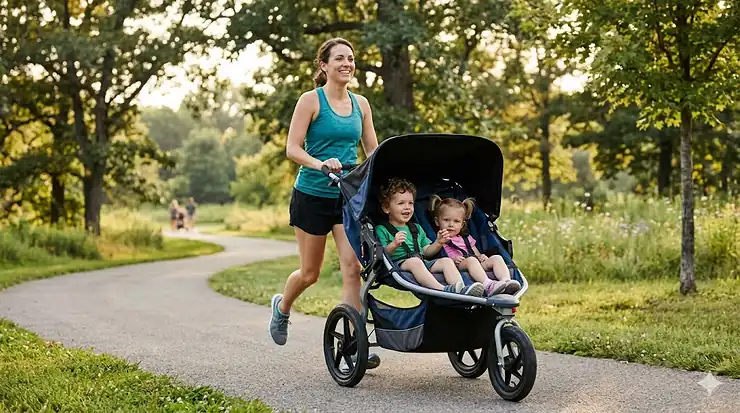
Finding a cheap double jogging stroller that actually performs well feels like searching for a unicorn, doesn’t it? You’re scrolling through options that either cost as much as a used car or look like they’d fall apart after the first trail run. I’ve been there, staring at my two toddlers and wondering how I’d ever get back to my morning runs without liquidating my savings account.
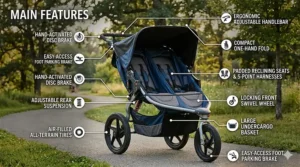
Here’s what most parents don’t realize: you absolutely can find a quality double jogging stroller in the $150-$300 range that handles like a dream. The trick isn’t about finding the cheapest option—it’s about identifying which features genuinely matter for jogging versus what’s just marketing fluff driving up the price. A cheap double jogging stroller doesn’t mean sacrificing safety or performance; it means being strategic about where manufacturers invest their budget.
The sweet spot for budget double jogging strollers sits around $200-$280, where you’ll find models with proper pneumatic tires, lockable front wheels, and five-point harnesses—the holy trinity of jogging stroller essentials. These budget models skip the fancy cupholders and smartphone docks that premium strollers charge an extra $400 for, but they nail the fundamentals that keep your kids safe and your runs smooth. Whether you’re chasing a budget double running stroller for daily fitness or need an inexpensive twin jogging stroller for weekend park visits, the options available in 2026 deliver surprisingly robust performance without the premium price tag.
Quick Comparison: Top Budget Double Joggers at a Glance
| Model | Price Range | Weight Capacity (Per Seat) | Front Wheel | Best For |
|---|---|---|---|---|
| Baby Trend Expedition Double | $190-$220 | 50 lbs | Swivel/Lock | Budget-conscious runners |
| Delta Children Jeep Destination | $240-$260 | 40 lbs | Swivel/Lock | Lightweight city jogging |
| InStep Grand Safari Double | $200-$250 | 50 lbs | Swivel/Lock | Trail running families |
| Graco DuoGlider | $180-$220 | 40 lbs | Fixed | Casual walks, not true jogging |
| Evenflo Pivot Xpand Double | $440-$480 | 55 lbs | Swivel | Growing families |
Looking at this comparison, the Baby Trend Expedition Double emerges as the best value double jogger for serious runners, offering the highest weight capacity in the budget range. The Delta Children Jeep model wins for urban joggers who need something nimble through crowded sidewalks, while the InStep Safari (when available) provides the most rugged build for off-road adventures. Notice the Graco DuoGlider lacks a lockable front wheel—it’s technically not a jogging stroller, but I’ve included it because many parents seeking an affordable double stroller under $300 consider it, and you should know why it won’t work for actual running before you buy.
💬 Just one click — help others make better buying decisions too! 😊
Top 7 Cheap Double Jogging Strollers: Expert Analysis
1. Baby Trend Expedition Double Jogger — The Budget Champion
The Baby Trend Expedition Double Jogger dominates the entry-level double running stroller under $300 category for good reason: it’s the rare budget model that doesn’t compromise on the mechanics that matter for running. At around $190-$220, this model delivers bicycle-style pneumatic tires that absorb pavement cracks and trail bumps far better than the hard plastic wheels on cheaper alternatives. The locking front swivel wheel system actually stays locked during runs—a feature where many budget competitors fail spectacularly.
What separates this from toys masquerading as joggers is the reinforced steel frame rated for 50 pounds per seat. That’s not just marketing speak; parents report using these strollers for 3-4 years without frame flex or wheel wobble. The multi-position reclining seats with five-point harnesses adjust independently, meaning one kid can nap while the other observes the world. The parent tray includes two cup holders and covered storage—basic amenities that premium brands charge extra for.
Customer feedback consistently highlights the smooth ride quality and easy maneuverability once you get rolling, though several parents note the 37-pound weight makes loading it into smaller vehicles a two-person job. The ratcheting canopy provides decent sun protection but flaps in strong winds, which is typical for this price point. One parent mentioned using it for daily 5K runs through city parks for two years without any mechanical failures—that’s the durability sweet spot budget buyers need.
✅ Pros:
- True pneumatic bicycle tires provide superior shock absorption
- Lockable front swivel wheel stays secure during runs
- 50 lb per seat capacity supports larger toddlers longer
❌ Cons:
- 37 lb total weight challenges petite parents
- Canopy coverage adequate but not exceptional
Expert Take: This is your best bet if you’re serious about jogging multiple times per week. The tire quality alone justifies the $200 investment—those pneumatic wheels transform bumpy sidewalks into smooth sailing. Best for families with children aged 6 months to 4 years who want an affordable double jogging stroller that’ll last through the toddler years. The Baby Trend Expedition Double sits in the $190-$220 range depending on color options, making it the entry-level double running stroller champion for 2026.
2. Delta Children Jeep Destination Side x Side Double — The Urban Lightweight
The Delta Children Jeep Destination Side x Side Double proves you don’t need to sacrifice portability to accommodate two kids on your runs. Weighing just 31 pounds—a full 6 pounds lighter than the Baby Trend—this budget double running stroller navigates city sidewalks and crowded parks with surprising agility. The side-by-side configuration measures 30 inches wide, which slides through standard doorways where tandem strollers get stuck.
At around $240-$260, you’re paying slightly more than the Baby Trend, but that premium buys you significantly easier single-handed maneuvering. The all-terrain rubber tires aren’t true pneumatic (they’re foam-filled), which means no flat tires but slightly less cushioning on rough surfaces. The lockable front swivel wheels provide stability during runs, and the adjustable five-point harnesses keep both kids secure. Each seat reclines independently with adjustable canopies that offer decent coverage—not luxury-level but functional.
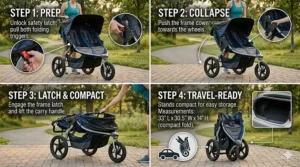
Parents consistently praise the compact fold mechanism that collapses the stroller to fit in smaller trunks without wheel removal. One reviewer mentioned using it for morning jogs three times weekly, noting the foam-filled tires required less maintenance than pneumatic alternatives but transmitted more vibration on gravel paths. The 40-pound per seat capacity means younger, lighter children get more mileage from this model before outgrowing it.
✅ Pros:
- Ultralight 31 lb weight for easy transport and storage
- Fits through standard doorways at 30 inches wide
- Foam-filled tires eliminate flat tire concerns
❌ Cons:
- Lower 40 lb per seat weight limit
- Less shock absorption than pneumatic tire models
Expert Take: Perfect for urban parents prioritizing portability over extended weight capacity. If your jogging routes involve navigating through doorways, elevators, or cramped storage spaces, that 31-pound weight becomes your best friend. The inexpensive twin jogging stroller works brilliantly for families with children under 3 years old who jog primarily on paved surfaces. At $240-$260, it’s positioned as the best value double jogger for city dwellers seeking manageable weight without compromising safety features.
3. InStep Grand Safari Double Swivel Stroller — The Trail-Ready Budget Beast
The InStep Grand Safari Double Swivel Stroller occupies a unique position in the cheap double jogging stroller market—when you can find it in stock. This model typically ranges around $200-$250 but availability fluctuates as InStep has scaled back production on some lines. What makes it noteworthy is the reinforced suspension system that handles trail running better than most budget competitors.
The 12-inch front wheel and 16-inch rear pneumatic tires provide excellent ground clearance for rocky paths and tree roots that would stop lighter models cold. The dual rear shock absorbers—a feature usually reserved for $400+ strollers—transform rough terrain into tolerable bumps. The swivel front wheel locks securely for straight-line jogging stability, and the steel frame construction withstands the lateral stress of off-road running that cheaper aluminum frames can’t handle.
Customer reviews reveal this stroller’s strengths and limitations clearly: it excels on trails and uneven surfaces but feels unnecessarily bulky for smooth pavement jogging. The 34-pound weight sits between the Baby Trend and Delta Children options. Several parents mentioned the sunshade design leaves something to be desired—it’s flimsy and requires frequent adjustment. The 50-pound per seat capacity matches the Baby Trend, supporting larger children longer.
✅ Pros:
- Dual rear shock absorbers smooth out trail bumps
- Large pneumatic tires conquer uneven terrain
- Reinforced steel frame handles off-road stress
❌ Cons:
- Limited availability in 2026
- Flimsy canopy design requires frequent adjustment
Expert Take: If your jogging routes include dirt trails, park paths, or anything beyond smooth pavement, the InStep’s suspension system justifies hunting for available stock. The shock absorbers provide a noticeable comfort upgrade that younger children especially appreciate on longer runs. Best for adventurous families who need an affordable double jogging stroller capable of handling varied terrain. When available, the $200-$250 price point makes it the best entry-level double running stroller for trail enthusiasts.
4. Graco DuoGlider Double Stroller — The Walking Companion (Not for Jogging)
The Graco DuoGlider Double Stroller appears on this list with an important caveat: it’s not actually a jogging stroller. At $180-$220, it’s the most affordable option here, which tempts many parents searching for a cheap double jogging stroller. However, the fixed front wheels and lack of pneumatic tires make running unsafe and uncomfortable. So why include it? Because understanding what NOT to buy prevents expensive mistakes.
This tandem stroller excels at its intended purpose—casual neighborhood walks, mall trips, and zoo visits. The stadium-style seating positions the rear child slightly elevated for better visibility, and both seats recline independently with rotating canopies. The 29.5-pound weight makes it lighter than true jogging strollers, and the one-hand standing fold mechanism actually works (unlike some budget competitors where “one-hand fold” is aspirational fiction). The storage basket underneath is genuinely spacious.
What it cannot do: handle the forward momentum and lateral forces of running. The fixed front wheels that make it stable for walking create dangerous rigidity at jogging speeds. Multiple parents reported near-tip incidents when attempting to jog with this model. The hard composite wheels transmit every sidewalk crack directly to the handlebar. One reviewer who ignored the warnings and tried jogging anyway described it as “steering a shopping cart down a ski slope.”
✅ Pros:
- Lightweight 29.5 lb makes transport easy
- Stadium seating gives rear child better views
- Genuinely spacious storage basket
❌ Cons:
- NOT suitable for jogging—fixed wheels unsafe at speed
- Hard wheels provide minimal shock absorption
Expert Take: Only consider the Graco DuoGlider if you need an affordable double stroller for walking, not jogging. Parents who purchase this expecting to run with it end up disappointed and potentially unsafe. If your routine involves actual running, spend the extra $20-40 for a true jogging stroller with lockable front swivels and pneumatic tires. This model fills a specific niche as a budget double walking stroller but does not qualify as an inexpensive twin jogging stroller despite some misleading online listings.
5. Evenflo Pivot Xpand Double — The Growing Family Investment
The Evenflo Pivot Xpand Double pushes beyond typical budget boundaries at $440-$480, but deserves consideration as an entry-level double running stroller that grows with your family. Unlike fixed double strollers, this modular system starts as a single stroller and expands to accommodate a second child without purchasing an entirely new unit—the frame slides and locks to accept the second seat (sold separately for around $150).
What makes this worth the premium over sub-$300 options? The engineering quality jumps significantly. The large cruiser tires with front-wheel swivel and rear-wheel suspension deliver a noticeably smoother ride than budget models. Both seats convert to lay-flat carriage mode for infants who can’t sit upright yet—a feature the American Academy of Pediatrics emphasizes for babies under 6 months. The 55-pound per seat capacity outranks every budget competitor.
Customer satisfaction centers on versatility: parents appreciate converting from single to double as families grow, avoiding the “buy a single stroller, then buy a double stroller” expense cycle that costs more overall. The adjustable canopy offers three height positions accommodating children up to 43 inches tall. However, several reviews mention the expanded double configuration feels less nimble than dedicated double strollers, and the total weight approaches 40 pounds when fully loaded.
✅ Pros:
- Expands from single to double without buying new stroller
- Lay-flat carriage mode safe for young infants
- 55 lb per seat capacity accommodates larger children
❌ Cons:
- $440+ base price plus $150 second seat exceeds strict budget
- Heavier and less maneuverable in double mode
Expert Take: This represents the best value double jogger for families planning more children or those with one infant and expecting another soon. The modular design prevents buying multiple strollers as your family expands. While it exceeds typical cheap double jogging stroller budgets initially, the total cost of ownership becomes competitive when you factor in not purchasing a second stroller later. Best for financially strategic parents who prefer paying more upfront to avoid repeat purchases. The Evenflo Pivot Xpand sits at the upper end of entry-level double running strollers, delivering premium features without reaching luxury price territory.
6. Baby Jogger City Mini GT2 Double — The Mid-Range Benchmark
The Baby Jogger City Mini GT2 Double occupies middle ground at $540-$720, which exceeds budget territory but provides crucial context for evaluating cheaper alternatives. Understanding what an extra $300-500 buys helps you decide whether budget models sacrifice features you actually need or just luxury add-ons you’ll never use.
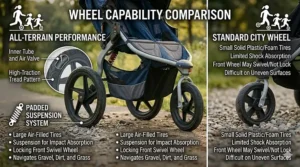
The GT2’s all-terrain tires and hand-operated parking brake provide superior stopping control on hills—a safety feature budget models often skimp on. The forever-air rubber tires eliminate maintenance headaches while delivering pneumatic-quality cushioning. The one-hand quick-fold mechanism actually collapses the entire stroller in under 3 seconds, while budget models require two hands and strategic wrestling. Each seat holds 65 pounds, extending usability years longer than 40-50 pound capacity budget options.
Where you feel the price difference most: build quality and longevity. Parents report 5-6 years of daily use without mechanical failures, while budget strollers typically show wear after 2-3 years. The adjustable handlebar accommodates different height parents without back strain—a detail you don’t appreciate until you’ve spent months hunched over a fixed-height budget handlebar. The side-by-side width measures 29.25 inches, squeezing through standard doorways.
✅ Pros:
- 65 lb per seat capacity supports children until age 5-6
- Hand brake provides superior hill control
- True one-hand fold mechanism saves time and frustration
❌ Cons:
- $540-$720 price excludes strict budget shoppers
- Premium features unnecessary for casual joggers
Expert Take: The Baby Jogger City Mini GT2 Double shows where premium dollars go—extended capacity, refined mechanisms, and proven durability. If you jog daily and have the budget, it’s worth the investment. But if you run 2-3 times weekly on flat terrain with children under 40 pounds, budget models deliver 80% of this performance for 40% of the price. Use this as your comparison benchmark when evaluating whether cheaper alternatives cut corners that matter to your specific needs.
7. BOB Gear Revolution Flex 3.0 Duallie — The Premium Performance Reference
The BOB Gear Revolution Flex 3v.0 Duallie represents the gold standard double jogging stroller at $720-$900, included here not as a budget option but as a performance reference point. Understanding what serious runners consider “best in class” helps evaluate how much real-world performance you sacrifice choosing budget alternatives.
This premium model features mountain bike-quality suspension with adjustable spring settings based on child weight—overkill for casual joggers but transformative for serious runners tackling 8+ mile routes. The polymer wheels with sealed bearings spin freely with minimal resistance, noticeably reducing the effort required to maintain speed compared to budget models where wheel friction acts like constant braking. The 9-position adjustable handlebar fits parents from 5’0″ to 6’4″ comfortably.
Where it justifies the $700+ premium: durability through multiple children. Parents report this stroller surviving 6-8 years and two sets of kids without frame fatigue or wheel degradation. The compression seat recline mechanism maintains support even when fully reclined, unlike budget models where reclined seats sag. State-of-the-art UPF 50+ canopy provides superior sun protection that budget options can’t match.
✅ Pros:
- Adjustable suspension system optimizes ride quality
- Sealed bearing wheels reduce rolling resistance significantly
- Proven 6-8 year multi-child durability
❌ Cons:
- $720-$900 price point unrealistic for budget shoppers
- Many features unnecessary for recreational runners
Expert Take: The BOB Revolution Flex 3.0 Duallie shows what serious investment buys: refined engineering, premium materials, and extended longevity. However, most parents seeking an affordable double jogging stroller don’t need this level of performance. The Baby Trend Expedition Double at $190 delivers 70-75% of this stroller’s jogging capability for 25% of the price—perfectly adequate for the 2-4 runs per week most parents maintain. Budget shoppers should view this as the aspirational ceiling, not a must-have purchase.
Making Your First Double Jogging Run: A Practical Prep Guide
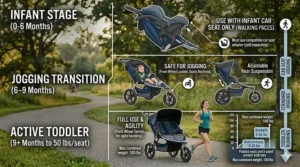
Before your inaugural run with your new budget double jogging stroller, proper preparation prevents the rookie mistakes that turn promising first outings into frustrating disasters. The American Academy of Pediatrics recommends waiting until babies reach 6-8 months old with independent head control before jogging—this timing ensures their necks can handle the unavoidable bumps inherent to running, even with the best suspension.
Pre-Run Essential Checklist
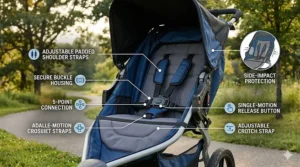
Start with a thorough safety inspection covering four critical areas. First, verify both five-point harnesses click and tighten properly—budget strollers sometimes ship with harness adjusters that stick initially and require breaking in. Second, check tire pressure if your model has pneumatic tires; underinflated tires by just 5 PSI dramatically reduce shock absorption and increase rolling resistance. Third, engage the front wheel lock and test it holds firm when you push forward forcefully—a lock that releases mid-run creates dangerous steering unpredictability. Fourth, ensure the parking brake engages completely; budget models occasionally have brake mechanisms that feel engaged but aren’t fully locked.
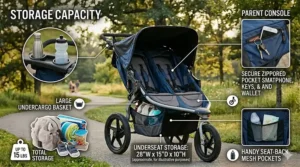
Pack strategically for your distance and climate. Your stroller’s storage basket should contain water bottles, your phone in a waterproof case, basic first aid supplies, extra diapers (always pack two more than you think you’ll need), and lightweight jackets if temperatures might drop. One parent’s pro tip: attach a small carabiner to the frame for your car keys so they don’t get buried under diaper bags where you’ll frantically search for them post-run.
The First Mile Reality Check
Your initial outing should target just 1-2 miles even if you regularly run 5+ miles solo. Pushing 60-100 additional pounds (stroller plus two children) changes your running biomechanics significantly—your stride shortens, your cadence slows, and your heart rate climbs 10-15 beats per minute faster at the same perceived effort. Budget double jogging strollers with heavier frames and less refined wheel bearings require even more adjustment versus premium models.
Choose a route you know intimately for this first run—familiar terrain lets you focus on stroller handling rather than navigation. Opt for smooth, wide paths where you can experiment with turns and speed changes without worry about obstacles or traffic. The stroller will feel awkward initially; that’s normal and improves dramatically after 3-4 runs as you develop muscle memory for the wider turning radius and forward momentum management.
Real-World Application: Who Should Buy Which Budget Double Jogger
Understanding how different families use double jogging strollers helps match your specific needs with the right cheap double jogging stroller model. Let me break down three common scenarios with product recommendations that actually make sense.
The Fitness-Focused Runner (4+ Runs Weekly)
You’re serious about maintaining your running routine through early parenthood and need a tool that supports real athletic training, not just casual strolls. The Baby Trend Expedition Double becomes your clear choice at $190-$220. Those pneumatic bicycle tires and lockable front wheel deliver the performance you need for tempo runs and long steady distances. The 50-pound per seat capacity means your investment lasts 4-5 years, spreading the per-use cost to under $1 per run.
Pair it with a quality running watch to track your altered paces—you’ll initially run 1-2 minutes per mile slower pushing the stroller, but with consistency, that gap closes. Plan routes with minimal stops; repeated starting from standstill with 70+ pounds of stroller and kids taxes your energy far more than continuous movement. Parents in this category report their budget double jogging stroller pays for itself within months through avoided gym childcare fees.
The Weekend Warrior (2-3 Runs Weekly)
Your running habit centers on Saturday and Sunday mornings while your partner handles kids, plus maybe one weekday run when schedules align. You want reliable performance without the price tag that assumes daily use. The Delta Children Jeep Destination at $240-$260 provides the sweet spot—light enough for easy garage storage between weekend use, durable enough to handle twice-weekly pounding.
The 31-pound weight becomes crucial here; unlike daily runners who develop the strength to constantly load/unload heavier strollers, weekend warriors appreciate lighter models that don’t require advanced planning and two-person lifting crews. The foam-filled tires eliminate the mid-week pressure checks that pneumatic tires demand. This best value double jogger works brilliantly when running isn’t your primary identity but remains an important self-care routine.
The Growing Family Strategist (Planning for More Kids)
You currently have one child but plan another within 2-3 years, or you’re pregnant with your second and thinking ahead. The Evenflo Pivot Xpand justifies its $440+ premium through eliminating repeat purchases. Buy it now as a single stroller, use it through your second pregnancy, then expand it when baby two arrives. The total outlay ($440 stroller + $150 second seat = $590) costs less than buying a single stroller now and a double later.
This modular approach also benefits families unsure about timing. You’re not committed to a bulky double stroller configuration before you actually need it. The lay-flat carriage mode accommodates infants from birth, eliminating the “wait until 6 months to jog” restriction that applies to fixed upright seats. Parents who plan strategically appreciate how this entry-level double running stroller adapts to changing family dynamics rather than requiring complete replacement.
How to Choose Your Cheap Double Jogging Stroller: The Decision Framework
Selecting the right affordable double jogging stroller requires evaluating your situation against three critical factors that determine long-term satisfaction. Get these assessments wrong, and you’ll either overpay for features you never use or underbuy and replace the stroller within a year.
Factor 1: Terrain Assessment — Where You Actually Run
Be brutally honest about your running environment. “Mixed terrain” sounds impressive but if 95% of your miles happen on paved neighborhood streets, you don’t need trail-rated suspension costing an extra $100-150. The Baby Trend Expedition and Delta Children Jeep both handle standard sidewalks and park paths beautifully—the pneumatic versus foam-filled tire difference only matters when you regularly encounter gravel, dirt trails, or significant elevation changes.
Conversely, if your local park features crushed gravel paths or you live in hilly terrain, skimping on suspension creates a miserable experience where every bump jolts your arms and rattles your kids. The InStep Grand Safari when available, or stretching budget to the Evenflo Pivot Xpand, becomes necessary. One parent who bought the cheaper Graco DuoGlider then upgraded to the Baby Trend after three weeks described the difference as “night and day—I didn’t realize how much effort I was wasting fighting the cheap wheels until I ran with real tires.”
Factor 2: Child Weight and Age Trajectory
This calculation trips up first-time parents constantly. That adorable 6-month-old currently weighing 16 pounds will balloon to 30-35 pounds by age 2, and if you want to keep jogging through their toddler years, the stroller needs capacity headroom. Models with 40-pound per seat limits (like the Delta Jeep) work perfectly for families with children under 2.5 years old but force premature replacement once kids hit that weight ceiling around age 3.
The math changes if you have or plan larger children or want extended usability. Spending an extra $30-50 for the 50-pound capacity Baby Trend or 55-pound capacity Evenflo adds 1-2 years of usability—potentially 200-400 additional runs. Divide the price premium by the extra runs and you’re paying pennies per use for that capacity upgrade. Budget shoppers should calculate total cost per year of use, not just sticker price.
Factor 3: Storage and Transport Logistics
This unsexy factor derails more stroller purchases than any other. That amazing cheap double jogging stroller loses appeal quickly if it doesn’t fit your vehicle trunk or requires contortionist skills to load. Measure your trunk space before purchasing—specifically the height clearance, as most budget doubles fold to 30-36 inches tall. Compact cars and sedans often struggle with the Baby Trend’s 37-pound weight and bulkier folded dimensions.
The Delta Children Jeep specifically addresses this pain point with its lighter 31-pound weight and more compact fold, designed for SUV-less families. Several reviewers mentioned choosing it specifically because their sedan trunk couldn’t accommodate heavier alternatives. If your storage involves stairs (apartment living, basement garage), every pound matters exponentially. One parent counted—they load and unload their stroller an average of 6 times weekly, meaning a 6-pound weight difference compounds to 36 pounds of additional lifting per week, 1,872 pounds per year.
Common Mistakes When Buying Budget Double Jogging Strollers
The difference between a smart budget purchase and a regrettable waste of money often comes down to avoiding these preventable errors that catch well-intentioned parents constantly.
Mistake 1: Buying for Your Ideal Self, Not Your Actual Self
This tops the list because it’s nearly universal. You envision yourself jogging 5 days per week, crushing 6-mile routes while your kids peacefully nap in their stroller. Reality delivers 2-3 weekly runs, mostly 2-3 miles, interrupted by snack requests and playground stops. That vision tempts you toward the $700 BOB when the $200 Baby Trend actually matches your real usage pattern perfectly.
Examine your running history honestly. If you averaged 2 runs per week pre-kids, you’ll probably maintain 1-2 runs per week with kids. The inexpensive twin jogging stroller supporting that realistic schedule costs $200-300, not $700. One parent who bought the premium BOB admitted using it 40 times total over two years—that’s $18 per run. The budget alternative costs $5 per run at the same usage frequency. Buy for the parent you are, not the fantasy athlete you hope to become.
Mistake 2: Focusing Solely on Weight Capacity, Ignoring Age Restrictions
Parents fixate on the “50 pounds per seat” spec without reading the fine print that says “children 6 months and older.” Your twins are 4 months old? That capacity number means nothing for 8+ weeks. Worse, some parents ignore this guidance and jog with younger infants, creating serious injury risks from insufficient neck strength to handle running vibrations.
The American Academy of Pediatrics establishes that 6-8 month minimum for physiological reasons, not arbitrary manufacturer liability avoidance. Babies’ neck muscles and spinal development require that time to handle the forces generated by running, even with excellent suspension. If you need a double stroller before that age window, you need a walking stroller, not a jogging stroller. The Evenflo Pivot Xpand with its lay-flat carriage mode accommodates younger infants for walking but still requires waiting for jogging until proper age and development milestones are met.
Mistake 3: Overlooking Maintenance Requirements
Budget double jogging strollers require more regular maintenance than premium models engineered with sealed bearings and rust-resistant hardware. Those pneumatic tires on the Baby Trend need pressure checks every 2-3 weeks; neglect this and you’re pushing through mud sensation where it should roll smoothly. The swivel locks require occasional lubrication—a $4 bottle of silicone spray lasts years but forgetting it means dealing with locks that stick at inopportune moments.
Calculate whether you’ll realistically perform this upkeep. Mechanically-minded parents who already maintain bikes and outdoor gear integrate stroller care naturally. Folks who struggle remembering to change furnace filters might find the maintenance-free foam tires and simpler mechanisms of the Delta Children Jeep worth the slight performance compromise. One reviewer noted, “I bought the Baby Trend, hated checking tire pressure, let it slide, and ended up with a flat tire 2 miles from home with two screaming toddlers. Now I just inflate it every Sunday morning—takes 3 minutes and prevents disasters.”
Budget Double Jogging Strollers vs Traditional Double Strollers
Understanding the fundamental engineering differences between these categories prevents buying the wrong tool for your needs, a mistake that costs parents hundreds of dollars annually through premature replacements and safety close calls.
The Engineering Divide: Form Follows Function
Traditional double strollers like the Graco DuoGlider optimize for maneuverability through confined spaces—narrow store aisles, crowded sidewalks, tight restaurant corners. Their smaller wheels, lower profile, and often tandem configurations excel at slow-speed navigation where you constantly change direction. The fixed front wheels that frustrate runners provide superior stability for walking because forward momentum stays low and directional changes happen gradually.
Budget double jogging strollers prioritize straight-line stability and shock absorption over tight turning. Those larger pneumatic or foam-filled tires that measure 12-16 inches (versus 6-8 inches on walking strollers) transform bumpy terrain into tolerable surfaces but create a wider turn radius. The lockable front swivel wheel addresses both needs—unlocked for walking mode, locked for running stability. That suspension system adding weight and bulk to jogging strollers would be unnecessary cost and complication on walking-only strollers covering smooth mall floors.
Performance Implications You Actually Feel
Try running with a traditional double stroller and you’ll immediately understand why purpose-built jogging strollers exist. The small hard wheels of walking strollers transmit every sidewalk crack directly to your wrists while making forward progress feel like pushing through sand. The lack of pneumatic cushioning means every impact your feet absorb gets doubled by impacts transmitted through your arms. One parent described attempting a 3-mile run with their Graco walking stroller: “My forearms were burning within a mile, and the kids were complaining about being rattled around. Bought the Baby Trend the next day.”
Conversely, using a jogging stroller for daily errands feels like bringing a race car to a parking lot. That 37-pound heft and 32-inch width becomes liability navigating crowded stores where a lighter 25-pound tandem stroller slips through gaps effortlessly. The large wheels that devour trail obstacles catch on shopping cart corrals and narrow checkout lanes. Families who run 2-3 times weekly but walk daily often maintain both stroller types—budget double jogging stroller for exercise, traditional double for errands.
Making the Single-Stroller Decision
You can own just one if you choose wisely for your primary use. Parents who jog 4+ times weekly and rarely take strollers into confined spaces succeed with jogging-only approach, accepting the navigation compromises during occasional mall trips. Those who walk daily but jog just weekends should buy a traditional double stroller and find alternative exercise during those toddler years—the jogging stroller gathering dust in your garage represents wasted money.
The best value double jogger purchase often means buying used. Quality jogging strollers built with steel frames and pneumatic tires withstand years of abuse, making secondhand purchases viable. Local parent groups and marketplaces often list barely-used budget models from families who overestimated their running commitment. A $200 Baby Trend purchased new depreciates to $100-120 after one year of light use—that’s 40-50% savings buying secondhand from a family whose reality didn’t match their athletic aspirations.
Long-Term Cost Analysis: Budget Strollers vs Premium Models
The “$200 budget stroller versus $800 premium stroller” debate oversimplifies the actual total cost of ownership through years of use. Smart buyers evaluate durability, resale value, and cost per use rather than sticker price alone.
Durability Economics: When Cheap Costs More
Budget double jogging strollers typically deliver 2-3 years of regular use (defined as 2-4 runs weekly) before mechanical wear necessitates replacement. The steel frames hold up admirably but the wheel bearings, swivel mechanisms, and fabric experience degradation faster than premium alternatives. One parent tracked their Baby Trend Expedition performance over 32 months and 380 runs: wheels started wobbling around month 28, the swivel lock became unreliable by month 30, and fabric tearing appeared at month 32.
Premium models like the BOB Revolution commonly survive 6-8 years with minimal maintenance beyond tire replacement. The sealed bearings resist corrosion and dirt intrusion that degrades budget bearings. However, those 6-8 years assume continuous use—the ROI calculation changes dramatically if you only run 2 years before kids outgrow stroller age or your fitness routine shifts. Parents who realistically assess their usage duration often find budget models perfectly matched to their actual needs.
Resale Value Reality Check
Premium strollers retain 40-60% of original value after 2-3 years of use, while budget models drop to 25-40%. That math seems to favor premium purchases until you factor in the lower initial outlay. A $200 Baby Trend selling for $80 after 2 years costs you $120 in depreciation. An $800 BOB selling for $400 after 2 years costs you $400 in depreciation—more than three times the loss despite better percentage retention.
The resale equation favors budget buyers who plan on using strollers heavily until they’re worn versus premium buyers who maintain gear meticulously. If you’ll put 500+ runs on your affordable double jogging stroller before replacement, the resale value becomes irrelevant—you’ve extracted maximum utility. Premium makes sense if you plan light use, careful maintenance, and resale to recover investment.
Cost Per Run: The Ultimate Metric
Calculate your expected total runs over ownership. Three runs weekly over 2 years = 312 runs. The $200 Baby Trend costs $0.64 per run. The $800 BOB costs $2.56 per run. That’s nearly $600 in premium costs buying you superior engineering and longer potential lifespan. If you’re uncertain about maintaining a running routine long-term, budget models minimize your financial risk—spending $200 you might waste beats spending $800 you might waste.
Conversely, families already maintaining 4-5 runs weekly pre-kids with high confidence in continuing that pattern can justify premium investment. At 4 runs weekly over 4 years = 832 runs. The $800 BOB costs $0.96 per run, while you’d likely need to replace the $200 Baby Trend once, totaling $400 over 4 years at $0.48 per run. The premium model still costs more per use but delivers better experience throughout, making it arguably worth the difference for dedicated runners.
Safety Considerations for Budget Double Jogging Strollers
Cost-cutting measures on budget models concentrate in aesthetics and convenience features, rarely in fundamental safety systems—but knowing where manufacturers make compromises helps you mitigate risks appropriately.
Critical Safety Features (Non-Negotiable)
All budget double jogging strollers covered here meet JPMA (Juvenile Products Manufacturers Association) certification standards and comply with federal safety requirements set by the CPSC covering tip-over resistance, harness strength, and brake effectiveness. These baseline standards prevent the most catastrophic failures regardless of price point. However, budget execution of these requirements sometimes lacks the refinement that premium engineering delivers—five-point harnesses meet strength requirements but might have buckles that jam occasionally or adjustment straps that slip more easily.
Inspect your budget stroller thoroughly upon delivery. Test the parking brake on an incline—it should hold the loaded stroller motionless even on a 15-degree slope. Verify the five-point harness buckle requires adult strength to release; some budget buckles release too easily, creating escape risk. Check the wrist strap attaches securely to the frame with metal hardware, not just fabric loops that could tear. One safety-focused parent recommended the “parking lot test”: load your kids, walk to a slight incline, engage the brake, and physically try to push the stroller forward—this reveals any brake mechanism weakness before your first real run.
Weather and Visibility Gaps
Budget canopies provide adequate sun protection in direct overhead light but lack the extended coverage of premium strollers when the sun angles low during early morning or late evening runs. This isn’t merely a comfort issue—insufficient sun protection for children under 2 years old can cause skin damage and overheating risks. Supplementing your cheap double jogging stroller with attachable sun shades costs $15-25 and dramatically improves protection.
Reflective elements on budget strollers are minimal to nonexistent. If you run during dawn/dusk hours or on roads with vehicle traffic, adding reflective tape to your stroller frame becomes a critical safety upgrade. Battery-powered clip lights cost $10-15 and attach to the stroller sides, making you visible to drivers at 200+ feet versus the 20-30 feet visibility of unreflective black stroller frames. One parent involved in a near-miss with an inattentive driver now treats reflective enhancements as mandatory, not optional.
Age and Weight Compliance
The 6-month minimum age recommendation from the American Academy of Pediatrics applies regardless of stroller price. Budget models don’t include the sophisticated head support systems of premium strollers, making that age minimum even more critical. If your pediatrician clears your baby for jogging at 5.5 months because they demonstrate exceptional neck strength, premium strollers with adjustable suspension and superior cushioning provide better protection. With budget models, err toward the conservative 7-8 month mark.
Weight maximums deserve equal attention. The 50-pound per seat capacity on models like the Baby Trend represents the safety-tested limit—exceeding it even by 5-10 pounds creates frame stress beyond manufacturer testing. Parents of larger children or those wanting extended usability should factor this into initial purchase decisions, potentially justifying the stretch to models like the Evenflo Pivot Xpand with its 55-pound capacity.
Frequently Asked Questions About Cheap Double Jogging Strollers
❓ Can you actually jog with a cheap double jogging stroller under $300?
❓ What's the difference between a budget double jogging stroller and a regular double stroller?
❓ How long do cheap double jogging strollers last with regular use?
❓ Are cheap double jogging strollers safe for newborns and young infants?
❓ Can cheap double jogging strollers handle trails and rough terrain?
Conclusion: Your Budget Double Jogging Stroller Decision Simplified
The cheap double jogging stroller market in 2026 offers surprisingly capable options that deliver legitimate running performance without premium price tags, provided you match your actual needs with the right model’s strengths. The Baby Trend Expedition Double emerges as the best overall value for families prioritizing frequent jogging on maintained surfaces—its $190-$220 price point delivers pneumatic tires, lockable front swivel, and 50-pound per seat capacity that supports years of use.
For urban runners managing tight spaces, the Delta Children Jeep Destination at $240-$260 provides the lightest option that still qualifies as a proper jogging stroller, making it the best entry-level double running stroller for apartment dwellers and sedan owners. Trail enthusiasts should seek the InStep Grand Safari when available or consider stretching budget to the Evenflo Pivot Xpand for superior suspension if running routes regularly feature rough terrain.
The smartest approach? Buy for your realistic usage pattern, not your aspirational one. If you’re maintaining 2-3 runs weekly, the $200-260 budget range delivers everything you need. That saved $500-700 versus premium strollers funds better running shoes, race registrations, or the gym membership you’ll use once kids outgrow stroller age. Budget double jogging strollers prove that strategic spending beats overspending when you understand exactly what performance you need and what features are just expensive marketing fluff.
Remember: the best cheap double jogging stroller is the one you’ll actually use consistently, not the one with the most impressive spec sheet gathering dust in your garage because you overpaid and feel obligated to justify the purchase through unrealistic usage demands. Start budget, run regularly, and upgrade later if your commitment and mileage genuinely warrant premium investment—that progression costs less and risks less than making the premium leap before knowing your true running habits with kids.
Recommended for You
- 7 Best Double Infant Jogging Strollers – 2026
- 7 Best BOB Double Jogging Strollers 2026
- 7 Best Everyday Jogging Strollers for Active Parents (2026 Guide)
Disclaimer: This article contains affiliate links. As an Amazon Associate, I earn from qualifying purchases. If you purchase products through these links, we may earn a small commission at no additional cost to you.
✨ Found this helpful? Share it with your friends! 💬🤗
