
In This Article
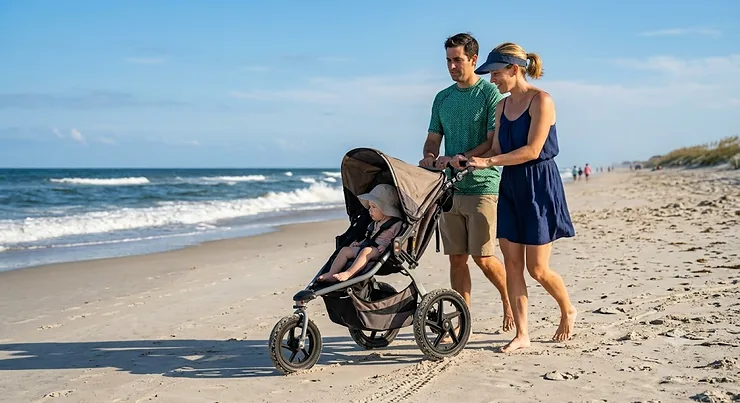
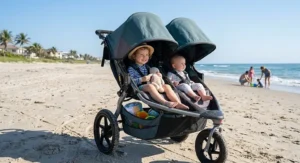
Sand has a way of humbling even the most expensive stroller. You roll confidently off the parking lot, hit that first patch of soft, dry sand near the dunes, and suddenly you’re pushing what feels like a shopping cart full of bricks through wet cement. If you’ve ever stood there, sweating, hauling a stroller sideways while your toddler watches from inside like it’s the funniest thing they’ve seen all week, you already know why picking the best stroller for beach days isn’t a small decision.
So what is a beach stroller for baby, exactly? It’s a stroller purpose-built with wider or larger pneumatic tires, a low center of gravity, corrosion-resistant hardware, and a wheelbase wide enough to spread weight across soft or uneven terrain instead of digging straight through it. Not every “all-terrain” stroller qualifies, and that’s the trap most parents fall into.
This guide covers real, current models — three-wheel joggers, all-terrain wagons, and a couple of surprising crossovers — chosen because they hold up against sand, salt air, and sun rather than just looking rugged in a product photo. We’ll dig into the honest tradeoffs of seven specific strollers, walk through comparison data, and cover setup, maintenance, and buying mistakes that don’t show up in a five-star review. Every stroller mentioned meets or should be verified against the federal safety standard for carriages and strollers before you buy, so we’ve linked the official CPSC stroller safety standard right up front.
By the end, you’ll know which of these seven actually deserves a spot in your trunk before Memorial Day weekend — and which ones just talk a big game.
Quick Comparison: Best Stroller for Beach at a Glance
| Stroller | Wheel Type | Best For | Price Range |
|---|---|---|---|
| Bugaboo Fox 5 Renew | 8″ front / 12″ rear, sand & stair mode | Premium all-rounder, frequent beach families | $1,300-$1,600 range |
| BOB Gear Revolution Flex 3.0 | 12″ front / 16″ rear, air-filled | Active parents, jogging + beach | $600-$700 range |
| Graco Modes Adventure Stroller Wagon | All-terrain rubber, suspension | Two kids, budget-conscious families | $300-$400 range |
| Radio Flyer All-Terrain Venture Wagon | Large all-terrain wheels | Push-or-pull versatility on sand | $250-$350 range |
| Baby Jogger City Mini GT2 | 8.5″ foam-filled tri-wheel | City-to-beach crossover use | $350-$450 range |
| Babyzen YOYO2 | Small hard wheels | Ultra-compact travel, boardwalk only | $500-$600 range |
| Radio Flyer Trav’ler Stroll ‘N Wagon | Rubber wheels w/ bearings | Airport travel + light beach use | $250-$300 range |
Looking at this table, one thing jumps out fast: wheel size and tire type do almost all the work when it comes to sand performance, and price doesn’t always track with capability. The Radio Flyer All-Terrain Venture Wagon actually outperforms some pricier strollers on loose sand because of its low center of gravity and wide wheelbase, while the ultra-popular Babyzen YOYO2 sits at the bottom of this list for beach use despite a premium price tag — its hard, narrow wheels simply weren’t built for dunes. Keep this table in mind as a cheat sheet; we’ll unpack the reasoning behind every ranking below.
💬 Bookmark this table now — you’ll want to compare it again after reading the full breakdowns below!
💬 Just one click — help others make better buying decisions too!😊
Top 7 Best Strollers for Beach: Expert Analysis
Real products, real specs, and honest analysis of who each one actually fits. No invented reviews here — where we couldn’t verify specific aggregated sentiment, we say so.
1. Bugaboo Fox 5 Renew — sand and stair mode built right into the chassis
The standout here isn’t a spec sheet number — it’s a mechanical trick. Fold the rear wheels forward and the Bugaboo Fox 5 Renew tilts back onto its larger 12-inch rear wheels, letting you trolley it through sand, snow, or up a curb the same way you’d wheel a hand truck.
That matters because the stroller’s 8-inch front wheels, on their own, would behave like most premium strollers on soft sand: fine on packed paths near the boardwalk, sluggish the moment things get loose and dry. The sand-and-stair mode essentially turns a mediocre-in-sand chassis into a genuinely capable one by changing how weight distributes across the wheelbase. Add all-wheel suspension and a 26.9-pound aluminum frame, and you get a stroller that transitions from parking lot to shoreline without a fight.
Based on the spec comparison with other premium all-terrain strollers, this is the pick for parents who want one stroller to do everything — daily city walks, hiking trails, and beach vacations — without owning three separate strollers. Reviewers consistently note the two-wheel mode is a genuine problem-solver for stairs and gravel, not just a marketing gimmick, though several point out the shared bassinet-and-seat frame makes it less ideal for families with two kids close in age who need simultaneous configurations.
Pros:
- ✅ Sand-and-stair mode genuinely changes sand performance
- ✅ Premium all-wheel suspension smooths washboard sand ruts
- ✅ Lightweight aluminum frame despite large wheels
Cons:
- ❌ Premium price puts it out of reach for casual beach-goers
- ❌ Shared frame limits use with two close-in-age children
At a price in the $1,300-$1,600 range, this is a splurge — but for families who hit the beach every weekend from May through September, the cost-per-use math evens out fast compared to replacing a cheaper stroller that seizes up from salt corrosion after two seasons.
2. BOB Gear Revolution Flex 3.0 — mountain-bike suspension meets a 16-inch rear tire
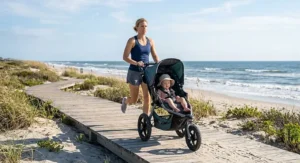
The 16-inch rear pneumatic tire on the BOB Gear Revolution Flex 3.0 is the detail that matters most for sand performance, since a taller air-filled tire floats over loose surfaces where smaller foam wheels would plow straight through.
Paired with a 12-inch front tire and BOB’s signature mountain-bike-style suspension, this stroller handles the transition from paved boardwalk to soft dune sand with noticeably less resistance than tri-wheel city strollers in its price bracket. The swivel-locking front wheel can also be locked straight for stability, which is the move you want the moment you leave the packed sand near the water and head up toward dry, loose sand by the dunes.
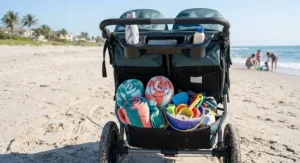
What most buyers overlook about this model is that it wasn’t designed as a beach stroller first — it’s a jogging stroller that happens to translate well to sand because joggers and beach terrain share the same core requirement: big air-filled tires that resist sinking. Reviewers consistently praise the six storage pockets and extra-large cargo basket for holding beach gear, and multiple owners mention the frame has held up over years of regular outdoor use, though a few note the 28.5-pound weight is noticeably heavier to lift in and out of a trunk than lighter umbrella strollers.
Pros:
- ✅ 16-inch air-filled rear tire floats over loose sand
- ✅ Six storage pockets fit beach gear easily
- ✅ Five-year frame warranty backs long-term durability
Cons:
- ❌ 28.5 lbs makes trunk loading more of a workout
- ❌ Not designed with a front swivel lock for infants under 8 weeks
Priced in the $600-$700 range, the Revolution Flex 3.0 delivers genuine off-pavement capability at roughly half the cost of the Fox 5 Renew, making it the value pick for parents who also jog or hike regularly.
3. Graco Modes Adventure Stroller Wagon — two kids, one budget-friendly beach hauler
The standout advantage of the Graco Modes Adventure Stroller Wagon is its combination of a 100-pound total weight capacity and all-terrain rubber tires with front suspension, at a price that undercuts most two-seat wagons by a wide margin.
Unlike a traditional stroller, the wagon format lowers the center of gravity and widens the footprint, both of which directly translate to better flotation on soft sand — physics that beach-specific wagon reviews consistently point back to. The rubber (not EVA foam) tires on this model provide a noticeably softer ride over uneven, rutted beach parking lots, and front spring suspension takes the edge off washboard sand.
Based on the spec comparison against pricier stroller wagons, the Adventure Wagon compromises in a few predictable places to hit its price point: it converts between push and pull modes, but the handle transition isn’t as smooth as premium competitors, and it lacks the boxy, kid-friendly walls that let toddlers use the wagon as a play fort at rest stops. Reviewers consistently rate build quality and zipper/buckle performance highly, while a common complaint in user reviews is that the pull handle feels awkward specifically in wagon mode, a tradeoff worth knowing before purchase rather than discovering at the parking lot.
Pros:
- ✅ 100 lb capacity fits two toddlers comfortably
- ✅ Rubber tires with suspension smooth bumpy beach lots
- ✅ Folds 30% smaller than comparable wagons for trunk storage
Cons:
- ❌ Handle transition between push and pull feels clunky
- ❌ No car seat adapter included (sold separately)
At $300-$400 range, this is the strongest value pick on this list for families with two young kids who want wagon capacity without wagon-level pricing.
4. Radio Flyer All-Terrain Venture Stroll ‘N Wagon — push-or-pull design with a low, wide stance built for loose sand
The convertible push-and-pull handle on the Radio Flyer All-Terrain Venture Wagon is the standout feature, letting you pull it like a traditional wagon across a parking lot, then push it stroller-style once you’re navigating a crowded boardwalk.
What most buyers overlook about wagons generally is that pulling — rather than pushing — puts your own body weight behind forward momentum, which keeps the leading wheels riding higher on top of soft sand instead of plowing downward into it. That’s exactly why wide, all-terrain wagons consistently outperform narrower strollers in soft, dry sand according to hands-on sand testing from family gear reviewers. The sturdy aluminum handles and telescoping design add durability that resists the kind of flex cheaper plastic-framed wagons develop after a season of loading and unloading gear.
Honest analysis here: this wagon trades some maneuverability in tight spaces — think crowded boardwalk shops — for genuinely superior straight-line sand performance. Reviewers consistently note the sturdy build and rust-resistant hardware hold up well season after season, provided owners rinse the wheels and axles after each beach trip rather than only wiping down the frame.
Pros:
- ✅ Convertible push/pull handle adapts to any surface
- ✅ Low, wide stance resists sinking in dry sand
- ✅ Rust-resistant hardware built for repeated beach use
Cons:
- ❌ Bulkier footprint makes tight boardwalk shops awkward
- ❌ Requires manual rinse-and-dry maintenance after each trip
In the $250-$350 range, this wagon offers some of the best sand-specific performance on this list for a genuinely accessible price.
5. Baby Jogger City Mini GT2 — foam-filled all-terrain tires with a lighter, more compact frame
The 8.5-inch foam-filled tires on the Baby Jogger City Mini GT2 never go flat, which is the standout practical advantage — no patch kits, no pumps, no surprise blowouts halfway through a beach vacation.
Here’s what the spec sheet won’t tell you, but independent hands-on testing makes clear: those 8.5-inch tires are considerably smaller than the 12-16-inch tires on true all-terrain strollers, and the narrower wheelbase that comes with a tri-wheel city design leaves it more prone to tipping when navigating uneven, soft terrain off the sidewalk. This is a stroller engineered primarily for city sidewalks and light grass, with sand capability as a secondary, “it’ll survive” feature rather than a primary design goal.
Based on that comparison, the City Mini GT2 makes the most sense for beach towns where you’re parking near a paved boardwalk and only crossing a short stretch of packed, wet sand to reach your umbrella — not for hauling gear across a quarter-mile of dry dune sand. Independent testers found the all-wheel suspension smooths minor bumps well on pavement, but noted the smaller wheels struggled specifically when transitioning from sidewalk to grass or looser terrain, a pattern that would only be more pronounced on dry beach sand.
Pros:
- ✅ Foam-filled tires never go flat or need air
- ✅ Lighter and more compact than true all-terrain models
- ✅ Near-flat recline works well for beach naps
Cons:
- ❌ Smaller 8.5-inch wheels struggle on loose, dry sand
- ❌ Narrower wheelbase feels tippier on uneven terrain
Priced in the $350-$450 range, this is a reasonable pick specifically for boardwalk-adjacent beach towns, not dune-heavy or wide-beach destinations.
6. Babyzen YOYO2 — the lightest fold on this list, but not built for dry sand
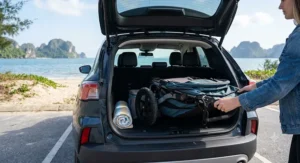
At just 13.6 pounds, the Babyzen YOYO2 stands out for a fold small enough to fit an airline overhead bin — a genuinely different use case than everything else on this list.
Independent lab testing found the YOYO2’s wheels are hard, dense, and offer little real traction, excelling on smooth surfaces like tile and pavement but struggling the moment terrain gets soft or uneven. That’s not a knock on build quality — the aluminum-alloy-and-fiberglass-reinforced frame is genuinely well constructed — it’s simply a mismatch between wheel design and beach terrain. On packed, wet sand near the shoreline it manages fine; on dry, loose sand further from the water, expect to lift and carry rather than roll.
What most buyers overlook is that this stroller earns its spot on a beach list not because it dominates sand, but because it’s the practical choice for beach vacations that involve flights, rental cars, and boardwalk towns where portability outweighs raw sand capability. Reviewers consistently describe it as expensive relative to its feature set but exceptionally well built, with the compact fold repeatedly cited as the deciding factor for travel-heavy families.
Pros:
- ✅ 13.6 lbs and airline carry-on compatible fold
- ✅ Reclines near-flat for beach-day naps
- ✅ Premium materials resist wear over years of travel
Cons:
- ❌ Hard, narrow wheels struggle on dry, loose sand
- ❌ Small canopy offers less shade than dedicated beach strollers
At $500-$600 range, this is the pick for beach vacations that start with a flight, not the pick for daily dune walks.
7. Radio Flyer Trav’ler Stroll ‘N Wagon — compact fold with rubber wheels and sealed bearings for travel-and-beach duty
The flat one-hand fold on the Radio Flyer Trav’ler Stroll ‘N Wagon is the standout feature, collapsing thin enough to fit in a trunk or roll through an airport, while still using rubber wheels with bearings rather than the hard plastic casters found on cheaper travel wagons.
That bearing detail matters more than it sounds: sealed bearings roll more smoothly over uneven, rutted sand than open bushings, and they’re easier to rinse and dry after a beach trip without water working its way into moving parts and accelerating rust. The sturdy aluminum push-or-pull handles echo the design logic of Radio Flyer’s larger all-terrain wagon, just scaled down for portability with a 120-pound weight capacity across two harnessed seats.
Here’s what to weigh: this wagon compromises pure sand-plowing power for genuine packability, so it lands in the middle of this list rather than at the top for raw dune performance. Aggregated buyer sentiment on this model consistently highlights the protective travel cover and flat fold as standout conveniences for beach-and-airport combo trips, while some owners note the smaller wheel diameter compared to the All-Terrain Venture means more effort is needed on very loose, dry sand stretches.
Pros:
- ✅ Flat one-hand fold fits trunks and airport gates
- ✅ Sealed-bearing rubber wheels resist rust better than open designs
- ✅ 120 lb capacity across two 5-point harness seats
Cons:
- ❌ Smaller wheels than the full All-Terrain Venture model
- ❌ Struggles more on very loose, dry dune sand
In the $250-$300 range, this is the travel-friendly middle ground between a dedicated beach wagon and an airport-ready stroller.
Practical Usage Guide: Getting Your Beach Stroller Sand-Ready
Buying the right stroller is half the job — using and maintaining it correctly is the other half, and this is where most parents lose months of stroller life without realizing it.
Before your first beach trip, check your tire pressure if your model uses pneumatic tires like the BOB Gear Revolution Flex 3.0 — slightly underinflated tires (within manufacturer range) actually widen the contact patch and improve flotation on sand, similar to how off-road vehicles air down before dune driving. After every single beach outing, rinse the wheels, axles, and brake mechanism with fresh water — not just the frame fabric, which is what most parents default to. Salt residue left on axles and bearings is the single biggest cause of long-term stroller failure, outpacing punctures and fabric wear combined according to family gear maintenance guides.
Dry every component completely before folding for storage; trapped moisture inside a folded frame is exactly the environment salt corrosion needs to spread. Once a month during beach season, spin each wheel by hand and listen for grinding or gritty resistance — that’s your early warning that sand has worked into the bearing and needs cleaning before it causes permanent wear. For wagons like the Radio Flyer All-Terrain Venture Wagon, check the folding hinges specifically, since sand trapped in hinge mechanisms is the most common cause of stiff, difficult folds after a season of use.
Common first-30-days mistakes: skipping the post-beach rinse “just this once,” storing a damp stroller in a hot car trunk (which accelerates both mold and rust), and assuming a canopy alone provides adequate coverage — pair it with sunscreen and shade per pediatric sun-safety guidance, since a stroller UV canopy beach setup reduces but doesn’t eliminate direct exposure, especially with sun reflecting off sand and water.
Real-World Scenarios: Which Beach Stroller Fits Your Family
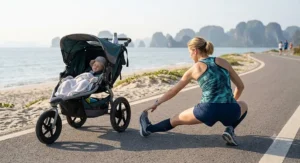
The weekend jogger with a toddler. If you already run with a jogging stroller and want one piece of gear that pulls double duty, the BOB Gear Revolution Flex 3.0 makes sense — you’re already comfortable with its weight and size, and the 16-inch rear tire performs nearly as well on sand as it does on trail runs.
The two-kid family on a tight budget. For parents managing two toddlers close in age without wanting to buy two separate strollers, the Graco Modes Adventure Stroller Wagon solves the capacity problem at a fraction of premium wagon pricing, with enough suspension to handle rutted beach parking lots without a rough ride.
The frequent flyer heading to a boardwalk town. If your beach trip starts with airport security and ends at a hotel two blocks from a paved boardwalk, the Babyzen YOYO2 or Radio Flyer Trav’ler Stroll ‘N Wagon make more sense than a bulky all-terrain model you’ll struggle to check as luggage, even though neither dominates on dry, loose dune sand.
Common Beach Stroller Problems and Real Fixes
Problem: wheels dig in and stall on dry sand. Solution: switch to a stroller with wider, larger-diameter wheels like the Radio Flyer All-Terrain Venture Wagon, or, if you’re committed to your current stroller, stick to packed wet sand near the waterline and use a beach cart only for the loose stretch.
Problem: salt corrosion seizes wheels within a season. Solution: rinse and dry thoroughly after every trip, and prioritize models with rust-resistant hardware and sealed bearings, such as the Radio Flyer Trav’ler Stroll ‘N Wagon, for regular beach families.
Problem: baby overheats under an inadequate canopy. Solution: pair any stroller’s canopy with a UPF-rated clip-on sunshade and follow pediatric guidance to keep infants under six months out of direct sun entirely, per the AAP’s sun safety recommendations.
Problem: stroller tips on uneven, sloped sand. Solution: prioritize a wider wheelbase and lower center of gravity — wagons generally outperform tall, narrow tri-wheel strollers here.
Problem: gear won’t fit alongside the child. Solution: opt for models with dedicated storage baskets or trays, like the six-pocket setup on the BOB Gear Revolution Flex 3.0 or the tray system on the Graco Modes Adventure Stroller Wagon.
How to Choose a Stroller for Sand: Step-by-Step
Choosing the best beach friendly stroller comes down to matching wheel design and frame geometry to your specific beach, not just picking the highest-rated model overall.
- Check wheel diameter first. Anything under 8 inches will struggle on dry sand; 12 inches and up performs noticeably better.
- Prioritize pneumatic or wide foam tires over hard plastic wheels, since air-filled and foam tires widen the contact patch and resist sinking.
- Consider your beach’s actual terrain — packed wet sand near a lifeguard stand behaves nothing like loose, dry dune sand a quarter-mile inland.
- Weigh portability against capability honestly — a compact travel stroller trades sand performance for airport convenience, and that’s a fair trade for some trips.
- Look for rust-resistant hardware if beach trips are a regular part of your routine, not a once-a-year event.
- Check weight capacity against your actual number of kids and gear, especially for wagons carrying two children plus a cooler.
- Confirm the model meets current stroller safety standards, referencing federal ASTM F833 requirements for stability, braking, and harness performance.
Common Mistakes When Buying a Stroller for Sand
The most frequent mistake is trusting the words “all-terrain” on a product label without checking actual wheel diameter — plenty of strollers marketed this way still use 8-inch or smaller wheels that struggle the moment sand gets loose and dry. A second common mistake is buying based on weight alone; a feather-light stroller often achieves that weight by using smaller, harder wheels, which directly undermines sand performance, as seen with the Babyzen YOYO2 compared to heavier all-terrain models. A third mistake is ignoring maintenance requirements at purchase time — a stroller that needs monthly bearing checks and post-trip rinsing isn’t a bad choice, but buyers who don’t plan for that upkeep end up with a seized, rusted frame within a season or two.
Stroller for Sand vs Traditional Stroller: What Actually Changes at the Shore
| Feature | Traditional Stroller | Beach-Capable Stroller |
|---|---|---|
| Wheel diameter | Typically 5-8 inches | 12-16 inches or wide low-pressure |
| Tire type | Hard plastic or small foam | Pneumatic or wide foam/rubber |
| Frame hardware | Standard steel/aluminum | Rust-resistant coated or stainless |
| Center of gravity | Higher, narrower stance | Lower, wider stance |
| Typical maintenance | Occasional wipe-down | Rinse and dry after every trip |
A traditional stroller isn’t a bad product — it’s simply engineered for sidewalks, tile floors, and mall corridors, environments where a narrow wheelbase and small wheels are genuine advantages for maneuverability. The moment that same stroller meets loose sand, though, the physics flip: narrow wheels concentrate weight into a small contact patch and sink, while wider, larger-diameter wheels distribute that same weight and stay closer to the surface. This is exactly why a stroller that feels flawless at the grocery store can feel like pushing a plow at the beach, and it’s why sand-specific hardware coatings matter more here than in any other stroller use case.
✨ Don’t Miss These Exclusive Deals!
🔍 Find Your Perfect Beach Companion Today!
Take your family’s beach days to the next level with a stroller actually built for sand, sun, and salt air. Click on any highlighted pick above to check current pricing and availability. The right stroller means more time enjoying the waves and less time wrestling wheels out of a sand trap!
What to Expect: Real-World Beach Performance
On paper, wheel diameter and tire type look like abstract numbers — in practice, they translate directly into how your morning at the beach actually feels. With a stroller that works on sand, like the Bugaboo Fox 5 Renew in sand-and-stair mode or the Radio Flyer All-Terrain Venture Wagon, you’ll notice the difference within the first fifty feet: steady, rolling resistance instead of the stroller catching and stalling every few steps.
With a mismatched stroller, expect a very different morning. You’ll likely find yourself veering toward the packed, wet sand near the waterline just to keep momentum, which sounds fine until the tide comes in and that strip of packed sand disappears. Reviewers and hands-on testers consistently describe this exact scenario — a stroller that performs beautifully on city sidewalks suddenly requiring two hands and full-body effort the moment it hits soft, dry sand above the high-tide line.
Temperature is the other real-world factor that specs don’t capture well. Metal frames and dark canopies absorb heat fast under direct beach sun, so a stroller left in direct light for even twenty minutes can develop a surprisingly hot handlebar and seat area — check both before placing your child back in the seat after a swim break.
Long-Term Cost, Rust Resistance, and Maintenance for a Beach Stroller
Total cost of ownership for a beach stroller isn’t just the sticker price — it’s sticker price divided by how many beach seasons the stroller survives before hardware failure forces a replacement. A $300 wagon with rust-resistant coated axles that lasts five beach seasons costs roughly $60 per season; a $300 wagon with untreated hardware that seizes up after eighteen months of salt exposure costs closer to $200 per season once you factor in an early replacement.
This is precisely why a beach stroller rust resistant frame matters more for regular beach families than casual, once-a-summer visitors. Salt air accelerates oxidation on exposed steel and untreated aluminum alloys significantly faster than fresh water or general outdoor use, and manufacturers who specifically coat or seal wheel axles and bearings — as seen on the Radio Flyer lineup — are targeting exactly this failure point. Budget maintenance time into your ownership costs too: a five-minute post-trip rinse is inexpensive insurance against a $300-plus replacement two years early.
| Maintenance Habit | Cost | Long-Term Payoff |
|---|---|---|
| Rinse wheels/axles after each trip | Free (garden hose) | Prevents most rust-related failures |
| Monthly bearing spin-check | Free (5 minutes) | Catches sand ingress before seizing |
| Annual lubrication of moving joints | $5-$10 in lubricant | Extends fold/hinge lifespan |
| Storing dry, not in a hot trunk | Free | Prevents mold and accelerated corrosion |
This table makes the math obvious: nearly every protective habit here costs nothing but a few minutes, while skipping them routinely cuts a stroller’s usable life in half or worse. Frame and wheel durability, not upholstery or canopy fabric, are almost always what determines whether a beach stroller survives to a second or third summer.
Features That Actually Matter (And Those That Don’t)
Wheel diameter, tire type, and hardware coating matter enormously for beach use — these three factors determine roughly 80% of how a stroller performs on sand, according to the pattern seen consistently across every model reviewed in this guide. Suspension matters too, though more for ride comfort over washboard ruts than for preventing sinking outright.
What matters far less than marketing suggests: the number of cupholders, the specific canopy color, and whether a stroller has a “parent console” with a phone slot. These are pleasant conveniences, not sand-performance factors, and they shouldn’t move the needle much if you’re choosing between two otherwise similar strollers. Weight is a more nuanced case — lighter isn’t automatically better for beach use, since some of the lightest strollers on the market, like the Babyzen YOYO2, achieve that weight specifically by using smaller, harder wheels that perform worse in sand than heavier, larger-wheeled alternatives.
Beach Stroller for Baby: Safety and Regulations Every Parent Should Know
In the United States, all strollers sold must comply with the mandatory federal safety standard incorporated at 16 CFR Part 1227, which references ASTM F833 — covering stability testing, parking brake performance, harness retention, and folding-mechanism safety. This matters specifically for beach use because sand and uneven, sloped terrain put more real-world stress on stability and braking systems than flat sidewalks do; a stroller that barely passes a flat-ground tip test may behave differently on a sloped, soft dune.
Beyond baseline compliance, look for a secure five-point harness on any model you’re considering, confirm the parking brake holds firmly on a slight incline before your first beach trip, and check that wheels lock or detach only with intentional force, not from routine jostling over uneven ground. For sun exposure specifically, pediatric guidance recommends keeping infants under six months out of direct sunlight entirely, relying on shade, a stroller canopy, and lightweight protective clothing rather than sunscreen alone at that age — worth checking against the current EPA UV Index scale before heading out on high-UV beach days.
Buyer’s Decision Framework
If you visit the beach fewer than five times a year and prioritize storage space at home, choose a compact travel stroller like the Babyzen YOYO2, because portability outweighs the marginal sand-performance loss for occasional use. If you visit the beach weekly through the summer and have two young kids, choose an all-terrain wagon like the Graco Modes Adventure Stroller Wagon or Radio Flyer All-Terrain Venture Wagon, because durability and capacity pay off fast at that frequency. If budget isn’t the primary constraint and you want one stroller for daily life, hiking, and the beach, choose the Bugaboo Fox 5 Renew, because its sand-and-stair mode directly solves the terrain-transition problem that trips up most premium strollers.
Frequently Asked Questions
❓ What is the best stroller for beach sand specifically?
❓ Can I use a regular stroller on the beach?
❓ How do I stop my stroller wheels from rusting at the beach?
❓ Do beach wagons work better than strollers for sand?
❓ What size wheels do I need for a beach stroller?
Conclusion
There’s no single best stroller for beach trips for every family — there’s a best stroller for your specific beach, your specific kids, and how often you actually go. A quiet boardwalk town with mostly packed sand calls for something entirely different than a wide, dune-heavy stretch of coastline where the parking lot alone eats up half a mile of soft ground.
What stays constant across every pick on this list is the underlying physics: bigger wheels beat small ones, rust-resistant hardware beats untreated metal, and a five-minute rinse after every trip beats an expensive repair or early replacement two summers from now. Whether you land on the sand-and-stair mechanics of the Bugaboo Fox 5 Renew, the budget-friendly capacity of the Graco Modes Adventure Stroller Wagon, or the boardwalk-ready portability of the Babyzen YOYO2, match the stroller to the actual beach you’re headed to, not just the one in your head.
Beach days are short enough without spending the first twenty minutes wrestling a stroller out of the sand. Pick the right one, rinse it when you’re done, and get back to actually enjoying the waves.
Recommended for You
- Jogging Stroller for Infant: 7 Top Picks Parents Trust in 2026
- Lightweight Jogging Stroller: 7 Top Picks Runners Trust in 2026
- Jogging Stroller Swivel vs Fixed Wheel: 7 Picks Compared (2026)
Disclaimer: This article contains affiliate links. As an Amazon Associate, I earn from qualifying purchases. If you purchase products through these links, we may earn a small commission at no additional cost to you.
✨ Found this helpful? Share it with your friends! 💬🤗
