
In This Article
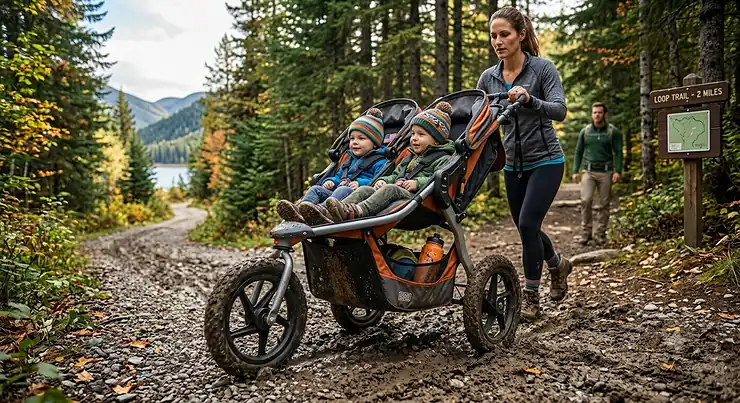
The first time I watched a regular umbrella stroller nose-dive into a rut on a packed-dirt trail, I understood something fast: not all strollers are built the same, and pretending otherwise is how you end up carrying a screaming toddler the last mile back to the car. A stroller for hiking trails is a completely different animal from the one you’d grab for a mall run, and once you’ve felt the difference — big air-filled tires soaking up roots, a hand brake saving your forearms on a downhill grade — you don’t go back.
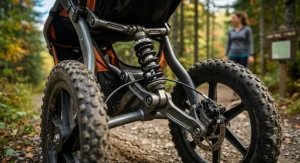
This guide breaks down seven real, currently-available options that hold up on gravel, packed dirt, and rooty forest paths, plus the honest tradeoffs of each. We’ll dig into suspension quality, hand brakes, weight capacity, and fold size, because a spec sheet alone never tells you how a stroller actually feels on a Saturday morning trail with a squirming eight-month-old. According to the American Academy of Pediatrics’ stroller safety guidance, a wide wheelbase and reliable brakes are two of the biggest factors separating a safe stroller from a risky one — and that’s doubly true once you leave pavement behind.
So, what is a stroller for hiking trails, exactly? It’s a jogging or all-terrain stroller built with large air-filled or foam-filled tires, some form of suspension, and a fixed or lockable front wheel, designed to stay stable and comfortable over uneven natural surfaces rather than smooth sidewalks. Below, you’ll find real products across every budget, honest analysis of what each one gets right and wrong, and practical guidance for choosing (and using) the right one for your family’s adventures.
Quick Comparison Table
If you’re in a hurry, here’s the fast version. This table ranks our seven picks by their standout strength so you can jump straight to the section that matters most to you.
| Stroller | Standout Strength | Price Range | Best For |
|---|---|---|---|
| BOB Gear Alterrain Pro | Hand brake + SmoothShox suspension | $550-$650 range | Steep, hilly trails |
| Thule Urban Glide 3 | Lightest and fastest | $600-$700 range | Speed-focused parents |
| Baby Jogger Summit X3 | Best value with all-wheel suspension | $400-$450 range | Budget-conscious trail users |
| Mountain Buggy Terrain | Dual wheel-size versatility | $550-$700 range | Mixed urban/trail families |
| Guava Roam | Most compact fold | $700-$800 range | Small cars, small apartments |
| Joovy Zoom 360 Ultralight | High weight limit, rear suspension | Under $300 | Budget families with older kids |
| Baby Trend Expedition | Lightest and cheapest | Under $200 | Occasional, light trail use |
Looking at the spread above, the BOB Gear Alterrain Pro and Baby Jogger Summit X3 are the only two with a true hand-operated brake, which matters enormously if your regular routes include any real elevation change. Budget picks like the Baby Trend Expedition trade away suspension entirely, which is fine on packed gravel but rougher on rooty single-track. If your trail system has any hills at all, weigh the brake column at least as heavily as the price column.
💬 Just one click — help other trail parents make a smarter buying decision too!😊
Top 7 Strollers for Hiking Trails: Expert Analysis
Here’s the deep dive. Each of these seven strollers is a real, currently sold model, evaluated on how it performs specifically off pavement — not just on a smooth sidewalk demo lap.
1. BOB Gear Alterrain Pro — best hand brake control on steep descents
The standout here is the ergonomic hand brake, a feature most jogging strollers skip entirely and one that matters the moment your trail points downhill. Beyond the brake, the BOB Gear Alterrain Pro pairs SmoothShox suspension with large air-filled tires, and reviewers consistently note that the combination absorbs root-and-rock chatter noticeably better than foam-filled competitors. Based on the spec comparison, the 75-lb weight capacity also means this stroller has real staying power — you’re not shopping again in a year.
Who should care: parents who live near actual elevation, not just flat greenways. What most buyers overlook about the Pro tier specifically is that the suspension, while excellent, is fixed rather than adjustable — babygearlab’s testers noted this as a step down from BOB’s older adjustable-shock models. Reviewers on Amazon and Walmart consistently praise the waterproof canopy and reflective rims for early-morning or late-evening trail sessions, while a recurring critique is the stroller’s overall bulk when folded for car storage.
Pros:
- ✅ SmoothShox suspension smooths out rocky, rooty trails
- ✅ Ergonomic hand brake controls steep downhill sections
- ✅ Waterproof canopy and reflective rims for visibility
Cons:
- ❌ Suspension is fixed, not adjustable like older BOB models
- ❌ Bulkier fold than lighter jogging-focused competitors
At around $550-$650 at the time of research, the BOB Gear Alterrain Pro earns its price if hills are a regular feature of your routes; if your trails are flat, you may be paying for control you won’t often use.
2. Thule Urban Glide 3 — lightest and fastest all-around glider
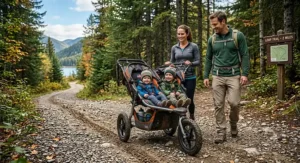
The 26.2-lb frame is the headline feature, making this the lightest stroller in this roundup by a real margin. What that weight buys you in practice: reviewers who’ve logged over a thousand miles describe the ride as smooth, light, and fast on man-made terrain, with air-filled 16-inch rear tires and a 12-inch front tire providing what one long-term tester called “gliding suspension” through turns. Based on the spec comparison, the swivel front wheel locks for jogging but rarely needs it, since testers report it tracks straight even at speed.
The honest tradeoff: the Thule Urban Glide 3 caps out at a 49-lb child weight limit, notably lower than the 75-lb ceilings on the BOB and Baby Jogger models here. What the spec sheet won’t tell you, but testers note, is that on genuinely rough terrain — big rocks, deep ruts — this stroller’s lighter build feels less planted than the heavier all-terrain options. It shines on packed dirt paths and forest terrain that’s reasonably graded, less so on technical scrambles.
Pros:
- ✅ Lightest jogging stroller in its class at 26.2 lbs
- ✅ One-hand compact fold with self-standing feature
- ✅ Reflective details and full canopy for visibility and shade
Cons:
- ❌ Lower 49-lb max child weight than most rivals here
- ❌ Narrow, angled handlebar not loved by every tester
At around $600-$700, the Thule Urban Glide 3 rewards parents who prioritize easy lifting, quick folding, and everyday versatility over maximum ruggedness.
3. Baby Jogger Summit X3 — best value all-wheel suspension
Here’s what most competitors don’t offer at this price: suspension on all three wheels, not just the rear. That’s the standout, and it’s a meaningful upgrade over single-suspension budget joggers. The Baby Jogger Summit X3 also includes a hand-operated deceleration brake, putting it in a very small club with the BOB Alterrain Pro on that front, despite selling for roughly $200 less. Reviewers consistently highlight the remote wheel lock mounted on the frame (rather than down at the wheel itself) as a small but genuinely useful convenience — no bending down to lock the front wheel before a run.
Based on the spec comparison, this is the strongest dollar-for-dollar suspension package in this list. What buyers should weigh against that: the handlebar height is fixed rather than adjustable, so tall or short parents may find the ergonomics slightly less tailored than on the Thule or BOB. Reviewers also note the peekaboo canopy windows use Velcro rather than a magnetic closure, a minor but repeated nitpick.
Pros:
- ✅ Hand-operated deceleration brake for downhill control
- ✅ All-wheel suspension, not suspension on the rear only
- ✅ Remote front-wheel lock switches modes instantly
Cons:
- ❌ Peekaboo window uses Velcro, not a magnetic closure
- ❌ Handlebar height is fixed, not adjustable
Around $400-$450, the Baby Jogger Summit X3 is arguably the best value pick in this entire roundup for anyone who wants brake-and-suspension performance without paying premium-tier prices.
4. Mountain Buggy Terrain — best dual wheel-size system for mixed terrain
The standout advantage: this stroller ships with both 16-inch and 12-inch rear wheel sets, letting you swap between an aggressive trail configuration and a tighter urban one in seconds. That’s a genuinely unique approach among the strollers here. The Mountain Buggy Terrain also includes a hand-operated control brake usable with either wheel size, plus a three-mode front wheel that locks forward, locks backward, or swivels freely — useful for the kind of stop-and-start maneuvering that real trails demand around switchbacks and creek crossings.
Based on the spec comparison, the aircraft-grade aluminum frame keeps weight reasonable despite all this hardware. What most buyers overlook is that swapping wheel sets, while simple, is still an extra step most competitors don’t require at all — if you rarely change environments, you may never use the second wheel set you paid for. Reviewers describe the lie-flat main seat as genuinely usable from the newborn stage onward with the compatible bassinet or car seat, extending this stroller’s useful window longer than most joggers here.
Pros:
- ✅ Dual wheel-size system swaps for trail or city terrain
- ✅ Three-mode front wheel: swivel, lock forward, lock back
- ✅ Lie-flat seat usable from the newborn stage onward
Cons:
- ❌ Premium price sits above most competitors in this list
- ❌ Swapping wheel sets adds a small extra step most rivals skip
At a typical $550-$700, the Mountain Buggy Terrain suits families who genuinely split their time between rugged trails and city sidewalks and don’t want to own two strollers.
5. Guava Roam — most compact fold for small apartments and trunks
The 3D Nesting Fold is the headline here, collapsing the Guava Roam roughly 50% smaller than a traditional jogging stroller without removing the wheels — a real differentiator if your car or closet space is tight. Reviewers consistently note the airless, foam-filled tires as a practical win too: no pump, no patch kit, no worrying about a flat halfway down a forest path. Based on the spec comparison, the independent swing-arm rear suspension performs well on normal roads and mildly bumpy trails, though one long-term tester found it struggled slightly with rocky or gravel terrain specifically at running pace.
Here’s what the spec sheet doesn’t fully convey: this stroller has no hand brake at all, which is a real gap for anyone tackling grades with any pitch to them. Reviewers have also flagged that the front wheel can occasionally catch during fast, sharp turns, something to be mindful of on winding single-track. It’s also worth noting Guava issued a recall on first-generation Roam units (manufactured mid-2020 through late 2021) over a brake-engagement hazard — current units are unaffected, but it’s a detail worth checking if you’re buying used.
Pros:
- ✅ 3D Nesting Fold collapses 50% smaller than typical joggers
- ✅ Airless tires eliminate flat-tire risk entirely
- ✅ Independent rear suspension smooths moderate trail bumps
Cons:
- ❌ No hand brake for controlled descents on steep grades
- ❌ Front wheel can catch during quick turns at speed
At around $700-$800, the Guava Roam is a strong pick for parents whose top priority is trunk space and daily versatility over technical trail performance.
6. Joovy Zoom 360 Ultralight — best budget all-terrain suspension
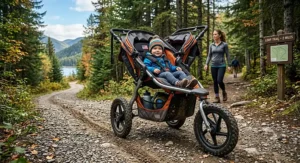
For a stroller that regularly sells for under $300, the standout is real rear-wheel suspension paired with a 75-lb weight capacity — one of the highest limits in this entire list, budget or premium. The Joovy Zoom 360 Ultralight uses a 12-inch air-filled front tire that locks for jogging and swivels for errands, and reviewers describe the maneuverability as a genuine strength, easy to steer one-handed even on gravel paths. Based on the spec comparison, that 75-lb ceiling means this stroller can realistically serve a family from six months through early elementary age, stretching its value well past the purchase price.
What reviewers consistently flag as the tradeoff: the front wheel tracking isn’t adjustable, so if the stroller starts pulling slightly to one side on a cambered trail, you can’t dial it back out the way you can on the BOB or Baby Jogger. There’s also no hand brake, which limits confident control on any real downhill. Reviewers do note the extra-large canopy and roomy seat as standout comfort features for bigger kids who’ve outgrown smaller joggers.
Pros:
- ✅ High 75-lb weight capacity extends usable years
- ✅ Rear suspension plus air-filled tires soften uneven paths
- ✅ Roomy seat and oversized canopy fit bigger kids comfortably
Cons:
- ❌ Front wheel tracking isn’t adjustable
- ❌ No hand brake for steep downhill sections
Under $300, the Joovy Zoom 360 Ultralight delivers real suspension and a long usable lifespan for families who don’t need the polish of premium brands.
7. Baby Trend Expedition — lightest, cheapest entry point
At roughly 23.6 lbs, the Baby Trend Expedition is the lightest stroller in this entire roundup, lighter than every other jogger here by two to nine pounds. That matters more than it sounds like when you’re lifting a folded stroller in and out of a trunk after a long hike. Based on the spec comparison, the air-filled rubber tires do smooth out grass and packed dirt reasonably well for the price, and reviewers note the rolling resistance is surprisingly low, meaning it’s genuinely easy to push.
Here’s the honest limitation: there’s no suspension system at all, so while grass and smooth dirt feel fine, rooty or rocky trails transmit real jolts straight through to your child. The 50-lb weight capacity is also meaningfully lower than the 75-lb ceilings on the Joovy, BOB, and Baby Jogger models above. Reviewers have flagged that the metal wheel spokes can rust over time, especially in humid or coastal climates — a detail that matches its budget positioning. This is an honest occasional-trail stroller, not a dedicated one.
Pros:
- ✅ Lightest stroller in this roundup at about 23.6 lbs
- ✅ Budget-friendly price with a low all-in cost
- ✅ Air-filled tires smooth out grass and packed dirt
Cons:
- ❌ No suspension system at all for rough terrain
- ❌ Lower 50-lb weight capacity than pricier rivals
At under $200, the Baby Trend Expedition makes sense for occasional trail walks and errands, not as a dedicated stroller for hiking trails with real elevation or technical footing.
Practical Usage Guide: Getting Your Trail Stroller Ready for the Backcountry
Before your first real outing, a few setup steps make a bigger difference than most parents expect. First, check tire pressure if your stroller uses air-filled tires — underinflated tires (common on the BOB Gear Alterrain Pro, Thule Urban Glide 3, Baby Jogger Summit X3, and Mountain Buggy Terrain) noticeably increase rolling resistance and reduce suspension effectiveness on rough ground. Second, adjust the handlebar to your height before you leave the driveway; pushing at the wrong height for even a mile turns into real shoulder fatigue.
In the first 30 days, the most common mistake is over-trusting the front wheel swivel on technical terrain. Lock the front wheel before any trail with roots, loose gravel, or real elevation change — a swivel wheel that catches at speed is one of the more common tip-risk scenarios reviewers describe. Maintenance-wise, wipe down the frame after muddy outings, check the hand brake cable tension monthly if your model has one, and inspect wheel bearings every few months for grit buildup, especially after wet-weather trails. A quick 60-second check before each outing — tires, brake, harness — catches most issues before they become problems mid-trail.
Real-World Scenario: Which Trail Stroller Fits Your Adventure?
Picture three different families, because “best” always depends on what you’re actually doing. First: a couple in a hilly Pacific Northwest suburb who hike wooded park trails most weekends with a one-year-old. Their non-negotiable is braking control on descents, which points squarely at the BOB Gear Alterrain Pro or Baby Jogger Summit X3 — both offer real hand brakes, and the Summit X3 saves real money without giving up much capability.
Second: a runner-parent in a flat Midwest suburb who wants one stroller for morning road runs and the occasional gravel rail-trail. Weight and speed matter more than rugged suspension here, which makes the Thule Urban Glide 3 the natural fit — it’s the lightest, fastest option, and gravel rail-trails are graded and smooth enough that its lighter suspension isn’t a liability.
Third: a budget-conscious family in a small apartment who hits packed-dirt neighborhood trails a few times a month, not committed distance runners. The Joovy Zoom 360 Ultralight or Baby Trend Expedition cover that use case honestly — real suspension on the Joovy if you can stretch the budget slightly, or the featherweight Baby Trend Expedition if trail use is occasional and storage space is tight.
Problem → Solution: Common Trail Stroller Headaches
Problem: The stroller drifts to one side on cambered trails. Solution: look for adjustable front-wheel tracking, available on the BOB Gear Alterrain Pro and Baby Jogger Summit X3; on strollers without it, like the Joovy Zoom 360 Ultralight, stick to more evenly graded paths.
Problem: Your arms are sore after downhill sections. Solution: prioritize a hand brake. Only the BOB Gear Alterrain Pro, Baby Jogger Summit X3, and Mountain Buggy Terrain in this list include one — it’s worth the price jump if your trails have real elevation.
Problem: The stroller won’t fit in your trunk alongside other gear. Solution: the Guava Roam‘s 3D Nesting Fold or the compact fold on the Baby Trend Expedition solve this specifically; heavier all-terrain models like the Mountain Buggy Terrain fold well but stay bulkier.
Problem: You’re worried about a flat tire mid-trail. Solution: the Guava Roam‘s airless, foam-filled tires remove that risk entirely, at the tradeoff of a slightly firmer ride on rough surfaces than true air-filled tires provide.
Problem: Your child has outgrown their old jogger. Solution: check weight capacity first — the BOB Gear Alterrain Pro, Baby Jogger Summit X3, and Joovy Zoom 360 Ultralight all support up to 75 lbs, meaningfully longer runway than budget options capped at 50 lbs.
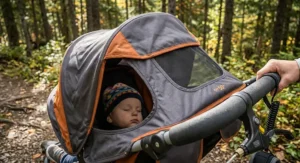
How to Choose a Stroller for Hiking Trails
Picking the right stroller for hiking trails comes down to seven practical criteria, roughly in order of importance for most families:
- Suspension type. Independent or all-wheel suspension (Baby Jogger Summit X3, BOB Alterrain Pro) handles roots and ruts noticeably better than rear-only or no suspension.
- Hand brake presence. If your trails have any real elevation, a hand brake isn’t a luxury — it’s the single biggest safety upgrade available.
- Tire type. Air-filled tires generally ride smoother than foam or airless alternatives, but airless tires (Guava Roam) remove puncture risk entirely.
- Weight capacity. A 75-lb ceiling buys years of extra use compared with a 50-lb limit.
- Fold size and stroller weight. Matters most if you’re loading and unloading a small trunk frequently.
- Front wheel modes. Lockable-swivel wheels offer the best of both worlds — maneuverability in parking lots, stability on trail.
- Budget realism. The jump from a $180 economy stroller to a $600 premium one buys real suspension and braking performance — decide honestly how often you’ll use it before paying for capability you won’t need.
Stroller for Hiking Trails vs Standard Jogging Stroller
It’s a fair question: isn’t any jogging stroller basically a stroller for hiking trails? Not quite. A standard road-focused jogging stroller, built primarily for pavement, often prioritizes low rolling resistance and light unsprung weight over rugged suspension travel — great for a 5K PR, less great for a rooty forest loop. A dedicated trail-capable stroller, like the BOB Gear Alterrain Pro or Mountain Buggy Terrain, adds more robust suspension travel, tougher materials, and often a hand brake, at the cost of some pavement-specific speed and a bit more weight to push.
In practice, several strollers in this list — the Thule Urban Glide 3 especially — blur the line, performing well on both smooth roads and moderately rough natural trails. The real dividing question is terrain: if your regular routes include loose gravel, roots, real elevation, or unpaved forest paths, prioritize the suspension-and-brake end of this list. If your “trail” is really a paved rail-trail or a groomed park path, a lighter road-focused jogger will serve you just as well and save you both money and pushing effort.
Common Mistakes When Buying a Hiking Stroller
The most frequent misstep is buying based on brand reputation alone rather than matching features to your actual terrain — a family hitting rooty single-track with a stroller that has no suspension, like the base Baby Trend Expedition, will feel every jolt their child does. A close second: skipping the hand brake to save money, then discovering the hard way that riding the frame brake down a real grade is exhausting and less safe than a proper hand-operated one.
Another common error is underestimating fold size and stroller weight until it’s time to load the car after a long hike with a sleeping toddler and a diaper bag — the heavier premium options are worth it for suspension, but that tradeoff is worth thinking through before you buy, not after. Finally, some parents overbuy weight capacity or wheel versatility (like the dual wheel sets on the Mountain Buggy Terrain) they’ll rarely use, when a simpler, cheaper stroller like the Baby Jogger Summit X3 would have covered their actual needs for less money.
✨ Don’t Miss These Exclusive Deals!
🔍 Take your next trail adventure to the next level with these carefully tested picks. Click any highlighted stroller above to check current pricing and availability — the right one turns a stressful outing into a genuinely great family hike!
What to Expect: Real-World Performance on Dirt Paths and Forest Terrain
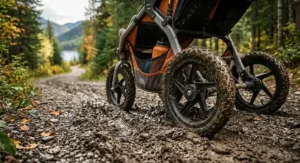
Specs only tell part of the story, so here’s what actually happens when these strollers hit a dirt path or forest terrain in practice. On packed, dry dirt — the kind you’d find on a well-maintained nature trail — nearly every stroller here performs reasonably, since packed dirt behaves similarly to smooth pavement with a bit more give. The differences show up once roots, rocks, or loose gravel enter the picture: strollers with real suspension, like the BOB Gear Alterrain Pro and Baby Jogger Summit X3, absorb that chatter noticeably, while suspension-free options like the Baby Trend Expedition transmit much more of it straight to the seat.
Forest path terrain adds another variable: shade means the ground often stays damp longer, and reviewers of the Guava Roam‘s airless tires note they handle that dampness without any flat-tire risk, though the stroller loses a bit of grip compared with knobbier air-filled options on truly muddy sections. On dry, hard-packed forest single-track, the lighter Thule Urban Glide 3 genuinely shines, gliding with less pushing effort than the heavier all-terrain builds — reviewers describe it as effortless on smooth stretches but slightly less planted once the trail turns technical.
Hiking Stroller Suspension and Travel: What Actually Matters
Not all “suspension” claims mean the same thing, and this is where a lot of marketing language gets vague. All-wheel suspension, like on the Baby Jogger Summit X3, means every wheel has some shock-absorbing travel — genuinely the gold standard for rough terrain. Rear-only suspension, found on the Joovy Zoom 360 Ultralight and Guava Roam, still helps meaningfully but leaves the front wheel to transmit more of the impact directly. According to standardized trail difficulty rating systems, terrain roughness and elevation change are graded independently of distance — which maps directly onto how much suspension travel actually matters for your specific route versus how far you’re going.
Suspension “travel,” the actual distance the shock can compress, matters more than whether a stroller has suspension at all. BOB’s SmoothShox and Baby Jogger’s all-wheel system both offer meaningful travel, absorbing bigger impacts before they reach the seat; budget systems tend to offer shorter travel that helps on minor bumps but bottoms out on bigger roots or rocks. Practically, if your regular trail has more than the occasional root or rock, prioritize a stroller with genuine wheel travel over one that merely lists “suspension” as a bullet point.
Hiking Stroller Hand Brake: Is It Worth the Extra Cost? (Review Breakdown)
Only three strollers in this list — the BOB Gear Alterrain Pro, Baby Jogger Summit X3, and Mountain Buggy Terrain — include a genuine hand-operated brake, and reviewers are remarkably consistent about why it matters. On the BOB, testers describe the brake as putting “downhill control at your fingertips,” a meaningful upgrade over relying on a parking brake alone. On the Baby Jogger, the deceleration brake pairs with a handlebar tether strap, and reviewers note it specifically for control when picking up pace or heading downhill.
The honest tradeoff is cost and complexity: hand brakes add roughly $100-$200 to a stroller’s price versus brake-free competitors like the Joovy Zoom 360 Ultralight, and they’re one more mechanical part that needs occasional cable-tension maintenance. For flat, well-graded trails, a hand brake is genuinely optional — the parking brake on any of these strollers is sufficient for stopping on level ground. But for regular routes with meaningful elevation change, reviewers across brands consistently frame the hand brake as the difference between confident control and constant low-level anxiety on the way back down.
Long-Term Cost & Maintenance for Trail Strollers
Sticker price is only part of the real cost. Air-filled tires, found on most strollers in this list except the Guava Roam, occasionally need a pump top-off and, rarely, a tube replacement — a minor ongoing cost that the Roam’s airless tires sidestep entirely. Premium frames like the BOB Gear Alterrain Pro and Thule Urban Glide 3 use higher-grade aluminum and fasteners that reviewers describe as holding up with “almost no flex” over years of use, while budget frames like the Baby Trend Expedition have documented issues with metal spoke rust in humid climates.
Thinking in cost-per-year rather than sticker price changes the math meaningfully. A Baby Jogger Summit X3 at roughly $425 used regularly for three years of trail outings works out to a genuinely reasonable per-outing cost, especially once you factor in that its hand brake and all-wheel suspension mean you’re less likely to want to upgrade mid-use. A $180 economy stroller that gets replaced after eighteen months of hard trail use because the wheels rusted out isn’t actually the cheaper option — it just moves the cost to later.
Safety, Regulations & Compliance Guide
Federal stroller safety standards, enforced by the Consumer Product Safety Commission, cover hinge safety, wheel attachment, parking brake performance, and harness integrity — worth checking against the CPSC’s searchable recall database before buying secondhand, since recalls do happen even among reputable brands (Guava’s first-generation Roam units, for example, were recalled over a brake-engagement issue affecting units made between mid-2020 and late 2021).
On the medical side, the American Academy of Pediatrics generally advises against jogging with an infant in a stroller before around six months of age, once a baby has developed reliable head and neck control — and pediatricians commonly suggest waiting closer to eight to twelve months before tackling technical, uneven trails specifically, since rough terrain demands more core stability than smooth pavement. Always use the five-point harness on every outing, keep cargo low and centered rather than hung from the handlebars (a common tip-over cause), and lock the front wheel before any trail with real elevation change or loose footing.
Best Stroller for Nature Trails: Matching Terrain to Wheel Type
Nature trails vary enormously — some are groomed gravel wide enough for two strollers side by side, others are narrow single-track with roots underfoot — so the “best” wheel setup really depends on which kind you’re facing. For wide, well-maintained nature trails with a gravel or packed-dirt surface, almost anything in this list performs well, and the lighter Thule Urban Glide 3 or Baby Trend Expedition make the outing easier on your arms without sacrificing much.
For narrower, rougher nature trails with roots, loose rock, or real elevation, the BOB Gear Alterrain Pro and Mountain Buggy Terrain are the stronger picks specifically because of their combination of deeper suspension travel and hand-brake control. And for nature trails that shift character seasonally — muddy in spring, dry and rutted in summer — the Mountain Buggy Terrain‘s swappable wheel sets offer a genuinely practical answer, letting you match the stroller to conditions rather than compromising year-round.
Frequently Asked Questions
❓ Can I take a regular stroller on a hiking trail?
❓ What age can a baby start using a hiking stroller?
❓ Do I really need a hand brake for hiking trails?
❓ Is suspension or wheel size more important for trail use?
❓ How much does a good stroller for hiking trails cost?
Conclusion
There’s no single best stroller for hiking trails — there’s a best one for your specific trails, your budget, and how often you’re actually out there. If hills and roots are a weekly reality, the BOB Gear Alterrain Pro or Baby Jogger Summit X3 earn their keep with real hand brakes and genuine suspension travel. If speed and light weight matter more than rugged capability, the Thule Urban Glide 3 is hard to beat. And if you’re testing the waters before committing serious money, the Joovy Zoom 360 Ultralight or Baby Trend Expedition get you outside without the premium price tag.
Whichever you choose, match the stroller’s real capabilities — suspension travel, brake type, weight capacity — to the actual trails you’ll use it on, not the trails you imagine you might use it on someday. That honest match is what turns a stroller purchase into years of genuinely good outings instead of a regret sitting in the garage.
Recommended for You
- Best Stroller for Beach in 2026: 7 Sand-Ready Picks That Won’t Fail You
- Jogging Stroller for Infant: 7 Top Picks Parents Trust in 2026
- Lightweight Jogging Stroller: 7 Top Picks Runners Trust in 2026
Disclaimer: This article contains affiliate links. As an Amazon Associate, I earn from qualifying purchases. If you purchase products through these links, we may earn a small commission at no additional cost to you.
✨ Found this helpful? Share it with your friends! 💬🤗
