
In This Article
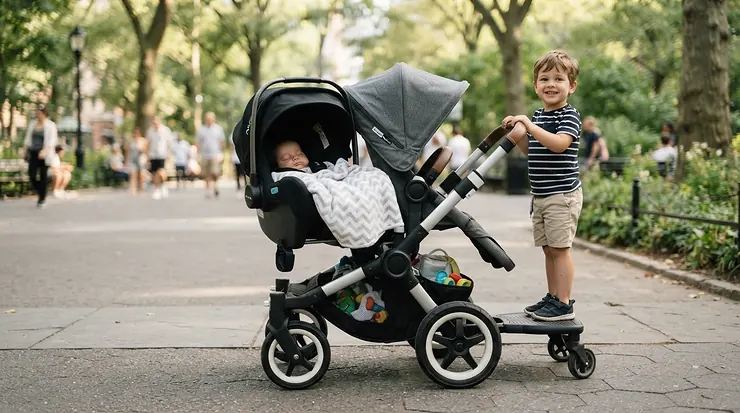
Grocery runs with two kids are a specific kind of chaos. You’ve got a toddler who refuses the cart seat, a preschooler who “wants to walk” for exactly ninety seconds before melting down in aisle six, and a cart that’s somehow already full before you’ve hit produce. A sit-and-stand stroller for grocery store trips solves a very particular problem: it gives your older kid somewhere to stand, sit, or bail out onto their own feet, while your younger one rides up front — all without you needing a second set of hands or a stroller the size of a parade float.
This guide skips the fluff and gets into what actually matters for grocery-specific use: aisle width, basket capacity, fold speed at the checkout line, and whether the thing will survive being rammed into a shopping cart corral for the third time this week. We researched seven real, currently available strollers — from Baby Trend’s budget-friendly workhorses to Joovy’s ultralight tandems and Chicco’s smoother-riding BravoFor2 — and broke down what the spec sheets don’t tell you. Whether you want a grocery-friendly sit-and-stand stroller under $200 or you’re ready to spend more for a lighter frame and better maneuverability, there’s a fit here for your routine.
What Is a Sit-and-Stand Stroller for Grocery Store Trips?
A sit-and-stand stroller for grocery store trips is a tandem stroller with a full seat up front for a younger child and a bench seat or standing platform in back for an older sibling, built narrow enough to clear standard 36-inch store aisles. It typically includes a reinforced storage basket rated to carry grocery loads in addition to child weight — a feature most standard double strollers skip entirely.
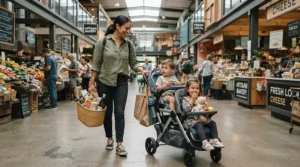
That storage detail matters more than it sounds. Most conventional side-by-side double strollers are built wide, which makes them a nightmare in a real supermarket — you’ll spend the whole trip apologizing to other shoppers and backing out of the cereal aisle. Sit-and-stand models keep both kids in a single-file line, so the stroller’s overall footprint stays close to that of a single stroller while still hauling two kids and a week’s worth of groceries.
Quick Comparison Table
| Stroller | Weight | Best For | Price Range |
|---|---|---|---|
| Baby Trend Sit N’ Stand Ultra | ~27 lbs | Budget pick, front-or-back infant seat | $160-$190 range |
| Baby Trend Sit N’ Stand 2.0 DLX | ~28 lbs | Elevated back seat on a budget | $180-$230 range |
| Baby Trend Sit N’ Stand 5-in-1 Shopper Plus | ~28 lbs | Maximum grocery-hauling storage | $185-$250 range |
| Joovy Caboose Too Ultralight | 23.5 lbs | Removable second seat, lightest tandem | $280-$330 range |
| Joovy Caboose Ultralight | 22 lbs | Lightest overall frame to lift and fold | $300-$370 range |
| Joovy Caboose UL | 26.5 lbs | Smart auto-lock fold, upgraded wheels | $350-$400 range |
| Chicco BravoFor2 | ~26.5 lbs | Smoothest push, all-wheel suspension | $350-$400 range |
Looking at the spread above, the three Baby Trend models undercut everything else on price while still hitting real storage capacity, which is exactly what a grocery-focused buyer wants. The Joovy Caboose Ultralight and Joovy Caboose Too Ultralight trade some of that savings for a frame that’s roughly 4-6 pounds lighter, which matters a lot when you’re hoisting the folded stroller into a trunk with a rotisserie chicken in your other hand. The Chicco BravoFor2 sits at the top of the price range but earns it with all-wheel suspension that noticeably smooths out cracked parking-lot pavement.
💬 Just one click — help other grocery-trip parents make a smarter pick too!😊
Top 7 Sit-and-Stand Strollers for Grocery Trips: Expert Analysis
1. Baby Trend Sit N’ Stand Ultra Stroller — best budget pick for front-or-back infant seat placement
The standout here is flexibility: the Baby Trend Sit N’ Stand Ultra lets you click an infant car seat into either the front or rear seating position, which is unusual for this category and genuinely useful for grocery trips where you want your napping infant closer to you at checkout.
Both seats carry a 50-pound weight capacity, and the stroller accepts a wide range of infant car seats beyond Baby Trend’s own line, including Graco SnugRide, Evenflo Embrace, and Britax Companion models with the right adapter. In practice, that spec means one stroller can realistically serve you from your baby’s first grocery run through your toddler’s “I want to walk” phase, without an expensive upgrade in between. Based on the spec comparison against its Baby Trend siblings, the Ultra’s dual-position infant seating is the single biggest reason to pick it over the otherwise similar 2.0 DLX.
This is the pick for budget-conscious parents who want one stroller to cover two kids at very different stages, and for anyone who specifically wants the option to keep a sleeping infant up front rather than in back. Reviewers consistently report that the covered parent tray and dual cup holders get heavy daily use, and a common complaint in user reviews is that the stroller runs longer than average, which can make tight checkout lanes awkward.
Pros:
- ✅ Infant seat clicks into front or rear position
- ✅ 50-lb capacity on both seats for growing kids
- ✅ Foot-activated dual rear brakes for grocery-lot slopes
Cons:
- ❌ Longer overall length than most rivals here
- ❌ Reclined front seat eats into rear passenger legroom
Priced in the $160-$190 range, this is one of the least expensive genuinely dual-purpose sit-and-stand strollers on the market, and the value case is strong if front-seat infant flexibility matters to you.
2. Baby Trend Sit N’ Stand Double Stroller 2.0 DLX — most affordable elevated-seat sit-and-stand
The Baby Trend Sit N’ Stand 2.0 DLX raises the rear seat higher than older Sit N’ Stand models, which sounds minor until you realize it means your back-seat rider can actually see over grocery bags piled in the basket below.
Both seats support up to 50 pounds, and the stroller ships with two ratcheting canopy panels up front plus a fixed visor canopy in back — solid sun coverage for parking-lot walks in July. What most buyers overlook about this model is that the elevated rear seat also improves sightlines for the child standing on the platform, since they’re not staring directly into the back of the front seat’s headrest. Folded dimensions come in at a compact 22.6 x 34 x 16 inches, which slides into most trunks without needing to fold down rear seats.
This is a solid pick for parents who specifically dislike the cramped, low rear-seat feel common on older sit-and-stand designs, and for families doing frequent short errand runs rather than long outings. Aggregated review sentiment on this line skews positive for ease of one-hand folding, though a recurring theme in user feedback is that the covered storage compartment is smaller than it looks in photos.
Pros:
- ✅ Elevated rear seat improves visibility and comfort
- ✅ Single-hand fold collapses to 16 inches tall
- ✅ Dual canopy panels plus rear visor for sun coverage
Cons:
- ❌ Covered parent compartment is smaller than expected
- ❌ Basket clearance is tight with a full grocery load
At around $180-$230, it undercuts most tandem strollers with a standing platform while still delivering the comfort upgrade that pushes families away from bargain-bin models.
3. Baby Trend Sit N’ Stand 5-in-1 Shopper Plus — biggest grocery-hauling storage capacity
If your main complaint about sit-and-stand strollers is “where do I put the groceries,” the Baby Trend Sit N’ Stand 5-in-1 Shopper Plus answers directly with its MagneTec basket and included Bench Tote, together rated for a combined 50 pounds of cargo.
The MagneTec basket alone holds up to 30 pounds and closes with a magnetic latch accessible from both the front and rear of the stroller, and the Bench Tote — a removable pouch that clips onto the back bench — adds another 20 pounds of capacity. Here’s what to weigh: that’s enough combined storage to genuinely replace a hand-basket on a mid-sized grocery run, which none of the other six strollers here can match without an add-on. The five interchangeable modes (travel system, car seat plus standing sibling, seat-only, seat-plus-bench, and seat-plus-standing) mean the storage setup adapts as your kids grow into and out of each configuration.
This is the strongest pick for parents who specifically want the stroller to double as a grocery cart, and for anyone doing large weekly hauls rather than quick top-off trips. Reviewers consistently report the extra-large basket as the top-cited reason for buying this model over Baby Trend’s other Sit N’ Stand variants, while a recurring criticism is that the Bench Tote reduces bench-seat space for a sitting toddler.
Pros:
- ✅ Combined 50 lbs of basket-plus-tote storage capacity
- ✅ Magnetic front-and-rear basket access
- ✅ Five configurable modes as kids grow
Cons:
- ❌ Bench Tote eats into rear bench seating room
- ❌ Heavier overall frame than the standard Sit N’ Stand Ultra
In the $185-$250 range, this is the pick to check first if the phrase “sit-and-stand with storage basket” is the whole reason you’re shopping.
4. Joovy Caboose Too Ultralight — lightest tandem with a fully removable second seat
The Joovy Caboose Too Ultralight stands out because its rear seat isn’t just foldable — it’s fully removable, letting you switch between a full second seat and an open bench/standing platform without tools, all while the frame weighs a claimed 23.5 pounds.
Both seats recline in three positions and the rear seat itself supports up to 45 pounds, while the overall frame carries a combined capacity of 90 pounds — high for a stroller this light. On paper, this means the Caboose Too Ultralight is built to serve from a newborn using an infant car seat adapter all the way through a heavier preschooler, without you needing to buy a second stroller mid-childhood. That combination of low frame weight and high total capacity is the core engineering trade-off Joovy solved here, and it’s genuinely hard to find elsewhere in this category.
This is the pick for parents who lift the stroller in and out of a trunk multiple times a day and feel every extra pound, and for families who want the option to run a full second seat for a while before switching to the standing platform. Aggregated customer sentiment consistently highlights the low lift weight as the top reason for the purchase, while a repeated concern in reviews is that the aluminum frame feels less rigid than the steel-framed Baby Trend models when fully loaded.
Pros:
- ✅ 23.5-lb frame among the lightest tandems available
- ✅ Removable rear seat converts to bench or platform
- ✅ 90-lb total weight capacity despite the light build
Cons:
- ❌ Frame feels less rigid than steel-built rivals when loaded
- ❌ Rear canopy coverage is smaller than the front
Priced around $280-$330, it commands a premium over the Baby Trend lineup, but the weight savings alone justify it for parents doing multiple daily loads and unloads.
5. Joovy Caboose Ultralight — lightest overall frame for one-hand lifting and folding
Shaving nearly 5 pounds off the original Caboose, the Joovy Caboose Ultralight comes in at roughly 22 pounds, making it the lightest sit-and-stand stroller in this entire roundup by a clear margin.
It ships with a universal car-seat adapter rather than being locked to one brand’s infant seats, a three-way reclining front seat, and four-wheel suspension that Joovy engineered specifically to keep a napping infant from waking over speed bumps and curb cuts. What the spec sheet won’t tell you, but reviewer patterns suggest, is that the lighter frame makes a real difference specifically at checkout — one-handed folding while holding a toddler’s hand is dramatically easier at 22 pounds than at 27-28 pounds. The easy-tap rear brake is a small but appreciated touch for parking-lot inclines near cart corrals.
This is the pick for parents who prioritize raw portability above all else — single-parent households doing solo grocery runs, or anyone parking farther from the store entrance than they’d like. Reviewers consistently praise the universal car seat compatibility as a cost-saver, while a recurring critique is that the lighter frame has a slightly narrower rear bench than the standard Caboose line.
Pros:
- ✅ Lightest frame in this roundup at roughly 22 lbs
- ✅ Universal car seat adapter works across brands
- ✅ Four-wheel suspension smooths speed bumps and curbs
Cons:
- ❌ Narrower rear bench than the standard Caboose
- ❌ Premium price relative to Baby Trend competitors
At around $300-$370, this is squarely a premium purchase, but for parents who’ve fought a 30-pound double stroller into a trunk before, the weight difference alone can be worth the extra spend.
6. Joovy Caboose UL — smartest fold with eco-friendly fabrics and upgraded wheels
The newest entry in Joovy’s lineup, the Joovy Caboose UL pairs a 26.5-pound frame with bigger wheels, an upgraded sunshade, and a genuinely quick auto-lock fold — the kind of small mechanical refinement that saves real seconds when you’re wrangling two kids at the return-cart corral.
It includes a universal car-seat adapter from day one, improved under-seat storage compared to earlier Caboose models, and fabrics Joovy markets as made from recycled materials, which matters to sustainability-minded shoppers. Based on the spec comparison with its Caboose siblings, the bigger wheels here are the most practical upgrade for grocery-lot use specifically, since larger wheels roll more smoothly over speed bumps, drainage grates, and the cracked asphalt typical of strip-mall parking lots. The auto-lock fold also reduces the risk of an incomplete fold that pops back open mid-carry — a known frustration with older-generation sit-and-stand designs.
This is the pick for parents replacing an aging stroller who want the latest engineering refinements without jumping to a full-size travel system, and for anyone who specifically dislikes fussy multi-step folding mechanisms. Reviewer sentiment trends positive on the improved storage and fold speed, while some buyers note the recycled fabric has a slightly different hand-feel than traditional polyester blends.
Pros:
- ✅ Larger wheels roll smoother over cracked parking lots
- ✅ Auto-lock fold prevents accidental reopening
- ✅ Improved under-seat storage over earlier Caboose models
Cons:
- ❌ Heavier than the Caboose Ultralight by roughly 4-5 lbs
- ❌ Recycled fabric feel is a matter of personal preference
Landing in the $350-$400 range, it’s the priciest Joovy here, positioned for buyers who want current-generation engineering rather than a stripped-down lightweight build.
7. Chicco BravoFor2 — smoothest push thanks to all-wheel suspension
Where the other six strollers on this list compete on weight or storage, the Chicco BravoFor2 wins on ride quality — its all-wheel suspension and rubber-treaded tires produce a noticeably smoother push across the cracked pavement and speed bumps typical of grocery store parking lots.
The front seat accepts any Chicco infant car seat (KeyFit, KeyFit 30, or Fit2) via a fold-forward mechanism, while the rear seat and standing platform support a child up to 40 pounds and 43 inches. Here’s what most spec sheets skip: the one-hand fold on this model also rotates the front wheels inward automatically, so the folded unit stands upright on its own — genuinely useful when you need both hands free to buckle a cart-averse toddler into a car seat. The 7-inch front and 9-inch rear wheels, combined with the suspension, are why this model consistently gets singled out for ride smoothness in comparison write-ups against other sit-and-stand designs.
This is the pick for parents who drive on rougher roads or park in older, poorly maintained lots, and for anyone who’s decided ride comfort matters more than shaving off a pound or two of stroller weight. Reviewers consistently cite the smooth push and stable one-hand fold as the top reasons for choosing this model, while a repeated criticism in aggregated feedback is that the rear seat’s recline options are more limited than the front seat’s.
Pros:
- ✅ All-wheel suspension smooths rough parking-lot pavement
- ✅ Self-standing one-hand fold frees up both hands
- ✅ Accepts three different Chicco infant car seats
Cons:
- ❌ Rear seat has fewer recline positions than the front
- ❌ Among the pricier options in this roundup
At around $350-$400, it competes directly with the Joovy Caboose UL, and the choice between them largely comes down to prioritizing ride smoothness versus fold engineering and storage.
Practical Usage Guide: Setting Up Your Sit-and-Stand for Grocery Runs
Getting a new sit-and-stand stroller grocery-ready takes more than unboxing it. First, practice the fold-and-unfold sequence at home, in your driveway, at least five times before your first real trip — fumbling with a one-hand fold mechanism for the first time while holding a squirming toddler in a parking lot is a rough introduction. Second, measure your trunk space before you buy if you haven’t already; even “compact fold” models vary by several inches, and the difference between fitting flat versus needing to move a seat back is real.
Once you’re using it regularly, build a simple maintenance habit: wipe down the wheels monthly, since grocery store parking lots deposit oil residue and grit that gums up swivel mechanisms faster than sidewalk use does. Check the brake tension every few weeks — foot-activated rear brakes on budget models like the Baby Trend Sit N’ Stand Ultra can loosen with repeated use on sloped lots. A common first-30-days mistake is overloading the basket beyond its rated capacity to avoid a second shopping trip; on the Joovy Caboose Ultralight, that’s an easy way to unbalance the stroller’s front-back weight distribution, since its 22-pound frame has less mass to counteract a heavy rear basket load.
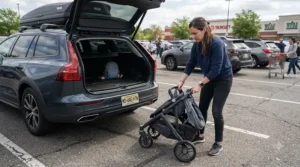
Finally, optimize your unloading routine at the car: load groceries into the trunk before folding the stroller, not after, so you’re not holding a folded frame and bags simultaneously while also managing two kids near a moving parking lot.
Real-World Scenarios: Which Sit-and-Stand Fits Your Grocery Routine
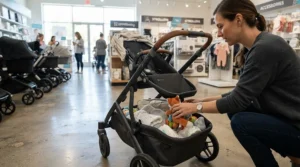
Consider three different grocery-trip profiles. A single parent doing solo weekday runs with a 6-month-old and a 3-year-old needs low lift weight above almost everything else — the 22-pound Joovy Caboose Ultralight or the 23.5-pound Joovy Caboose Too Ultralight make one-handed folding realistic when there’s no second adult to help. A budget-conscious family doing one large weekly Costco-style haul, by contrast, should prioritize storage over weight: the Baby Trend Sit N’ Stand 5-in-1 Shopper Plus, with its combined 50-pound basket-and-tote capacity, is built specifically for that use case even though it’s a few pounds heavier to lift.
A third profile — a family in an older suburb with cracked strip-mall parking lots and frequent short errand stops — benefits most from ride quality over either weight or storage. The Chicco BravoFor2‘s all-wheel suspension absorbs the kind of pothole-and-speed-bump combination that makes lighter, less-suspended frames feel jarring on repeated short trips. None of these three profiles is objectively “right” — the point is matching the stroller’s actual engineering trade-offs to your specific weekly pattern rather than buying whichever model has the highest star rating in isolation.
Problem → Solution: Fixing the Most Common Grocery-Stroller Headaches
Parents run into a handful of recurring problems with sit-and-stand strollers at the grocery store, and most have straightforward fixes. Problem one: the stroller won’t fit through a narrow end-cap display aisle. Solution: check a model’s assembled width before buying — most sit-and-stand strollers run 22-24 inches wide, comfortably under the 36-inch ADA-mandated minimum aisle width in most stores, but seasonal end-cap displays can still narrow that clearance unexpectedly, so approach tight spots at an angle rather than head-on.
Problem two: the basket is full before you’ve finished shopping. Solution: models like the Baby Trend Sit N’ Stand 5-in-1 Shopper Plus with dual storage (basket plus bench tote) solve this structurally, but on any stroller, loading heavier items low and centered — not piled high — keeps the frame stable and prevents tip-back when the standing platform is also occupied.
Problem three: the fold mechanism jams at the car when you’re in a hurry. Solution: this is almost always debris in the folding hinge from parking lot grit; a quick wipe-down prevents most jams, and models with an auto-lock fold, like the Joovy Caboose UL, are specifically engineered to reduce this failure point. Problem four: an older child refuses to stay on the platform mid-shop. Solution: several of these strollers, including the Baby Trend Sit N’ Stand Ultra and Chicco BravoFor2, offer a rear seat as an alternative to the standing platform — swapping configurations mid-trip, when the stroller allows it, often resolves restlessness faster than repeated verbal redirection.
How to Choose a Sit-and-Stand Stroller for Grocery Store Trips
- Measure your car trunk first. Folded dimensions vary by several inches across these models; know your space before comparing features.
- Weigh your actual lift frequency. If you’re loading and unloading the stroller multiple times a day, prioritize lighter frames like the Joovy Caboose Ultralight over heavier, storage-heavy options.
- Match storage capacity to your shopping pattern. Weekly bulk-haul families benefit from combined basket-and-tote systems; quick top-off shoppers can prioritize other features instead.
- Check car seat compatibility before you buy the stroller, not after. Universal adapters, like the one on the Joovy Caboose Ultralight, avoid locking you into one car seat brand.
- Consider your parking lot surface. Cracked pavement and frequent speed bumps favor suspension-equipped models like the Chicco BravoFor2.
- Test the fold mechanism in-store if possible. A “one-hand fold” on paper can still take real practice; auto-lock designs reduce user error.
- Confirm the assembled width against your usual stores’ aisles. Most sit-and-stand strollers clear standard aisles comfortably, but warehouse-club stores and boutique grocers vary more than you’d expect.
Sit-and-Stand Stroller vs Traditional Double Stroller
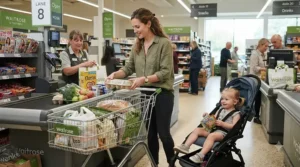
A side-by-side double stroller and a sit-and-stand tandem solve the “two kids, one trip” problem in fundamentally different ways, and the difference matters enormously inside an actual grocery store. Side-by-side doubles are typically 30+ inches wide — often wider than a single standard grocery aisle — which forces parents into constant three-point turns and apologetic aisle negotiations. Sit-and-stand tandems keep both kids in a single-file line, generally landing in the 22-24 inch width range, closer to a single stroller’s footprint.
| Feature | Sit-and-Stand Tandem | Side-by-Side Double |
|---|---|---|
| Typical width | 22-24 inches | 30+ inches |
| Aisle clearance | Fits most 36-inch aisles | Frequently too wide |
| Storage for groceries | Basket + optional tote | Basket only, split under two seats |
| Best For | Grocery trips, errands | Wide sidewalks, parks |
| Fold compactness | Generally more compact | Bulkier, heavier |
The comparison above makes the aisle-width case clearly, but it’s worth noting side-by-side doubles do win on one thing: both children get equal, forward-facing seat quality, whereas the back rider on a sit-and-stand often gets a smaller seat or a standing-only option. For grocery-specific use, though, the narrower footprint of a sit-and-stand tandem is close to a non-negotiable advantage — you’re simply not going to enjoy fighting a 32-inch-wide stroller through a cereal aisle.
Common Mistakes When Buying a Sit-and-Stand Stroller for Errands
The most common mistake is buying based on weight capacity alone and ignoring assembled width — a stroller can technically hold both your kids’ weight and still be too wide for your regular grocery store’s aisles, especially older stores built before modern ADA-mandated 36-inch aisle clearance became standard practice. A second common error is underestimating basket capacity needs; parents doing large weekly hauls often buy a lightweight model built for portability, then find themselves making a second trip because the basket can’t hold a full cart’s worth of groceries.
A third mistake is skipping the car-seat compatibility check before purchase — discovering after the fact that your existing infant car seat doesn’t click into a new stroller’s adapter is a frustrating and avoidable expense. Finally, many buyers underrate fold speed and mechanism reliability, assuming all “one-hand folds” are equivalent; in practice, auto-lock designs like the one on the Joovy Caboose UL meaningfully reduce fumbling compared to older push-button-and-fold two-step mechanisms, especially when you’re managing an impatient toddler at the same time.
Aisle Maneuverability: What to Expect in Real Grocery Stores
Spec sheets list assembled width, but real-world aisle maneuverability depends on more than that single number. Standard grocery aisles are typically planned in the 5-6 foot range for secondary aisles, well above any sit-and-stand stroller’s footprint, but end-cap displays, seasonal promotional bins, and other shoppers’ carts routinely eat into that clearance, according to industry grocery aisle planning guidance. In practice, that means the strollers with tighter turning radii — generally the lighter-framed Joovy models — feel noticeably easier to maneuver around a stray cart or a produce display than longer, heavier tandems.
Wheel size also plays a bigger role in maneuverability than most buyers expect. Larger wheels, like those on the Joovy Caboose UL, roll over uneven transition strips between store sections (tile to carpet, indoor to covered cart corral) more smoothly than smaller wheels, which can catch and require an extra shove. Swivel front wheels, standard across all seven models here, are what actually let you pivot around a 90-degree aisle corner without a three-point turn — but swivel wheels lock less precisely at speed, so most parents find themselves locking the front wheels only when navigating a genuinely crowded checkout line.
Shopping Cart Compatibility: Can a Sit-and-Stand Work With Store Carts?
None of the seven strollers in this guide physically attach to a shopping cart — sit-and-stand strollers are designed as cart replacements, not cart accessories, which is actually the point for grocery-focused buyers. The practical workaround most parents use is one of two approaches: push the stroller one-handed while pulling a hand-basket, or rely entirely on the stroller’s own basket-and-tote storage, as intended on models like the Baby Trend Sit N’ Stand 5-in-1 Shopper Plus. A small number of stores offer cart-and-stroller hybrid carts at the entrance, but these are store property, vary widely by location, and aren’t something you can count on consistently, so building your storage plan around your own stroller’s basket capacity is the more reliable strategy.
Long-Term Cost & Maintenance
Sit-and-stand strollers in this roundup range from roughly $160 to $400, but the sticker price is only part of the total cost of ownership. Budget steel-framed models like the Baby Trend Sit N’ Stand Ultra tend to have more replaceable parts available directly from the manufacturer, which can extend usable life cheaply if a wheel or canopy wears out. Lighter aluminum-framed models like the Joovy Caboose Ultralight cost more upfront but reduce a different kind of long-term cost — the physical toll of daily lifting, which matters over years of regular use even though it’s not a line item on a receipt.
Maintenance costs stay low across the category generally: wheel bearings, brake pads, and canopy fabric are the parts most likely to need replacement, typically after two to three years of regular grocery-trip use. Universal car-seat adapters, like the one included with the Joovy Caboose Ultralight, add long-term value by letting you switch car seat brands without buying a new stroller — a real cost-per-use advantage over models locked to one manufacturer’s car seat line. Cost-per-use, when you factor in a typical 2-4 year usage window covering two kids’ toddler years, generally favors mid-range models in the $250-$350 band, which balance durability against upfront price better than either the cheapest or priciest options here.
Safety & Regulations for Grocery-Ready Strollers
Every stroller sold in the U.S., including all seven models in this guide, must meet the ASTM F833 stroller safety standard, which the Consumer Product Safety Commission has incorporated into federal law under 16 CFR Part 1227. That standard covers stability testing on slopes, parking brake holding power, restraint system strength, and folding-mechanism finger-pinch prevention — the exact hazards most relevant to grocery-lot use, where strollers regularly sit on sloped pavement near cart corrals. According to CPSC’s own stroller safety resources, historical incident data on strollers has centered heavily on entrapment, instability, and non-functioning restraint systems, which is precisely why the five-point harnesses standard across all seven strollers here matter as more than a marketing checkbox.
For grocery-specific safety, always engage the parking brake fully before loading or unloading a child, even on seemingly flat lots — a slight incline near a cart corral is often enough to let an unlocked stroller roll. Regularly inspect the folding hinge mechanism for wear, since a compromised latch is one of the more common causes of unintended folding incidents. And note that Baby Trend, like most major stroller manufacturers, has issued voluntary recalls in the past for specific hinge and canopy-attachment issues on select models — always register your stroller with the manufacturer after purchase so you receive direct recall notifications rather than relying on catching the news yourself.
Frequently Asked Questions
❓ Can a sit-and-stand stroller fit through standard grocery store aisles?
❓ How much weight can a sit-and-stand stroller basket hold for groceries?
❓ What is the lightest sit-and-stand stroller for grocery trips?
❓ Do sit-and-stand strollers work with shopping carts?
❓ Is a sit-and-stand stroller better than a double stroller for grocery shopping?
Conclusion
There’s no single best sit-and-stand stroller for grocery store trips — there’s a best one for your specific routine. If storage is your top priority and budget matters, the Baby Trend Sit N’ Stand 5-in-1 Shopper Plus earns its spot with genuinely useful combined basket-and-tote capacity. If you’re lifting the stroller in and out of a trunk multiple times a day, the Joovy Caboose Ultralight or Joovy Caboose Too Ultralight make that daily task noticeably easier at roughly 22-23.5 pounds. And if your parking lot pavement has seen better days, the Chicco BravoFor2‘s all-wheel suspension is worth the added cost.
What all seven of these strollers share is a footprint built to actually clear a real grocery aisle — something a standard side-by-side double stroller often can’t promise. Match your pick to your storage needs, your lifting frequency, and your local parking lot conditions, and grocery runs with two kids stop being a logistical event and go back to being, well, just grocery runs.
✨ Don’t Miss These Exclusive Deals!
🔍 Take your grocery-trip stroller shopping to the next level with these carefully researched picks. Click on any highlighted model to check current pricing and availability. These strollers will help you create smoother, easier shopping trips your whole family will actually enjoy!
Recommended for You
- Sit-and-Stand Stroller With Standing Platform for Older Kids (2026)
- Sit-And-Stand Stroller Under $200: 7 Real Picks for 2026
- Sit-and-Stand Stroller for Toddler and Preschooler: 7 Top Picks 2026
Disclaimer: This article contains affiliate links. As an Amazon Associate, I earn from qualifying purchases. If you purchase products through these links, we may earn a small commission at no additional cost to you.
✨ Found this helpful? Share it with your friends! 💬🤗
