
In This Article
Let’s be honest — most of us pick a stroller based on how it looks in the store or how smoothly it glides across a showroom floor. But here’s the thing: that’s almost never the situation you’ll actually be in. You’ll be navigating a cracked sidewalk in the rain, one hand gripping the handlebar and the other holding a half-eaten rice cake, wondering why your baby keeps trying to twist backward to see your face. That’s the moment the reversible seat stroller becomes less of a “nice to have” and more of a “where have you been my whole parenting life” kind of product.
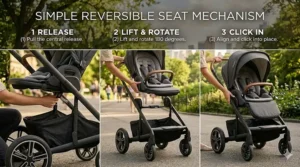
A reversible seat stroller — also called a modular stroller — is a stroller with a seat that can face either toward the parent or out toward the world. Simple concept. Surprisingly powerful in practice. Research from the University of Dundee found that babies in parent-facing strollers showed lower stress levels and vocalized more — in other words, they talked more and cried less. Eye contact, it turns out, is not a luxury. It’s developmental currency.
But here’s what most buying guides won’t tell you: not all reversible seat strollers are created equal. Some flip the seat in 15 seconds flat; others require a degree in mechanical engineering. Some are light enough to haul up apartment stairs; others are built like small tanks. The price range alone — from under $100 to pushing $800 — tells you this category has a lot going on beneath the surface.
That’s exactly why we put together this guide. We researched 7 real products currently available on Amazon, dug into actual customer reviews, and stress-tested the specs against real-world parenting life. Whether you’re a first-timer building out your registry or a second-time parent who knows exactly what they wish they’d bought the first time around — this is for you.
Quick Comparison Table: Top 7 Reversible Seat Strollers at a Glance
| Stroller | Weight | Weight Capacity | Price Range | Best For |
|---|---|---|---|---|
| Graco Modes Pramette | ~20 lbs | Up to 50 lbs | $180–$250 | Budget-conscious families |
| Mompush Wiz 2-in-1 | ~22 lbs | Up to 50 lbs | $150–$200 | Newborn-to-toddler versatility |
| BABY JOY 2-in-1 High Landscape | ~17 lbs | Up to 48 lbs | $80–$130 | Tight budgets, first-time buyers |
| Lortsybab 2-in-1 Baby Stroller | ~18 lbs | Up to 44 lbs | $100–$150 | Style-forward budget shoppers |
| Cybex Balios S Lux | ~22 lbs | Up to 55 lbs | $550–$650 | Urban families wanting premium value |
| UPPAbaby Cruz V3 | ~20 lbs | Up to 50 lbs | $699–$799 | Long-term investment buyers |
| Jeep Unlimited Reversible Handle | ~21 lbs | Up to 50 lbs | $150–$220 | Travel & theme park parents |
What this table tells you: The budget tier ($80–$250) covers a surprisingly broad range of quality — the Graco Modes Pramette punches far above the BABY JOY in terms of build quality and longevity, even though both sit in similar price neighborhoods. In the premium tier, the Cybex Balios S Lux is the value MVP: it delivers features that approach UPPAbaby quality at roughly $150 less. If budget isn’t a constraint, the Cruz V3 is the last stroller you’ll ever need to buy.
💬 Just one click — help others make better buying decisions too! 😊
✨ Don’t Miss These Exclusive Deals!
🔍 Take your parenting game to the next level with these carefully selected strollers. Click on any highlighted product name to check current pricing and availability on Amazon. These picks will help you create comfortable, connected moments with your little one on every single walk!
Top 7 Reversible Seat Strollers: Expert Analysis
1. Graco Modes Pramette Stroller — The Workhorse That Won’t Break the Bank
The Graco Modes Pramette is the stroller that’s been quietly making it onto “best of” lists for years — and for genuinely good reasons that go beyond name recognition.
Key specs with real-world meaning: The 3-in-1 system transitions from infant car seat carrier (compatible with all Graco car seats via one-step Click Connect) to infant pramette to toddler stroller. That means from Day 1 in the hospital parking lot to the first day of preschool, you’re covered. The reversible seat flips between parent-facing and forward-facing, and the toddler seat reclines into a flat pramette position — useful for early-stage newborns who shouldn’t be seated upright. It holds up to 50 lbs, which is solidly above average for this price point. One-hand fold is genuinely one-handed, not the “technically one hand if you use your hip too” kind.
Who this is for: Parents who want a reliable, brand-name reversible seat stroller without dipping into the $500+ range. It’s the stroller equivalent of a Honda Civic — not glamorous, but almost universally recommended for good reason. First-time parents who aren’t sure how much they’ll actually use a stroller will appreciate not over-investing here.
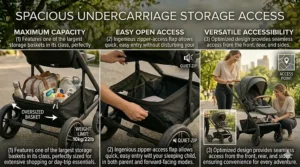
What buyers say: Reviews consistently praise the easy fold and the wide variety of color options. A common note: the storage basket is smaller than expected given the stroller’s footprint.
✅ Excellent value for a brand-name 3-in-1 system
✅ Compatible with all Graco infant car seats
✅ Genuine one-hand fold that works in real life
❌ Storage basket could be larger
❌ Slightly heavier than other options at the same price
Price range: $180–$250 for stroller only; travel system bundles run $300–$400.
2. Mompush Wiz 2-in-1 Baby Stroller — The Newborn-to-Toddler Overachiever
The Mompush Wiz doesn’t have the legacy brand recognition of a Graco, but it’s been picking up serious momentum — and after spending time with the specs and parent feedback, it’s easy to see why.
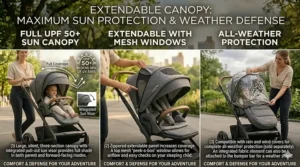
Key specs with real-world meaning: The “2-in-1” refers to a genuine bassinet/pramette mode alongside the reversible toddler seat. The pramette mode isn’t just a deep recline — it’s a true lie-flat position, which matters for newborns whose spines aren’t ready for any compression. The UPF 50+ canopy is notably large, covering more of the seat than the typical budget canopy that blocks maybe 60% of direct sun. One-hand fold works whether the seat is parent-facing or forward-facing — you don’t need to reconfigure it first, which is a quality-of-life detail that most parents only appreciate after being burned by a stroller that requires three steps before it’ll collapse.
Who this is for: New parents who want a proper newborn-capable stroller with the reversible seat feature, without needing to buy a separate bassinet or travel system. It’s an especially strong choice if you’re doing a lot of neighborhood walks and want to maintain that face-to-face connection through early infancy.
What buyers say: Parents frequently mention how much they appreciate the canopy size. A few noted the fold isn’t quite as compact as some competitors, which can matter in smaller car trunks.
✅ True lie-flat bassinet mode for newborns
✅ One-hand fold in any seat position
✅ Oversized UPF 50+ sun canopy
❌ Larger folded footprint than some alternatives
❌ No included car seat adapter (sold separately)
Price range: $150–$200.
3. BABY JOY 2-in-1 High Landscape Baby Stroller — Surprisingly Capable at an Entry-Level Price
The BABY JOY 2-in-1 is the stroller you mention when someone says “I just want a reversible seat stroller but I’m on a really tight budget.” It’s not competing with Cybex or UPPAbaby — but it’s also not trying to.
Key specs with real-world meaning: “High landscape” means the seat sits elevated above the ground — typically 20+ inches — which keeps your baby further from road-level exhaust and dust. That’s not just a marketing term; it’s a meaningful feature for city parents. The aluminum alloy frame keeps weight down while maintaining structural integrity. Four shock-absorbing wheels with independent suspension springs handle light rough terrain adequately. The reversible seat can flip between parent-facing and forward-facing, and the backrest adjusts to 3 recline positions. A 5-point safety harness is standard, and the detachable guardrail adds an extra layer of containment.
Who this is for: First-time parents on a strict budget, grandparents buying a secondary stroller for weekend visits, or families in developing climates where a “beater” stroller makes more sense than a premium one. Don’t expect it to last through three kids, but it’ll absolutely serve one through the stroller years.
What buyers say: Customers frequently express surprise at the quality relative to the price. Some noted the setup instructions could be clearer.
✅ Elevated seat position keeps baby away from ground-level pollution
✅ Solid aluminum frame at an entry-level price
✅ Includes storage bag, foot cover, and rain cover
❌ Not suitable for air travel (per product listing)
❌ Smaller weight capacity than premium options
Price range: $80–$130.
4. Lortsybab 2-in-1 Baby Stroller — The Style-Forward Budget Pick with Real Safety Chops
Lortsybab doesn’t have the name recognition of the big players, but what they’ve built in the 2-in-1 model is worth serious attention — especially if you care about both aesthetics and safety without spending mid-range money.
Key specs with real-world meaning: The front wheels come with two high-quality shock absorption springs each — not just a single damper, which is common in this price range. The sleeping basket uses a suspension frame design, which means the seat absorbs shock independently from the wheels. That’s two layers of suspension for your baby’s head and spine, which is genuinely more than you’d expect under $150. The reversible seat covers 0–36 months, the 360° rotating front wheels lock for stability on straight paths, and the one-touch brake hits both rear wheels simultaneously — no hunting for a second brake pedal.
Who this is for: Parents who want the reversible seat stroller experience without the budget-stroller “look.” The Lortsybab has a cleaner visual profile than most options in its price tier. It’s also a strong pick for parents of infants specifically, given the double-layer suspension protecting young skulls from rough surfaces.
What buyers say: Very positive feedback on the suspension feel for a sub-$150 stroller. A few parents mentioned the canopy isn’t the largest.
✅ Double-layer suspension (wheel + frame) for newborn comfort
✅ Eco-friendly, tear-resistant fabrics
✅ One-touch simultaneous rear brake
❌ Canopy coverage is modest
❌ Seat capacity tops out at 44 lbs (lower than some competitors)
Price range: $100–$150.
5. Cybex Balios S Lux — The Premium Stroller That Doesn’t Ask You to Choose Between Quality and Value
Here’s where the conversation shifts. The Cybex Balios S Lux lives in a different league from everything above — and within that league, it’s arguably the best dollar-for-dollar proposition on Amazon right now.
Key specs with real-world meaning: The two-tier suspension system (front wheel + frame-based rear suspension) is the engineering highlight here. Most strollers at this price either have front wheel suspension OR rear, not both. The result is a ride quality that parents describe as “floating.” The reversible seat positions at table height — meaning your baby can be at eye level with you at a café, not staring up at strangers’ chins. The one-pull harness, borrowed directly from Cybex’s car seat technology, cinches the 5-point harness evenly with a single tug — no fussing with individual straps while your baby wiggles. Weight capacity reaches 55 lbs, the highest in the mid-premium tier. Folded, it stands independently, which sounds minor until you’re in a Starbucks bathroom trying to not set it on the floor.
Who this is for: Urban parents who put in serious stroller mileage — daily errands, weekend farmers’ markets, irregular sidewalks. The suspension difference is most noticeable on the kinds of surfaces you encounter in real cities: brick paths, cobblestones, cracked pavement. It’s also the best pick for parents who value the parent-facing connection but need a stroller that can genuinely handle all terrain without constant jostling.
What buyers say: Near-universal praise for ride quality and the one-pull harness. Some buyers note the carry cot (bassinet) is sold separately, which is a meaningful additional cost for newborn families.
✅ Dual suspension (front wheel + frame) for true all-terrain performance
✅ Table-height seating for better social interaction
✅ One-pull car-seat-inspired harness
✅ Includes cup holder and rain cover (usually extras)
❌ Bassinet sold separately — adds to total cost for newborn use
❌ On the heavier end for its size
Price range: $550–$650.
6. UPPAbaby Cruz V3 — The Last Stroller You’ll Ever Buy (and That’s the Point)
The UPPAbaby Cruz V3, released in late 2025, is the kind of product that makes you understand why some parents spend $700+ on a stroller. It’s not extravagance. It’s math — specifically, the math of buying one excellent thing instead of three mediocre ones.
Key specs with real-world meaning: The V3 introduces a genuinely lay-flat reversible seat with an integrated infant insert — meaning the Cruz is newborn-ready out of the box, no bassinet purchase required. That alone justifies a significant portion of the price premium for families planning to use it from Day 1. The FlexRide suspension is all-wheel, which is the correct answer when you’re pushing a stroller daily. The magnetic harness buckle is pure genius — one-handed buckling a squirming 18-month-old in a restaurant parking lot becomes a 3-second process instead of a 30-second ordeal. Weight capacity to 50 lbs. XL storage basket (30 lbs capacity). Folds one-step, stands on its own. Compatible with UPPAbaby’s Mesa and Aria infant car seats without any adapter required.
Who this is for: Parents who want to buy once and be done with it. The Cruz V3 is particularly compelling for families planning a second child — the PiggyBack board attachment turns it into a ride-along solution for the older sibling without buying a double stroller. It’s also the pick for anyone who finds themselves using the stroller daily and wants the push quality to stay good years in, not just months.
What buyers say: Owners almost universally describe the push quality as exceptional. The magnetic buckle gets specific shout-outs in reviews. Occasional comments about the premium price point, but few regrets.
✅ Lay-flat reversible seat, newborn-ready without bassinet
✅ Magnetic harness buckle (genuinely changes your life at restaurant time)
✅ No-adapter car seat compatibility with UPPAbaby models
✅ PiggyBack board compatible for future siblings
❌ Premium price point — significant upfront investment
❌ Requires UPPAbaby ecosystem for best compatibility
Price range: $699–$799.
7. Jeep Unlimited Reversible Handle Stroller — The Travel Warrior Built for Parents Who Never Stop Moving
Not every great stroller is designed for city sidewalks. The Jeep Unlimited Reversible Handle Stroller is engineered for a different kind of parent: the one who spends weekends at theme parks, travels frequently, and needs a stroller that folds into a car trunk without a tetris strategy.
Key specs with real-world meaning: At approximately 20.9 lbs with a folded footprint of 21.3″ × 9.8″ × 31″, this stroller meets Disney’s size requirements — a specific, meaningful spec for families who visit theme parks regularly. The “reversible handle” design is different from most reversible seat strollers: rather than detaching and re-attaching the seat, you flip the handlebar from one end to the other, changing the direction the child faces. This makes face-direction changes faster and less hands-on than traditional modular strollers. Seven front swivel-locking wheels and eight rear shock-absorbing wheels provide stability on the kinds of varied surfaces you encounter at outdoor venues and uneven urban terrain. Supports up to 50 lbs, with an extendable UPF 50+ canopy.
Who this is for: Traveling families, theme park regulars, and parents who want a reversible-handle stroller rather than a detachable-seat model. The faster face-direction switch is genuinely convenient; you don’t need to stop, unbuckle, remove the seat, and reinstall it — you simply rotate the handle and go.
What buyers say: Buyers highlight the compactness and the ease of the reversible handle mechanism. A few noted it’s not the smoothest push on very rough terrain compared to heavier all-terrain models.
✅ Meets Disney/theme park size requirements
✅ Fastest face-direction change of any reversible model (handle flip, not seat removal)
✅ 7 front + 8 rear shock-absorbing wheels
✅ Compatible with select infant car seats via adapter
❌ Not ideal for serious off-road terrain
❌ Reversible handlebar mechanism differs from traditional modular stroller approach
Price range: $150–$220.
Full Specifications Comparison Table
| Feature | Graco Modes Pramette | Mompush Wiz | Cybex Balios S Lux | UPPAbaby Cruz V3 | Jeep Unlimited |
|---|---|---|---|---|---|
| Weight Capacity | 50 lbs | 50 lbs | 55 lbs | 50 lbs | 50 lbs |
| Stroller Weight | ~20 lbs | ~22 lbs | ~22 lbs | ~20 lbs | ~21 lbs |
| Newborn-Ready | With car seat | Yes (bassinet mode) | With cot (sold sep.) | Yes (infant insert) | With adapter |
| Suspension | Basic front | Basic front | Dual (front + frame) | All-wheel FlexRide | Multi-wheel shock |
| Car Seat Compat. | All Graco (Click Connect) | Adapter sold sep. | CYBEX/gb | UPPAbaby (no adapter) | Select brands |
| Price Range | $180–$250 | $150–$200 | $550–$650 | $699–$799 | $150–$220 |
The key insight from this data: The suspension system is the single biggest differentiator between price tiers — and it’s the feature most overlooked on spec sheets. Basic front-wheel suspension (budget tier) handles smooth sidewalks. All-wheel or dual suspension (premium tier) handles the world you actually live in. If your daily routes include cracked pavement, cobblestones, or gravel paths, that difference translates directly into fewer jolts to your baby’s developing spine and head.
How to Use Your Reversible Seat Stroller: A First 30 Days Survival Guide
Buying the stroller is only half the challenge. The other half is actually learning to use it efficiently — and most new parents waste the first several weeks relearning things by accident.
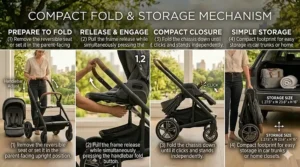
Week 1: Set up before the baby arrives. This sounds obvious but is systematically ignored. Read the manual (yes, the actual manual), set up and collapse the stroller at least five times before you need to do it in a hospital parking garage with a screaming newborn. Pay specific attention to the seat reversal process — whether it’s a handlebar flip (Jeep Unlimited) or a seat detach-reinstall (most modular strollers). Know your stroller’s mechanism cold before you need it.
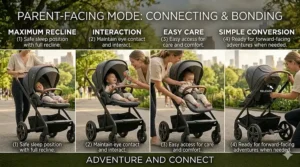
The parent-facing phase (0–6 months). Keep the seat parent-facing during this window. According to the American Academy of Pediatrics, face-to-face interaction during the first year is directly linked to language development. When your baby makes sounds and you respond — even just mirroring their expression — you’re building neural pathways. The stroller is the setting for a significant portion of those interactions. Don’t forfeit them to forward-facing simply because it looks cooler.
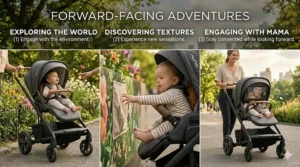
Switching to forward-facing. Most developmental experts and the CDC’s Early Childhood Development guidelines suggest the switch around 6–9 months when babies become more curious about the world around them. Watch your baby for cues: craning their neck to see what’s behind them is a strong signal. The switch itself should take under 2 minutes on any quality modular stroller. If it’s taking longer, you’re missing a latch or button — stop, refer to the manual, and don’t force anything.
Maintenance basics that double the stroller’s lifespan: Clean the wheel wells after every muddy outing — debris build-up in swivel wheels is the #1 cause of degraded maneuverability over time. Check harness buckles monthly for grit or food debris that can prevent clean clicks. For folding mechanisms, a tiny drop of silicone lubricant on the fold joint every 3–4 months keeps one-hand folds actually one-handed for years.
Who Should Buy Which Reversible Seat Stroller? Real-World Profiles
Every stroller recommendation is really a lifestyle recommendation in disguise. The “best” reversible seat stroller doesn’t exist in the abstract — it exists relative to your specific situation.
The New York/Chicago apartment parent. You live on the 4th floor with no elevator, push this thing onto buses and subways, and fold it 6 times a day. You need: lightweight (under 22 lbs), compact fold, self-standing when folded (for tiny apartment foyers). Best match: UPPAbaby Cruz V3 or Cybex Balios S Lux. Both fold compactly and stand independently. The Cruz is slightly lighter; the Cybex is $150 cheaper.
The suburban parent with a minivan. You have trunk space, use the stroller primarily for mall walks, park trails, and Target runs. You care about a smooth push and easy car seat transfer. Best match: Graco Modes Pramette Travel System. The Click Connect car seat compatibility means you snap the car seat right onto the frame without waking a sleeping newborn — one of the genuinely transformative small pleasures of early parenthood.
The theme park family. Disney, Universal, Six Flags — you’re there four or more times a year. Size requirements, compact fold, and that reversible function for indoor queues where your child needs to see your face. Best match: Jeep Unlimited Reversible Handle Stroller. It was practically designed for this use case.
The budget-first first-time parent. You’re not sure how much you’ll use a stroller, you have a baby shower coming up, and you want something respectable without overspending on gear you might not need. Best match: Mompush Wiz 2-in-1 in the mid range, or BABY JOY 2-in-1 if the budget is truly tight. Both offer genuine reversible seat functionality and bassinet mode without requiring a second mortgage.
The long-game investor. You’re planning two or three kids, you do 5+ mile walks regularly, and you want to buy once. Best match: UPPAbaby Cruz V3, full stop. The PiggyBack board compatibility alone saves you from buying a double stroller later.
How to Choose the Best Reversible Seat Stroller: 7 Criteria That Actually Matter
Walk into any baby store and a salesperson will tell you about five features that don’t particularly matter and skip the three that do. Here’s a no-nonsense framework.
1. Suspension system. Ask specifically: is it front-wheel only, all-wheel, or dual-system (wheel + frame)? Front-wheel only is acceptable for smooth urban surfaces. Anything rougher than a clean sidewalk requires all-wheel or dual suspension. This is non-negotiable for your baby’s comfort and long-term spinal health. The American Chiropractic Association notes that repeated micro-vibrations in infants can contribute to discomfort — proper suspension is the engineering solution.
2. Weight. Not the stroller’s weight capacity — its actual weight. Pick it up in the store (or check reviews that specifically address this). “22 lbs” sounds reasonable until you’re lifting it into an SUV 4 times a day for two years.
3. Seat reversal speed. Time yourself doing it in the store. Under 90 seconds is acceptable. Over 3 minutes means you’ll stop doing it regularly, defeating the whole point of buying a reversible seat stroller.
4. Fold mechanism. Specifically: does it stand when folded? Can you fold it without removing the seat? Does it fit in your specific car trunk? Measure your trunk before buying anything in the full-size category.
5. Newborn readiness. If you’re buying this before or shortly after birth: does it include a bassinet/pramette mode, or do you need to buy a separate carry cot? Factor that cost into the total. The Mompush Wiz and Cruz V3 are newborn-ready out of the box; the Cybex Balios S Lux requires a separate Cot S Lux purchase.
6. Car seat ecosystem. If you already have a car seat, check compatibility before buying. Graco-to-Graco is seamless. UPPAbaby car seats clip directly to the Cruz V3. Cybex works within the Cybex/gb ecosystem. Cross-brand compatibility requires adapters and research.
7. Long-term support. Check whether replacement parts (tires, harness buckles, canopy) are available for the brand. Budget brands often have poor parts availability. Graco, UPPAbaby, and Cybex all maintain strong replacement parts ecosystems.
Parent Facing vs. World Facing: What the Research Actually Says
The stroller-facing debate has generated more parenting forum heat than almost any other topic in baby gear. Here’s what the actual evidence says, without the tribalism.
The 2008 University of Dundee study, often cited in this debate, followed 2,722 parent-child pairs and found that babies in forward-facing strollers had lower conversation rates with parents and showed measurably higher stress indicators (as measured by cortisol-adjacent behavioral markers). Babies in parent-facing strollers laughed more and vocalized more. The study’s conclusion was that stroller design directly influences parent-child interaction quality.
What this means in practice is not “always parent-face your child forever.” It means the ability to choose — which is exactly what a reversible seat stroller gives you. The ideal approach for most developmental stages: parent-facing for the first 6–9 months (when language and emotional development are most sensitive to face-to-face interaction), then gradually transitioning to forward-facing as curiosity about the external world increases.
Crucially, the stroller where baby can face parent isn’t just about emotional development. It’s about safety monitoring. In a parent-facing position, you can immediately see if your child has nodded off into an unsafe chin-to-chest position, if they’ve spit up, if they’ve grabbed something they shouldn’t have. That kind of real-time visual monitoring simply isn’t possible with a forward-facing setup.
The stroller eye contact with baby during the first year isn’t sentimentality — it’s evidence-based parenting infrastructure.
Common Mistakes When Buying a Reversible Seat Stroller
Mistake 1: Buying based on online photos alone. Stroller aesthetics translate terribly from product photos. The weight, the push feel, the actual size of the canopy, the real-world ease of the seat reversal — none of that comes through in images. If you have any access to a store that stocks the model, make the trip.
Mistake 2: Ignoring the stroller-facing both directions tradeoff on bulk. Modular strollers are almost universally heavier and bulkier than fixed-seat strollers. That’s the physics of the design. If ultra-portability is your primary need, a lightweight travel stroller will serve you better than a reversible model. Know the tradeoff before you buy.
Mistake 3: Buying the cheapest reversible stroller for daily heavy use. Budget reversible strollers are excellent secondary strollers and adequate primary strollers for low-frequency use. But if you’re pushing this thing 2+ hours daily, the suspension, wheel quality, and frame durability at the $80–$130 price point will show wear within 12–18 months. Buy one tier up from what you think you need if daily use is the plan.
Mistake 4: Forgetting about the infant phase. Many reversible seat strollers are marketed primarily as toddler products but can technically accept newborns — with caveats. Always verify whether newborn use requires a separate bassinet/carry cot purchase. Surprise $200 add-ons are unpleasant.
Mistake 5: Not testing the fold with one hand while holding a baby (weight). Ask a store clerk to hold a 12-lb bag while you test the fold. That’s the real condition. One-hand folds that work perfectly with two free hands sometimes require a subtle hip assist when one arm is occupied. Know your stroller’s actual behavior before it matters.
Features That Actually Matter (And Those That Don’t)
Features Worth Paying For
Dual or all-wheel suspension — The difference between a $200 and a $600 stroller often lives entirely in the suspension system. It’s not marketing. It is the single most impactful engineering difference for daily push quality.
Magnetic harness buckle — The UPPAbaby Cruz V3’s magnetic buckle is the best example of a feature that sounds minor until you’ve done 400 buckle-and-unbuckle cycles. Shaves 20–25 seconds off every single use.
Independent seat reversal (no tool required) — This should be standard but isn’t always. Test it.
Self-standing fold — Matters enormously in small spaces, urban transit, restaurant bathrooms.
Features That Are Mostly Marketing
“Premium” fabrics at budget prices — Eco-friendly, tear-resistant, machine-washable fabric sounds great in bullet points. At the $80–$150 tier, these claims are relative. The fabric is acceptable, not remarkable.
Cup holder count — Two cup holders are fine. Three is unnecessary. The stroller equivalent of a car having six USB ports.
“All-terrain” at budget prices — A stroller with 4-inch EVA wheels is not genuinely all-terrain. It handles cracked sidewalks. It does not handle hiking trails. True all-terrain means large air-filled rubber tires (think Cybex Balios S Lux and above).
One-touch fold systems on budget strollers — Budget one-touch folds frequently stop being truly one-touch after 6 months of real use. Mechanism tolerance loosens. Premium one-touch folds (Graco, UPPAbaby) maintain their reliability because the engineering tolerances are tighter.
Long-Term Cost & Maintenance: The Real Price of a Reversible Seat Stroller
The sticker price is only the beginning of the financial calculation. Here’s how the true total cost of ownership shakes out across tiers.
Budget tier ($80–$150): Lower upfront cost, but replacement parts are often unavailable or expensive to source. Expect 2–3 year lifespan with regular use before maneuverability and fold quality degrade noticeably. If you have multiple children, plan to replace rather than reuse. True total cost over 5 years: $150–$300 if you replace once.
Mid-range tier ($150–$300): Graco in particular has excellent parts availability — tires, harness buckles, trays, and canopies are all findable and reasonably priced. With normal care, a Graco Modes Pramette will serve one child fully and a second child with acceptable wear. Total cost over 5 years: $200–$350 with one minor part replacement.
Premium tier ($550–$800): UPPAbaby and Cybex both maintain strong replacement parts programs. The UPPAbaby Cruz V3 specifically is designed to outlast multiple children — the PiggyBack board compatibility means you extend its functional life rather than retire it. A Cruz V3 bought at $750 amortizes to roughly $125–$150 per year over a 5-year multi-child use period. That’s comparable to, or cheaper than, buying two mid-range strollers. True total cost over 5 years: $750–$900 (including one minor accessory).
Maintenance basics that apply across all price tiers:
- Clean swivel wheel wells monthly (pebbles and grit destroy bearings faster than any other factor)
- Wipe harness webbing with mild soap — never machine wash, as it degrades tensile strength
- Check all folding joints and hinges every 3 months; a drop of silicone spray maintains smooth operation
- Test all buckles quarterly; replace at the first sign of stiffness or misalignment
✨ Don’t Miss These Exclusive Deals!
🛒 Ready to shop smarter? Click on any highlighted stroller name throughout this article to check the latest pricing and availability on Amazon. Every pick in this guide is currently available and ships with Prime. Find the right reversible seat stroller for your family today!
FAQ: Reversible Seat Strollers — Your Questions Answered
❓ What is a reversible seat stroller?
❓ At what age should I switch my baby from parent-facing to forward-facing?
❓ Is a stroller where baby can face parent worth the extra cost over a fixed-seat stroller?
❓ What is the best facing both ways stroller for travel?
❓ Do reversible handlebar strollers work the same as reversible seat strollers?
Conclusion: The Reversible Seat Stroller That’s Right for You
Here’s the bottom line on reversible seat strollers in 2026: the category has never been stronger, the price range has never been wider, and the research supporting the parent-facing position during infancy has never been more convincing. But none of that means anything if you buy the wrong stroller for your specific life.
Buy the BABY JOY 2-in-1 or Lortsybab if you need something functional and affordable right now. Buy the Graco Modes Pramette if you want a reliable brand-name experience without mid-range pricing. Go Mompush Wiz for a budget-to-mid stroller that genuinely handles newborns without add-ons. Step up to the Cybex Balios S Lux for the best urban riding experience under $650. And if you’re buying once for the long haul, the UPPAbaby Cruz V3 is the investment that pays for itself across multiple children and years of daily use.
The stroller eye contact with baby you maintain during those first months isn’t just heartwarming. It’s actively shaping who your child becomes. The stroller that makes that easier isn’t a luxury — it’s infrastructure.
✨ Ready to Find Your Perfect Stroller?
🔍 Click on any product name above to check current pricing and availability on Amazon. From budget-friendly picks to premium investments, the right reversible seat stroller for your family is just one click away — and it’ll make every walk a little more connected. 🤗
Recommended for You
- Best Modular Stroller 2026: 7 Top Picks for Smart Families
- 7 Best Luxury Strollers of 2026 That Are Worth Every Penny
- Best Everyday Stroller: 7 Expert Picks for 2026
Disclaimer: This article contains affiliate links. As an Amazon Associate, I earn from qualifying purchases. If you purchase products through these links, we may earn a small commission at no additional cost to you.
✨ Found this helpful? Share it with your friends! 💬🤗
