
In This Article
Somewhere around mile four of a stroller run, you learn things about physics that no parenting book ever mentioned. A jogging double stroller for marathon training parents isn’t a stroller in the ordinary sense — it’s closer to a piece of training equipment that happens to also hold two children, snacks, and approximately one thousand emergency wipes. If you’re logging real mileage, week after week, the difference between a stroller built for the mall and one built for the road shows up fast: in your shoulders, in your pace, and in how confidently you can bomb down a hill without white-knuckling the handlebar.
This guide skips the marketing copy and goes straight to what matters for people actually training — real products, real specs, honest aggregated review sentiment, and side-by-side comparisons that explain why one stroller beats another in specific situations. Whether you’re chasing a Boston qualifier with twins in tow or just trying to keep your long runs consistent through a full training block, you’ll find a genuine fit here, from budget-friendly options to the deluxe machines serious runners swear by.
What Is a Jogging Double Stroller for Marathon Training Parents?
A jogging double stroller for marathon training parents is a three-wheeled, side-by-side stroller engineered specifically for sustained running: a fixed (lockable) front wheel for stability at speed, air-filled or high-durability tires for shock absorption, and a frame rigid enough to hold its line over miles of pavement, gravel, or trail without wandering off course. Pediatric guidance generally advises against running with a stroller until a baby is at least six months old and has independent head and neck control, which is worth keeping in mind before you plan your first stroller long run — read more on the age guidelines here.
Quick Comparison Table
Before diving into full reviews, here’s a scannable snapshot of where each stroller sits on the budget-to-premium spectrum and what makes it worth a second look.
| Product | Price Range | Standout Feature | Best For |
|---|---|---|---|
| BOB Revolution Flex 3.0 Duallie | $700-$800 range | Mountain-bike-style suspension | High-mileage road and light trail training |
| BOB Revolution Pro Duallie | $850-$950 range | Hand-activated drum brakes | Hilly routes and technical descents |
| Baby Jogger Summit X3 Double | $750-$850 range | Hand brake + tether combo | Runners who want dual-layer downhill control |
| Thule Urban Glide 3 Double | $800-$900 range | Zip-top storage, reflective trim | Early-morning or dusk marathon training runs |
| BOB Gear Wayfinder Double | $550-$650 range | Independent dual suspension | Mid-range buyers who still want real suspension |
| Schwinn Turismo Swivel Double | Around $350 range | Hand brake at a budget price | New runners easing into stroller mileage |
| Baby Trend Expedition Double Jogger | Under $250 | Pneumatic tires on a tight budget | Occasional joggers, not full marathon blocks |
Looking at the table, the pattern is clear: hand brakes and true suspension systems cluster in the $550-and-up range, while anything under $350 trades some downhill control and shock absorption for affordability. If your training routes are flat and paved, that trade-off may not matter much — but the moment hills enter the picture, the gap between the Baby Trend Expedition Double Jogger and the BOB Revolution Pro Duallie becomes very real, very fast.
💬 Just one click — help other running parents make better buying decisions too!😊
Top 7 Jogging Double Strollers: Expert Analysis
Every product below is a real, currently available stroller. Where possible, we’ve noted aggregated sentiment from verified buyer reviews — never invented quotes or star ratings. Prices are shown as ranges only, since actual Amazon pricing fluctuates.
1. BOB Revolution Flex 3.0 Duallie — best all-around suspension for high-mileage training
The BOB Revolution Flex 3.0 Duallie built its reputation on one thing: a mountain-bike-style suspension system that keeps two kids settled over broken pavement instead of passing every crack straight through to their spines.
Its aluminum frame keeps overall weight manageable despite the dual-seat footprint, and the 9-position adjustable handlebar (roughly 34.5 to 45.5 inches) means a 5’2″ parent and a 6’3″ running partner can both push it without hunching or reaching. In practice, that adjustability matters more than it sounds — a handlebar set too low turns every run into a lower-back workout. The air-filled tires absorb noticeably more road buzz than foam alternatives, which is the difference between kids who nap through your tempo run and kids who complain about every seam in the sidewalk.
Who this is for: runners logging 15-plus miles a week with two kids in tow, especially on mixed terrain that includes curbs, cracked sidewalks, or light gravel. Reviewers consistently report that the swivel-lock front wheel switches modes via a handlebar lever, so you never have to bend down mid-run to convert it for jogging.
Aggregated buyer sentiment frequently praises the ride quality and tracking stability at speed, with the most common critique being the lack of a hand brake — something only the Pro version in this lineup addresses.
Pros:
- ✅ Mountain-bike suspension smooths out cracked pavement
- ✅ Nine-position handlebar fits parents of very different heights
- ✅ Compression seats accommodate kids from infancy to 50 pounds each
Cons:
- ❌ No hand brake, which matters on steep descents
- ❌ Heavier lift into a trunk than budget alternatives
Price verdict: around $700-$800, and worth it if your weekly mileage is genuinely high and your routes include rough terrain — flat-land, low-mileage joggers may not need this much stroller.
2. BOB Revolution Pro Duallie — hand brake built for descents
If your marathon training route includes any real elevation change, the BOB Revolution Pro Duallie exists specifically for you. It’s the deluxe version of the Flex platform, with one addition that changes everything on hills: hand-activated rear drum brakes.
The brake sits at the center of the handlebar, letting you bleed off speed on a downhill with a squeeze rather than fighting the stroller’s momentum with your arms and shoulders. Paired with the same 9-position adjustable handlebar and 3 inches of suspension travel as the Flex 3.0, the Pro adds two stages of weight support, so ride quality stays consistent as your kids grow rather than getting bouncier under a heavier load. The locking swivel front wheel handles tight turns at the end of a cul-de-sac, then locks flat again for the next straightaway.
Reviewers consistently single out the hand brake as the feature that “justifies the premium” for anyone training in hilly neighborhoods, with buyers in flatter regions more often saying they didn’t end up needing it.
Aggregated sentiment also flags this as BOB’s largest-capacity double for storage, useful when marathon training doubles as a grocery run with two kids strapped in.
Pros:
- ✅ Hand-activated drum brakes for real downhill control
- ✅ Adjustable suspension keeps ride quality steady as kids grow
- ✅ Largest cargo capacity in the BOB double lineup
Cons:
- ❌ Premium price mainly justified by hilly terrain
- ❌ Overkill for parents who only run flat, paved loops
Price verdict: in the $850-$950 range — a smart investment for hill repeats and technical descents, less necessary if your long runs stay pancake-flat.
3. Baby Jogger Summit X3 Double — hand brake plus tether for dual-layer safety
The Baby Jogger Summit X3 Double takes a slightly different approach to downhill control: a hand-operated deceleration brake paired with a handlebar tether strap, giving you two separate safety layers instead of one.
That combination means you can modulate speed smoothly through a long descent — unlike foot-only brake systems, which are essentially either locked or free-rolling with no middle setting — while the tether prevents a runaway situation if you trip. All-wheel suspension (rather than rear-only) rides on 16-inch rear and 12-inch front air-filled tires, and the all-black frame with reflective canopy accents genuinely helps with visibility on dawn or dusk marathon-training runs during winter months when daylight is scarce.
Honest analysis here: the dual-brake-and-tether system is the standout, but it comes with a learning curve. Buyers report needing a few runs to find the “sweet spot” of brake engagement, since a squeeze-handle brake doesn’t lock as positively as a foot pedal.
Independent reviewers also note that the seats run a bit short in height, meaning a tall four-year-old may outgrow the back support sooner than on a BOB Revolution Flex 3.0 Duallie or BOB Revolution Pro Duallie.
Pros:
- ✅ Hand brake and tether give two layers of downhill control
- ✅ All-wheel suspension on both front and rear tires
- ✅ Reflective canopy trim aids visibility on early or late runs
Cons:
- ❌ Brake modulation takes practice to master
- ❌ Seats run short for taller, older kids
Price verdict: roughly $750-$850, a strong pick for runners who specifically want a second layer of downhill safety beyond a standard brake.
4. Thule Urban Glide 3 Double — zip-top storage and standout visibility
The Thule Urban Glide 3 Double brings Scandinavian design sensibility to the category, and its most practical upgrade is one nobody talks about enough: a zip-top cover on the storage basket, so your jacket, phone, and diapers are still there when you finish your run instead of bounced out somewhere around mile three.
Air-filled tires and a tuned suspension system deliver a smooth push comparable to the BOB lineup, and there’s generous clearance between the storage basket and the ground, which matters when you’re running over uneven curb cuts. Reflective trim on the canopy and reflective rims on all three wheels genuinely add up for parents who train before sunrise or after sunset — a detail more roundups gloss over than they should, given how much marathon training happens in low light.
What most buyers overlook about this model is that the handlebar adjustment range is narrower than on the BOB models, so very tall runners are the ones most likely to notice — and reviewers consistently name this as the model’s main drawback.
Aggregated sentiment describes the ride as smooth and the fold-and-store process as relatively painless for a double stroller, though it lacks the hand brake found on the BOB Revolution Pro Duallie and Baby Jogger Summit X3 Double.
Pros:
- ✅ Zip-top basket keeps gear secure over long runs
- ✅ Reflective trim on canopy and all three wheels
- ✅ Smooth push with genuine suspension tuning
Cons:
- ❌ Narrower handlebar adjustment range than BOB models
- ❌ No hand brake for steep descents
Price verdict: around $800-$900, best suited to runners who train in low light or wet conditions and value visibility as much as ride quality.
5. BOB Gear Wayfinder Double — independent dual suspension at a mid-range price
The BOB Gear Wayfinder Double is BOB’s answer for parents who want genuine suspension performance without paying flagship prices. Independent dual suspension and air-filled tires carry over from the pricier Revolution line, just with a slightly lower overall weight capacity.
At a 75-pound combined capacity rather than the 100 pounds offered by the BOB Revolution Flex 3.0 Duallie, this model is built more for parents whose kids are still on the smaller side, or who plan to retire the stroller before their oldest hits full elementary-school size. What that lower capacity buys you in return is a frame that’s a bit easier to maneuver and, often, a friendlier price tag for parents not ready to commit to the full Revolution lineup.
Based on the spec comparison, the independent suspension setup (each wheel absorbing shock separately rather than as a single system) is the feature worth paying attention to here — it’s a genuine mechanical upgrade over foam-tire budget models, not just marketing language.
Aggregated review sentiment describes this as “80% of the premium experience at a meaningfully lower price,” a calculation that tends to make sense for families who run consistently but aren’t chasing elite mileage.
Pros:
- ✅ Independent dual suspension on both wheels
- ✅ Lighter overall footprint than the full-size Revolution line
- ✅ Air-filled tires deliver a smoother ride than foam alternatives
Cons:
- ❌ Lower 75-pound weight capacity than premium BOB models
- ❌ No hand brake included at this price point
Price verdict: in the $550-$650 range, a genuinely smart middle ground for parents who want real suspension without the flagship price.
6. Schwinn Turismo Swivel Double — hand brake at a genuinely budget price
The Schwinn Turismo Swivel Double is proof that a hand brake doesn’t have to live exclusively in the premium tier. This model pairs a locking swivel front wheel with a hand-operated brake, individually adjustable 5-position reclining seats, and — somewhat unexpectedly — a built-in speaker mount for parents who like music on their long runs.
The frame runs bulkier than a BOB Revolution Flex 3.0 Duallie, and side-by-side comparisons show it doesn’t quite match BOB’s refinement in suspension travel, but the core jogging functionality — locking front wheel, bicycle-style tires, adjustable handlebar — is genuinely present at a fraction of the price. Real buyers note the width can be tight for standard doorways, something worth measuring before you buy if apartment storage is a factor.
What most buyers overlook about this model is that the swivel wheel, while lockable, isn’t quite as rock-solid at faster paces as a fixed-only front wheel design, which is why serious marathon-mileage runners tend to graduate to BOB or Baby Jogger over time.
Aggregated sentiment is largely positive on value, with buyers commonly comparing it favorably to stroller lines costing two to three times as much, provided expectations are calibrated to its price tier.
Pros:
- ✅ Hand brake included well below premium price points
- ✅ Individually adjustable reclining seats for each child
- ✅ Locking swivel wheel switches between stroll and jog modes
Cons:
- ❌ Bulkier frame than premium aluminum competitors
- ❌ Width may not clear narrower standard doorways
Price verdict: around $350, an excellent entry point for parents building up to consistent mileage without a flagship budget.
7. Baby Trend Expedition Double Jogger — pneumatic tires on a genuinely tight budget
The Baby Trend Expedition Double Jogger proves you don’t need to spend $700-plus to get pneumatic bicycle-style tires and a locking swivel wheel. This is the most budget-friendly true jogger in this lineup, and it delivers surprisingly capable performance for recreational joggers running two to three times weekly rather than training for a full marathon.
Composite pneumatic tires — 12-inch front, 16-inch rear — with molded rims provide adequate shock absorption on sidewalks and park paths, though you’ll notice more vibration transfer on gravel compared to the premium options above. There’s no true suspension system here, just the tires themselves doing the cushioning work, which is a meaningfully different experience from the mountain-bike-style setups on the BOB Revolution Flex 3.0 Duallie and BOB Revolution Pro Duallie.
Honest analytical take: this stroller is a genuinely reasonable choice for parents just starting to reintroduce running post-baby, or for households where jogging is one use case among several rather than the primary function. Marathon-specific, high-weekly-mileage training is where it starts to show its limits.
Aggregated buyer sentiment is generally favorable for the price point, with the most common critique being reduced stability at faster running paces compared to fixed-front-wheel-only designs.
Pros:
- ✅ Genuine pneumatic tires at a budget price
- ✅ Locking swivel front wheel for jogging mode
- ✅ Ample storage for both kids’ and parents’ gear
Cons:
- ❌ No suspension system beyond the tires themselves
- ❌ Less stable at faster paces than fixed-wheel premium models
Price verdict: under $250, a smart pick for light or occasional jogging, but not the first choice for a full marathon training block.
Practical Usage Guide: Setting Up Your Stroller for Training Runs
Getting a new jogging double stroller for marathon training parents dialed in takes about fifteen minutes, and skipping it is the single most common first-month mistake. Start by checking tire pressure before your first run — pneumatic and air-filled tires lose a few PSI just sitting in a warehouse, and underinflated tires drag noticeably over distance, adding real effort to every mile. Most manufacturers print the recommended PSI directly on the tire sidewall.
Next, lock the front wheel before you start moving faster than a brisk walk. Swivel mode is genuinely dangerous above jogging pace on any stroller, premium or budget — it’s the single most common cause of stroller instability at speed. Adjust the handlebar to hip height first, then fine-tune from there; too low forces a hunch that will wreck your lower back over a training block, too high causes shoulder strain on longer runs.
In the first 30 days, check bolts and quick-release levers weekly, since new frames settle slightly. If your model has a hand brake, practice modulating it on a gentle slope before you need it on a real hill — the squeeze-and-release feel varies enough between brands that it’s worth a dry run. Finally, always clip the wrist tether, every single time, with no exceptions — it’s the cheapest insurance policy against a stroller getting away from you if you trip.
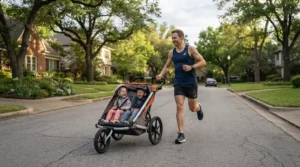
Real-World Scenario: Which Stroller Fits Your Training Life
Consider three composite profiles built from common patterns in aggregated buyer feedback. First, a parent training for a fall marathon on hilly suburban roads with a 3-year-old and a 1-year-old: the elevation changes and combined weight point toward the BOB Revolution Pro Duallie or Baby Jogger Summit X3 Double, where hand-brake control on descents genuinely changes the experience rather than being a nice-to-have.
Second, a budget-conscious parent easing back into running two to three times a week on flat suburban sidewalks with two toddlers: the Schwinn Turismo Swivel Double or Baby Trend Expedition Double Jogger covers the basics without overspending on suspension you won’t fully use at moderate mileage.
Third, a parent training for a spring marathon in a northern climate, running before sunrise most mornings on mixed terrain: visibility and suspension both matter here, making the Thule Urban Glide 3 Double or BOB Revolution Flex 3.0 Duallie the more sensible pick, since both handle low-light safety and rougher pavement without compromise.
How to Choose a Jogging Double Stroller for Marathon Training Parents
- Confirm the front wheel locks fully straight. A swivel-only front wheel is unsafe above walking pace, full stop — this is non-negotiable regardless of budget.
- Match weight capacity to your kids’ combined weight, plus growth room. A stroller rated right at your current total leaves no runway as your kids grow.
- Decide if hills are part of your training. If yes, prioritize a hand brake — it’s the single biggest quality-of-life upgrade for descents.
- Check tire type against your terrain. Air-filled tires soften rough pavement and trail; foam or composite tires trade some comfort for zero-maintenance reliability.
- Measure your storage and doorways. Wide frames like the Schwinn’s can be a real problem for narrow hallways or elevators.
- Weigh the empty stroller yourself, mentally. You’ll lift it into a trunk hundreds of times over a training cycle — lighter frames add up in convenience.
- Read the age and weight minimums for your exact model, since these vary by brand and matter for both comfort and safety.
High-Mileage Jogging Double Stroller: What Changes When the Miles Add Up
A high-mileage jogging double stroller for marathon training parents faces a different set of demands than one used for occasional weekend jogs. At 15 to 25-plus miles a week, small design compromises compound quickly: a stroller with foam-only cushioning that feels fine for two miles becomes noticeably harsher by mile eight, and a handlebar that’s slightly misadjusted turns into real shoulder and wrist fatigue over a full training block.
This is where suspension travel and tire type stop being spec-sheet trivia and start being the difference between finishing a long run comfortably or nursing a sore back the next day. Reviewers who’ve logged hundreds of miles on models like the BOB Revolution Flex 3.0 Duallie consistently describe the mountain-bike-style suspension as the feature that made high weekly mileage sustainable, whereas budget models built for occasional use tend to show wear — looser bolts, wobblier front wheels — much sooner under that kind of repeated load.
Performance Double Running Stroller vs Everyday Double Stroller
A performance double running stroller and a standard everyday double stroller may look superficially similar, but they’re built for entirely different jobs. Everyday doubles — the kind found in most big-box baby aisles — prioritize a compact fold, a padded parent console, and a swivel front wheel for maneuvering around a grocery store. None of that translates well to running: swivel wheels wobble dangerously at speed, and the softer frame geometry that makes tight turns easy also makes the stroller wander off a straight line during a run.
A true performance double running stroller, like the BOB Revolution Flex 3.0 Duallie or Thule Urban Glide 3 Double, locks the front wheel rigid for tracking, uses larger air-filled tires for shock absorption at speed, and typically runs a longer wheelbase for stability. The trade-off is that these strollers are usually heavier, pricier, and less nimble in tight indoor spaces — a fair exchange if running is genuinely part of your weekly routine, and a poor one if jogging is occasional. Buyers switching from an everyday double to a dedicated performance model consistently report better tracking and noticeably less arm fatigue on longer runs.
Hand Brake for Descents: Why It Matters More Than You Think
A hand brake for descents sounds like a nice-to-have until you’re three miles into a long run and hit an unexpected hill with 75 pounds of kids and gear in front of you. Without one, controlling speed on a downhill means leaning back and fighting the stroller’s momentum with your arms and core — tiring at best, and genuinely risky if the grade is steep or the surface is uneven.
Models like the BOB Revolution Pro Duallie use hand-activated drum brakes positioned like a bicycle brake lever, letting you modulate speed with a simple squeeze rather than physical resistance. The Baby Jogger Summit X3 Double pairs a similar deceleration brake with a tether strap for a second layer of control. Reviewers in hilly regions consistently rate the hand brake as the single feature they’d never go without again, while flat-route runners more often say it’s a nice extra rather than a necessity — which is exactly the kind of honest, terrain-specific trade-off worth weighing before you spend the extra $100 to $150 that a hand brake typically adds to the price.
Running Stroller Tire Durability: What Actually Holds Up
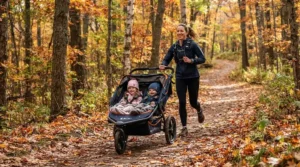
Running stroller tire durability comes down to a fairly simple trade-off: air-filled (pneumatic) tires absorb more shock and roll more smoothly, but they can go flat and need occasional pressure checks; foam-filled and composite tires skip the maintenance and the flat-tire risk, at the cost of a slightly firmer ride. Some brands address this with foam-injected tires that never lose air pressure at all, a middle-ground approach worth considering if you never want to think about tire maintenance.
For marathon training specifically, where mileage adds up fast and a flat tire mid-run is a genuine inconvenience, this trade-off deserves real thought. The BOB Revolution Flex 3.0 Duallie and BOB Revolution Pro Duallie use true pneumatic tires that reward the ride-quality trade-off with noticeably better shock absorption over long distances, provided you’re willing to check pressure periodically. The Baby Trend Expedition Double Jogger‘s composite pneumatic tires split the difference reasonably well for lighter use, while still requiring occasional air top-ups. If you genuinely never want to think about tire maintenance, look specifically for foam-filled or “never-flat” branding rather than assuming all air-look tires behave the same way.
What to Expect: Real-World Performance
Specs only tell part of the story — what actually changes when you strap two kids into a jogging stroller and run is a matter of biomechanics as much as gear. Recent biomechanics research found that stroller running tends to push runners into a noticeably more forward lean than coaches typically recommend, shifting the center of mass and altering leg positioning — worth knowing before you assume stroller runs should feel identical to unencumbered ones. The full breakdown of that research is here.
In practice, this means your pace will likely be slower than your normal training pace, and your perceived effort will run higher for the same heart rate — completely normal, not a sign anything is wrong with your fitness. A properly adjusted handlebar and a hand brake for descents both help offset some of that added strain by letting you maintain more natural posture rather than compensating with your arms and shoulders.
Long-Term Cost & Maintenance
The sticker price is only part of what a jogging double stroller for marathon training parents actually costs over a multi-year training cycle. Budget models with foam tires need essentially no ongoing spend, but pneumatic-tire models on the BOB and Baby Jogger lineups will need occasional tube replacements or a hand pump top-up every few weeks — a minor recurring cost that’s easy to forget when comparing sticker prices alone.
Resale value is the other side of the equation. BOB’s Revolution line consistently holds value better than most competitors on the secondhand market, which can meaningfully offset its higher upfront price if you plan to sell once your kids outgrow it. Budget models depreciate faster but cost less to begin with, so the total cost of ownership over two to three years often lands closer together than the sticker prices suggest — it’s worth running that math before assuming the cheaper option is automatically the better value.
Safety, Regulations & Compliance Guide
Every jogging double stroller sold in the U.S. must meet mandatory federal safety standards enforced by the Consumer Product Safety Commission, and checking for open recalls before buying — especially secondhand — is a simple step that’s easy to skip. You can search current stroller recalls directly on CPSC.gov before finalizing any purchase.
Beyond recalls, always use the five-point harness on every ride, clip the wrist tether without exception, and never leave a running-pace front wheel unlocked. Separate biomechanics research has found that while stroller use can reduce certain vertical impact forces on the runner’s legs, it may increase torsional loading in ways that raise the risk of stress-related injuries — a good reminder to build stroller mileage gradually rather than jumping straight into marathon-length long runs with a brand-new setup.
✨ Don’t Miss These Exclusive Deals!
🔍 Take your marathon training to the next level with these carefully selected jogging strollers. Click on any highlighted model to check current pricing and availability. These strollers will help you build consistent, comfortable miles your whole family can enjoy!
Frequently Asked Questions
❓ Can I run a full marathon distance pushing a double stroller?
❓ What age can my baby ride in a jogging double stroller?
❓ Do I really need a hand brake for descents if I mostly run flat routes?
❓ How often do jogging stroller tires need air?
❓ Is a heavier suspension-equipped stroller worth it for occasional joggers?
Conclusion
Choosing a jogging double stroller for marathon training parents really comes down to three honest questions: how many miles you’re actually logging each week, what your terrain looks like, and how much you value a hand brake for descents versus saving a few hundred dollars. Runners chasing serious weekly mileage on hilly or mixed terrain get the most out of premium options like the BOB Revolution Pro Duallie or Baby Jogger Summit X3 Double, while parents easing back into running or training on flat, predictable routes can get genuinely solid performance from the Schwinn Turismo Swivel Double or Baby Trend Expedition Double Jogger without overspending.
Whichever model fits your training life, prioritize the fundamentals first — a front wheel that locks fully straight, a weight capacity with room to grow, and tires matched to your actual terrain. Get those right, and the rest of your training block becomes about the running, not the equipment.
Recommended for You
- 7 Best Jogging Double Stroller Under $400 Picks for 2026
- 7 Best All-Terrain Jogging Double Stroller Picks for Trail Running (2026)
- Jogging Double Stroller for Running with Twins: 7 Best Picks (2026)
Disclaimer: This article contains affiliate links. As an Amazon Associate, I earn from qualifying purchases. If you purchase products through these links, we may earn a small commission at no additional cost to you.
✨ Found this helpful? Share it with your friends! 💬🤗
