
In This Article
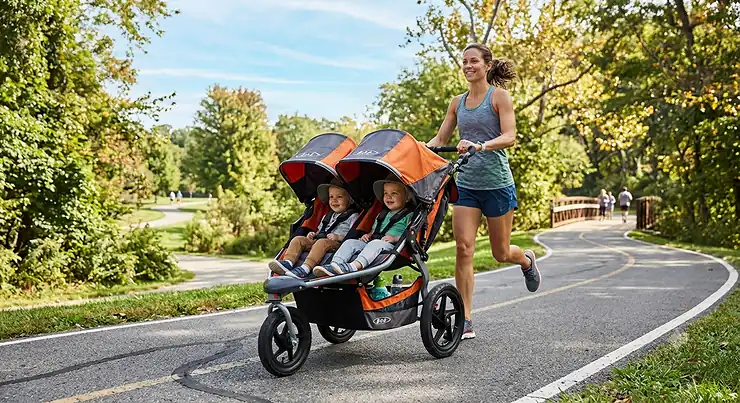
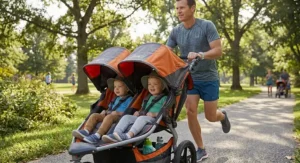
Somewhere around week three of maternity leave, most twin parents hit the same wall: the stroller that fit through every doorway in the hospital suddenly feels like steering a shopping cart with a bent wheel down a gravel driveway. If you’re hunting for a jogging double stroller for running with twins, you already know regular double strollers weren’t built for pavement pounding — they wobble, they drag, and they turn a 5K into a wrestling match. Real running strollers solve that with pneumatic tires, locking front wheels, and suspension systems borrowed straight from mountain bikes.
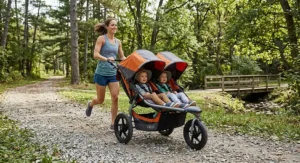
A jogging double stroller for running with twins is a side-by-side or tandem stroller built with air-filled tires, a lockable or fixed front wheel, and a hand brake, specifically engineered to stay stable at running speeds while carrying two children. That combination of features is what separates an actual running rig from a stroller that merely looks sporty on the showroom floor.
Twin births rose sharply in the U.S. between 1980 and 2014 before beginning to decline in recent years, which means a huge population of parents are navigating this exact shopping decision every year, often exhausted, often on a deadline, and often unsure which spec sheet claims actually matter. This guide breaks down seven real, currently available models — from budget-friendly to genuinely luxurious — with honest analysis of what each one does well, where it falls short, and who should actually buy it. We’ll also dig into the fixed vs swivel front wheel debate, because that single design choice affects everything from your 400-meter warmup to your Saturday long run.
Quick Comparison Table: Double Jogging Strollers for Twins at a Glance
| Stroller | Weight | Front Wheel | Best For |
|---|---|---|---|
| BOB Gear Revolution Flex 3.0 Duallie | 33.1 lbs | Swivel-lock | All-terrain runners wanting the industry benchmark |
| Thule Urban Glide 2 Double | ~32-33 lbs | Swivel-lock | Runners prioritizing a lighter, nimbler push |
| Baby Jogger Summit X3 Double | ~34 lbs | Remote swivel-lock | Parents who want handlebar-mounted wheel control |
| Bumbleride Indie Twin | 36 lbs | Swivel (no dedicated jog-lock confirmed) | Eco-conscious families needing dual infant car seats |
| Mountain Buggy Duet V3 | ~29-31 lbs | Swivel-lock | Narrow doorways and daily multitasking |
| Baby Trend Expedition Double Jogger | 32.5 lbs | Swivel-lock | Budget-conscious first-time twin parents |
| Joovy Zoom X2 | Mid-weight, aluminum frame | All-terrain (lock spec unconfirmed) | Lightweight jogging on a mid-range budget |
Looking at the table above, the BOB Gear Revolution Flex 3.0 Duallie remains the reference point every competitor gets measured against, largely because its suspension and locking wheel combination has been refined since 2019. If narrow doorways are your dealbreaker, the Mountain Buggy Duet V3 is the only stroller here built to the width of a single stroller, which matters enormously in older homes or city apartments. Parents chasing the lightest push for actual training runs should look closely at the Thule Urban Glide 2 Double, though its single-car-seat compatibility is a real limitation worth reading twice.
💬 Just one click — help others make better buying decisions too!😊
Top 7 Double Jogging Strollers for Twins: Expert Analysis
Choosing a double jogging stroller for running with twins isn’t just about top-line specs — it’s about matching a stroller’s real-world behavior to your actual running habits, your car’s trunk space, and the age gap between your twins’ developmental milestones. Below, all seven models are broken down honestly, using manufacturer data and aggregated reviewer sentiment rather than invented testing claims.
1. BOB Gear Revolution Flex 3.0 Duallie — the gold-standard all-terrain jogger
The BOB Gear Revolution Flex 3.0 Duallie built its reputation on a mountain-bike-style suspension system that most competitors still haven’t matched a decade later. At 33.1 pounds with a 100-pound total weight capacity split across two independent 50-pound seats, it’s engineered to handle two kids without buckling under trail-level abuse. The 12-inch front and dual 16-inch rear pneumatic tires soak up cracked sidewalks and gravel paths in a way foam-filled tires simply can’t, and the swivel-locking front wheel means you get everyday maneuverability for errands and a rock-solid straight line once you lock it for a run.
Based on the spec comparison against lighter competitors, the trade-off here is obvious: this stroller is heavy, and folding it takes both hands and a little practice. What most buyers overlook is that the ten storage pockets actually solve a real twin-parent problem — you’re not just carrying diapers, you’re carrying two of everything. Reviewers across retail platforms consistently note that the BOB Gear Revolution Flex 3.0 Duallie handles daily use for years without the frame flexing or squeaking, which matters when you’re putting 20+ miles a week on it.
Pros:
- ✅ Mountain-bike suspension handles trails, not just sidewalks
- ✅ Compatible with BOB, Britax, Chicco, and Graco infant seat adapters
- ✅ No-rethread harness adjusts easily as twins grow
Cons:
- ❌ Among the heaviest options here at 33+ pounds
- ❌ Bulkier fold than newer lightweight competitors
BOB recommends waiting until babies are at least 8 months old before jogging or off-road use, and prices for this model typically land in the $650-$750 range at the time of research — always check current pricing before buying. For families who genuinely run trails, not just paved loops, this is still the stroller to beat.
2. Thule Urban Glide 2 Double — the lightest push in the premium tier
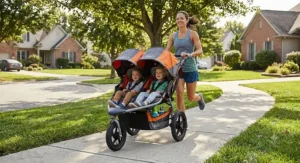
The Thule Urban Glide 2 Double trims roughly a pound or two off the BOB’s weight while keeping a comparable 16-inch rear wheel setup and a twist hand brake for hill control. Reviewers at BabyGearLab and Lucie’s List repeatedly describe it as “nimble,” which tracks with Thule’s engineering focus on a narrower, sleeker frame that folds down to a relatively compact 34 x 30 x 16 inches.
Here’s what to weigh before falling for the smooth ride: the Thule Urban Glide 2 Double only accepts one infant car seat adapter at a time, meaning it isn’t the right choice if you need to carry two newborns in car seats simultaneously — a genuinely important limitation for twin parents that some retail listings gloss over. Each child seat is rated to 49 pounds, with combined stroller weight capacity commonly listed around 75 pounds. On paper, this means the Urban Glide is best suited to families who plan to use it primarily once both twins can sit upright, rather than as a from-birth infant travel system.
Pros:
- ✅ Noticeably lighter and easier to maneuver than most doubles
- ✅ Twist hand brake improves control on downhill routes
- ✅ Compact fold works well for smaller trunks
Cons:
- ❌ Only compatible with one infant car seat adapter
- ❌ Premium price tag compared to mid-range competitors
Expect to pay in the $750-$900 range depending on retailer and current promotions. If a plush, glide-like feel matters more to you than from-birth twin car seat compatibility, this is a strong contender.
3. Baby Jogger Summit X3 Double — smartest wheel-lock mechanism on this list
What sets the Baby Jogger Summit X3 Double apart is its remote swivel lock — a lever mounted right on the handlebar that flips the front wheel between locked and swivel modes without you bending down or touching the wheel itself. It’s a small mechanical detail, but reviewers on Baby Jogger’s own product page and Babylist repeatedly call out how much friction that removes from switching between a stroll through the grocery store and a run around the block.
Specs matter here too: 16-inch rear and 12-inch front quick-release pneumatic tires, all-wheel independent suspension, and a hand-operated deceleration brake for hills — features you’d expect from something priced closer to premium jogging strollers. The near-flat recline and vented seat tops address a real twin-specific problem: two children napping mid-run need airflow just as much as a single child does, and the mesh venting here is genuinely more generous than several competitors offer.
Pros:
- ✅ Handlebar-mounted wheel lock is faster than reaching for the wheel
- ✅ Lifetime frame warranty backs up the build quality claims
- ✅ Near-flat recline works well for younger or napping twins
Cons:
- ❌ Bulky footprint can feel cumbersome in tight indoor spaces
- ❌ Consult a pediatrician before jogging with children under 6 months, per the manufacturer
Pricing typically falls in the $500-$650 range, positioning it as a genuine mid-tier value against pricier European imports. For parents who hate fumbling with a wheel lock mid-run, this detail alone can justify the purchase.
4. Bumbleride Indie Twin — built for twins from day one
Unlike most strollers on this list, the Bumbleride Indie Twin was engineered around the idea that you might need two infant car seats or two bassinets clipped in simultaneously — a detail that matters enormously if you’re bringing twin newborns home from the NICU on the same day. Its independent side-by-side seats can each run a different configuration, so one twin can nap in a bassinet while the other sits upright, which single-configuration doubles simply can’t replicate.
Reviewers highlight the eco-conscious build — recycled PET fabric, a cork handlebar, and OEKO-TEX certification — as a differentiator for parents who care about sourcing, not just specs. What most buyers overlook is that Bumbleride doesn’t explicitly market a dedicated front-wheel jog-lock the way BOB or Baby Jogger does; the brand recommends jogging use at approximately 9 months and older after a pediatrician consult, but if a confirmed locking mechanism is a non-negotiable for serious training runs, it’s worth double-checking the current spec sheet before buying rather than assuming parity with dedicated jogging brands.
Pros:
- ✅ Accepts two infant car seats or bassinets for true from-birth use
- ✅ Independently adjustable seats suit twins at different developmental stages
- ✅ Eco-certified fabrics and non-toxic cork handlebar
Cons:
- ❌ Heaviest stroller on this list at 36 pounds
- ❌ Jog-lock mechanism isn’t as explicitly documented as competitors’
Expect a price range around $700-$750. If you need genuine dual-infant readiness more than serious trail-running credentials, this is the most thoughtfully designed option here.
5. Mountain Buggy Duet V3 — narrowest double on the market
At just 25 inches wide, the Mountain Buggy Duet V3 is engineered to match the footprint of a single stroller — a genuinely rare feat among side-by-side doubles, most of which run 30-32 inches and fight you at every doorway. Reviewers at BabyGearLab specifically praised its above-average maneuverability and quality scores, and the newer V3 revision added a hand-operated control brake similar to what you’d find on a dedicated jogging stroller, useful for slowing two kids’ worth of momentum on a downhill stretch.
Based on the spec comparison, the front wheels here lock back for stability or swivel fully for tight-space maneuvering, giving you genuine flexibility between a fast-paced run and weaving through a farmers market. The trade-off for that narrow width is a seating area that feels tighter than the BOB or Thule for bigger toddlers, so this stroller shines brightest during the years when twins are still small enough that shoulder room isn’t a battle.
Pros:
- ✅ Narrowest side-by-side double available, fits nearly any doorway
- ✅ Accepts two infant car seats or two carrycots from birth
- ✅ Hand-operated brake adds real control on hills
Cons:
- ❌ Premium pricing compared to budget and mid-range options
- ❌ Seating area is tighter for larger or older toddlers
Pricing generally sits in the $750-$950 range depending on the fabric collection chosen. For apartment dwellers and city parents who need a jogger that doesn’t fight every hallway, the width alone makes this worth serious consideration.
6. Baby Trend Expedition Double Jogger — best value for first-time twin parents
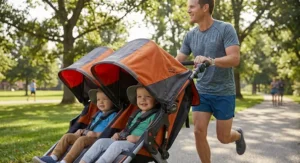
Not every twin parent needs — or can justify — an $800 stroller in year one, and the Baby Trend Expedition Double Jogger exists precisely for that reality. At 32.5 pounds with bicycle tires and a locking front swivel wheel, it delivers the two non-negotiable jogging features (air-filled tires, a wheel you can lock straight) at a fraction of the premium-tier price. BabyGearLab’s comparative testing specifically praised its maneuverability, noting it “nearly matches” pricier competitors in that category despite the budget positioning.
The spec sheet won’t tell you this, but reviewer sentiment across Amazon and Walmart consistently flags the ratcheting canopy and dual cup holders as genuinely useful daily-use touches, not just marketing filler. What you’re trading for the lower price is a lighter-duty suspension system and a bulkier overall fold compared to premium alternatives — reasonable compromises for parents who mostly stick to paved paths rather than technical trails.
Pros:
- ✅ Locking front wheel and bicycle tires at a budget price point
- ✅ JPMA-certified for baseline safety compliance
- ✅ Ratcheting canopy blocks more sun than fixed alternatives
Cons:
- ❌ Bulkier fold than premium lightweight competitors
- ❌ Suspension isn’t built for aggressive trail running
Typical pricing runs in the $200-$300 range, making it one of the most accessible genuine jogging strollers for twins on the market. If your runs are mostly neighborhood loops rather than singletrack, this is a smart place to start.
7. Joovy Zoom X2 — lightweight aluminum build on a mid-range budget
Rounding out the list, the Joovy Zoom X2 takes Joovy’s lightweight aluminum-frame approach and applies it specifically to jogging use, with extra-wide independently reclining seats rated to 50 pounds each and 16-inch rear plus 12.5-inch front all-terrain, air-filled tires. The UPF 50+ canopies with peek-a-boo windows and the included tire pump and parent organizer reflect Joovy’s broader reputation — established through models like the well-reviewed Scooter X2 — for packing genuine utility into a mid-range price.
Here’s an honest caveat worth flagging: Joovy’s own product materials describe “smooth-rolling all-terrain tires” without spelling out a dedicated swivel-lock mechanism the way BOB, Thule, or Baby Jogger explicitly do. If a confirmed lockable front wheel is essential for your running routine, verify the current spec sheet or contact Joovy directly before assuming feature parity with the more running-focused brands on this list.
Pros:
- ✅ Lightweight aluminum frame simplifies loading and carrying
- ✅ Extra-wide seats each rated to 50 pounds
- ✅ Comes with a parent organizer and tire pump included
Cons:
- ❌ Front-wheel locking mechanism isn’t explicitly documented
- ❌ Less brand recognition in dedicated running communities than BOB or Thule
Expect pricing around $350-$450, positioning it as a genuine middle ground between the Baby Trend budget pick and the premium-tier options above.
Practical Usage Guide: Getting Your Twin Jogging Stroller Run-Ready
Buying the stroller is genuinely the easy part. Setup mistakes are where most first-time twin joggers lose confidence in week one. Start by checking tire pressure before every single run — pneumatic tires lose a few PSI over weeks of storage, and underinflated tires drag noticeably, turning what should feel like a smooth push into an arm workout you didn’t sign up for. Most manufacturers list a recommended PSI right on the tire sidewall; a $10 hand pump earns its keep fast.
Next, actually lock that front wheel before you pick up any real pace. This sounds obvious, but it’s the single most common first-30-days mistake: parents leave the wheel in swivel mode out of habit from strolling, then get an unpleasant surprise the moment they hit jogging speed and the stroller starts fishtailing. Physical therapists recommend building up gradually — running for around 30 minutes total, alternating five to 10 minutes of a faster pace with one- to two-minute walking breaks rather than trying to hold marathon pace on day one with 60+ pounds of twins and gear in front of you.
Your own running form changes too. Keep your core engaged rather than leaning on the handlebar for support, and shorten your stride slightly since you’re now pushing significant extra weight ahead of you. Always clip the safety wrist strap on before you start moving — it’s not optional decoration, and it’s the only thing standing between you and a runaway stroller on a downhill stretch. For deeper technique guidance, REI’s stroller-running guide covers posture adjustments most new stroller runners never think to make.
Maintenance-wise, a monthly check of the brake cable tension, wheel bolts, and harness stitching takes ten minutes and catches small issues before they become safety problems. Store the stroller somewhere temperature-stable if possible; extreme heat and cold both accelerate wear on tire rubber and plastic housing components faster than most parents expect.
✨ Don’t Miss These Exclusive Deals!
🔍 Take your twin running routine to the next level with these carefully selected products. Click on any highlighted item to check current pricing and availability. These tools will help you build genuinely joyful, active outings your family will love!
Real-World Scenarios: Which Twin Jogger Fits Your Life
Consider three composite profiles built from common patterns across twin-parent communities. First, the marathon-training parent living in a suburb with mixed pavement and gravel trails, running 20-30 miles a week: the BOB Gear Revolution Flex 3.0 Duallie makes the most sense here, since its suspension and tire setup are genuinely built for repeated high-mileage abuse rather than occasional weekend jogs.
Second, the city-apartment parent whose building has narrow hallways and a small elevator, running mostly on paved paths a few times a week: the Mountain Buggy Duet V3‘s 25-inch width solves a problem the wider BOB or Thule can’t, even if it means paying a premium for that narrow footprint. Third, the budget-conscious new parent of twin newborns who isn’t sure yet whether stroller running will become a real habit, wanting something safe and functional without a four-figure commitment: the Baby Trend Expedition Double Jogger offers genuine jogging capability — locking wheel, pneumatic tires — without the financial risk of a premium purchase before you know your routine will stick.
A fourth common case: parents whose twins arrived early and need dual infant car seat compatibility from the very first walk home, well before jogging is even medically appropriate. Here, the Bumbleride Indie Twin‘s dual-car-seat and dual-bassinet flexibility solves a logistics problem the running-focused options simply weren’t designed to address.
How to Choose a Double Jogging Stroller for Twins
- Confirm your twins meet the age minimum first. Most pediatricians recommend waiting until babies are 6 to 8 months old, since that’s roughly when head and neck control develops enough to handle running-speed jostling safely.
- Decide if you need dual infant car seat compatibility. If your twins are newborns, prioritize strollers like the Bumbleride Indie Twin or Mountain Buggy Duet V3 that explicitly support two car seats.
- Weigh doorway and trunk clearance honestly. Measure your narrowest hallway and your actual trunk space before falling for a stroller online — a 32-inch-wide double won’t forgive a 30-inch doorway.
- Prioritize a lockable or fixed front wheel if you plan to run seriously. This single feature separates genuine jogging strollers from stroll-and-jog hybrids that wobble at speed.
- Match suspension quality to your actual terrain. Trail runners need BOB-level suspension; sidewalk joggers can save money with lighter-duty systems.
- Factor in combined weight capacity as your twins grow. A 90-100 lb total capacity buys you more years of use than a stroller capped closer to 75 lbs.
- Set a realistic budget band before shopping, since this category genuinely spans from around $200 to nearly $1,000 for comparable core functionality.
Fixed vs Swivel Front Wheel: Which Matters More for Twin Runners
The fixed vs swivel front wheel decision is arguably the single most misunderstood spec in this entire category, and it deserves more than a bullet point. A fixed front wheel — like the one on Thule’s dedicated single-child Glide model — never turns; it points straight ahead permanently, which delivers maximum stability at running speed but makes the stroller nearly impossible to maneuver through a grocery store or tight sidewalk crowd. A swivel-lock wheel, by contrast, gives you the best of both: swivel it freely for everyday walking and errands, then flip a lever to lock it rigid the moment you pick up your pace.
Here’s what most first-time buyers don’t realize: a swivel wheel left unlocked at jogging speed is genuinely dangerous, not just annoying. Runners are advised to ensure their stroller has a fixed front wheel if they want to run alongside it rather than directly behind it, since an unlocked swivel wheel can catch a crack or pebble and yank the whole stroller sideways with two kids inside. On paper, this means the “convenience” of swivel mode only pays off if you remember, every single time, to lock it before you start moving.
For twin parents specifically, the calculus tilts even further toward swivel-lock designs over permanently fixed wheels, simply because you’ll use the stroller for far more non-running errands — with two kids, you’re not just training for a 10K, you’re hauling groceries, hitting the pediatrician’s office, and navigating crowded playgrounds weekly. Every model in our top seven except the dedicated single-child Thule Glide uses some form of swivel-lock system, which reflects how the broader market has settled on this compromise as the practical standard for double joggers.
Double Jogging Stroller vs Regular Double Stroller: What Actually Changes
A regular double stroller and a double jogging stroller for twins look similar in a showroom, but the differences show up the moment pavement gets uneven. Standard doubles typically use smaller plastic or foam-filled wheels that prioritize a tight turning radius for tile floors and shopping aisles — exactly the opposite of what you want at running speed, where those same small wheels transmit every crack and pebble straight into your wrists and your kids’ spines.
| Feature | Regular Double Stroller | Jogging Double Stroller |
|---|---|---|
| Tires | Plastic/foam-filled | Pneumatic (air-filled) |
| Front wheel | Fixed-swivel only | Swivel with jog-lock |
| Braking | Foot parking brake only | Hand brake + parking brake |
| Suspension | Minimal or none | Dedicated suspension system |
| Best For | Mall trips, flat sidewalks | Running, trails, uneven paths |
The analysis here is straightforward: even brands that make excellent everyday doubles, like the UPPAbaby Vista or Baby Jogger City Select, aren’t built with jogging as the primary use case, and pushing them at running speed accelerates wear on components never designed for that stress. If your twins will mostly ride during walks and errands with only occasional light jogging, a well-reviewed regular double may genuinely serve you better and cost less. But if running is a real, recurring part of your routine, the dedicated jogging category — including every model reviewed above — earns its higher price tag through tires, brakes, and suspension actually engineered for the job.
What to Expect: Real-World Performance With Twins
Specs on a page rarely capture what running with 60-90 pounds of twins and gear actually feels like on mile three. Expect your pace to slow meaningfully — commonly by a minute or more per mile compared to running solo — simply because you’re pushing significant extra resistance the entire route, uphill sections especially. Expect your upper body, particularly shoulders and forearms, to fatigue faster than your legs early on; pushing a stroller genuinely does work your deltoids, pectorals, and biceps in ways solo running doesn’t, which is a real fitness upside even though it changes how tired you feel afterward.
Expect twins to react differently to the same stroller — one child might nap instantly to the rhythmic motion while the other stays wide awake watching the world go by, which is exactly why independently adjustable recline (found on the Bumbleride Indie Twin and Baby Jogger Summit X3 Double) matters more with twins than with a single child. And expect that hills change everything: a stroller that feels effortless on flat pavement can turn a modest incline into a genuine workout, which is precisely where a real hand brake, not just a foot parking brake, earns its keep on the way back down.
Long-Term Cost & Maintenance: What Twin Joggers Actually Cost Over Time
The sticker price is only the opening bid in this category’s true cost of ownership. Replacement tubes for pneumatic tires typically run $10-$20 each, and budget-tier strollers used on rough terrain may need one or two replacements over several years of regular use — a real but modest ongoing cost. Infant car seat adapters, when not included, commonly add $40-$70 to your total spend, which matters if you’re comparing the BOB Gear Revolution Flex 3.0 Duallie‘s adapter compatibility against a bundled system from another brand.
Where the math genuinely favors premium options is resale value and lifespan. A well-maintained BOB Gear Revolution Flex 3.0 Duallie or Mountain Buggy Duet V3 frequently holds meaningful resale value on secondhand marketplaces years later, partly because both brands built reputations for frames that don’t develop the wobble or squeak that plagues cheaper competitors after a couple of years of daily use. Baby Trend recommends replacing strollers after roughly 5-7 years or at the first sign of significant wear, regardless of brand, since materials fatigue over time even without a hard expiration date the way car seats have.
Cost-per-use tells a clearer story than sticker price alone: a $250 stroller used twice a week for two years costs roughly $1.20 per outing, while an $850 premium stroller used daily for four years costs closer to $0.58 per outing — meaning genuinely frequent runners often get better long-term value from the pricier, more durable option, even though the upfront number looks scarier.
Safety, Regulations & Compliance for Double Jogging Strollers
Every stroller sold in the U.S. must meet federal safety requirements, and it’s worth understanding what that actually covers before you shop by brand name alone. The Consumer Product Safety Commission incorporated ASTM F833 as the mandatory federal safety standard for carriages and strollers, covering stability testing, brake performance, harness integrity, and structural durability — the technical backbone behind every “5-point harness” and “locking brake” spec you see on a product page. You can review the official CPSC rule on stroller safety standards if you want the underlying regulatory detail.
Beyond baseline compliance, age readiness is the safety variable parents control most directly. The AAP’s guidance centers on head and neck control, which typically develops around 6 months of age — before that milestone, the jostling motion of running poses real injury risk regardless of how well-engineered the stroller is. For a deeper dive into age-readiness signs specific to your child, Healthline’s guide to jogging with a baby offers useful pediatrician-sourced context. Always follow the specific manufacturer’s stated age and weight minimums over generic advice, since suspension quality and seat design vary enough between models that a “safe” age on one stroller may not transfer directly to another.
FAQ: Double Jogging Strollers for Twins
❓ What is the best jogging double stroller for running with twins?
❓ Can you run with newborn twins in a jogging stroller?
❓ Is a fixed or swivel front wheel better for running?
❓ How much does a double jogging stroller for twins cost?
❓ Do double jogging strollers fit through standard doorways?
Conclusion
Choosing a jogging double stroller for running with twins ultimately comes down to being honest about your actual running habits, not the routine you imagine you’ll have. If you’re training seriously on mixed terrain, the BOB Gear Revolution Flex 3.0 Duallie remains the benchmark for good reason. If doorway width rules your daily life, the Mountain Buggy Duet V3 solves a problem no other stroller here fully addresses. If your twins arrived early and need dual car seat compatibility today, the Bumbleride Indie Twin was built specifically for that reality. And if you’re not yet certain stroller running will stick as a habit, starting with the budget-friendly Baby Trend Expedition Double Jogger lets you test the waters without a four-figure commitment.
Whichever model you choose, prioritize the fundamentals covered throughout this guide over marketing language: a genuine swivel-lock or fixed front wheel, pneumatic tires, a real hand brake for hills, and an age-appropriate start once your twins have the head and neck control to handle it safely. Twin parenting already demands enough improvisation — your stroller shouldn’t be one more thing you have to fight with every time you lace up your shoes.
Recommended for You
- 7 Best Travel Double Stroller for Toddlers and Preschoolers 2026
- Travel Double Stroller That Fits Airline Overhead Compartments: 7 Picks (2026)
- Compact Double Stroller for Cruise Vacations: 7 Winning Picks (2026)
Disclaimer: This article contains affiliate links. As an Amazon Associate, I earn from qualifying purchases. If you purchase products through these links, we may earn a small commission at no additional cost to you.
✨ Found this helpful? Share it with your friends! 💬🤗
