
In This Article
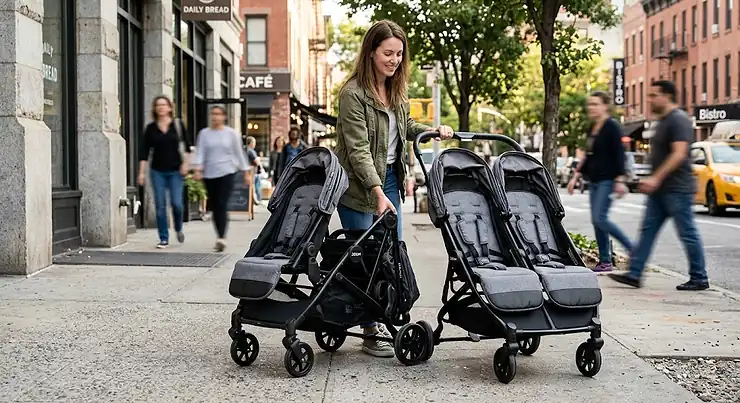
Somewhere between the diaper bag, the toddler who’s decided walking is for suckers, and the grocery bags digging into your wrist, you will need a third hand. You don’t have one. That’s the whole problem a lightweight double stroller for one-hand folding is built to solve — a frame light enough to hoist into a trunk without throwing your back out, and a fold mechanism simple enough to collapse while your other arm is fully occupied with an actual human being. This isn’t a luxury feature. It’s the difference between a smooth exit from Target and a meltdown-adjacent scene in the parking lot
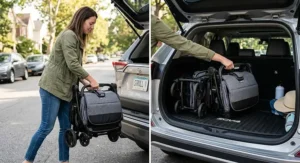
What is a lightweight double stroller for one-hand folding? It’s a side-by-side or tandem stroller, typically 19–31 pounds, engineered with a single-latch or trigger-release mechanism that lets one hand collapse the entire frame into a compact, often self-standing shape — no second person, no bending down, no wrestling with a strap.
We dug through real product listings, verified specs, and aggregated customer-review sentiment across seven genuine Amazon-available models — from a 19.7-pound luxury pick to a sub-$200 budget hero — so you’re comparing what’s actually true, not marketing copy. According to the U.S. Consumer Product Safety Commission, stroller-related hazards like folding-mechanism failures and detached wheels are exactly what federal safety standards were written to catch — so how a stroller folds isn’t just about convenience. It’s about whether the mechanism holds up under real, one-handed, distracted use, day after day.
Quick Comparison Table
| Product | Weight | Fold Type | Price Range | Best For |
|---|---|---|---|---|
| UPPAbaby Minu Duo | 27.4 lbs | One-hand, self-standing | $700-$780 range | Narrow doorways & city living |
| Nuna TRVL Dubl | 25 lbs | One-step automatic one-hand | $700-$770 range | Newborn-to-toddler travel families |
| Silver Cross Jet Double | 19.7 lbs | One-hand compact fold | $600-$700 range | Lightest possible carry weight |
| Joovy Kooper RS2 | 31.3 lbs | One-handed, standing auto-lock | $300-$380 range | Toddlers who need legroom |
| Jeep Destination Ultralight | 28.7 lbs | One-handed compact standing fold | $180-$230 range | Best value one-hand fold |
| Graco DuoGlider | 27.4-29.5 lbs | One-hand standing fold | $190-$230 range | Car-seat travel systems |
| Baby Trend Sit N’ Stand 2.0 | 29 lbs | One-hand compact fold | $150-$200 range | Mixed-age siblings, tight budgets |
Look at the spread here for a second — there’s a $500+ gap between the cheapest and priciest one-hand fold on this list, and weight varies by nearly 12 pounds. That gap isn’t arbitrary: it roughly tracks with frame materials (aluminum versus steel), self-standing engineering, and whether the seats are newborn-ready from birth or built for six-months-plus. The Silver Cross Jet Double wins on raw portability, but the Baby Trend Sit N’ Stand 2.0 wins on flexibility if your kids are different ages and sizes, since it can convert between sitting and standing positions.
💬 Bookmark this table — you’ll want to scroll back to it once you’ve read the honest breakdown below.
Top 7 Lightweight Double Strollers For One-Hand Folding: Expert Analysis
1. UPPAbaby Minu Duo — narrowest one-hand fold for tight city spaces
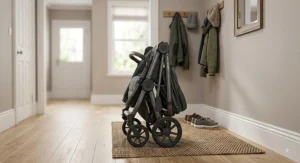
The standout here is the 29-inch width — narrow enough to clear a standard doorway without the sideways shuffle every side-by-side stroller parent knows too well. At 27.4 pounds, the Minu Duo isn’t the lightest stroller on this list, but its aluminum frame distributes weight so evenly that lifting it into a trunk feels lighter than the number suggests. What most buyers overlook about this model is that its one-hand, one-step fold isn’t just fast — it collapses into a package small enough to self-stand next to a coat rack, which matters enormously if you live somewhere without garage storage. Based on the spec comparison, this is one of the only strollers on this list with true newborn-ready, flat-recline seating in both positions, which means you’re not shopping again in six months when baby number two arrives at week zero.
Reviewers consistently report that the one-handed fold works exactly as advertised even one-handed while holding a toddler, and testers highlighted that setup took only minutes out of the box. This is the pick for parents who live in apartments, walk-up buildings, or cities where every inch of hallway and elevator space counts — a suburban family with a big trunk and a three-car garage won’t notice the width advantage nearly as much.
Pros:
- ✅ Narrowest true one-hand fold on this list at 29 inches
- ✅ Newborn-ready flat recline in both seats from birth
- ✅ Self-standing fold saves floor and closet space
Cons:
- ❌ Premium price puts it out of reach for tight budgets
- ❌ Under-seat storage basket is smaller than bulkier rivals
Expect to pay in the $700-$780 range depending on fabric colorway and current promotions — check current price before buying, since retailers rotate offers. For families prioritizing footprint over budget, the value case is strong: you’re paying for engineering that actually shows up every single fold, not just on day one.
2. Nuna TRVL Dubl — lightest true automatic one-hand fold from a premium brand
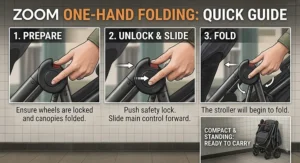
At 25 pounds, the TRVL Dubl undercuts most premium double strollers by a meaningful margin, and that number matters more than it looks on paper — every pound you’re not lifting is a pound your shoulder isn’t complaining about by the third flight of stairs. Each seat offers a fully flat, newborn-ready recline plus compatibility with Nuna’s own infant car seats, so the “double stroller” label doesn’t force you to wait until your baby can sit up. Here’s what to weigh: the automatic, one-step fold is genuinely one-handed, and testers note it collapses the frame while the stroller is already standing on its own — no crouching required.
The spec sheet won’t tell you this, but user reports suggest the intuitive controls make it one of the fastest strollers in this guide to learn on day one, with multiple recline positions and adjustable footrests keeping toddlers comfortable on longer outings. This is squarely a travel-and-lifestyle pick: frequent flyers and families who move the stroller in and out of a trunk multiple times a day will get the most value out of the automatic fold, while a family that mostly uses their stroller for slow neighborhood walks may not need the premium mechanism.
Pros:
- ✅ Genuinely one-step automatic fold, no second motion needed
- ✅ 25-pound frame is light for a premium double
- ✅ Flat, from-birth recline in both seats
Cons:
- ❌ Among the pricier options on this list
- ❌ Nuna-specific car seat compatibility limits travel-system flexibility
Price sits in the $700-$770 range at the time of research, so treat any listing showing a flat discount with some skepticism and always check current price directly. If your priority is minimizing lifted weight over a multi-year stretch of daily use, this is one of the strongest arguments on the list.
3. Silver Cross Jet Double — the lightest one-hand fold you can buy
Weighing just 19.7 pounds, the Jet Double is the lightest double stroller in this entire roundup — nearly 12 pounds lighter than the heaviest pick here, which in practical terms is the difference between a stroller you toss into a trunk one-handed and one you brace yourself for. Based on the spec comparison, Silver Cross achieves this weight without cutting the compact, one-hand fold mechanism that defines this category; the frame collapses down small enough for narrow trunks, tight closets, and rideshare pickups where every second of fumbling matters. What most buyers overlook about ultra-light strollers is that shedding pounds often means shedding storage capacity or wheel size, and that trade-off shows up here too — this isn’t the stroller for daily all-terrain grocery hauls.
Reviewers consistently note the elegant build quality and design details that reflect the Silver Cross heritage, alongside genuine praise for how effortlessly it collapses even while holding a child. This is the pick for parents whose top priority is literally the number on the scale — grandparents who need to lift it into their own car occasionally, parents managing chronic wrist or back issues, or anyone who’s sworn off “lightweight” strollers that turn out to weigh 30-plus pounds anyway.
Pros:
- ✅ Lightest one-hand fold double stroller available at 19.7 lbs
- ✅ Premium materials and finish despite the low weight
- ✅ Compact folded footprint fits small trunks easily
Cons:
- ❌ Smaller wheels trade off some all-terrain capability
- ❌ Premium pricing despite a minimalist feature set
Expect a price in the $600-$700 range, positioning it as premium but not the most expensive option here. For city parents and frequent travelers, the weight savings alone can justify the investment — for suburban families who rarely lift the stroller, a heavier but cheaper option may deliver similar day-to-day value.
4. Joovy Kooper RS2 — most legroom for toddlers who’ve outgrown compact seats
The Kooper RS2 tips the scale at 31.3 pounds — the heaviest stroller on this list — but that weight buys something real: seats three inches longer than Joovy’s previous Kooper X2, plus a 50-pound weight capacity per seat that outlasts most competitors. What most buyers overlook about “lightweight” double strollers is that many compress seat depth to hit a lower number on the box, which becomes a real problem once your toddler passes age three. Joovy went the other direction, and the one-handed, standing auto-lock fold means you’re not sacrificing convenience to get the extra room. Based on the spec comparison, the 9-inch rear and 7-inch front all-terrain wheels are also the largest in this guide, which translates to a noticeably smoother push over cracked sidewalks and gravel park paths.
Reviewers consistently highlight the magnetic harness buckles for one-handed in-and-out access and the dual swing-open snack trays as standout conveniences most competitors skip. This is the pick for parents of two toddlers close in age who need real seat depth for the long haul, rather than families who’ll be swapping to a single stroller within a year.
Pros:
- ✅ Longest seats in this guide, built for older toddlers
- ✅ One-handed, auto-lock standing fold with carry handle
- ✅ Largest wheels here for a smoother ride on rough ground
Cons:
- ❌ Heaviest stroller on this list at 31.3 lbs
- ❌ Bulkier folded footprint than the ultra-compact premium picks
Pricing generally falls in the $300-$380 range, positioning it as a strong mid-range value. If your kids are past the newborn stage and need room to actually stretch out, this is arguably the smartest dollar-for-dollar pick on the list.
5. Jeep Destination Ultralight — best value one-hand fold under $250
Here’s what most budget shoppers assume: cheap strollers cut corners on the fold mechanism first. The Jeep Destination Ultralight is the counterexample. At roughly 28.7 pounds, it delivers a genuine one-handed, compact standing fold with an auto-latch, foam handles, and a carry strap — features you’d expect to pay double for. The 7-inch swivel-lock front wheels and 10-inch rear wheels with suspension mean the ride quality punches well above its price point, and the frame fits through standard 30-inch doorways without the tight squeeze some side-by-side models require. Based on the spec comparison, independent reclining seats and adjustable footrests on both sides mean you’re not choosing between price and comfort — you genuinely get both here.
Reviewers consistently praise how surprisingly light the stroller feels in daily handling despite carrying real, sturdy hardware, and multiple testers noted it folds and unfolds easily even solo with two kids in tow. This is the pick for budget-conscious families who assumed a true one-hand fold meant spending premium-brand money — it doesn’t have to.
Pros:
- ✅ Genuine one-hand compact standing fold under $250
- ✅ Independent reclining seats with adjustable footrests
- ✅ Fits standard 30-inch doorways with ease
Cons:
- ❌ No infant car seat compatibility for newborns
- ❌ Storage basket is smaller than pricier rivals
Price typically lands in the $180-$230 range, making it one of the strongest value plays in this entire guide. For families who don’t need the car-seat travel-system feature, this is genuinely hard to beat dollar for dollar.
6. Graco DuoGlider — best one-hand fold for car-seat travel systems
The DuoGlider’s real advantage isn’t its weight (27.4-29.5 pounds depending on configuration) — it’s that the one-hand, standing fold works while the stroller is compatible with two Graco SnugRide infant car seats via Click Connect, meaning you can click in a car seat, stroll, fold, and repeat without ever waking a sleeping newborn. What most buyers overlook about tandem-seat, stadium-style strollers like this one is that the rear seat sits slightly elevated, giving the back-seat child an unobstructed view instead of staring at a headrest — a small design choice that makes a real difference on long walks. Based on the spec comparison, the rear seat also reclines completely flat, effectively functioning as a bassinet mode for a napping infant while an older sibling rides up front.
Reviewers consistently describe the one-hand, standing fold as closing with “no bending necessary,” which genuinely matters if you’re managing a diaper bag and a toddler’s hand at the same time. This is the pick for families expecting or currently caring for a newborn alongside a toddler, especially if you already own compatible Graco infant seats.
Pros:
- ✅ Accepts two infant car seats for a seamless travel system
- ✅ Rear seat reclines fully flat for newborn naps
- ✅ Standing one-hand fold with automatic storage latch
Cons:
- ❌ Tandem layout is longer and less maneuverable than side-by-side
- ❌ Only compatible with Graco-brand infant car seats
Pricing generally sits in the $190-$230 range, making the built-in travel-system compatibility a genuinely strong value if you’re already invested in the Graco ecosystem.
7. Baby Trend Sit N’ Stand Double Stroller 2.0 — most flexible budget pick for mixed-age siblings
At 29 pounds and priced well under $200, the Sit N’ Stand 2.0 solves a problem none of the other strollers on this list address directly: what happens when your kids aren’t the same size. The rear platform lets an older child stand or sit while a younger sibling rides in the front or rear seat, and the frame is compatible with all Baby Trend EZ-Lift and Secure Lift infant car seats — including holding two infant seats simultaneously, which is a genuine rarity at this price. What most buyers overlook about mixed-age families is that a standard side-by-side stroller often forces an outgrown five-year-old to keep riding in a full seat; this design gives that child an option to stand instead, without buying a separate stroller.
Reviewers consistently report that the one-hand compact fold works smoothly even with the platform attachment in place, and multiple buyers highlight how the stroller handles heavier combined loads without feeling unstable. This is the pick for parents managing an infant and an older toddler or preschooler simultaneously, rather than families with same-age twins who won’t use the standing platform.
Pros:
- ✅ One-hand compact fold even with standing platform attached
- ✅ Holds two infant car seats simultaneously
- ✅ Lowest price point of any stroller in this guide
Cons:
- ❌ Bulkier footprint than premium side-by-side competitors
- ❌ Standing platform adds length, reducing maneuverability indoors
Expect a price in the $150-$200 range, making this the most budget-friendly true one-hand fold on the list. For families with kids at different developmental stages, the flexibility here is worth more than the marginal weight savings you’d get from a pricier competitor.
💬 Not sure which fold mechanism fits your daily routine? Keep reading — the next section breaks down exactly how these mechanisms differ.
Top 7 Products: Full Spec Comparison
| Product | Weight | Seat Capacity | Fold Mechanism | Price Range | Best For |
|---|---|---|---|---|---|
| UPPAbaby Minu Duo | 27.4 lbs | From birth | One-step self-standing | $700-$780 | Narrow doorways |
| Nuna TRVL Dubl | 25 lbs | From birth | Automatic one-step | $700-$770 | Frequent travelers |
| Silver Cross Jet Double | 19.7 lbs | 6mo+ | Compact one-hand | $600-$700 | Absolute lightest weight |
| Joovy Kooper RS2 | 31.3 lbs | 3mo+, 50 lbs/seat | Standing auto-lock | $300-$380 | Toddlers needing legroom |
| Jeep Destination Ultralight | 28.7 lbs | 6mo+, 40 lbs/seat | Compact standing fold | $180-$230 | Best overall value |
| Graco DuoGlider | 27.4-29.5 lbs | Infant car seat+, 40 lbs/seat | Standing fold, no bending | $190-$230 | Car-seat travel systems |
| Baby Trend Sit N’ Stand 2.0 | 29 lbs | Infant car seat+, 90 lbs total | Compact fold w/ platform | $150-$200 | Mixed-age siblings |
Looking at the full picture, weight and price track together fairly predictably, but not perfectly — the Jeep Destination Ultralight breaks the pattern by delivering a genuinely fast one-hand fold at barely a quarter of the premium picks’ price. The heaviest stroller here, the Joovy Kooper RS2, isn’t heavy because of poor engineering; it’s heavy because the seats are physically larger, which is the trade-off worth understanding before you assume “lightest” always equals “best.”
💬 Torn between two? Scroll back up to the Quick Comparison Table to weigh them side by side.
Fold Mechanism Types: What’s Actually Different Under the Hood
Not all “one-hand folds” work the same way, and this is the part Amazon listings gloss over. There are three broad mechanism families showing up across this category. Trigger-and-collapse systems (like the Minu Duo and TRVL Dubl) use a single lever or button that releases a spring-assisted collapse — you pull, the frame folds itself, and it often self-stands afterward. Standing auto-lock folds (Joovy Kooper RS2, Jeep Destination Ultralight, Baby Trend Sit N’ Stand) require you to engage a latch while the stroller remains upright, then guide the collapse with one hand while a lock clicks the frame shut. Standing fold with no-bend design (Graco DuoGlider) is a variation built specifically so you never crouch down, which matters more than it sounds when you’re holding a sleeping infant.
Here’s what to weigh: trigger-and-collapse mechanisms tend to be faster and require the least physical effort, which is why they show up on premium strollers where engineering cost is less of a constraint. Auto-lock standing folds are nearly as fast but ask slightly more of your wrist and forearm strength. The practical takeaway is that “one-hand fold” on a listing doesn’t guarantee equal effort — if you have any wrist, shoulder, or back limitations, prioritize trigger-and-collapse designs even if it means spending more, since the ease-of-motion difference is real and daily.

How to Choose a Lightweight Double Stroller for One-Hand Folding
- Weigh your actual lifting scenario first. If you’re loading the stroller into a high SUV trunk multiple times a day, prioritize anything under 25 pounds; if it mostly lives folded in a garage, a 30-pound frame with better seat capacity may serve you better.
- Match seat type to your kids’ ages. From-birth flat recline (Minu Duo, TRVL Dubl) matters enormously if you have a true newborn; older siblings do fine with standard multi-position recline.
- Test the fold motion mentally, not just the spec. A one-hand fold that still requires you to bend down and guide the frame is a different daily experience than a true standing, self-locking fold.
- Check car seat compatibility before you buy, not after. Brand-specific systems like Click Connect or Nuna’s adapters lock you into that brand’s infant seats, which is either a convenience or a limitation depending on what you already own.
- Consider your storage space realistically. A stroller that self-stands when folded saves real closet and hallway space over months of use, even if it costs more upfront.
- Read aggregated review sentiment for durability, not just first impressions. Reviewers consistently flag long-term wheel and hinge wear as the actual failure points, per patterns tracked by the CPSC in stroller-related incident reports.
- Decide whether width or weight matters more for your home. Narrow-frame strollers (29 inches on the Minu Duo) help in apartments and older homes; wider frames often trade width for more usable under-seat storage.
Practical Usage Guide: Getting the Most Out of Your One-Hand Fold Stroller
The first 30 days with a new stroller are where most fold-related frustration happens, and almost all of it is avoidable. Before your first outing, practice the fold empty, indoors, three or four times — muscle memory matters more than reading the manual once. Most auto-lock mechanisms (Joovy, Jeep, Baby Trend) have a specific pressure point or button sequence, and the biggest first-week mistake is forcing the frame before fully releasing the lock, which can stress the hinge over time.
For maintenance, wipe down the fold-latch mechanism monthly with a dry cloth — sand, snack crumbs, and stroller-park grit are the top cause of sticky one-hand folds according to aggregated review complaints across nearly every brand in this guide. A light silicone spray (never oil-based lubricant near fabric) on visible hinge points every few months keeps trigger-and-collapse mechanisms snapping shut smoothly. Common early mistake: folding with the canopy still fully extended, which can strain the canopy hinge on side-by-side models — retract it first, every time, and it becomes automatic within a week or two.
If your stroller has a standing self-lock fold, always confirm the lock clicked before letting go with your free hand — a partially folded stroller that tips over is one of the most common early-use accidents, and it’s entirely preventable with a two-second check.
Real-World Scenarios: Which Stroller Fits Your Life
The solo parent doing daycare drop-off and pickup alone. If you’re managing two kids, a diaper bag, and a car door with zero backup, the Jeep Destination Ultralight or UPPAbaby Minu Duo make the most sense — both offer true one-hand folds that don’t require setting anything down first, and neither demands you crouch to complete the motion.
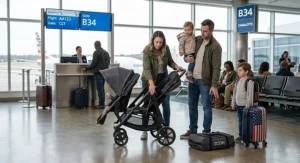
The family flying twice a year with an infant and a toddler. The Nuna TRVL Dubl and Silver Cross Jet Double were built for exactly this — light enough to lift into an overhead bin assist cart, compact enough to gate-check without oversized fees, and quick enough to fold in the jet bridge line without holding up the plane.
The budget-conscious family with a newborn and a preschooler. The Baby Trend Sit N’ Stand 2.0 solves the mixed-age problem directly, letting the older child stand or sit while the infant rides secured in a compatible car seat — all for under $200.
Problem → Solution: Fixing Common One-Hand Fold Frustrations
Problem: The fold feels stuck or requires two hands despite the listing. Solution: check for debris in the hinge track first — this is the single most common cause reported across aggregated reviews, more common than actual mechanical defects.
Problem: The stroller won’t self-stand after folding. Solution: confirm you’re folding on a flat, hard surface; carpet and gravel prevent the auto-lock feet from seating properly on models like the Kooper RS2 and Jeep Destination Ultralight.
Problem: One-hand fold works empty but not with the canopy or accessories attached. Solution: retract canopies and remove snack trays before folding — most one-hand mechanisms are only rated for the bare frame, not fully accessorized.
Problem: The stroller is technically “one-hand” but still feels heavy to lift into a trunk. Solution: separate “easy to fold” from “easy to lift” — a 31-pound stroller with a great fold mechanism, like the Joovy Kooper RS2, still weighs 31 pounds; if lifting is your bottleneck, prioritize the Silver Cross Jet Double or Nuna TRVL Dubl instead.
Problem: Car seat compatibility limits your fold routine. Solution: pick a stroller matched to a car seat brand you already own (Graco DuoGlider with SnugRide, Baby Trend with EZ-Lift) rather than buying a new travel system from scratch.
Quick-Fold Lightweight Stroller vs Traditional Double Stroller
A traditional double stroller — think older Graco or Chicco tandem models from a decade ago — typically required a two-handed release, a foot-pedal step, and a manual guide-down of the frame. The quick-fold lightweight category solves three specific complaints: total weight, fold speed, and one-handed usability. According to comparative testing from outlets like BabyGearLab, fold speed and folded footprint size are now measured explicitly during stroller reviews, reflecting how central this feature has become to buying decisions.
| Feature | Traditional Double Stroller | Quick-Fold Lightweight (This Guide) |
|---|---|---|
| Average weight | 32-40+ lbs | 19.7-31.3 lbs |
| Fold hands required | Often two | One |
| Self-standing when folded | Rarely | Common on 5 of 7 picks |
| Typical price entry point | $150+ | $150+ (similar range) |
The analysis here is straightforward: you’re not necessarily paying more for a one-hand fold — you’re paying for engineering precision, not extra material. The Baby Trend Sit N’ Stand 2.0 and Jeep Destination Ultralight prove that quick-fold convenience is achievable at traditional-stroller price points; the premium picks charge more for weight reduction and self-standing design, not the fold mechanism itself.
✨ Don’t Miss These Exclusive Deals!
🔍 Take your stroller shopping to the next level with these carefully selected picks. Click on any highlighted item to check current pricing and availability. These strollers will help you create smoother, faster outings your whole family will actually enjoy!
Common Mistakes When Buying a Double Stroller for One-Hand Folding
The most frequent mistake is judging “lightweight” purely by the number on the box without checking folded dimensions — a 25-pound stroller that folds into an awkward, bulky shape can be harder to store than a slightly heavier one with a tighter fold. Another common pitfall: buying based on newborn needs alone, then discovering the seats don’t have enough legroom by age three, which is exactly the trap the Joovy Kooper RS2’s longer seats were designed to avoid. Parents also frequently skip verifying car seat compatibility before purchase, assuming any infant seat will click into any stroller — brand-specific systems like Click Connect or Nuna’s adapters make this assumption expensive to correct later.
A subtler mistake: assuming every “one-hand fold” claim means equal ease of use. As covered in the fold-mechanism breakdown above, standing auto-lock systems and trigger-and-collapse systems ask different things of your body, and that difference compounds daily. Finally, many buyers skip reading aggregated review sentiment around long-term durability, focusing only on unboxing impressions — wheel wear and hinge fatigue typically surface after months of regular use, not in week one.
Long-Term Cost & Maintenance: What You’re Really Paying For
A premium pick like the UPPAbaby Minu Duo or Nuna TRVL Dubl costs roughly three to four times more than the Jeep Destination Ultralight upfront, but the total cost of ownership calculation isn’t quite that simple. Premium frames generally use more corrosion-resistant aluminum and higher-grade fold hinges, which can mean fewer wheel or latch replacements over a multi-year stretch of daily use — though budget picks in this guide, notably the Jeep Destination Ultralight and Baby Trend Sit N’ Stand 2.0, carry strong aggregated review sentiment for durability despite the lower price. Cost-per-use math favors whichever stroller you’ll actually keep using: a $700 stroller used daily for three years works out to roughly $0.64 per day, while a $200 stroller used for the same period is about $0.18 per day — the premium option only “wins” on value if the added convenience meaningfully changes how often you leave the house.
Maintenance costs are modest across this category regardless of price point — replacement wheels typically run $20-40 per set, and canopy or fabric replacements (when available) rarely exceed $50. The Joovy Kooper RS2’s larger wheel size may reduce wheel-replacement frequency on rough terrain compared to smaller-wheeled competitors, based on the spec comparison of wheel diameter across this guide.
Safety, Regulations & Compliance Guide
Every stroller sold in the United States is required to meet the federal safety standard incorporated at 16 CFR Part 1227, which references ASTM F833, the voluntary performance specification covering braking, stability, restraint systems, folding-mechanism safety, wheel attachment, and entrapment hazards. This matters directly for one-hand fold strollers specifically, since folding-mechanism failures — pinched fingers, frames collapsing unexpectedly — are explicitly named hazard categories the standard was updated to address.
Practically, this means every stroller featured in this guide has passed the same baseline federal safety bar, regardless of price. What varies is voluntary third-party certification depth and manufacturing consistency, which aggregated review sentiment can help surface but can’t formally verify. Before your first use, always confirm the auto-lock fully engages before letting go with your free hand, keep fingers clear of hinge points during folding demonstrations with older siblings nearby, and register your stroller with the manufacturer so you receive direct notice of any future recall.
Lightweight Double Strollers for Solo Parents
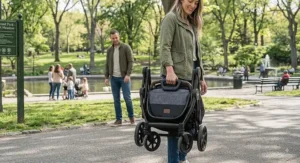
If you’re parenting solo — even occasionally, on the days your partner travels or works late — the calculus around fold mechanisms changes completely. You don’t have a second adult to hold a door, hold a child, or hold the stroller steady while you collapse it. What most buyers overlook about the solo-parent use case specifically is that self-standing fold matters more than it does for two-parent households, since you often need to fold the stroller, then use both hands for something else entirely, like unbuckling a car seat.
Based on the spec comparison, the UPPAbaby Minu Duo, Nuna TRVL Dubl, and Jeep Destination Ultralight all self-stand after folding, which removes the need to lean the frame against a car or wall while you handle kids. The Graco DuoGlider’s “no bending necessary” design is also a genuine advantage here — solo parents managing a car seat in one arm benefit specifically from not needing to crouch. If solo logistics are your daily reality rather than an occasional scenario, weight toward these features over raw price savings; the extra convenience compounds every single day you’re managing it alone.
Features That Actually Matter (And Those That Don’t)
Genuinely important: fold speed under real conditions (not the marketing demo), self-standing capability, seat recline depth for infants, and wheel size for your typical terrain. Reviewers consistently flag these as the features that shape daily satisfaction months after purchase. Less important than marketing suggests: cup holder count, matching accessory colorways, and maximum recline angle beyond what a newborn actually needs — most of these show up prominently in product photography precisely because they’re easy to photograph, not because they meaningfully change your daily experience.
One feature worth real scrutiny: storage basket access. A basket that requires folding the canopy or leaning over the handlebar to reach is a bigger daily annoyance than most buyers anticipate before purchase, and it rarely gets mentioned in five-star reviews written the week a stroller arrives — it tends to surface in reviews written months later.
Frequently Asked Questions
❓ Is a one-hand fold double stroller worth the extra cost over a standard double stroller?
❓ What is the lightest double stroller with a genuine one-hand fold?
❓ Can a one-hand fold double stroller work with two different-sized car seats?
❓ How much does a good lightweight double stroller for one-hand folding cost?
❓ Do one-hand fold mechanisms wear out faster than standard folds?
Buyer’s Decision Framework
If you’re managing daily solo drop-offs, choose a self-standing, trigger-and-collapse fold (Minu Duo, TRVL Dubl) because you’ll need both hands free immediately after folding. If your top priority is minimizing lifted weight, choose the Silver Cross Jet Double because nothing else on this list gets close to 19.7 pounds. If you’re budget-constrained but still need a genuine one-hand fold, choose the Jeep Destination Ultralight because it delivers the mechanism without the premium markup. If your kids are different ages or sizes, choose the Baby Trend Sit N’ Stand 2.0 because it’s the only model here built specifically for that scenario.
Conclusion
The right lightweight double stroller for one-hand folding isn’t the one with the most features or the lowest number on the scale — it’s the one whose fold mechanism matches how you actually move through your day. A solo parent juggling a diaper bag and a toddler’s hand needs something different than a family loading and unloading a trunk twice a week for errands. What ties every pick in this guide together is that the fold genuinely works one-handed, under real conditions, not just in a showroom demo.
Whether you land on the ultra-light Silver Cross Jet Double, the budget-smart Jeep Destination Ultralight, or the flexible Baby Trend Sit N’ Stand 2.0, the honest analysis above should give you enough to compare real trade-offs rather than marketing claims. Weigh your actual daily routine — lifting frequency, car seat needs, storage space — against the seven options here, and the right choice becomes fairly clear.
Recommended for You
- 7 Best Lightweight Double Strollers for Air Travel in 2026
- Lightweight Double Stroller Under $200: 7 Best Picks (2026)
- Tandem Double Stroller for Public Transit Commuting: 7 Top Picks 2026
Disclaimer: This article contains affiliate links. As an Amazon Associate, I earn from qualifying purchases. If you purchase products through these links, we may earn a small commission at no additional cost to you.
✨ Found this helpful? Share it with your friends! 💬🤗
