

In This Article
If you’ve ever tried to wedge a double stroller past a scaffolding pole, a hot dog cart, and a very unimpressed dog walker, all in the same ten feet of pavement, you already understand the assignment. A twin stroller for narrow city sidewalks isn’t a stroller with a nicer paint job — it’s a fundamentally different tool built to solve a fundamentally different problem than the double strollers designed for cul-de-sacs and shopping-mall parking lots. What is a twin stroller for narrow city sidewalks? It’s a double stroller engineered with a slimmer overall width (typically 20 to 30 inches, versus 34-plus inches for a standard side-by-side) so it can pass through doorways, subway turnstiles, and tight sidewalk corridors without forcing pedestrians into the street. Many U.S. sidewalks only guarantee a minimum clear path of 36 inches once you account for benches, tree pits, and sign posts — which means a wide double stroller can eat the entire legal walking lane by itself.

That matters more than it sounds like it should. Twin parents in cities aren’t just optimizing for comfort; they’re optimizing for not becoming a walking obstruction eight times a day. The good news is that stroller makers have quietly gotten very good at solving this particular puzzle, whether through true inline tandem seating, clever side-by-side engineering, or modular systems that convert as your family’s needs change. We spent real research time digging into actual product specs, verified widths, and aggregated owner feedback across seven genuinely different narrow twin stroller options — not to sell you the fanciest one, but to help you find the one that fits your actual doorway, your actual budget, and your actual commute. Let’s get into it.
Quick Comparison Table
| Stroller | Width | Price Range | Best For |
|---|---|---|---|
| Zoe Tandem+ | 20.5″ | $350-$450 range | Tightest budget, tightest doorways |
| Joovy Caboose Ultralight | 21.25″ | Under $350 | Toddler who wants to stand, not sit |
| Joovy Scooter X2 | 30″ | $250-$350 range | Cheapest doorway-width side-by-side |
| Mountain Buggy Nano Duo | 28-29″ | $450-$550 range | Curb-heavy commutes, cobblestones |
| Baby Jogger City Select 2 | ~29.5″ | $750-$900 range | Families who want 20+ configurations |
| Valco Baby Slim Twin S2 | 26″ | $700-$800 range | Narrowest full-size double available |
| UPPAbaby Vista V3 + RumbleSeat | 25.7″ | $1,300-$1,500 range | Premium build, single-stroller footprint |
A quick read of the numbers above tells its own story: width and price don’t move together in a straight line. The Zoe Tandem+ undercuts almost everything on this list in both width and price, but it sacrifices some ride comfort and recline depth to get there. Meanwhile, the UPPAbaby Vista V3 with RumbleSeat costs roughly three times as much as the Joovy Scooter X2 for barely four inches of extra narrowness — you’re paying for suspension, fabrics, and a system that can also run three kids deep, not just the width number. If your building’s front door is your hard constraint, measure it before you fall in love with a price tag.
💬 Just one click — help other city parents make a smarter buying decision too!😊
Top 7 Twin Stroller For Narrow City Sidewalks Picks: Expert Analysis
We picked these seven specifically because they represent every real strategy for narrowing a double stroller: true tandem seating, sit-and-stand hybrids, engineered side-by-side frames, and modular systems. Budget, mid-range, and premium options are all represented so you can match a stroller to your actual life instead of an aspirational one.
1. Zoe Tandem+ — narrowest footprint for the price
The standout here is blunt: at 20.5 inches open, the Zoe Tandem+ is barely wider than a single umbrella stroller, which is exactly the point for parents whose front door, elevator, or corner bodega aisle simply won’t forgive extra inches. It’s built from a 19-pound aluminum frame, starts life as a single stroller (the Zoe Tour+), and becomes a double with a $119 add-on seat that rides in front of the primary seat. On paper, that modularity means you’re not locked into double-stroller bulk once your older child ages out of needing it — you just remove the front seat and you’re back to a single.
Based on the spec comparison against wider doubles on this list, this is squarely a beginner-city-parent and budget-conscious pick: reviewers at Twiniversity and independent parenting reviewers consistently describe the ride as light and maneuverable for errands, though several also note that tandem seating limits how deeply both kids can recline simultaneously compared to a side-by-side.
Aggregated owner sentiment skews positive on portability and gate-checkability for flights, with recurring praise for the two-piece breakdown that fits into overhead bins.
Pros:
- ✅ Narrowest width on this entire list at 20.5 inches
- ✅ Converts to a single stroller as your child grows
- ✅ Only 19 lbs — easy to carry up a walk-up building
Cons:
- ❌ Tandem seats can’t both recline flat at once
- ❌ Smaller canopy coverage than the premium picks here
At around the $350-$450 range including the add-on seat, the Zoe Tandem+ is the best value verdict on this list if width is your single non-negotiable constraint.
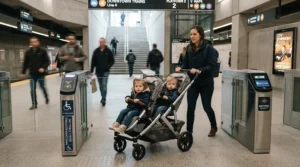
2. Joovy Caboose Ultralight — best for a toddler who’d rather stand than sit
The Joovy Caboose Ultralight takes a completely different approach to narrowness: instead of two full seats stacked front-to-back, it pairs one full reclining seat with a rear bench-and-standing-platform combo, keeping the whole rig at just 21.25 inches wide. What most buyers overlook about this configuration is that it isn’t really a “double stroller” in the traditional sense — it’s a single stroller with legitimate capacity for a second, older rider who’s outgrowing full-time seated stroller use anyway.
At 22 pounds, it’s genuinely one of the lightest tandem-style strollers on the market, and the front seat holds up to 45 pounds with multi-position recline, so an infant or younger toddler still gets a proper ride.
Aggregated reviews on Joovy’s own storefront and third-party retailers repeatedly highlight the standing platform as a hit with three- and four-year-olds who resent being strapped down, while some parents note the rear bench isn’t ideal for napping since there’s no real recline back there.
Pros:
- ✅ Only 21.25 inches wide — clears almost any doorway
- ✅ Standing platform keeps an older toddler engaged, not fighting straps
- ✅ Car-seat adapter included for newborn-ready use from day one
Cons:
- ❌ Rear rider can’t recline for a proper nap
- ❌ Less ideal once both kids are the same age and size
Priced under $350, this is a genuinely smart pick for siblings a year or two apart rather than same-age twins who both need full seating.
3. Joovy Scooter X2 — cheapest doorway-width side-by-side
Here’s what the spec sheet won’t tell you outright: a 30-inch side-by-side stroller sounds wide until you realize that’s roughly the width of a standard interior residential doorway, which is exactly why the Joovy Scooter X2 has built a loyal following among budget-conscious city parents. Unlike the tandem options above, both kids sit at true seat height, side by side, with independent recline and their own snack trays — no seating hierarchy, no fighting over who got the “better” seat. At 32 pounds it’s heavier to lift than the ultralight tandems, and reviewers consistently flag that maneuverability in truly tight spaces (think crowded subway platforms) lags behind narrower inline options. Still, aggregated sentiment across Lucie’s List and BabyGearLab is notably positive on value: testers repeatedly call it a strong pick for nanny-shares and families who want side-by-side equality without a premium price tag.
Pros:
- ✅ Fits standard 30-inch doorways without folding
- ✅ Both kids get equal seating — no positional “seat envy”
- ✅ One of the largest canopies and storage baskets in its price class
Cons:
- ❌ Wider than every tandem option on this list
- ❌ Heavier and less nimble in genuinely tight crowds
At $250-$350, it’s the best economy pick for parents who value equal seating over ultra-narrow width.
4. Mountain Buggy Nano Duo — best for curb-heavy commutes
If your daily walk is less “smooth plaza” and more “cracked pavement, cobblestones, and curbs that were clearly poured by someone in a hurry,” the Mountain Buggy Nano Duo earns its spot through build quality rather than raw width. At roughly 28 to 29 inches wide and just 20 pounds thanks to an aircraft-grade aluminum frame, it’s genuinely one of the smallest folded footprints in this category, which matters as much for storing it in a studio apartment as for pushing it down a sidewalk.
Here’s what most spec sheets skip: this stroller has a reputation, backed by repeated real-world owner reports, for handling curb cuts and uneven pavement with noticeably less jolt than flimsier umbrella-style doubles, thanks to its rigid frame and reinforced construction.
Reviewers who tested it across multiple European cities consistently praised its curb-friendliness and tight-elevator compatibility, though several noted the canopy coverage is smaller than premium competitors and it lacks built-in cup holders out of the box.
Pros:
- ✅ Aircraft-grade aluminum frame handles curbs and cracked pavement well
- ✅ Compact fold — self-stands when folded, great for small apartments
- ✅ Lightweight at 20 lbs despite a sturdy feel
Cons:
- ❌ Smaller canopies with no peekaboo windows
- ❌ No included cup holders or extra storage pockets
Sitting in the $450-$550 range, this is the pick for parents whose “narrow sidewalks” problem is really a “rough sidewalks” problem in disguise.
5. Baby Jogger City Select 2 Double — most configurations for a growing family
The Baby Jogger City Select 2 Double takes the opposite philosophy from the ultralight tandems: instead of minimizing width above all else, it maximizes flexibility, and the width comes in at a respectable-for-its-category roughly 29.5 inches in inline double mode. With 24-plus documented seating configurations, this modular system can run single, double, or even triple with a glider board, which is a genuine advantage for families who aren’t done growing or who have kids with different needs.
Based on the spec comparison, the front-heavy seating layout (second seat mounts toward the front rather than the back) means taller parents won’t kick the rear seat with every stride, and reviewers at Lucie’s List and BabyGearLab both note the extra seat spacing gives each child noticeably more personal room than several tighter tandem competitors.
The tradeoff, and it’s a real one: in double mode, this stroller gets long — reviewers consistently flag it as harder to pivot in genuinely tight corners than narrower inline strollers, even though the width itself clears most doorways fine.
Pros:
- ✅ Over 24 configurations — grows from single to double to triple
- ✅ More seat spacing than most tandem competitors
- ✅ Front-facing, rear-facing, and face-to-face seating options
Cons:
- ❌ Long wheelbase makes tight corner turns more cumbersome
- ❌ Second seat sold separately, adding to total cost
At $750-$900 range for stroller plus second seat, this is the pick for parents who value long-term versatility over pure narrowness.

6. Valco Baby Slim Twin S2 — narrowest full-size double on the market
The Valco Baby Slim Twin S2 deserves its reputation: at exactly 26 inches wide, it delivers genuinely full-size, independently reclining seats in a footprint nearly five inches narrower than most side-by-side doubles, all while weighing just 30 pounds. What most buyers overlook about “slim” doubles is that narrowness usually costs you seat comfort or recline depth — the Slim Twin S2 doesn’t really make that trade.
Each seat reclines independently to near-flat, supports up to 45 pounds, and includes a built-in newborn cocoon, so one child can nap while the other sits up and watches the city go by, which is a genuine practical win for parents managing two different nap schedules.
Aggregated owner reviews on Valco’s own site and independent retailers are strikingly consistent: parents repeatedly compare its width favorably to the UPPAbaby Vista, note it fits through doors “with room to spare,” and highlight the one-hand, stand-up fold as a daily-life win. A recurring minor complaint is that it doesn’t come with snack trays standard and only accepts one infant car seat via adapter, so it’s not quite a full twin-newborn travel system out of the box.
Pros:
- ✅ Full-size independently reclining seats in a 26-inch frame
- ✅ Near-flat recline supports true newborn use with a built-in cocoon
- ✅ One-hand, stand-up fold with a built-in carry strap
Cons:
- ❌ Only accepts one infant car seat, not two
- ❌ Snack trays sold as an add-on, not included
At $700-$800 range, this is the value-meets-width sweet spot for families who want a genuinely premium ride without the top-tier price.
7. UPPAbaby Vista V3 with RumbleSeat — most luxurious single-stroller footprint
The UPPAbaby Vista V3 with RumbleSeat rounds out this list as the premium pick, and its standout feature is almost sneaky: at 25.7 inches wide, adding a second child barely changes the stroller’s footprint at all, because the RumbleSeat mounts in a lower, inline position rather than beside the primary seat. That 25.7-inch width is actually the same width as the single Vista, which is a genuinely rare feat in double-stroller engineering.
The RumbleSeat V3 holds up to 40 pounds, reclines, and can face forward or toward the parent, while the main FlexRide suspension system smooths out the exact kind of curb cuts and cracked pavement narrow-sidewalk parents deal with daily.
On paper this means you get premium ride quality without paying the width penalty most double strollers carry — but that premium extends to the price tag, and reviewers do note the RumbleSeat rider sits noticeably lower and less scenic than the main seat, a positional tradeoff worth knowing before your toddler notices it too. Aggregated sentiment from retailer reviews is consistently strong on build quality, suspension smoothness, and the seamless “grows with your family” system, with occasional notes that the full double setup gets heavy to lift into a trunk.
Pros:
- ✅ Same 25.7-inch width whether running single or double
- ✅ FlexRide suspension smooths curbs and rough pavement
- ✅ Modular system expands to a third rider later if needed
Cons:
- ❌ Premium price — the highest on this list by a wide margin
- ❌ RumbleSeat rider sits in a lower, less scenic position
At $1,300-$1,500 range for the full double bundle, this is the splurge pick for parents who want boutique build quality without sacrificing sidewalk width.
Practical Usage Guide: Living With a Narrow Twin Stroller
Getting the stroller home is the easy part — living with it daily in a city is where the real learning curve shows up. In the first 30 days, most new owners make the same handful of adjustments. First, practice the fold indoors before you’re doing it one-handed on a subway platform with two crying kids and a bag of groceries; every model on this list has a slightly different locking mechanism, and muscle memory matters more than reading the manual twice. Second, measure your actual chokepoints — the narrowest point of your building’s vestibule, your elevator door, your go-to coffee shop’s entrance — rather than trusting “fits through doorways” as a universal claim, since standard doorway width varies by several inches depending on your building’s age.
Maintenance-wise, narrow tandem and inline strollers tend to have smaller wheels than wide all-terrain doubles, which means grit and debris from city streets accumulate faster; wipe down axles weekly and check tire pressure (if air-filled) monthly. A common early mistake is over-tightening the recline mechanism trying to get a “flatter” nap position than the stroller is designed to offer — this stresses the hinge and is a frequent source of the pinching complaints regulators have tracked in stroller-related incident reports. Finally, budget an extra five minutes for your first few trips: narrow strollers often require a slightly different turning technique (a gentle lean-and-pivot rather than a wide arc), and that’s a skill, not a stroller flaw.

Real-World Scenarios: Which Narrow Twin Stroller Fits Your City Life
Consider three composite profiles built from common city-parent situations. The car-free apartment dweller on a fourth-floor walk-up, juggling two under two and a tight budget, is best served by something like the Zoe Tandem+ or Joovy Caboose Ultralight — both are light enough to carry up stairs without a workout and narrow enough for the tightest hallway. The commuting professional who rides transit daily and needs a stroller that survives subway grates, escalators near-misses, and genuine daily mileage benefits most from the durability-first build of the Mountain Buggy Nano Duo or the suspension-forward comfort of the UPPAbaby Vista V3, since both are engineered for repeated real-world abuse rather than occasional weekend outings.
Then there’s the growing family in a rowhouse or brownstone, twins now but possibly a third child down the line, who should lean toward the modular flexibility of the Baby Jogger City Select 2 or the near-full-size comfort of the Valco Baby Slim Twin S2 — both handle the “we might need this to do more later” use case without forcing a second stroller purchase. None of these profiles are rigid categories; they’re starting points. Match your own frequency of use, building layout, and budget against them rather than the label alone.
Problem → Solution: Common Narrow-Sidewalk Stroller Headaches, Solved
Even the right stroller runs into predictable friction points in city life, so here’s honest troubleshooting rather than marketing gloss. Problem: the stroller won’t clear a specific narrow storefront aisle. Solution: fold-and-carry is faster than trying to reverse-maneuver a double stroller in a tight retail space — practice a quick one-hand fold at home so it’s not your first attempt in public. Problem: curb cuts jolt a sleeping baby awake. Solution: models with genuine suspension, like the Mountain Buggy Nano Duo or UPPAbaby Vista V3, handle this meaningfully better than budget frames with rigid axles; approach curb cuts at a slight diagonal angle to soften the impact further.
Problem: pedestrians get frustrated behind a slow-moving stroller on a crowded block. Solution: narrower models like the Zoe Tandem+ or Valco Baby Slim Twin S2 let you hug one side of the sidewalk rather than commanding the center, which measurably reduces friction with other foot traffic. Problem: elevator doors are narrower than expected in an older building. Solution: always measure before buying rather than trusting spec-sheet doorway claims, since pre-war and older commercial buildings frequently run narrower than modern code minimums.
Buyer’s Decision Framework: Choosing Your Narrow Twin Stroller
Use this simple priority checklist if you’re stuck between models. If your single biggest constraint is an actual measured doorway or elevator width under 24 inches, choose a true inline tandem like the Zoe Tandem+ because nothing else on this list gets narrower. If your kids are close in age but not twins and one is ready to stand rather than sit, choose the Joovy Caboose Ultralight because the platform-and-bench design solves a problem pure double seating can’t. If your walking routes are rough, cracked, or curb-heavy, prioritize suspension and frame rigidity in the Mountain Buggy Nano Duo or UPPAbaby Vista V3 over width alone.
| Consideration | Best-Value Pick | Best Premium Pick |
|---|---|---|
| Tightest budget | Zoe Tandem+ | — |
| Curb & pavement durability | Mountain Buggy Nano Duo | UPPAbaby Vista V3 |
| Long-term family flexibility | Baby Jogger City Select 2 | Valco Baby Slim Twin S2 |
| Narrowest possible width | Zoe Tandem+ | UPPAbaby Vista V3 |
Looking at the framework above, notice that no single stroller wins every category — that’s normal, and it’s exactly why measuring your specific pain points before shopping saves you from an expensive mismatch. A parent optimizing purely for width might overpay on suspension they don’t need, while a parent optimizing purely for ride comfort might end up with a stroller that’s technically too wide for their actual front door.
How to Choose a Narrow Twin Stroller
Picking the right twin stroller for narrow city sidewalks comes down to seven concrete checks, in roughly this priority order:
- Measure your tightest chokepoint first. Your front door, elevator, and most-visited store aisle set your true maximum width — not the sidewalk itself.
- Decide between tandem and side-by-side seating. Tandem wins on width; side-by-side wins on seating equality and simultaneous full recline.
- Weigh the stroller’s actual weight, not just its width. A narrow stroller you can’t lift up your building’s stairs solves the wrong problem.
- Check recline depth for nap schedules. Twins and close-in-age siblings often nap at different times, so independent recline matters more than it seems.
- Confirm car seat compatibility if you have a newborn. Some narrow models, like the Slim Twin S2, only accept one infant car seat via adapter.
- Test the fold mechanism before buying if at all possible. A one-hand, stand-up fold is a daily-life feature, not a luxury.
- Compare price against total configurations, not sticker price alone. A modular system’s higher upfront cost can undercut buying a second stroller later.
Based on the spec comparison across all seven picks here, the width-versus-comfort tradeoff is the single decision that determines almost everything else about which stroller fits your life.
Common Mistakes When Buying a Compact-Width Twin Stroller
The single most common mistake is trusting a manufacturer’s “fits through standard doorways” claim without an actual tape measure — “standard” varies enormously between a 2020s apartment building and a 1920s brownstone. A close second: buying based on width alone while ignoring weight, which matters enormously for walk-up buildings, subway stairs, and lifting a folded stroller into a trunk. Independent testers who’ve run dozens of these strollers through controlled lab evaluations consistently flag that narrower frames often sacrifice storage basket size and canopy coverage, a tradeoff many first-time buyers don’t anticipate until they’re stuck without shade on a summer walk.
Another frequent misstep: assuming a sit-and-stand hybrid like the Joovy Caboose Ultralight works the same as a true double for same-age twins — it doesn’t, since the rear rider can’t fully recline. And finally, plenty of parents skip test-folding a stroller in the store, only to discover the mechanism is fussier than expected the first time they’re doing it solo with groceries and a toddler mid-tantrum.

Narrow Twin Stroller vs Side-by-Side Twin Stroller
This comparison comes up constantly, and the honest answer is that neither format is objectively better — they optimize for different problems. A narrow twin stroller, whether a true inline tandem like the Zoe Tandem+ or an engineered slim frame like the Valco Baby Slim Twin S2, wins decisively on doorway and elevator clearance, and it lets you walk single-file through crowds without commanding the whole sidewalk. What it costs you is seating equality (one child often sits lower or faces a different direction) and, in pure tandem designs, simultaneous full recline for both kids.
A traditional side-by-side, like the Joovy Scooter X2, flips those tradeoffs: both kids get identical seats, sightlines, and recline depth, and pushing feels more stable because the weight distributes evenly left-to-right. The cost is real width — even a “narrow” side-by-side at 30 inches is still wider than every tandem on this list, and it will not fit through genuinely tight residential doorways without folding. If sibling equity and simultaneous naps matter more to you than shaving off the last few inches, a side-by-side is the better honest answer, even in a city.
Curb Cut Navigation: What to Expect From Real-World Performance
Spec sheets rarely mention curb cut navigation, but it’s one of the biggest everyday performance differences between these seven strollers. A curb cut — the sloped ramp where a sidewalk meets a street crossing — sounds like a minor detail until you’re pushing a loaded double stroller over one dozens of times a day, and design standards for these transitions vary meaningfully between older and newer city infrastructure. Strollers with genuine suspension and larger wheels, like the UPPAbaby Vista V3 and Mountain Buggy Nano Duo, translate a rough curb transition into a gentle dip rather than a jarring bump, which matters enormously if a child is asleep.
Budget umbrella-style frames, including the Joovy Scooter X2 and to a lesser extent the Zoe Tandem+, handle curb cuts adequately on well-maintained pavement but transmit noticeably more shock on cracked or poorly graded transitions, since their smaller wheels and lighter frames prioritize weight savings over absorption. What most buyers overlook about “urban all-terrain” claims is that they’re rarely tested against actual curb cut geometry — approaching at a slight angle rather than dead-on softens the impact regardless of which stroller you own, a habit worth building early.
Urban Stroller Maneuverability Across Different City Environments
Urban stroller maneuverability isn’t one universal skill — it changes depending on your specific environment. In a dense grid city with narrow prewar sidewalks (think older neighborhoods in Boston, Philadelphia, or San Francisco), the tightest tandem options, the Zoe Tandem+ and Joovy Caboose Ultralight, shine because raw width is the binding constraint more often than pavement quality. In a newer, wider-boulevard city with rougher pavement and longer curb-to-curb crossings, frame rigidity and suspension quality from the Mountain Buggy Nano Duo or UPPAbaby Vista V3 matter more than shaving off another inch of width.
Transit-heavy cities add a third variable entirely: subway turnstiles, bus ramps, and escalator gaps. Here, the modular quick-fold of the Baby Jogger City Select 2 earns its keep, since a stroller that folds fast and stands on its own is genuinely more useful on a train platform than one that’s marginally narrower but slower to collapse. The honest takeaway is that “best for narrow sidewalks” and “best urban maneuverability” aren’t always the same stroller — think through your actual daily route, not just your doorway.
Safety, Regulations & Compliance Guide
All strollers sold in the U.S., including every option on this list, must meet the federal mandatory safety standard for carriages and strollers, which incorporates the ASTM F833 voluntary standard covering stability, folding-hinge pinch hazards, and restraint system performance. That regulatory baseline is genuinely useful context for narrow-frame strollers specifically, since regulators have flagged folding-hinge injuries as a recurring hazard pattern, and tandem or modular strollers with multiple moving joints deserve a careful hands-clear check every time you fold or unfold around a child.
Beyond the federal floor, a few practical habits matter more in dense cities than suburban ones: always engage the parking brake fully before letting go on a sloped curb cut, never hang heavy bags on the handlebar of a narrow-frame stroller (it can tip a lighter frame backward), and register your specific model for recall notifications, since even well-reviewed brands occasionally issue safety updates. None of the seven strollers featured here carry open recalls as of this research, but stroller ownership is a multi-year commitment, so checking periodically is worth the two minutes it takes.

FAQ
❓ What is the narrowest twin stroller available?
❓ Do narrow twin strollers fit through standard doorways?
❓ Are tandem strollers harder to push than side-by-side strollers?
❓ Can a narrow twin stroller work for newborn twins?
❓ How much should I budget for a good narrow twin stroller?
Conclusion
There’s no single “best” twin stroller for narrow city sidewalks — there’s only the best one for your specific doorway, your specific budget, and your specific daily route. If width is your only real constraint, the Zoe Tandem+ and Joovy Caboose Ultralight solve it cheaply and effectively. If your sidewalks are as cracked as they are narrow, the Mountain Buggy Nano Duo and UPPAbaby Vista V3 earn their higher price tags through genuine ride quality. And if you want a system that grows with your family for years rather than months, the Baby Jogger City Select 2 and Valco Baby Slim Twin S2 offer real long-term value that a cheaper, narrower stroller simply can’t match.
Whatever you choose, measure first, read the aggregated owner feedback honestly, and remember that the “perfect” stroller on paper is worthless if it doesn’t clear your actual front door. Prices and availability shift constantly, so always check current pricing before you commit.
Recommended for You
- Twin Stroller Under $300: 7 Picks That Actually Deliver (2026)
- Twin Stroller for Newborn Twins: 7 Best Picks for 2026
- Sit-and-Stand Stroller for Grocery Store Trips: 7 Smart Picks (2026)
Disclaimer: This article contains affiliate links. As an Amazon Associate, I earn from qualifying purchases. If you purchase products through these links, we may earn a small commission at no additional cost to you.
✨ Found this helpful? Share it with your friends! 💬🤗
