
In This Article
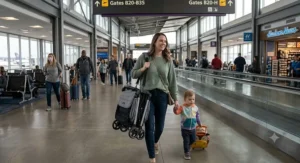
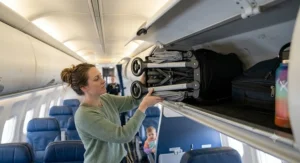
Somewhere between the security line and the gate, every parent of two small kids asks the same question: will this thing actually fit up there? A travel double stroller that fits airline overhead compartments isn’t a luxury — it’s the difference between strolling straight onto the jet bridge and standing at a baggage carousel forty-five minutes later, one kid on your hip and the other one melting down over a dropped goldfish cracker. The good news is that stroller engineers have spent the last few years in a genuine arms race over folded dimensions, and the results are strange, wonderful, occasionally suitcase-shaped machines that would have seemed impossible a decade ago.
This guide breaks down seven real, current double strollers — from a $200-ish auto-folder that splits into two single strollers to a premium side-by-side with a three-year warranty — and tells you honestly which ones can plausibly ride in the bin, which ones are built for confident gate-checking instead, and why that distinction actually matters more than the marketing copy usually lets on. We’ll also cover the regulatory fine print most articles skip: what “overhead bin dimensions” really means when it’s not one fixed number, and what your actual rights are when an airline’s ground crew decides your stroller isn’t coming with you into the cabin after all.
What Is a Travel Double Stroller That Fits Airline Overhead Compartments?
A travel double stroller that fits airline overhead compartments is a side-by-side or tandem stroller engineered to fold down small and light enough — typically under roughly 23 x 24 x 10 inches and well under 30 pounds — to be stowed in a standard aircraft bin rather than gate-checked, though actual bin space and airline policy still vary by aircraft.
Quick Comparison Table: At a Glance
| Stroller | Folded Fold Type | Weight | Best For |
|---|---|---|---|
| UPPAbaby Minu Duo | Standing, one-hand | 27.4 lbs | Premium comfort, from-birth twins |
| Silver Cross Jet Double | Suitcase-style, pull-along | ~26-28 lbs | Airport ninjas who hate lifting |
| Baby Jogger City Tour 2 Double | Flat, one-step | 22.7-23.2 lbs | Best real shot at the bin itself |
| Zoe Twin+ | Flat, two-hand | 20-25 lbs | Narrow doorways, Disney trips |
| Beberoad Love R1 Double | Auto-fold, splits in two | 23.5 lbs combined | Solo-parenting one flight, two the next |
| Mompush Lithe Double | Flat, one-step | 25 lbs | Budget side-by-side |
| Summer Infant 3Dlite Double | Standing, compact | Under 22 lbs | First double stroller on a tight budget |
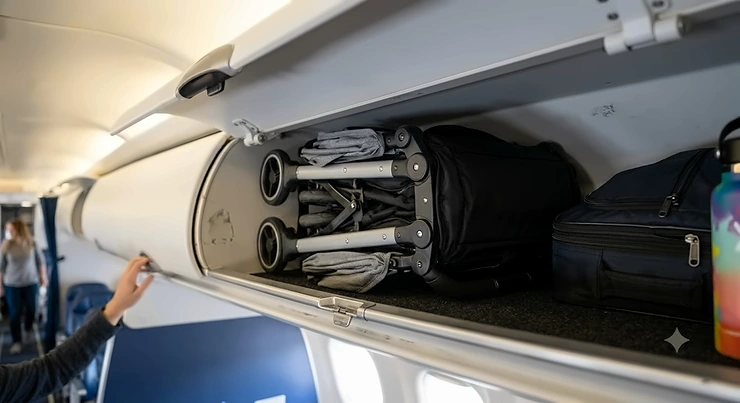
Looking at the spread above, weight and folded volume tell two different stories — the Baby Jogger City Tour 2 Double is the only one on this list that owners routinely report physically sliding into an overhead bin on larger aircraft, while the UPPAbaby Minu Duo and Silver Cross Jet Double trade a few extra inches for sturdier frames and from-birth features. If your priority is genuinely making the cabin cut, weight matters less than folded depth; if your priority is surviving a two-week trip without the wheels falling off, the heavier options usually win.
💬 Just one click — help other traveling parents find the right double stroller too! 😊
Top 7 Travel Double Strollers That Fit Airline Overhead Compartments: Expert Analysis
1. UPPAbaby Minu Duo — most compact fold of any premium double
The standout here isn’t just that it folds small — it’s that a premium, from-birth double stroller manages a 12.9 x 27.8 x 23.7-inch folded footprint at all. Both seats accommodate a child from birth up to 50 pounds, with independent recline and footrests, and the frame weighs 27.4 pounds — genuinely light for a full-featured double. Based on the spec comparison, the 27.8-inch width is the number that matters most for real-world use: it clears a standard 29-inch doorway and satisfies Disney’s park-entry width requirements, which tells you a lot about how it’ll handle narrow jet-bridge turns and airport restroom stalls.
Who should care: parents who want one stroller to survive from newborn twins through preschool, not just a disposable travel gadget. Reviewers consistently note that the one-hand, one-step fold is genuinely fast — under 10 seconds by some accounts — and that it stands upright on its own once folded, which is a small mercy when you’re also holding a diaper bag and a boarding pass. A common thread in aggregated owner feedback is that the Minu Duo is recognized on sight by gate agents, which in practice seems to reduce friction at check-in compared with less familiar brands.
Pros:
- ✅ From-birth seats on both sides, no infant insert needed
- ✅ Genuinely narrow 27.8-inch width for doorways and aisles
- ✅ Three-year warranty plus a dedicated travel-damage program
Cons:
- ❌ Folded depth still runs a few inches past most bin specs
- ❌ Premium price puts it out of reach for occasional flyers
At around $800, the UPPAbaby Minu Duo sits at the top of this list price-wise, and the value verdict depends entirely on how often you fly: for a family boarding six or more flights a year, the durability and from-birth flexibility likely justify the cost; for a single vacation, it’s probably overkill.
2. Silver Cross Jet Double — rolls suitcase-style right to the gate
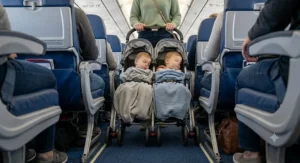
What most buyers overlook about this model is that it isn’t really designed to be carried at all — it’s designed to be pulled. The freestanding fold collapses to roughly 9 inches deep and stands on two wheels, so you tow it behind you like rolling luggage rather than hauling it under an arm. Each of the two seats holds up to 50 pounds, with independent deep recline, and the bumper bar detaches to double as the pull handle once folded.
Based on the aggregated impressions from Silver Cross’s own product literature and independent retailer listings, the appeal is less about squeezing into an overhead bin and more about the walk to get there: parents managing two kids solo tend to rate the suitcase-style rolling fold highly precisely because it frees up both hands. The magnetic Genius buckle system is also worth flagging as a real usability upgrade — a snap-together closure is genuinely faster to manage one-handed than a traditional five-point clip, especially with a squirming toddler.
Pros:
- ✅ Freestanding, pull-along fold frees both your hands
- ✅ Magnetic buckle system speeds up loading two kids at once
- ✅ UPF 50+ hoods with mesh viewing windows on both seats
Cons:
- ❌ Rolling fold is bulkier than flat-fold competitors for trunk storage
- ❌ Premium pricing puts it near the top of this category
Priced in the $900s at most retailers, the Silver Cross Jet Double is a premium pick best suited to families who gate-check confidently and value the walk-through-the-terminal experience over a shot at the bin itself.
3. Baby Jogger City Tour 2 Double — the double most likely to squeeze into a bin on bigger jets
Here’s the spec that actually matters: independent testers measuring the folded frame have put it at roughly 26.2 x 24.8 x 9.8 inches, and lighter tests have clocked it closer to 22 x 20 x 7 inches with the wheels popped off — both larger than the strict 22 x 14 x 9-inch carry-on standard, but consistently the closest of any full double stroller on the market. The frame itself weighs in around 22.7 to 23.2 pounds depending on the retailer’s scale, with a one-hand fold and auto-lock that owners describe as satisfyingly quick once you’ve practiced it twice.
Reviewers consistently note that this is not the same thing as the popular single-seat City Tour 2 — the double version is not compatible with infant car seats and skips the carrycot option that the single model offers, so it’s genuinely built for toddlers and preschoolers rather than newborns. What most buyers overlook is that “fits in overhead bins on larger planes” is doing real work in that sentence: independent stroller testers are explicit that on smaller regional jets, even this stroller likely needs to be gate-checked, so treat it as your best shot at the bin, not a guarantee.
Pros:
- ✅ Closest folded footprint to overhead-bin dimensions in this roundup
- ✅ Genuine one-hand, one-step fold with auto-lock
- ✅ Near-flat recline keeps toddlers napping through layovers
Cons:
- ❌ Not compatible with any infant car seat
- ❌ Storage basket is noticeably small for a double
In the $350-$450 range depending on color and retailer, the Baby Jogger City Tour 2 Double delivers the best odds of actually making the cabin cut, and the trade-off — modest storage, no infant compatibility — is a fair one for families past the newborn stage.
4. Zoe Twin+ — narrowest side-by-side double on the market
The 29-inch width is the headline number, and it’s a genuinely rare feat for a side-by-side double: most competitors in this configuration run 32 inches or wider, which means the extra three inches is the difference between clearing a standard interior doorway or bouncing off the frame every single time. Weight sits in the 20-to-25-pound range depending on which generation you buy (the original Twin+ tests at roughly 19.8 pounds; the newer Twin v3 closer to 25), with a 165-degree recline on each seat and a folded size of about 29 x 9 x 28 inches.
Here’s what the spec sheet won’t tell you, but user reports suggest: the fold takes two hands rather than one, because the width makes a true one-handed pull awkward. That’s a fair trade for the narrow frame, but it’s worth knowing before you’re standing at a crowded gate trying to fold it while also holding a toddler’s hand. Aggregated owner sentiment on this stroller is unusually positive for a sub-$350 double — the giant independent canopies and 60-pound-per-seat weight capacity get mentioned constantly, and it’s one of relatively few doubles explicitly confirmed to meet Disney park size limits.
Pros:
- ✅ Narrowest side-by-side frame available, fits standard doorways
- ✅ Independent 165-degree recline on both seats
- ✅ 60-lb-per-seat capacity, unusually high for the price bracket
Cons:
- ❌ Two-hand fold, less convenient solo at a crowded gate
- ❌ No infant car seat compatibility on any version
At roughly $300-$350, the Zoe Twin+ is genuinely one of the best value doubles here — the narrow frame alone solves a problem that pricier competitors haven’t cracked.
5. Beberoad Love R1 Double — splits into two 11.5-lb overhead-bin singles
This is the cleverest idea in the category, and it’s worth explaining plainly: you buy two individual R1 strollers and a connector kit, and they lock together into a side-by-side double using an auto-folding patent design. Combined, the double weighs about 23.5 pounds, but the real trick is what happens when you disconnect them — each single stroller weighs just 11.5 pounds and folds to roughly 23.6 x 16.7 x 7.3 inches, small enough that manufacturer and owner reports both describe it fitting into an airplane’s overhead bin on its own.
Based on the spec comparison, this matters most for families who fly with one kid sometimes and two kids other times, or who want genuine backup flexibility if a connecting flight is on a smaller regional jet. A common thread in verified owner reviews is appreciation for how the auto-fold mechanism works essentially one-handed, though several owners note the frame feels notably more flexible than a rigid aluminum stroller — Beberoad’s own materials acknowledge this directly, framing it as a byproduct of the folding mechanism rather than a durability flaw, though buyers should weigh that trade-off honestly.
Pros:
- ✅ Splits into two 11.5-lb strollers, each genuinely bin-sized
- ✅ Auto-folding mechanism works nearly one-handed
- ✅ Flexible for families switching between one-kid and two-kid trips
Cons:
- ❌ Frame feels less rigid than competitors due to the fold design
- ❌ Connector kit is one more part to track through security
Typically priced in the $200-$300 range for the connected double kit, the Beberoad Love R1 Double offers a value proposition none of the fixed-frame doubles here can match: actual single-seat overhead-bin eligibility, twice.
6. Mompush Lithe Double — lightest true side-by-side under $300
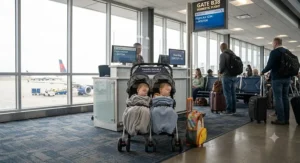
The 30-inch width and 25-pound weight put this stroller in a strange, useful spot: heavier than the ultra-light singles-that-connect, but noticeably lighter than most fixed-frame doubles at a similar price. The one-step fold and independent recline on each seat are both features usually reserved for pricier models, and the UPF 50+ canopy with all-wheel suspension rounds out a spec sheet that reads well above its price bracket on paper.
What most buyers overlook about budget doubles in general is that “lightweight” and “well-built” aren’t always the same claim, and this is exactly the kind of product where honest, verifiable review data matters more than a glossy listing photo. Independent, aggregated feedback on lightweight side-by-side doubles in this price tier tends to flag long-term durability as the open question — a fair caveat, since this is a newer entrant without years of accumulated owner history behind it. If you can verify current review volume before buying, that’s worth doing.
Pros:
- ✅ 25-lb weight is unusually low for a fixed-frame double
- ✅ Independent recline on both seats, not always found this cheap
- ✅ One-step fold simplifies solo gate-checking
Cons:
- ❌ Limited long-term durability data compared with established brands
- ❌ Smaller accessory ecosystem than legacy stroller brands
At a price generally under $300, the Mompush Lithe Double is a reasonable budget bet for families who want a genuine side-by-side without premium-brand pricing, provided expectations for long-haul durability stay realistic.
7. Summer Infant 3Dlite Double — budget entry point for first-time double flyers
Under 22 pounds is a genuinely light number for any double stroller, let alone one priced for a family buying their first travel double on a budget. The compact standing fold, anti-shock front wheels, and multi-position reclining seats cover the basics competently, and the adjustable canopies keep two kids shaded without needing to be premium hardware to do it.
Here’s what the spec sheet won’t tell you: at this price point, the honest trade-off is usually storage and ride smoothness rather than fold size. Aggregated comparisons against similarly priced competitors like the Jeep Scout note that the 3Dlite tends to edge ahead specifically on toddler comfort — deeper recline positions and better anti-shock front wheels for a smoother ride — while giving up a little in overall frame rigidity compared with mid-range options like the Baby Jogger City Tour 2 Double. For a family testing out air travel with two kids for the first time, that’s often the right trade to make.
Pros:
- ✅ Under 22 lbs, among the lightest doubles in this roundup
- ✅ Anti-shock front wheels smooth out uneven terminal floors
- ✅ Genuinely budget-friendly entry point for first-time flyers
Cons:
- ❌ Smaller storage basket than mid-range and premium options
- ❌ Less frame rigidity than pricier fixed-frame doubles
Usually found in the $150-$250 range, the Summer Infant 3Dlite Double is the value verdict of this list: not the stroller you keep for ten years, but a sensible way to find out whether double-stroller air travel even suits your family before investing more.
How to Prep Your Double Stroller for Flight Day: A Practical Usage Guide
Getting a double stroller through an airport smoothly is less about the stroller and more about your routine, and most of the friction happens in three predictable places: security, the gate, and the jet bridge on arrival. Before you ever leave the house, practice the fold at home, in the dark, half-distracted — because that’s exactly the condition you’ll be folding it in at 6 a.m. with a connecting flight in forty minutes. TSA screens strollers at the checkpoint, so plan on folding it and sending it through the X-ray belt, or requesting a hand inspection if it’s too large.
At the gate, empty the storage basket completely before you check in, since both TSA and most gate agents want the stroller itself free of loose items during handling — treat the basket as temporary storage, never as your actual luggage plan. Remove any detachable accessories like cup holders, snack trays, and bumper bars beforehand too, since these are the pieces most likely to get lost or cracked during cargo handling, according to widely repeated advice from experienced traveling parents. The most common mistake in the first 30 days of owning a new travel double isn’t a folding mishap — it’s forgetting to register for a manufacturer’s travel-damage program (where offered) before the first flight, which several premium brands, including UPPAbaby’s TravelSafe program, tie to pre-registration rather than after-the-fact claims.
Real Families, Real Trips: Matching a Double Stroller to Your Travel Style
Consider a family flying twice a year with newborn twins and a tight budget: the honest answer here usually isn’t the flashiest overhead-bin fold, but a stroller with genuine from-birth seating and a manageable price, since twins that young won’t be walking through the terminal themselves regardless of how compact the fold is. The Zoe Twin+ or a fixed-frame budget option like the Mompush Lithe Double tends to fit this profile better than a premium pick, simply because the money is better spent on car seats and adapters than on marginal fold-size gains.
Now picture a solo parent flying alone with a toddler and a preschooler several times a year, sometimes connecting through smaller regional airports. This is the scenario where the Beberoad Love R1 Double‘s split-in-two design earns its keep — the ability to break the double into two genuinely bin-sized singles means a smaller regional jet with tight overhead space isn’t automatically a gate-check situation. Finally, imagine a family taking one big international trip a year with two preschool-age kids who still tire out fast: the UPPAbaby Minu Duo or Silver Cross Jet Double‘s combination of durability, deep recline, and manufacturer support programs likely earns back its higher price over years of repeated use, even if it never technically clears the bin on its own.
How to Choose a Travel Double Stroller That Fits Airline Overhead Compartments
- Measure the folded footprint first, not the weight. A stroller can be light and still too deep for a bin — folded depth (front to back) is usually the dimension that breaks the deal.
- Check your specific aircraft, not just your airline. The same airline flying a regional jet versus a widebody can have wildly different bin space, so a stroller that fit last trip may not fit this one.
- Decide if you actually need infant compatibility. Several of the most bin-friendly doubles, including the Baby Jogger City Tour 2 Double, skip car seat compatibility entirely — know this before you buy.
- Weigh the fold mechanism against your real airport behavior. A one-hand fold matters enormously if you travel solo with two kids; a two-hand fold like the Zoe Twin+‘s is a non-issue with a second adult along.
- Price the connector-kit option honestly. The Beberoad Love R1 Double effectively buys you two products, which changes the value math compared with a single fixed-frame double.
- Factor in gate-check risk regardless of fold size. Even a stroller that fits some bins will occasionally be denied cabin space on a full flight, so plan for graceful gate-checking as your fallback, not your failure state.
- Read aggregated owner reviews for durability, not just fold specs. Manufacturer photos show a perfect fold; real owner feedback over months of use tells you whether that fold still works after fifty repetitions.
Common Mistakes When Buying an Overhead-Bin-Size Double Stroller
The single most common mistake is buying based on a manufacturer’s “fits in overhead bins” claim without checking the actual folded dimensions against your specific airline’s stated carry-on maximum, since that phrase is marketing language, not a guarantee. A close second is assuming that because a single-seat version of a stroller fits in a bin, the double version automatically will too — as the Baby Jogger City Tour 2 comparison in this guide shows, single and double versions of the same product line can have meaningfully different folded footprints and even different feature sets, like car seat compatibility.
Another frequent error is underestimating how much airport behavior matters more than stroller specs: a technically bin-sized stroller that takes ninety seconds and two hands to fold is a worse real-world choice for a solo-parenting trip than a slightly bulkier one that folds one-handed in five seconds. Finally, many buyers skip registering for manufacturer travel-damage programs where they exist, then are surprised when a major airline’s contract of carriage explicitly disclaims liability for stroller damage — a detail worth reading before your first flight, not after a cracked wheel.
Carry-On-Compatible Double Stroller vs Checked Double Stroller: What Actually Changes
| Factor | Carry-On-Compatible Double | Gate-Checked Double |
|---|---|---|
| Handling risk | Minimal — stays with you | Moderate — cargo hold handling |
| Speed off the plane | Immediate | Wait at jet bridge or carousel |
| Weight/fold requirement | Strict, under ~25-28 lbs typically | Flexible, most doubles qualify |
| Damage liability | Not applicable | Often disclaimed by airline |
| Best For | Baby Jogger City Tour 2 Double, Beberoad Love R1 Double | UPPAbaby Minu Duo, Silver Cross Jet Double |
The practical difference between these two paths is less about comfort and more about risk tolerance: a carry-on-compatible double removes the cargo-hold handling risk entirely, but only a small number of doubles genuinely qualify, and bin space still isn’t guaranteed on a full flight. Gate-checking, by contrast, works with virtually any double stroller on this list, but per the U.S. Department of Transportation’s consumer guidance, most major carriers explicitly write stroller damage out of their standard baggage liability, which is worth knowing before you hand over a $800 frame at the jet bridge.
What to Expect: Real-World Airport Performance
On paper, folded dimensions and weight tell you almost everything — in practice, terminal floors, security lines, and jet bridge slopes add variables no spec sheet captures. A stroller that glides beautifully through a spacious suburban mall can feel entirely different navigating a crowded connecting-flight corridor at a hub airport, where turning radius and one-handed maneuverability matter more than top-line weight. Reviewers who’ve tested doubles specifically for airport use consistently flag front-wheel swivel and lock as a bigger real-world factor than raw weight, since a stroller that tracks straight through a packed terminal saves real time over a full trip.
Recline quality matters more on travel days than on a normal errand run, too: a near-flat recline, like the one on the Baby Jogger City Tour 2 Double, or the 165-degree recline on the Zoe Twin+, means a toddler can actually nap through a long layover instead of fighting an upright seat back. And storage baskets, often an afterthought in marketing copy, become genuinely important on travel days when a diaper bag, snacks, and a spare set of clothes all need somewhere to live that isn’t your own arms.
Ultra-Compact Fold Double Stroller: Features That Actually Matter (And Those That Don’t)
Marketing copy loves the phrase “ultra-compact fold,” but not every feature behind that phrase earns its keep. What actually matters: folded depth (front-to-back), because that’s usually the dimension that determines bin eligibility; one-hand operability, because it directly affects how fast and safely you can fold at a crowded gate; and whether the stroller stands upright once folded, since a self-standing fold like the UPPAbaby Minu Duo‘s means you’re not hunting for wall space to lean it against.
What matters less than the marketing suggests: raw weight alone, since a 25-pound stroller with a shallow fold can be easier to manage than a 19-pound stroller with an awkward, bulky fold shape. Also lower on the priority list, despite how often it’s advertised, is the number of recline positions — most toddlers only ever use two or three of the five-plus positions some strollers boast. The spec sheet won’t tell you this, but user reports suggest that a simple, reliable near-flat recline beats a complicated multi-position system that’s fiddly to adjust one-handed at 30,000 feet of accumulated travel fatigue.
Overhead Bin Dimensions and Airline Carry-On Rules: A Safety & Compliance Guide
There’s no single, universal number for overhead bin dimensions, which is precisely why so many “fits in the bin” stroller claims are honest but incomplete. Per IATA’s published passenger baggage rules, airlines set their own maximum cabin baggage dimensions rather than following one mandatory global standard, though a commonly cited reference point is roughly 22 x 14 x 9 inches for U.S. carriers, with international and budget airlines often running smaller. Aircraft type matters just as much as airline policy — a stroller that clears the bin on a widebody jet may not clear it on a smaller regional aircraft, even on the exact same airline.
On the airline carry-on rules side, most major U.S. carriers treat strollers as a separate free item under the Air Carrier Access Act rather than counting them against your standard carry-on allowance, whether gate-checked or checked at the counter — but that doesn’t guarantee cabin storage space, and it doesn’t guarantee damage coverage. According to aggregated contract-of-carriage language reported across several major U.S. airlines, damage liability for gate-checked strollers is frequently and explicitly disclaimed, which is a meaningfully different situation from standard checked-baggage liability rules. If a stroller is damaged in transit, filing a report immediately at the airport, documenting the condition with photos beforehand, and knowing your options through official consumer channels are the practical steps that protect you.
Long-Term Cost & Maintenance of a Travel Double Stroller
The sticker price is only the first number in the real cost of ownership. A budget double in the $150-$250 range may need replacing within two or three years of regular travel use, while a premium option near $800-$900, backed by a multi-year warranty and manufacturer travel-damage program, can realistically stretch across a family’s entire multi-kid stroller phase — often five years or more when you factor in siblings close in age. Cost-per-trip is the more useful lens than sticker price alone: a $900 stroller used on 20 flights works out to roughly $45 per trip in stroller cost alone, while a $200 stroller replaced after 10 flights due to wear costs about the same, with none of the comfort upgrades.
Maintenance itself is fairly minimal across this category — wheel debris removal after outdoor use, periodic harness and buckle checks, and keeping fold mechanisms free of grit are the main recurring tasks. For families weighing whether a pricier pick is worth it, Consumer Reports’ independent testing of compact travel strollers is a useful outside check against manufacturer marketing claims before committing serious money to any single model.
✨ Don’t Miss These Exclusive Deals!
🔍 Take your family’s next flight to the next level with these carefully selected double strollers. Click on any highlighted pick to check current pricing and availability. The right fold could turn your next connecting flight into an actually manageable morning!

Frequently Asked Questions
❓ Does a double stroller count as a carry-on?
❓ What are typical overhead bin dimensions for strollers?
❓ Can I bring a double stroller all the way to the gate?
❓ Which double stroller is most likely to fit in an overhead bin?
❓ Is gate-checking a double stroller safe for the frame?
Conclusion
There’s no single perfect travel double stroller that fits airline overhead compartments for every family — there’s only the right trade-off for how you actually fly. If cabin storage is the priority above all else, the Baby Jogger City Tour 2 Double and the split-frame Beberoad Love R1 Double give you the best realistic odds, while accepting some compromise on storage or car seat compatibility. If you’re flying with newborns or want a stroller built to last years rather than one big trip, the UPPAbaby Minu Duo and Silver Cross Jet Double justify their higher price with genuine durability and manufacturer support. And if you’re simply trying to find out whether double-stroller air travel even suits your family before spending big, the Zoe Twin+, Mompush Lithe Double, and Summer Infant 3Dlite Double all offer honest, budget-friendly entry points.
Whichever you choose, remember that folded dimensions are a strong signal, not a guarantee — aircraft type, flight fullness, and gate-agent discretion all still play a role on the day itself. Build in a gate-check plan as your fallback, register for any manufacturer travel-damage program before you fly, and you’ll be ready either way.
Recommended for You
- Compact Double Stroller for Cruise Vacations: 7 Winning Picks (2026)
- Travel Double Stroller for Airplane Gate Check: 7 Best Picks (2026)
- 7 Best Lightweight Double Strollers for Grandparents (2026)
Disclaimer: This article contains affiliate links. As an Amazon Associate, I earn from qualifying purchases. If you purchase products through these links, we may earn a small commission at no additional cost to you.
✨ Found this helpful? Share it with your friends! 💬🤗
