
In This Article
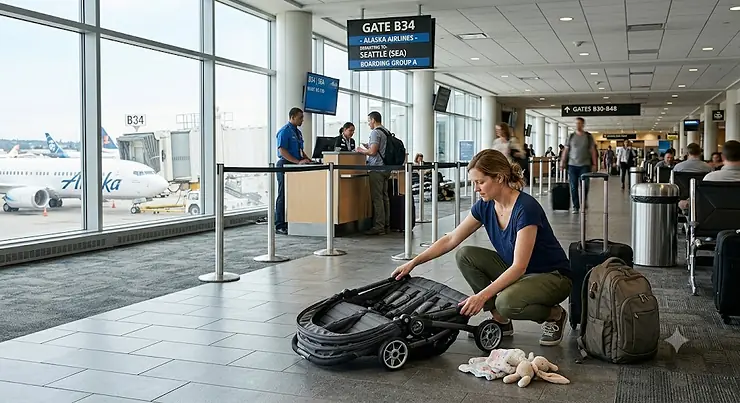
Somewhere between the check-in counter and the jet bridge, every parent traveling with two kids has the same mid-flight-panic thought: is this stroller actually going to survive the trip? A travel double stroller for airplane gate check is a compact, lightweight two-seat stroller designed to fold small enough for free gate-side surrender and reclaim, ride in the belly of the plane instead of checked baggage, and bounce back without falling apart after being tossed around by ground crews. That’s the whole job description, and honestly, most double strollers on the market were never built for it.
Here’s the thing nobody tells you at the baby store: a stroller that glides beautifully through Target aisles can turn into a 34-pound anchor the second you’re sprinting toward a delayed connection with a toddler under one arm. Weight, fold speed, and how the frame handles impact matter more at a jet bridge than cup holders ever will. We dug through real product specs, verified folded dimensions, and aggregated customer-review sentiment across seven genuinely available double strollers — from a 23-pound side-by-side that practically disappears into a gate-check bag to a premium option gate agents recognize on sight — so you’re not gambling on a stroller you’ve never seen survive an actual flight.
This guide covers what separates a true gate-check travel stroller from a stroller that merely claims to be “travel friendly,” how airline gate-check policies actually work, and which of these seven models earns its keep for your specific family. We’ll also get into the unglamorous stuff — damage protection, jet bridge etiquette, and what to do when your stroller comes back with a cracked wheel — because that’s the part most buying guides skip entirely.
Quick Comparison Table
| Stroller | Weight | Folded Size (approx.) | Price Range | Best For |
|---|---|---|---|---|
| Zoe Twin+ V2 | ~23 lbs | 29″ x 9″ x 28″ | $500-$550 range | Lightest all-around gate-check pick |
| Baby Jogger City Tour 2 Double | ~23 lbs | 22″ x 20″ x 7″ | $320-$380 range | Narrowest fold for tight jet bridges |
| UPPAbaby Minu Duo | ~27.4 lbs | 23.7″ x 27.8″ x 12.9″ | $780-$830 range | Premium build, best gate-agent recognition |
| Britax B-Lively Double | ~29 lbs | 27″ x 31.5″ x 13″ | $380-$420 range | Fastest one-hand fold |
Just glancing at the numbers, the Zoe Twin+ V2 and Baby Jogger City Tour 2 Double are essentially tied for lightest, but they solve different problems — the Zoe Twin+ V2 wins on overall compactness once folded flat, while the Baby Jogger City Tour 2 Double wins on sheer footprint width for squeezing through narrow jet bridge doors. The UPPAbaby Minu Duo costs more than the other three combined, but reviewers consistently note that its brand recognition means fewer questions from gate agents unfamiliar with off-brand folds. If your airline enforces a hard weight cutoff for gate-checking (more on that below), the Britax B-Lively Double sits closest to the edge of that limit, so weigh it before you fly.
💬 Just one click — help others make better boarding decisions too! 😊
Top 7 Travel Double Strollers for Airplane Gate Check: Expert Analysis
Picking the right travel double stroller for airplane gate check trips isn’t about finding the “best” stroller in some abstract sense — it’s about matching the fold speed, weight, and durability to how you actually travel. Below are seven real, currently available double strollers spanning budget to premium, each pulled from verified product specs and aggregated review sentiment rather than a rewritten spec sheet.
1. Zoe Twin+ V2 — lightest side-by-side built for gate-check duty
The standout here is weight: at roughly 23 pounds, the Zoe Twin+ V2 is genuinely one of the lightest full-size double strollers most parents will ever gate-check, and that number is doing a lot of work when you’re the one lifting it back over your shoulder at baggage reclaim. Each seat reclines independently to about 165 degrees, which is close enough to flat that a napping toddler doesn’t wake up mid-recline, and the 29-inch width clears most standard jet bridge and ADA doorways without a fight. Based on the spec comparison against similarly priced doubles, the Zoe Twin+ V2 trades a few premium touches — no all-terrain tires, a fairly basic storage basket — for weight savings that matter more in an airport than a park. Reviewers consistently report that the two-handed fold, while not one-handed, takes only a few seconds once you’ve done it twice, and several parents specifically mention using it as a Disney and airport combo stroller because it clears Disney’s size rule too. What most buyers overlook about this model is that the included backpack-style travel bag isn’t just padding — it frees up your hands for boarding passes and a second kid while the stroller rides on your back through security to the gate.
Pros:
- ✅ One of the lightest true double strollers on the market
- ✅ Deep 165-degree recline works well for napping toddlers
- ✅ Convertible carry bag frees your hands at the gate
Cons:
- ❌ Fold requires two hands, not ideal solo with two kids
- ❌ Storage basket is smaller than most full-size doubles
At around $500-$550, the Zoe Twin+ V2 isn’t the cheapest option here, but for families who fly several times a year, the weight savings alone justify the price over a heavier budget double.
2. Baby Jogger City Tour 2 Double — narrowest fold for tight jet bridges
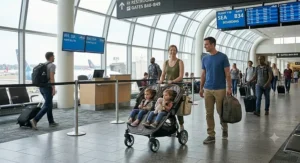
The Baby Jogger City Tour 2 Double earns its spot with a folded footprint that’s noticeably narrower than most competing doubles, which matters more than people expect when you’re trying to wheel a folded stroller down a single-file jet bridge line behind a slow-moving crowd. At roughly 23 pounds and a one-step, one-hand auto-locking fold, this stroller collapses fast enough to not hold up boarding — something that genuinely can’t be said for every double on this list. Here’s what to weigh before buying: the smaller wheels that make this stroller so compact also mean it’s happiest on smooth airport flooring and hotel hallways rather than cobblestone streets or gravel parking lots, so if your trip includes a lot of rough terrain once you land, this isn’t your only stroller. Aggregated customer-review sentiment is fairly consistent on two points — parents love how small it packs down, and parents wish the underseat storage basket were bigger, since the compact frame simply doesn’t leave much room underneath. The seats hold up to 33-45 pounds depending on version, so it’s realistically sized for two younger kids rather than a toddler-plus-preschooler combo.
Pros:
- ✅ Genuinely one of the narrowest folds in the double category
- ✅ One-hand, one-step fold with auto-lock is fast under pressure
- ✅ Fits through standard doorways and jet bridges with ease
Cons:
- ❌ Smaller wheels struggle on rough or uneven surfaces
- ❌ Underseat storage basket is tight for two kids’ worth of gear
Priced in the $320-$380 range, the Baby Jogger City Tour 2 Double is one of the better value picks here if your travel is mostly airports, hotels, and paved sidewalks rather than hiking trails.
3. Britax B-Lively Double — fastest one-hand fold at the gate
If gate-checking is stressful mainly because of the fold itself — fumbling with two straps while a line forms behind you — the Britax B-Lively Double solves that specific problem better than almost anything else here. The one-hand quick fold genuinely closes in a couple of seconds and stands upright on its own once folded, which means you’re not trying to balance a floppy stroller against your leg while also holding a boarding pass. Each seat reclines independently and infinitely rather than in fixed positions, so you can dial in exactly the right angle for a mid-flight nap versus an alert toddler watching planes through the terminal window. Reviewers consistently note that the all-wheel suspension makes this one of the smoother-riding doubles in its price tier, though the plastic front wheels on some testing units were flagged as less durable than rubber composite alternatives. What the spec sheet won’t tell you, but user reports suggest, is that the extra-large front-access storage basket is genuinely one of the best in this list for stuffing a diaper bag, snacks, and a rolled-up rain cover without digging around blind.
Pros:
- ✅ Fastest one-hand, self-standing fold of any double on this list
- ✅ Infinite recline on both seats, not just fixed positions
- ✅ Extra-large front-access storage basket
Cons:
- ❌ Plastic front wheels wear faster than rubber alternatives
- ❌ At roughly 29 pounds, heavier than the lightest picks here
Meets Disney’s stroller size requirements and typically runs $380-$420, making it a strong middle-ground choice between the ultralight options and the pricier premium builds.
4. UPPAbaby Minu Duo — premium pick gate agents recognize instantly
The UPPAbaby Minu Duo is the stroller you buy when you want the folding drama to simply not happen. Its one-hand, one-step fold locks in under ten seconds and the whole unit stands on its own, and the folded dimensions come in at a remarkably compact 23.7 x 27.8 x 12.9 inches — among the tightest folds of any premium double stroller currently sold. Based on the spec comparison, the frame’s aluminum construction and full-grain leather handlebar put this firmly in the premium tier, and at roughly 27.4 pounds, it’s still lighter than most non-travel doubles despite the upgraded materials. What most buyers overlook about this model is the brand-recognition factor: reviewers and travel bloggers alike note that UPPAbaby’s reputation with major U.S. carriers tends to reduce friction and confusion at the gate compared to lesser-known brands, since gate agents already know roughly what to expect from the fold and size. Both seats work from birth without accessories thanks to integrated infant barriers, and the stroller is backed by UPPAbaby’s TravelSafe program, which specifically covers travel-related damage — a rare feature genuinely built with flying in mind rather than bolted on as marketing.
Pros:
- ✅ Most compact fold of any premium double stroller tested
- ✅ TravelSafe program covers damage sustained during air travel
- ✅ From-birth seats with integrated infant barriers, no accessories needed
Cons:
- ❌ Highest price point on this list by a wide margin
- ❌ Only one car seat adapter fits at a time, not both sides
At around $780-$830, the UPPAbaby Minu Duo is a genuine investment, but for families who fly frequently and want the fold-related stress removed entirely, reviewers consistently say it’s worth the premium.
5. Graco Ready2Grow 2.0 — budget configurable bench-and-stand double
Not every family needs two identical seats — sometimes one kid has outgrown sitting the whole flight and just wants to stand or perch, and that’s exactly the gap the Graco Ready2Grow 2.0 fills. The stroller folds like a single stroller despite functioning as a double, with a self-standing one-step fold that doesn’t require detaching either seat first. Key specs with real-world meaning: the front seat holds up to 50 pounds and the rear seat holds up to 40 pounds, and the rear seat position can convert into a bench seat or a standing platform, which is genuinely useful for an older sibling who’s aged out of wanting to sit strapped in for an entire terminal walk. Aggregated review sentiment is mixed but instructive — parents with an age gap between kids consistently praise the flexible seating, while parents of same-age twins note the fold requires two hands and the ride feels bulkier than side-by-side alternatives. At roughly 32 pounds, this is the heaviest stroller on this list, so it’s a stronger fit for families who gate-check occasionally rather than every single trip.
Pros:
- ✅ Converts to bench seat or standing platform as kids grow
- ✅ Accepts two Graco infant car seats simultaneously
- ✅ Lowest price point of any full-featured double here
Cons:
- ❌ Heaviest stroller on this list at roughly 32 pounds
- ❌ Fold requires two hands and more effort than lighter models
Typically priced in the $280-$330 range, the Graco Ready2Grow 2.0 is the clear pick for budget-conscious families with kids of noticeably different ages.
6. Joovy Kooper RS2 — sturdiest build for rough tarmac handling
Gate-checked strollers don’t get handled gently — they get stacked, dropped down a ramp, and occasionally left out on wet tarmac during a delay — and the Joovy Kooper RS2 is built with that reality in mind more than most. At roughly 31 pounds, it’s not a lightweight pick, but that extra weight comes from a noticeably sturdier frame and larger wheels than the ultralight options on this list, which reviewers consistently point to as the reason it survives repeated rough handling better than flimsier competitors. The one-handed fold with an integrated tray attachment means snacks stay contained through security lines and boarding delays alike, and the bigger wheels smooth out the transition from smooth terminal flooring to bumpy jet bridge ramps far better than smaller-wheeled travel strollers manage. Here’s what to weigh: this is not the stroller for parents chasing the lowest gate-check weight, but for families whose trips involve as much walking on uneven ground after landing as they do inside the airport, the trade-off toward durability over minimal weight is a genuinely reasonable one.
Pros:
- ✅ Larger wheels handle uneven jet bridges and tarmac well
- ✅ One-handed fold despite the sturdier, heavier frame
- ✅ Integrated snack trays reduce mid-terminal meltdowns
Cons:
- ❌ Noticeably heavier than the ultralight picks on this list
- ❌ Bulkier folded size takes up more overhead or trunk space
Generally priced in the $400-$450 range, the Joovy Kooper RS2 is worth considering for families prioritizing durability over the lightest possible carry.
7. Mompush Lithe Double — best value lightweight alternative
Rounding out the list is a lesser-known but genuinely capable option: the Mompush Lithe Double, a side-by-side stroller weighing approximately 25 pounds with a one-step fold, independent recline on both seats, and a 30-inch width built to clear standard doorways. What most buyers overlook about lesser-known brands like this one is that the core mechanics — fold speed, recline range, wheel suspension — often match name-brand doubles costing two to three times as much, since the savings mostly come from marketing spend rather than engineering shortcuts. The UPF 50+ canopy and all-wheel suspension put it in the same functional category as strollers costing significantly more, and reviewers consistently frame it as the stroller they’d recommend to a friend who flies once or twice a year and doesn’t want to spend premium-brand money on something that mostly sits in a closet between trips. The honest caveat: because it’s a newer entrant, the pool of long-term durability reviews is thinner than for established brands, so if you can’t verify five years of track record, budget mentally for a shorter expected lifespan than the UPPAbaby Minu Duo or Britax B-Lively Double.
Pros:
- ✅ Strong feature set for the price, including all-wheel suspension
- ✅ Independent recline on both seats
- ✅ Lightweight at approximately 25 pounds
Cons:
- ❌ Smaller brand means a thinner long-term review history
- ❌ Replacement parts and accessories are harder to source
At an approximate $250-$300 price range, the Mompush Lithe Double is the pick for budget-focused families who still want real recline and suspension features.
What Is a Gate-Check Travel Stroller?
A gate-check travel stroller is a double or single stroller light and compact enough to wheel all the way to the airplane door, fold at the last possible moment, and hand off to airline staff for free storage in the cargo hold — then reclaim it on the jet bridge the moment you land. It’s distinct from checked luggage because it never enters the terminal baggage system, and distinct from a carry-on because it rarely fits in an overhead bin, especially as a double. According to the FAA’s carry-on baggage guidance, items too large to stow safely may need to be gate-checked, and strollers routinely fall into that category.
The appeal of a dedicated gate-check travel stroller, as opposed to your everyday full-size double, comes down to three things: weight you can actually lift one-handed while holding a toddler, a fold that doesn’t require a manual mid-boarding-line, and a frame built to tolerate rougher handling than a living room floor. Most full-size doubles were never stress-tested for being stacked in a cargo hold next to golf bags, which is exactly why the picks above emphasize verified folded dimensions and real review sentiment about durability rather than marketing copy alone.
Jet Bridge Stroller Policy: What Every Airline Requires
Here’s a distinction that trips up a lot of first-time flying parents: the FAA does not set stroller size or weight rules for gate-checking. Airlines set their own policies, and those policies genuinely vary. Most major U.S. carriers gate-check strollers for free regardless of size, but the specifics differ enough that it’s worth checking before you travel rather than assuming. Some carriers historically enforced a hard weight cutoff — commonly cited around the 20-pound mark — above which a stroller had to be checked at the counter instead of gate-checked, though several airlines have relaxed or removed these limits in recent years. The U.S. Department of Transportation’s baggage policy resources are a useful starting point for understanding your rights if a gate-check goes wrong, including delayed or damaged item procedures.
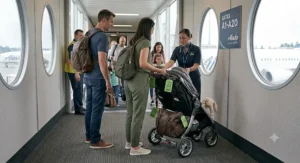
Practically, here’s how the process works at the gate: you wheel the stroller up to the jet bridge door (not the main gate counter), fold it right before boarding, hand it to a gate agent or flight crew member, and it gets tagged and loaded into cargo. On arrival, it’s typically returned to you at the jet bridge door of your arrival gate rather than at baggage claim, though on some smaller regional aircraft or with certain codeshare partners it may come out at baggage claim instead — a detail worth confirming with your specific airline. Reviewers who fly frequently consistently recommend gate-checking over checking at the ticket counter whenever the option exists, since gate-checked items generally see less handling and a shorter time away from you than items that ride the full baggage system.
How to Choose a Travel Double Stroller for Airplane Gate Check
- Weigh your airline’s specific policy first. Before falling in love with a stroller, confirm whether your carrier enforces a weight cutoff for free gate-checking, since that single number can eliminate half the strollers on this list.
- Prioritize fold speed over fold compactness. A stroller that folds in three seconds with one hand beats a slightly smaller fold that requires two hands and a knee, especially when you’re also managing a child.
- Check the folded width against jet bridge doorway sizes. Most jet bridges and standard doorways run close to 30 inches, so anything wider risks an awkward squeeze.
- Match seat recline to your kids’ nap schedules. If your flight lands during nap time, a deep or near-flat recline genuinely changes how smoothly the trip goes.
- Weigh durability against raw weight. The lightest stroller isn’t always the sturdiest one, and a stroller that survives rough cargo handling saves you money over several trips.
- Consider whether your kids need identical seats. Families with an age gap often do better with a configurable seat like the Graco Ready2Grow 2.0 rather than two matching seats.
- Factor in brand recognition at the gate. Reviewers note that well-known brands sometimes mean fewer questions or delays from unfamiliar gate staff, which can matter during a tight connection.
Compact Travel Double Stroller vs Full-Size Double Stroller
The instinct to just bring your everyday full-size double stroller to the airport is understandable — why buy a second stroller? — but the trade-offs are real once you compare them side by side. A compact travel double stroller typically weighs 20-27 pounds, folds in one motion, and is engineered around minimizing bulk, while a full-size everyday double often weighs 30-40+ pounds, may require detaching a seat to fold, and prioritizes ride comfort and storage over portability.
| Factor | Compact Travel Double | Full-Size Everyday Double |
|---|---|---|
| Typical weight | 20-27 lbs | 30-40+ lbs |
| Fold speed | One motion, seconds | Often two-step, slower |
| Storage basket | Smaller, tighter access | Larger, easier access |
| All-terrain performance | Weaker on rough ground | Stronger, bigger wheels |
| Best For | Frequent flyers, tight connections | Daily use, occasional flying |
The analysis here is straightforward: if you fly more than once or twice a year, the weight and fold-speed savings of a compact double like the Baby Jogger City Tour 2 Double or Zoe Twin+ V2 pay for themselves in reduced stress alone, even if you lose some storage capacity and rough-terrain performance. Families who fly rarely, on the other hand, may reasonably decide that lugging their everyday double stroller to the airport once a year isn’t worth the cost of a second, travel-specific stroller — but they should budget extra time for a bulkier fold at the gate.
Stroller Damage Protection: Practical Usage Guide
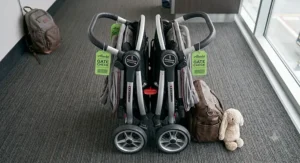
Stroller damage protection starts well before you reach the jet bridge, and a little prep genuinely reduces the odds of getting your stroller back with a cracked wheel or bent frame. First, remove anything that isn’t bolted down — cup holders, snack trays, phone mounts, and rain covers — since loose accessories are the most common casualty of cargo handling and the easiest thing to lose entirely. Second, invest in a padded gate-check bag; even a basic drawstring cover meaningfully reduces scuffing and keeps grease, rain, and dirt off the fabric, and several manufacturers, including UPPAbaby, only honor travel-damage warranty claims if the stroller was bagged.
Third, snap a few photos of the stroller’s condition right before you hand it off — timestamped photos are the single most useful thing you can have if you need to file a damage claim, and most airlines require documentation of pre-existing condition to process a claim fairly. Fourth, in the first 30 days of ownership, get in the habit of folding and unfolding the stroller at home a dozen times before your first flight; reviewers consistently note that folding mechanisms loosen up and become faster with repetition, and you don’t want your first real-world fold attempt to happen under boarding pressure. Finally, register your stroller with the manufacturer immediately after purchase — not only does this often start your warranty clock, but the Consumer Product Safety Commission’s stroller safety information notes that registration is also how you’d be notified of a safety recall, which matters more for a product that gets tossed around cargo holds than one that stays in your living room.
✨ Don’t Miss These Exclusive Travel Stroller Deals!
🔍 Take your airport travel to the next level with these carefully selected double strollers. Click on any highlighted pick to check current pricing and availability. The right stroller turns a stressful connection into a manageable one for your whole family!
Real-World Scenarios: Which Stroller Fits Your Family
The frequent-flying family of four. Two kids under four, six or more flights a year, tight connections the norm rather than the exception. This family’s top priority is fold speed and weight above almost everything else, which points toward the Zoe Twin+ V2 or Baby Jogger City Tour 2 Double — both light enough to carry up a jet bridge stairwell if a gate agent asks, and both fast enough to fold without holding up a boarding line.
The occasional vacationer with an age gap. One toddler, one preschooler, flying once or twice a year for a family trip. Because the kids’ needs differ — one wants to sit and nap, the other wants to stand and look around — the Graco Ready2Grow 2.0‘s configurable bench-and-stand rear seat solves a real logistical problem that a matched side-by-side double can’t.
The premium traveler prioritizing zero friction. Budget isn’t the primary constraint; the priority is minimizing stress and maximizing durability across dozens of trips a year. The UPPAbaby Minu Duo‘s combination of the most compact premium fold available and a dedicated travel-damage protection program makes it the rational choice for this family, even at a higher upfront cost.
Common Mistakes When Buying a Travel Double Stroller
The single most common mistake is buying based on folded size alone without checking actual weight — a stroller that folds impressively small but weighs 34 pounds is still exhausting to carry solo with a child on your hip. A close second is skipping the recline check; parents consistently report regretting a stroller with only upright or fully-flat positions when their child needed something in between for an in-flight nap. Another frequent misstep is assuming every airline’s gate-check policy is identical — as covered above, weight cutoffs and procedures genuinely differ by carrier, and finding this out at the gate instead of before booking creates entirely avoidable stress. Finally, many parents skip a gate-check bag to save $20-$30, then are surprised when the fabric comes back scuffed or a wheel comes back bent; reviewers who’ve made this mistake once rarely make it twice.
What to Expect: Real-World Performance at the Airport
On paper, every stroller in this guide “folds compactly,” but in practice, that phrase covers a wide range of real experiences. A one-hand auto-lock fold like the Britax B-Lively Double‘s means you can fold with a toddler still on your hip; a two-handed fold like the Zoe Twin+ V2‘s means you’ll need somewhere to briefly set your child down, which matters more than it sounds like on a crowded jet bridge. Once folded, expect a genuine size difference at security screening too — TSA typically requires strollers to go through the X-ray belt separately, and the more compact your fold, the less likely you are to hold up the line behind you. Reviewers consistently note that the biggest real-world surprise isn’t the fold itself but the reclaim process — strollers occasionally return with light surface scuffing even when handled properly, which is normal wear rather than damage, and shouldn’t be confused with the more serious bent-frame or broken-wheel damage that does warrant a formal claim.
Long-Term Cost & Maintenance of a Gate-Check Travel Stroller
Thinking about total cost of ownership rather than sticker price changes the calculus on several of these picks. A $250-$300 lightweight double like the Mompush Lithe Double looks like the clear budget winner upfront, but if replacement wheels or fabric are hard to source three years in, the effective lifetime cost can end up comparable to a pricier, better-supported brand. Conversely, the UPPAbaby Minu Duo‘s roughly $780-$830 price tag looks steep, but its three-year warranty and dedicated TravelSafe program for flight damage meaningfully offset the risk of an expensive repair or replacement after a rough cargo experience — value that’s easy to overlook if you’re only comparing sticker prices.
Maintenance-wise, the good news is that most of these strollers require very little upkeep: wipe down the frame with mild soap and water, spot-clean or machine-wash the seat fabric per the manufacturer’s instructions, and periodically check that wheels spin freely and lock properly after repeated gate-checking, since grit and debris from cargo holds can work into wheel axles over time. Budgeting $20-$40 a year for a gate-check bag replacement and the occasional accessory (a lost cup holder, a torn canopy pocket) is realistic for a stroller that flies several times annually.
Buyer’s Decision Framework
If weight is your absolute top priority and you fly frequently, choose the Zoe Twin+ V2 or Baby Jogger City Tour 2 Double, because both sit near the bottom of the weight range while still offering full-size double functionality. If your kids are different ages and need different seating experiences, choose the Graco Ready2Grow 2.0, because its configurable bench-and-platform rear seat solves that specific problem better than a matched side-by-side. If budget is the primary constraint but you still want real recline and suspension features, choose the Mompush Lithe Double, because it delivers premium-adjacent mechanics at a fraction of the price. If you want the fold-related stress removed entirely and can absorb a higher price, choose the UPPAbaby Minu Duo, because its compact fold and TravelSafe program are purpose-built around exactly this use case. And if your trips mix airport travel with genuinely rough terrain after landing, choose the Joovy Kooper RS2, because its larger wheels and sturdier frame outperform the ultralight options once you’re off smooth flooring.
Features That Actually Matter (And Those That Don’t)
Features that actually matter for gate-checking: one-hand fold capability, verified folded weight, self-standing fold (so you’re not wrestling a floppy frame while boarding), and independent seat recline. Features that sound appealing in marketing but matter far less for air travel specifically: all-terrain tires (irrelevant if your trip is airport-to-hotel-to-airport), extensive cup holder counts, and elaborate parent organizer attachments, which mostly add weight without solving a gate-check-specific problem. Reviewers consistently note that the features they actually reach for mid-trip are the boring, structural ones — a fold that works one-handed, a canopy that blocks enough sun for a nap, and a storage basket that survives being crammed full — rather than the flashier features that dominate product photos.
Frequently Asked Questions
❓ Do airlines charge to gate-check a double stroller?
❓ What's the weight limit for gate-checking a stroller?
❓ Will my stroller come back to the same gate when I land?
❓ Is a compact travel double stroller worth it if I only fly once a year?
❓ How do I file a claim if my stroller is damaged during gate-check?
Conclusion
Choosing a travel double stroller for airplane gate check trips ultimately comes down to being honest about how you actually travel — frequent short-haul trips call for a different stroller than one big annual vacation. The Zoe Twin+ V2 and Baby Jogger City Tour 2 Double reward families chasing the lightest possible carry, the Graco Ready2Grow 2.0 solves the age-gap seating problem better than a matched pair, and the UPPAbaby Minu Duo removes fold-related stress entirely for families willing to pay a premium for it. None of these seven strollers is universally “best” — each one is a genuine trade-off between weight, durability, price, and features, and the right pick is simply the one that matches your specific family’s flying habits.
Whichever stroller you land on, remember that a gate-check bag, a few pre-flight photos, and a little practice folding at home do more for stroller damage protection than any single product feature. Airports are hard on gear no matter how well-engineered it is, and a little preparation goes a long way toward getting your stroller back in one piece.
Recommended for You
- 7 Best Lightweight Double Strollers for Grandparents (2026)
- Lightweight Double Stroller For One-Hand Folding: 7 Picks (2026)
- 7 Best Lightweight Double Strollers for Air Travel in 2026
Disclaimer: This article contains affiliate links. As an Amazon Associate, I earn from qualifying purchases. If you purchase products through these links, we may earn a small commission at no additional cost to you.
✨ Found this helpful? Share it with your friends! 💬🤗
