
In This Article
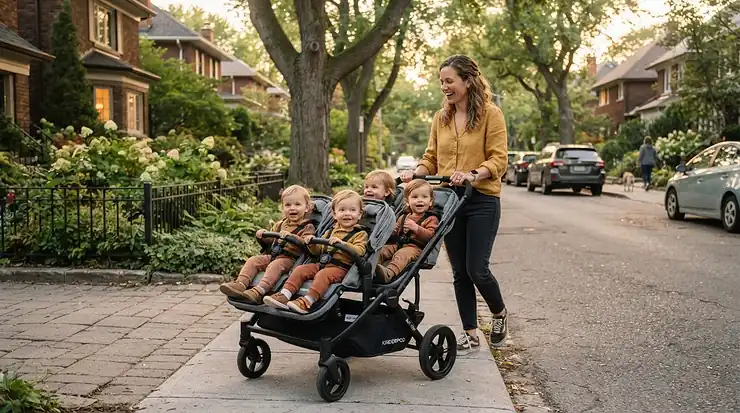
Somewhere between the newborn stage and the “I can walk five miles, Mom” stage sits a brutal, sleep-deprived middle ground: one kid who still needs to ride, and one kid who’s done being carried but absolutely cannot be trusted to walk in a straight line through a parking lot. That’s the gap a sit-and-stand stroller for toddler and preschooler is built to close. Instead of wrestling a side-by-side double through a single grocery aisle, you get one narrower frame with a seat up front and a bench, platform, or extra seat in back — so your independent-minded preschooler can ride, stand, or hop on and off at will while your toddler stays buckled and happy.
This guide skips the marketing copy and gets into what actually matters: real weight limits, real fold dimensions, real aggregated reviewer sentiment, and honest trade-offs between seven models currently sold in the U.S. We looked at Baby Trend, Graco, Chicco, Joovy, and a lesser-known budget brand so you’re comparing apples to apples, not glossy product photos. Every price below is shown as a range because retailer pricing shifts constantly — always check current price before buying. By the end, you’ll know exactly which sit-and-stand stroller for toddler and preschooler fits your family’s age gap, budget, and daily routine.
What Is a Sit-and-Stand Stroller for Toddler and Preschooler?
A sit-and-stand stroller for toddler and preschooler is a double stroller with an inline (front-and-back) layout where the rear position converts between a seat, a bench, and a standing platform stroller board. It’s designed for siblings who are close in age but not the same size — one still needs full support, the other just needs a ride option. Unlike side-by-side doubles, the narrow inline frame fits through single doorways and store aisles.
Quick Comparison Table: Sit-and-Stand Strollers at a Glance
| Stroller | Price Range | Weight | Best For |
|---|---|---|---|
| Joovy Caboose Too Ultralight | $270–$320 | 23.5 lbs | Lightest tandem lift |
| Baby Trend Sit N’ Stand Double 2.0 | $180–$230 | ~32.5 lbs | Budget-friendly value |
| Graco Ready2Grow 2.0 | $220–$270 | 32.4 lbs | Most seat configurations |
| Chicco BravoFor2 | $350–$400 | 26.5 lbs | Smoothest, sturdiest ride |
| INFANS Double Stroller | $150–$180 | ~28 lbs | Lowest entry price |
Looking at the spread above, price and weight don’t move together in a straight line — the Chicco BravoFor2 is lighter than the Baby Trend Sit N’ Stand Double 2.0 despite costing almost double, because you’re paying for suspension and build quality, not just less aluminum. Budget-conscious families gravitate toward the INFANS Double Stroller or Baby Trend Sit N’ Stand Double 2.0, while parents who plan to use two infant car seats at once should look hardest at the Graco Ready2Grow 2.0. We’ll unpack all seven models, including the two not shown here, in the full breakdown below.
💬 Just one click — help other parents make better buying decisions too!😊
Top 7 Sit-and-Stand Strollers for Toddler and Preschooler: Expert Analysis
1. Joovy Caboose Too Ultralight — lightest tandem with a real second seat
At 23.5 pounds, the Joovy Caboose Too Ultralight is one of the lightest true tandem strollers sold in the U.S. today — a meaningful number when you’re the one hoisting it into a trunk with a toddler on your hip. The front seat and the optional “Too” rear seat both recline three ways and carry a 45-pound limit each, for a combined 90-pound capacity, which is unusually generous for something this light.
What that means in practice: this is one of the few sit-and-stand models where the back position can be a genuine second stroller seat for a younger sibling, not just a bench or platform, if you buy the Too seat add-on. Based on the spec comparison with rivals in this roundup, the Joovy Caboose Too Ultralight trades car-seat-doubling flexibility (it doesn’t easily accept two infant car seats at once) for raw portability and price.
Aggregated reviewer sentiment from long-term owner blogs consistently mentions the oversized canopy and how much kids seem to love riding in it — several parents describe their toddlers insisting on bringing “the stroller” on vacation. A recurring complaint in the same reviews is that the under-seat storage basket is awkwardly shaped and hard to reach with the rear seat installed.
Pros:
- ✅ Lightest true tandem sit-and-stand in this roundup
- ✅ Three-way reclining seats front and rear for naps
- ✅ Oversized canopy with added sun-visor extension
Cons:
- ❌ Storage basket is cramped and awkward to reach
- ❌ Doesn’t easily accommodate two infant car seats at once
Priced around $270–$320 depending on retailer and the included rear seat, this is a strong value pick if lightness and nap-friendly recline matter more to you than dual-car-seat compatibility.
2. Baby Trend Sit N’ Stand Double 2.0 — best value for a growing family
The Baby Trend Sit N’ Stand Double 2.0 is the redesigned successor to Baby Trend’s long-running budget classic, and the numbers tell the story: both the front seat and rear standing platform stroller position now hold up to 50 pounds each, an upgrade from the 40-pound cap on older models. What that means for real families is extra runway — a heavier-than-average 4-year-old can keep standing on the platform well past the age most competitors force a switch to walking.
The stroller ships with five configurable modes, from full travel-system mode with an infant car seat up front to a sibling standing on the rear platform. Based on lab-style testing data referenced by independent stroller review sites, the Baby Trend Sit N’ Stand Double 2.0 has historically scored on the tougher end to maneuver and fold compared with lighter tandem rivals — worth weighing if one-handed folding in a rush is a daily requirement for you.
One honest safety note: earlier Sit N’ Stand Double and Ultra models with model numbers starting SS76 or SS66 were the subject of a 2023 federal entrapment warning tied to the pivoting front canopy design; the 2.0 uses a different canopy mounting, but if you’re shopping secondhand, always check the model number sticker before buying.
Pros:
- ✅ 50-pound weight cap on both front and rear positions
- ✅ Five configurable modes for a growing family
- ✅ One-hand fold with a large underseat basket
Cons:
- ❌ Heavier and bulkier than lightweight tandem rivals
- ❌ Rated harder to maneuver in independent lab comparisons
Expect to pay in the $180–$230 range, making this one of the more affordable ways to get a 50-pound-rated standing platform stroller.
3. Graco Ready2Grow 2.0 — most seat configurations for siblings close in age
If seating versatility is your top priority, the Graco Ready2Grow 2.0 is hard to beat: it ships with two full stroller seats, a bench seat, and a standing platform, and it’s compatible with two Graco infant car seats at once. That last point matters more than it sounds — most sit-and-stand strollers in this category can only click in one infant car seat up front, which forces families with two young kids into an either/or choice.
The front seat holds up to 50 pounds while the rear position caps at 40 pounds, a detail worth noting if your older rider runs big for their age. What most buyers overlook about this model is the fold: despite functioning like a double stroller on the sidewalk, it collapses down to roughly the footprint of a single stroller, which is a real advantage for car trunk space.
Aggregated owner sentiment collected from retailer review sections leans strongly positive, with parents repeatedly describing daily use over many months without major complaints — though a smaller number flag the pull-out bench mechanism as an extra step to remember when folding.
Pros:
- ✅ Accepts two Graco infant car seats simultaneously
- ✅ Folds to roughly single-stroller size despite double capacity
- ✅ Four seating configurations: two seats, bench, or platform
Cons:
- ❌ Rear seat capped at 40 lbs, lower than the front’s 50
- ❌ Pull-out bench adds a step to the folding process
Priced around $220–$270, this is the pick for families who specifically need two-infant-car-seat compatibility alongside standing-platform flexibility.
4. Chicco BravoFor2 — smoothest ride and sturdiest build quality
The Chicco BravoFor2 consistently earns a reputation as the step-up choice in this category, and the spec sheet backs that up: all-wheel suspension smooths out cracked sidewalks and curb cuts in a way that budget frames simply can’t match. At 26.5 pounds it isn’t the lightest model here, but it’s lighter than several rivals with lower price tags, which tells you the weight savings came from engineering rather than thinner materials.
The rear standing platform includes easy-grip handles and a padded backrest — small details, but ones that make a real difference for a preschooler standing through a 20-minute walk to daycare. Chicco caps both the front and rear positions at 40 pounds and 43 inches, which is lower than some 50-pound rivals, so height-and-weight math matters more here than with the Baby Trend or Graco options.
Reviewers consistently note the one-hand fold as satisfying once you learn the motion, though several mention it takes a few tries to get comfortable with, since Chicco doesn’t include printed folding instructions in the box. Aggregated feedback also repeatedly flags that the front seat doesn’t recline, which is the single most common criticism of this model across owner reviews.
Pros:
- ✅ All-wheel suspension for the smoothest ride tested
- ✅ Standing platform includes grip handles and a backrest
- ✅ One-hand, free-standing fold once you learn it
Cons:
- ❌ Front seat doesn’t recline, a frequent owner complaint
- ❌ Lower 40 lb / 43″ weight-and-height cap than some rivals
At around $350–$400, the Chicco BravoFor2 sits at the premium end of this roundup, and on paper it earns that price through ride quality rather than flashy extras.
5. Baby Trend Sit N’ Stand 5-in-1 Shopper Plus — most modes packed into one frame
The Baby Trend Sit N’ Stand 5-in-1 Shopper Plus takes the same 50-pound-per-seat platform as the standard 2.0 and wraps it in a slightly more feature-loaded package, including a “Comfort Cabin” extra-long canopy rated UPF 50+ for sun protection. What the spec sheet doesn’t spell out clearly is how much that extended canopy matters for families in sunnier climates — UPF 50+ is a meaningfully higher protection level than the shorter canopies on entry-level competitors.
Five modes of use cover everything from full travel-system setup to a sibling sitting on the bench to a sibling standing on the platform, matching the flexibility of pricier models at a friendlier price point. Based on the spec comparison with the standard Sit N’ Stand Double 2.0, the Shopper Plus is essentially the same core platform with upgraded parent-facing conveniences — a multi-directional cell phone positioner and deeper cup holders among them.
The trade-off is size: this is one of the bulkier frames in the roundup, and it doesn’t include an infant car seat, so budget an additional cost if you need one.
Pros:
- ✅ 50 lb weight cap on both front and platform seats
- ✅ UPF 50+ extended canopy for stronger sun protection
- ✅ Modern parent console with phone positioner and deep cups
Cons:
- ❌ Bulkier footprint eats more trunk and storage space
- ❌ Car seat sold separately, adding to total cost
Typical pricing lands around $200–$240, making it a reasonable step up from the standard 2.0 if the extended canopy and console upgrades appeal to you.

6. Joovy Caboose UL — easiest entry-level lift and steer
The Joovy Caboose UL is Joovy’s refreshed entry point into the sit-and-stand category, built around a 26.5-pound aluminum frame with bigger wheels than earlier Caboose generations and a universal car seat adapter included in the box — a genuine cost saver, since some rivals require you to buy an adapter separately. What most buyers overlook about this model is that Joovy switched to recycled fabrics without changing the price much, which is a quiet win if sustainability factors into your buying decision at all.
The front seat reclines for naps, while the rear position offers a bench seat and standing platform combo rather than a true second seat — an important distinction versus the pricier Caboose Too Ultralight, which can add a genuine second seat. Based on the spec comparison, the auto-lock fold is a meaningful convenience upgrade over older Caboose models, letting you collapse the frame in one motion without fumbling for a secondary latch.
Owner sentiment on this newer version is still building since it’s a recent release, but it inherits the strong reputation of earlier Caboose Ultralight models for easy one-handed pushing.
Pros:
- ✅ Universal car seat adapter included at no extra cost
- ✅ Bigger wheels than earlier Caboose generations
- ✅ Quick auto-lock fold in a single motion
Cons:
- ❌ Heavier than its Caboose Too Ultralight sibling
- ❌ Rear position is bench/platform only, not a true second seat
Expect a price range of roughly $200–$250, positioning this as a solid middle-ground pick between the ultra-budget and premium tiers.
7. INFANS Double Stroller with Standing Board — budget pick most parents haven’t heard of
Not every good sit-and-stand stroller comes from the big four brands, and the INFANS Double Stroller with Standing Board is proof. At a price range of roughly $150–$180, it undercuts every other model in this roundup while still including a two-position reclining front seat, a rear standing board, 5-point harnesses, dual rear brakes, and lockable front wheels — a feature set that would cost noticeably more from a household-name brand.
What the low price doesn’t buy you is a long track record: because INFANS is a newer entrant to the U.S. stroller market, the pool of verified long-term durability reviews is thinner than what exists for Baby Trend, Graco, Joovy, or Chicco, all of which have years of aggregated owner feedback to draw on. If you cannot verify extensive real-world reviews for a specific component’s long-term wear, the honest approach is to say so rather than promise durability the data doesn’t support yet.
Where it does compete well on paper is safety redundancy — dual rear brakes plus a separate front-wheel lock is a more robust braking setup than several pricier competitors offer, and the leather-look handle grip reads as a nicer touch than the price tag suggests.
Pros:
- ✅ Lowest price point of any model in this roundup
- ✅ Dual rear brakes plus a separate front-wheel lock
- ✅ Leather-look handle feels upscale for the price
Cons:
- ❌ Thinner pool of verified long-term durability reviews
- ❌ Smaller brand means a less established resale and parts network
If budget is your primary constraint and you’re comfortable with a newer brand, the INFANS Double Stroller with Standing Board is worth serious consideration.
Top 7 Sit-and-Stand Strollers at a Glance
| Stroller | Price Range | Weight | Rear Position Cap | Best For |
|---|---|---|---|---|
| Joovy Caboose Too Ultralight | $270–$320 | 23.5 lbs | 45 lbs | Lightest tandem lift |
| Baby Trend Sit N’ Stand Double 2.0 | $180–$230 | ~32.5 lbs | 50 lbs | Budget-friendly value |
| Graco Ready2Grow 2.0 | $220–$270 | 32.4 lbs | 40 lbs | Most seat configurations |
| Chicco BravoFor2 | $350–$400 | 26.5 lbs | 40 lbs | Smoothest, sturdiest ride |
| Baby Trend Sit N’ Stand 5-in-1 Shopper Plus | $200–$240 | ~33 lbs | 50 lbs | Sun protection, most modes |
| Joovy Caboose UL | $200–$250 | 26.5 lbs | Bench/platform only | Easiest lift and steer |
| INFANS Double Stroller | $150–$180 | ~28 lbs | Standing board only | Lowest entry price |
Scanning this full table, the pattern that jumps out is that higher rear-position weight caps (50 lbs on the two Baby Trend models) tend to come paired with heavier overall stroller weight — there’s no free lunch in engineering a platform to hold a bigger kid. If your two children are close in age and both approaching 40+ pounds, the Baby Trend Sit N’ Stand Double 2.0 or the Baby Trend Sit N’ Stand 5-in-1 Shopper Plus buy you more runway before you outgrow the stroller entirely.

Standing Platform Weight Limit and Age Cutoffs, Model by Model
The standing platform stroller position isn’t a one-size-fits-all feature — every manufacturer sets its own combination of minimum age, maximum weight, and maximum height, and mixing those numbers up is one of the more common shopping mistakes. Baby Trend’s official guidance states the rear stand-on platform is designed for a child who is at least 2.5 years old and not over 40 inches tall, with a maximum weight of 40 to 50 pounds depending on the specific model generation. Graco sets its Ready2Grow 2.0 rear position cap at 40 pounds regardless of height, while Chicco caps the BravoFor2 at 40 pounds and 43 inches combined. These aren’t arbitrary numbers — they’re tied to the federal safety standard for strollers, 16 CFR Part 1227, which incorporates the ASTM F833 performance specification covering stability, static load, and tip-over testing at multiple incline angles. In practice, this means a stroller’s standing platform weight limit isn’t just a suggestion — it reflects the load the frame was actually tested and certified to carry without tipping. If your preschooler is unusually tall or heavy for their age, prioritize models like the Baby Trend 50-pound platforms over the 40-pound Chicco or Graco rear positions, since you’ll get more usable months before the platform ages out of practical use.
Seated vs Standing Position: What Actually Changes for Your Kids
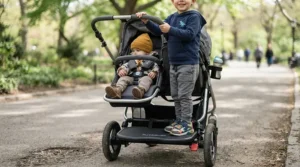
The seated vs standing position debate isn’t just about which one your kid prefers in the moment — the two positions serve genuinely different developmental and practical purposes. A seated rear position, whether it’s a true second seat or a fold-down bench, gives a younger or more tired child full back support, a harness, and often a recline option for naps mid-errand. The standing platform, by contrast, is built for a child with the balance and core strength to hold themselves upright using grip handles for a sustained period — generally the 2.5-to-5-year-old range most manufacturers target. What most parents overlook is that standing burns real energy: a preschooler who stands the entire walk to preschool is doing meaningfully more physical work than one sitting passively, which lines up with the American Academy of Pediatrics’ recommendation that children ages 3 to 5 get roughly three hours of physical activity spread across each day. That’s not a reason to force standing on a reluctant toddler, but it is a reason not to feel guilty about a stroller feature that keeps a preschooler moving instead of slumped. The honest trade-off: standing positions typically lack a harness in the way a seated bench does, so active climbers and jumpers need closer supervision on the platform than in a buckled seat.
Sit-and-Stand for Close-in-Age Kids: Special Considerations
Families with two kids under 24 months apart face a specific version of this shopping problem: both children may still need real seated support at different points in the same walk, not just a ride-or-stand binary. For sit-and-stand for close-in-age kids specifically, the two models in this roundup that add the most flexibility are the Graco Ready2Grow 2.0, which accepts two infant car seats simultaneously, and the Joovy Caboose Too Ultralight, which can add a genuine second reclining seat rather than only a bench. If your children are 18 months or less apart, plan for the strong possibility that both will need seated, harnessed positions well into toddlerhood — a stroller that only offers a bench or platform in back may age out of usefulness faster than you’d like. On paper, this means close-in-age families should weight their decision toward seat-count flexibility over standing-platform weight capacity, since the younger sibling likely won’t be standing independently for at least another year or two after purchase.
Sit-and-Stand Stroller for Older Sibling: Getting the Fit Right
When the “big kid” in a sit-and-stand stroller for older sibling setup is already a confident 3- or 4-year-old, fit and dignity matter more than most buying guides admit. An older sibling wedged into a too-small bench seat, knees up near their chest, is a recipe for a kid who refuses the stroller altogether — which defeats the entire purpose of buying one. Check the specific height limit on the rear position, not just the weight limit: Baby Trend’s 40-inch height cutoff and Chicco’s 43-inch combined cap will feel tight faster on a tall-for-their-age preschooler than a same-age child on the shorter end of the growth curve. Here’s what to weigh: an older sibling who still enjoys standing and looking around usually does better on a true standing platform stroller than a cramped bench, since standing gives more legroom and a better view than folding into a seated position built for a smaller child.
Sibling Stroller Solutions: Sit-and-Stand vs Side-by-Side vs Wagon
Sit-and-stand isn’t the only sibling stroller solution on the market, and it’s worth being honest about where it wins and where it doesn’t. Compared with a side-by-side double stroller, the inline sit-and-stand layout is meaningfully narrower — typically 21 to 25 inches wide versus 28-plus inches for many side-by-sides — which translates directly into an easier fit through single doorways, narrow store aisles, and crowded sidewalks. Side-by-sides do win on one front: both children get equal, symmetrical seating with matched views and legroom, which a sit-and-stand’s front-and-back layout can’t replicate. Stroller wagons, meanwhile, trade the narrow footprint for genuinely huge weight capacity and bench-style seating for two or more kids, but most don’t fold as compactly or fit as easily into a trunk alongside groceries.
| Format | Width | Car Seat Compatible | Best For |
|---|---|---|---|
| Sit-and-stand (inline) | ~21–25 in | Usually front seat only | Narrow spaces, mixed ages |
| Side-by-side double | ~28–30 in | Often both seats | Equal seating, twins |
| Stroller wagon | ~30+ in | Rarely, or with adapter | Big kids, outdoor trips |
Reading across this table, the honest takeaway is that no single format wins every category — a sit-and-stand like the Graco Ready2Grow 2.0 earns its keep in tight urban environments and doorways, while a side-by-side or wagon may serve a family better if width isn’t a constraint and equal seating matters more than maneuverability.
✨ Don’t Miss These Exclusive Deals!
🔍 Take your search for the right sibling stroller to the next level with these carefully compared picks. Click on any highlighted model to check current pricing and availability. The right stroller will make every errand, walk, and school run genuinely easier for your whole family!
How to Choose a Sit-and-Stand Stroller: 6 Criteria That Matter
- Weight limits on both positions. Compare the front seat cap and the rear platform or seat cap separately — the Baby Trend models’ 50-pound rear caps buy more usable years than the 40-pound Chicco and Graco positions.
- Overall stroller weight. A 23.5-pound frame like the Caboose Too Ultralight is dramatically easier to lift into a trunk daily than a 33-pound model, even if both hold the same kids.
- Car seat compatibility. If you have two children under 12 months apart, prioritize models like the Ready2Grow 2.0 that accept two infant car seats.
- Fold size and mechanism. A one-hand, self-standing fold matters enormously if you’re regularly folding the stroller solo with a child on your hip.
- Height cutoffs on the standing platform. Don’t just check weight — a tall 3-year-old may hit the height limit long before the weight limit.
- Certified safety compliance. Confirm the model meets the current federal stroller standard rather than assuming all listings are automatically compliant.

Common Mistakes When Buying a Sit-and-Stand Stroller
The single most common mistake is buying based on overall stroller weight alone and ignoring the rear position’s specific age, height, and weight cutoffs — a lightweight frame does you no good if your preschooler ages out of the platform in four months. A close second is assuming every sit-and-stand model accepts two infant car seats; as this roundup shows, that’s true of the Graco Ready2Grow 2.0 but not most of its competitors. Parents also frequently underestimate fold complexity, buying a stroller that looks compact in photos but requires a two-handed, multi-step fold that’s genuinely difficult with a toddler underfoot. Finally, secondhand shoppers sometimes skip checking model numbers against safety notices entirely — with the Baby Trend Sit N’ Stand line specifically, verifying you don’t have an SS76 or SS66 model with the recalled canopy design is a five-minute check worth doing before first use.
Practical Usage Guide: Your First 30 Days
Getting a new sit-and-stand stroller for toddler and preschooler set up right in the first month prevents most of the frustration owners report later. Start by adjusting the harness on the seated position to the tightest snug-but-comfortable fit before the first outing — a loose harness is the single biggest factor in the entrapment risks regulators have flagged industry-wide. Practice the fold and unfold motion at home, ideally five or six times, before you’re doing it solo in a parking lot with both kids waiting. In week one, introduce the standing platform gradually rather than assuming your preschooler will balance confidently right away; most manufacturers’ 2.5-year minimum age assumes some prior standing and balance experience, not day-one mastery. A common first-month mistake is over-tightening or under-tightening the standing platform’s grip handles setting, if your model has an adjustable height — check it against your child’s actual arm reach rather than a generic setting. By day 30, most families have settled into a routine of which child rides where and when, and it’s worth reassessing the setup as your younger child grows into needing more seated support and your older one grows more confident standing.
Real-World Scenarios: Which Stroller Fits Which Family
The commuting-to-daycare family: Two kids 20 months apart, walking six blocks each way, five days a week. A lightweight, quick-fold model like the Joovy Caboose Too Ultralight or the Joovy Caboose UL minimizes daily lifting fatigue and makes narrow sidewalk maneuvering easier.
The frequent-flyer family: Parents who travel several times a year with kids close in age. The Graco Ready2Grow 2.0‘s single-stroller-sized fold and dual infant-car-seat compatibility make it the strongest fit for rental cars and gate-checking.
The budget-first family: A single income, a first and second child 3 years apart, and a tight household budget. The INFANS Double Stroller or Baby Trend Sit N’ Stand Double 2.0 deliver the core sit-and-stand function without the premium price tag of the Chicco.
Long-Term Cost & Maintenance: The Real Total Cost of Ownership
The sticker price on a sit-and-stand stroller is rarely the full cost story. Budget models in the $150–$230 range, like the INFANS Double Stroller and Baby Trend Sit N’ Stand Double 2.0, typically use simpler wheel and suspension systems that may need replacement parts sooner under heavy daily use, though data on this varies by household and terrain. Premium models like the Chicco BravoFor2, priced around $350–$400, spread that higher upfront cost across all-wheel suspension components generally built to handle rougher pavement without part failure — in theory reducing the odds of a mid-life repair, though we can’t verify long-term failure rates without more owner data over a full multi-year lifecycle. Replacement parts like wheels, harness buckles, and canopy fabric are available from every brand in this roundup, but availability and price vary significantly, so it’s worth checking a brand’s parts page before buying if repairability matters to you. Cost-per-use math favors whichever model actually survives your specific family’s daily mileage — a $270 stroller used daily for three years costs less per outing than a $180 stroller replaced after one.
Safety, Recalls & Regulations: What Every Parent Should Verify
Every carriage and stroller sold in the U.S. is required to meet 16 CFR Part 1227, the federal safety standard covering stability, braking, restraint systems, folding mechanisms, and entrapment hazards. That said, meeting a standard at the time of manufacture doesn’t mean every unit stays incident-free forever — in February 2023, the Consumer Product Safety Commission and Baby Trend issued a joint warning about a head-and-neck entrapment risk on certain Sit N’ Stand Double and Ultra strollers with model numbers beginning SS76 or SS66, tied to the pivoting front canopy design. If you’re buying secondhand or already own an older Baby Trend Sit N’ Stand model, it’s worth checking your model number against the official CPSC notice before use, and to always fully secure children with the five-point harness regardless of which model you own. Beyond recalls, a simple habit — never allowing a non-occupant child to climb on the stroller’s exterior — addresses the specific hazard pattern regulators flagged, and applies to every sit-and-stand model in this category, not just the affected Baby Trend units.
Buyer’s Decision Framework: If This, Choose That
If your top priority is the lightest possible lift, choose the Joovy Caboose Too Ultralight because its 23.5-pound frame minimizes daily fatigue better than any other model here. If you need two infant car seats to work simultaneously, choose the Graco Ready2Grow 2.0 because it’s the only model in this roundup built specifically for that use case. If your children run big for their age and you want maximum standing-platform runway, choose the Baby Trend Sit N’ Stand Double 2.0 or the 5-in-1 Shopper Plus because their 50-pound rear caps outlast the 40-pound competition. If ride comfort on rough sidewalks is non-negotiable, choose the Chicco BravoFor2 because its all-wheel suspension is the standout feature reviewers consistently return to. If budget is the deciding factor above all else, choose the INFANS Double Stroller because it delivers the core sit-and-stand functionality at the lowest price point tested.

Frequently Asked Questions
❓ What weight can a standing platform stroller hold?
❓ Can a sit-and-stand stroller hold two infant car seats?
❓ What's the difference between a bench seat and a standing platform?
❓ How much does a sit-and-stand stroller for toddler and preschooler cost?
❓ Is a sit-and-stand stroller narrower than a side-by-side double?
Conclusion
Choosing a sit-and-stand stroller for toddler and preschooler really comes down to matching the rear position’s age, weight, and height limits to your specific kids rather than picking whatever’s cheapest or most popular. The Joovy Caboose Too Ultralight wins on portability, the Graco Ready2Grow 2.0 wins on car-seat flexibility, the Chicco BravoFor2 wins on ride quality, and the Baby Trend models win on weight-capacity runway and price. None of these seven is objectively “the best” in a vacuum — they’re built for genuinely different family situations, which is exactly why we compared real specs and honest reviewer sentiment instead of just picking a winner. Whichever model you land on, spend the first week practicing the fold, snugging the harness, and letting your preschooler get comfortable on the standing platform before you’re relying on it during a rushed morning commute. Do that, and the right sit-and-stand stroller for toddler and preschooler should genuinely make your daily routine easier for the next several years, not just the first few months.
Recommended for You
- Jogging Double Stroller for Marathon Training Parents: 7 Best (2026)
- 7 Best Jogging Double Stroller Under $400 Picks for 2026
- 7 Best All-Terrain Jogging Double Stroller Picks for Trail Running (2026)
Disclaimer: This article contains affiliate links. As an Amazon Associate, I earn from qualifying purchases. If you purchase products through these links, we may earn a small commission at no additional cost to you.
✨ Found this helpful? Share it with your friends! 💬🤗
