
In This Article
Bringing home one newborn rearranges your whole life. Bringing home two rearranges your garage, your car, and apparently your bank account, because suddenly “just get a stroller” is a research project with the stakes of a small home renovation. If you’re hunting for an infant twin stroller with full recline seats, you already know the non-negotiable: two babies who can’t hold their own heads up yet need two seats that actually lie back, not two seats that sort of slouch at a 45-degree angle and call it a day.

That distinction — genuine flat recline versus marketing-speak “recline” — is where most twin stroller shopping goes sideways. Manufacturers love the word “flat.” Far fewer of them mean it literally. So this guide digs into seven real, currently sold twin strollers, spanning budget frames under $300 to modular systems that cost more than your first car’s down payment, and it’s honest about which ones actually deliver a newborn-safe lie-flat position and which ones are merely close.
We’ll also cover the mechanics behind seat recline mechanisms, what pediatric guidance actually says about stroller naps, and how canopy coverage affects a summer stroll gone long. Buckle up — or rather, buckle them up.
What Is an Infant Twin Stroller With Full Recline Seats?
An infant twin stroller with full recline seats is a side-by-side or tandem double stroller whose seats — ideally both of them — can be laid back to a near-horizontal position suitable for a newborn’s undeveloped neck and spine, without needing a separate bassinet or infant car seat attached. Not every “double stroller” qualifies, and not every “reclining seat” reaches truly flat.
Quick Comparison Table
| Stroller | Recline Type | Price Range | Best For |
|---|---|---|---|
| Graco DuoGlider | Rear seat flat, front ~48° | $200-$300 | Tightest budgets |
| Joovy ScooterX2 | Near-flat (149° max) | $280-$350 | Big storage on a budget |
| Contours Curve V2 | Both seats almost flat | $550-$700 | City sidewalks & tight turns |
| Valco Baby Trend Duo | Both seats true lay-flat | $700-$850 | Lightweight travel |
| UPPAbaby Minu Duo | Both seats deep recline | $750-$950 | Equal-seat fairness |
| Valco Baby Ultra Duo S2 | Built-in cocoon, near-flat | $950-$1,150 | Modular newborn setup |
| Bugaboo Donkey 5 Twin | Three-position, true flat | $2,200-$2,700 | Long-term family investment |
Looking at the spread above, the gap between “recline” and “flat” is really the whole story here — the Graco DuoGlider and Joovy ScooterX2 get you into the game affordably, but only one of the seven genuinely lies both seats flat without accessories at every price point. Budget shoppers should weigh whether a partial recline works for supervised daytime naps, while anyone planning to use the stroller heavily in the newborn stage may find the extra spend on the Valco Baby Trend Duo or UPPAbaby Minu Duo pays for itself in fewer meltdowns — theirs and yours.
💬 Found a favorite already? A quick click on any pick below helps you compare real listings before you decide.
Top 7 Infant Twin Strollers With Full Recline Seats: Expert Analysis
1. Graco DuoGlider — budget pick, though only one seat truly lies flat
The Graco DuoGlider is the stroller most twin parents cross paths with first, mostly because it’s the one sitting in every big-box baby aisle at a price that doesn’t require a financing plan. Its stadium-style seating puts the rear passenger slightly higher for a better view, and at <span></span>29.5 lb it’s genuinely easy to muscle in and out of a trunk.
Here’s the catch buyers often miss: both seats recline, but only the rear seat reclines completely flat, while the front sits closer to 48 degrees. That’s not a dealbreaker if one twin naps in back while the other rides upright, but it does mean this isn’t a stroller where both newborns get equal treatment. Reviewers testing the DuoGlider gave it modest marks for ease of use, largely because of this exact asymmetry and a front passenger tray that looked useful but rarely was.
Where the Graco DuoGlider earns its keep is car-seat compatibility — it accepts two Graco Click Connect infant seats directly, no third-party adapter required, which matters enormously in the newborn stage when you’re not ready to trust either baby to the built-in seat yet. Each seat holds a child up to 40 lbs, so it has real staying power past infancy too.
Pros:
- ✅ Rear seat’s true flat recline works well for supervised naps
- ✅ Accepts two Graco infant car seats with zero adapters needed
- ✅ One-hand, self-standing fold saves closet and trunk space
Cons:
- ❌ Front seat only reclines to roughly 48°, not flat
- ❌ Reclining the front seat crowds the rear passenger’s legroom
Reviewers testing both seats side by side flagged the same design tension: reclining the front seat with a passenger behind it could prove difficult, since the rear passenger is then given closer access to the front rider’s head — worth knowing if your twins are the poking type. At around $200-$300, the Graco DuoGlider is a fair budget entry as long as you accept that “full recline” here really means “one full recline, one partial.”
2. Joovy ScooterX2 — biggest basket, near-flat multi-position recline
If storage anxiety is your love language, the Joovy ScooterX2 was built for you. Owners consistently point to a basket and canopy larger than nearly anything else in its class, which sounds like a small thing until you’re three blocks from home with two diaper bags, a Costco run, and one baby who dropped a pacifier under the seat.
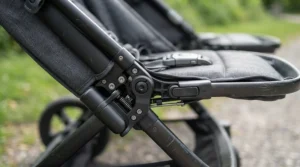
The recline system locks into an “infinite number of positions,” and it genuinely gets low — a one-hand recline system locks into positions all the way down to a near-flat napping position. Independent testing measured the maximum recline angle at 149 degrees, which is generous for a side-by-side in this price bracket but stops short of a genuine 180-degree lie-flat.
That distinction matters for the newborn stage specifically, because the Joovy ScooterX2 is rated for babies 3 months and up out of the box — there’s no built-in bassinet mode, and it doesn’t include car seat adapters, so brand-new newborns need a separate accessory purchase to ride safely from week one. Once your twins clear that 3-month mark, though, the seats recline independently and each gets its own adjustable footrest and 5-point harness.
Pros:
- ✅ Storage basket and canopy outsize nearly every rival in class
- ✅ One-hand recline glides down to a near-flat napping position
- ✅ Narrow 30-inch frame slides through standard doorways
Cons:
- ❌ Recline tops out at 149°, not a genuine flat lie
- ❌ Minimum age of 3 months means newborns need a separate car seat adapter
At $280-$350, the Joovy ScooterX2 makes the most sense for twins who are past the newborn stage or for parents pairing it with infant car seats for the earliest months, then transitioning to the built-in seats once babies can support their own necks better.
3. Contours Curve V2 — tightest turning radius for city sidewalks
The Contours Curve V2 solves a problem most twin strollers don’t even acknowledge: turning a double-wide frame through a narrow store aisle without three-point-turning it like a moving truck. Its six-wheel design and curb-assist feature genuinely change how the stroller behaves on cracked sidewalks and elevator thresholds — the six-wheel design provides superior maneuverability for narrow store aisles and a tight turn radius to navigate busy streets and compact elevators.
On the recline question, Contours does something refreshingly even-handed: each seat can hold a child up to 40 lbs and recline to almost flat, with both seats included at no extra cost. Neither twin gets stuck with the lesser seat, which resolves the sibling-rivalry problem that plagues cheaper tandem models. “Almost flat” is doing real work in that sentence, though — this is a three-position recline, not a full 180-degree lie, so newborns benefit most when paired with the optional bassinet or car seat adapters rather than relying on the seat alone in the first weeks.
Pros:
- ✅ Both seats recline almost flat, so neither twin gets the “worse” seat
- ✅ Six-wheel design turns like a single stroller in tight aisles
- ✅ Curb-assist feature smooths the push up sidewalk edges
Cons:
- ❌ Car seat adapters and the bassinet accessory are sold separately
- ❌ Recline is “almost flat,” not a genuine 180° lay-flat position
Kolcraft, the parent brand, has built a reputation for above-standard testing on the Contours line, and the removable, reversible seats mean you can face your twins toward each other or toward the world as they grow. At $550-$700, it’s the mid-range pick for parents who prioritize street-level handling over ultimate recline depth.
4. Valco Baby Trend Duo — lightest lay-flat design at 26 pounds
Weight is the silent tax on every stroller purchase — you don’t feel it in the store, you feel it hauling a folded frame up three flights with a diaper bag on each shoulder. At 26 lbs, the Valco Baby Trend Duo is genuinely one of the lightest twin strollers that still delivers a true lay-flat recline, thanks to what Valco calls its infinity belt system.
Reviewers describe the mechanism plainly: an infinity belt recline adjusts your children from upright to a lay flat position, making it suitable to use from birth. That’s a meaningfully stronger claim than “almost flat” — this is a genuine newborn-capable recline built into the seat itself, no bassinet purchase required to get there, though Valco does sell bassinets and car seat adapters for parents who want that added structure.
Comfort details back up the newborn-ready framing too: the seats include ventilation on each seat back when fully reclined, which matters for a baby who spends real time lying flat in warm weather. The stroller folds one-handed and fits through standard doorways at 29 inches wide, which is respectable for a side-by-side twin frame.
Pros:
- ✅ Infinity-belt recline genuinely lies flat for newborn use
- ✅ At 26 lbs it’s among the lightest true-recline twin strollers
- ✅ Ventilated seat backs help keep reclined babies cool
Cons:
- ❌ Bassinets and car seat adapters are sold separately, adding cost
- ❌ Aluminum frame commands a premium over bulkier steel-frame rivals
At $700-$850, the Valco Baby Trend Duo sits squarely in “worth the extra spend” territory if lay-flat recline without a bassinet purchase is your top priority and you’re tired of hauling anything heavier than absolutely necessary.
5. UPPAbaby Minu Duo — equal-size from-birth seats, no favorite twin
Twin parents talk about “seat equity” more than you’d expect, and the UPPAbaby Minu Duo was engineered around exactly that grievance. Both seats are identical, full-size, and rated from birth — two spacious seats with integrated foot barriers and two-position footrests comfortably accommodate children from day one up to 50 lbs — so there’s no “good seat” to fight over as your twins grow old enough to notice.
The recline itself is described as deep and one-handed: one-handed, deep recline for a comfortable rest during long strolls, paired with mesh peekaboo windows so you can check on a reclined baby without unzipping anything. Independent listings put the true stroller weight at 27.4 lbs — light for a side-by-side that still fits through a standard doorway.
Materially, UPPAbaby leans premium: full-grain leather handlebar, aluminum frame, and Greenguard Gold certification, which speaks to lower chemical emissions in the materials — a detail that matters to parents doing air-quality research for a nursery-adjacent purchase. Where it falls short of true modularity is car seat compatibility: it accepts one UPPAbaby infant car seat via adapters on the parent’s left side, not two simultaneously, so twins in the newborn stage will likely ride in the built-in seats rather than dual car seats.
Pros:
- ✅ Two identical seats end the “who gets the good side” debate
- ✅ Greenguard Gold certification signals lower chemical emissions
- ✅ Slim enough for a standard 29-inch doorway
Cons:
- ❌ Only one car seat adapter slot, so both newborns typically use the seats
- ❌ Leather handlebar and premium materials add to long-term upkeep
Pricing varies meaningfully by retailer and color, landing roughly in the $750-$950 range at the time of research — check current listings, since UPPAbaby runs frequent seasonal promotions.

6. Valco Baby Ultra Duo S2 — modular cocoon seats built for day-one newborns
Most twin strollers treat “newborn mode” as an afterthought bolted on with a bassinet accessory. The Valco Baby Ultra Duo S2 builds it into the architecture from the start. According to product research, for twins, the Ultra Duo S2 is designed to support newborns from day one without the need for additional inserts or attachments, with each seat featuring a near-flat recline and a built-in cocoon offering a secure, supported position.
That built-in cocoon is the standout here — instead of buying a separate bassinet to get true newborn support, the seat itself does that job. And because both stroller seats are removable and independently reversible, each child can ride parent-facing or world-facing, you get modular flexibility rare in a side-by-side chassis. Parents can even swap either seat for a compatible infant car seat or bassinet down the line, effectively future-proofing the frame against a second set of siblings.
Practically, multi-terrain wheels provide a smooth push across sidewalks, neighborhood streets, and everyday surfaces, while the compact one-hand fold simplifies car-to-curb transitions — a detail that matters more than it sounds when you’re managing two carriers, a diaper bag, and a coffee you’re not allowed to have gotten cold.
Pros:
- ✅ Built-in cocoon supports newborns without extra bassinet inserts
- ✅ Seats are independently reversible for parent- or world-facing rides
- ✅ Multi-terrain wheels smooth out sidewalk cracks and gravel
Cons:
- ❌ Premium price sits well above most side-by-side competitors
- ❌ More modular parts mean more pieces to track and maintain
Valco doesn’t publish a single fixed U.S. price, and retailer listings shift with promotions, but shoppers should expect a range in the neighborhood of $950-$1,150 at full retail — worth checking current listings before you commit, since modular Valco systems occasionally run bundle discounts with the matching bassinet.
7. Bugaboo Donkey 5 Twin — premium expandable frame that grows with your family
If the Valco Baby Ultra Duo S2 is modular, the Bugaboo Donkey 5 Twin is modular’s overachieving older sibling. This is the stroller that starts as a single-child frame and expands to a full twin rig in three clicks, and it’s the one repeatedly named a top twin pick by stroller reviewers for exactly that flexibility.
The recline claim here is unambiguous, not hedged with “near” or “almost”: one-handed recline to three positions, including a flat position for sleeping or newborns. Combined with an included bassinet for each child in twin configuration, this is the stroller in our lineup most explicitly engineered around the newborn stage from the factory floor, not as an add-on afterthought.
Build quality shows in the details — the seats are reversible, letting your twins face the world or face each other, which pediatric development advocates note can support early social bonding between siblings on long walks. The twin-mode frame weighs 32.8 lbs and measures 29 inches wide, respectable for a stroller carrying this much structural hardware.
Pros:
- ✅ Genuine flat recline position built for newborns, not a workaround
- ✅ Expandable single-to-twin architecture grows with your family
- ✅ Reversible seats let twins face each other or the world
Cons:
- ❌ Premium price sits far above every other stroller in this roundup
- ❌ At nearly 33 lbs in twin mode, it’s not the lightest to lift into a trunk
Twin-specific bundles including two bassinets have listed in the $2,200-$2,700 range historically — this is an investment-tier purchase, and it only makes sense if the expandability and premium build genuinely matter to your family’s plans, not just the badge on the frame.
Top 7 Products at a Glance: Specs, Price & Ratings
| Stroller | Weight | Suitable From | Price Range | Reviewer Consensus |
|---|---|---|---|---|
| Graco DuoGlider | 29.5 lbs | Birth (w/ car seats) | $200-$300 | Solid budget value, uneven recline |
| Joovy ScooterX2 | ~32-39 lbs | 3 months+ | $280-$350 | Storage champion, not newborn-ready alone |
| Contours Curve V2 | ~30-37 lbs | Birth (w/ adapters) | $550-$700 | Best-in-class maneuverability |
| Valco Baby Trend Duo | 26 lbs | Birth | $700-$850 | Lightest true lay-flat option |
| UPPAbaby Minu Duo | 27.4 lbs | Birth | $750-$950 | Most balanced dual-seat design |
| Valco Baby Ultra Duo S2 | Modular | Birth | $950-$1,150 | Most flexible newborn setup |
| Bugaboo Donkey 5 Twin | 32.8 lbs | Birth | $2,200-$2,700 | Premium benchmark, priciest by far |
This table makes the pattern obvious once you see it laid out: price climbs roughly in step with how confidently a brand can say “flat” without an asterisk. The Graco DuoGlider and Joovy ScooterX2 ask you to accept partial compromises for a fraction of the cost, while the Valco Baby Trend Duo, UPPAbaby Minu Duo, Valco Baby Ultra Duo S2, and Bugaboo Donkey 5 Twin all deliver on genuine from-birth positioning — the question becomes how much modularity, weight savings, or brand polish you’re willing to pay extra for on top of that baseline.

How to Choose an Infant Twin Stroller With Full Recline Seats
- Confirm the recline angle, not just the word “recline.” Ask retailers or check spec sheets for the actual degree — anything short of roughly 170-180° is a partial recline, useful for daytime rest but not equivalent to a flat sleep surface.
- Check whether both seats recline equally. Models like the Graco DuoGlider recline one seat fully and the other partially — fine for staggered napping, frustrating if your twins nap on the same schedule (most do, mercifully).
- Weigh car seat compatibility against built-in seat quality. If you plan to use infant car seats for the first several months, prioritize adapter compatibility over recline depth in the built-in seats themselves.
- Test the fold with two seats attached, not one. A one-hand fold rating often assumes an empty or single-seat frame — twin folds with both seats installed can behave differently.
- Factor in your actual doorways and elevators. A 29-inch-wide frame like the Bugaboo Donkey 5 Twin or UPPAbaby Minu Duo clears most standard doors; anything wider may mean detours through side entrances daily.
- Add up the true cost, not just the sticker price. Bassinets, car seat adapters, and rain covers are frequently sold separately, and they can add $150-$400 to a stroller’s real cost.
- Match the weight to your daily reality. A stroller you carry up stairs regularly benefits enormously from shaving even 5 lbs off the frame — the difference between the 26-lb Valco Baby Trend Duo and a 33-lb premium frame is felt in your shoulders, not just your budget.
Seat Recline Mechanism Explained: What “Full Recline” Actually Means
Marketing copy treats “recline” as a single word covering wildly different engineering. In practice, twin stroller seat recline mechanisms fall into roughly three tiers, and understanding which tier you’re buying into prevents an expensive surprise.
The first tier is a multi-position ratchet recline, typically three to five fixed angles adjusted by a lever or strap on the back of the seat. The Contours Curve V2 and Graco DuoGlider‘s rear seat both use variations of this — functional, but the flattest setting still isn’t necessarily a true horizontal line.
The second tier is a continuous or “infinity” recline, where the seat back slides along a track rather than clicking into fixed notches. This is the mechanism Valco brands as its “infinity belt” system on the Valco Baby Trend Duo, and it’s what allows a genuinely stepless transition from upright to flat, without a gap between “almost there” and “all the way.”
The third tier is a cocoon or bassinet-integrated seat, where the seat itself is contoured with raised sides and a supportive base built specifically for a newborn’s proportions, as seen in the Valco Baby Ultra Duo S2 and the Bugaboo Donkey 5 Twin‘s bassinet mode. This tier does the most work to support a newborn’s spine without additional inserts, because the seat wasn’t just reclined — it was shaped for the job.
Reclining seats also interact with harness position: a seat that reclines flat but keeps the harness anchor points fixed can leave straps sitting awkwardly across a lying-down infant, so check that the harness height adjusts along with the recline, not independently of it.
Newborn-Safe Twin Stroller Seating vs. Standard Recline
“Newborn-safe” isn’t a regulated label the way “flame retardant” or “meets ASTM F833” are, so it’s worth separating marketing language from engineering fact. A standard recline seat, even reclined to its lowest setting, is still built around a seated pelvis position with a bend at the hip — useful for older infants and toddlers, but not identical to a true lie-flat surface designed around a newborn’s still-forming spine.
Newborn-safe seating, by contrast, either reclines to a genuine flat plane (as with the Valco Baby Trend Duo‘s infinity belt or the Bugaboo Donkey 5 Twin‘s three-position recline) or replaces the seated shape entirely with a cocoon or bassinet insert shaped for lying down, as the Valco Baby Ultra Duo S2 does. The practical difference shows up in how a newborn’s head and shoulders are supported — a standard recline can let a small baby’s chin drop toward the chest even when reclined, which is exactly the kind of positioning pediatric guidance flags as a concern for airway management in young infants.
The takeaway for shoppers: if your twins will spend real stretches of time in the stroller during the first eight to twelve weeks, prioritize genuine flat recline or a cocoon seat over a partial recline, even if it costs more. If your twins are already sitting independently by the time you’re shopping, a standard multi-position recline like the Contours Curve V2‘s is perfectly serviceable.
AAP Newborn Positioning Guidance for Stroller Naps
This is the section that deserves the least marketing spin and the most straight talk. The American Academy of Pediatrics has been explicit that the AAP recommends a safe sleep environment including supine positioning and use of a firm, noninclined sleep surface for reducing sleep-related infant deaths, and separate reporting on that same 2022 policy update notes that sitting devices such as car seats, strollers, swings, infant carriers, and infant slings are not recommended for routine sleep in the hospital or at home, particularly for infants younger than 4 months.
That guidance applies regardless of how impressively flat a given seat reclines. Even the most genuinely lie-flat stroller seat on this list — the Bugaboo Donkey 5 Twin‘s flat recline mode or the Valco Baby Ultra Duo S2‘s built-in cocoon — is engineered for supervised rest and comfortable positioning during awake strolls, not as a substitute for a crib, bassinet, or play yard that meets federal sleep-surface standards. In practice, this means a full-recline twin stroller is genuinely useful for keeping a fussy newborn calm and comfortably positioned on errands and walks, but if a baby falls asleep in it, pediatric guidance suggests moving them to an approved flat sleep surface as soon as reasonably possible rather than treating the stroller as a routine nap location.
None of this diminishes why full recline still matters — a properly reclined seat supports a newborn’s neck and reduces slumping far better than an upright seated position does, which matters for comfort, digestion, and simple crying-baby peace of mind. It’s a comfort-and-positioning feature, not a sleep-safety substitute, and reputable brands generally don’t claim otherwise in their fine print even when their ad copy leans enthusiastic.
Twin Stroller Canopy Coverage: UPF, Ventilation, and Weather Protection
Canopy coverage is the feature nobody thinks about until the first 85-degree afternoon walk turns into a negotiation with a sunburned, overheated baby. Every stroller in this roundup includes some form of UPF-rated canopy, but coverage area and ventilation design vary more than spec sheets suggest.
The Joovy ScooterX2‘s canopy is genuinely oversized relative to its price point, though it’s a single shared shade rather than independently adjustable per seat — fine if your twins keep the same schedule, less ideal if one wants shade and the other wants sun. The Valco Baby Trend Duo and Valco Baby Ultra Duo S2 both add ventilation panels behind the seat back specifically for reclined use, which matters more than it sounds: a fully reclined baby’s head sits closer to the canopy fabric, and airflow there prevents the stuffy, overheated feeling that can make a napping newborn fussier, not calmer.
The Bugaboo Donkey 5 Twin and UPPAbaby Minu Duo both add mesh peekaboo windows to their canopies, letting you check a reclined baby’s face without fully unzipping the shade — a small design choice that saves you from waking a sleeping baby fifteen times per walk just to confirm they’re still breathing comfortably (every twin parent knows this anxiety intimately). When comparing canopies, look specifically for extendable coverage that reaches past the footrest, magnetic or zippered peekaboo panels, and — if you live somewhere with real seasons — a canopy that can layer a weather shield or rain cover on top without needing to buy an entirely new hood.
Setting Up Your Flat-Recline Twin Stroller: A Practical First-30-Days Guide
Getting a new twin stroller out of the box and into daily rotation involves more trial and error than the manual suggests, so here’s what the first month typically looks like in practice.
Unboxing and first fold-out: Most side-by-side frames need a firm push-and-click on both sides simultaneously to lock into the open position — a common first-week mistake is only engaging one side, which leaves the frame wobbly and can trip the safety lock warning. Practice the fold and unfold three or four times before your first real outing, ideally without babies in the seats, so your hands know the motion under pressure later.
Setting the recline for two different babies: Twins are not always the same size, especially with a weight difference at birth. Adjust each seat’s recline and harness height independently rather than assuming a mirrored setting works for both — a smaller twin may need the harness a notch tighter and the footrest a step higher to avoid sliding down inside a fully reclined seat.
The first walk test: Take a short, low-stakes walk around the block before a longer outing. Check that reclined seats don’t bounce excessively over pavement seams, that canopies stay latched at speed, and that the parking brake actually engages fully — a surprising number of early-stroller mishaps come from a half-engaged brake on a slight incline.
Common first-month mistakes to avoid: Overloading the storage basket beyond its rated weight limit can affect stability, especially on strollers with a narrower wheelbase; leaving the recline in a single position rather than adjusting it through the day misses the point of a multi-position seat; and skipping the manufacturer’s car seat adapter compatibility list before buying a specific infant car seat brand is a frequent, expensive mistake.
Real-World Scenarios: Matching Families to the Right Twin Stroller
The budget-conscious first-time twin parent, tight urban apartment, daily 20-minute walks: The Graco DuoGlider or Contours Curve V2 cover the essentials without a four-figure commitment, and the Curve’s tight turning radius suits narrow apartment hallways and elevators particularly well.
The parent planning frequent air travel or long-term use through toddlerhood: The Valco Baby Trend Duo‘s 26-lb frame is genuinely easier to hoist into overhead bins and rental car trunks than most alternatives, while its true flat recline covers the newborn stage without a separate bassinet purchase.
The family that wants one system to grow from newborn twins through a future third child: The Bugaboo Donkey 5 Twin‘s expandable single-to-double architecture and the Valco Baby Ultra Duo S2‘s modular reversible seats both future-proof against a growing family in a way fixed-configuration strollers simply can’t. It’s worth noting the frame itself can expand from a single-child Mono configuration to a full twin setup, which matters more than it might seem for families who aren’t certain their stroller needs stop at two.
The parent prioritizing fairness between two babies who notice everything: The UPPAbaby Minu Duo‘s identical, equal-sized seats sidestep sibling rivalry over “the good seat” years before it would otherwise start, a detail that becomes more valuable as multiple births continue trending upward and twin-specific gear becomes a larger share of the baby product market.
Twin Stroller for Sleeping Infants: Managing Naps On the Go
Every twin parent eventually faces the same math problem: two babies, one nap schedule that never quite aligns, and a stroller that has to accommodate whichever configuration reality hands you that day. A few practical fixes handle the most common friction points.
Problem: one twin naps while the other stays alert. Independent recline control, present on the Valco Baby Trend Duo, Contours Curve V2, and UPPAbaby Minu Duo, lets you lay one seat flat while keeping the other upright for people-watching — a feature worth prioritizing if your twins rarely sync schedules.
Problem: a reclined baby overheats mid-nap. Canopies with rear ventilation panels, found on the Valco models in this lineup, address this directly by letting airflow reach the reclined seat back rather than trapping heat against fabric.
Problem: transferring a sleeping baby without waking them. This is less about the stroller and more about approach — a fully reclined seat minimizes the angle change needed when lifting a baby out, compared to an upright seat where the transition from seated to horizontal (for a crib transfer) jostles them awake more easily.
Problem: managing naps during errands that require stopping and starting frequently. A stroller with a reliable, easy-to-engage parking brake, like the curb-assist system on the Contours Curve V2, reduces the jarring stop-start motion that can rouse a light sleeper mid-errand.
Problem: needing to check on a sleeping baby without unzipping the whole canopy. Mesh peekaboo windows, standard on the Bugaboo Donkey 5 Twin and UPPAbaby Minu Duo, solve this specific annoyance elegantly.
Common Mistakes When Buying a Twin Stroller With Full Recline Seats
Even attentive shoppers trip over a handful of recurring mistakes. The most expensive one is assuming “recline” automatically means “flat” — as covered extensively above, plenty of strollers recline to 45 or 60 degrees and market that as generous, when it’s genuinely a partial position. Read the actual degree measurement, not the adjective.
A second common mistake is buying based on single-child stroller reviews and assuming the twin version behaves identically — twin and double configurations often have different weight distributions, fold mechanisms, and stability profiles than the single-seat version of the same product line, so seek out twin-specific reviews when possible.
A third mistake is underestimating storage basket capacity needs. Twin outings mean double the diapers, double the bottles, and often a toddler sibling’s gear too — a basket rated for 15 lbs fills up embarrassingly fast, while the Joovy ScooterX2‘s notably larger basket avoids this pain point specifically.
Finally, many parents skip verifying doorway and elevator width against the stroller’s open dimensions before buying, only to discover their building’s elevator is two inches too narrow for a fully assembled frame — measure first, especially with wider side-by-side models.
Long-Term Cost & Maintenance for Twin Strollers
The sticker price is rarely the full financial picture. Bassinets, car seat adapters, rain covers, and replacement wheel sets are frequently sold separately across every brand in this roundup, and they add up — a Valco Baby Ultra Duo S2 or Bugaboo Donkey 5 Twin bundled with matching bassinets can add several hundred dollars to the base frame price, while budget options like the Graco DuoGlider keep accessory costs lower but may need full replacement sooner as wear shows.
Maintenance costs also diverge by build quality. Aluminum-framed strollers like the Valco Baby Trend Duo and UPPAbaby Minu Duo tend to resist rust better over years of outdoor use than steel-framed budget models, which can develop wheel and hinge corrosion in wetter climates. Fabric seats that are machine washable, a feature on the Contours Curve V2 and Bugaboo Donkey 5 Twin, save real money over the stroller’s lifespan compared to spot-clean-only fabrics that show stains permanently.
Resale value is worth factoring in too — premium strollers from established brands like Bugaboo and UPPAbaby tend to hold a meaningfully higher percentage of their original price on the secondhand market than budget frames, which partially offsets the higher upfront cost for families who plan to sell once their twins outgrow stroller use. Organizations like Consumer Reports track long-term reliability data across brands, which is worth cross-referencing before a four-figure purchase.
Features That Actually Matter (And Those That Don’t)
Sorting genuine value from marketing filler saves real money. Genuinely matters: true flat or near-flat recline for the newborn stage, independent recline control per seat, a parking brake that engages reliably on inclines, and a fold that actually works one-handed with both seats attached, not just in the showroom demo.
Matters less than it sounds: cup holder count (nice, rarely decisive), interchangeable fashion fabric kits (charming, expensive, unnecessary), and “all-terrain” branding on a stroller that will spend 95% of its life on sidewalks and grocery store floors. Genuinely doesn’t matter for most families: oversized parent consoles with device chargers, which add weight and cost for a feature most parents use rarely once the novelty wears off.
The federal government does regulate baseline stroller safety regardless of brand hype — every stroller sold in the US must meet the CPSC’s mandatory carriage and stroller standard, which covers stability, brakes, restraint systems, and folding-mechanism entrapment hazards. That baseline is worth knowing so you can focus your comparison shopping on genuine differentiators — recline depth, weight, and canopy design — rather than safety features every compliant product is already required to have.

Frequently Asked Questions
❓ Do both seats really recline flat in a twin stroller?
❓ Is it safe for my twins to sleep in a full-recline stroller?
❓ What's the difference between a twin stroller and two single strollers for newborns?
❓ How much does an infant twin stroller with full recline seats cost?
❓ Can I use infant car seats instead of the built-in seats for newborn twins?
Conclusion
Shopping for an infant twin stroller with full recline seats really comes down to one honest question: how literally does this brand mean “flat”? The Graco DuoGlider and Joovy ScooterX2 prove that budget strollers can still be genuinely useful, as long as you accept their recline limitations going in rather than discovering them on a fussy 2am walk. The Contours Curve V2 splits the difference nicely for city-dwelling families who value maneuverability as much as recline depth.
For parents who want a true, no-asterisk flat recline without a second mortgage, the Valco Baby Trend Duo and UPPAbaby Minu Duo deliver that at a genuinely mid-range price, while the Valco Baby Ultra Duo S2 adds built-in newborn support that some families will find worth the premium. And if budget is no object and you want a stroller that will still be relevant when your twins are toddlers — or when a third sibling arrives — the Bugaboo Donkey 5 Twin‘s expandable, genuinely flat-reclining architecture earns its considerable price tag.
Whichever you choose, remember that a stroller’s flat recline is a comfort feature for awake, supervised outings — not a substitute for a certified sleep surface at home. Keep that distinction in mind, check current prices before you commit, and you’ll end up with a stroller that actually serves your family instead of just looking good in the product photos.
Recommended for You
- Infant Twin Stroller For NICU Graduate Twins: 7 Best Picks (2026)
- Infant Twin Stroller Under $400: 7 Smart Picks For 2026
- Infant Twin Stroller With Car Seat Adapters: 7 Real Picks (2026)
Disclaimer: This article contains affiliate links. As an Amazon Associate, I earn from qualifying purchases. If you purchase products through these links, we may earn a small commission at no additional cost to you.
✨ Found this helpful? Share it with another twin parent who needs it! 💬🤗
