
In This Article
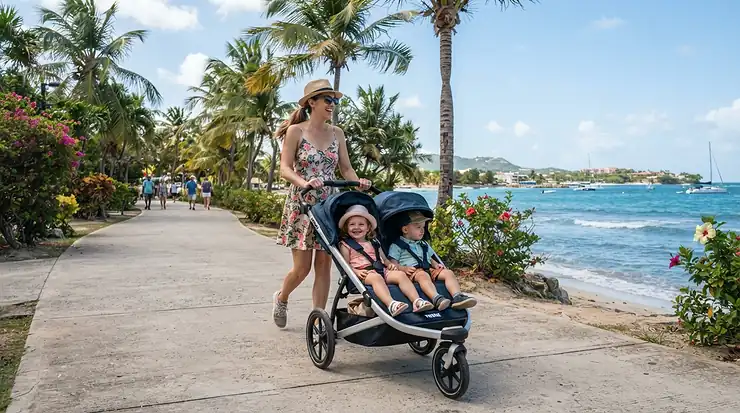
A compact twin stroller for cruise vacations is a narrow-fold, lightweight double stroller built to survive 24-inch cabin doors, tight ship elevators, and gangway crowds — while still hauling two toddlers through a dozen ports without falling apart. If you’ve ever tried to wedge a full-size side-by-side through a stateroom hallway while a line of impatient passengers forms behind you, you already know why this matters.

Cruising with twins (or two kids close in age) sounds dreamy right up until you start packing. Somewhere between “which swimsuits fit” and “will the kids nap on the ship,” a terrifying realization hits: your stroller at home is built for sidewalks, not submarines-with-buffets. Standard staterooms run in the 22 to 27-inch doorway range, elevators fill up fast during embarkation, and your cabin steward is not going to thank you for parking a 34-inch-wide rig in the hallway. That’s the whole game with a compact fold twin stroller — shrinking your footprint without shrinking your kids’ comfort.
This guide breaks down seven real, currently available double strollers that actually earn the “cruise-friendly” label, plus the comparison data, buying logic, and on-ship survival tactics that Amazon’s product page will never tell you. We looked at real folded dimensions, real weight limits, and genuine aggregated review sentiment — not marketing copy — so you can pick a stroller that fits through your cabin door on the first try, not the fourth. According to the Consumer Product Safety Commission, all strollers sold in the U.S. must meet federal performance requirements for carriages and strollers, which is a useful baseline before you even start comparing fold widths.
Quick Comparison Table
| Stroller | Folded Width | Weight | Price Range | Best For |
|---|---|---|---|---|
| Dream On Me Volgo Twin | ~29.5″ | 22 lbs | Under $200 | Tightest budgets |
| Summer Infant 3Dlite Double | 29.5″ | 21.8 lbs | $150–$250 | Everyday value |
| Jeep Destination Ultralight Side x Side | Under 30″ | 18.3 lbs | $200–$300 | Lightest overall |
| Kolcraft Cloud Plus Double | 31″ doorway fit | 23 lbs | $200–$300 | Standing fold |
| Baby Jogger City Tour 2 Double | Doorway-width fold | ~28 lbs | $400–$550 | Auto-lock convenience |
| UPPAbaby Minu Duo | Flattest of the group | ~25 lbs | $700–$900 | Premium recline |
| Valco Baby Slim Twin S2 | 26″ | ~28 lbs | $600–$750 | Narrowest side-by-side |
Look at that spread for a second: folded width barely nudges between the cheapest and priciest options here, which tells you something important — a bigger budget buys you smoother recline mechanisms and nicer fabric, not necessarily a dramatically narrower fold. The Jeep Destination Ultralight Side x Side undercuts everything else on weight, while the Valco Baby Slim Twin S2 wins on raw width if your cabin doorway is the tightest bottleneck in your plan. If your ship’s elevators are your bigger worry than the cabin door itself, prioritize the tandem-style folds — the Baby Jogger City Tour 2 Double and Kolcraft Cloud Plus Double — since their narrower overall profile matters more once you’re squeezed between six other strollers.
💬 Compare these seven side by side before you buy — one wrong measurement and you’re wrestling a stroller through a doorway on embarkation day.
Top 7 Compact Twin Strollers for Cruise Vacations: Expert Analysis
1. Dream On Me Volgo Twin — flattest one-step fold for the money
The standout here is the price-to-portability ratio: this is one of the few sub-$200 double strollers that folds genuinely flat with a single motion, which matters enormously when you’re maneuvering in a stateroom the size of a walk-in closet. At 22 pounds with a lightweight iron frame and a slim 29.5-inch width, it’s engineered for exactly the scenario cruisers face — narrow doorways, small storage nooks, and the need to collapse the thing one-handed while holding a toddler’s other hand. The recline goes deep enough for naps during sea days, and the mesh canopy keeps sun off little faces during pool-deck stretches.
Based on the spec comparison, this stroller trades some structural robustness for its low weight and price — it’s iron-framed rather than aluminum, so it won’t feel as premium as strollers costing three times as much. Budget-conscious families cruising for the first time, or parents who want a “beater” stroller they won’t stress over getting salt-air-damaged on a beach excursion, are the ideal audience. Reviewers consistently note that the fold mechanism works smoothly out of the box, though a few mention the cup holders and canopy hardware feel less durable after repeated folding over a multi-week trip.
Pros:
- ✅ One-step flat fold fits tight cabin corners easily
- ✅ Genuinely budget-friendly for a true double stroller
- ✅ Lightweight iron frame at just 22 pounds
Cons:
- ❌ Accessory hardware feels flimsy after heavy daily folding
- ❌ Less structural durability than aluminum-frame competitors
At around $150–$200, this is hard to beat as a low-risk pick for a single cruise or a family still deciding whether twins-and-travel is a regular thing. The value verdict: if you want the cheapest genuinely cruise-viable option, start here.
2. Summer Infant 3Dlite Double — narrow doorway clearance with a one-hand fold
What jumps out immediately is the 29.5-inch width paired with a proper one-hand folding mechanism — a small design detail that makes an enormous difference when you’re holding a diaper bag, a room key card, and a squirming toddler simultaneously. At 21.8 pounds, it splits the difference between “flimsy budget stroller” and “heavy premium tank,” landing in a genuinely practical middle ground for families who’ll be folding and unfolding this thing multiple times a day across a week-long itinerary.
Here’s what the spec sheet won’t tell you: the compact fold on this model collapses small enough to tuck beside a cabin closet or under a bed frame in most standard staterooms, which solves the single biggest headache of cruise stroller ownership — where does it live when you’re not using it? Reviewers frequently mention that the one-hand mechanism holds up well over repeated daily use, a detail that matters far more on a cruise than on a weekend trip to the park. Families juggling two toddlers under four will find the seats supportive enough for both nap time and active exploring.
Pros:
- ✅ True one-hand fold, useful with hands full
- ✅ Narrow 29.5-inch profile clears most doorways
- ✅ Lightweight at under 22 pounds for a double
Cons:
- ❌ Canopy coverage is narrower than pricier alternatives
- ❌ Basket storage is modest for longer excursion days
Priced in the $150–$250 range depending on retailer promotions, this is arguably the best all-around value pick on this list — not the cheapest, not the flashiest, but reliably competent at the one job that matters most on a ship.
3. Jeep Destination Ultralight Side x Side Double Stroller — lightest frame in this entire lineup
The headline feature is right there in the name: at 18.3 pounds, this is a genuinely ultralight double stroller, a category that barely existed a few years ago for side-by-side models. What most buyers overlook about ultralight strollers is that the weight savings usually come from thinner tubing and simpler recline hardware — and Jeep managed to keep both the five-point harness and ASTM/CPSC/JPMA safety compliance intact while shedding pounds elsewhere. That’s not a small engineering trick.
Practically speaking, an 18-pound stroller is the difference between one parent single-handedly folding it while carrying a sleeping toddler up a gangway, versus needing two people. The 360-degree swivel wheels add real maneuverability advantages in crowded ship corridors and buffet lines, where sharp turns happen constantly. Reviewers consistently praise the weight and the swivel wheels, though a handful mention the recline angle is more limited than heavier competitors — a reasonable trade for the portability gain.
Pros:
- ✅ Lightest double stroller in this comparison at 18.3 lbs
- ✅ Meets ASTM, CPSC, and JPMA safety standards
- ✅ 360-degree swivel wheels ease tight-corner turns
Cons:
- ❌ Recline range is more limited than heavier premium models
- ❌ Sun canopy is smaller than some competitors offer
At a typical $200–$300 range, this earns its spot for parents who prioritize raw portability above all else — particularly anyone flying to their embarkation port and then cruising, where every pound in the carry-on chain compounds.
4. Kolcraft Cloud Plus Double — standing fold that fits through 31-inch doorways
The stand-out trait here is the standing fold: once collapsed, it stays upright on its own, meaning you’re not hunting for wall space to lean it against in a cramped stateroom. At 23 pounds and designed to clear roughly 31-inch doorways, it sits in a comfortable middle zone — narrower than most full-size doubles, though not quite as slim as the tightest tandem folds on this list.
Based on the spec comparison, the side-by-side seating (each holding up to 40 pounds, with independent five-point harnesses and recline) gives siblings equal sightlines and prevents the “who’s stuck in the back seat” arguments that tandem strollers sometimes create. The three-tier canopy and peek-a-boo window are small touches that matter enormously on pool-deck strolls where sun exposure adds up fast across a week. What most buyers overlook is how much a standing fold saves in daily friction — you’re not bending down to prop it against furniture every single time you park it.
Pros:
- ✅ Standing fold saves space and hassle in tight cabins
- ✅ Independent recline and harness for each child
- ✅ Generous three-tier canopy with peek-a-boo window
Cons:
- ❌ Side-by-side width is wider than tandem-fold competitors
- ❌ Folded footprint still noticeable in very small staterooms
In the $200–$300 range, this is the pick for families who want side-by-side seating (so kids can see and interact with each other) without fully sacrificing compactness for it.
5. Baby Jogger City Tour 2 Double — auto-locking fold built for tight spaces
This model’s calling card is its auto-locking, ultra-compact fold combined with a frame narrow enough to fit through a standard doorway — a genuinely rare combination for a true double stroller, since most doorway-width models achieve that by using a tandem (front-back) layout rather than side-by-side. The auto-lock detail is more meaningful than it sounds: it means the fold secures itself without a separate latch step, which is one less thing to fumble with while balancing a toddler on your hip in a moving elevator.
What the spec sheet won’t fully convey is how this translates to the reality of ship life — narrow ship corridors, elevator jams during dinner seatings, and buffet-line congestion all favor a stroller that’s genuinely narrow rather than merely “compact when folded.” Reviewers frequently highlight the intuitive one-hand collapse and note that the frame threads through crowded spaces more easily than bulkier double strollers they’ve previously owned. The trade-off is a higher price point than the budget tier on this list, reflecting the more sophisticated fold hardware.
Pros:
- ✅ Auto-locking fold narrow enough for standard doorways
- ✅ Excels in crowded aisles, elevators, and hallways
- ✅ Reinforced frame built specifically for frequent daily folding
Cons:
- ❌ Noticeably pricier than the budget and mid-tier options
- ❌ Heavier in folded form than the ultralight competitors
Typically priced in the $400–$550 range, this is the pick for cruisers who fold and unfold constantly throughout the day — port mornings, ship-deck afternoons, dinner-seating evenings — and want hardware that won’t fatigue under that repetition.
6. UPPAbaby Minu Duo — the flattest, most premium recline in this lineup
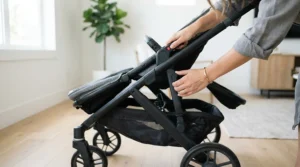
The defining feature is sheer compactness at the premium end: this is widely regarded as the flattest, narrowest fold among higher-end double strollers, engineered originally with air travel and gate-checking in mind — a design goal that overlaps almost perfectly with cruise cabin storage. Full recline on both seats, a standing fold, and UPF 50+ canopies round out a spec sheet clearly built for families who travel often and want the best available comfort in the smallest possible package.
Here’s what most buyers overlook about premium travel strollers: the price difference isn’t really about durability at this tier — most well-reviewed doubles in this price range are built to last years — it’s about the refinement of the fold mechanism and the quality of materials your kids actually touch (padding, harness straps, canopy fabric). Reviewers consistently frame this as their top pick specifically for pure compactness, noting the fold is flatter and narrower than nearly every competitor, premium or budget. That matters enormously in a stateroom closet that’s maybe 18 inches deep.
Pros:
- ✅ Flattest, narrowest fold among premium double strollers
- ✅ Full independent recline for naps on either seat
- ✅ UPF 50+ canopies for pool-deck and port sun exposure
Cons:
- ❌ Premium price point well above budget and mid-tier picks
- ❌ Overkill for families cruising only once or twice
At roughly $700–$900, this is squarely a buy for frequent travelers — families who cruise annually, fly often, or simply value having the single most compact premium option available and don’t mind paying for it.
7. Valco Baby Slim Twin S2 — the narrowest side-by-side frame you’ll find
This stroller’s whole identity is built around one number: 26 inches wide, which is genuinely rare for a side-by-side double and puts it in direct competition with tandem strollers on width alone, while still letting both kids sit shoulder-to-shoulder. That’s a meaningful engineering feat, since side-by-side frames are usually the wider option by a wide margin (pun intended).
Based on the spec comparison, that slim frame is specifically marketed as useful for crowded sidewalks, apartment elevators, narrow store aisles, and smaller trunks — which is essentially a checklist of everything a cruise ship throws at you, minus the sidewalks. What most buyers overlook about ultra-narrow side-by-side models is the trade-off in per-seat width; your kids will sit slightly more snugly than they would in a wider frame, which matters for toddlers who like to spread out but is barely noticeable for younger infants and babies. Reviewers highlight the maneuverability through tight spaces as the single biggest selling point.
Pros:
- ✅ Only 26 inches wide — narrowest side-by-side available
- ✅ Kids sit shoulder-to-shoulder, unlike tandem layouts
- ✅ Purpose-built for elevators, aisles, and tight doorways
Cons:
- ❌ Per-seat width is tighter than standard side-by-side frames
- ❌ Premium pricing similar to other high-end travel doubles
Priced around $600–$750, this is the pick specifically for families who want side-by-side seating (for sibling interaction) but refuse to compromise on doorway width — a genuinely narrow niche this stroller fills almost alone.
Practical Usage Guide: Boarding Day to Balcony Storage
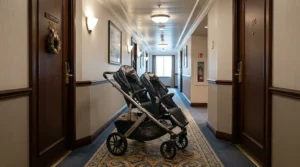
Embarkation day is chaos on the best of days, and a stroller adds a whole extra layer of logistics. Fold your twin stroller before you reach the terminal security checkpoint — most cruise lines process strollers through X-ray like any other carry-on, and a pre-folded stroller moves through faster than an assembled one someone has to manually collapse under pressure. Once onboard, resist the urge to leave it in the hallway “just for a minute” — fire safety regulations on every major line prohibit leaving strollers in corridors or stairwells, and cabin stewards will (politely) ask you to move it.
For the first 24 hours, do a dry run: fold and unfold the stroller inside your actual cabin before you need it in a hurry. This surfaces any awkward pinch points between your specific stroller and your specific stateroom layout — a lesson better learned calmly on day one than frantically on day three with a toddler mid-tantrum. Store it folded in the closet, against the wall behind the door, or under the bed if your cabin has clearance; balconies are usually off-limits for stroller storage due to weather and safety concerns. A common mistake in the first few days is over-relying on elevators during peak dinner-seating windows (roughly 6–8 PM); if your stroller folds flat enough, stairs during those windows are often genuinely faster.

Real-World Scenario: Matching Families to the Right Stroller
Picture the Ramirez family: two toddlers, first cruise, budget-conscious, sailing a mainstream line out of Florida for a week of Caribbean ports. Their priority is minimizing upfront cost while still getting through their inside stateroom’s tighter doorway without a fight. The Dream On Me Volgo Twin or Summer Infant 3Dlite Double fits this profile precisely — both stay under $250, fold flat in seconds, and don’t represent a devastating loss if a wheel gets scuffed on a cobblestone port street in Cozumel.
Now picture the Chen family: annual cruisers, twins turning three, a balcony cabin, and a habit of flying to the embarkation port first. Weight matters twice over here — once in the airport, once on the ship — which makes the Jeep Destination Ultralight or the UPPAbaby Minu Duo the stronger fits, depending on budget tier. Finally, consider the Osei family: a longer 10-night itinerary, an interior cabin with an unusually narrow door, and two kids who each want their own seat facing forward. The Valco Baby Slim Twin S2 solves the width-plus-side-by-side puzzle that a tandem stroller can’t, even though it costs more.
How to Choose a Compact Twin Stroller for Cruise Vacations
- Measure your actual cabin doorway before you shop. Standard staterooms across most major lines run 22 to 27 inches wide; don’t guess — ask your cruise line or travel agent for your specific ship and cabin category.
- Decide tandem versus side-by-side early. Tandem (front-back) frames are almost always narrower and better for elevators and hallways; side-by-side frames let kids interact but cost you inches.
- Weigh the stroller, not just fold it. You’ll be lifting this over ship thresholds and gangway lips dozens of times a week — an 18-pound frame feels dramatically different by day five than a 28-pound one.
- Check the folded footprint, not just the folded width. A stroller that folds narrow but stays tall or deep can still be awkward to wedge into a small closet.
- Confirm recline depth for nap time. Sea days often mean unpredictable nap schedules; a stroller that reclines flat doubles as a portable crib substitute.
- Factor in port terrain, not just ship terrain. Cobblestones, sand, and uneven excursion paths favor slightly larger wheels, even on a compact frame.
- Read aggregated review sentiment for fold durability. A stroller folded and unfolded a dozen times a day for a week faces more mechanical stress than one used on weekends — look for reviews mentioning repeated daily use specifically.
Elevator Width on Ships: Why Inches Matter More at Sea
Ship elevators are smaller and busier than almost any elevator you’ll encounter on land, and the math gets uncomfortable fast during embarkation, disembarkation, and dinner-seating rush hours. Standard building-code elevators on land typically run considerably wider than what you’ll find aboard a cruise ship, and unlike an office building, a ship elevator is competing with luggage carts, wheelchairs, and forty other families all trying to reach dinner at the same time. One traveler’s account of the elevator crunch on a newer ship put it plainly: the elevator cars are pretty small for a ship this size and that, compounded with luggage, strollers, etc., produced somewhat of an early traffic jam during peak boarding hours.
This is exactly why a genuinely narrow fold matters more on a ship than it would at home. A detailed breakdown of stateroom doorway widths by cruise line shows most standard cabins clustering in the low-to-mid 20-inch range — tight enough that a stroller measuring 29 or 30 inches unfolded may need to be collapsed even to enter your own room, let alone squeeze into an elevator alongside other passengers. Practically speaking, this pushes the case toward tandem-style folds like the Baby Jogger City Tour 2 Double, or genuinely slim side-by-side frames like the Valco Baby Slim Twin S2, over wider standard doubles that measure fine on paper but feel enormous in a crowded elevator bank at 6:45 PM.
Cabin Storage Space: Where Your Stroller Actually Lives for a Week
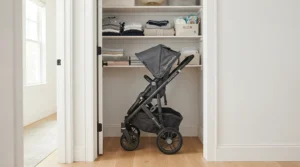
Here’s a detail nobody mentions until you’re standing in your stateroom wondering where, exactly, a folded stroller is supposed to go for seven straight nights. Most standard cabins simply don’t have a dedicated spot for gear this size — the closet is often shallow, under-bed clearance varies wildly by ship, and balconies are generally not approved storage due to weather and safety rules. One veteran cruiser summed up the workaround simply: fold it and lean it against a wall, since you will have to park it in your cabin — it can’t be on the balcony or in the hall.
This is where a standing fold, like the one on the Kolcraft Cloud Plus Double, earns its keep — it doesn’t need a wall to lean against, which matters in cabins where every wall is already claimed by luggage or a bathroom door swing. Flat-folding models like the UPPAbaby Minu Duo or Dream On Me Volgo Twin slide under a bed frame in cabins with enough clearance, effectively erasing the storage problem entirely. Before you book a stroller-dependent cruise, it’s worth emailing your cruise line or checking your specific ship’s deck plans for under-bed clearance — a five-minute question that saves a week of stepping over gear.
Compact Fold Twin Stroller vs Standard Side-by-Side Twin Stroller
| Factor | Compact Fold Twin Stroller | Standard Side-by-Side Twin Stroller |
|---|---|---|
| Typical folded width | 26–30 inches | 34–40+ inches |
| Cabin doorway fit | Usually clears standard staterooms | Often requires wedging or partial disassembly |
| Elevator maneuverability | Strong — narrower footprint | Weak — frequently blocks other passengers |
| Weight | 18–28 lbs typical | 28–40+ lbs typical |
| Sibling interaction (side-by-side seating) | Varies by model | Excellent — full side-by-side view |
| Best fit | Cruise cabins, elevators, tight aisles | Large homes, wide sidewalks, everyday strolling |
The analysis here is fairly clean-cut: a standard side-by-side twin stroller genuinely wins on everyday comfort and sibling interaction when you’re strolling through a wide suburban neighborhood, but it becomes a liability the moment you’re navigating a ship. A compact fold twin stroller — whether that’s a genuinely narrow side-by-side like the Valco Baby Slim Twin S2 or a tandem frame like the Baby Jogger City Tour 2 Double — sacrifices a small amount of everyday sprawl-room for a dramatically better fit through the specific pinch points a cruise throws at you. If you already own a standard double stroller at home, it’s rarely worth forcing it into a cruise role; the mismatch tends to cause daily friction for an entire trip.
Port Excursion Strollers: What Changes Once You’re Off the Ship
The stroller that works beautifully in a carpeted ship corridor can struggle the moment you step onto a cobblestone plaza in Nassau or a sandy path near a beach excursion. Port days demand slightly different priorities than ship days — sturdier wheels, better suspension over uneven terrain, and a canopy that actually blocks midday sun rather than just ship-deck glare. It’s also worth noting that tender ports (where the ship anchors offshore and passengers ride smaller boats to land) sometimes restrict stroller use entirely; some island stops explicitly ask guests to leave personal strollers aboard and use complimentary ones provided on-site instead, so it pays to check your specific itinerary’s port list in advance.
Among the seven strollers here, the Jeep Destination Ultralight and Kolcraft Cloud Plus Double handle uneven port terrain slightly better thanks to sturdier wheel setups, while the ultra-slim frames on the Valco Baby Slim Twin S2 and UPPAbaby Minu Duo are optimized more for narrow indoor spaces than rugged excursion paths. A sensible middle-ground strategy many cruising parents land on: use the compact stroller for ship days and short walkable port stops, and lean on a baby carrier or the excursion operator’s own equipment for genuinely rough terrain like beach access or hiking-adjacent tours. According to Royal Caribbean’s own guidance for families cruising with infants, jogging-style strollers specifically are discouraged for cruise trips simply because of the stateroom space they consume — reinforcing that “compact” isn’t a nice-to-have on a cruise, it’s close to a requirement.
Common Mistakes When Buying a Cruise-Friendly Twin Stroller
The single biggest mistake is buying based on “compact” marketing language alone without checking an actual folded-width measurement against your specific cabin category — doorway widths vary by cruise line and even by ship within the same line, so a stroller that fit fine on your friend’s Royal Caribbean cruise might not clear your narrower cabin on a different ship. A close second is bringing a jogging stroller or all-terrain model, assuming its outdoor capability will translate well to ship life; large air-filled tires and bulky frames simply weren’t designed for cabin storage, and multiple long-time cruisers report exactly this regret after packing oversized strollers expecting easy indoor use.
A third common error is underestimating how often you’ll fold and unfold the stroller in a single day — cheap latch mechanisms that feel fine for occasional weekend use can start sticking or loosening after daily embarkation-to-bedtime cycling across a full week. Finally, many first-time cruising parents skip confirming their cruise line’s specific stroller and storage policies before booking, only to discover mid-cruise that hallway storage is prohibited and their cabin has no realistic spot for a bulkier frame. Confirming policy details in advance — most lines publish clear guidance on bringing strollers onboard — takes minutes and prevents a genuinely stressful embarkation-day surprise.
Twin Stroller for Ship Cabins: Safety, Weight Limits & Long-Term Value
Every stroller on this list is designed to meet the federal safety standard for carriages and strollers, which incorporates the ASTM F833 voluntary standard covering structural integrity, harness requirements, and folding-mechanism safety — details worth checking against a product listing’s stated compliance before buying, especially from lesser-known brands. Weight limits matter more on a cruise than you’d expect: most models here cap each seat around 35–40 pounds, which is plenty for toddlers but worth double-checking if you’re cruising with an older or larger child.
| Price Tier | Approx. Range | What You’re Paying For | Long-Term Value |
|---|---|---|---|
| Budget | Under $250 | Basic fold, lighter materials | Good for 1–2 trips before wear shows |
| Mid-range | $250–$550 | Reinforced fold, better recline | Holds up across multiple cruises |
| Premium | $600–$900 | Flattest fold, premium fabric/harness | Best cost-per-use for frequent travelers |
The value analysis is fairly intuitive once you see it laid out: a budget stroller amortized over a single cruise is genuinely the cheapest option, but a family cruising annually will likely spend more in total by replacing a $180 stroller every year or two than by buying a $700 premium model built to withstand years of folding cycles. Think of it less as “budget versus premium” and more as cost-per-cruise — the UPPAbaby Minu Duo at $800 across five annual trips works out to roughly $160 per cruise, competitive with replacing a budget model every couple of years anyway.
Features That Actually Matter (And Those That Don’t)
Cutting through the marketing noise: folded width, weight, and standing-versus-leaning fold are the three specs that actually change your daily cruise experience. A stroller’s maximum recline angle matters if you plan to use it for naps; if you don’t, it’s largely irrelevant. Cup holders, parent organizer trays, and “all-terrain” wheel branding sound appealing on a product page but rarely move the needle on an actual ship, where you’re mostly rolling over carpet and polished decking rather than gravel trails.
What genuinely doesn’t matter as much as it seems: color options, “designer” fabric collaborations, and oversized canopies that look impressive in photos but add bulk to the folded footprint. What’s consistently underrated: a stroller’s ability to fold one-handed, since you will, at some point, be holding a toddler, a room key, and a churro simultaneously while trying to collapse this thing in a hallway.
FAQ
❓ Do cruise ships allow you to bring your own twin stroller?
❓ Can I leave my stroller in the hallway outside my cabin?
❓ What's the narrowest twin stroller for a cruise cabin?
❓ Are tandem or side-by-side twin strollers better for cruises?
❓ Does my cruise line rent strollers instead of bringing my own?
Conclusion
Cruising with twins doesn’t have to mean choosing between comfort and cabin logistics — it means matching your stroller to the specific pinch points a ship actually creates: narrow doorways, crowded elevators, and storage-starved staterooms. Whether you land on the budget-friendly Dream On Me Volgo Twin, the featherweight Jeep Destination Ultralight, or the premium-flat UPPAbaby Minu Duo, the right pick comes down to measuring your actual cabin, being honest about how many times a day you’ll fold this thing, and deciding early whether side-by-side sibling interaction or tandem narrowness matters more to your family.
Every stroller featured here clears the basic bar of being genuinely cruise-viable, which is more than can be said for whatever oversized rig might already be sitting in your garage. Do the doorway measurement, check your specific ship’s storage realities, and pack the stroller that fits your family’s actual week at sea — not just the one that looked good in a five-star Amazon review written by someone who’s never navigated a ship elevator at 6:45 PM on formal night.
Recommended for You
- 7 Best Twin Travel Strollers For Airplane Travel In 2026
- 7 Best Infant Twin Strollers With Full Recline Seats (2026)
- Infant Twin Stroller For NICU Graduate Twins: 7 Best Picks (2026)
Disclaimer: This article contains affiliate links. As an Amazon Associate, I earn from qualifying purchases. If you purchase products through these links, we may earn a small commission at no additional cost to you.
✨ Found this helpful? Share it with your friends! 💬🤗
