
In This Article
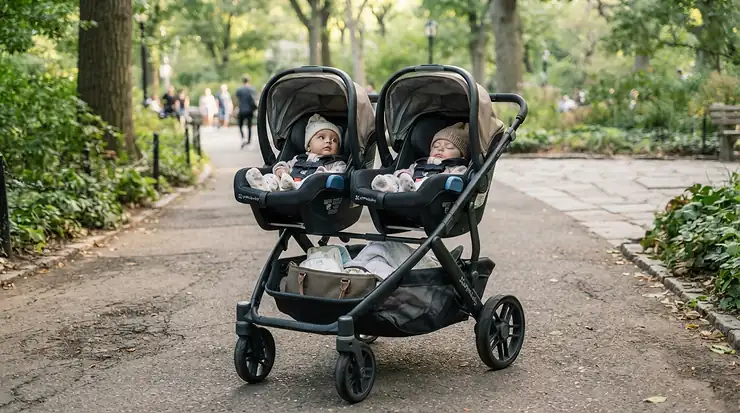
A twin jogging stroller for infant twins is a double stroller with air-filled wheels and a lockable front wheel that also accepts infant car seats. It works for walks in the newborn weeks and becomes a true running stroller once both babies reach roughly six months and have their pediatrician’s go-ahead.

That definition hides an awkward truth most product pages skip. No stroller turns a newborn into a jogging passenger. The pediatric advice summarized by CPCMG says the AAP does not recommend running with a baby in a jogging stroller until at least six months. Before that, a jogging stroller is only a sturdy walking stroller with a car seat clicked in.
So “infant-ready” is the phrase to focus on. You’re really buying two things in one frame: a travel system for the first half-year, and a runner for everything after.
Twins make this harder. One child needs one adapter. Two newborns need two seats, and a side-by-side frame has to stay narrow enough to fit through a doorway. That tension explains why so few strollers do both jobs well.
This guide covers seven real models and how each handles infant car seats. It also covers what the manufacturer fine print says about running, and where marketing outruns reality. Prices are ranges only, so check current pricing before you buy.
Quick Comparison Table: Infant-Ready Twin Joggers at a Glance
| Stroller | Layout | Two Infant Seats? | Running Age Guidance | Best For |
|---|---|---|---|---|
| BOB Revolution Flex 3.0 Duallie | Side-by-side | No, one adapter only | ~6 months+ | Runners who’ll wait for the premium ride |
| Thule Urban Glide 3 Double | Side-by-side | One seat via adapter | 6 months+ | Premium all-terrain families |
| Baby Jogger Summit X3 Double | Side-by-side | Verify before buying | 6 months+ | Hilly routes |
| Baby Jogger City Mini GT2 Double | Side-by-side | Adapter included; verify a second | Walker first | Daily errands, mixed terrain |
| Baby Trend Expedition Double Jogger | Side-by-side | No | 6 months+ | Budget runners |
| Baby Trend Navigator Double Jogger | Side-by-side | Yes, two Baby Trend seats | 6 months+ | Twins needing two seats now |
| Baby Trend Snap-N-Go Double | Frame carrier | Yes, two seats | Not a jogger | Newborn bridge |
The table shows the trade-off. Only two models take two infant seats at once, and neither is the premium runner. The strollers that run best accept one seat at most. For many twin families that is a real dilemma, and the answer is often a two-stroller strategy, covered below.
💬 Just one click — help others make better buying decisions too!😊
Top 7 Twin Jogging Strollers for Infant Twins: Expert Analysis
1. BOB Revolution Flex 3.0 Duallie — premium ride, one-seat infant adapter
The BOB Revolution Flex 3.0 Duallie is the stroller most runners picture when they think “double jogger.” It weighs about 33 lb, so it’s lighter than most rivals. It carries up to 50 lb per seat and is about 30.5 inches wide. That width matters because it clears most standard doorways.
On paper, the near-flat recline and nine-position handlebar suit two different runners sharing a stroller. The catch for twins is the adapter. BOB’s own FAQ states its car seat adapter is designed for one seat. Fitting two seats side-by-side would push the width past 32 inches. Adapters are brand-specific (Britax/BOB, Chicco and Graco versions exist) and typically cost around $95-$120.
One adapter user noted the loaded stroller pushes a bit heavier off flat ground. BOB also warns against running with the adapter and car seat attached. Treat this as a walking setup until the babies move into the seats.
Pros:
- ✅ Narrow enough for most doorways
- ✅ Light for a premium double
- ✅ Strong running pedigree
Cons:
- ❌ Only one infant seat at a time
- ❌ Adapter sold separately
Price range: roughly $600-$750 at the time of research; check current price. It’s strong value for runners but a poor fit for twin newborns in car seats.
2. Thule Urban Glide 3 Double — premium suspension, slim adapter
The Thule Urban Glide 3 Double has big air-filled tires and a locking front wheel. It weighs about 35.3 lb and holds 49 lb per seat, 100 lb total. Thule markets it as usable from birth with a bassinet or an infant car seat adapter, both sold separately.
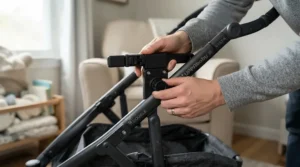
For twins, the key spec is the adapter. The universal double adapter is rated for walking use only and approved up to roughly 20 lb (9 kg). That limit means it covers the early months, then retires. One reviewer on a retailer page noted the adapter is slim enough that the child in the neighboring seat is unbothered.
Thule markets this model as a true jogger, though its single Urban Glide 3 is explicitly not approved for running. Check the manual for your exact model before you run.
Reviewers across roundups praise the ride quality and the one-hand fold. The adapter’s one-seat limit and the premium price are the common complaints.
Pros:
- ✅ Excellent suspension and handling
- ✅ One-hand compact fold
- ✅ Slim adapter leaves neighbor seat usable
Cons:
- ❌ Only one infant seat supported
- ❌ Premium pricing
Price range: roughly $900-$1,100; check current price. It’s a luxury buy and best if you can bridge the newborn months some other way.
3. Baby Jogger Summit X3 Double — best for hilly routes
The Baby Jogger Summit X3 Double is the pick when your loop has real hills. Roundups cite about 37.4 lb and a 50 lb per-seat limit, so it’s among the heavier premium options. Baby Jogger’s guidance puts the minimum age for jogging at 6 months.
That weight shows up on stairs and in trunks, so expect a workout before you even start running. In return you get a stroller built for running on slopes.
I couldn’t verify a two-infant-seat configuration for this model. Check Baby Jogger’s current compatibility chart before you count on it. For newborn walking, one adapter-style seat is the likelier setup.
Based on the spec comparison, it suits parents who plan to run from month six and don’t need to car-seat both babies on day one. Reviewers’ general complaint with this class is weight, not performance.
Pros:
- ✅ Built for hills and rough routes
- ✅ 50 lb per-seat capacity
- ✅ Clear 6-month minimum for jogging
Cons:
- ❌ Heavy to lift and store
- ❌ Two-seat infant fit unverified
Price range: roughly $700-$900; check current price. It’s a specialist buy, best if hills are your reality.
4. Baby Jogger City Mini GT2 Double — the everyday all-rounder
The Baby Jogger City Mini GT2 Double was named best double for most families in two 2026 roundups. It carries 50 lb per seat and has all-wheel suspension. It includes a Baby Jogger car seat adapter and is compatible with Britax, Cybex, Graco and Maxi-Cosi seats. It also supports carrycots for newborn use and folds with one hand.
It’s the most newborn-friendly stroller here. Its weakness is running. Reviewers recommend the Summit line for serious jogging, and I’d confirm the manufacturer’s running guidance before treating it as a runner. Read it as a walker with trail ambitions.
Whether a second adapter fits for twin car seats isn’t clear from the reviews I found. Ask the retailer before you buy.
Pros:
- ✅ Adapter included in the box
- ✅ Handles mixed terrain smoothly
- ✅ Carrycot option for newborn use
Cons:
- ❌ Not positioned as a running stroller
- ❌ Twin car seat fit needs verification
Price range: roughly $600-$750; check current price. It’s strong value if daily walks matter more than race pace.
5. Baby Trend Expedition Double Jogger — budget runner, no car seats
The Baby Trend Expedition Double Jogger is the budget jogger. Roundups list it at about 32-34 lb with 12-inch wheels and a 50 lb per-child limit. The seats recline nearly flat. One review suggests leisurely walks from around three months and running from six, but check Baby Trend’s own age guidance too.
The deal-breaker for infant twins is that it accepts no infant car seats. Both BabyGearLab and Lucie’s List say so. That makes it a stroller for after the newborn phase, not a bridge through it.
Reviewers’ recurring complaint is seat sagging when reclined, a sign of the economy build. The same reviewers still call the value strong for runners.
Pros:
- ✅ Very affordable for a double jogger
- ✅ Relatively light for its class
- ✅ Nearly flat independent recline
Cons:
- ❌ No infant car seat compatibility
- ❌ Seats can sag when reclined
Price range: roughly $200-$300; check current price. It’s great value if your babies will be six months old before you need it.

6. Baby Trend Navigator Double Jogger — the two-car-seat jogger
The Baby Trend Navigator Double Jogger is the one jogger that holds two infant car seats at once, though only Baby Trend’s own seats. It has a four-wheel side-by-side design with 12-inch wheels, two canopies, and locking front swivel wheels. Users say the two front wheels add stability.
Baby Trend’s own recommendation is to wait until both passengers are six months old before jogging. One retailer lists the Navigator for ages “4 months and up,” but follow the stricter pediatric guidance.
The downsides are real. BabyGearLab found it bulky, with poor storage access, and doesn’t recommend it generally. Lucie’s List wouldn’t jog with it. Consumer Reports calls its Lite sibling sturdy but heavy and wide.
For twins, I’d call it the practical answer to “I need two car seats on day one,” and a compromise on running quality later.
Pros:
- ✅ Holds two infant seats simultaneously
- ✅ Equal seating for both twins
- ✅ Locking front wheels
Cons:
- ❌ Heavy and bulky when folded
- ❌ Baby Trend seats only
Price range: roughly $250-$350; check current price. It’s a utility pick, strongest in the newborn months.
7. Baby Trend Snap-N-Go Double — the newborn bridge frame
The Baby Trend Snap-N-Go Double isn’t a jogger, and that’s why it’s here. It’s a lightweight frame that holds two infant car seats, and Baby Trend’s compatibility chart lists its Flex-Loc seats as compatible. Its job is the first six months, after which you move up to a real runner.
That “bridge” approach is the strongest twin strategy I found. Pair this with a jogger that only needs to accept toddlers, and you avoid the compromise of the Navigator or the single-adapter premium models.
I couldn’t verify detailed review data for this model, so judge it on its job, not its ratings. A frame carrier trades comfort and cargo space for portability.
Pros:
- ✅ Carries two infant car seats
- ✅ Simple, light frame design
- ✅ Frees you to buy a pure runner later
Cons:
- ❌ Not suitable for jogging
- ❌ Limited storage and comfort
Price range: budget tier; check current price. It’s useful value if you pair it with a dedicated runner.
How to Choose a Twin Jogging Stroller for Infant Twins
Quick answer: Choose a stroller that matches your newborn plan first, your running plan second. Here are the steps.
- Count your car seats. If you need both babies in car seats on day one, only a few strollers qualify. Verify two-seat support in writing.
- Check the width. Under about 32 inches is the usual line for fitting through standard doorways, which is why BOB limits its adapter to one seat.
- Confirm seat brand compatibility. Adapters are brand- and model-specific, so match your exact infant seats.
- Read the running age. Six months is the baseline, and federal rules under 16 CFR Part 1227 cover strollers generally, including jogging and multi-occupant models. Check the manual for the running claim.
- Look for a lockable front wheel. It’s the single biggest control feature when you run.
- Weigh the lifting. A 35-43 lb frame is a daily workout. Test your trunk first.
- Price the full setup. Adapters add roughly $95-$120 each.

Pediatric Guidance on Jogging With Infants
Pediatric guidance on jogging with infants is consistent: wait. The CPCMG summary says the AAP does not recommend running with a baby until at least six months, and babies need good trunk and neck control first. Healthline’s pediatrician source notes that most jogging strollers don’t recline fully, which is the reason six to eight months is the practical window.
For twins, there’s a subtle point. Both babies need to be ready, not just the bigger one. If one twin is a preemie or lags on head control, the safe date is the later child’s date.
Before six months, jogging strollers are for walking only. Another source suggests brisk walking at three to four months if the seat reclines fully flat, but that’s a walking guideline, not a running one. Stick to smooth surfaces, and hold off on rougher trails until your babies are older.
Ask your pediatrician for explicit clearance for running, not only general stroller use.
Infant Car Seat Adapter Compatibility: What a Dual Adapter Bar Really Does
Infant car seat adapter compatibility is where most twin shoppers get stung. Adapters are brand- and model-specific. BOB’s FAQ says its newer adapters fit fewer car seats than older ones, and Thule sells separate adapters for Chicco-style and Maxi-Cosi-style seats.
A dual adapter bar is the crossbar or bracket arrangement that lets a stroller hold two seats at once. Whether built in or sold as an accessory, it determines whether a twin stroller works from day one. The Baby Trend Navigator Double Jogger and Baby Trend Snap-N-Go Double are the two here that do this. The BOB Revolution Flex 3.0 Duallie and Thule Urban Glide 3 Double use single-seat adapters.
Two cautions apply. Adapters have weight limits. Thule’s double adapter is approved only up to roughly 20 lb, and Baby Trend’s adapters carry a 50 lb combined limit. And NHTSA’s guidance is that babies under one year ride rear-facing in the car, which the seat does regardless of the stroller.
Also remember the two-hour rule. Experts suggest limiting car seat time to about two hours at a stretch, including on a stroller frame.
Newborn Twin Running Stroller: What to Expect in Real Life
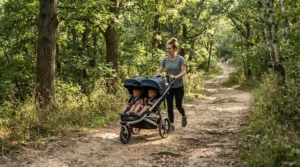
A newborn twin running stroller doesn’t exist in the sense the phrase implies. What exists is a stroller that carries newborns for walks and later runs with older babies.
Real-world newborn use looks like this. You click in one or two car seats and take short, smooth walks. The loaded stroller feels heavier than the spec sheet suggests, and one adapter reviewer noted this on non-flat ground. Weather shields often won’t fit with a car seat attached, as BOB’s FAQ notes, so plan for rain gear.
Seven months in, it flips. The seats do the work, wheels get air in them, and your pace climbs gradually. Front-wheel locking becomes habitual.
Expect the stroller to feel two different ways depending on the month. That’s why choosing for the six-month-plus phase matters as much as the newborn phase.
Twin Jogging Stroller vs Double Car Seat Carrier
| Feature | Twin Jogging Stroller | Double Car Seat Carrier |
|---|---|---|
| Newborn seats | Often one | Two |
| Runs with babies | Yes, from ~6 months | No |
| Lifespan | 4-5+ years | ~12 months |
| Best For | Long-term runners | Newborn walks |
A carrier like the Baby Trend Snap-N-Go Double wins the first half-year. A jogger wins everything after. For many families the cheapest path is both: a cheap frame now, a real runner later, instead of one compromised stroller for the whole stretch.
Analysis: the table shows why single-purchase strategies struggle. The jogger’s lifespan dwarfs the carrier’s, but the carrier solves the problem that matters most on day one.
Features That Actually Matter (And Those That Don’t)
Matter: a lockable front wheel, a wrist strap, a five-point harness, and good brakes. Healthline’s expert source specifically recommends locking the front wheel when running to prevent tipping.
Matter for twins: width, because a stroller that won’t fit your doorway stays in the trunk.
Don’t matter much: cup-holder counts, MP3 speakers (the Navigator has them), and fancy canopy patterns. Those are nice, but they won’t change how safely you run.
Overrated: “newborn jogging” claims. If a listing implies running with a baby under six months, treat it as a red flag.
Common Mistakes When Buying a Twin Jogger for Infants
- Assuming car seat compatibility means jogging compatibility. BOB explicitly says not to run with an infant car seat adapter attached.
- Buying adapters before checking your seat model. They’re brand- and model-specific.
- Ignoring weight. A 43 lb stroller plus two seats is a lot to lift.
- Skipping the width check. Two seats side-by-side get wide fast.
- Trusting the youngest age printed anywhere. Different retailers list four months for the Navigator while the maker says six for jogging. Follow the stricter number.
- Forgetting the pediatrician. Get explicit running clearance.
Transformation: Practical Usage Guide for Your First 30 Days
Week one: assemble the stroller and practice folding it with your car seats on the counter. Check tire pressure and tighten screws, a routine the CPCMG source recommends every few weeks. Place a weighted bag in the seat to mimic baby weight, a tip an expert in Healthline’s piece offers.
Weeks two-three: do short walks on smooth pavement. Lock the front wheel before you pick up speed. Keep the wrist strap on.
Month one onward: build a loop you trust. Use the brakes at every stop, because both rear brakes need to be set on some models.
Maintenance schedule: inspect tires monthly, wipe down seats weekly, and check adapters for cracks. Review Healthline’s pediatrician-sourced running advice before the first real run.
Common first-month mistakes: leaving harnesses loose, and skipping the lock on the front wheel. A one-finger gap at the chest is the harness check recommended by one source.
Transformation: Real-World Scenarios
Scenario 1: The marathon-training mom with twin newborns. She plans to run from month six. Her best strategy is the Baby Trend Snap-N-Go Double for the first half-year, then the BOB Revolution Flex 3.0 Duallie for training. Budget: a few hundred for the frame, premium for the runner. Frequency: daily.
Scenario 2: The budget-conscious urban dad. Daily walks, occasional jogs, tight apartment hallway. The Baby Trend Navigator Double Jogger gives him two seats now and a runner later, in one purchase. Weight and bulk are the cost.
Scenario 3: The hill-country family. Steep neighborhood and gravel paths. The Baby Jogger Summit X3 Double suits the terrain, with a separate walking solution for the newborn months.
Each scenario matches budget, environment and frequency to a stroller, and none relies on one stroller doing everything.
Transformation: Problem and Solution Guide
Problem: “I need two car seats but want a runner.” Solution: use the two-stroller bridge strategy, or accept the Navigator’s compromises.
Problem: “The adapter only holds one seat.” Solution: put the second twin in a bassinet-style carrycot where offered, or carry the second seat on a separate frame. Check each brand’s accessories first.
Problem: “The stroller won’t fit my doorway.” Solution: measure before buying. The BOB Revolution Flex 3.0 Duallie is about 30.5 inches wide.
Problem: “The seats sag when reclined.” Solution: this is a known complaint on the Baby Trend Expedition Double Jogger, so inspect the seat in person and consider a more rigid premium option.
Problem: “It’s too heavy.” Solution: favor the lighter options like the BOB Revolution Flex 3.0 Duallie, and avoid 43 lb frames if you lift often.
Safety, Regulations and Compliance Guide
In the U.S., strollers fall under a mandatory CPSC standard covering travel systems, tandem, side-by-side, multi-occupant and jogging strollers. The standard is 16 CFR Part 1227, which incorporates ASTM F833. Your stroller should state compliance in its documentation.
Practical checks: confirm a five-point harness, working brakes, a wrist strap, and a locking front wheel. Never run with a baby in a carrier or sling instead of a stroller.
Register your stroller and car seats for recall notices. NHTSA reports that nearly half of car seats are installed incorrectly, so have a certified technician check your car installation.
And don’t treat age labels as the only gate. Developmental readiness matters as much as the calendar.

FAQ
❓ Can you jog with twin newborns in a jogging stroller?
❓ Which twin jogger takes two infant car seats?
❓ What is a dual adapter bar on a double stroller?
❓ Is a twin jogger car seat compatible with any brand?
❓ When can infant twins start riding in a running stroller?
Conclusion
The best twin jogging stroller for infant twins depends on how you answer one question: do you need two car seats on day one? If yes, the Baby Trend Navigator Double Jogger or the Baby Trend Snap-N-Go Double bridge the gap, with the second serving as a cheap frame before a real runner. If you can wait, the BOB Revolution Flex 3.0 Duallie, Thule Urban Glide 3 Double and Baby Jogger Summit X3 Double are stronger runners. For everyday walking, the Baby Jogger City Mini GT2 Double is the easy all-rounder, and the Baby Trend Expedition Double Jogger wins on budget.
Whatever you pick, running waits until six months and a pediatrician’s go-ahead. Verify adapter fit before you buy.
✨ Don’t Miss These Exclusive Deals!
🔍 Take your infant twin strolling to the next level with these carefully selected strollers. Click on any highlighted item to check current pricing and availability. These picks will help you create safe, happy outings your family will love! 🏃♀️
Recommended for You
- Twin Jogging Stroller Under $450: 7 Proven Picks 2026
- All-Terrain Twin Jogging Stroller For Trail Runs: 7 Proven Picks 2026
- Twin Jogging Stroller For Running With Twins: 7 Best Picks 2026
Disclaimer: This article contains affiliate links. As an Amazon Associate, I earn from qualifying purchases. If you purchase products through these links, we may earn a small commission at no additional cost to you.
✨ Found this helpful? Share it with your friends! 💬🤗
