
In This Article
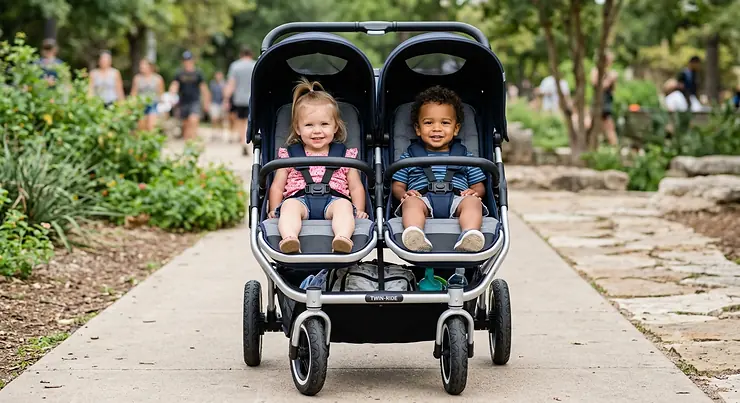
If you’ve got twins, or two kids close enough in age that “who gets the good seat” is already a daily argument, a side-by-side double stroller with equal-size seats solves a problem tandem strollers just weren’t built for. Unlike front-and-back designs, where one kid stares at a canopy while the other gets the view, side-by-side models put both children at the same height, in the same width of seat, under the same slice of shade. Nobody’s riding in coach while the other one gets first class.
We spent our research hours digging through real spec sheets, testing notes from outlets like BabyGearLab and Lucie’s List, and the recurring gripes and praise buried in verified owner reviews. What follows is a genuinely comparative look at seven real, currently available strollers — budget, mid-range, and premium — so you can figure out which one actually fits your doorway, your driveway, and your two kids’ very different naptime schedules. According to the U.S. Consumer Product Safety Commission, strollers sold in the United States must also meet a specific federal safety standard, which we’ll touch on later since it matters more than most product pages let on (CPSC’s stroller standards page).
Quick Comparison Table
Here’s the 30-second version before we get into the weeds.
| Stroller | Width | Weight | Best For |
|---|---|---|---|
| Jeep Destination Ultralight Side x Side | ~29.5″ | ~28.7 lbs | Tight budgets, everyday walks |
| Joovy Scooter X2 | 30″ | 32-34 lbs | Storage-hungry families |
| Joovy Kooper X2 | 30.3″ | 28 lbs | Slightly lighter push, higher weight cap |
| Baby Jogger City Mini GT2 Double | ~29.25″ | 36.6 lbs | Rougher sidewalks, parks |
| UPPAbaby G-Link V2 | 28.5″ | ~22 lbs | Air travel, narrow city doorways |
| BOB Gear Revolution Flex 3.0 Duallie | ~30″ | 33.1 lbs | Running, trail walks |
| Thule Urban Glide 3 Double | 29.25-31.1″ | 35.3-36.5 lbs | Serious jogging, all-weather use |
Looking at the numbers, the split is pretty clean: the UPPAbaby G-Link V2 wins on raw portability at barely 22 pounds, while the Thule Urban Glide 3 Double and BOB Gear Revolution Flex 3.0 Duallie trade that lightness for the suspension and tire quality that actual running demands. Budget shoppers land on the Jeep Destination Ultralight or Joovy Scooter X2, both of which undercut the premium options by hundreds of dollars without giving up independent recline. If your daily terrain is cracked sidewalks and playground gravel rather than a jogging loop, the Baby Jogger City Mini GT2 Double sits in a sensible middle ground most families never outgrow.
💬 Just one click — help others make better buying decisions too!😊
Top 7 Side-by-Side Double Strollers With Equal-Size Seats: Expert Analysis
Every one of these seven is a genuine, currently sold model — no hypothetical “similar products,” just what’s actually on shelves and warehouses right now. We’ve grouped budget, mid-range, and premium options, and every one keeps the seats truly symmetrical, so neither kid gets stuck in a lesser spot.
1. Jeep Destination Ultralight Side x Side — lightest true budget pick
The standout here is the frame weight: at roughly 28.7 pounds, this is genuinely one of the lighter full-size doubles you’ll find under $250. That matters more than it sounds, because a stroller you dread lifting into the trunk is a stroller that stays in the garage.
Specs-wise, it’s about 29.5 inches wide, which clears most standard 30-inch doorways with an inch to spare, and each seat holds up to roughly 40-50 pounds depending on retailer listing, for a combined capacity around 80-100 pounds. The 7-inch front wheels and 10-inch rear wheels with suspension mean it rides smoother than its price tag suggests, though it’s built for sidewalks and errands, not trails.
Based on the spec comparison, this is the stroller for families who want two kids treated identically without spending premium-stroller money. It’s a strong fit for parents doing daily neighborhood loops, grocery runs, or daycare pickup — not for serious hiking. Reviewers consistently report that assembly is quick and the standing fold is a genuine convenience, though several also note the fold-out process from its upright stored position takes a bit of practice.
Pros:
- ✅ Genuinely lightweight for a full-size double
- ✅ Fits standard 30-inch doorways with room to spare
- ✅ Independent multi-position recline on both seats
Cons:
- ❌ Wheels aren’t built for off-road or gravel paths
- ❌ Unfolding from its standing storage position takes practice
Price sits comfortably under $250, and at that range, the value case is hard to beat if smooth sidewalks are your main terrain.
2. Joovy Scooter X2 — biggest storage for the dollar
What jumps out first is the storage: a massive under-seat basket plus two zippered pockets, which is unusual generosity at this price point. That’s on top of individual snack trays and cup holders for both kids.
At 30 inches wide and roughly 32-34 pounds, the Joovy Scooter X2 sits right at the edge of doorway-friendly, and each seat handles up to 45 pounds (90 pounds combined). The 7-inch front and 9.5-inch rear sealed-bearing wheels roll smoothly on pavement, though this isn’t an all-terrain design — Joovy built it for city sidewalks and mall floors, not hiking trails.
What most buyers overlook about this model is how much recline range it packs into a budget shell: seats recline to a near-flat 149 degrees independently, which is genuinely useful for uneven nap schedules between two kids. Reviewers at BabyGearLab and long-time parent testers consistently flag the two-handed recline adjustment as fiddly, but they also rate the overall comfort and storage as best-in-class for the price.
Pros:
- ✅ Enormous storage basket plus zippered side pockets
- ✅ Independent near-flat recline on both seats
- ✅ Each child gets their own tray and cup holder
Cons:
- ❌ Recline adjustment requires two hands and some effort
- ❌ Not designed for off-road or rough terrain
Expect a price in the $300-$350 range, which for this much seat comfort and cargo space is a genuine bargain.
3. Joovy Kooper X2 — lighter update with more weight capacity
The headline feature is the weight capacity jump: 50 pounds per seat versus 45 on the older Scooter X2, while the stroller itself actually got lighter, at about 28 pounds.
It measures roughly 30.3 inches wide, so it clears standard doorways the same way its sibling does, and it keeps the near-flat independent recline, adjustable leg rests, and oversized canopies that make Joovy’s lineup popular for nanny-shares and daycare drop-off. The included snack trays are a nice touch parents don’t have to buy separately.
Here’s what to weigh: because this is a newer release than the Scooter X2, there’s a smaller pool of verified long-term owner reviews to draw honest sentiment from, so treat early feedback as a smaller sample size than the more established models on this list. What is available so far echoes the Scooter X2’s strengths — big canopies, easy one-hand fold — without yet showing a large track record of long-haul durability data.
Pros:
- ✅ Higher per-seat weight capacity than the Scooter X2
- ✅ Lighter overall frame despite the capacity increase
- ✅ Included snack trays and one-hand fold
Cons:
- ❌ Smaller pool of verified long-term reviews so far
- ❌ Not built for off-road or jogging use
Price lands in the $300-$380 range, making it a reasonable upgrade pick if the extra weight capacity matters for your kids’ ages.
4. Baby Jogger City Mini GT2 Double — best all-terrain ride quality
The standout feature is the forever-air tire and all-wheel suspension combo, which genuinely changes how the stroller feels on cracked pavement or park paths compared to hard-plastic-wheeled budget models.
At about 36.6 pounds and roughly 29.25 inches wide, it’s heavier than the budget picks on this list, largely because of added suspension hardware and a reinforced rear bar. Seats recline to a near-flat position independently, and the one-step in-seat fold is genuinely quicker to operate one-handed than most competitors in this price bracket.
On paper this means a smoother, more stable ride for families who walk daily on uneven neighborhood sidewalks rather than smooth mall floors. Reviewers and parent testers note the weight gain from the previous generation as a real trade-off — this is not a stroller you’ll enjoy carrying up several flights of stairs — but the same testers consistently praise the suspension, the peekaboo canopy windows, and one-infant-car-seat compatibility with major adapter brands.
Pros:
- ✅ All-wheel suspension smooths out rough sidewalks
- ✅ Near-flat independent recline on both seats
- ✅ One-step in-seat fold works well one-handed
Cons:
- ❌ Noticeably heavier than the budget picks on this list
- ❌ Accepts only one infant car seat, not two
Expect a price in the $650-$750 range — the premium buys genuine ride-quality improvement over entry-level side-by-sides.
5. UPPAbaby G-Link V2 — lightest premium travel double
The number that matters here is 22 pounds. That’s astonishingly light for a full double stroller, and it’s the reason this model shows up on so many “best for travel” lists.
At 28.5 inches wide, it’s the narrowest stroller on this list, which counts for a lot in older city apartment doorways and airport security lines. Each seat holds up to 55 pounds, and the four-wheel design (down from six on the previous generation) trims both weight and turning radius without sacrificing the independent three-position recline both kids get.
The spec sheet won’t tell you this, but reviewers who’ve actually pushed it note the trade-off directly: it’s the lightest option here, yet testers still describe it as one of the heavier strollers in the double-umbrella category specifically, since that’s a lighter class overall. In other words, it’s light for a full-featured double, but not featherweight compared to true umbrella singles. Owners consistently rate the tri-panel canopy and accessible under-seat basket as standout upgrades from the original G-Link.
Pros:
- ✅ Lightest full-featured double stroller on this list
- ✅ Narrow enough for tight doorways and aisles
- ✅ Independent three-position recline per seat
Cons:
- ❌ Handlebar height isn’t adjustable
- ❌ Underseat basket has a modest 10-pound limit
Price generally falls in the $350-$450 range, and for parents who fly or walk city blocks daily, the weight savings alone can justify it.
6. BOB Gear Revolution Flex 3.0 Duallie — best for running and trails
The defining feature is the mountain-bike-style suspension paired with pneumatic, air-filled tires — a genuinely different ride category from the foam or hard-plastic wheels on budget models.
It weighs about 33.1 pounds, holds up to 50 pounds per seat (100 pounds total), and rolls on a 12-inch front wheel with two 16-inch rear wheels, all built for actual running, not just “all-terrain” as a marketing phrase. The swivel-locking front wheel unlocks for tight-space maneuvering and locks flat for stability at jogging speed, and the seats recline from fully upright to near-flat with one hand.
Based on the spec comparison, this is the pick for parents who genuinely run or hike with two kids in tow, not just want the word “jogging” on the box. Independent testers and BabyGearLab reviewers rate it among the most nimble side-by-sides they’ve tested for its category, while also flagging it as heavier and bulkier to fold than lighter around-town models — a fair trade for the terrain capability it delivers.
Pros:
- ✅ True pneumatic tires with mountain-bike-style suspension
- ✅ Near-flat recline with a one-handed adjustment
- ✅ Compatible with major infant car seat adapters
Cons:
- ❌ Heavier and bulkier to fold than everyday models
- ❌ Overkill (and pricier) if you never actually jog
Price typically runs in the $800-$900 range, positioning it as a serious investment rather than an impulse buy.
7. Thule Urban Glide 3 Double — smoothest jogging suspension
The standout is ride smoothness at speed — testers consistently single out the Urban Glide’s suspension and air-filled tires as the most refined in this jogging-stroller category.
It weighs between roughly 35.3 and 36.5 pounds depending on configuration, measures 29.25 to 31.1 inches wide, and each seat holds 49-50 pounds. It accepts a Thule-brand bassinet or compatible infant car seat with adapters (sold separately), though only one newborn attachment fits at a time, so twins from birth will need to plan around that limitation.
What most buyers overlook about this model is the handbrake — a feature genuinely rare outside jogging strollers, which reviewers note gives real control on downhill sidewalks that a foot brake alone can’t match. Testers who’ve run and walked with it consistently describe the push as effortless even fully loaded, and call it one of the most popular all-terrain doubles they see in daily use, though the width and weight mean it’s a two-hands-on-the-bar stroller more often than a one-handed one.
Pros:
- ✅ Exceptionally smooth ride on rough or uneven terrain
- ✅ Handbrake gives real control on inclines
- ✅ Independently reclining, well-padded seats
Cons:
- ❌ Only fits one newborn attachment at a time
- ❌ Among the heaviest and widest options here
Expect a price in the $900-$1,000 range, which reflects genuinely premium build quality rather than badge pricing.
Practical Usage Guide: Getting the Most From Your Stroller
Getting a side-by-side double stroller with equal-size seats home is only step one. In the first 30 days, the most common mistake is skipping the “trial fold” — practicing the fold and unfold three or four times in your driveway before you’re doing it one-handed in a parking lot with a screaming toddler under one arm. Do this before you actually need it under pressure.
Tire maintenance matters more on air-filled models like the BOB Gear Revolution Flex 3.0 Duallie and Thule Urban Glide 3 Double — check pressure monthly, since underinflated tires drag and wear unevenly, quietly ruining the smooth ride you paid for. On foam or hard-wheel models like the Joovy Scooter X2 or Jeep Destination Ultralight, the maintenance is lighter: wipe wheel axles free of grit every few weeks so they keep spinning freely.
Optimization tip: adjust both seats’ recline and footrest independently on day one, even if your kids seem the same size. “Equal-size” seats still let each child sit differently, and dialing that in early prevents the daily fuss of one kid slouching while the other’s knees hit the footrest. Store the canopy fully extended when not folding for storage — repeatedly cramming it closed while still snapped open stresses the fabric hinges faster than normal use ever would.
✨ Don’t Miss These Exclusive Deals!
🔍 Take your search for the perfect twin or sibling stroller further with these carefully selected picks. Click on any highlighted model to check current pricing and availability before you commit!
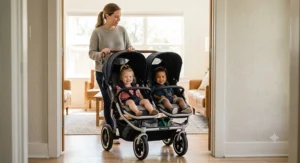
Real-World Scenarios: Which Stroller Fits Your Life
Picture three different families, because “best stroller” really does depend on who’s pushing it.
Family one: apartment-dwelling parents of newborn twins in a fourth-floor walk-up with no elevator. Weight and fold speed dominate every decision here — the UPPAbaby G-Link V2 at roughly 22 pounds is the obvious answer, since carrying anything heavier up four flights daily gets old fast.
Family two: parents of a toddler and a preschooler who walk two miles to school and back on cracked suburban sidewalks. Ride comfort and suspension matter more than portability — the Baby Jogger City Mini GT2 Double handles curb cuts and uneven pavement without jolting either kid awake mid-nap.
Family three: a running parent training for a half-marathon while pushing twins three mornings a week. Here, nothing but real jogging hardware will do — the BOB Gear Revolution Flex 3.0 Duallie or Thule Urban Glide 3 Double are the only two on this list actually built for that use case, with the tire pressure and handbrake control that pavement-only strollers simply lack.
None of these families would be happy swapping strollers with each other, which is really the point: “best” only means anything once you know your own terrain, stairs, and budget.
Buyer’s Decision Framework: A Quick Priority Checklist
If sorting through seven options still feels overwhelming, run through this simple framework before you decide.
If you’re carrying the stroller up stairs daily, choose the lightest option — the UPPAbaby G-Link V2 — because weight, not features, will be the thing you resent every single day.
If your budget is under $300 and your terrain is mostly sidewalks and errands, choose the Jeep Destination Ultralight or Joovy Scooter X2, since neither sacrifices independent recline for the lower price.
If you run or hike regularly, choose the BOB Gear Revolution Flex 3.0 Duallie or Thule Urban Glide 3 Double, because pneumatic tires and real suspension aren’t optional extras for that use case — they’re the entire point.
If you’re splitting the difference between everyday walks and rougher terrain, choose the Baby Jogger City Mini GT2 Double, which handles both without excelling narrowly at either.
How to Choose a Side-by-Side Double Stroller With Equal-Size Seats
Six criteria matter more than anything printed on the box:
- Doorway width. Measure your narrowest interior doorway before shopping — most side-by-side models run 28.5 to 31 inches wide, and a half-inch can be the difference between “fits” and “doesn’t.”
- True seat symmetry. Confirm both seats are genuinely identical, not just similarly shaped — some “side-by-side” marketing hides a slightly staggered or narrower second seat.
- Independent recline. Twins rarely nap on the same schedule; independent recline per seat, not a shared mechanism, avoids waking one child to adjust the other.
- Terrain match. Air-filled tires and suspension only matter if you’re actually running or hitting gravel — on smooth sidewalks, they’re extra weight you’re paying for and hauling around unnecessarily.
- Weight capacity headroom. Buy for where your kids will be in a year, not just today, especially if there’s an age gap between siblings.
- Fold mechanism. A one-hand fold matters enormously the first time you’re managing two kids and no free hands at once.
Common Mistakes When Buying a Symmetrical Twin Stroller
The most frequent mistake is assuming “double stroller” automatically means equal seating — many popular doubles are actually tandem, front-and-back designs where one seat sits higher, narrower, or with a smaller canopy. If true symmetrical seating matters to you, specifically confirm the stroller is a side-by-side stroller with no front/back seat arrangement before buying, since product photos can be misleading at a glance.
A second common error: buying based on folded size alone without checking unfolded width against actual doorways at home, daycare, and grandparents’ houses. A third: ignoring canopy size differences between seats — some equal-seat twin stroller models still shortchange one side’s shade coverage due to handlebar placement. Finally, many buyers skip verifying car seat adapter compatibility before purchase, then discover their existing infant seat doesn’t attach to their new stroller at all.
Side-by-Side vs Tandem: Which Symmetrical Setup Wins
The core trade-off is width versus length. A side-by-side stroller with equal-size seats is wider — often 28 to 31 inches — but shorter front to back, while tandem strollers stay narrow enough for any doorway but stretch out long, sometimes over 45 inches.
Where side-by-side wins decisively is fairness and interaction: both kids get identical seat width, depth, and canopy coverage, and they can see and talk to each other the entire walk. Tandem strollers, by contrast, frequently give the front seat better sightlines and the rear seat a smaller footwell, which is exactly the “front/back inequality” problem symmetrical seating design was built to solve.
Where tandem wins is maneuverability through narrow spaces — subway turnstiles, cramped store aisles, older building doorways — since length is rarely the constraint width is. If your daily environment is wide-open sidewalks and parks, side-by-side is the stronger everyday pick; if you’re navigating tight urban infrastructure constantly, tandem’s narrower footprint may outweigh the seating-equality benefit.
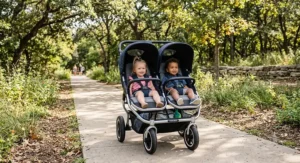
Seat Width and Depth: What “Equal-Size” Actually Means
“Equal-size seats” sounds simple, but seat width and depth vary more between models than most shoppers expect, and it directly affects how long a stroller stays comfortable as kids grow. Compact travel doubles like the UPPAbaby G-Link V2 prioritize a narrow overall frame, which sometimes means slightly tighter seat width per child compared to full-size doubles like the Baby Jogger City Mini GT2 Double.
Seat depth matters just as much as width, particularly for the “leg bend to seat crease” measurement that determines whether a growing preschooler’s knees hit the footrest edge. Models with adjustable leg rests, like the Joovy Scooter X2 and Joovy Kooper X2, buy extra months of comfortable use as kids’ legs lengthen, without needing a completely new stroller. When comparing seat width and depth across models, look past the marketing copy and check the actual measurements in inches — “roomy” is not a spec, and two strollers both marketed as spacious can differ by two or three inches in either dimension.
Twin Fairness in Seating: Why Symmetry Matters More Than You Think
Twin fairness in seating isn’t just about avoiding sibling squabbles — though it does that too. Identical seat width, depth, recline range, and weight capacity mean neither child is quietly disadvantaged by a stroller design decision, which matters especially for identical twins who are otherwise developing at nearly the same pace.
This is also where side-by-side genuinely outperforms tandem on principle, not just marketing: with true equal-seat twin stroller designs, there’s no “good seat” and “other seat” to negotiate every single outing. Parents of twins researching this category consistently mention, in real owner reviews, that the ability to let both kids independently recline, see out identically, and interact face-to-face reduces daily friction in a way that’s hard to quantify on a spec sheet but easy to notice in practice.
Stroller Canopy Coverage Per Seat: The Detail Everyone Forgets
Canopy coverage per seat is one of the most overlooked specs on any side-by-side double, and it varies more than width or weight capacity between comparable models. The Joovy Scooter X2 and Joovy Kooper X2 both feature oversized canopies with peek-a-boo windows sized generously for both seats equally, while narrower travel-focused doubles like the UPPAbaby G-Link V2 use a tri-panel canopy design specifically engineered to give each side full, independent shade despite the narrower overall frame.
For families in sunnier climates, UPF 50+ rated canopy fabric — standard on most models here, including the Jeep Destination Ultralight and Thule Urban Glide 3 Double — is worth confirming explicitly rather than assuming, since not every budget stroller advertises the rating even when the fabric qualifies. Extendable visors, as seen on the Jeep Destination Ultralight, add meaningful extra coverage during low-angle morning or evening sun that a fixed canopy edge simply can’t reach.
Long-Term Cost & Maintenance
The sticker price is rarely the full cost story. Air-tire models like the BOB Gear Revolution Flex 3.0 Duallie and Thule Urban Glide 3 Double occasionally need a tire patch or replacement tube over several years of use — a minor cost, but one budget foam-wheel models never incur at all.
Fabric and canopy wear is the other long-term factor: machine-washable seat fabric, standard on most models in this list, keeps replacement-part costs near zero for years, while stitched-in (non-removable) fabric on some ultra-budget strollers can mean the whole seat degrades together. Weighing cost-per-year rather than sticker price alone, a $700 stroller used daily for four years across two kids often works out cheaper per use than a $250 stroller replaced after eighteen months of harder wear — though for families with a shorter usage window, the cheaper option remains the smarter buy.
Safety, Regulations & Compliance Guide
Every stroller legally sold in the United States must meet a federal safety standard incorporated by reference into the Code of Federal Regulations. Specifically, U.S. rules require carriages and strollers to comply with ASTM F833-21, covering stability, brakes, restraint systems, folding mechanisms, and entrapment hazards, as codified directly in 16 CFR 1227.2.
That standard evaluates real hazards — tip-over risk on inclines, wheel detachment under stress, and accidental-fold prevention — rather than cosmetic features, and manufacturers must certify compliance through accredited third-party testing before a stroller reaches shelves, a process explained in detail by ANSI’s overview of the ASTM F833-21 revision. Practically, this means any of the seven strollers featured here already meets a baseline safety floor; what varies between them is fit, comfort, and terrain match, not fundamental structural safety. Always register your stroller with the manufacturer after purchase, since that registration card is how you’ll be notified directly if a recall is ever issued.
Frequently Asked Questions
❓ Are side-by-side double strollers with equal-size seats good for twins?
❓ Do side-by-side strollers fit through standard doorways?
❓ What's the difference between side-by-side and tandem double strollers?
❓ How much do side-by-side double strollers with equal seats cost?
❓ Can a side-by-side double stroller hold an infant car seat?
Conclusion
A side-by-side double stroller with equal-size seats isn’t a luxury — it’s the practical fix for the “who gets the better seat” problem that tandem strollers were never designed to solve. Whether you land on the ultra-light UPPAbaby G-Link V2 for city sidewalks and travel, the trail-ready BOB Gear Revolution Flex 3.0 Duallie or Thule Urban Glide 3 Double for genuine off-road use, or a budget-friendly Jeep Destination Ultralight or Joovy Scooter X2 for everyday errands, the underlying principle stays the same: measure your doorways, be honest about your terrain, and prioritize the features that solve your actual daily friction points rather than the ones that look impressive in a product photo.
None of these seven strollers is objectively “the best” — each earns its spot for a specific kind of family and a specific kind of walk. What they all share is genuine seat equality, which, if you’ve ever refereed a fight over whose turn it is to sit in front, is worth more than almost any other spec on the list.
Recommended for You
- 7 Side-By-Side Double Stroller for Twins Under $400 Picks (2026)
- 7 Best Side-by-Side Double Strollers for Narrow Sidewalks 2026
- 7 Best Double Strollers for Airport Travel With Two Kids (2026)
Disclaimer: This article contains affiliate links. As an Amazon Associate, I earn from qualifying purchases. If you purchase products through these links, we may earn a small commission at no additional cost to you.
✨ Found this helpful? Share it with your friends! 💬🤗
