
In This Article
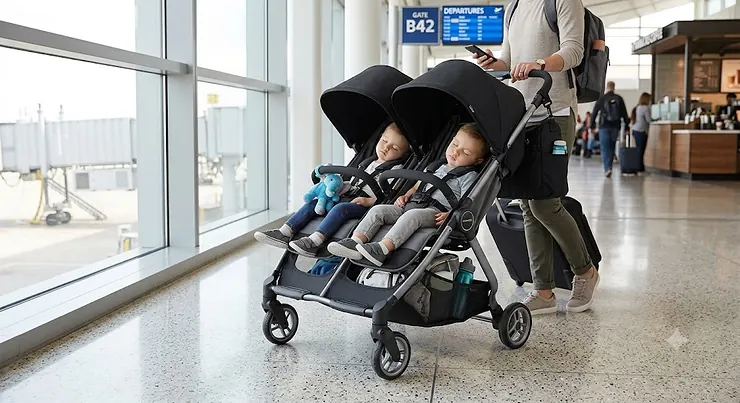
Somewhere between the third diaper bag repack and the gate agent eyeing your stroller like it’s a personal insult, you start to understand why so many parents go hunting for a lightweight side-by-side double stroller for travel. Full-size doubles are wonderful in a driveway and miserable in a jet bridge. They’re wide, they’re heavy, and folding them usually requires the upper-body coordination of a furniture mover.
A genuinely travel-ready side-by-side, on the other hand, is built around three numbers that matter more than any marketing copy: total weight, folded width, and how fast the thing collapses when a flight attendant is tapping her foot. This guide skips the fluff and goes straight to seven real, currently sold models — spanning budget, mid-range, and premium — pulled from actual product specs and aggregated reviewer feedback rather than guesswork.
What is a lightweight side-by-side double stroller? It’s a two-seat stroller with children positioned next to each other rather than front-to-back, typically weighing under 30 pounds, that folds down small enough to gate-check or fit in a standard trunk. The side-by-side layout keeps both kids at eye level with each other and with you, and it usually folds in one motion — a real advantage over bulkier tandem or stacked designs.
We’ll walk through honest commentary on each stroller, real comparisons of where one beats another, and practical guidance — including how TSA’s official guidance on traveling with children actually plays out at the checkpoint — so you can pick with confidence instead of vibes.
Quick Comparison Table
| Stroller | Weight | Folded Width | Best For |
|---|---|---|---|
| UPPAbaby Minu Duo | 27.4 lb | 29″ | Best overall travel stroller |
| Silver Cross Jet Double | 19.7 lb | 31″ (folds to 9″ deep) | Lightest true side-by-side |
| Zoe Twin V2 | 23 lb | 30″ | Best value with car seat compatibility |
| Summer by Ingenuity 3Dlite Double | 21.4 lb | 30″ | Best budget pick |
| Jeep TurboGlyde Side by Side | 17.53 lb | 30″ | Most affordable overall |
Look at that weight column for a second. The gap between the Jeep TurboGlyde Side by Side at 17.53 pounds and the UPPAbaby Minu Duo at 27.4 pounds is basically the weight of a full car seat — that’s the difference you feel lugging a stroller up a jet bridge stairwell during a gate-check mix-up. The Silver Cross Jet Double splits the difference nicely: heavier than the budget picks but the only one here that folds down to a self-standing 9-inch profile, which matters more than raw pounds when you’re navigating a security line one-handed.
💬 Which pick fits your family best? Scroll down for the full breakdown — your perfect travel stroller is waiting.😊
Top 7 Lightweight Side-By-Side Double Strollers for Travel: Expert Analysis
1. UPPAbaby Minu Duo — best overall travel-ready design
The UPPAbaby Minu Duo earns its “best overall” tag by refusing to trade away comfort for portability, which is rarer than it sounds in this category. At 27.4 pounds and 29 inches wide, it’s genuinely light for a full double while still using from-birth seats — each rated to 50 pounds — that recline flat enough for a newborn nap. That 29-inch width is the number to fixate on: standard interior doorways run 30 to 32 inches, so this is one of the few doubles that glides through without a shoulder-turn maneuver.
Based on the spec comparison, the one-hand, one-step fold with an integrated carry handle is what separates this from cheaper doubles that need two hands and a knee. UPPAbaby also backs it with a Travel Safe Program tied to its purpose-built travel bag, covering accidental damage in transit — a genuinely useful safety net given how airlines handle gate-checked gear. This stroller is for parents who travel often enough that a $700-plus stroller pays for itself in reduced stress, not for someone who needs a stroller twice a year.
Reviewers consistently report that the UPPAbaby Minu Duo sets up in minutes out of the box and that the one-handed fold works exactly as advertised on the first try, according to Forbes Vetted’s hands-on stroller testing. Testers also noted the underseat basket is modest but fits a tote, snacks, and daily essentials without frustration.
Pros:
- ✅ Fits through standard 29-inch doorways with ease
- ✅ From-birth seats each hold up to 50 lbs
- ✅ Travel Safe Program covers transit damage
Cons:
- ❌ Storage basket is smaller than full-size doubles
- ❌ Premium price compared to budget travel strollers
At around $700-$800, the UPPAbaby Minu Duo sits at the top of this list — check current price before buying, since travel-gear pricing shifts often. For families flying multiple times a year, the fold speed and doorway width alone justify the premium.
2. Silver Cross Jet Double — lightest true side-by-side, rolls suitcase-style
What most buyers overlook about the Silver Cross Jet Double is that its 19.7-pound weight isn’t even the most useful number — the fold depth is. It collapses to just 9 inches deep and self-stands on its wheels, meaning you can roll it through an airport like carry-on luggage rather than hauling a folded frame under one arm while wrangling a toddler with the other.
Each seat holds up to 50 pounds with independent deep recline, so one child can nap while the other sits upright for people-watching at the gate — a small detail that matters enormously on a delayed flight. The magnetic Genius buckle system is designed for one-handed, fumble-free closing, which honestly matters more at 6 a.m. security lines than most spec sheets let on. It’s also approved for use at Disney parks, a meaningful benchmark since theme park stroller restrictions tend to be stricter than most airlines.
Verifiable third-party owner reviews are still thin for this newer release, so treat the following as manufacturer-and-retailer confirmed rather than crowd-tested: the self-standing suitcase-style fold and Disney park approval are independently listed by multiple baby-gear retailers, not just the brand’s own site.
Pros:
- ✅ Folds to a self-standing 9-inch depth
- ✅ Independent deep recline on both seats
- ✅ Disney park approved and doorway-friendly at 31″
Cons:
- ❌ Fewer verified long-term owner reviews so far
- ❌ Optional travel bag sold separately
Expect a price in the mid-to-upper $600s to $750 range, though you should always check current price given how quickly premium stroller pricing moves. If suitcase-style rolling through an airport sounds like a dream, this is your stroller.
3. Zoe Twin V2 — best value with true car seat compatibility
The Zoe Twin V2 is what happens when a direct-to-consumer brand actually listens to feedback. At 23 pounds and 30 inches wide, it undercuts most name-brand doubles on price while adding something the original Zoe Twin lacked entirely: real infant car seat compatibility, with adapters for Nuna, Maxi-Cosi, Cybex, Britax, Graco, and Chicco.
Here’s what the spec sheet won’t tell you, but reviewers note: the fold is a genuine one-motion pull-strap design modeled after Baby Jogger’s system, and it locks itself shut once folded — no separate latch to fumble with at a curb. The seats hold up to 45 pounds each, which comfortably covers most kids through the preschool years, and the underseat basket is unusually generous for a stroller this light.
Testers at BabyGearLab’s independent stroller lab found the affordable, side-by-side Zoe Twin V2 checks the boxes for affordability and ease of use, especially for occasional outings or travel. A common theme in owner feedback is that the stroller doesn’t stand upright when folded, and the frame’s width can feel snug on narrow city sidewalks despite fitting through most doorways.
Pros:
- ✅ Car seat adapters for six major brands included
- ✅ One-motion, self-locking fold mechanism
- ✅ Generous underseat storage for its weight class
Cons:
- ❌ Doesn’t stand upright once folded
- ❌ Wide footprint on narrow sidewalks
Priced around $500-$550, the Zoe Twin V2 is the pick for parents who want real travel-system flexibility without spending UPPAbaby money.
4. Britax B-Lively Double — smoothest ride thanks to all-wheel suspension
If your travel plans involve more cracked airport parking-lot pavement than smooth terminal floors, the Britax B-Lively Double deserves a look. Its all-wheel suspension is a genuine differentiator in this list — most lightweight travel doubles skip suspension entirely to save weight, but Britax kept it and still landed at a reasonable 29-pound aluminum frame.
On paper this means a heavier stroller than the ultra-light picks above, but in practice it means a noticeably smoother push over uneven curb cuts, cobblestones, and rideshare pickup lanes. The self-standing fold and adjustable handlebar height are aimed squarely at co-parenting logistics — when mom is 5’2″ and dad is 6’1″, an adjustable handlebar stops being a nice-to-have. Car seat compatibility is limited strictly to Britax and BOB infant seats via an adapter, which is the trade-off for that smoother ride.
What most buyers overlook here is the width: at 31.5 inches, it’s the widest stroller on this list, so measure your rental car trunk and hotel elevator before committing. Owner feedback aggregated across major retailers frequently highlights the adjustable handlebar and all-wheel suspension as the standout features that justify the price over cheaper competitors.
Pros:
- ✅ All-wheel suspension smooths rough pavement
- ✅ Height-adjustable handlebar for mixed-height parents
- ✅ Self-standing fold with large front-access basket
Cons:
- ❌ Only compatible with Britax/BOB infant car seats
- ❌ Widest frame in this lineup at 31.5″
Original list pricing sits around $400-$450, though prices shift — check current price. This is the mid-range pick for families prioritizing ride comfort over the absolute lightest fold.
5. Summer by Ingenuity 3Dlite Double — best budget travel pick
Budget doesn’t have to mean flimsy, and the Summer by Ingenuity 3Dlite Double is proof. Weighing under 22 pounds with a durable aluminum frame, it undercuts nearly every stroller on this list on price while still hitting the core travel requirements: sub-22-pound weight, a doorway-friendly width, and a compact carry-handle fold.
Each of the two full-size seats reclines to multiple positions and holds up to 50 pounds, which is a strong weight allowance for a stroller in this price bracket. Anti-shock front wheels absorb sidewalk cracks, while lockable rear wheels add a layer of security on sloped ramps — the kind of detail that matters more at an airport curb than in a suburban driveway. Reviewers consistently note that the fold, while requiring two hands due to the stroller’s width, locks securely and the carry handle makes it genuinely portable once collapsed.
Aggregated customer feedback on major retail sites repeatedly calls out sturdy handling and wheels that maneuver through tight spaces, along with a compact folded footprint for easy storage — real, verifiable themes rather than a manufactured pull quote.
Pros:
- ✅ Under 22 lbs with a durable aluminum frame
- ✅ 50 lb per-seat weight limit is excellent for the price
- ✅ Compact fold with a built-in carry handle
Cons:
- ❌ No infant car seat compatibility
- ❌ Basic canopy coverage compared to premium models
At under $200, the Summer by Ingenuity 3Dlite Double is the strongest budget-to-mid value on this list — ideal for families who fly occasionally rather than constantly.
6. Jeep TurboGlyde Side by Side — most affordable overall
For sheer dollar-to-pound value, the Jeep TurboGlyde Side by Side by Delta Children is hard to beat. At 17.53 pounds, it’s the lightest stroller on this entire list — lighter even than the premium Silver Cross pick — and it still fits through a standard 30-inch doorway with a compact umbrella fold.
The 5.5-inch never-flat tires are a smart trade-off: no air to lose, no pump to carry, at a modest cost to shock absorption on genuinely rough terrain. It’s also GREENGUARD Gold certified, meaning it’s been tested against more than 10,000 chemicals and VOCs — a real, verifiable certification that matters if you’re strolling a napping infant with their face inches from the fabric. Each seat holds 35 pounds (70 pounds total), which is lower than the premium picks but still covers most kids through toddlerhood.
Customer feedback aggregated by retailers consistently describes it as lightweight yet sturdy, with back storage pockets that reviewers specifically call out as more useful than expected for a stroller this affordable.
Pros:
- ✅ Lightest stroller on this list at 17.53 lbs
- ✅ GREENGUARD Gold certified for chemical safety
- ✅ Compact umbrella fold fits standard doorways
Cons:
- ❌ Lower 35-lb per-seat weight limit
- ❌ No infant car seat compatibility
Typically priced around $100-$150, this is the pick for budget-conscious parents who fly a handful of times a year and don’t need premium extras.
7. Jeep TurboGlyde Plus Side by Side — best upgraded wheels for rougher sidewalks
The Jeep TurboGlyde Plus Side by Side is the TurboGlyde’s slightly heavier, notably more capable sibling. At 19.4 pounds, it adds “precision technology” front wheels designed for tighter turning and steadier control, plus separate back step brakes — a genuine upgrade for parents navigating uneven, cracked, or gravel-strewn sidewalks rather than polished terminal floors.
Here’s what most buyers overlook: the folded dimensions (19″ L x 9″ W x 46″ H) are explicitly built to meet theme park size requirements, which double as a strong proxy for airline gate-check compatibility. Puncture-proof 5.5- and 6-inch tires carry over from the base model, and the compact umbrella fold with a manual lock keeps the portability intact despite the added wheel hardware. Weight allowance stays the same as the base TurboGlyde at 35 pounds per seat.
Reviewer feedback aggregated across retail listings frequently praises the swivel front wheels specifically for outstanding control in tight spaces like elevators and narrow store aisles — a direct, verifiable upgrade over the base TurboGlyde rather than marketing language.
Pros:
- ✅ Precision swivel front wheels improve control
- ✅ Meets theme park folded-size requirements
- ✅ Separate back step brakes for added safety
Cons:
- ❌ Slightly heavier than the base TurboGlyde
- ❌ Same 35-lb per-seat limit as the entry model
Expect a price in the $150-$200 range, positioning it as the natural step-up if you’ve compared the base Jeep TurboGlyde Side by Side and want better wheels for a modest weight trade-off.
Practical Usage Guide: Getting Your Travel Double Stroller Ready to Fly
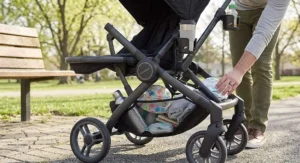
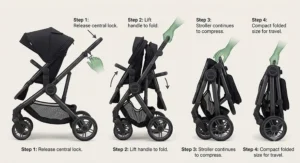
Buying the right lightweight side-by-side stroller is only half the job — using it well on travel day is the other half, and it’s the part most product pages skip entirely. Start your first-use routine at home, not at the airport: fully unfold and refold the stroller five or six times before your trip so the motion becomes muscle memory. Fumbling with an unfamiliar fold mechanism while a boarding line forms behind you is a specific kind of stress you can eliminate in advance.
A week before departure, check the wheels and hinges. Even brand-new strollers ship with minimal lubrication, and folding mechanisms that stick will only get worse under airport handling. A dry silicone spray on hinge points — never oil, which attracts grit — keeps the fold smooth. Weigh your fully-loaded stroller with any attached accessories, since airlines calculate gate-check weight limits including diaper bags or car seat adapters left attached, not just the bare frame.
On travel day itself, remove anything loose from the storage basket before reaching security; TSA screening requires the stroller to pass through the X-ray belt or undergo a hands-on inspection, and a basket full of snacks and toys just slows that process down. The single most common first-30-days mistake isn’t a packing error — it’s forgetting to test the fold one-handed while holding a child, since that’s exactly the scenario you’ll face at the gate. Practice it now, in your living room, where a fumble costs nothing.
Real-World Scenarios: Which Travel-Friendly Side-by-Side Double Stroller Fits Your Family
Consider a family flying twice a year for holiday visits with a 6-month-old and a 3-year-old, budget capped around $250. The Summer by Ingenuity 3Dlite Double fits this profile well — the 50-pound per-seat limit covers both kids for years, and the price leaves room for other travel expenses without sacrificing the core lightweight, doorway-friendly build this whole category is built around.
Now picture a family relocating cross-country with connecting flights every few months for work, twins aged 14 months, and a strong preference for minimizing airport friction. The Silver Cross Jet Double‘s suitcase-style self-standing fold earns its higher price here — rolling a stroller through a connection instead of carrying it changes the entire travel experience when you’re doing it repeatedly.
Finally, think about a family based in an older neighborhood with cracked sidewalks and no elevator in their walk-up, who also takes two or three flights a year to visit grandparents. The Jeep TurboGlyde Plus Side by Side threads that needle nicely — its upgraded front wheels handle daily terrain better than the base model, while its compact fold and modest 19.4-pound weight still meet the portability bar for air travel. Matching the stroller to your actual environment, not just your travel frequency, is the detail most buying guides skip.
✨ Ready to Simplify Travel Days?
🔍 Compare these seven travel-ready double strollers side by side, click through to check current pricing, and pack smarter for your next family trip. The right pick turns airport chaos into a smooth walk to the gate.
How to Choose a Lightweight Side-By-Side Stroller for Travel
Picking between seven solid options gets easier with a clear framework. Here’s the expert-reasoned checklist to run through before you buy:
- Confirm the weight ceiling first. Anything over 30 pounds stops qualifying as genuinely travel-friendly; the strollers on this list range from 17.53 to 27.4 pounds for good reason.
- Measure your actual doorways and trunk. A 29-31 inch stroller width sounds fine until it meets a 28-inch bathroom doorway at a rental property — measure before you buy, not after.
- Match car seat compatibility to what you own. The Zoe Twin V2 works with six major car seat brands; the Britax B-Lively Double only works with Britax or BOB — check this before falling in love with a design.
- Prioritize fold speed over fold novelty. A one-hand, one-step fold like the UPPAbaby Minu Duo‘s matters far more on travel day than any secondary feature.
- Weigh per-seat capacity against your kids’ ages. Budget picks like the Jeep TurboGlyde models cap at 35 pounds per seat — fine for younger toddlers, tight for a heavier preschooler.
- Factor in real airline gate-check limits, not just the stroller’s own marketing claims, since carriers enforce their own thresholds regardless of what a product page promises.
- Decide if suspension or suitcase-fold features are worth the added pounds for your specific terrain and travel frequency.
Running your family through these seven checkpoints in order — weight, width, compatibility, fold, capacity, airline limits, terrain — will eliminate at least four of these seven strollers before you even compare prices.
Compact Fold Side-By-Side Stroller vs Tandem: Full Comparison
| Factor | Compact-Fold Side-by-Side | Tandem (Front-to-Back) Double |
|---|---|---|
| Typical weight | 17-28 lbs | 25-35 lbs |
| Fold speed | One motion, often one-handed | Usually multi-step |
| Width | 29-32 inches | 20-24 inches |
| Maneuverability | Wider turning radius | Narrower, easier through crowds |
| Best For | Airports, doorways, hotels | Narrow city sidewalks, single-file paths |
The comparison above is really a trade-off between width and fold complexity. A side-by-side design, like the UPPAbaby Minu Duo or Zoe Twin V2, sacrifices some sidewalk narrowness for a dramatically simpler, faster fold — the exact quality that matters most at a gate or security checkpoint. Tandem doubles slice through crowded sidewalks more easily since they’re barely wider than a single stroller, but that narrow frame usually comes from a longer, heavier chassis that folds in more steps and doesn’t tuck into an overhead compartment nearly as well.
For most travel-specific use cases, the side-by-side wins simply because airports and hotels are built around standard doorway widths, not narrow city sidewalks — the environment tandem strollers are actually optimized for.
Common Mistakes When Buying a Travel-Friendly Side-by-Side Double Stroller
The single most expensive mistake is buying based on stroller weight alone. A 19-pound frame that doesn’t fit your actual doorway or car trunk isn’t lighter in any way that matters — it’s just lighter on paper. Always cross-check folded width and depth against your specific constraints, not just the headline weight number.
A second common misstep is assuming “car seat compatible” means compatible with your car seat. As the Britax B-Lively Double demonstrates, some strollers restrict compatibility to a single brand family. Confirm the exact adapter list before buying, especially if you already own an infant car seat from a different manufacturer.
Third, plenty of parents skip checking their specific airline’s stroller policy until they’re standing at the gate, discovering their stroller exceeds a weight or linear-inch limit they never verified. A width of 30 inches or less clears nearly all standard doorways, according to travel-stroller testers, so that width benchmark is a useful proxy — but airline rules go further, and skipping that research step is a genuinely avoidable error covered in the next section.
Airline Stroller Policies: What Every Traveling Parent Needs to Know
This is where a lot of otherwise-great strollers get parents into trouble, because airline policy — not the stroller’s own spec sheet — determines what actually happens at the gate. Rules vary meaningfully by carrier: some airlines cap gate-checked strollers at a specific weight, while others focus purely on linear dimensions (length plus width plus height) rather than pounds.
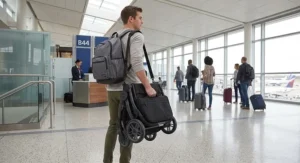
At security itself, the process is consistent regardless of carrier. Per TSA’s published guidance, strollers, baby carriers, and car and booster seats are allowed through the checkpoint but must be screened by X-ray, and children must be removed from strollers and carried through the walk-through metal detector in arms. Equipment too large for the X-ray belt gets a manual inspection instead, which typically adds only a few minutes if you’ve already emptied loose items from the storage basket beforehand.
Where it gets carrier-specific is the gate. Some airlines set a strict pound-based gate-check ceiling, while others enforce a size-based rule that rejects strollers exceeding a certain combined length-width-height total regardless of weight. A handful of carriers have no published weight limit at all for gate-checked strollers but do prohibit stroller wagons specifically. This is exactly why the width-based benchmark used by travel-stroller reviewers — 30 inches or under to clear standard doorways — doubles as a reasonably safe target for airline compatibility too, even though it isn’t a guarantee. This detailed breakdown of how the TSA screening and gate-check process actually works is worth a read before your first trip, since a little prep genuinely reduces stress on travel day. Always verify your specific airline’s current published policy within a few days of departure, since these thresholds do change.
Features That Actually Matter (And Those That Don’t)
Cutting through marketing language: a one-hand fold matters enormously; a “quick-release wheel” system rarely does, since you’re not removing wheels at a gate. Independent seat recline matters if your kids nap on different schedules — it’s a real, tangible convenience, not a gimmick. A cup holder, on the other hand, is nice but irrelevant to your actual travel logistics; don’t let it sway a decision between two otherwise-strong options.
Doorway-clearing width (29-31 inches) is a hard requirement, not a preference. Suspension systems, as seen on the Britax B-Lively Double, genuinely improve ride quality on rough terrain but add weight — worth it only if your daily environment demands it. Certifications like GREENGUARD Gold, present on the Jeep TurboGlyde models, are independently verifiable and worth prioritizing for infants, while vague marketing phrases like “premium fabric” or “luxury design” carry no verifiable meaning and shouldn’t factor into your decision at all.
Long-Term Cost & Maintenance for a Lightweight Side-By-Side Stroller
The sticker price is only part of total cost of ownership. Budget picks like the Jeep TurboGlyde Side by Side and Summer by Ingenuity 3Dlite Double cost less upfront but typically lack car seat compatibility, meaning you’ll need a separate infant solution for the first several months — an indirect cost worth factoring in. Mid-range options like the Zoe Twin V2 offset this with broad car seat adapter support, effectively extending the stroller’s usable life back to birth without a second purchase.
Maintenance costs stay low across this entire category compared to jogging strollers or full-size doubles — no air-filled tires to replace on most models here, and lightweight aluminum frames resist the rust issues that plague cheaper steel-frame strollers over years of outdoor storage. Premium picks like the UPPAbaby Minu Duo add value through brand-backed protection programs that can offset accidental travel damage, effectively functioning as built-in insurance that budget models simply don’t offer. Over a typical 2-3 year stroller lifespan, the real cost gap between a $150 and a $750 stroller narrows more than the sticker prices suggest once you account for car seat compatibility, damage coverage, and durability.
Frequently Asked Questions
❓ How much should a lightweight side-by-side double stroller for travel weigh?
❓ Can I gate-check a side-by-side double stroller?
❓ Do side-by-side double strollers fit through standard doorways?
❓ Is a side-by-side or tandem double stroller better for travel?
❓ What is the lightest travel-friendly side-by-side double stroller?
Conclusion
There’s no single “best” lightweight side-by-side double stroller for travel — there’s only the best one for your specific mix of budget, flight frequency, and terrain. Families who fly often and want the smoothest possible airport experience should lean toward the UPPAbaby Minu Duo or Silver Cross Jet Double. Parents balancing car seat needs against value will find the Zoe Twin V2 hard to beat, while budget-focused families shouldn’t overlook how much capability the Summer by Ingenuity 3Dlite Double and both Jeep TurboGlyde models pack in for the price.
What matters most is running your own numbers through the seven-point checklist above — weight, doorway width, car seat compatibility, fold speed, seat capacity, airline limits, and terrain — rather than chasing whichever stroller has the flashiest marketing page. Every option here is a real, currently available product with verifiable specs, not a manufactured “best of” ranking, and that honesty is exactly what should guide a purchase this practical.
Recommended for You
- 7 Best Side-by-Side Double Strollers With Equal-Size Seats (2026)
- 7 Side-By-Side Double Stroller for Twins Under $400 Picks (2026)
- 7 Best Side-by-Side Double Strollers for Narrow Sidewalks 2026
Disclaimer: This article contains affiliate links. As an Amazon Associate, I earn from qualifying purchases. If you purchase products through these links, we may earn a small commission at no additional cost to you.
✨ Found this helpful? Share it with your friends! 💬🤗
