
In This Article
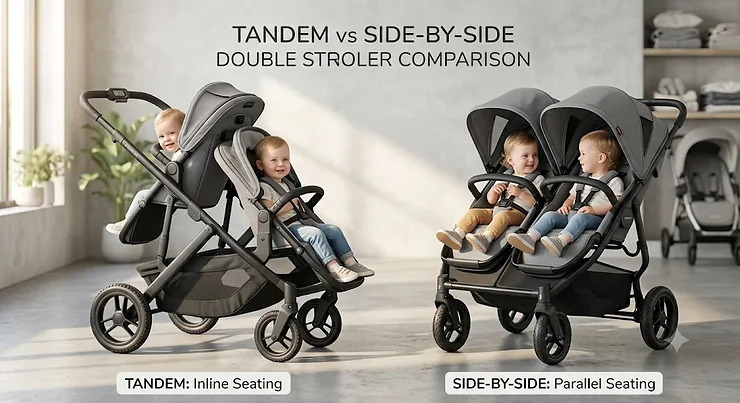
Somewhere around week thirty of a twin pregnancy, most parents hit the same wall: which stroller actually works for two babies at once? The tandem vs side-by-side double stroller for twins question sounds simple until you’re standing in a store aisle staring at two very different silhouettes, one long and skinny, one wide and squat, both promising to solve your life. A tandem vs side-by-side double stroller for twins decision really comes down to two things — how your house and car are built, and how much you value equal seating over a slimmer profile.

Here’s the short version: a tandem stroller stacks two seats front-to-back like a canoe, keeping the whole rig narrow enough to slip through doorways and store aisles, while a side-by-side stroller places both seats next to each other so twins get identical views, legroom, and access to Mom or Dad — at the cost of extra width. Neither layout is objectively “better.” As Valco Baby notes, for twins a side-by-side stroller offers an equal experience for both, while a tandem may make more sense in narrow indoor spaces or urban settings, and that tension is really the whole article in one sentence.
Below, we’ve pulled real specs, honest pros and cons, and aggregated review sentiment on seven strollers — three tandem, four side-by-side-style — spanning budget to premium, so you can match the layout to your actual doorways, sidewalks, and daily routine instead of guessing. For more on how the two layouts differ day to day, we’ll also link out to independent sources throughout so you can dig deeper.
Quick Comparison Table: Tandem vs Side-by-Side at a Glance
| Stroller | Layout | Approx. Width | Best For |
|---|---|---|---|
| Baby Jogger City Mini GT2 Double | Side-by-side | ~29.75″ | Narrow doorways, daily walks |
| Delta Children Jeep Destination Side x Side | Side-by-side | ~30″ fit | Budget-conscious twin parents |
| Graco DuoGlider | Tandem | ~20.5″ | Tightest hallways, lowest price |
| Baby Trend Sit N’ Stand Double 2.0 | Tandem (+ stand platform) | ~50.8″ unfolded | Twins plus an older sibling |
| Evenflo Pivot Xpand | Tandem/modular | Expands from single | Families who want one stroller that grows |
| UPPAbaby Vista V3 + RumbleSeat | Tandem | ~25.7″ | Parents who want premium ride quality |
| Bugaboo Donkey 5 Twin | Side-by-side (convertible) | ~29″ in twin mode | Design-focused families, easy one-hand steering |
Look at the width column and a pattern jumps out immediately: the tandem models cluster near or under 26 inches, while the side-by-side options sit closer to 29–30 inches — right at the edge of a standard 32–36 inch doorway. That gap is the entire tandem vs side-by-side double stroller for twins debate in numbers. Budget doesn’t map neatly to width either; the Graco DuoGlider is both the cheapest stroller here and one of the narrowest, while the Bugaboo Donkey 5 Twin proves a premium side-by-side can still be engineered to squeeze through most home doorways.
💬 Scroll down for the full breakdown of all seven strollers — plus which layout actually fits your life.😊
Top 7 Tandem and Side-by-Side Double Strollers for Twins: Expert Analysis
1. Baby Jogger City Mini GT2 Double — narrowest side-by-side for tight doorways
The City Mini GT2 Double has spent years as the side-by-side benchmark, mostly because it manages to squeeze two kids next to each other without turning into a hallway obstacle. At 29.75 inches wide, it will get through a standard door frame, though not with a ton of room to spare, since standard door widths run 32 to 36 inches. Forever-air tires and all-wheel suspension mean you’re not babysitting a flat tire mid-walk, and the near-flat recline with peekaboo canopy windows keeps naps and peekaboo games both possible on the same outing.
Weighing in around 32.5 pounds, this isn’t a featherweight, but the payoff is real all-terrain capability most budget side-by-sides skip. It’s built for parents who walk daily on cracked sidewalks, curbs, and the occasional patch of grass and don’t want to feel every bump through the handlebar. Reviewers consistently describe the fold as genuinely one-step, and long-time owners report the frame holding up well past the toddler years into preschool use.
Pros:
- ✅ Fits most standard doorways at 29.75 inches wide
- ✅ Forever-air tires never go flat on rough pavement
- ✅ Near-flat recline works for infant naps on the go
Cons:
- ❌ At 32.5 lbs, it’s heavier than comparable tandem strollers
- ❌ Sits at the higher end of the mid-range price bracket
Expect this one to land in the mid-$300s to mid-$400s range depending on retailer and bundle; check current price before buying, since availability shifts often. For families who walk more than they drive, the Baby Jogger City Mini GT2 Double earns its keep.
2. Delta Children Jeep Destination Side x Side — best budget side-by-side pick
If the City Mini GT2 Double is the side-by-side splurge, the Jeep Destination is the side-by-side entry point. Its lightweight aluminum frame weighs 28.66 pounds and fits through standard 30-inch doorways, which is a genuinely competitive number for a stroller priced well under its premium rivals. Seven-inch swivel-lock front wheels and 10-inch rear wheels with suspension are meant to keep the ride smooth even when the frame itself is built to a budget.
What the spec sheet doesn’t say outright: this stroller trades some plushness and long-term durability for accessibility. It’s a smart pick for parents who want to try side-by-side seating without committing to a premium price tag first, or as a lighter-duty second stroller for grandparents’ houses or daycare drop-off. Independently reclining seats with adjustable footrests mean each twin can nap or sit up regardless of what the other is doing, which matters more than people expect once naps stop syncing.
Pros:
- ✅ Fits 30-inch doorways at under 29 pounds
- ✅ Independent multi-position recline per seat
- ✅ Peekaboo windows and pop-out SPF 50 visors
Cons:
- ❌ Smaller wheels feel rougher on cracked sidewalks
- ❌ Less premium padding than higher-tier competitors
Price-wise, this one typically sits in the $250–$300 range, occasionally dipping lower during sales — always check current pricing since Jeep-branded strollers move around seasonally. For a first side-by-side on a real budget, the Delta Children Jeep Destination Side x Side is hard to beat.
3. Graco DuoGlider — most affordable tandem for growing families
The DuoGlider is the stroller most parents’ own parents remember, and it’s stuck around because the fundamentals still work. Stroller width comes in at just 20.5 inches, meaning it will pass through nearly any interior doorway without a second thought — narrower than most single strollers, let alone side-by-side twin models. Stadium-style seating gives the rear-seated child a slightly elevated view, which is Graco’s answer to the classic tandem complaint that the back seat feels like coach class.
What that means in practice: the rear seat won’t have the same open sightline as the front, but it’s a meaningfully better setup than flat tandem seating with no elevation. Each seat reclines individually, and the rear seat lays flat enough to work as a newborn pramette, so this can realistically carry twins from the newborn stage onward, not just once they’re sitting up. Reviewers frequently cite the low price and low weight as the reasons they’d buy it again, even if premium buyers might miss the plusher fabrics found on pricier tandems.
Pros:
- ✅ Just 20.5 inches wide — fits almost any doorway
- ✅ Stadium seating improves the rear child’s view
- ✅ One-hand standing fold, no bending required
Cons:
- ❌ Compatible only with Graco-brand infant car seats
- ❌ 40 lb per-seat weight limit is lower than modular rivals
Typically priced under $200, occasionally closer to $250 depending on the retailer, the DuoGlider remains the budget tandem to beat. If narrow hallways and a tight budget are both non-negotiable, the Graco DuoGlider is worth putting at the top of your list.
4. Baby Trend Sit N’ Stand Double 2.0 — best for twins plus a third rider
This one solves a problem the other six strollers on this list don’t even attempt: what happens when twins are done needing a stroller but a new baby arrives, or when an older sibling wants in on the walk? The rear seat converts into a standing platform, so the Sit N’ Stand can run as a true double for twins today and flex into a stand-and-ride setup for a third child down the road. Unfolded dimensions run roughly 50.8 inches wide, which is wide by any stroller standard and worth measuring your trunk and front door against before buying.
Both seats carry a 5-point harness, and the front seat’s ratcheting canopy contrasts with a simpler fixed canopy in back — a small but real asymmetry buyers should know about upfront rather than discover on day one. Reviewers on major retail sites frequently flag Baby Trend’s history of stroller recalls involving hinge mechanisms, so it’s worth registering the product and checking recall status before use; that’s simply honest due diligence, not a reason to avoid the brand outright, since recalls get resolved and Baby Trend remains a mainstream, budget-friendly stroller manufacturer.
Pros:
- ✅ Converts to a stand-and-ride platform for a third child
- ✅ Budget-friendly price point for a full-featured tandem
- ✅ 5-point harness on both seats
Cons:
- ❌ 50.8-inch unfolded width demands real storage space
- ❌ Front and rear canopies aren’t identical in coverage
Expect a price in the $150–$220 range depending on configuration and included accessories. For families expecting a third child soon after twins, the Baby Trend Sit N’ Stand Double 2.0 offers a growth path few competitors match.
5. Evenflo Pivot Xpand — most configurable modular tandem
The Pivot Xpand takes a different approach entirely: instead of being built as a double from day one, it starts as a single stroller frame that expands. The frame widens without extra tools, parts, or adapters, and without compromising storage basket space, turning one stroller into a genuine double when the second child arrives — useful for twin parents who want a single-to-double workflow they can practice with before both car seats are in play. The toddler seat also transitions into a lay-flat pramette mode for newborn use, adding flexibility most fixed-tandem competitors don’t offer.
Baby Gear Lab’s testers called it a stroller with features and functionality often only found on higher-priced products, though somewhat heavy, large, and not the highest level of build quality — an honest trade-off for the price. That’s a fair summary: you’re getting near-premium versatility at a mid-range cost, with some corners cut on materials. Real owner reviews are mixed on long-term durability, with some praising the value and others reporting car-seat attachment frustrations, so this is one to test in person if a local store carries it.
Pros:
- ✅ Expands from single to double with no tools needed
- ✅ Toddler seat converts to a lay-flat newborn pramette
- ✅ Up to 8 seating configurations out of the box
Cons:
- ❌ Mixed durability feedback in owner reviews
- ❌ Bulkier storage footprint once expanded to double mode
Pricing generally lands in the $350–$500 range depending on bundle. For parents who like the idea of buying one stroller and growing into it, the Evenflo Pivot Xpand is worth serious consideration.
6. UPPAbaby Vista V3 with RumbleSeat V3 — premium ride quality and modularity
At the top of the tandem lineup sits the Vista V3, a stroller built to be a single from birth and expand into a genuine twin-capable tandem with the RumbleSeat attachment. The RumbleSeat offers one-handed multi-position recline, a water-repellent UPF 50+ canopy with mesh panels, and front wheel locks with visual indicators. It’s GREENGUARD Gold certified, a detail that matters to parents specifically screening for lower chemical emissions in gear their kids sit in for hours a day.
The toddler seat handles children up to 50 lb, while the RumbleSeat carries a 40 lb limit — generous ceilings that mean this stroller realistically lasts from infancy through preschool without an upgrade. Consumer Reports includes the Vista V3 with RumbleSeat in its ongoing stroller test program, evaluating it on ease of use and maneuverability across pavement, dirt, grass, curbs, and inclines — independent third-party testing that carries more weight than brand marketing copy. What the spec sheet won’t tell you: premium fabric and leather detailing genuinely photograph and feel better in person, but that polish is exactly what you’re paying the premium for.
Pros:
- ✅ GREENGUARD Gold certified for lower chemical emissions
- ✅ High weight limits extend usable life to preschool age
- ✅ Independently tested by Consumer Reports for maneuverability
Cons:
- ❌ Among the priciest options in this entire category
- ❌ RumbleSeat is typically bundled or sold separately, adding cost
Full bundles with the RumbleSeat commonly run in the $900–$1,200+ range depending on fabric and accessory choices — always verify current pricing before buying, since UPPAbaby adjusts bundle pricing frequently. For parents who see a stroller as a multi-year investment, the UPPAbaby Vista V3 with RumbleSeat V3 is the category’s premium tandem benchmark.
7. Bugaboo Donkey 5 Twin — most compact premium side-by-side
The Donkey 5 Twin tries to solve the central side-by-side problem — width — through clever engineering rather than compromise. In Mono (single) mode it’s only 23.6 inches wide, and Duo and Twin configurations are just 5.5 inches wider, specifically designed for standard doorways and elevators. That puts the twin configuration around 29 inches, genuinely competitive with mid-range side-by-side rivals despite the premium components underneath.
Seats are independently reversible and reclinable, letting twins face each other, face forward, or face the parent, a flexibility most side-by-side strollers simply don’t offer. The underseat basket carries up to 22 lbs, with an additional 22 lbs available via a side luggage basket in single mode. Bugaboo’s core pitch — that side-by-side geometry steers more easily with one hand even fully loaded — tracks with independent reviews praising the brand’s steering geometry across its lineup, though buyers should expect a genuine learning curve with the three-click conversion system in the first week.
Pros:
- ✅ Converts single-to-double in three simple clicks
- ✅ Reversible seats let twins face each other or the parent
- ✅ Puncture-proof foam wheels need zero maintenance
Cons:
- ❌ One of the most expensive strollers in this roundup
- ❌ Three-click conversion has a learning curve at first
Expect a price well north of $1,000 for the twin bundle, with exact figures shifting by retailer and season — check current price before committing. For families who want a side-by-side without the usual width penalty, the Bugaboo Donkey 5 Twin is the closest thing to having it both ways.
Practical Usage Guide: Setting Up and Living With a Double Stroller for Twins
Getting a double stroller out of the box is the easy part; making it work for actual daily life takes a little planning most product manuals skip. Start by measuring your narrowest regular doorway — front door, elevator, and the aisle at your usual grocery store — before you even open the box, since that single number does more to determine tandem vs side-by-side than any review will.
On first use, practice the fold and unfold in your driveway or living room, not for the first time in a parking lot with two crying infants strapped in a car. Most tandem strollers like the Graco DuoGlider and Baby Trend Sit N’ Stand Double 2.0 use a standing, one-hand fold; side-by-side models like the Baby Jogger City Mini GT2 Double typically require a two-step in-seat pull. Check tire pressure monthly on air-filled wheels, and wipe down fabric seats weekly if you’re walking daily, since twin strollers see roughly double the spills and snack debris of a single.
A common first-30-days mistake: parents adjust the harness once at delivery and never again, even as babies grow fast in the early months. Recheck strap height and recline position every two to three weeks for the first six months. For strollers with independent recline, like the Delta Children Jeep Destination Side x Side and Evenflo Pivot Xpand, get in the habit of adjusting each seat separately rather than assuming twins nap on the same schedule — because, reliably, they won’t.
Real-World Scenarios: Which Twin Parents Choose Which Layout
Consider a family in a prewar apartment building with a 28-inch front door and a small elevator. For them, width isn’t a preference, it’s a hard constraint, which pushes toward the Graco DuoGlider or the UPPAbaby Vista V3 with RumbleSeat, both narrow enough to clear tight urban thresholds without a struggle. A suburban family with a wide driveway, a minivan, and daily neighborhood walks faces the opposite calculus — for them, the Baby Jogger City Mini GT2 Double or Bugaboo Donkey 5 Twin make more sense, since width matters less than giving both twins equal legroom and sightlines on long walks.
Then there’s the budget-first family furnishing a nursery from scratch, weighing a double stroller against a car seat, crib, and a hundred other line items. For them, the Delta Children Jeep Destination Side x Side or Graco DuoGlider deliver twin-ready function without draining the baby budget in one purchase. And for families expecting to add a third child within a couple of years, the Baby Trend Sit N’ Stand Double 2.0 or Evenflo Pivot Xpand offer a growth path the fixed-seat models simply can’t.
A useful gut check across all three scenarios: measure first, budget second, and let terrain and daily mileage — not aesthetics — settle the tandem vs side-by-side double stroller for twins question last.
Buyer’s Decision Framework for Twins
If your daily walk is mostly indoors — malls, grocery stores, apartment hallways — choose a tandem, because the narrow profile matters more than seating equality in cramped spaces. If your daily walk is mostly outdoors on sidewalks and in parks, choose side-by-side, because both twins get equal views and legroom without sacrificing much maneuverability.
If your budget is under $300, prioritize the Graco DuoGlider or Delta Children Jeep Destination Side x Side — both deliver core functionality without premium pricing. If your budget allows $500 or more, weigh the UPPAbaby Vista V3 with RumbleSeat or Bugaboo Donkey 5 Twin against how many years you expect to use the stroller, since both are built to last well beyond the twin-infant stage. If you expect a third child soon, the Baby Trend Sit N’ Stand Double 2.0 should move to the top of your shortlist regardless of layout preference.
Tandem Stroller Pros and Cons
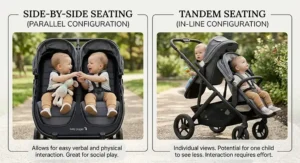
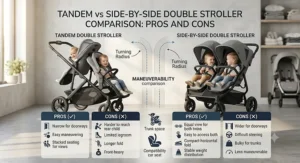
A tandem stroller for twins stacks both seats front-to-back, and the biggest advantage shows up the moment you try to get through a doorway. Tandem models are typically no wider than a single stroller, making them well suited to urban use, shopping trips, and tight hallways, and they tend to fold more compactly than side-by-side models — a real advantage for small apartments and smaller trunks. What most buyers overlook is that the fold advantage compounds: a stroller that folds smaller also stores more easily in a coat closet or under a stairwell, which matters every single day, not just on trips.
The honest downside is seating inequality. The child in the back seat may have a more limited view and less legroom, and tandem strollers can be harder to maneuver and turn in tight spaces. For twins specifically — as opposed to a baby-and-toddler pairing — that inequality is felt more acutely, since neither child should reasonably be treated as the “lesser” seat. Weight distribution can also feel unbalanced if one twin is notably heavier than the other, though for twins born close in weight this is rarely a dealbreaker in practice.
Side-by-Side Stroller Pros and Cons
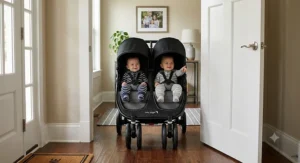
A side-by-side stroller for twins puts both seats next to each other, and the core selling point is fairness: both twins get an equal view of their surroundings, equal legroom since neither seat sits in front of the other, and parents can keep an eye on both children simultaneously. In many models, both seats recline independently, so uneven nap schedules don’t force one twin to sit upright because the other is asleep.
The trade-off is almost entirely about space. The wider design can make it difficult to fit through standard doorways and maneuver in tight spaces, and side-by-side strollers are generally bulkier to store and transport, taking up more room in vehicles and at home. Based on the spec comparison across all seven strollers in this guide, the width penalty ranges from roughly zero (the Bugaboo Donkey 5 Twin‘s clever narrow-mono design) to nearly ten inches wider than a comparable tandem — so “side-by-side means wide” is true on average but not universal.
Stroller Layout for Twins: What the Research and Reviews Say
Choosing the right stroller layout for twins comes down to a short, repeatable checklist. Here’s how experienced parents and product testers actually work through it:
- Measure your tightest doorway or hallway first. This single number eliminates half your options before you compare a single spec sheet.
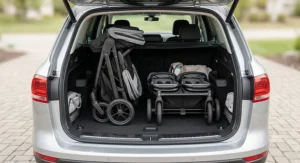
- Count your car’s trunk depth, not just width. A stroller that fits through your front door can still fail to fold into a compact-car trunk.
- Decide how much seating equality matters to you. If both twins need identical sightlines and legroom, side-by-side wins by design.
- Factor in your typical terrain. Sidewalks and parks favor side-by-side stability; hallways and store aisles favor tandem width.
- Set a real budget range before browsing. Prices here span from under $200 to well over $1,000, and window-shopping without a ceiling leads to overspending.
- Check independent testing, not just brand marketing. Sites doing independent lab testing evaluate maneuverability and durability in ways a product page never will.
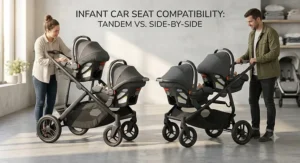
- Confirm car seat compatibility if you’re building a travel system. Not every stroller accepts every infant car seat brand out of the box.
Working through those seven steps in order — rather than starting with brand loyalty or aesthetics — is genuinely the fastest way to land on the right layout for your specific home, car, and walking routine.
Stroller Maneuverability and Doorway Width: What to Expect
On paper, a two-inch width difference sounds trivial. In practice, it’s the difference between gliding through a doorway one-handed and doing an awkward three-point turn with two babies watching. Standard interior door widths in the US typically run 32 to 36 inches, which means any stroller over roughly 30 inches wide is going to require some careful angling at your own front door, not just at stores.
Maneuverability is a separate question from width, and it’s easy to conflate the two. A narrow tandem can still handle awkwardly if its wheelbase is long, since turning radius depends on length as much as width — this is the real-world trade-off behind reviewer complaints that tandem strollers can be long and awkward to turn, especially in tight spaces. Side-by-side strollers, by contrast, are often reported as easier to pivot precisely because their shorter wheelbase compensates for the extra width, especially on models like the Bugaboo Donkey 5 Twin, which is engineered specifically for one-hand steering.
Seat Visibility for Infants: Why It Matters for Twins
Seat visibility sounds like a minor comfort feature until you’re the parent walking behind a stroller wondering if your back-seated infant is actually asleep or quietly upset. In tandem strollers, the rear seat is structurally the one with reduced sightlines, since a front seat and canopy sit directly in the line of view. Stadium-style seating, where the rear seat sits slightly elevated, is one manufacturer response to this exact complaint, and it does meaningfully help, even if it doesn’t fully equalize the two positions.
Side-by-side strollers sidestep the issue almost entirely. Because neither seat sits in front of the other, both twins get the same forward view and the same amount of parental eye contact during a walk. For newborn twins especially, who spend a large share of stroller time either asleep or quietly observing their surroundings, that equal visibility can matter more to some parents than the width trade-off costs them.
Common Mistakes When Buying a Double Stroller for Twins
The most frequent mistake is buying based on a showroom test walk rather than your actual daily route — a stroller that glides beautifully across polished store floors can behave very differently on cracked sidewalks or gravel. A close second is skipping the doorway-and-trunk measurement step entirely and assuming “double stroller” means one standard size; as this guide shows, widths swing from about 20 to over 30 inches across real products.
Parents also frequently underestimate weight limits, assuming a stroller rated for two children will comfortably last until preschool, when many budget tandems cap out at 35–40 lbs per seat — worth checking against your own growth curve expectations. Finally, don’t skip safety verification: strollers sold in the US must meet the CPSC’s ASTM F833 safety performance and labeling requirements, which cover latching mechanisms, structural integrity, and stability, and checking a model against federal stroller safety standards takes a few minutes and can flag any open recalls before you buy secondhand or discounted units.
Long-Term Cost & Maintenance
The sticker price is only part of the real cost of a twin stroller. Air-filled tires, like those on the Baby Jogger City Mini GT2 Double, ride smoother but need occasional pressure checks; foam or puncture-proof tires, like those on the Bugaboo Donkey 5 Twin, trade a slightly firmer ride for essentially zero maintenance over the stroller’s life. Fabric seats need regular washing on a twin stroller far more than a single, simply because two children generate roughly double the mess.
Cost-per-use is worth calculating honestly: a $1,000+ premium stroller used daily for three years works out to under a dollar a day, often less than a cheaper stroller replaced twice due to wear. All carriages and strollers sold in the US must meet the CPSC’s mandatory ASTM F833 standard, and manufacturers periodically update compliance under revised federal safety rules, so registering your stroller with the manufacturer ensures you’re notified directly if a recall or safety update ever applies to your specific model.
✨ Don’t Miss These Exclusive Deals!
🔍 Ready to see current pricing on any of these seven strollers? Click through to check availability and grab the twin-ready pick that fits your doorway, budget, and daily walk best!
Frequently Asked Questions
❓ Is a tandem or side-by-side stroller better for twins?
❓ Do side-by-side strollers fit through standard doorways?
❓ How much does a good double stroller for twins cost?
❓ Can twins use a tandem stroller from birth?
❓ What's the biggest downside of a side-by-side stroller for twins?
Conclusion
There’s no single right answer to tandem vs side-by-side double stroller for twins — there’s only the right answer for your doorways, your car, your budget, and your walking routine. If your home and daily errands are tight on space, a tandem like the Graco DuoGlider or UPPAbaby Vista V3 with RumbleSeat solves the width problem outright. If equal seating and visibility matter more to you than doorway clearance, a side-by-side like the Baby Jogger City Mini GT2 Double or Bugaboo Donkey 5 Twin delivers that fairness without excessive compromise.
Whichever direction you lean, measure before you buy, verify current pricing since it shifts constantly, and confirm the model meets current federal safety standards before it ever carries your twins. Every stroller on this list has real strengths and real trade-offs — the honest work is matching those trade-offs to your actual life, not to a showroom floor.
🛒 Ready to Compare Your Top Picks?
Check current pricing and availability on the strollers that fit your doorway and budget best — the right double stroller for twins is out there, and now you know exactly what to look for.
Recommended for You
- 7 Best Lightweight Side-By-Side Double Strollers For Travel (2026)
- 7 Best Side-by-Side Double Strollers With Equal-Size Seats (2026)
- 7 Side-By-Side Double Stroller for Twins Under $400 Picks (2026)
Disclaimer: This article contains affiliate links. As an Amazon Associate, I earn from qualifying purchases. If you purchase products through these links, we may earn a small commission at no additional cost to you.
✨ Found this helpful? Share it with your friends! 💬🤗
