
In This Article
Twins, or two kids close in age, have a funny way of making your stroller budget feel like a joke. You go shopping expecting to spend $150, and suddenly you’re staring at a $700 tandem with a leather handlebar wondering if it also walks the dog. Here’s the good news: a genuinely solid tandem double stroller under $350 exists, and you don’t have to gamble on a no-name brand from a shipping container to find one.
A tandem double stroller under $350 is a front-and-back (inline) double stroller — one seat behind the other rather than side by side — priced at or near the $350 mark, built to carry two kids without needing a second mortgage. It’s the format most parents pick when doorway width, sidewalk etiquette, and store aisles matter more than symmetrical seating. Below, we dug into seven real, currently sold models — from a scrappy $170 economy pick to a $350-ish option with genuine one-hand 360° steering — and broke down what each one actually delivers once you get it home. Every product mention here reflects real specs and real aggregated review sentiment, not marketing copy dressed up as opinion.
We’ll also dig into the questions that actually decide whether you’re happy with this purchase in six months: tandem stroller width and whether it clears your hallway, how stroller storage capacity holds up once you’ve got two diaper bags in tow, and whether “one-hand steering” on the box translates to real life or just sounds nice on Amazon. If you’re weighing an affordable tandem double stroller against a mid-price tandem stroller, this guide should settle the question by the time you hit the FAQ.
Quick Comparison Table
| Stroller | Price Range | Weight | Best For |
|---|---|---|---|
| Graco DuoGlider Click Connect | around $200-230 | 29.5 lbs | Lightest all-rounder, Graco car seat families |
| Baby Trend Sit N’ Stand Double 2.0 | around $170-215 | approx. 30 lbs | Toddler + infant combo, standing platform |
| Baby Trend Morph Single to Double | around $240-300 | approx. 25 lbs (single mode) | Modular families who want a bassinet option |
| Graco Ready2Grow LX 2.0 | around $200-240 | 32.85 lbs | Huge storage basket, two infant car seats |
| Chicco Cortina Together | around $330-360 | 34 lbs | Premium ride quality, dual car seat click-in |
| Joovy Caboose Ultralight | around $300-330 | 22 lbs | Lightest sit-and-stand tandem on this list |
| Contours Curve V2 | around $330-370 | approx. 33 lbs | Best one-hand steering, 360° turning |
Looking at the spread above, the budget tier (Graco DuoGlider Click Connect and Baby Trend Sit N’ Stand Double 2.0) wins on pure dollars-per-pound, but they trade away some ride smoothness and basket access. The middle of the pack — Baby Trend Morph Single to Double and Graco Ready2Grow LX 2.0 — is where most families actually land, since both flex with a growing family without cracking $300. At the top, Chicco Cortina Together and Contours Curve V2 creep right up to (and occasionally past) the $350 ceiling, but they’re the two picks that feel like a “real” stroller rather than a budget compromise.
💬 Just one click — help others make better buying decisions too!😊
Top 7 Tandem Double Stroller Under $350 Picks: Expert Analysis
1. Graco DuoGlider Click Connect — lightest full-size tandem on the list
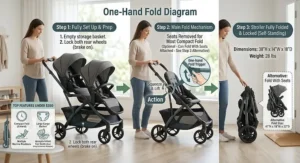
At 29.5 pounds, the Graco DuoGlider Click Connect is genuinely one of the lighter full-size tandem strollers you’ll find near this price point, which matters more than it sounds like it should when you’re lifting a loaded stroller into a trunk with a toddler screaming about goldfish crackers. The stadium-style seating raises the rear seat slightly above the front, so the back-seat kid isn’t just staring at their sibling’s shoulder blades the whole walk. Both seats recline, and the rear seat goes fully flat, which is the detail that makes this workable for a younger baby riding behind an older sibling.
Who should care: parents already invested in Graco’s SnugRide Click Connect car seat ecosystem, since the DuoGlider accepts two of them directly with no adapter. Aggregated review sentiment across major retailers puts this model around a 4.0-star average — reviewers consistently note the one-hand fold as a genuine convenience, while a recurring complaint is that the stroller feels less sturdy than pricier tandems once both seats are loaded with older toddlers near the 40-pound limit.
Pros:
- ✅ One of the lightest full tandem strollers near this price
- ✅ Rear seat reclines fully flat for younger riders
- ✅ Accepts two Graco infant car seats with no adapter
Cons:
- ❌ Feels less stable with two heavier toddlers aboard
- ❌ Only compatible with Graco SnugRide car seats
Expect to pay somewhere in the $200-230 range at the time of research, prices may vary. Given the weight and fold convenience, it’s a strong value pick for families who don’t need off-road capability.
2. Baby Trend Sit N’ Stand Double 2.0 — best for mismatched ages
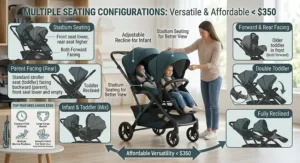
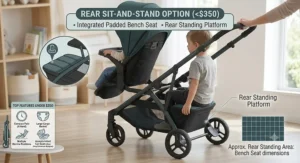
The Baby Trend Sit N’ Stand Double 2.0 solves a specific problem: what do you do when one kid has outgrown sitting still but still can’t walk three miles? The rear seat converts into a standing platform or bench, so an independent 3- or 4-year-old can ride standing up while a younger sibling sits up front. The redesigned single front wheel (versus the older dual-wheel version) trims the footprint and makes it noticeably easier to push through a single grocery-store aisle.
Here’s what most buyers overlook: the “large basket with front and rear access” sounds generous on the box, but real-world access is genuinely limited by the rear seat’s footrest, and quite a few reviewers report items sliding out the open back of the basket during a bumpy walk. Based on the spec comparison with other budget tandems on this list, the Sit N’ Stand’s main advantage isn’t storage — it’s the standing platform flexibility, which none of the pure two-seat models here offer.
Pros:
- ✅ Converts to standing platform for an older rider
- ✅ 5-point harness on both seats for security
- ✅ Single front wheel improves maneuverability
Cons:
- ❌ Basket access is awkward and items can fall out
- ❌ Feels heavy once the rear seat and platform are both loaded
Price runs around $170-215 depending on retailer and color — genuinely one of the more affordable tandem double stroller options that isn’t a total gamble on build quality.
3. Baby Trend Morph Single to Double Modular Stroller — most configurable frame
The Baby Trend Morph Single to Double Modular Stroller takes a different approach: it starts as a single stroller with a seat that converts into a bassinet, then grows into a double by adding a rear seat, bench, or standing board. Baby Trend markets over 25 riding configurations, and while that number is obviously generous marketing math, the underlying flexibility is real — this is the only stroller in our lineup that can genuinely take a newborn in bassinet mode and later carry two kids at once on the same frame.
What that means in practice: if your second child hasn’t arrived yet, you’re not buying a double stroller you’ll only half-use for a year. The height-adjustable handlebar is a small but appreciated touch for taller parents, something budget doubles frequently skip. On the honest side, this modularity comes with a learning curve — expect the first assembly and mode-switch to take real trial and error, and the extra hardware (adapters, second seat) adds bulk when folded compared to a simpler two-seat tandem.
Pros:
- ✅ Bassinet mode for true newborn use
- ✅ Height-adjustable handlebar for tall parents
- ✅ Grows from single to double on one frame
Cons:
- ❌ More parts means a steeper learning curve
- ❌ Bulkier fold than simpler two-seat tandems
At around $240-300, this sits squarely in mid-price tandem stroller territory rather than rock-bottom budget, but the modularity is what you’re paying for.
4. Graco Ready2Grow LX 2.0 — biggest storage basket, most seat modes
The Graco Ready2Grow LX 2.0 leans hard into flexibility: two full stroller seats, a pull-out bench, and a standing platform, all built into one frame that folds like a single stroller despite riding like a double. It accepts two Graco infant car seats simultaneously, with a 50-pound front seat weight limit and a 40-pound rear seat limit — generous numbers that mean this stroller has real staying power as your kids grow.
The storage basket underneath is enormous by tandem standards, and that’s the honest headline feature here. What the spec sheet won’t tell you, but independent lab testing notes, is that the basket’s usable capacity is capped at only around 10 pounds despite its physical size, and access is limited when the bench seat is tucked in — so “giant basket” doesn’t automatically mean “giant hauling capacity.” Reviewers are split: many twin and sibling parents genuinely love the versatility and compact fold, while others report the stroller pushes harder than lighter competitors and that only the lower seat reclines.
Pros:
- ✅ Multiple seating and standing configurations
- ✅ Accepts two infant car seats at once
- ✅ Folds compact despite double-stroller capacity
Cons:
- ❌ Basket weight limit caps at roughly 10 lbs
- ❌ Upper seat recline is more limited than the lower seat
Typically priced around $200-240, making it one of the better-value mid-price tandem stroller picks if the multi-seat flexibility matters more to you than a plush ride.
5. Chicco Cortina Together — most premium ride and car-seat integration
The Chicco Cortina Together is the closest thing on this list to a “real” stroller rather than a budget compromise, and it shows in the details: an aluminum frame, all-wheel suspension, and a click-in attachment that accepts two Chicco KeyFit or Fit2 infant car seats with zero adapters. At 34 pounds it’s not light, but the added weight buys a noticeably smoother ride over cracked sidewalks and curb cuts than the lighter economy picks on this list.
Based on the spec comparison, the Cortina Together’s standout feature is genuine car-seat integration for families with two Chicco seats already in rotation — the front seat folds forward and the rear seat reclines to accept a car seat directly, no bar attachment required. Aggregated review sentiment is more mixed than Chicco’s reputation might suggest: reviewers consistently praise the smooth ride and generous storage basket, while a recurring complaint in independent lab testing is that only the front seat gets dual cup holders and the canopies run smaller than expected for the price.
Pros:
- ✅ Accepts two Chicco infant car seats, no adapter
- ✅ All-wheel suspension for a smoother ride
- ✅ One-hand standing fold, self-supporting
Cons:
- ❌ Heavy at 34 lbs, harder to lift into a trunk
- ❌ Rear seat lacks cup holders included on the front
Priced around $330-360 depending on color and retailer, the Cortina Together sits right at the edge of a tandem double stroller under $350 budget — worth it specifically if car-seat compatibility and ride comfort outweigh saving another $100.
6. Joovy Caboose Ultralight Sit and Stand Tandem — lightest sit-and-stand double
Sit-and-stand tandems are usually heavy by design, which makes the Joovy Caboose Ultralight Sit and Stand Tandem stand out: at roughly 22 pounds, it’s genuinely one of the lightest strollers in this entire category, tandem or otherwise, while still carrying a combined 90-pound capacity across a full front seat plus a rear bench-and-standing platform. That’s a meaningful advantage over the Baby Trend Sit N’ Stand covered earlier — same basic concept, noticeably less mass to wrangle up stairs or into a hatchback.
The honest trade-off: Joovy achieves that low weight partly through a simpler aluminum frame and fewer padded extras than its heavier Caboose siblings, so this isn’t the plushest ride if smooth pavement isn’t guaranteed. What most buyers overlook is that it ships with a universal car-seat adapter included standard, something several competitors on this list charge extra for or omit entirely. Reviewers who compare it directly to the original (heavier) Caboose consistently note they don’t miss the extra weight in daily use.
Pros:
- ✅ About 22 lbs — lightest sit-and-stand tandem here
- ✅ Universal infant car-seat adapter included
- ✅ Meets Disney park stroller size requirements
Cons:
- ❌ Less cushioned than Joovy’s heavier Caboose models
- ❌ Standing platform still adds bulk when folded
At around $300-330 based on current Joovy pricing, it undercuts the Cortina Together while still feeling like a considered purchase rather than a bargain-bin grab.
7. Contours Curve V2 — best one-hand steering and maneuverability
If one-hand steering is your top priority, the Contours Curve V2 is built specifically to deliver it. Its 6-wheel design and curb-assist feature let you pivot the whole double stroller with a single hand the way you’d steer a single stroller — a genuine differentiator, since most tandems on this list need two hands the moment you’re navigating a tight aisle or reversing out of an elevator. Both seats are reversible, removable, and recline nearly flat, each supporting up to 40 pounds.
Here’s what the spec sheet doesn’t fully capture: that 360° turning radius comes from a small-wheel rear axle setup rather than large single wheels, which trades a bit of off-road smoothness for tight-space agility. Based on aggregated buyer feedback, reviewers who live in cities or shop in narrow-aisle stores consistently rate the steering as the single best reason to choose this over a heavier tandem, while suburban parents who mostly walk flat sidewalks report they’d have been just as happy with a cheaper, simpler model.
Pros:
- ✅ Genuine one-hand 360° steering via 6-wheel design
- ✅ Both seats fully reversible and removable
- ✅ Curb-assist feature eases handling over curbs
Cons:
- ❌ Small rear wheels feel rougher on uneven terrain
- ❌ Price sits at or slightly above the $350 mark
Expect to pay around $330-370 at the time of research — worth stretching the budget for if maneuverability in tight urban spaces is a daily reality rather than an occasional annoyance.
Practical Usage Guide: Setting Up and Maintaining Your Tandem Double Stroller
First 30 days matter more than people expect. Before your first outing, fully extend and re-fold the stroller two or three times at home — most first-time frustration with a new tandem comes from fighting an unfamiliar fold mechanism on a sidewalk, not a defective unit. Check that both harnesses click at the same tension setting; tandem strollers see uneven wear because the rear seat often carries the lighter, younger child and gets adjusted less often.
A maintenance habit that pays off: wipe down the wheel axles monthly, especially if you’re pushing over gravel, sand, or salted winter sidewalks — grit works into the bearings faster on a two-seat stroller because of the added weight bearing down on each wheel. Most manufacturer manuals recommend a light oil on squeaky wheels rather than heavier grease, which attracts more dirt over time. Common early mistake: overloading the parent tray or storage basket beyond its rated capacity, which throws off the stroller’s balance point and makes one-hand steering — even on models built for it — noticeably harder. Finally, register your stroller with the manufacturer in the first week; recall notices for hinge and latch mechanisms are common enough in this category that registration is worth the five minutes it takes.
Real-World Scenarios: Which Tandem Stroller Fits Your Family
The new-baby-plus-toddler household. If your second child is due soon and your toddler still naps in a stroller, the Baby Trend Morph Single to Double is built exactly for this transition — bassinet mode now, second seat added later, one frame the whole way through. Budget for the $240-300 range and you won’t need to rebuy in six months.
Twins with a daily commute on foot. For parents pushing two same-age kids through city blocks, narrow store entries, and elevator doors multiple times a day, the Contours Curve V2‘s one-hand steering earns its higher price. The 360° turning radius genuinely changes how tiring a two-mile walk feels by the third stop.
A budget-first family doing mostly flat, suburban walking. If your typical outing is a paved neighborhood loop or a mall, the Graco DuoGlider Click Connect or Baby Trend Sit N’ Stand Double 2.0 covers the basics without the premium price tag — and if your older child mostly wants to stand rather than sit, the Sit N’ Stand’s platform mode is the more practical pick of the two.
Problem → Solution: Common Tandem Stroller Headaches Solved
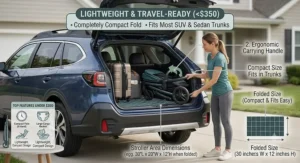
Problem: the stroller won’t fit through your front door or a store aisle. Solution: measure your tightest doorway before buying, then cross-check it against the assembled width listed for each stroller — most tandems here run 23-26 inches wide, narrow enough for standard 30-inch doorways, but a few inches makes a real difference in tight older homes.
Problem: the storage basket looks big but you can’t actually reach it. Solution: prioritize models with rear-zipper or drop-down basket access, like the Chicco Cortina Together, over baskets that are only reachable from the front when the rear seat is reclined.
Problem: one kid always wants to stand, not sit. Solution: a sit-and-stand hybrid like the Baby Trend Sit N’ Stand Double 2.0 or Joovy Caboose Ultralight solves this directly rather than fighting a toddler who refuses to stay seated.
Problem: steering feels like arm day at the gym. Solution: if daily maneuverability is the actual pain point, don’t settle for a heavier, two-hand-steering model just to save $50 — the Contours Curve V2‘s one-hand steering is worth the stretch.
Problem: you’re not sure the stroller will still fit your kids in a year. Solution: check the per-seat weight limit, not just the total. The Graco Ready2Grow LX 2.0‘s 50-pound front seat limit buys meaningfully more runway than a 35-pound umbrella-style tandem.
How to Choose an Affordable Tandem Double Stroller
- Start with your doorway and car trunk, not the stroller’s marketing photos. Measure both before you shop; an affordable tandem double stroller that doesn’t fit your hallway isn’t actually affordable once you’re returning it.
- Decide if you need dual car-seat compatibility now, or can wait. If you’re expecting a second child soon, click-in car seat compatibility (like on the Graco DuoGlider or Chicco Cortina Together) saves you from buying a separate infant travel system.
- Weigh the stroller in-store if at all possible. A 10-pound difference between models sounds trivial until you’re lifting it up porch steps daily.
- Check the per-seat weight limit against your kids’ ages, not just current weight. Buying for growth room avoids a second purchase within a year.
- Read the basket access details, not just the capacity number. A “large basket” that’s hard to reach isn’t actually more useful than a smaller, accessible one.
- Factor in your actual walking surfaces. Smooth suburban sidewalks tolerate smaller wheels fine; gravel paths or cracked urban pavement reward larger, suspension-equipped wheels.
- Register the product and read the manual’s fold instructions before day one, since fold mechanism confusion is the single most common early frustration reported across brands.
Tandem Stroller Width: Why It Matters More Than You Think
Tandem stroller width is the entire reason people choose this format over side-by-side doubles in the first place — most tandems on this list run between roughly 20.5 and 25.7 inches wide, comfortably clearing a standard 30-inch doorway, while side-by-side doubles routinely run 30+ inches and can require an awkward sideways shuffle through narrower openings. The Graco DuoGlider Click Connect, at 20.5 inches, is among the narrowest full-size options here, which matters if you’re navigating older homes, coffee shop entrances, or crowded transit.
Here’s what buyers overlook: width alone doesn’t guarantee easy handling. A narrow stroller with a long wheelbase (many tandems run 44-48 inches long) can still feel unwieldy around tight corners, which is exactly the gap the Contours Curve V2‘s 360° steering is designed to close. If your daily route involves narrow store aisles more than doorways, prioritize turning radius alongside raw width, not instead of it.
Basket Storage and Stroller Storage Capacity: What “Big Basket” Really Means
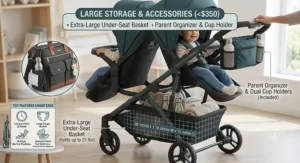
Stroller storage capacity gets marketed almost entirely on visual size, but the number that actually matters is the weight limit, and it’s frequently buried in the fine print. The Graco Ready2Grow LX 2.0 is the clearest example on this list: its basket looks enormous, yet independent testing caps usable capacity around 10 pounds — plenty for a light diaper bag, not enough for a loaded one plus groceries.
If you specifically want a tandem stroller with basket storage you can actually load up, prioritize access design over sheer size. The Chicco Cortina Together‘s rear-zipper access means you can reach the basket even with the seat reclined, while baskets that are only front-accessible (or open-backed, like on the Baby Trend Sit N’ Stand) tend to lose items during a bumpy walk regardless of their stated capacity. A practical rule of thumb: if you’re regularly hauling a full diaper bag, a water bottle, snacks, and a jacket or two, look for stated capacities north of 15 pounds and confirm the access point before buying, not after.
One-Hand Steering: Which Picks Actually Deliver
One-hand steering means different things depending on the stroller’s wheel design, and it’s worth understanding the distinction before you assume every “easy to push” claim on a listing page means the same thing. True one-hand 360° steering — where you can pivot the entire frame with a single wrist motion — really only shows up on the Contours Curve V2 in this lineup, thanks to its 6-wheel, curb-assist design built specifically for that purpose.
The rest of the field offers one-hand folding, which is a genuinely useful feature but a different one entirely — the Graco DuoGlider, Graco Ready2Grow LX 2.0, and Chicco Cortina Together all fold one-handed for storage, but still require two hands to comfortably steer once loaded and moving, particularly around tight corners. If one-hand steering while walking (not folding) is your actual priority — say, because you’re often carrying a coffee, a phone, or a second kid’s hand — that narrows your realistic field to the Curve V2, even accounting for its position at the top of this budget range.
Budget vs Mid-Price Tandem Stroller vs Premium: What You Actually Get
At the budget end (roughly $170-215), the Baby Trend Sit N’ Stand Double 2.0 and lower-priced Graco DuoGlider listings deliver the essentials — two seats, a harness, basic recline — but expect tradeoffs in ride smoothness and basket access. Move into mid-price tandem stroller territory (roughly $220-300), and you pick up meaningfully more: the Baby Trend Morph‘s modularity, the Graco Ready2Grow LX 2.0‘s multi-seat flexibility, and the Joovy Caboose Ultralight‘s genuinely lighter frame all live here, representing the sweet spot where most families land.
At the top of this budget, roughly $330-370, the Chicco Cortina Together and Contours Curve V2 aren’t dramatically better strollers in every category — they’re better at one or two specific things (ride comfort and car-seat integration for the Cortina, steering for the Curve) that either matter enormously to your daily life or don’t matter much at all. The honest ROI question isn’t “is expensive better,” it’s “does the specific upgrade this model offers solve a problem I actually have.”
Common Mistakes When Buying a Tandem Double Stroller Under $350
The most common mistake is buying based on the front-page photo rather than the per-seat weight limit — several economy tandems cap out around 35-40 pounds per seat, which sounds like plenty until a healthy 3-year-old blows past it earlier than expected. A close second: skipping the doorway and trunk measurements, then discovering the stroller technically fits but only with a fight every single time.
Parents also frequently underestimate fold complexity. A one-hand fold on the spec sheet doesn’t tell you how many steps precede that final motion — some strollers require removing trays or repositioning seats first, which defeats the “one-hand” convenience in practice. Finally, don’t assume a higher price automatically means a smoother ride; as covered above, the Chicco Cortina Together and Contours Curve V2 earn their price with specific strengths, not universal superiority over every cheaper option here.
Tandem Stroller vs Side-by-Side Stroller
Tandem strollers, like the seven covered here, seat kids one behind the other and keep the overall width close to a single stroller — typically 20-26 inches — which is the format’s core advantage for doorways, aisles, and public transit. Side-by-side doubles distribute weight more evenly left-to-right, which several parents find easier to push in a straight line, and both kids get equal forward visibility rather than one staring at the other’s headrest.
The trade-off runs the other direction too: side-by-sides routinely measure 30+ inches wide, which is exactly the width many standard doorways max out at, leaving little margin for error. Tandems, meanwhile, tend to run longer (44-48 inches is typical), which can make them feel less nimble in a tight 180-degree turn unless, like the Contours Curve V2, they’re specifically engineered around that problem. If your daily environment is narrow — city apartments, small stores, crowded sidewalks — tandem wins on paper almost every time; if you’re mostly in wide-open suburban spaces and want equal sightlines for both kids, a side-by-side is worth cross-shopping too.
Long-Term Cost & Maintenance
A $200 tandem and a $350 tandem often end up costing similar amounts over three years once you factor in wheel bearing wear, replacement fabric liners, and — in the case of lighter budget frames — a higher chance of needing hinge or latch part replacements covered under warranty. Heavier, suspension-equipped models like the Chicco Cortina Together tend to show less wear on rough pavement over time, which can offset some of the higher upfront cost if your walking routes include cracked sidewalks or gravel.
Practical total-cost-of-ownership tips: buy machine-washable seat liners if the stroller doesn’t include them, since replacing a stained non-removable seat pad usually costs more than a liner would have. Budget roughly $20-40 a year for wheel maintenance supplies and the occasional replacement harness clip. Strollers with wider brand ecosystems — Graco and Chicco both sell readily available replacement parts — tend to have a lower effective cost of ownership than smaller brands where parts can be harder to source secondhand.
Safety, Regulations & Compliance Guide
Every stroller sold in the United States, tandem or otherwise, is legally required to meet the federal safety standard for carriages and strollers, which incorporates the ASTM F833 specification covering stability, brakes, restraint systems, and structural integrity. The U.S. Consumer Product Safety Commission maintains ongoing oversight of stroller safety standards, and it’s worth a quick search of any model you’re considering before purchase, since hinge-pinch and latch-related recalls have affected multiple mainstream stroller brands over the years, including some covered in this article.
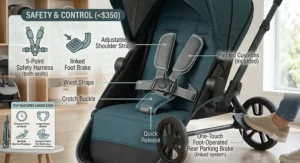
Practical safety habits matter as much as the stroller itself: always use the 5-point harness on both seats, even for a “quick trip,” since a majority of documented stroller injuries involve a child who wasn’t fully restrained. Check that front-wheel locks engage properly before heading downhill, and never hang heavy bags directly from the handlebar — it’s a leading cause of tip-overs on lighter tandem frames, since it shifts the stroller’s center of gravity backward and up.
✨ Don’t Miss These Exclusive Deals!
🔍 Take your tandem double stroller under $350 search to the next level with these carefully selected picks. Click on any highlighted item to check current pricing and availability. These strollers will help you create smooth, stress-free outings your family will love!
FAQ
❓ What is the best tandem double stroller under $350?
❓ Is a tandem stroller better than a side-by-side for two kids?
❓ How wide is a typical tandem double stroller?
❓ Can a tandem double stroller hold two car seats?
❓ How much storage does a tandem stroller basket actually hold?
Conclusion
A tandem double stroller under $350 doesn’t have to mean choosing between “cheap and flimsy” or “nice but over budget.” The seven models above cover genuinely different priorities — the Baby Trend Sit N’ Stand Double 2.0 and Graco DuoGlider Click Connect for families who want the basics done well and affordably, the Baby Trend Morph Single to Double and Graco Ready2Grow LX 2.0 for those who need flexibility as their family grows, and the Chicco Cortina Together, Joovy Caboose Ultralight, and Contours Curve V2 for parents willing to stretch toward $350 for a specific, meaningful upgrade in ride quality, weight, or steering.
The right pick genuinely comes down to your daily reality: measure your doorway, be honest about your walking surfaces, and decide whether car-seat compatibility, storage access, or one-hand steering matters most to your routine. Any of these seven will get your kids where they’re going safely — the differences that matter are the ones that show up on the fortieth walk, not the first.
✨ Ready to find your perfect match? Compare these picks side by side and grab the one that fits your family’s daily routine best!
Recommended for You
- Tandem vs side-by-side double stroller for twins: 7 Picks for 2026
- 7 Best Lightweight Side-By-Side Double Strollers For Travel (2026)
- 7 Best Side-by-Side Double Strollers With Equal-Size Seats (2026)
Disclaimer: This article contains affiliate links. As an Amazon Associate, I earn from qualifying purchases. If you purchase products through these links, we may earn a small commission at no additional cost to you.
✨ Found this helpful? Share it with your friends! 💬🤗
