
In This Article
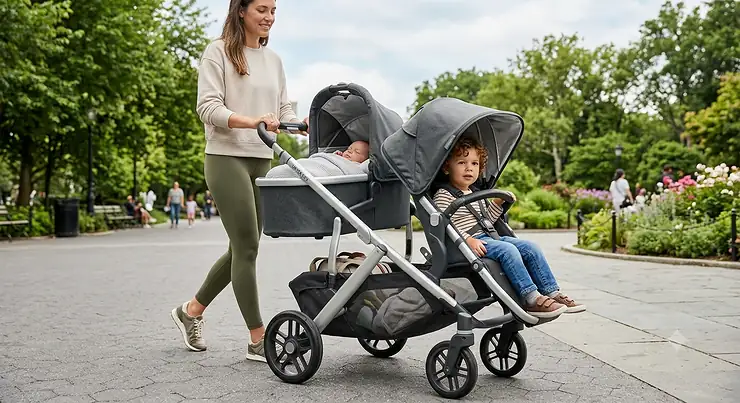
Nobody tells you, in those glassy-eyed first weeks with a toddler already running the show, that the stroller aisle is where your sanity goes to get tested. You need something that can cradle a six-pound newborn one week and wrangle a squirmy two-year-old the next, and most of what’s on the shelf is built for one job, not both. A tandem double stroller for newborn and toddler is a front-to-back stroller — as opposed to side-by-side — designed to carry two children of noticeably different ages and sizes on the same frame, usually with a near-flat or fully reclining rear seat, bassinet compatibility, and the ability to click in an infant car seat without waking anyone up in the process. That’s the forty-five-second definition. The rest of this guide is the part nobody puts on the box: which real models actually deliver on that promise, which ones quietly fall apart on the “newborn” half of the equation, and how to read the spec sheet like someone who’s already made the mistake so you don’t have to.
We pulled together seven real, currently available strollers — from an entry-level Graco to a four-figure Bugaboo — after digging through manufacturer specs, the federal safety standard that governs how strollers must be built and tested, and the aggregated sentiment from real owner reviews. The Consumer Product Safety Commission’s mandatory stroller standard exists precisely because tandem strollers see more real-world stress than almost any other baby gear category — two kids, uneven curbs, a diaper bag the size of a duffel — so we’re weighing durability and hardware just as heavily as looks. What most buyers overlook is that “double stroller” and “tandem double stroller for newborn and toddler” are not interchangeable terms; plenty of doubles simply aren’t built to safely hold an infant until they’re six months old. We’ll flag exactly which of these seven get that right, and which ones you should only buy if your baby is already walking.
Quick Comparison Table
| Stroller | Best For | Price Range | Newborn-Ready |
|---|---|---|---|
| Uppababy Vista V3 Double | Best all-around from-birth system | $1,300-$1,700 range | Yes, bassinet included |
| Bugaboo Kangaroo Double | Best suspension and ride quality | $1,600-$2,000 range | Yes, bassinet compatible |
| Baby Jogger City Select 2 Double | Most seating configurations | $800-$950 range | With adapter/bassinet |
| Contours Options Elite V2 | Most flexible budget seating | Around $400-$500 | With car seat adapter |
| Chicco Cortina Together | Simplest car-seat click-in | Around $350-$400 | Yes, no adapter needed |
| Graco DuoGlider | Best overall value | $180-$230 range | Yes, Click Connect seats |
| Baby Trend Sit N’ Stand 2.0 DLX | Lowest cost of entry | Under $200 (stroller only) | With car seat only |
Looking at the spread here, the price gap between the cheapest and priciest option isn’t really about “quality” in a simple sense — it’s about how the newborn stage is handled. The Graco DuoGlider and Chicco Cortina Together get a baby through the infant months by clicking in a compatible car seat, while the Uppababy Vista V3 Double and Bugaboo Kangaroo Double build a dedicated bassinet into the system, which costs more but means less time spent in a semi-reclined position. If your toddler is already past 35 pounds, the math shifts hard toward the budget end, since none of that premium engineering does much for an already-mobile kid.
Take five seconds and tap that share icon — it helps other sleep-deprived parents find this before they buy the wrong stroller. 💬
Top 7 Tandem Double Strollers: Expert Analysis
Every product below got the same treatment: real specs, real aggregated review sentiment (clearly labeled as such), and an honest read on who it’s actually for. Prices are shown as ranges because Amazon pricing shifts constantly — always check the current listing before you buy.
1. Uppababy Vista V3 Double — best from-birth travel system
The headline feature here is that the bassinet, the toddler seat, and Uppababy’s own infant car seats all click directly onto the frame without adapters, which sounds like a small thing until you’re doing it one-handed at 6 a.m. The stroller itself weighs about 27 pounds, the bassinet is rated from birth to 20 pounds, and the toddler seat carries a child up to 50 pounds, so the system is built to transport up to three children when accessories are added. In practice, that means a genuinely newborn-safe setup on one end and a preschooler-capable seat on the other, all on the same chassis. This is the pick for parents who want one stroller to survive the entire 0-to-4 stretch without buying a second unit, and who don’t mind paying premium prices for that longevity — reviewers consistently note the fold is impressively compact for a stroller this capable, though several also mention that without the optional upper seat adapters, legroom between the two seats gets tight fast. Aggregated owner sentiment across major retailers is strongly positive on build quality and ride smoothness, with the recurring complaint being how many accessories are sold separately rather than bundled.
Pros:
- ✅ Bassinet and car seats click in without adapters
- ✅ Toddler seat holds up to 50 pounds — grows with your child
- ✅ Reflective trim and Greenguard Gold certified fabrics
Cons:
- ❌ Upper adapters cost extra but are nearly essential
- ❌ One of the priciest tandem systems on this list
At around $1,300-$1,700 once you add the bassinet and second seat, the Uppababy Vista V3 Double isn’t cheap, but families who keep it for three-plus years often end up spending less per month of use than owners of two separate strollers.
2. Bugaboo Kangaroo Double — best suspension for daily errands
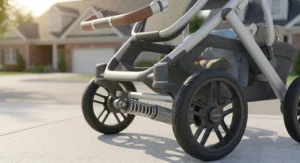
What most buyers overlook about the Bugaboo Kangaroo Double is that its extra-large, shock-absorbing wheels aren’t just a marketing line — they’re the actual reason this stroller gets singled out by testers for ride comfort on cracked sidewalks and cobblestone. The main seat handles children from roughly 6 months to 4 years at up to 50 pounds, while the sibling seat is designed for about 6 to 40 months and up to 40 pounds, and a bassinet rated to 20 pounds fills the newborn gap. Based on the spec comparison with the Vista, the Kangaroo trades a bit of modularity for a noticeably smoother push, thanks to its front-wheel suspension system. This is the stroller for parents doing a lot of walking on imperfect pavement rather than smooth mall floors — new parents in cities with cobblestones or poorly maintained sidewalks report it feels meaningfully steadier than lighter-weight competitors. One thing the spec sheet won’t tell you: the Kangaroo Double only fits one bassinet in the lower position, not two, so it can’t function as a twin newborn stroller — it’s built specifically for the newborn-plus-toddler pairing this article covers, not for twins.
Pros:
- ✅ Extra-large wheels smooth out rough sidewalks
- ✅ One-hand recline, fold, and handlebar adjustment
- ✅ Car seat adapters included in the box
Cons:
- ❌ Can’t hold two bassinets for twin newborns
- ❌ Among the more expensive tandem options here
Expect to pay in the $1,600-$2,000 range for the complete double setup with bassinet, which puts it squarely against the Vista — the deciding factor usually comes down to whether you prioritize ride smoothness (Kangaroo) or from-birth modularity (Vista).
3. Baby Jogger City Select 2 Double — most seating configurations
If flexibility is your priority, the Baby Jogger City Select 2 Double claims 24 different seating configurations once you factor in the second seat, car seat adapters, and glider board. That number sounds like marketing fluff until you actually use it — reversible seats, adjustable recline, and a frame that reconfigures for parent-facing, forward-facing, or face-to-face setups mean this stroller can genuinely adapt as your toddler’s preferences (and your family size) change. Each seat carries up to 45 pounds, for 90 pounds total, and both seats recline independently, which matters enormously with a mixed-age pair since a napping newborn and an alert toddler rarely want the same seat angle at the same time. Reviewers consistently praise the compact fold — Baby Jogger says it’s roughly 20 percent smaller folded than the market-leading rival — but aggregated complaints cluster hard around one specific issue: the second-seat adapter needed to convert it to a true double has repeatedly gone out of stock, forcing buyers into a pricier bundle. Budget for that possibility before you commit.
Pros:
- ✅ 24 seating configurations across single and double modes
- ✅ Independent recline on both seats
- ✅ Folds smaller than most comparable tandems
Cons:
- ❌ Second-seat adapter availability has been inconsistent
- ❌ Car seat adapters sold separately, adding to total cost
Priced around $800-$950 for the double configuration, this sits comfortably in the mid-range tier — a real step down from the Vista and Kangaroo without sacrificing much in the way of build quality.
4. Contours Options Elite V2 — most flexible budget seating
Here’s what the spec sheet won’t tell you, but user reports suggest: the Contours Options Elite V2 manages to pack in seven seating configurations — forward, parent-facing, face-to-face, back-to-back — into a stroller that costs less than half of what the premium tandems on this list run. The aluminum frame weighs only about 34 pounds despite all that seat-swapping hardware, and each seat holds up to 40 pounds. For a newborn-and-toddler pairing specifically, the face-to-face mode is the sleeper feature here — it lets an older sibling keep an eye on (and talk to) the baby, which genuinely cuts down on backseat-style bickering during long walks. Based on the spec comparison, this is the strongest “does almost everything the $1,500 strollers do, at a third of the price” pick on this list, provided you’re comfortable with brand-specific click-in adapters rather than universal compatibility. Aggregated reviews single out the curb-hopping maneuverability as a pleasant surprise for the price point, while the recurring gripe is that when seats are arranged back-to-back, the bottom-seat child’s recline gets limited by the seat above it.
Pros:
- ✅ Seven seating configurations at a budget price
- ✅ Face-to-face mode keeps siblings connected
- ✅ Lightweight aluminum frame for its seating range
Cons:
- ❌ Requires brand-specific car seat adapters
- ❌ Back-to-back recline is limited for the lower seat
At roughly $400-$500, the Contours Options Elite V2 is the value pick for parents who want real configuration flexibility without premium-tier pricing.
5. Chicco Cortina Together — simplest car-seat click-in
The standout here is refreshingly simple: the Cortina Together accepts two Chicco KeyFit or Fit2 infant car seats directly, with no adapter needed. If you already own a Chicco infant seat — and a lot of first-time parents do, since KeyFit is one of the most widely recommended models by pediatric safety technicians — this removes an entire category of compatibility guesswork. The front seat folds forward and the rear seat reclines to accept a car seat with an integrated click-in attachment, and once your kids outgrow their infant seats, both stroller seats offer a multi-position recline of their own for continued use up to 40 pounds each. What most buyers overlook is that “no adapter needed” only applies within the Chicco ecosystem — if your car seat is a different brand, this stroller isn’t for you at all, full stop. Aggregated review sentiment is mixed: parents who stayed within the Chicco system report near-seamless setup, but independent testing has flagged the Cortina as heavier and harder to steer than similarly priced rivals, with notably small canopies that don’t offer much weather protection.
Pros:
- ✅ No adapter needed for Chicco KeyFit or Fit2 seats
- ✅ Rear seat fully reclines for infant comfort
- ✅ One-hand standing fold for easy storage
Cons:
- ❌ Only works with Chicco-brand infant car seats
- ❌ Independent testing found it heavy and hard to turn
Priced around $350-$400, the Chicco Cortina Together is a smart pick specifically for households already invested in Chicco’s car seat lineup — and a poor one for everybody else.
6. Graco DuoGlider — best overall value
The Graco DuoGlider is the stroller most likely to already be sitting in a friend’s garage, and there’s a reason it’s stuck around: it does the fundamentals well at a genuinely low price. It accepts two Graco SnugRide infant car seats via Click Connect, and the rear seat reclines completely flat to double as a cozy infant enclosure when a car seat isn’t attached. At roughly 29.5 pounds with stadium-style seating — the rear child sits slightly elevated for a better view — this hits a sweet spot between weight and durability that pricier strollers sometimes overcorrect on. Reviewers consistently note that tall parents, including plenty over six feet, find the push comfortable and the handlebar height forgiving, which isn’t a given in the tandem category. Here’s what the spec sheet doesn’t fully capture: this is a long stroller, and multiple owners describe the sensation of “pushing a bus” through narrow store aisles, a common tradeoff with tandem designs generally, not a Graco-specific flaw. Reviewers also consistently recommend putting the heavier child up front for better balance.
Pros:
- ✅ Accepts two Graco Click Connect infant car seats
- ✅ Rear seat reclines flat for newborn comfort
- ✅ Comfortable push height, even for tall parents
Cons:
- ❌ Long wheelbase struggles in narrow aisles
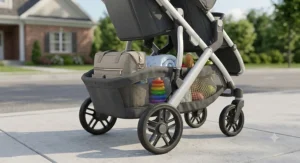
- ❌ Storage basket is tight with two kids’ gear loaded
At $180-$230, the Graco DuoGlider delivers the best dollar-for-dollar value on this list if your only need is reliable, no-frills tandem seating.
7. Baby Trend Sit N’ Stand 2.0 DLX — lowest cost of entry
If budget is the deciding factor above all else, the Baby Trend Sit N’ Stand 2.0 DLX gets you into a tandem-style stroller for less than any other option here, especially when purchased as a stroller-only unit rather than bundled with car seats. It’s compatible with Baby Trend’s own EZ-Lift Plus infant car seats, and the car seat base includes a Flip Foot recline adjustment with a bubble level indicator to help you find a safe angle. The rear platform can also convert to a standing position for an older toddler who’s outgrown seated tandem rides, which stretches the stroller’s useful life further than most budget competitors. Honest talk on this one, though: independent lab testing rated it near the bottom of its category for maneuverability, describing it as harder to push and steer than nearly everything else tested, and the front seat has limited recline room because of how close it sits to the rear seat. This is a stroller for parents who need to check the “does it technically work for a newborn and toddler” box on a tight budget, not one that’s going to feel effortless on a three-mile walk.
Pros:
- ✅ Lowest price point on this list by a wide margin
- ✅ Rear standing platform extends usable life
- ✅ Car seat base includes a recline angle indicator
Cons:
- ❌ Independent testing found it hard to push and steer
- ❌ Front seat recline is limited by rear seat proximity
At under $200 for the stroller alone, the Baby Trend Sit N’ Stand 2.0 DLX is a reasonable stopgap, not a long-term daily driver, and it’s worth setting expectations accordingly before you buy.
Practical Usage Guide: Getting Your Tandem Stroller Set Up Right
Unboxing day is where most of the avoidable mistakes happen, so let’s walk through it properly. First, before your newborn ever rides in the bassinet or a reclined seat, double-check the weight and age minimums printed on the actual product label rather than relying on the marketing copy — the Uppababy Vista V3 Double bassinet, for example, is rated to 20 pounds specifically, and exceeding that isn’t a suggestion you can bend. Second, install any car seat adapters before your first outing, not in a parking lot with a screaming baby; on strollers like the Baby Jogger City Select 2 Double, where adapters are notoriously easy to misplace or find backordered, buy them at the same time as the stroller itself. Third, practice the fold mechanism at home, empty, at least five times — nearly every one-hand-fold stroller has a learning curve, and you don’t want to be discovering it one-handed with a toddler pulling at your sleeve.
For the first 30 days specifically, recheck the harness fit weekly rather than once and forgetting about it; newborns and young toddlers both grow fast enough that a snug fit in week one can be loose by week four. A common mistake is leaving the recline on the toddler seat maxed out even after the child can comfortably sit upright, which reduces their view and can make them more restless on long walks — adjust it up gradually as they show interest in looking around. Finally, register your stroller with the manufacturer immediately; recall notices for hinge and wheel issues do happen across brands, and registration is the only reliable way to get notified directly rather than stumbling across a recall months later.
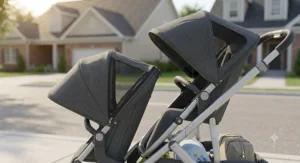
Real-World Scenarios: Matching a Stroller to Your Family
Picture three different households, because “best tandem stroller” genuinely depends on which one you are. First, there’s the apartment-dwelling family of four with a newborn and a two-year-old, tight on storage and doing most errands on foot or by elevator — for them, a compact fold and manageable weight matter more than off-road suspension, which points toward the Chicco Cortina Together or Graco DuoGlider, both of which fold down small enough for a coat closet. Second, consider the suburban family with a driveway, two cars, and a newborn plus an active three-year-old who wants to see everything — here, the Baby Jogger City Select 2 Double‘s face-forward and face-to-face configurations earn their keep, letting the toddler ride forward-facing while the infant seat stays rear-facing and protected.
Third, picture the family that walks three miles a day regardless of weather, on sidewalks that have seen better decades — this is squarely Bugaboo Kangaroo Double or Bob Gear-style suspension territory, where the extra cost buys genuine comfort for both kids over the long haul, not just a status symbol. If your budget caps out well before four figures but you still want configuration flexibility for a newborn and a mobile toddler with very different needs, the Contours Options Elite V2 threads that needle better than almost anything else on this list, giving you seven seating arrangements without the premium price tag.
How to Choose a Tandem Double Stroller for Newborn and Toddler
Cutting straight to it: here’s the numbered process worth following before you spend real money.
- Confirm newborn compatibility first. Check whether the stroller uses a true bassinet, an infant car seat, or both — a stroller seat alone usually isn’t safe or comfortable for a baby under about 4-6 months.
- Match car seat brands before comparing prices. If you already own an infant car seat, compatibility (built-in click-in vs. adapter-required vs. no support at all) should filter your options before cost does.
- Weigh the stroller yourself, loaded. A stroller that feels manageable empty in a showroom can feel very different with two kids, a diaper bag, and a stroller organizer hanging off the handlebar.
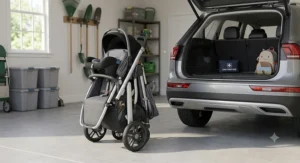
- Check the fold dimensions against your trunk or hallway. Consumer Reports notes that folded dimensions deserve real scrutiny since a stroller that won’t fit your storage space defeats the purpose regardless of how good it is on paper.
- Prioritize independent recline if ages are far apart. A newborn and a toddler almost never want the same seat angle at the same moment, so shared or synced recline mechanisms cause real friction.
- Test the brakes and swivel lock in person if possible. Reviews consistently flag brake stiffness and swivel-wheel drift as the details that separate a pleasant daily push from a frustrating one.
- Budget for accessories separately. Car seat adapters, rain covers, and upper seat spacers are frequently sold apart from the stroller itself, and they add up fast.
Car Seat Adapter Compatibility: What to Check Before You Buy
This is the section most buyers skip, and it’s usually the one that bites them later. Car seat adapter compatibility isn’t universal — it’s brand-specific, sometimes model-specific, and it changes when manufacturers release new stroller or car seat generations. The Chicco Cortina Together sidesteps the issue entirely by only working with Chicco’s own KeyFit and Fit2 seats, no adapter required, which is either a convenience or a dealbreaker depending on what’s already in your garage. The Baby Jogger City Select 2 Double, by contrast, supports a wider range of outside brands — Britax, Chicco, Graco, Nuna, and Uppababy among them — but only once you’ve purchased the correct adapter, and availability has been an inconsistent pain point for buyers.
For a tandem stroller for infant seat use specifically, always verify compatibility using the manufacturer’s official chart rather than a general “compatible with most car seats” claim on a listing page, since a loose or improperly rated adapter is a genuine safety issue, not just an inconvenience. NHTSA’s car seat installation guidance is written for vehicle installation, but the same core principle applies to stroller adapters: the seat should not shift more than an inch in any direction once locked in. If you’re buying the stroller and the car seat at the same time, strongly consider staying within one brand’s ecosystem — it eliminates the adapter question entirely and tends to be the cheaper path overall once you account for adapter costs.
Bassinet Attachment Options for Tandem Strollers
A bassinet attachment is what separates a stroller that merely tolerates a newborn from one that’s genuinely built for the newborn stage. True bassinets — like those on the Uppababy Vista V3 Double and Bugaboo Kangaroo Double — lie completely flat, unlike a reclined stroller seat, which matters because pediatric guidance is specific on this point. Per the American Academy of Pediatrics’ safe sleep guidance, sitting devices including strollers and car seats are not recommended for routine sleep, particularly for babies under four months, and any sleep surface should be firm and flat rather than inclined. A proper bassinet attachment satisfies the flat-surface piece of that guidance for supervised naps on the go, while a semi-reclined stroller seat does not — that distinction is worth paying for if your baby will be napping in the stroller regularly.
Not every tandem stroller on this list offers a true bassinet; several instead rely on an infant car seat clicked into the frame, which keeps baby in a semi-reclined position rather than flat. That’s a completely normal and safe way to transport a sleeping newborn for a walk, but it isn’t a substitute for flat sleep at home, and it shouldn’t be treated as a nap solution for hours at a time. If overnight or extended stroller naps are part of your routine — hello, nap-resistant babies everywhere — a genuine bassinet attachment is worth the extra cost over car-seat-only compatibility.
✨ Don’t Miss These Exclusive Deals!
🔍 Take your search for the right tandem double stroller for newborn and toddler to the next level with these carefully compared picks. Click on any highlighted stroller above to check current pricing and availability, and give your growing family a smoother, calmer ride from day one!
Full Recline and Seat Recline Positions Explained
Tandem stroller full recline is one of those specs that sounds simple until you’re actually shopping, because “reclines” and “reclines flat” are not the same claim. A multi-position recline — three or four notches, typically — lets a toddler adjust from upright to a relaxed lounging angle, which is plenty for most daytime use once a child can sit up unassisted. A full, near-flat recline is a different tier entirely, and it’s what you actually need for a newborn riding in the stroller seat itself rather than a bassinet, since a baby that young can’t safely hold a semi-upright position for long stretches.
Among the strollers here, the Graco DuoGlider‘s rear seat reclines completely flat, effectively functioning as an infant pramette when a car seat isn’t attached, which is a meaningful feature at its price point. The Chicco Cortina Together offers a similar multi-position full recline paired with what the brand calls a cozy infant enclosure. On the premium end, seat recline positions on the Uppababy Vista V3 Double and Baby Jogger City Select 2 Double are independently adjustable per seat — genuinely useful with a newborn and toddler pairing, since you’ll frequently want one seat flat for a nap and the other upright for sightseeing at the exact same time.
Mixed-Age Seating: Configurations for a Newborn and a Toddler
Tandem stroller mixed-age seating is really about solving one core tension: a newborn needs to be protected, supported, and often flat, while a toddler wants to see the world, interact with you, and sit upright. The strongest mixed-age setups let you place the more protective configuration — bassinet or car seat — in whichever position (front or rear) makes sense for your specific stroller’s engineering, since not every model treats front and rear seats identically. On the Bugaboo Kangaroo Double, the bassinet only fits in the lower position, so plan your seating order around that constraint rather than assuming flexibility that isn’t there.
Face-to-face configurations, available on the Contours Options Elite V2 and the Baby Jogger City Select 2 Double, deserve special mention for mixed-age families specifically, because they let an older sibling watch over and babble at the baby, which several parents in aggregated reviews describe as genuinely reducing meltdowns on longer outings. The tradeoff is usually a slightly wider or bulkier fold, since face-to-face seating needs more frame length between the two positions than simple front-to-back stacking.
Tandem Double Strollers vs Side-by-Side Double Strollers
The other major double-stroller category is side-by-side, where both kids sit at the same level, next to each other, and the honest comparison matters more than most buying guides let on. Tandem designs are narrower — usually fitting through standard doorways and store aisles that a side-by-side simply can’t — which is the single biggest reason tandems dominate the newborn-and-toddler category specifically. Side-by-sides, on the other hand, tend to be shorter overall and easier to maneuver in wide-open spaces like malls or parks, since the weight is distributed left-to-right instead of stretched out front-to-back.
| Factor | Tandem Double | Side-by-Side Double |
|---|---|---|
| Width | Narrow — fits most doorways | Wide — can struggle with aisles |
| Length | Long — turning radius is wider | Short — turns tightly |
| Best For | Newborn + toddler pairs | Twins or close-in-age siblings |
| Seat Equality | Often unequal (front vs. rear) | Usually identical, side by side |
The analysis here is pretty clear-cut: if your kids are meaningfully different ages and sizes, a tandem’s ability to pair a bassinet or infant seat with a full toddler seat outweighs the side-by-side’s tighter turning radius. Twin parents, or those with children close in age who want identical seating experiences, tend to prefer side-by-side models instead — it’s less about which category is objectively better and more about which problem you’re actually solving.
Common Mistakes When Buying a Tandem Double Stroller
The single most common mistake is buying based on the toddler’s needs today and forgetting the newborn is coming in a few months — parents who already have a toddler and are expecting often default to whatever stroller looks sturdiest for their current kid, then discover too late that it has no real bassinet or car seat compatibility. A close second is skipping the weighed, loaded test: a stroller that steers fine empty in a store can feel dramatically different once loaded with two kids and a full diaper bag, and that difference only shows up on the sidewalk. Buyers also frequently underestimate fold dimensions relative to their actual trunk space, particularly with tandem strollers, which run longer than side-by-side models by design.
Another overlooked pitfall: assuming universal car seat compatibility from vague marketing language instead of checking the manufacturer’s official adapter chart, which can lead to an expensive return once the “compatible” seat turns out to need a $40-$60 adapter that’s backordered for weeks. Finally, plenty of parents skip registering the stroller after purchase, missing recall notifications entirely — a five-minute step that costs nothing and genuinely matters given how often hinge, wheel, and brake issues drive stroller recalls industry-wide.
Long-Term Cost & Maintenance
The sticker price is rarely the full cost of a tandem stroller once accessories enter the picture. Car seat adapters typically run $35-$80 depending on brand, bassinets sold separately can add $150-$250, and upper seat spacers or organizers push the total higher still — on a stroller like the Uppababy Vista V3 Double, the “real” all-in cost frequently lands well above the base stroller price alone. Maintenance is comparatively cheap but easy to neglect: wheels and hinges benefit from an occasional wipe-down and inspection, especially on strollers used in rain or snow, and a squeaky or sticking brake is usually a five-minute fix if caught early rather than a reason to replace the whole unit.
| Consideration | Budget Tier (Graco, Baby Trend) | Premium Tier (Uppababy, Bugaboo) |
|---|---|---|
| Upfront Price | $180-$230 range | $1,300-$2,000 range |
| Accessory Costs | Minimal, often included | $200-$400 in add-ons common |
| Expected Lifespan | 1-3 years of heavy use | 3-5+ years, often resold |
| Resale Value | Low | Moderate to strong |
Looked at over a three-to-five-year window rather than at checkout, the value math shifts meaningfully — premium strollers hold resale value well enough that the effective cost of ownership narrows the gap with budget models, especially for families planning a second or third child on the same system. Budget strollers remain the better call for families expecting to outgrow the tandem stage quickly or who simply don’t want to think about resale at all.
Safety, Regulations & Sleep Guidelines for Tandem Strollers
Every stroller sold in the U.S. is legally required to meet a federal mandatory standard, and it’s worth understanding what that standard actually covers before you assume “for sale on Amazon” means “fully vetted.” The CPSC’s rule incorporates the ASTM F833 voluntary standard and specifically addresses hinge issues that have caused pinched or cut fingers, broken and detached wheels, parking brake failures, locking mechanism problems, restraint issues, structural integrity, and overall stability — in other words, the exact failure points parents worry about most. That’s a meaningful baseline, but it’s a floor, not a guarantee of comfort or convenience, which is why the aggregated review sentiment throughout this guide matters just as much as the spec sheet.
On the sleep side specifically, it bears repeating clearly: neither a stroller seat nor an attached infant car seat is a substitute for a crib or bassinet at home. If your baby falls asleep during a walk, that’s completely normal and fine for the duration of the outing, but pediatric guidance is consistent that babies should be moved to a firm, flat sleep surface as soon as it’s practical once you’re home, rather than left to nap for hours in a semi-reclined position. This is a sensitive topic if you’re navigating infant sleep struggles, and if that’s weighing on you, it’s worth a conversation with your pediatrician about what’s normal and what additional support might help.
Frequently Asked Questions
❓ Is a tandem stroller safe for a newborn baby?
❓ Can one tandem stroller really work for a newborn and a toddler at once?
❓ Do all tandem strollers accept car seats without an adapter?
❓ What's the difference between a tandem and a side-by-side double stroller?
❓ How long can a family typically use one tandem double stroller?
Conclusion
There’s no single “best” answer here, and that’s honestly the whole point of comparing seven real products instead of crowning one winner. If budget isn’t the constraint, the Uppababy Vista V3 Double and Bugaboo Kangaroo Double both deliver genuine from-birth capability with the ride quality and configuration options to match a growing family for years. If you’re watching every dollar but still need something that safely handles a newborn and an active toddler, the Graco DuoGlider and Chicco Cortina Together prove you don’t need four figures to get real recline and dependable car seat compatibility — you just need to know which brand ecosystem you’re committing to. And if seating flexibility for two very different kids is the priority above all else, the Baby Jogger City Select 2 Double and Contours Options Elite V2 both earn their keep with configuration options that most side-by-side strollers simply can’t match.
Whatever you land on, run it through the checklist in this guide before you buy: confirm newborn compatibility first, verify car seat adapter details against the manufacturer’s chart rather than a vague listing claim, and physically test the fold and brakes if you can. A tandem double stroller for newborn and toddler is a purchase you’ll use nearly every day for years — it’s worth the extra twenty minutes of research to get it right the first time.
Recommended for You
- 7 Best tandem double stroller under $350 Picks for 2026
- Tandem vs side-by-side double stroller for twins: 7 Picks for 2026
- 7 Best Lightweight Side-By-Side Double Strollers For Travel (2026)
Disclaimer: This article contains affiliate links. As an Amazon Associate, I earn from qualifying purchases. If you purchase products through these links, we may earn a small commission at no additional cost to you.
✨ Found this helpful? Share it with your friends! 💬🤗
