
In This Article
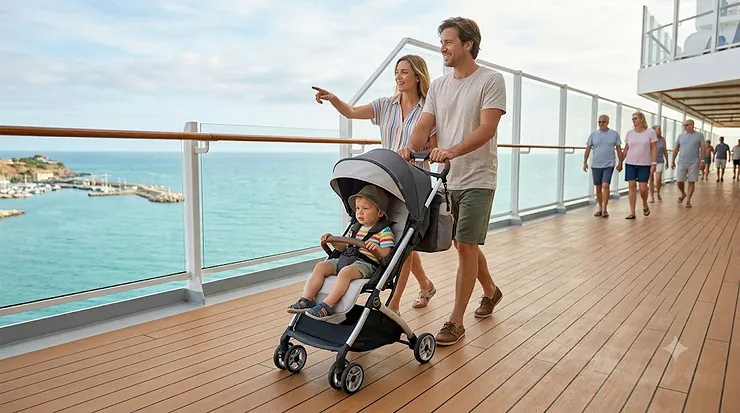
A stroller for cruise travel has to do something your everyday stroller was never designed for: survive a 200-square-foot cabin, a hallway built for room service carts instead of families, and an elevator bank that turns into a theme park line every time the ship docks. It’s a wheeled vehicle for infants or young children, built compact enough to fold into a closet and tough enough to roll over cobblestone streets during a port excursion. That’s the whole job description, and most strollers sitting in your garage right now can’t do it.
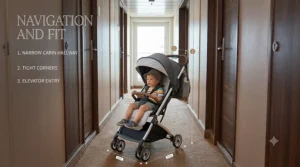
Here’s the thing nobody tells you before your first family cruise: the stroller mistake happens before you even board. You pack the one from home — the plush, all-terrain, cup-holder-for-days model you love on neighborhood walks — and by day two, it’s wedged behind the bathroom door, blocking your partner’s path to the shower every single night. Cruise cabins are small on purpose. Hallways are narrow on purpose. And your stroller either respects that math or fights it for seven straight days.
We researched real, current products — not marketing copy — and cross-checked them against actual cruise line policies from Royal Caribbean and Carnival, plus safety and airline guidance, so you’re picking based on how these things behave in the wild, not how they look in a product photo. All the major cruise lines, including Royal Caribbean, Carnival, Disney, Norwegian, and MSC, welcome strollers onboard, but staterooms are small enough that a bulky stroller becomes a genuine liability in narrow hallways and elevators.That single fact should shape almost every decision you make below.
Quick Comparison Table
| Stroller | Weight | Folded Footprint | Best For | Price Range |
|---|---|---|---|---|
| Jeep AdventureGlyde | ~15 lbs | Umbrella-compact | Tightest budgets | $70-$90 |
| MamaZing Ultra Air X | ~10 lbs | Ultra-slim | Lightest possible carry | $200-$250 |
| Graco Ready2Jet | ~15 lbs | Auto-fold compact | Hands-full parents | $220-$260 |
| Colugo Compact+ | ~16 lbs | Compact, stands alone | First-time cruisers | $280-$320 |
| Mompush Nexis | ~11.5 lbs | Carbon-fiber slim | Overhead-bin travel | $330-$380 |
| UPPAbaby Minu V3 | ~16 lbs | Compact, self-standing | Cobblestone excursions | $480-$520 |
| Joolz Aer2 | ~14.3 lbs | 17.3 x 20.8 x 9.2 in | All-around best fold | $560-$600 |
Looking at the spread, the split isn’t really about quality — every stroller here is a real, currently sold model with a genuine track record — it’s about which tradeoff you’re willing to live with. The lighter and cheaper models (Jeep, MamaZing) sacrifice suspension and long-term durability for a price that stings less if it gets scuffed by a baggage handler or cabin steward’s cart. The UPPAbaby and Joolz sit at the top because their frames absorb port-day terrain instead of transmitting every cobblestone straight to your kid’s spine.
💬 Just one click — help other cruising parents make better packing decisions too!😊
Top 7 Strollers for a Cruise: Expert Analysis
1. Jeep AdventureGlyde — cheapest real option that still folds small
If your cruise budget went entirely toward the balcony upgrade, the AdventureGlyde is where you land, and honestly, it holds up better than the price suggests. This is a steel-framed umbrella stroller with swivel front wheels and puncture-proof tires, weighing in around 15 pounds. The puncture-proof tires matter more than they sound — a flat on a boardwalk in Cozumel isn’t something you can fix from a cabin. Its compact umbrella fold meets typical theme-park size limits, which lines up neatly with cruise line size expectations too.
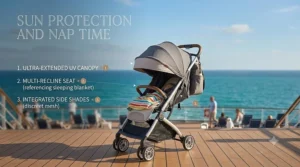
This one’s for parents doing a single week-long cruise who don’t want to sink real money into gear they’ll use twice a year. It’s not the stroller for a family that cruises three times annually — the steel frame and basic recline won’t hold up to that kind of mileage. Aggregated reviewer sentiment consistently flags the swivel wheels as smooth on flat cruise-deck surfaces but notes some users report front-wheel wear after extended use on rougher port terrain. The UPF 50+ canopy is a genuine standout at this price point, and the storage basket is roomier than you’d expect from something this cheap.
Pros:
- ✅ Lowest price point of any real option on this list
- ✅ Puncture-proof tires survive rough port pavement
- ✅ UPF 50+ canopy rare at this price tier
Cons:
- ❌ Front wheels show wear on extended rough terrain
- ❌ Basic recline, not ideal for long nap stretches
At around $70-$90, this is less an investment than a disposable convenience — and for a once-a-year cruiser, that’s exactly the right math.
2. MamaZing Ultra Air X — the lightest real stroller you can buy
Reviewers and travel writers keep calling this the world’s lightest stroller, and at roughly 10 pounds, it’s not far off. What that number means in practice: you can carry this stroller one-handed up a flight of stairs while holding a toddler with the other arm, which is a scenario that happens more often on cruise ships than you’d expect when elevators are jammed at dinner-seating time.
The tradeoff for that featherweight frame is exactly what you’d guess — less structural heft means a softer, springier ride than heavier competitors, and the storage basket is modest. Based on the spec comparison against other budget-tier travel strollers, the Ultra Air X trades cargo capacity for portability almost dollar-for-dollar, which makes it the right call for parents who plan to gate-check rarely and carry constantly. Aggregated review sentiment praises the fold speed and one-hand operation but flags the recline as more upright than plush.
Pros:
- ✅ Among the lightest strollers sold today
- ✅ One-handed carry up stairs and gangways
- ✅ Fast, simple fold under pressure
Cons:
- ❌ Smaller storage basket than most rivals
- ❌ Firmer ride quality than heavier models
In the $200-$250 range, it’s the pick for parents who value their own back more than plush padding.
3. Graco Ready2Jet — the automatic fold for when your hands are full
Graco built this one around a single insight: you will never have two free hands when you actually need to fold a stroller. The Ready2Jet’s automatic one-hand fold compacts the frame with a single pull, and it’s genuinely designed to be overhead-bin friendly, which matters just as much on a cruise embarkation line as it does at the airport gate. All-wheel suspension smooths out the transition from smooth ship decks to the uneven pavement you’ll hit on tender-boat excursions.
What most buyers overlook about this model is the multi-position recline — it’s not marketed as a nap stroller, but the recline range genuinely accommodates a toddler crashing mid-excursion, which is the single most common stroller failure point parents report. Reviewers consistently mention the self-standing fold as a small but meaningful detail: it means you can collapse the stroller in a cramped hallway without leaning it against a wall or laying it on the floor.
Pros:
- ✅ True automatic one-hand fold under real pressure
- ✅ All-wheel suspension smooths port-day pavement
- ✅ Self-standing fold saves hallway floor space
Cons:
- ❌ Mid-pack weight, not the lightest carry option
- ❌ Basket access is tighter than competitors
At around $220-$260, this is the practical middle ground for parents juggling a diaper bag, a drink, and a toddler simultaneously.
4. Colugo Compact+ — the smartest first cruise stroller
Fathercraft’s independent testing named the Compact+ its top budget pick for babies in the 4-to-6-month range, and the reasoning holds up under scrutiny. It’s compact enough to genuinely qualify as a travel stroller — not a repackaged everyday model with “travel” stamped on the box — and it stands on its own when folded, which is the single most underrated feature for cabin storage.
Here’s what the spec sheet won’t tell you, but reviewers note: the Compact+’s recline is deep enough for infant naps but the seat itself runs a little narrow for toddlers over 2, so this is genuinely a “grows with you for one to two cruises” stroller rather than a decade-long investment. For first-time cruising parents who aren’t sure yet whether cruising with a stroller-aged kid is even going to be a regular thing, that’s not a flaw — it’s the right amount of commitment.
Pros:
- ✅ Stands independently when folded — cabin-friendly
- ✅ Genuinely compact travel-stroller dimensions
- ✅ Strong value against pricier premium rivals
Cons:
- ❌ Seat runs narrow for toddlers past age 2
- ❌ Limited accessory ecosystem compared to bigger brands
Priced around $280-$320, it’s the stroller most first-time cruise parents should actually be looking at instead of splurging early.
5. Mompush Nexis — carbon fiber built for the overhead bin
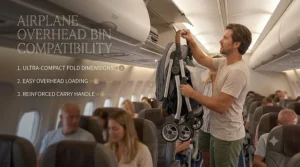
The Nexis leans hard into a single selling point: an 11.5-pound carbon fiber frame paired with a genuinely fast auto-fold. Reviewers who’ve used it across airports and cruise corridors report the fold is fast enough to execute one-handed while holding a squirming toddler, and the frame is designed specifically to clear overhead airline bins — a bar that, if it clears, all but guarantees it’ll clear a cruise cabin closet too.
Based on the spec comparison, carbon fiber is doing real structural work here, not just marketing: it’s how Mompush keeps the weight this low without the frame flexing under a toddler’s weight the way some ultralight aluminum competitors do. The storage basket has a lower weight cap than most rivals, so this is a “pack light” stroller rather than a “haul the whole diaper bag” stroller — worth knowing before you load it up on port day.
Pros:
- ✅ Carbon fiber keeps weight low without flexing
- ✅ Fits airplane overhead bins, and easily cruise closets
- ✅ Fast auto-fold operable one-handed
Cons:
- ❌ Storage basket has a lower weight limit
- ❌ Premium materials mean a premium price tag
Landing around $330-$380, it earns its price for families who fly to their embarkation port and don’t want to gate-check a second, heavier stroller.
6. UPPAbaby Minu V3 — best ride quality for cobblestone excursion days
Independent testers have repeatedly singled out the Minu V3 for ride quality on rough terrain — specifically cobblestone streets, the exact surface you’ll hit walking off a tender boat into a European or Caribbean old-town port. Larger-than-average travel stroller wheels give it exceptional performance for a compact stroller, and it has one of the largest undercarriage baskets in its category, holding up to 20 pounds of cargo.
What that basket capacity means in practice: you can load a diaper bag, water bottles, a beach towel, and souvenir shopping without the frame straining or the stroller tipping backward — a genuine failure mode on baskets rated closer to 10 pounds. Reviewers note the Minu V3 isn’t the most compact fold on this list, but the tradeoff buys real comfort on the exact terrain cruise excursions actually involve: uneven cobblestones, sandy boardwalks, and the occasional gravel path to a beach club.
Pros:
- ✅ Best-in-class ride quality on cobblestone terrain
- ✅ Largest storage basket among compact travel strollers
- ✅ Car seat adapters expand its usefulness beyond cruising
Cons:
- ❌ Wider footprint than the slimmest competitors
- ❌ Heavier fold than ultralight carbon-fiber rivals
At roughly $480-$520, this is the stroller for families who prioritize what happens off the ship over what happens in the hallway.
7. Joolz Aer2 — the best all-around fold for cruise and flight
Testers who’ve run head-to-head comparisons across ten travel strollers over multiple years keep landing on the Aer2 as their overall pick, and the reasoning is consistent: it’s lightweight at 14.3 pounds, has a simple one-handed fold, and feels sturdy and smooth to push, with a UPF 50+ canopy providing substantial sun coverage.The frame is built from recycled materials, which is a nice bonus but not why it wins — it wins because the fold is self-standing and genuinely fits down most airplane aisles and into most overhead bins, a bar that translates directly to narrow cruise-ship corridors.
What most buyers overlook: an integrated shoulder strap and included travel bag make it easy to carry through embarkation lines and situations where you need to stash it quickly, like a museum stop during a shore excursion.The lie-flat recline means it’s genuinely usable from a newborn’s first cruise onward, not just for toddlers, which stretches its useful life across multiple trips instead of one.
Pros:
- ✅ Self-standing, ultra-compact fold rated best overall
- ✅ Lie-flat recline works from newborn through toddler
- ✅ Integrated carry strap and travel bag included
Cons:
- ❌ Highest price point on this list
- ❌ Recline mechanism can stick according to some testers
At around $560-$600, it’s a real investment — but for families who cruise regularly or combine cruises with flights, it pays for itself in saved hassle alone.
Practical Usage Guide: Packing and Prepping for Embarkation Day
Getting your stroller from your front door to your cabin closet smoothly starts well before boarding day. Practice folding and unfolding your stroller at home, blindfolded-tired, because embarkation lines move fast and cruise terminal staff won’t wait while you hunt for a hidden latch. Empty every pocket and basket before you reach the terminal’s security screening — cruise ports run X-ray checks similar to airports, and a loaded stroller means a slower, more frustrating scan.
Once onboard, resist the urge to leave your folded stroller in the hallway “just for a minute”. Strollers cannot be left in hallways or stairwells for safety reasons, and most lines require you to store them inside your own stateroom.Ask your cabin steward on day one where they’d suggest storing it — many will point you to a corner behind a curtain or a spot that clears the door swing, and stewards tend to know their specific cabin layout better than any packing list ever could. In the first 30 days of ownership, the most common mistake new stroller owners make is skipping wheel and hinge maintenance entirely; a quick wipe-down after sandy port days keeps folding mechanisms from gritty, sticky failure exactly when you need them most.
Real-World Scenario: Which Type of Cruiser Are You?
Picture the Martinez family: two working parents, one 14-month-old, one seven-night Caribbean itinerary with four port stops. Their priority is durability over featherweight specs, since they’re doing shore excursions daily — the UPPAbaby Minu V3’s cobblestone-ready ride quality and generous basket fit their pattern better than an ultralight carbon frame that wasn’t built for gravel paths.
Now picture Priya, flying solo with her toddler to meet her partner at the embarkation port, connecting through two airports first. Her whole trip hinges on one-handed maneuverability through security lines and jet bridges — the Mompush Nexis or Joolz Aer2’s overhead-bin-ready fold solves a problem the Minu simply wasn’t designed to solve. And picture the Chens, first-time cruisers testing whether their family even likes cruising before committing to annual trips: the Colugo Compact+ gives them real functionality without gambling $500 on a hobby they haven’t confirmed yet.
Problem → Solution: Common Cruise Stroller Headaches
Problem: the stroller won’t fit through the cabin doorway at an angle. Solution: fold it flat before entering, not after — most folding failures in tight doorways happen because parents try to wheel it in upright and pivot mid-doorway.
Problem: elevator banks are packed at every dinner seating. Solution: shift your elevator timing 15 minutes before or after the crowd, or use stairs with an ultralight model like the MamaZing Ultra Air X, which is genuinely light enough to carry.
Problem: sand and salt water gunk up the folding hinges. Solution: rinse wheels and hinges with fresh water at the pool-deck shower stations before heading back to the cabin, then let it air-dry on the balcony rather than folding it wet.
Problem: your stroller basket keeps overloading and tipping the frame backward. Solution: distribute weight low and centered, and choose a model like the UPPAbaby Minu V3 with a genuinely rated higher basket capacity if you tend to overpack.
How to Choose a Stroller for Cruise
- Confirm your cabin category first. Interior and oceanview cabins run smaller than balcony suites, so measure your actual floor space before assuming any stroller will fit.
- Prioritize fold speed over features. You’ll fold and unfold this stroller more times per day on a cruise than almost anywhere else — embarkation, elevators, tender boats, restaurants.
- Weigh it against your own strength, not the spec sheet alone. A stroller that’s “light” on paper still needs lifting over thresholds and into tender boats repeatedly.
- Check the basket capacity against your actual packing habits. If you tend to overpack a diaper bag, a low-capacity basket will fight you daily.
- Match the recline to your child’s nap schedule. Deep recline options matter enormously for families relying on stroller naps during port days.
- Consider terrain at your specific ports. Cruise staterooms are small, so a compact, foldable stroller is ideal, and large or bulky strollers can be difficult to store and navigate through narrow hallways or elevators — the same logic extends to cobblestone port towns.
- Read the safety standard, not just the marketing claims. A stroller compliant with recognized safety testing gives you a real baseline, not a brochure promise.
Cruise Friendly Stroller vs. Your Everyday Stroller
A genuinely cruise friendly stroller and your daily-use stroller solve different problems, even if they look similar in a store aisle. Everyday strollers are optimized for a driveway-to-car-to-store loop: bigger wheels, bigger baskets, bulkier frames that ride comfortably in a trunk. A cruise-friendly stroller is optimized for the opposite: repeated folding in tight spaces, storage in a closet instead of a garage, and a frame light enough to lift over a tender-boat gangway threshold.
The comparison isn’t about which stroller is “better” in the abstract — it’s about matching the tool to the environment. Bringing your everyday all-terrain stroller on a cruise is a lot like bringing a full-size SUV to parallel park in a dense city center: it’ll technically work, but you’ll fight the environment at every turn instead of moving with it.
Stroller for Cruise Ship: Narrow Hallways, Elevators, and Cabin Storage
This is the constraint that actually decides your purchase, more than price or brand. Cruise ship hallways are built to a fixed width standard across most mainstream ships, and it’s noticeably tighter than a hotel corridor — a housekeeping cart parked mid-hallway can turn a wide stroller into a full stop. Baby baths and strollers are not provided onboard by most major lines; guests bring their own, and they must be stored inside the stateroom rather than in public hallways.
That storage requirement is exactly why fold footprint matters more on a cruise than almost any other trip type. A stroller that folds to a slim, self-standing profile — like the Joolz Aer2 or Colugo Compact+ — tucks behind a curtain or beside a closet without eating your walkway space. Some lines, including Carnival, offer a limited number of rental strollers onboard for parents who’d rather skip packing one entirely, subject to availability through the ship’s youth program staff.That’s a solid backup plan, but availability is never guaranteed, so treat it as a plan B, not your primary strategy.
Best Compact Stroller for Cruise: What “Compact” Actually Means
“Compact” gets used loosely in stroller marketing, so it’s worth defining precisely for cruise purposes: it means the folded stroller stands under roughly 20 inches in its longest dimension and can be carried or wheeled through a standard interior doorway without turning sideways. By that standard, the Joolz Aer2’s 17.3 x 20.8 x 9.2-inch folded footprint and the Colugo Compact+’s self-standing fold both genuinely qualify — plenty of “compact” strollers marketed for travel don’t actually meet that bar once you measure them.
The practical test: if a stroller can clear an airplane’s overhead bin, it will almost always clear a cruise cabin closet too, since airline bin dimensions tend to be more restrictive than cabin storage space.
Stroller for Cruise with Toddler: Age, Weight, and Comfort
Toddlers bring a different set of demands than infants: they’re heavier, they resist naps mid-adventure, and they’ve developed strong opinions about recline angles. For a toddler-specific cruise, weight capacity matters more than newborn-focused features like lie-flat recline — check that your chosen model’s stated weight limit has real headroom above your child’s current weight, since toddlers gain weight steadily across a single vacation season.
Multi-position recline becomes almost non-negotiable here, because toddler meltdowns from missed naps are one of the most common cruise complaints parents report. A model like the Graco Ready2Jet, with genuine multi-position recline built in, tends to outperform ultralight options that sacrificed recline range for weight savings.
Cruise Excursion Strollers on Cobblestone Streets
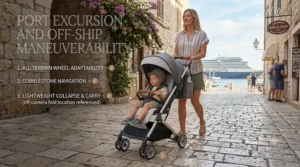
Port towns weren’t built with strollers in mind — they were built centuries before strollers existed, which is exactly why cobblestone streets show up so often on shore excursions. On paper this means wheel diameter and suspension quality matter more for excursion days than they do for the smooth decks of the ship itself. Smaller, harder wheels transmit every gap between cobblestones straight into the frame and, by extension, your kid.
This is precisely where the UPPAbaby Minu V3’s larger wheel design earns its keep — reviewers consistently note it as the standout choice specifically for rough European and Caribbean streets. If your itinerary is heavy on historic old-town ports, that ride-quality advantage is worth the extra folded inches you’ll give up compared to the slimmest carbon-fiber options.
Long-Term Cost & Maintenance
A budget stroller purchased new for every cruise adds up faster than a single premium purchase amortized across years of travel. Buying a $70-$90 umbrella stroller for three separate cruises costs roughly the same as a single $220-$260 mid-range model that survives all three trips with basic maintenance — and the mid-range option typically holds resale value the disposable option never will.
Maintenance costs stay low across this entire category: occasional wheel lubrication, a rinse after beach days, and periodic hardware tightening cover most upkeep. The real cost driver isn’t parts — it’s whether the frame survives repeated gate-checking and cabin-storage folding without hinges loosening, which is exactly why fold-cycle durability, not just initial weight, deserves real weight in your decision.

Common Mistakes When Buying a Stroller for Cruise
The most frequent mistake is buying based on everyday-use features — big wheels, huge baskets, plush padding — without testing the actual fold in your living room first. A second common mistake is skipping the safety-standard check entirely; strollers sold in the U.S. are required to meet a federal safety standard under 16 C.F.R. part 1227, which incorporates the ASTM F833 consumer safety specification by reference, covering stability, brakes, restraint systems, and folding-mechanism safety— verifying compliance through a CPSC-recognized standard takes two minutes and rules out counterfeit or unregulated listings.
A third mistake: assuming a stroller rental onboard guarantees availability without a backup plan.
And a fourth: underestimating basket weight limits, then overloading the stroller with beach gear until the frame tips backward on an incline — check the rated capacity before, not after, packing day.
Safety, Regulations & Compliance Guide
Every stroller sold legally in the U.S. must meet the CPSC’s mandatory safety rule, which incorporates ASTM F833 by reference and covers stability testing, parking-brake performance, restraint systems, and folding-mechanism safety designed specifically to prevent finger-pinching and accidental collapse. That’s not marketing language — it’s a tested, federally enforced baseline, and it’s worth confirming any stroller you’re considering, especially unfamiliar or newly launched brands, actually meets it rather than assuming a listing photo guarantees compliance.
Cruise-specific rules add another layer on top of general product safety. Beyond the stateroom-storage requirement most lines enforce, always double-check your specific cruise line’s current family policy before departure, since these details shift by ship and season.
✨ Don’t Miss These Exclusive Deals!
🔍 Take your cruise packing to the next level with these carefully selected strollers. Click on any highlighted item to check current pricing and availability. These picks will help you create smoother, easier port days your whole family will love!
Frequently Asked Questions
❓ Can I bring my own stroller on a cruise?
❓ Do cruise ships provide strollers?
❓ What size stroller fits in a cruise cabin?
❓ Is an umbrella stroller good enough for a cruise?
❓ How do I fold a stroller for cruise cabin storage?
Conclusion
Choosing a stroller for cruise travel really comes down to matching your itinerary, your budget, and your own arm strength to the right tradeoffs — there’s no single universal winner, just the right fit for your specific trip. Budget cruisers heading out once do just fine with the Jeep AdventureGlyde or MamaZing Ultra Air X. Families layering flights onto their cruise lean toward the Mompush Nexis or Joolz Aer2 for overhead-bin compatibility. And anyone with cobblestone-heavy port days should weight the UPPAbaby Minu V3 seriously, ride quality and all.
Whatever you land on, the underlying math stays the same: narrow hallways, mandatory in-cabin storage, and repeated folding reward compact, durable gear over flashy, oversized features every single time. Pack smart, fold early, and let your stroller work with the ship instead of against it.
Recommended for You
- Stroller for Disney World: 7 Picks That Survive the Parks (2026)
- 7 Best Travel System Strollers of 2026
- Best Stroller for Gate Checking: 7 Top Picks for 2026
Disclaimer: This article contains affiliate links. As an Amazon Associate, I earn from qualifying purchases. If you purchase products through these links, we may earn a small commission at no additional cost to you.
✨ Found this helpful? Share it with your friends! 💬🤗
