

In This Article
Bringing a newborn home means you suddenly need two pieces of gear to work together perfectly: a car seat and a stroller. That’s exactly what a travel system stroller solves — it’s a matched car seat and stroller combo designed to click together so your baby never has to be unbuckled and rebuckled just to move from the car to the sidewalk.

The catch is that not every travel system is built the same way. Some prioritize a featherweight fold for city living, others lean into all-terrain suspension for parents who walk five miles a day, and a few stretch their car seat’s weight limit so you get more mileage before upgrading. After digging into specs, manufacturer documentation, and real owner feedback across dozens of current models, I narrowed the field to seven travel system strollers that are actually worth your money in 2026 — spanning budget-friendly modular sets to luxury picks with rotating car seats. Whether you’re outfitting a nursery for the first time or replacing a stroller that’s seen better days, this guide breaks down exactly which one fits your situation.
Quick Comparison Table
| Travel System | Best For | Stroller Weight Capacity | Price Range |
|---|---|---|---|
| Safety 1st Grow and Go Flex 8-in-1 | Best budget pick | 50 lbs | Around $200–$280 |
| Baby Trend Passport Switch 6-in-1 | Best value / modular | 50 lbs | Around $200–$280 |
| Graco Modes Pramette | Most versatile (3-in-1) | 50 lbs | Around $280–$390 |
| Chicco Bravo 3-in-1 Trio | Best all-around reliability | 50 lbs | Around $300–$400 |
| Maxi-Cosi Zelia Pro 5-in-1 | Best eco-conscious style | 50 lbs | Around $400–$500 |
| Britax Willow Brook S+ | Best for safety-first parents | 50 lbs | Around $450–$600 |
| Evenflo Shyft Intuiti+ | Best luxury / tech pick | 55 lbs | Around $500–$600 |
A clear pattern shows up once you line these up side by side: the jump in price from budget to premium buys you less plastic-feeling hardware, smarter car seat installation systems, and extras like rotating seats or sustainable fabrics — not a meaningfully higher weight capacity, since nearly every stroller here tops out around 50 lbs. If your main concern is simply getting a working car seat and stroller combo through the newborn stage, the budget tier genuinely competes with the luxury tier on usability. If you want a stroller that still feels solid when your toddler is climbing in themselves at age three, the mid-range and premium picks tend to hold up better over years of daily use.
💬 Just one click — help others make better buying decisions too!😊
✨ Don’t Miss These Exclusive Deals!
🔍 Take your stroller shopping to the next level with these carefully selected travel systems below. Click on any highlighted item to check current pricing and availability. These picks will help you create smooth, stress-free outings your whole family will love!
Top 7 Travel System Strollers: Expert Analysis
1. Safety 1st Grow and Go Flex 8-in-1 Travel System
Safety 1st Grow and Go Flex 8-in-1 stands out immediately for cramming eight strolling configurations into one of the cheapest travel systems on this list. The included onBoard FLX infant car seat clicks directly onto the stroller frame with no separate adapter, and the stroller seat itself converts into a carriage mode, so a dozing baby can lie flat instead of slumping forward. That carriage conversion is the detail most budget systems skip — it’s normally reserved for $400+ strollers.
What most buyers overlook about this set is how long it actually lasts: the stroller seat carries kids up to 50 lbs and includes a step-up bar so your toddler can climb in independently, meaning you’re not shopping for a “big kid” stroller nearly as soon as you’d expect from an entry-level set. Owner feedback collected across major retailers consistently calls out the easy one-hand fold and the comfortable memory-foam seat as the strongest selling points, while a smaller number of reviewers note the canopy could extend further for full sun coverage.
✅ Pros: Eight configurations including carriage mode · stroller seat holds up to 50 lbs · no-adapter car seat attachment
❌ Cons: Canopy coverage is modest · fabric isn’t as premium as pricier sets
At around $200–$280, this is the best budget travel system stroller on the list if you want genuine versatility without the luxury price tag.

2. Baby Trend Passport Switch 6-in-1 Modular Stroller Travel System
The Baby Trend Passport Switch 6-in-1 earns its spot through sheer modularity. It’s built around the EZ-Lift Plus infant car seat, which includes a built-in side grip for one-handed carrying and a handle that doubles as an anti-rebound bar when locked forward — a feature usually found on cars seats costing twice as much on their own. The system swaps between six configurations: infant seat or bassinet, each facing the parent or the world, plus a forward- or rear-facing toddler seat.
In my experience, this kind of swap-everything modularity is the deciding factor for parents who can’t predict whether their baby will nap better facing them or facing out — instead of guessing right the first time, you just flip the seat. The bassinet mode in particular gets singled out in owner feedback as the unexpected favorite, since most travel systems in this price bracket skip a true bassinet entirely.
✅ Pros: Six modes including a true bassinet · anti-rebound carrying handle doubles as a safety feature · large basket with front and rear access
❌ Cons: Some buyers report wheel-fit issues on certain frame batches · leatherette accents show wear faster than fabric
At roughly $200–$280, it’s neck-and-neck with the Safety 1st for value, but wins if a bassinet mode matters more to you than carriage-style recline.
3. Graco Modes Pramette Travel System
The Graco Modes Pramette is the closest thing to a do-everything travel system stroller and car seat combo on this list, because it genuinely functions as three strollers in one — infant car seat carrier, true pramette (a lie-flat carriage), and reversible toddler stroller. Paired with the included SnugRide LX infant car seat, rated for infants from 4–30 lbs, it’s designed so the seat unit itself reclines flat for newborns rather than relying only on the car seat for that early flat position.
The spec sheet won’t tell you this, but the pramette conversion is genuinely the differentiator here: most “3-in-1” travel systems use that label loosely, while the Modes Pramette’s seat unit actually unfolds into a real bassinet-style carriage rather than just reclining further. Owner feedback skews heavily positive on versatility and the one-hand fold, though a minority of reviewers flagged the assembly process as more time-consuming than expected and noted the ride feels less smooth on four wheels compared to three-wheel jogging-style strollers.
✅ Pros: True pramette mode for newborns · reversible seat faces parent or world · one-hand stroller fold
❌ Cons: Initial assembly takes longer than average · ride quality is average on rough pavement
Priced around $280–$390, this is the pick if you want maximum mode flexibility without jumping into luxury pricing — arguably the best stroller car seat combo for parents who can’t decide between a pram-style setup and a standard stroller.
4. Chicco Bravo 3-in-1 Trio Travel System
The Chicco Bravo 3-in-1 Trio has built its reputation on the KeyFit 30 infant car seat, one of the most consistently top-rated infant seats on the market for ease of correct installation. The SuperCinch tightener uses force-multiplying leverage so a single pull achieves a tight installation that would otherwise take several yanks on a standard belt-and-buckle base, and the RideRight bubble-level indicators show you exactly when the recline angle is correct.
What most buyers overlook about this system is that the stroller frame itself is unusually light for a full-size stroller — about 23 lbs without the seat — which matters more than it sounds once you’re lifting it in and out of a trunk daily. Independent testing from Consumer Reports has noted that the system serves adaptable users well, accommodating children from roughly 4 to 60 pounds across its various configurations, which is a wider effective range than most competitors advertise. The most common complaint in owner reviews isn’t about either component alone, but about folding the stroller one-handed while the car seat adapter tray is still attached — several long-term owners describe it as a learning curve rather than a dealbreaker.
✅ Pros: KeyFit 30 is one of the easiest car seats to install correctly · lightweight stroller frame at 23 lbs · stands independently when folded
❌ Cons: One-hand fold is trickier with the car seat adapter attached · styling is more functional than fashionable
At about $300–$400, it’s the system I’d point a first-time parent toward if “easy, correct car seat installation” is the priority over flashy extras.
5. Maxi-Cosi Zelia Pro 5-in-1 Travel System
The Maxi-Cosi Zelia Pro 5-in-1 is built around sustainability without sacrificing the premium feel — both the stroller and the included Mico Pro infant car seat use EcoCare fabric made from 100% recycled plastic bottles, paired with vegan-leather accents on the handle and trim. The Mico Pro car seat itself uses ClimaFlow shell technology for extra ventilation, which matters more in practice than it sounds: overheating is one of the more common complaints with budget infant seats during warmer months, and added airflow through the shell helps regulate that without needing a separate insert.
In my experience, the detail that actually changes day-to-day use is the one-click LATCH base — most stay-in-car bases on this list require more fiddling to get a level, secure fit, while the Zelia Pro’s base includes three adjustable positions to dial in the correct recline angle quickly. Owner feedback consistently praises the smooth ride from the large, all-wheel-suspension wheels, with the most frequent critique being that the premium fabric and vegan-leather trim require a bit more care than basic polyester.
✅ Pros: Sustainable EcoCare fabric throughout · ClimaFlow ventilation in the car seat · one-click LATCH base with adjustable recline
❌ Cons: Premium materials need gentler cleaning · higher price point than mid-range competitors
Around $400–$500, this is the pick for parents who want their travel system stroller and car seat combo to look and feel elevated, not just function well.
6. Britax Willow Brook S+ Travel System
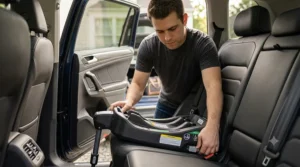
The Britax Willow Brook S+ leans hardest into crash-protection engineering of anything on this list. The Willow S infant car seat uses ClickTight installation — instead of threading a seat belt through guides and cinching by hand, you open the seat, thread the belt, and close it, with the mechanism itself tensioning the installation. Britax pairs that with a RightSize system offering adjustment points at the hips, shoulders, and between the legs, so the harness genuinely fits a 6-lb newborn and a 25-lb toddler without needing a different seat.
What most buyers overlook about this set is the ReboundReduce stability bar built into the Alpine base — it’s specifically engineered to limit how far the car seat rotates forward during a frontal impact, which is a feature usually reserved for separately-purchased premium car seats, not included travel system bundles. The Brook+ stroller itself is intentionally lightweight for a full-size frame, and owner feedback frequently highlights the one-step fold as faster than competitors’, though a handful of reviewers note the narrower wheel base feels less stable on uneven gravel paths than wider-wheelbase strollers.
✅ Pros: ClickTight installation removes most install error · RightSize harness adjusts at hips, shoulders, and legs · ReboundReduce stability bar on the base
❌ Cons: Narrower wheelbase isn’t ideal for gravel or grass · among the pricier sets here
At roughly $450–$600, it’s the system I’d recommend first to any parent whose top priority is minimizing car seat installation error.
7. Evenflo Shyft Intuiti+ Travel System
The Evenflo Shyft Intuiti+ is the luxury and tech pick of the group, built around the Revolve180 LiteMax NXT — a car seat that rotates 180 degrees with one hand, so you load your baby in facing the open door instead of twisting your torso into the back seat. That single feature solves one of the most repeated physical complaints parents have about standard infant seats: shoulder and back strain from leaning across a bucket seat dozens of times a day.
The spec sheet calls out “SensorySoothe” lights, music, and sounds built into the carry handle, controllable through Evenflo’s app — that’s a genuine novelty, but the detail that matters more day-to-day is the all-wheel suspension and premium rubber tires, which noticeably smooth out the ride on cracked sidewalks compared to the plastic-wheeled budget options on this list. Owner feedback skews strongly positive on comfort and the rotating seat’s convenience, with the most common critique being that buyers wish a newborn insert came standard rather than being added separately on certain trims.
✅ Pros: One-hand 180° rotating car seat reduces installation strain · all-wheel suspension with premium tires · SensorySoothe lights and sound features
❌ Cons: Among the most expensive systems here · no newborn insert included on every color/trim
At around $500–$600, this is the splurge-worthy pick for parents who want the smoothest possible ride and the easiest possible car seat ins-and-outs, even if it costs more than anything else on this list.
Real-World Scenarios: Which Travel System Fits Your Life
The first-time parent on a tight budget. If you’re outfitting a nursery from scratch and don’t yet know whether your baby will tolerate a car seat carrier or prefer a flat carriage, the Safety 1st Grow and Go Flex 8-in-1 or Baby Trend Passport Switch 6-in-1 make the most sense — both let you try multiple configurations without committing to a $500 system before you know your baby’s preferences.
The parent who walks everywhere. If strollers in your house log serious mileage — daily walks, errands on foot, no car involved most days — prioritize ride quality over car seat tech. The Chicco Bravo 3-in-1 Trio and Evenflo Shyft Intuiti+ both stand out for smoother wheels and suspension that absorb cracked sidewalks and curb cuts better than entry-level frames.
The safety-focused second-time parent. If you’ve already lived through one car seat installation that didn’t feel quite right, the Britax Willow Brook S+ is built specifically to remove that uncertainty, with ClickTight installation and a stability bar most competitors don’t include standard.
The style-and-sustainability shopper. If recycled materials and a refined aesthetic matter as much as function, the Maxi-Cosi Zelia Pro 5-in-1 is the only system here built around eco-conscious fabric from the ground up.
Practical Usage Guide: Your First 30 Days
Setting up a new travel system stroller correctly the first time prevents most of the frustration parents report later. Before your first outing, install the car seat base in your vehicle and have it checked — many fire departments and hospitals offer free car seat installation checks, and even ClickTight or one-click LATCH systems benefit from a second set of eyes the first time.
Practice the click-in and click-out motion for the car seat on the stroller frame at home, without your baby in it, until it’s reflexive — fumbling with an unfamiliar mechanism in a parking lot with a crying newborn is where most “this stroller is so frustrating” reviews are born. Check the recline angle indicator on the car seat base regularly during the newborn stage, since a too-upright angle can affect a young infant’s breathing.
In the first 30 days, the most common mistake is leaving the infant insert in the car seat too long after baby outgrows it, or conversely removing it too early — follow the weight cutoffs in your specific car seat’s manual rather than guessing. Wipe down wheels and folding hinges monthly if you’re walking on salted winter sidewalks or sandy beach paths, since debris buildup is the leading cause of sticky folds and squeaky wheels reported in long-term owner reviews.

How to Choose a Travel System Stroller
- Match the car seat’s weight limit to how long you want to use it. Seats rated to 30 lbs typically last 12–18 months; seats rated to 35 lbs often stretch closer to two years before a forward-facing convertible seat becomes necessary.
- Check the stroller’s folded dimensions against your trunk and front closet, not just its weight. A stroller that’s light but folds bulky can be more frustrating daily than a slightly heavier one that collapses flat.
- Decide if you need a true bassinet/carriage mode. If your baby will nap mid-stroll often, a flat-lying mode (not just a reclined seat) makes a real difference in comfort and sleep quality.
- Test the one-hand fold mechanism if you can, in person. Demo units at baby stores let you fold and unfold before buying — this single motion is the most-cited daily frustration point in long-term reviews.
- Confirm car seat compatibility if you plan to add a second seat later (for example, for a grandparent’s car or a second vehicle) — not every infant seat is sold separately with a compatible base.
- Consider terrain. All-wheel suspension and larger wheels matter far more on cracked sidewalks, gravel, or grass than they do on smooth indoor mall floors.
- Factor in your child’s growth, not just their current size. A stroller seat rated to 50 lbs typically lasts through preschool; one rated lower may mean an earlier, unplanned upgrade.
Travel System vs. Buying a Stroller and Car Seat Separately
Buying a matched travel system stroller and car seat combo is almost always cheaper than purchasing a comparable stroller and infant car seat individually, since manufacturers price the bundle below the sum of its parts to encourage the sale. The tradeoff is flexibility: with a bundle, you’re committed to whatever stroller frame ships with that particular car seat, even if you’d have preferred a different brand’s stroller.
Buying separately makes more sense if you already own a car seat you love (say, from a previous child) and just need a compatible stroller frame, or if you want to mix a premium car seat with a more budget-friendly everyday stroller. Most major car seat brands sell separate stroller-frame adapters specifically for this reason — it’s worth checking compatibility charts on the manufacturer’s site before assuming a mismatch won’t work.
Common Mistakes When Buying a Travel System Stroller
One frequent misstep is buying based on stroller looks alone and treating the included car seat as an afterthought — since the car seat is the component directly responsible for crash protection, its installation ease and harness adjustability deserve at least equal weight in your decision.
Another common mistake is underestimating storage needs. Parents routinely report wishing they’d checked the storage basket size and accessibility before buying, especially once daily errands start requiring diaper bags, groceries, and toys simultaneously.
A third misstep is ignoring the stroller’s folded footprint relative to your actual vehicle trunk — a stroller that’s perfect in the showroom can become a daily headache if it barely fits (or doesn’t fit) alongside groceries and a stroller bag.
Features That Actually Matter (And Those That Don’t)
Matters: Correct, repeatable car seat installation (ClickTight, SuperCinch, and similar tensioning systems genuinely reduce installation error).
Matters less: Built-in phone holders and cup holder count — nice extras, rarely a deciding factor in daily satisfaction.
Matters: All-wheel suspension if you walk on anything other than smooth pavement.
Matters less: Marketing language like “all-terrain” without specifying wheel size or suspension type — check the actual wheel diameter and suspension mechanism rather than the label.
Matters: True flat-recline or bassinet/carriage modes for newborns who need to lie flat.
Matters less: App-connected features like lights and sounds — genuinely fun, but several owner reviews note novelty wears off within a few months.

Best Travel System Stroller and Car Seat Combo: Compatible Brands
If you’re shopping with an eye toward future flexibility — say, you might add a second base for a grandparent’s car, or eventually want a different stroller frame — it helps to know which travel system compatible car seat brands have the broadest adapter ecosystems. Graco’s SnugRide and Chicco’s KeyFit lines are both supported by the widest range of third-party stroller adapters, since both brands have been on the market the longest and stroller manufacturers build adapters to match their popularity. Maxi-Cosi and Britax’s infant seats also fit a respectable range of compatible stroller frames within their own brand families, though cross-brand adapter support is more limited. Before assuming compatibility, always check the specific model numbers against the stroller manufacturer’s published compatibility list rather than relying on the general brand name alone.
Long-Term Cost & Maintenance
The sticker price is only part of the real cost of a travel system. Infant car seats expire — typically six to seven years after manufacture, a detail printed on a sticker on the seat itself — so a “deal” on a heavily discounted older model may already be closer to its expiration than a similarly priced newer unit. Replacement parts like wheels, canopy fabric, and harness pads vary widely in availability and price between brands; established brands like Graco and Chicco tend to stock replacement parts longer than newer entrants, which matters if you plan to use the stroller for a second child years later.
Maintenance costs are mostly about time rather than money: machine-washable seat pads (now standard on most systems reviewed here) save real effort over the toddler years compared to older models requiring hand-washing or spot cleaning only.
Safety, Regulations & Compliance Guide
All car seats sold in the U.S. must meet Federal Motor Vehicle Safety Standard 213, the baseline crash-test requirement enforced by the National Highway Traffic Safety Administration. Beyond that baseline, the CDC recommends keeping infants in a rear-facing car seat with a harness until they reach the maximum weight or height limit set by that specific seat’s manufacturer, rather than switching based on age alone. It’s also worth registering every car seat with its manufacturer — car seats can reduce the risk of fatal injury in a crash by 71% for infants when properly installed, but only when parents are notified of any recalls, which registration enables. For installation help, NHTSA’s resources can connect you with car seat installation guidance and inspection stations near you if you’re ever unsure whether your specific setup is correct.
✨ Don’t Miss These Exclusive Deals!
🔍 Take your travel system stroller shopping to the next level with these expert-reviewed picks. Click on any highlighted item to check current pricing and availability — these systems will help you create smooth, stress-free outings your whole family will love!
Best Travel System Stroller for Newborns: What to Look For
The American Academy of Pediatrics urges that every newborn be brought home from the hospital in a rear-facing infant car seat, which makes the car seat half of your travel system just as important as the stroller half from day one. For a true newborn — anything under about three months — the features that matter most shift slightly from what matters for an older infant. Look for a car seat rated down to at least 4 lbs with a removable newborn insert, a stroller seat with a near-flat or true-flat recline (not just a steep reclining angle), and a canopy that fully covers the seat rather than just shading the top half. Among the systems above, the Graco Modes Pramette‘s true pramette mode and the Maxi-Cosi Zelia Pro‘s carriage configuration both stand out specifically for newborn comfort, since both let baby lie genuinely flat rather than semi-reclined.
Benefits vs. Traditional Alternatives
| Approach | Upfront Cost | Convenience | Long-Term Flexibility | Best For |
|---|---|---|---|---|
| Matched travel system (bundle) | Lower combined cost | High — everything fits together from day one | Moderate — stroller may outlast the included car seat | First-time parents, single-vehicle households |
| Stroller + car seat bought separately | Often higher combined cost | Requires checking adapter compatibility | High — mix any premium car seat with any compatible stroller | Parents with strong brand preferences |
| Lightweight travel stroller + separate infant seat | Variable, often two purchases | High for flying or frequent travel | High — each piece optimized for its specific job | Frequent flyers, multi-household custody arrangements |
The comparison makes the core tradeoff clear: a bundled travel system wins on cost and day-one convenience, while buying separately wins on flexibility if you already have strong opinions about either component. For most new parents outfitting a nursery for the first time, the bundled route in this guide’s top 7 remains the more practical starting point, with room to swap in a different stroller frame later if your needs change.

Frequently Asked Questions
❓ What is a travel system stroller?
❓ How much do travel system strollers cost?
❓ Is a travel system stroller worth it for a newborn?
❓ What's the best travel system for newborns specifically?
❓ Can I use a travel system stroller without the included car seat?
Conclusion
There’s no single “best” travel system stroller — there’s a best one for your specific situation. If budget is the deciding factor, the Safety 1st Grow and Go Flex 8-in-1 and Baby Trend Passport Switch 6-in-1 both deliver genuine versatility without genuine compromise on safety. If you want the broadest mode flexibility, the Graco Modes Pramette’s true pramette conversion is hard to beat at its price point. If correct car seat installation is your top concern, the Chicco Bravo 3-in-1 Trio and Britax Willow Brook S+ both build their entire car seat design around minimizing installation error. And if you want the smoothest ride and the most thoughtful extras, the Maxi-Cosi Zelia Pro and Evenflo Shyft Intuiti+ both justify their higher price tags with details you’ll notice every single day, not just on the showroom floor.
Whichever system you land on, the most important step isn’t the purchase — it’s installing the car seat correctly and getting it checked by a certified technician if you’re ever unsure. A perfect stroller fold means nothing if the car seat underneath it isn’t installed right.
✨ Don’t Miss These Exclusive Deals!
🔍 Ready to choose your travel system stroller? Click on any highlighted pick above to check current pricing and availability, and give your family the smooth, stress-free outings you deserve!
Recommended for You
- Best Stroller for Gate Checking: 7 Top Picks for 2026
- 7 Best Strollers for Flying with a Toddler in 2026
- 7 Best Strollers That Fit in the Overhead Bin in 2026
Disclaimer: This article contains affiliate links. As an Amazon Associate, I earn from qualifying purchases. If you purchase products through these links, we may earn a small commission at no additional cost to you.
✨ Found this helpful? Share it with your friends! 💬🤗
