
In This Article
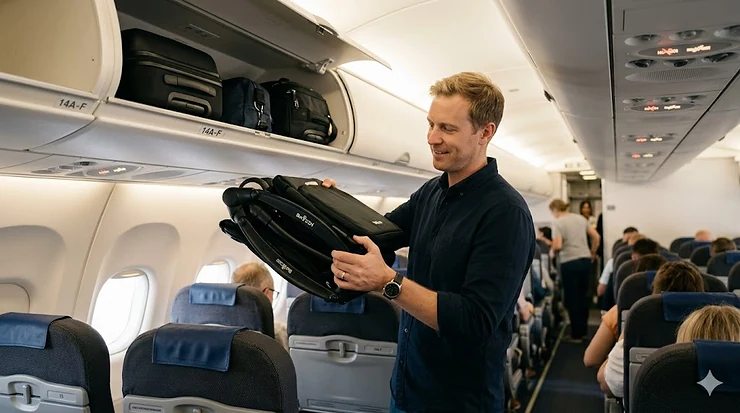
Here’s the thing nobody tells you before your first flight with a baby: the gate agent doesn’t care that your stroller is “basically compact.” They care about inches. Real, measured, tape-measure inches. And if your stroller doesn’t clear them, you’re checking it at the ticket counter and praying it survives the baggage carousel gauntlet looking less like a stroller and more like abstract art.
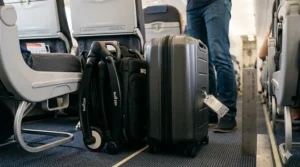
A stroller that genuinely fits in the overhead bin isn’t a luxury — it’s the difference between strolling off the jet bridge with a sleeping toddler and standing at baggage claim for twenty minutes with a screaming one. The good news is that the travel-stroller category has gotten ridiculously good in the last few years. The bad news is that “fits in overhead bin” has become marketing wallpaper, slapped on boxes that, once you actually fold them, look more like a kayak than a carry-on.
So what actually counts as overhead-bin compatible? Most airlines size their overhead bins around the same general envelope as a standard carry-on bag — commonly cited as around 22 x 18 x 10 inches, though this varies by aircraft, and regional jets are noticeably stingier than wide-bodies. A stroller that folds down to roughly 20 x 17 x 9 inches or smaller has a real shot. Anything bigger is a coin flip that depends on the plane, the flight, and how generous your gate agent is feeling that morning.
Below are seven real, currently available strollers that were built — not just marketed — with that math in mind. We’ll go through what each one actually does well, where it falls short, and who should (and shouldn’t) buy it.
Quick Comparison Table
| Stroller | Weight | Folded Size | Price Range | Best For |
|---|---|---|---|---|
| Babyzen YOYO2 | 13.6 lbs | 20.5 x 17.3 x 7.1 in | $350–$450 | Frequent flyers who want the gold standard |
| Joolz Aer2 | 14.3 lbs | 20.9 x 17.3 x 9.2 in | $550–$600 | Parents who hate fumbling at the gate |
| Cybex Libelle 2 | 13.7 lbs | Among the smallest in this group | $200–$280 | Car-seat travel systems on a budget |
| Ergobaby Metro+ | ~17 lbs | 21.2 x 17.3 x 9.8 in | $250–$330 | Newborn-to-toddler versatility |
| gb Pockit | 9.5–10.6 lbs | 11.8 x 7 x 13.8 in | $180–$230 | The smallest physical fold, period |
| Munchkin Sparrow | Under 13 lbs | 15 x 14 x 6.25 in | $120–$170 | Budget buyers who still want a tiny fold |
| Graco Ready2Jet | 13.2 lbs | 23.9 x 19.5 x 11 in | $130–$180 | Graco car-seat owners, daily use over flying |
A few patterns jump out here. Price and fold size aren’t tightly correlated — the gb Pockit is one of the cheapest strollers on this list and folds the smallest, while the Graco Ready2Jet is marketed as “overhead friendly” but is actually the largest folded package in the group, closer to a roomy carry-on than a true bin-stuffer. That gap between marketing language and folded reality is exactly why this list exists. If your main goal is squeezing into a regional jet’s bin, lean toward the top half of this table. If you’re buying one stroller to use for years and occasionally fly with it, the bottom half still does the job on most mainline aircraft.
💬 Just one click — help others make better buying decisions too! 😊
✨ Don’t Miss These Exclusive Deals!
🔍 Take your travel setup to the next level — tap any stroller above to check current Amazon pricing and availability before your next trip.
The 7 Best Overhead-Bin Strollers, One by One
1. Babyzen YOYO2
The Babyzen YOYO2 has become the unofficial uniform of parents in airport lounges, and there’s a reason beyond fashion. Babyzen built this thing around the exact dimensions of European cabin luggage allowances, which is why it folds to a flat 7-inch-thick package that slides into a bin sideways without anyone having to rearrange a single backpack.
What the spec sheet won’t tell you is how that thinness translates in practice: a 7-inch fold means you can often wedge it in after the bin looks full, vertically against the wall, which matters more than total volume on a packed flight. The reclining backrest goes nearly flat, so it doubles as a napping surface for red-eye flights, and the four independent wheel suspensions smooth out the joint between jet bridge and tarmac better than most umbrella strollers manage on a sidewalk.
The trade-off is the fold itself. It’s a two-hand, three-step process — release, pull, press — and it takes a few tries to feel natural. There’s also no infant mode without buying the separate newborn pack or bassinet, so this isn’t a one-and-done purchase if you’re starting from birth.
✅ Thinnest fold in this lineup
✅ Near-flat recline for naps
✅ Recognized and accepted by gate agents almost everywhere
❌ Two-hand fold takes practice
❌ Newborn use requires a separate accessory
Best for: Parents who fly often enough that shaving an inch off the fold is worth a premium price.
Price range: $350–$450, depending on color pack and retailer.
2. Joolz Aer2
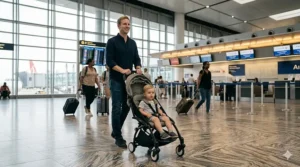
If the YOYO2 is the popular kid, the Joolz Aer2 is the overachiever who shows up with a one-hand, one-second fold and doesn’t even seem to be trying. Pull a single strap and the frame collapses and self-stands on its own — genuinely useful when you’re holding a toddler in one arm and a boarding pass in your teeth.
At 14.3 lbs it’s not the lightest stroller here, but the weight buys you a sturdier ride than the ultra-minimalist options, with suspension that holds up better on cobblestones, ramps, and the occasional poorly maintained terminal floor. The 50-lb weight capacity and from-birth car seat compatibility (with the right adapter) also make it more of a long-term investment than a one-trip gadget.
The catch is the price tag, which sits well above most of this list, and the folded depth of 9.2 inches is noticeably thicker than the YOYO2’s — fine for most bins, but worth double-checking if you’re flying a smaller regional aircraft.
✅ Fastest fold in this category, hands down
✅ Self-stands when folded
✅ Comfortable, stable ride for a compact stroller
❌ Among the pricier options here
❌ Thicker fold than the YOYO2
Best for: Parents who want speed and confidence at the gate more than they want the absolute smallest package.
Price range: $550–$600.
3. Cybex Libelle 2
The Cybex Libelle 2 quietly does something clever: it gives you a near-premium fold and full car-seat compatibility for roughly half the price of the strollers above it. At 13.7 lbs, it’s light enough to lift overhead with one arm, and the one-pull harness and one-hand recline mean fewer fumbled seconds when your toddler is already losing patience in the security line.
The practical sell here is the travel-system angle. Because it accepts Cybex infant car seats directly, you can run a single piece of gear from car to stroller to gate without buying a second adapter kit, which is where a lot of “budget” travel strollers quietly add the cost back in.
It does lose some ground on canopy coverage and storage compared to the Metro+ or Joolz, and the basket capacity (around 11 lbs) is on the small side for a long layover with snacks, diapers, and a jacket all competing for space.
✅ Strong value for a car-seat-compatible travel stroller
✅ One-hand recline and one-pull harness
✅ Lightweight at 13.7 lbs
❌ Smaller storage basket than competitors
❌ Forward-facing only
Best for: Parents building a full travel system without spending YOYO2 or Aer2 money.
Price range: $200–$280.
4. Ergobaby Metro+
The Ergobaby Metro+ is the stroller equivalent of a Swiss Army knife — not the single best at any one thing, but genuinely good at almost everything. Its built-in Newborn Nest mode reclines to 175 degrees and tucks in side flaps to create a secure cocoon, which means this is one of the few strollers on this list you can actually use from day one without a bassinet attachment.
That from-birth flexibility is the real selling point. A lot of “travel strollers” only become usable around four to six months, forcing new parents into a second stroller purchase right when they’re least interested in shopping. The Metro+ skips that step, and its adjustable handlebar (a genuinely rare feature in this weight class) means it works for a 5’2″ parent and a 6’3″ one without anyone hunching over.
The fold, while technically one-handed, is described by more than one reviewer as a little fiddly until you’ve done it a dozen times, and at roughly 17 lbs it’s heavier than the ultra-light category leaders. The 9.8-inch folded depth also puts it closer to “fits in most bins” than “fits in literally every bin.”
✅ Usable from birth without extra accessories
✅ Adjustable handlebar for mixed-height parents
✅ Near-flat recline and roomy storage basket
❌ Fold takes some practice to do smoothly
❌ Heavier than the ultra-compact options
Best for: Parents who want one stroller to cover newborn through toddler, with travel as a bonus rather than the sole purpose.
Price range: $250–$330.
5. gb Pockit
The gb Pockit earned a Guinness World Record for being the smallest folding stroller on the market, and even years later, nothing else here comes close. Folded, it measures roughly 11.8 x 7 x 13.8 inches — small enough to genuinely fit inside some carry-on bags, let alone the overhead bin above them.
That party trick comes with real compromises. The seat is narrower and the ride firmer than anything else on this list; this is a stroller built for short hops through an airport and quick errands, not for an all-day theme park marathon. There’s no recline worth mentioning and minimal padding, so it suits toddlers who can sit upright far better than infants.
If your travel pattern is “land, walk through the airport, get in a cab,” the Pockit’s size advantage is hard to argue with. If your trip involves long days of strolling once you arrive, you’ll likely want a second, more comfortable stroller waiting at your destination.
✅ Smallest fold of any stroller on this list, by a wide margin
✅ Genuinely budget-friendly for the category
✅ Easy two-step fold
❌ Minimal recline and padding
❌ Not ideal for all-day use or long naps
Best for: Short trips and toddlers who don’t need a flat recline.
Price range: $180–$230.
6. Munchkin Sparrow
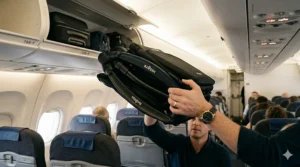
The Munchkin Sparrow is the budget pick that doesn’t feel like a compromise, at least on paper. Folded to roughly 15 x 14 x 6.25 inches and weighing under 13 lbs, it actually beats several pricier strollers on this list in raw fold size, while supporting kids up to 55 lbs and 41 inches tall.
The savings show up in the details rather than the headline numbers. There’s no recline, so this is strictly a stroller for kids who can sit upright comfortably — a non-starter for newborns and most babies under six months. Under-seat storage is also thin, which means a parent juggling a diaper bag, water bottle, and snacks will be relying on a backpack more than the basket.
For families with an older baby or toddler who mostly needs the stroller for nap-free trips through the airport and around the destination, the Sparrow’s combination of tiny fold and low price is genuinely hard to beat.
✅ Smaller fold than several pricier competitors
✅ Mesh headrest and UPF 50+ canopy for comfort
✅ Supports kids up to 55 lbs
❌ No recline
❌ Limited under-seat storage
Best for: Budget-conscious parents traveling with an older baby or toddler.
Price range: $120–$170.
7. Graco Ready2Jet
The Graco Ready2Jet belongs on this list with an asterisk, and it’s worth being upfront about why. Graco markets it as “overhead friendly,” and at 13.2 lbs it’s genuinely light. But its folded footprint — roughly 23.9 x 19.5 x 11 inches by independent measurement — is actually the largest in this entire lineup, closer to a generously sized carry-on bag than a true bin-squeezer.
What it does deliver is value and convenience for a different kind of traveler: anyone already invested in the Graco car-seat ecosystem. It accepts Graco SnugRide infant seats directly with zero adapters, the recline is deeper and more forgiving than budget rivals like the Sparrow, and the automatic self-fold genuinely works with one hand, no wrestling required.
If your flights are mostly on wide-body aircraft with generous bins, or if you’re comfortable gate-checking on tighter regional jets, the Ready2Jet is a perfectly reasonable everyday stroller that happens to travel. If guaranteed overhead-bin clearance on every flight is the deciding factor, one of the more compact options above is the safer bet.
✅ Accepts Graco infant car seats with no adapter needed
✅ Genuine one-hand automatic fold
✅ Deeper recline than most budget competitors
❌ Largest folded footprint on this list
❌ “Overhead friendly” doesn’t guarantee bin fit on smaller aircraft
Best for: Graco car-seat owners who want one stroller for daily life and occasional travel, not frequent-flyer precision packing.
Price range: $130–$180.
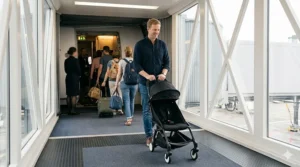
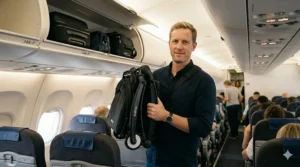
How to Choose a Stroller That Fits in the Overhead Bin
Specs on a box are marketing copy until you check them against reality. Here’s the actual decision process worth running before you buy:
- Check your specific airline’s bin dimensions, not a generic average. A regional CRJ-700 has noticeably tighter bins than a 737 or A321. If most of your travel is on smaller regional jets, build in an extra inch of margin everywhere.
- Measure the folded depth, not just length and height. Depth is what determines whether a stroller slides in sideways next to other bags or needs its own dedicated space. Anything under 8 inches deep gives you real flexibility.
- Weigh how often you’ll actually lift it overhead. A stroller you’re hoisting solo with a baby on your hip should be under 15 lbs. If a partner is usually there to help, a few extra pounds buys you better ride quality.
- Decide if you need from-birth use. Strollers like the Metro+ skip the bassinet step entirely; others, like the YOYO2 and Joolz, need an add-on accessory for newborns.
- Match the recline to your trip length. Long-haul flights and naps call for something closer to flat. A quick domestic hop doesn’t demand the same recline depth.
- Factor in storage realistically. The tiniest folds (Pockit, Sparrow) tend to sacrifice basket space — fine for a backpack-carrying parent, less fine if you’re checking nothing and need the basket to hold everything.
- Price the accessories, not just the frame. Car seat adapters, travel bags, and rain covers can add $50–$150 to several of these strollers. Factor that in before comparing sticker prices.
What Actually Happens at the Gate (Problem → Solution)
Problem: Your stroller looks compact but the gate agent says it has to be checked. Solution: treat every “carry-on compatible” stroller as a maybe, not a guarantee. According to the TSA’s official guidance for traveling with children, strollers must be screened by X-ray at security regardless of size, and final cabin stowage is ultimately an airline call, not a TSA one. Build in a gate-check plan even with the smallest stroller on this list.
Problem: You’re not sure if your airline checks strollers for free. Solution: check before you fly rather than at the gate. American Airlines’ official policy, for instance, allows one stroller and one car seat to be checked at no charge per ticketed child, and most major US carriers follow a similar model — Southwest’s stroller policy is one of the more generous, covering essentially any stroller type free of charge.
Problem: You want to know the stroller itself is actually safe, not just compact. Solution: look for compliance with the federal stroller safety standard. In the US, strollers are regulated under 16 CFR Part 1227, the CPSC’s safety standard for carriages and strollers, which sets requirements for tip resistance, brake performance, harness retention, and fold-lock safety. A compact fold means nothing if the brakes or harness don’t hold up.
Features That Actually Matter (And Those That Don’t)
Matters: Folded depth under 9 inches. This is the single biggest predictor of whether a stroller clears a tight regional-jet bin.
Doesn’t matter as much as you’d think: All-terrain wheels. Unless your trip involves gravel trails or cobblestones, the smaller wheels on ultra-compact strollers handle smooth airport floors and city sidewalks just fine.
Matters: A self-standing fold. When you’re juggling a boarding pass, a diaper bag, and a toddler, a stroller that stays upright on its own once folded saves you from setting it on a questionable airport floor.
Doesn’t matter as much as you’d think: Maximum weight capacity above 50 lbs. Most kids outgrow stroller use entirely well before hitting that ceiling, so chasing extra capacity rarely changes your buying decision.
Matters: Car seat compatibility, if you’re traveling with an infant. Adapters can cost $30–$80 separately, so checking compatibility before you buy avoids an unpleasant surprise.
5 Common Mistakes When Buying an Overhead-Bin Stroller
- Trusting “fits in overhead bin” marketing language without checking the actual folded dimensions. As the Ready2Jet shows, the phrase doesn’t always match reality.
- Buying based on weight alone. A 10-lb stroller with a bulky 12-inch-deep fold can be harder to stow than a 14-lb stroller that folds flat.
- Skipping a practice fold before the trip. Several strollers on this list have a learning curve. Doing it for the first time at a crowded gate is not the moment to discover that.
- Ignoring recline needs for long flights. A stroller with no recline works for short hops but turns into a fight on a five-hour red-eye with an overtired toddler.
- Forgetting accessory costs when comparing prices. A “cheaper” stroller that needs a $60 car seat adapter and a $40 travel bag can end up costing more than a pricier one that includes both.
FAQ
❓ Is there a stroller that actually fits in the overhead bin?
❓ How small does a stroller need to fold to fit in an overhead bin?
❓ What is the best lightweight stroller for airplane travel?
❓ Does a stroller count toward your carry-on allowance?
❓ Can a stroller be too big to gate-check?
Conclusion
There’s no single “best” stroller here — there’s a best stroller for your specific mix of how often you fly, how old your kid is, and how much you’re willing to spend to shave an inch off the fold. If you’re chasing the smallest possible package, the gb Pockit and Babyzen YOYO2 sit at opposite price points but both deliver on that promise. If you want one stroller to handle newborn through toddler with travel as a side benefit, the Ergobaby Metro+ earns its middle-of-the-road price tag. And if budget matters more than bragging rights about fold size, the Munchkin Sparrow and Cybex Libelle 2 both punch well above their price.
Whichever one you land on, build a gate-check backup into your plan regardless of how compact the box claims it is. The stroller that fits in the overhead bin on a 737 might not fit on the regional jet for your connecting flight — and a five-minute backup plan beats a frustrated standoff at the jet bridge every time.
✨ Don’t Miss These Exclusive Deals!
🔍 Ready to pick your travel stroller? Tap any product above to check current pricing and availability on Amazon before your next flight.
Recommended for You
- Best Stroller for Flying: 7 Travel Picks Parents Trust (2026)
- Best One Hand Fold Stroller 2026: 7 Top Picks Reviewed
- 7 Best Compact Fold Strollers of 2026 That Actually Fit Everywhere
Disclaimer: This article contains affiliate links. As an Amazon Associate, I earn from qualifying purchases. If you purchase products through these links, we may earn a small commission at no additional cost to you.
✨ Found this helpful? Share it with a fellow traveling parent! 💬🤗
