
In This Article
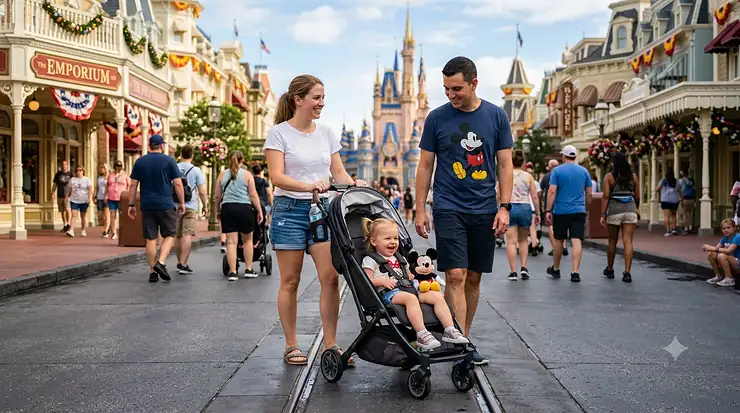
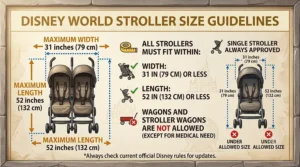
A stroller for Disney World is not a luxury. It is closer to a survival tool, somewhere between a diaper bag and a pair of decent walking shoes. A stroller for Disney World is a wheeled vehicle that meets Disney’s published size limit of 31 inches wide by 52 inches long, gives a toddler somewhere to nap between Splash Mountain’s successor and the fireworks, and folds fast enough to keep up with a Disney bus driver who has somewhere to be. That’s the forty-second definition. Everything else in this guide is the long version.
Here’s the thing nobody tells you before your first trip: the parks themselves are basically a 10-mile fitness test disguised as a vacation, and most of those miles happen on pavement that radiates Florida heat like a skillet. Add a 3-year-old who refuses to walk past the gift shop, a diaper bag, two water bottles, and a stack of churros you’re definitely not finishing alone, and you start to understand why “which stroller” eats up entire parenting forums every spring. Based on the spec comparison across this year’s most-discussed models, the right answer depends less on brand reputation and more on a blunt question: are you optimizing for compactness, comfort, storage, or sheer toddler-hauling capacity?
This guide walks through seven real products — based on actual specs, official Disney rules, and aggregated review sentiment pulled from independent testers and verified buyers — so you can pick a stroller for Disney World without gambling at the bag-check line. We’ll cover budget, mid-range, and premium options, plus the double-stroller question, the rain cover question, and the parking-lot-sized headache that is “where did my stroller go.” Reviewers consistently note that the wrong stroller doesn’t ruin a Disney trip outright, but it does make every single day slightly harder than it needed to be, and over a five-day trip, slightly harder adds up fast.
This article contains affiliate links, which means a purchase made through one of these links may earn a small commission at no extra cost to you.
Quick Comparison Table
Before the deep dive, here’s the cheat sheet. Every stroller below clears Disney’s published 31-inch width and 52-inch length limit, so size compliance isn’t a variable — comfort, weight, and storage are.
| Stroller | Weight | Folded Width | Price Range | Best For |
|---|---|---|---|---|
| UPPAbaby Minu V2 | ~16.9 lbs | 20.3 in | $400–$480 | Compact comfort seekers |
| gb Pockit+ All-Terrain | ~13 lbs | 7.9 in | $200–$260 | Air travel + tiny trunks |
| Kolcraft Cloud Plus | ~12 lbs | 31 in | $70–$100 | Tight budgets |
| Baby Jogger City Mini GT2 | ~19–20 lbs | 25.7 in | $400–$470 | Bumpy queues, longer kids |
| Britax B-Lively | ~19–20 lbs | 23 in | $300–$380 | Everyday + travel system |
| Joovy Kooper X2 (Double) | 28 lbs | 30.3 in | $300–$350 | Two kids, one push |
| Summer Infant 3Dlite | ~13–15 lbs | 19.5 in | $70–$110 | Backup or grandparent trip |
Looking at the numbers, the spread between the lightest and heaviest single strollers here is roughly 8 pounds — which sounds small until you’re hoisting it into a rental car trunk for the fourth time in a week. The gb Pockit+ wins on packed size by a wide margin, but that compactness comes at the cost of ride comfort, something we’ll unpack in the product breakdown. Budget buyers should note that the Kolcraft Cloud Plus and Summer Infant 3Dlite sit in a different price universe entirely — under $110 versus $300 to $480 for the rest — and that gap mostly buys you better wheels, smoother folds, and sturdier frames rather than dramatically different features.
💬 Just one click — help others make better buying decisions too! 😊
Found a pick you like already? Save it to your trip planning doc — you’ll want this comparison handy when packing day arrives.
Top 7 Strollers for Disney World: Expert Analysis
Picking the best stroller for Disney World really comes down to matching the product to your specific trip: how many kids, how many park days, whether you’re flying or driving, and whether nap time is still a daily non-negotiable. The seven below cover budget through premium, single through double, and ultra-packable through built-for-comfort.
1. UPPAbaby Minu V2
The UPPAbaby Minu V2 stands out for one reason above all others: a genuinely one-handed, one-motion fold that locks into a freestanding shape, which matters enormously when you’re holding a churro in one hand and a toddler’s wrist in the other.
At roughly 16.9 pounds with a folded footprint of about 11.5 by 20.3 by 23 inches, the Minu V2 splits the difference between an umbrella stroller and a full-size model. Spring-action, shock-absorbing all-wheel suspension means the ride stays smooth over Magic Kingdom’s brick-paved Main Street, and the seat holds a child up to 50 pounds — enough to carry most kids through age 4 or 5. Based on the spec comparison, what most buyers overlook is the genuine leather handlebar and bumper bar, which is less about style and more about grip; after eight hours of pushing, a textured leather grip feels noticeably better in your palm than slick plastic.
This is the pick for parents who want compact convenience but aren’t willing to sacrifice ride quality or a real recline for naps. Independent testers found the Minu V2’s small wheels still outperform many competitors on flat surfaces, though it’s worth noting it isn’t the lightest in its class — testers measured it closer to 17 pounds on the nose, a few pounds heavier than the smallest umbrella strollers.
✅ Pros: smooth one-hand fold, genuine all-wheel suspension, 50-lb capacity, large 20-lb basket
❌ Cons: pricier than competitors, slightly heavier than ultra-compact rivals
In the $400 to $480 range, the Minu V2 is a strong value if you’ll also use it outside the parks — it works double duty as a daily stroller and a travel companion long after your trip ends.
2. gb Pockit+ All-Terrain
If your top priority is folding a stroller down to something that fits inside an overhead bin, the gb Pockit+ All-Terrain is hard to beat. Independent testing measured it folding to roughly 13.4 by 7.9 by 16.5 inches — small enough to tuck under a café table or behind a hotel door, which matters a lot if you’re staying off-property and dealing with limited closet space.
Weighing around 13 pounds with a reclining seat and dual front swivel wheels, this stroller earns its “all-terrain” name loosely; independent testers found it performs well on flat surfaces but struggles once you leave smooth pavement, with the frame flexing noticeably on tight turns. What the spec sheet won’t tell you, but reviewers note, is that this flex feels alarming the first few times you use it, even though the frame is engineered to handle it.
The Pockit+ is for the family flying into Orlando who refuses to check a stroller, or anyone whose rental car trunk is smaller than expected. Reviewers consistently report that folding and unfolding takes a bit of practice — testers clocked it at roughly 6 seconds to fold, slower than competitors, and unfolding sometimes requires a firm push to pop into place.
✅ Pros: smallest folded size in its category, airplane-compliant, reclining seat for naps
❌ Cons: frame flex on turns, two-handed fold, less padding than full-size options
At around $200 to $260, this is squarely a specialty pick rather than an everyday workhorse — buy it for the packing convenience, not for all-day comfort over rough terrain.
3. Kolcraft Cloud Plus
The Kolcraft Cloud Plus is the budget anchor of this list, and it earns that spot honestly. At roughly 12 to 13 pounds and priced between $70 and $100, it’s explicitly marketed as Disney Size Approved and built for airplane travel, with a 50-pound weight capacity that covers most toddlers through preschool age.
Here’s what most buyers overlook about this category: independent testing found the Cloud Plus uses softer, foam-filled wheels and a more flexible frame than pricier rivals, which means it’s genuinely harder to push through grass or gravel — not a dealbreaker inside paved theme parks, but worth knowing if you’re also using it for neighborhood walks back home. Testers measured it at under 12 lbs, making it one of the lightest strollers in its category, though the folded size is larger than you’d expect given that low weight.
This is the right call for families who want a true backup stroller, a one-trip purchase they won’t mourn if an axle gets bent in baggage claim, or parents stretching a tight vacation budget after paying for park tickets and a hotel.
✅ Pros: extremely low price, genuinely lightweight, large storage basket, parent and child trays included
❌ Cons: lower-quality wheels, basic comfort, not built for daily long-term use
Aggregated review sentiment skews positive specifically for theme park use, with buyers consistently citing the price-to-convenience ratio as the main selling point rather than build quality.
4. Baby Jogger City Mini GT2
For parents who want a stroller that rides like a full-size model but still clears Disney’s gate, the Baby Jogger City Mini GT2 is the strongest all-terrain option here. Forever-air rubber tires that never go flat, paired with all-wheel suspension, mean it handles cracked pavement and the occasional curb cut without jostling a sleeping toddler awake.
Folded dimensions run about 32.5 by 25.7 by 13 inches, and weight sits in the high-teens to low-20-pound range depending on configuration — heavier than the Minu V2, but the tradeoff is a roomier seat, a near-flat recline, and an adjustable handlebar that genuinely helps when mom is 5’1″ and dad is 6’2″. Reviewers consistently note that the one-hand, in-seat fold is one of the smoothest in the category, a detail that matters every single time you board a Disney bus.
This stroller is for families prioritizing ride comfort and durability over absolute compactness — particularly anyone who’ll keep using it well past the trip, since it’s built more like a daily-driver stroller than a single-use travel gadget.
✅ Pros: smooth all-terrain ride, near-flat recline, adjustable handlebar, durable build quality
❌ Cons: heavier than compact rivals, storage basket is smaller than competitors at this price
Priced roughly $400 to $470, this sits at the premium end, but reviewers and testers alike consistently rank it among the most comfortable all-terrain options for families doing multiple park days back to back.
5. Britax B-Lively
The Britax B-Lively occupies the mid-range sweet spot: lighter and cheaper than the City Mini GT2, but with more structure and a better recline than budget umbrella strollers. At roughly 19 to 20 pounds with an infinite recline that lets you find the perfect angle for napping, this is a genuinely comfortable option for kids who still nap mid-day, which — let’s be honest — covers a huge chunk of the Disney-stroller-buying audience.
What the spec sheet won’t tell you is how the dual front-wheel design performs in practice: independent testers found steering requires more effort than expected, and sharp, frequent turns demand real input from the pusher, particularly compared to single-wheel competitors. The extra-large storage basket, accessible from front and back, more than makes up for it on long park days when you’re hauling extra layers, snacks, and a stroller fan.
This stroller is built for parents who already own or plan to buy a Britax infant car seat, since the click-and-go compatibility turns it into a full travel system, and for anyone who wants a true one-hand fold without paying premium-tier prices.
✅ Pros: genuine infinite recline, XL storage with multiple access points, true one-hand fold, quiet ride
❌ Cons: steering takes more effort than rivals, handlebar doesn’t adjust for height
In the $300 to $380 range, the B-Lively delivers most of what you’d want from a premium stroller for Disney World without the premium price tag — the compromise shows up in maneuverability, not comfort.
6. Joovy Kooper X2
For two kids, the Joovy Kooper X2 is the strongest value on this list. At 30.3 inches wide, it slides in under Disney’s 31-inch width cap with less than an inch to spare, so measuring your specific model before the trip genuinely matters — this is one to double-check, not assume.
Each seat reclines independently to near-flat, which solves the classic double-stroller problem of one toddler napping while the other one is wide awake and bored. Two swing-open snack trays come included, a detail solo travel strollers rarely offer and one that buyers consistently call out as a meaningful upgrade over cheaper double models. At 28 pounds folded, this is genuinely portable for a side-by-side double — reviewers note it fits into smaller car trunks than expected, including compact sedans.
This is the pick for families with two stroller-aged kids who want independent recline, real storage, and a stroller that doesn’t require a minivan to transport.
✅ Pros: fits Disney’s width limit with room to spare, independent near-flat recline per seat, included snack trays, large storage basket
❌ Cons: 30.3-inch width is tight for some doorways, heavier than single strollers by design
At $300 to $350, this beats out pricier double-stroller competitors on value alone — reviewers consistently compare it favorably against models costing twice as much.
7. Summer Infant 3Dlite
Rounding out the list is the Summer Infant 3Dlite, a lesser-known but genuinely useful budget alternative, particularly for grandparents tagging along on the trip or families who want a true backup. At roughly 13 to 15 pounds and priced between $70 and $110, it undercuts nearly everything else here.
Independent testing found mixed results: the canopy is on the small side and the harness webbing feels rougher than premium competitors, and the elongated umbrella-style fold takes up more trunk space than tri-fold rivals despite the low weight. What buyers overlook here is that this stroller isn’t trying to compete with the Minu V2 or City Mini GT2 — it’s solving a different problem entirely: a genuinely cheap, genuinely light option for someone who needs a stroller for three days and doesn’t want to spend $400 doing it.
✅ Pros: very low price, genuinely light at under 15 lbs, large storage basket, simple to assemble
❌ Cons: smaller canopy, harder to maneuver on uneven ground, two-handed fold
For a one-trip purchase, a second stroller for grandparents, or a backup in case your primary stroller gets damaged in transit, the 3Dlite earns its spot purely on price-to-function ratio.
Disney World Stroller Size Rules: What Actually Gets You Turned Away
Disney World stroller size rules are spelled out directly in Disney’s own property rules and regulations, and they’re straightforward but firmly enforced. Strollers greater than 31 inches in width and 52 inches in length are not permitted, and that measurement applies to the widest and longest points of the entire setup — cup holder attachments, organizers, and clip-on accessories included. Cast Members measure strollers that appear to exceed the limits at park entrances, and if yours is too big, you’ll be asked to return it to your car or resort.
The second rule trips up more families than the size limit itself: stroller wagons are prohibited at any theme park or water park, full stop, regardless of size. Brands like Keenz and Wonderfold that are legal at many regional amusement parks simply don’t clear a Disney World gate, so if you’ve been eyeing one of those pull-along wagons for the trip, it’s worth reconsidering before you buy.
A few practical notes worth knowing before you go:
- Measure at home, not at the gate. Most strollers list dimensions on the manufacturer’s site or the box — confirm before packing rather than discovering a problem in line.
- Remove add-on accessories before entry if your stroller is borderline on size; cup holder attachments and organizer bars can push a compliant frame over the limit.
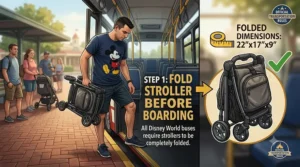
- Folding is mandatory on Disney buses, so factor fold speed into your decision, not just folded size.
- Strollers can’t enter ride queues, so you’ll park near each attraction and collect it after.
How to Choose a Stroller for Disney World
Picking the right stroller for Disney World comes down to seven practical criteria, ranked roughly by how often they actually matter once you’re in the parks.
- Weight, because you’ll lift it constantly. Between buses, monorails, and the occasional curb, a stroller under 20 pounds saves real effort over a multi-day trip.
- Fold speed and one-hand capability. You’ll fold and unfold this thing dozens of times a day, often holding a child simultaneously.
- Recline depth, if naps are still happening. A near-flat recline is the difference between a peaceful nap and a cranky toddler at dinner.
- Storage capacity. Sunscreen, ponchos, water bottles, and souvenirs add up fast; a deep, accessible basket earns its keep.
- Width relative to the 31-inch limit. Don’t just check compliance — check margin, since accessories and canopy extensions can push borderline models over.
- Wheel type and suspension. Brick-paved areas and uneven pathways reward all-wheel suspension over basic plastic wheels.
- Whether you’ll use it after the trip. A pricier, full-featured stroller makes more sense if it’ll see daily use back home; a budget pick makes more sense for a single trip.
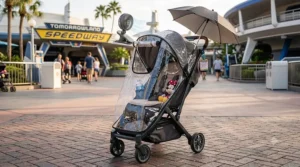
Best Compact Stroller for Disney: When Smaller Wins
The best compact stroller for Disney isn’t automatically the smallest one — it’s the smallest one that still gives you a usable recline and enough basket space for a day’s worth of gear. This is where the UPPAbaby Minu V2 and gb Pockit+ genuinely diverge in purpose, even though both qualify as compact.
If you’re flying and need something that survives a gate-check or, ideally, fits in an overhead bin, the gb Pockit+ All-Terrain wins outright on folded size. But here’s what the spec sheet won’t tell you: that tiny fold comes from a smaller frame overall, which means less seat depth and a shorter recline range than a stroller like the Minu V2. For toddlers who still nap hard mid-afternoon — which, again, is most toddlers on a Disney trip — that recline difference matters more than an extra two inches of packed width.
A compact stroller for Disney also needs to survive Main Street’s brick pavement and the uneven transitions between park lands. Based on the spec comparison, all-wheel suspension (present on the Minu V2, absent on more basic compacts) smooths out exactly that kind of terrain. The takeaway: pick ultra-compact if your trip is short and your priority is packing logistics; pick a slightly larger compact model with real suspension if comfort across a full week matters more than shaving an inch off the folded footprint.
✨ Compare folded dimensions side by side before you buy — even strollers in the same “compact” category can differ by several inches.
Best Double Stroller for Disney: Side-by-Side vs Tandem
Choosing the best double stroller for Disney usually comes down to a single architectural decision: side-by-side or tandem (front-and-back). Each has real tradeoffs once you’re actually navigating crowds.
Side-by-side doubles, like the Joovy Kooper X2, put both kids at the same eye level, which most parents find easier for managing snacks, sunscreen, and the inevitable sibling squabble. The tradeoff is width — side-by-side models eat up more of Disney’s 31-inch limit, leaving less margin for error, and they can feel noticeably wider when threading through a packed queue area. Tandem doubles solve the width problem by stacking kids front-to-back instead, often coming in several inches narrower, but the back seat usually has a worse view and less recline room than the front.
For most families considering a double stroller for Disney, side-by-side wins on day-to-day usability specifically because both kids can see, interact, and nap independently without one child feeling boxed in behind a canopy. The Joovy Kooper X2 demonstrates why: independent near-flat recline per seat means a sleeping toddler in seat one doesn’t force seat two into the same position, something tandem models can’t always replicate. The math also favors buying over renting for multi-day trips — a four-day double rental commonly runs past $120, which exceeds the purchase price of a budget double stroller you keep afterward.
💬 Got siblings close in age? A side-by-side double like the Kooper X2 solves more problems than it creates — check current pricing and availability before your trip!
Disney Park Stroller Parking Tips
Stroller parking Disney tips matter more than most first-time visitors expect, mostly because every attraction has its own designated stroller parking area, and Cast Members reposition strollers throughout the day to keep walkways clear. Translation: your stroller probably won’t be exactly where you left it, and that’s normal, not a sign something went wrong.
A few habits make this less stressful:
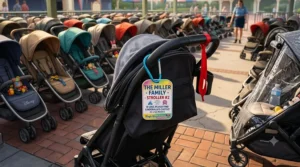
- Tag your stroller distinctly. A bright ribbon, a luggage tag, or even a strip of colored tape on the handlebar makes yours identifiable among fifty nearly identical rentals or popular models.
- Note the attraction name, not the exact spot. Cast Members consolidate parked strollers near each land, so remembering “near the Haunted Mansion stroller area” beats trying to remember an exact location.
- Check nearby designated zones first if yours seems missing. Strollers get shuffled frequently during peak hours, and most “lost” strollers are simply repositioned a short walk away.
- Keep your receipt if you’re renting from Disney, since misplaced rental strollers can typically be replaced at other rental locations on property by showing proof of rental.
A Disney park stroller that’s easy to identify at a glance saves real time across a multi-day trip — a problem worth solving before you arrive, not while standing outside Space Mountain trying to remember which gray stroller is yours among a dozen others.
Real-World Scenarios: Matching Strollers to Your Family
Scenario one: the family of three flying in for a long weekend. Two adults, one toddler, four park days, arriving by air with carry-on luggage only. The gb Pockit+ All-Terrain makes sense here specifically because the folded size clears most airline overhead-bin requirements, sidestepping checked-stroller risk entirely. The tradeoff in ride comfort matters less over a short trip.
Scenario two: the road-trip family with two kids under five. Driving from out of state, plenty of trunk space, two toddlers who both still nap. The Joovy Kooper X2 solves the sibling-management problem directly, and since trunk space isn’t a constraint, the slightly larger folded footprint of a quality double stroller stops being a dealbreaker.
Scenario three: the budget-conscious family stretching every dollar after park tickets. One toddler, a tight overall trip budget, driving distance from Orlando. The Kolcraft Cloud Plus or Summer Infant 3Dlite both make financial sense here — neither is a forever-stroller, but at $70 to $110, either one pays for itself compared to a four-day rental, while still meeting every Disney World stroller size rule.
Stroller Rain Cover Disney: Surviving Afternoon Storms
A stroller rain cover for Disney trips isn’t optional gear in Florida — it’s closer to mandatory, given how reliably afternoon thunderstorms roll through Orlando, especially during summer months. Most strollers don’t include one standard, so this is worth adding to your packing list before departure rather than scrambling for one in a gift shop mid-downpour.
A few practical notes on choosing and using a rain cover: universal covers fit most strollers but can trap heat if left on too long after a storm passes, so remove it the moment skies clear rather than leaving your child sealed inside a humid plastic tent. The American Academy of Pediatrics’ guidance on sun and heat safety for kids consistently warns against draping blankets or non-breathable covers over a stroller, since trapped heat poses a real overheating risk — the same logic applies to leaving a rain cover zipped shut in direct sun after the rain stops.
Brand-specific rain covers, like the Baby Jogger Weather Shield designed for the City Mini GT2 line, tend to fit more precisely than universal covers but cost more and only work with that specific model. For most families, a $15 to $25 universal stroller rain cover, packed in the basket every single day regardless of the forecast, solves the problem cheaply — Florida weather changes fast enough that “it looked sunny this morning” isn’t a reliable plan.
Common Mistakes When Buying a Stroller for Disney World
The single most common mistake is buying based on folded size alone and skipping the recline check — a stroller that packs small but barely reclines becomes a problem the moment a toddler needs an actual nap mid-afternoon, which happens on nearly every Disney trip with kids under four.
A second frequent mistake: assuming a stroller is Disney-compliant without measuring the specific model and color variant, since dimensions can shift slightly between versions of the same product line. A third: underestimating storage needs — between ponchos, sunscreen, water bottles, and souvenirs, a shallow basket fills up by lunchtime, forcing parents to carry overflow themselves. And a fourth, more subtle mistake is prioritizing weight over wheel quality; an ultra-light stroller with cheap plastic wheels can actually feel harder to push over Disney’s uneven pavement transitions than a slightly heavier model with proper suspension.
Long-Term Cost & Value: Buy vs Rent
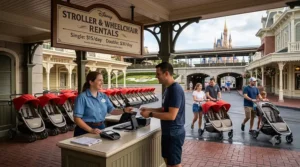
Disney’s own in-park rental strollers run roughly $15 a day for a single and somewhere in the $30 range for a double, with modest length-of-stay discounts — but they’re hard plastic, don’t recline, and must be surrendered at the gate every time you leave for a midday resort break, then rented again on re-entry. Third-party companies like Orlando Stroller Rentals, BabyQuip, and Magic Strollers deliver hotel-friendly strollers for roughly $40 to $70 a week, which solves the resort-break problem but adds logistics around delivery and pickup timing.
Run the math on a five-day trip and the value proposition shifts quickly: a single Disney rental across five days lands around $75, a double closer to $150 — both before tipping or length-of-stay adjustments. Compare that to the Kolcraft Cloud Plus at $70 to $100 or the Joovy Kooper X2 at $300 to $350, and the ownership math starts to favor buying for anyone planning a return trip, a future sibling, or regular use back home. Renting still wins for one-off trips where storage space afterward is a genuine concern, particularly for families flying without checked-bag room for a stroller on the return flight.
Features That Actually Matter (And Those That Don’t)
Recline depth, basket size, and fold speed consistently matter across every stroller in this guide — these show up in real complaints and real praise across aggregated review sentiment far more often than flashier marketing features. All-wheel suspension matters specifically because of Disney’s mix of brick, asphalt, and the occasional dirt-adjacent pathway near attractions like Animal Kingdom’s trails. It’s also worth checking that any stroller you buy meets the federal safety standard for carriages and strollers, which covers stability, brake performance, and folding-mechanism safety — every product in this guide is sold by a major U.S. retailer and built to that standard, but it’s a detail worth confirming on lesser-known brands.
What matters less than marketing suggests: cup holder count, color options, and “all-terrain” branding on strollers that are really designed for paved surfaces. A stroller advertised as all-terrain but tested primarily on smooth ground, like several budget options in this guide, won’t perform meaningfully differently from a standard model inside Disney’s paved parks — that feature mostly matters for families who’ll also use the stroller on hiking trails or unpaved neighborhoods back home. Snack trays, while genuinely convenient, are easy to add as accessories later if your chosen stroller doesn’t include one standard.
Frequently Asked Questions
❓ What is the actual stroller size rule for Disney World?
❓ Can I bring a double stroller into Disney World?
❓ Do I need a rain cover for a Disney World stroller?
❓ Is it cheaper to rent or buy a stroller for Disney World?
❓ What happens if my stroller is too big at the Disney gate?
Conclusion
There’s no single best stroller for Disney World — there’s a best stroller for your specific trip, your specific kid, and your specific tolerance for folding things in tight spaces while holding a toddler. Families flying in with limited luggage room lean toward the gb Pockit+’s ultra-compact fold; families prioritizing comfort over a full week of park days lean toward the UPPAbaby Minu V2 or Baby Jogger City Mini GT2; families with two kids gravitate toward the Joovy Kooper X2’s independent recline and Disney-friendly width; and budget-conscious families get genuine value from the Kolcraft Cloud Plus or Summer Infant 3Dlite without sacrificing compliance with Disney World’s stroller size rules.
What matters most across every option here is matching real specs to your real trip, not chasing whichever stroller shows up first in a search result. Check the width against your specific double-stroller needs, check the recline against your child’s actual nap schedule, and check the fold speed against how many times you’ll realistically use a Disney bus. Get those three things right, and the stroller stops being a source of stress and goes back to being what it’s supposed to be: a tool that lets your family enjoy more park time and less logistics headache.
✨ Ready to lock in your pick? Check current pricing and availability before your trip dates fill up — Disney crowds (and stroller rental lines) only get longer as the season heats up!
Recommended for You
- 7 Best Travel System Strollers of 2026
- Best Stroller for Gate Checking: 7 Top Picks for 2026
- 7 Best Strollers for Flying with a Toddler in 2026
Disclaimer: This article contains affiliate links. As an Amazon Associate, I earn from qualifying purchases. If you purchase products through these links, we may earn a small commission at no additional cost to you.
✨ Found this helpful? Share it with your friends! 💬🤗
