
In This Article
Here’s a scene that plays out in stroller aisles every single weekend: a bleary-eyed parent, phone open to three browser tabs, trying to figure out why one jogging stroller’s front wheel spins like a shopping cart’s and another’s is bolted stiff as a surfboard fin. It looks like a small detail. It isn’t. The jogging stroller swivel vs fixed wheel decision shapes almost everything about how the next few years of your mornings will feel — whether you’re gliding through a farmer’s market on Saturday or grinding out mile repeats on Tuesday.
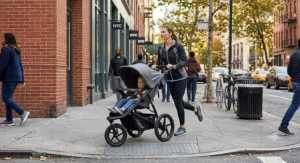
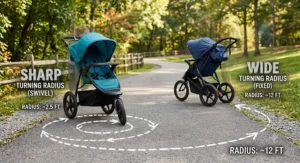
A jogging stroller with a fixed front wheel doesn’t rotate at all; it locks in a straight-ahead position for maximum stability at running speed, while a swivel wheel rotates 360 degrees for tight turns and can usually be locked into a fixed position when you pick up the pace. That single mechanical difference decides how a stroller behaves on a grocery run, a trail loop, or a stroller-jog through a crowded park path.
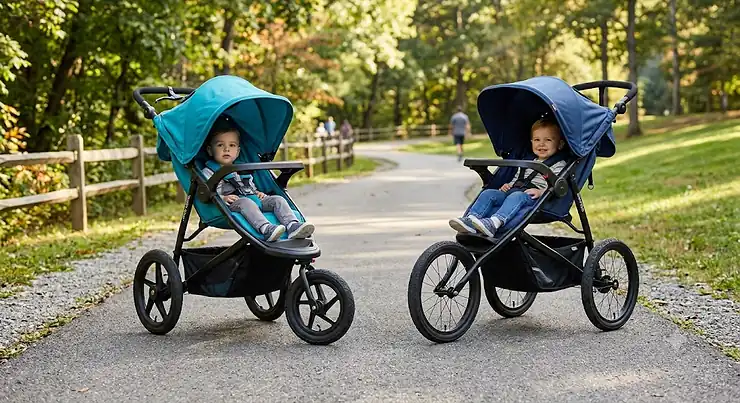
This guide breaks down seven real, currently sold strollers — three with lockable swivel wheels, one true fixed-wheel model, and a spread of budget-to-premium options — so you can match the hardware to your actual routine instead of guessing from a spec sheet. We’ll get into why pediatric guidance points to somewhere around the six-to-eight-month mark, once a baby has real head and neck control, as the earliest sensible starting line for jogging-stroller rides at all (more on that in our stroller safety overview), how the swivel-lock mechanism actually behaves at speed versus at a standstill, and which of these seven strollers deserves a spot in your garage. No fluff, no invented reviews — just real specs, honest analysis, and the tradeoffs nobody puts on the box.
Quick Comparison Table
| Stroller | Front Wheel | Best For | Price Range |
|---|---|---|---|
| BOB Gear Revolution Flex 3.0 | Lockable swivel | All-terrain daily runners | $430–$480 |
| Thule Urban Glide 3 | Lockable swivel | Premium everyday + jogging | $450–$550 |
| Thule Glide 2 | Fixed | Dedicated speed runners | $450–$500 |
| Baby Trend Expedition Jogger | Lockable swivel | Budget-conscious families | $150–$220 |
| Joovy Zoom 360 Ultralight | Lockable swivel | Mid-range balance | $280–$330 |
| UPPAbaby Ridge V2 | Lockable swivel | Premium suspension seekers | $500–$620 |
| Guava Roam Crossover | Lockable swivel | Compact fold, no-flat tires | $400–$500 |
Looking across the table, six of the seven strollers here use a lockable swivel front wheel, which lines up with where the market has moved — the vast majority of joggers on the market today ship with either a truly fixed axle or a swivel wheel that locks into place, and the swivel-lock design has become the default because it gives one stroller both running stability and everyday agility. The lone holdout, the Thule Glide 2, exists precisely for the small slice of buyers who never intend to use their jogger for anything but running. If you already own a separate everyday stroller, that tradeoff might make sense; if this is your only stroller, the swivel-lock models below will almost certainly serve you better day to day.
✨ Ready to see which of these strollers matches your routine? Keep scrolling — the full breakdown is just below.
💬 Just one click — help others make better buying decisions too!😊
Top 7 Jogging Strollers: Expert Analysis
1. BOB Gear Revolution Flex 3.0 — the swivel-lock gold standard
The BOB Gear Revolution Flex 3.0 has been the benchmark other jogging strollers get measured against for the better part of a decade, and the swivel-lock front wheel is a big reason why. The adjustable suspension and 16-inch air-filled tires mean the fork can absorb curb drops and gravel chunks instead of transmitting every jolt straight into the frame — in practice, that translates to a noticeably calmer ride on cracked sidewalks and unpaved trails alike. Real user reports describe the swivel-lock as the single most-used feature on the stroller, flipping to locked mode for tempo runs and back to swivel for casual walks around the farmer’s market, which is exactly the flexibility a lockable front wheel is supposed to deliver.
Based on the spec comparison, this stroller is built for parents who want one machine to do double duty: serious trail miles on weekends and grocery-store maneuverability during the week. The 75-pound weight capacity also means you’re not shopping for a replacement stroller in eighteen months. Reviewers consistently note the two-step fold as the biggest annoyance, along with a bunchy canopy that doesn’t retract quite as neatly as some competitors.
Pros:
- ✅ Adjustable suspension smooths rough terrain noticeably
- ✅ 75 lb capacity means years of use as your child grows
- ✅ Swivel-lock wheel switches easily between jogging and errands
Cons:
- ❌ Two-step fold is clunkier than one-hand competitors
- ❌ Canopy bunches instead of retracting cleanly
At around $430–$480, the BOB Gear Revolution Flex 3.0 sits in the sweet spot between budget and premium — a fair trade for a suspension system and swivel mechanism built to last years of daily pushing.

2. Thule Urban Glide 3 — twist-brake control for hills
The Thule Urban Glide 3 pairs a lockable swivel front wheel with a twist hand brake, a combination that matters more than it sounds like on paper. What most buyers overlook about hand brakes is that they’re not just a nice-to-have for steep trails — they let you modulate speed on any downhill without riding the footbrake or dragging a shoe, which keeps your stride natural. The 16-inch air-filled tires and adjustable tracking dial mean you can fine-tune drift issues rather than fighting a stroller that consistently pulls left or right.
Here’s what the spec sheet won’t tell you: the 49-pound maximum child capacity is noticeably lower than the BOB’s 75 pounds, so this is a stroller you’ll likely retire from jogging duty sooner if your child is on the larger side. Reviewers who’ve put in weeks of testing describe the ride quality as capable of lulling a toddler to sleep on rough terrain, which says a lot about how well the suspension is tuned. The angled, narrow handlebar draws mixed reactions — some runners love how it encourages one-handed pushing, others find it cramped.
Pros:
- ✅ Twist hand brake gives real control on descents
- ✅ Adjustable tracking dial corrects drift without a wrench
- ✅ Suspension smooths gravel and packed dirt impressively
Cons:
- ❌ 49 lb capacity limits long-term use versus rivals
- ❌ Narrow handlebar isn’t comfortable for every runner
Priced around $450–$550, the Thule Urban Glide 3 earns its premium tag through ride quality, though families with a heavier child should weigh the capacity limit before buying.
3. Thule Glide 2 — the dedicated fixed-wheel runner
If the rest of this list is about swivel-lock versatility, the Thule Glide 2 is the counterpoint: a genuinely fixed front wheel that never rotates under any condition, paired with a larger 16-inch front wheel and 18-inch rear wheels built specifically for speed. Based on the spec comparison, that larger front wheel rolls over cracks and expansion joints with less resistance than the smaller swivel wheels on competing strollers, and the fixed geometry means there’s no bushing or lock mechanism to wear out or wobble loose over years of use.
Who should care about this one? Distance runners who already own a second stroller for errands, and who want their running stroller to do exactly one job supremely well. Reviewers who’ve compared it directly against swivel-lock rivals note the tracking feels calmer at race pace, with fewer of the tiny corrections a locked-but-technically-swiveling wheel sometimes still needs. The tradeoff is real, though: you cannot lift the front wheel and pivot for a tight U-turn the way you can with a swivel model, so a crowded playground or a narrow grocery aisle will make this stroller feel clumsy fast.
Pros:
- ✅ Larger fixed wheel tracks straighter at running pace
- ✅ No swivel mechanism to loosen or wear over time
- ✅ Lightweight, aerodynamic build built purely for speed
Cons:
- ❌ Cannot swivel — tight turns require lifting and pivoting
- ❌ Poor fit as a sole everyday/errand stroller
At roughly $450–$500, the Thule Glide 2 only makes sense as a value proposition if running performance is genuinely your top priority and you have another stroller for daily life.
4. Baby Trend Expedition Jogger — the budget swivel-lock champion
The Baby Trend Expedition Jogger consistently shows up as the budget pick across independent test guides, and for good reason: aggregated review data on this model shows well over 5,500 reviews with roughly 84% landing at five stars, a rare feat at this price tier that testers attribute to genuine value rather than marketing hype. The all-terrain bicycle-style tires handle gravel and dirt roads with a composure that punches well above the price tag, and the lockable front swivel wheel transitions between walking and jogging modes just as smoothly as strollers costing twice as much.
What most buyers overlook here is the car-seat compatibility — the child’s tray accepts compatible infant car seats, meaning this stroller can function as a travel-system piece from birth for walking use, well before your baby is old enough for actual jogging. Reviewers describe the extra-wide rubber handle as genuinely comfortable for long pushes, and the trigger fold as fast enough that you won’t dread loading it into a trunk. The compromise, honestly, shows up in the suspension: it’s adequate for sidewalks and light trails, but it won’t smooth out serious washboard gravel the way a BOB or Thule will.
Pros:
- ✅ Exceptional value with a proven 84% five-star rating
- ✅ Lockable swivel wheel eases both walking and jogging
- ✅ Car-seat compatible tray extends usability from birth
Cons:
- ❌ Suspension is basic compared to premium riva ls
- ❌ Fewer premium touches like a hand brake
Sitting around $150–$220, the Baby Trend Expedition Jogger is the easiest recommendation on this list for anyone testing the jogging-stroller waters without a big budget commitment.
5. Joovy Zoom 360 Ultralight — the mid-range balancer
The Joovy Zoom 360 Ultralight occupies the middle ground between the Baby Trend’s budget simplicity and the premium suspension systems on the BOB and UPPAbaby models. Its large wheels and lockable swivel front wheel give it genuine all-terrain capability, while the oversized canopy and parent console add conveniences that budget strollers often skip entirely. Based on the spec comparison, the lack of an adjustable handlebar is the most notable omission at this price point — taller and shorter runners are stuck with a single handle height, which won’t suit every household.
Here’s what tends to surprise first-time buyers: despite sitting in the middle of the price spectrum, the Zoom 360’s suspension quality earns consistent praise as punching above its price class, making rougher neighborhood sidewalks and light trails feel smoother than the price tag suggests. Reviewers describe it as a strong value pick for parents who want real jogging capability without paying premium-brand prices, though the fixed handlebar height is worth testing in person if you and a co-parent have significantly different heights.
Pros:
- ✅ Strong suspension quality for its mid-range price
- ✅ Huge canopy shades passengers effectively
- ✅ Parent console adds real everyday convenience
Cons:
- ❌ Non-adjustable handlebar won’t suit every height
- ❌ Heavier than some ultralight-branded competitors suggest
Priced around $280–$330, the Joovy Zoom 360 Ultralight is a smart middle option for parents who’ve outgrown entry-level strollers but aren’t ready for premium pricing.
6. UPPAbaby Ridge V2 — two-stage suspension for serious terrain
The UPPAbaby Ridge V2 brings a two-stage suspension system that independent testers rank among the best in the category, alongside a hand-activated disc brake that gives precise speed control on descents. Based on the spec comparison, that two-stage design lets the suspension respond differently to small vibrations versus larger impacts, which in practice means smoother handling whether you’re on packed dirt or hopping a curb.
It’s worth noting honestly: UPPAbaby issued a voluntary recall in 2022 covering roughly 14,400 Ridge jogging strollers after the rear disc brakes were found to have openings that could cause cuts or amputation risk to a bystander’s fingertip while the brake was engaged, and the company provided free replacement brake discs to affected owners. That’s the kind of transparency worth knowing before you buy secondhand — always confirm any used Ridge you’re considering already received the replacement discs. Setting that history aside, current-production models address the issue, and reviewers who’ve spent extended time with the Ridge V2 consistently praise its handling as some of the most refined in the premium jogging-stroller class.
Pros:
- ✅ Two-stage suspension excels on mixed and rough terrain
- ✅ Disc brake gives precise, confident downhill control
- ✅ Premium build quality throughout the frame and fabric
Cons:
- ❌ Highest price point in this lineup
- ❌ Past recall history worth checking on secondhand units
At roughly $500–$620, the UPPAbaby Ridge V2 is a premium buy best suited to families who run varied, technical terrain and want the smoothest ride money can currently buy.
7. Guava Roam Crossover — the compact-fold, no-flat option
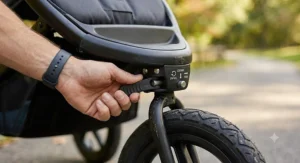
The Guava Roam Crossover stands out for two things most jogging strollers don’t offer together: foam-filled tires that eliminate flat-tire risk entirely, and a locking swivel front wheel you can operate right from the handlebar without bending down. Independent testers measured its folded footprint as one of the smallest in the entire jogging-stroller category, which matters enormously if you’re working with a small trunk or a cramped apartment closet.
Based on the spec comparison, the handlebar-operated wheel lock is a genuinely underrated convenience — most competitors, including the BOB and Thule models above, require you to crouch down at the front wheel to switch modes, which gets old fast when you’re mid-route and hit a stretch of gravel. Real tester feedback describes the Roam as a pleasure across running, walking, and light off-road trail use, calling it a strong contender for families who want one stroller to genuinely replace two. The tradeoff comes in weight — at roughly 28.5 pounds it’s on the heavier side of this group, though testers note it still pushes easily thanks to the design.
Pros:
- ✅ Foam-filled tires mean zero flat-tire maintenance
- ✅ Wheel lock operates from the handlebar, no bending required
- ✅ Smallest folded footprint of any stroller in this guide
Cons:
- ❌ Heavier overall weight than most swivel-wheel rivals
- ❌ Foam tires ride firmer than air-filled alternatives on rough gravel
Priced around $400–$500, the Guava Roam Crossover is the strongest pick here for anyone who genuinely wants a single crossover stroller and hates dealing with tire maintenance.
Practical Usage Guide: Getting Your Jogging Stroller Run-Ready
Unboxing day always feels like assembling a small bicycle, and in a sense, you are. Start by locating the swivel-lock dial or lever near the front wheel fork — on most of the models above, including the BOB Gear Revolution Flex 3.0 and Thule Urban Glide 3, this is a twist or flip mechanism, not a button, so don’t force it. Test the lock and unlock action a few times in your driveway before your first real run; a mechanism that feels stiff out of the box usually loosens with a few cycles, but one that grinds or catches may need a drop of silicone lubricant (never petroleum-based oil, which can degrade rubber seals).
For the first thirty days, resist the urge to hit full running pace immediately. Walk with the front wheel locked for a few sessions so you learn how the stroller tracks before you’re moving fast enough that a drift becomes a real correction. Check tire pressure weekly if you’re running air-filled tires like the BOB or Thule models — underinflation is the single most common cause of a stroller pulling to one side, and it’s often mistaken for a wheel-alignment problem. Recheck the front-wheel bolt or quick-release monthly; BOB has, in the past, put out guidance reminding owners to fully seat and secure the front wheel’s quick-release lever, since an improperly closed lever has been linked to the wheel working loose mid-run — so a thirty-second check before longer outings is cheap insurance.
✨ Don’t Miss These Exclusive Deals!
🔍Take your jogging stroller with swivel wheel search to the next level with these carefully selected options. Click on any highlighted model above to check current pricing and availability before you commit.
Real-World Scenarios: Matching Your Life to the Right Wheel Setup
If you’re a new parent living in a walk-up apartment with a stroller stored in a closet, prioritize the Guava Roam Crossover or Baby Trend Expedition Jogger — both offer compact folds and swivel wheels that make elevator rides and grocery-aisle maneuvering painless, and neither demands premium-stroller storage space.
If you’re a marathon-training parent logging 20+ weekly miles with a stroller and you already own a separate everyday stroller, the Thule Glide 2‘s fixed wheel rewards you with straighter tracking at faster paces and one less mechanism to maintain. You’re trading versatility for pure running performance, which only makes sense when this isn’t your only stroller.
If you’re a suburban parent juggling daycare drop-off, weekend trail runs, and the occasional farmer’s market haul, the BOB Gear Revolution Flex 3.0 or UPPAbaby Ridge V2 covers the widest range of terrain and use cases in one purchase — the higher upfront cost buys you years of not needing a second stroller for “real life” errands.
Problem → Solution: Fixing Wobble, Drift, and Tracking Issues
Problem: The stroller pulls to one side even with the wheel locked. This is almost always a tire-pressure or tracking-dial issue rather than a defective wheel. Check both front and rear tire pressure first, then use the tracking adjustment dial found on models like the Thule Urban Glide 3 to nudge the wheel’s default angle until it rolls straight on flat ground.
Problem: The swivel wheel feels wobbly even when locked. Independent testers have called this out on specific competing models, where the wobble only became obvious once the wheel was actually unlocked — which is a useful diagnostic clue. First confirm the lock is fully engaged rather than only partially seated. If the wobble persists with the lock genuinely confirmed, the bushing inside the fork may be worn and typically needs a manufacturer replacement part.
Problem: You can’t decide between locking the wheel for a mixed sidewalk-and-trail route. Lock it for the trail portion and any stretch faster than a brisk walk; unlock it for tight sidewalk corners or crowded areas. Several premium models, including the Thule Urban Glide 3 and Guava Roam Crossover, let you switch mid-route without stopping, which removes the friction from doing this correctly every time.
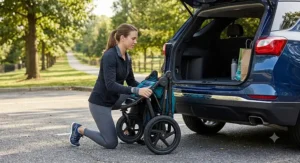
Problem: The stroller won’t fold compactly enough for your trunk. The Guava Roam Crossover and Baby Trend Expedition Jogger both measure among the smallest folded footprints tested in this category — swapping to either solves a storage problem that no amount of adjusting the current stroller will fix.
How to Choose Between Swivel and Fixed Front Wheels
- Start with your primary use case. If jogging is genuinely 90% of how you’ll use the stroller and you own a second stroller for errands, a fixed wheel like the Thule Glide 2 rewards you with simpler mechanics and straighter tracking.
- Weigh your storage and lifestyle needs. A lockable swivel wheel, present on the other six strollers here, gives you one machine that handles both jogging and daily life without a second purchase.
- Check the child weight capacity against your child’s growth curve. The BOB Gear Revolution Flex 3.0‘s 75-pound limit outlasts the Thule Urban Glide 3‘s 49-pound cap by years of usable life.
- Test the lock mechanism in person if at all possible. Some locks operate from the handlebar (Guava Roam Crossover); others require bending to the fork (BOB, Thule).
- Factor in terrain. Rougher gravel and trail routes reward more aggressive suspension, like the two-stage system on the UPPAbaby Ridge V2, more than they reward the wheel type itself.
- Budget realistically for the full ownership period, not just the sticker price — a $180 Baby Trend that lasts three solid years may out-value a $500 stroller retired after eighteen months due to a lower weight cap.
- Confirm your baby meets developmental milestones before jogging at all, regardless of which wheel you choose — the wheel setup only matters once running with baby is actually appropriate.
When to Lock the Front Wheel on a Jogging Stroller
The simplest rule: lock the front wheel any time you’re moving faster than a relaxed walking pace, on any surface less predictable than smooth, flat pavement, and any time you’re not holding onto the handlebar directly. The reasoning is straightforward — an unlocked wheel introduces just enough side-to-side play that it turns small surface irregularities into a wandering, unstable ride once your speed picks up, so the smart move is locking it before you start moving rather than waiting for the first wobble to show up on an uneven patch. Unlock it once you’re back to browsing store aisles, navigating a crowded sidewalk, or making the kind of tight, repeated turns a locked wheel simply can’t manage gracefully.
Swivel vs Fixed Wheel Jogging Strollers: Maneuverability Comparison
| Factor | Swivel (Locked) | Swivel (Unlocked) | Fixed |
|---|---|---|---|
| Straight-line tracking at speed | Very good | Poor | Excellent |
| Tight-turn maneuverability | None (locked) | Excellent | None |
| Everyday/errand usability | Good (unlock as needed) | Excellent | Poor |
| Mechanism complexity | Moderate | Moderate | Lowest |
| Best For | Mixed jogging + errands | Walking, shopping, tight spaces | Dedicated running only |
This table makes the actual tradeoff obvious: a locked swivel wheel performs almost as well as a true fixed wheel at running speed, while an unlocked swivel wheel and a fixed wheel sit at completely opposite ends of the maneuverability spectrum. On a stroller with a permanently fixed wheel, the only way to make a sharp, low-speed turn is to physically tip the front end up and pivot the whole frame by hand — manageable for the occasional intersection, exhausting if you’re weaving through a crowded aisle or a playground full of scattered toys. That’s the core reason six of the seven strollers in this guide use a lockable swivel design rather than a permanently fixed one — most families simply don’t own a dedicated second stroller for daily life.
Jogging Stroller for Everyday Use: Making the Swivel Wheel Earn Its Keep
Buying a jogging stroller for everyday use means the swivel wheel needs to work as hard at 2 mph in a crowded aisle as it does at 6 mph on an open path. The Baby Trend Expedition Jogger and Guava Roam Crossover both lean into this dual role especially well — the Baby Trend’s car-seat compatibility means it functions as a genuine travel-system piece from birth, long before actual jogging is appropriate, while the Guava’s handlebar-operated lock means switching modes mid-errand doesn’t require crouching down in a parking lot with a toddler in tow.
The BOB Gear Revolution Flex 3.0 and UPPAbaby Ridge V2 also handle everyday use well, though their premium price tags make more sense if you’re genuinely splitting time between serious trail runs and daily walks rather than using the stroller almost exclusively for errands. If daily, low-speed use dominates your routine and jogging is occasional, prioritize fold size, storage basket capacity, and ease of the swivel-lock switch over top-tier suspension — you’ll rarely need the suspension’s full capability if most of your miles are on flat sidewalk.
Common Mistakes When Buying a Swivel Wheel Jogging Stroller
One of the most common mistakes is assuming every “jogging stroller” on a marketplace listing is actually rated for running. Some models marketed with jogging-adjacent branding carry explicit not-suitable-for-running warnings buried in the manual, and the safety label should always be treated as the final word over how the stroller looks or is marketed. Another frequent misstep: buying based on weight capacity alone and ignoring the front-wheel lock’s ease of use — a stroller that requires bending down and fumbling with a stiff dial every time you switch modes gets used incorrectly (or not switched at all) far more often than a handlebar-operated version.
Parents also commonly underestimate how much the folded size matters until move-in day or a small trunk makes the decision for them retroactively. And a genuinely underrated mistake: skipping the recall check entirely, especially when buying secondhand. Always search the CPSC’s public database before finalizing a used purchase, since jogging strollers — including past BOB front-wheel and UPPAbaby brake recalls — have had real safety notices worth confirming were resolved.
Long-Term Cost & Maintenance: Swivel vs Fixed Wheel Systems
A fixed-wheel stroller like the Thule Glide 2 has fewer moving parts at the front axle, which theoretically means less to maintain over years of use — there’s no lock mechanism to lubricate, loosen, or eventually replace. In practice, though, most owners report the swivel-lock mechanisms on well-built strollers like the BOB Gear Revolution Flex 3.0 and Thule Urban Glide 3 hold up for years of regular use with nothing more than occasional lubrication and a periodic bolt check.
Where the real long-term cost difference shows up is tires and suspension, not the wheel-lock mechanism itself. Air-filled tires, standard on five of the seven strollers here, will eventually need a patch kit or replacement tube — a minor, inexpensive fix, but one air-filled tire owners should budget for. The Guava Roam Crossover‘s foam-filled tires sidestep that cost entirely, trading a firmer ride for zero flat-tire maintenance across the stroller’s lifespan. Weigh the total cost of ownership, not just the sticker price: a $180 stroller with a low weight cap that gets replaced in two years can cost more over time than a $450 stroller that lasts until your child outgrows strollers altogether.
Features That Actually Matter (And Those That Don’t)
Actually matters: a five-point harness with a proper wrist tether. Of every safety feature on a jogging stroller, the wrist strap arguably does the most real-world work — it’s the one piece of hardware standing between a simple stumble and the stroller rolling off on its own down a hill or into traffic. Actually matters: a hand brake if your regular routes include hills — the Thule Urban Glide 3‘s twist brake and the UPPAbaby Ridge V2‘s disc brake both give real control that a footbrake alone can’t match on a steep descent.
Doesn’t matter nearly as much as marketing suggests: an oversized cup holder count or a phone-charging port built into the parent console. Nice touches, but they don’t affect safety or how well the stroller actually performs on a run. Also overrated for most buyers: chasing the absolute lightest frame weight in the category. A few pounds of difference between strollers matters far less than suspension quality and wheel-lock ease of use once you’re actually pushing the thing for thirty minutes on real terrain.
Safety, Regulations & Compliance Guide
Every stroller sold in the U.S., jogging strollers included, must meet a federal safety standard. That standard lives at 16 C.F.R. part 1227, which folds in the ASTM F833 performance specification — a rulebook covering tip-over resistance, brake holding power, harness and restraint design, fold-and-latch safety, frame durability, and wheel-detachment resistance, as laid out on the CPSC’s official business guidance page. Before buying secondhand, it’s worth a quick search of the CPSC’s recall database — past notices have covered issues ranging from front-wheel detachment risk to disc-brake pinch points on specific models.
Beyond hardware compliance, timing matters just as much as equipment. Pediatric guidance, including answers from a pediatric medical group that fields this exact question from parents, generally holds off on actual jogging with a baby in a stroller until around the six-month mark at the earliest — before that, a jogging stroller can still be used for gentle walks, but only with a compatible infant car seat or bassinet attachment doing the actual supporting. Babies also need solid trunk and neck control before regular jogging sessions start, and many pediatricians suggest sticking to smooth, predictable surfaces until closer to twelve months, once core strength has caught up. None of the seven strollers in this guide change that timeline — the wheel type only becomes relevant once your pediatrician has confirmed jogging is appropriate in the first place.
Frequently Asked Questions
❓ Is a swivel wheel or fixed wheel better for jogging strollers?
❓ Can you jog with the front wheel unlocked on a swivel model?
❓ What age can a baby start using a jogging stroller?
❓ Do all jogging strollers have a lockable front wheel?
❓ How do you know if a jogging stroller's swivel wheel is wobbling too much?
Conclusion
The jogging stroller swivel vs fixed wheel decision really comes down to one honest question: will this stroller live a double life, or a single-purpose one? For the overwhelming majority of parents, a lockable swivel wheel — found on the BOB Gear Revolution Flex 3.0, Thule Urban Glide 3, Baby Trend Expedition Jogger, Joovy Zoom 360 Ultralight, UPPAbaby Ridge V2, and Guava Roam Crossover — delivers running-stable tracking when locked and everyday agility when unlocked, without asking you to own two separate strollers. The Thule Glide 2‘s fixed wheel remains the right call only for serious runners who already have a dedicated everyday stroller and want the marginal tracking edge that comes from a simpler, permanently locked front axle.
Whichever route you take, the mechanism matters less than the fundamentals: a proper five-point harness, a wrist tether you actually use, tires checked regularly, and a green light from your pediatrician before the first real run. Get those right, and the swivel-versus-fixed debate becomes what it should be — a lifestyle question, not a safety one.
✨ Found your match among these seven? Check current pricing before it changes — availability on popular models moves fast. 💬
Recommended for You
- Lightweight Umbrella Stroller: 7 Best Picks Tested for 2026
- Reclining Umbrella Stroller: 7 Best Picks for Naps On the Go (2026)
- Best Umbrella Stroller 2026: 7 Top Picks That Won’t Let You Down
Disclaimer: This article contains affiliate links. As an Amazon Associate, I earn from qualifying purchases. If you purchase products through these links, we may earn a small commission at no additional cost to you.
✨ Found this helpful? Share it with your friends! 💬🤗
