
In This Article
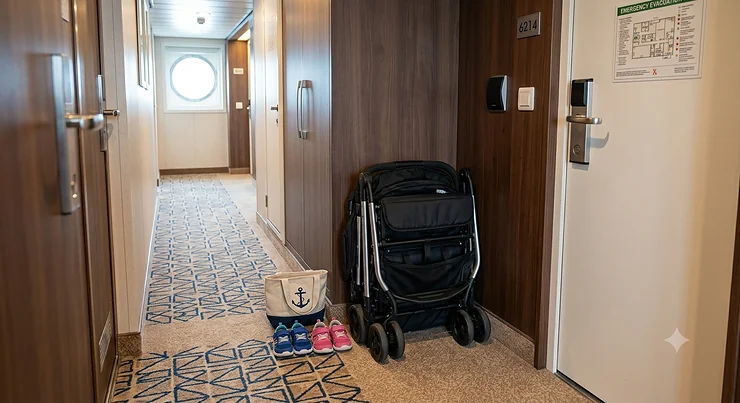
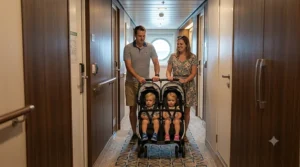
Here’s the thing nobody tells you before your first family cruise: the ship is basically a floating hallway maze designed by someone who has never met a double stroller. A compact double stroller for cruise vacations isn’t a luxury item — it’s the difference between gliding through the buffet line with two kids in tow and wedging yourself sideways against a housekeeping cart while your toddler screams about pizza. Cabin doorways run narrow, elevators fill up fast, and closet space is basically a rumor. So the stroller you bring needs to fold down small, roll smoothly over gangways and tender ramps, and still survive a week of saltwater air and sandy little feet.
We spent time digging through real product specs, aggregated owner reviews, and actual cruise-line policies to build this guide, because “just grab whatever’s on sale” is how people end up hauling a 35-pound tank through security in Cozumel. Below, you’ll find seven real, currently available double strollers — spanning budget, mid-range, and premium — each one picked specifically for narrow cabin doors, tight elevator banks, and the general chaos of embarkation day. We’ll also walk through how cabin storage actually works, what mistakes trip up first-time cruising parents, and how to match a stroller to your specific itinerary. Let’s get into it.
Quick Comparison Table
Before the deep dives, here’s a scannable snapshot of how these seven stack up on the metrics that matter most for cruising: fold size, weight, and price tier.
| Stroller | Folded Width | Weight | Price Range | Best For |
|---|---|---|---|---|
| Summer Infant 3Dlite Double | 29″ (narrowest) | Under 22 lbs | Budget ($150–$220) | Tightest cabin hallways |
| Kolcraft Cloud Plus | Fits 31″ doorways | 23 lbs | Budget ($150–$200) | First-time cruise parents |
| Baby Jogger City Tour 2 Double | Overhead-bin compact | ~23 lbs | Mid-range ($350–$450) | Multi-port itineraries |
| Delta Children LX | 29.6″ profile | Under 20 lbs | Budget (under $150) | Occasional cruisers |
| Jeep Destination Ultralight | Compact aluminum fold | 28.66 lbs | Mid-range ($300–$400) | Cobblestone port towns |
| Zoe Twin V3 | Standard-door width | Mid-weight | Mid-to-premium ($400–$550) | Frequent cruisers |
| UPPAbaby Minu Duo | One-hand compact fold | 27.4 lbs | Premium ($700–$900) | Comfort-focused families |
A quick read on the numbers: the Summer Infant 3Dlite Double and Delta Children LX win on raw narrowness, which matters more than almost anything once you’re navigating a cabin corridor built for one adult walking sideways. The Baby Jogger City Tour 2 Double and UPPAbaby Minu Duo trade a little width for fold speed and ride comfort, which pays off on port days spent walking miles of cobblestone. If your cruise involves three or more port stops, that trade-off is usually worth it.
💬 Know a fellow cruising parent who’s stressing over stroller logistics? Send this their way — future-you will thank present-you.
Top 7 Compact Double Strollers for Cruise Vacations: Expert Analysis
Cabin doors on most mainstream cruise ships run somewhere between 26 and 32 inches wide, and stateroom hallways are notoriously tight — you’ll be sharing that space with luggage carts, dinner trays, and other families doing the exact same awkward shuffle you are. That’s the filter we used to pick these seven: real products, real specs, and genuine buyer feedback, not just a rewritten spec sheet from a manufacturer’s Amazon listing.
1. Summer Infant 3Dlite Double — narrowest cabin-hallway profile
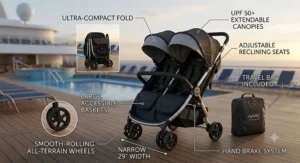
The standout here is the 29-inch folded width, which is genuinely the slimmest number on this list, and it shows the moment you try to wheel it past a room service cart. At under 22 pounds with a durable aluminum frame, this is a stroller you can lift with one arm while balancing a diaper bag on the other shoulder — a scenario that happens approximately every single day of a cruise. The seats each get a multi-position recline and a UPF 50+ canopy, and the accommodation runs from birth up to 50 pounds per seat, so it covers a wide age spread without needing separate gear.
What most buyers overlook about this model is how much the anti-shock front wheels change the ride on textured surfaces — tender ramps, cobblestone piers, and the metal grating you’ll cross getting on and off the ship all get noticeably smoother. This is the pick for parents whose top priority is squeezing through the narrowest possible cabin door without a fight. Reviewers consistently report that the compact fold is genuinely one-handed and that the stroller stands on its own once collapsed, which matters when you’re also holding a toddler’s hand at the same time.
Pros:
- ✅ Narrowest folded width of any model on this list
- ✅ Under 22 lbs, easy to lift into overhead bins or car trunks
- ✅ Multi-position recline works well for cabin naps
Cons:
- ❌ Basic canopy coverage compared to premium models
- ❌ Basket storage is smaller than heavier double strollers
At a price generally in the $150–$220 range, the Summer Infant 3Dlite Double delivers outsized value for cruisers whose main battle is hallway width, not rough terrain.

2. Kolcraft Cloud Plus — lightest full-featured budget double
The headline number is simple: this side-by-side fits through standard 31-inch doorways, which covers the vast majority of cruise cabin entries without requiring you to fold it every single time you step in or out. At 23 pounds, it’s genuinely one of the lighter full-featured doubles on the market, and it carries two large storage baskets plus extendable canopies with sun visors — a detail that matters more than it sounds like on a sun-drenched pool deck.
Based on the spec comparison, this model’s tool-free assembly (reportedly around 10 minutes) is a meaningful advantage for parents who are setting up gear in a cramped cabin the night before a 6 a.m. excursion. The side-by-side layout also means both kids get the same sightline, which cuts down on the sibling squabbling that a front-and-back tandem layout tends to invite. Aggregated owner feedback describes the ride quality as solid for the price point, though a few reviewers note the frame feels less premium than pricier competitors — an honest trade-off at this cost tier.
Pros:
- ✅ Fits standard 31-inch cabin doorways without folding
- ✅ Tool-free assembly in about 10 minutes
- ✅ Two large storage baskets for excursion gear
Cons:
- ❌ Frame feels less premium than mid-range competitors
- ❌ Canopy coverage is good but not the largest available
Priced generally between $150 and $200, the Kolcraft Cloud Plus is the pick for first-time cruising parents who want doorway compatibility without a big spend.
3. Baby Jogger City Tour 2 Double — fastest one-step compact fold
What sets this one apart is speed: the one-step fold collapses the entire frame in a couple of seconds, and it’s genuinely compact enough to fit in overhead bins on larger aircraft, which tells you everything about how it’ll perform in a cruise-ship elevator. At just over 23 pounds, it pairs front-wheel suspension with UV 50+ canopy protection, which on paper means a noticeably smoother ride across the metal gangway plates and uneven port pavement you’ll cross on tender days.
Here’s what the spec sheet won’t tell you, but reviewers note repeatedly: the auto-lock fold clicks into a genuinely flat rectangle, and actual owners report sliding it into overhead bins without drama. That kind of real-world confirmation matters more than a manufacturer’s marketing copy. For families doing multi-port itineraries — three, four, five stops in a week — the fast fold means less time fumbling at the gangway while a line forms behind you, and more time actually getting off the ship.
Pros:
- ✅ One-step fold collapses in seconds
- ✅ Front-wheel suspension smooths gangways and cobblestones
- ✅ Confirmed overhead-bin-compatible fold size
Cons:
- ❌ Costs meaningfully more than budget-tier options
- ❌ Slightly heavier to carry than the lightest models here
In the $350–$450 range, the Baby Jogger City Tour 2 Double earns its price tag on itineraries with heavy port-day turnover.
4. Delta Children LX — most wallet-friendly narrow double
The short version: a 29.6-inch profile, an umbrella-style fold, and a price that won’t make you flinch if it gets scuffed on a gangway. This side-by-side keeps things simple — no elaborate suspension system, no premium fabric — but for families counting every pound and every dollar before a cruise, that simplicity is the point rather than a shortcoming.
Based on the spec comparison, the narrow 29.6-inch width puts it right alongside models costing two or three times as much, which is honestly the best argument for buying this one. Reviewers describe it as a solid “keep it in the trunk” or “keep it in the cabin closet” option rather than a daily workhorse, and that’s an accurate framing — it’s built for occasional use, not years of daily commuting. If this is a once-a-year cruise stroller rather than an everyday piece of gear, the value math here is hard to beat.
Pros:
- ✅ Narrow 29.6-inch profile at a budget price point
- ✅ Lightweight umbrella-style fold under 20 lbs
- ✅ Simple design means fewer parts to break in transit
Cons:
- ❌ Recline range is more limited than premium models
- ❌ Storage basket is smaller than mid-range competitors
Generally priced under $150, the Delta Children LX is the pick for occasional cruisers who don’t want a permanent stroller commitment.
✨ Don’t Miss These Exclusive Deals!
🔍 Take your next family cruise to the next level with a stroller that actually fits your itinerary. Click on any highlighted pick to check current pricing and availability — the right choice here means smoother embarkation days and happier kids all week.
5. Jeep Destination Ultralight Side x Side — smoothest ride on port cobblestones
The 28.66-pound aluminum frame is the headline, but the real story is the swivel-lock wheels, which switch between loose maneuvering through crowded ship corridors and a locked, stable roll across uneven cobblestone streets in ports like Cozumel or Nassau. That versatility matters more on a cruise than almost anywhere else, since a single day can take you from a smooth ship deck to a genuinely rough colonial-era sidewalk.
What most buyers overlook about this model is how much the suspension system reduces jostling for a napping toddler — a detail that becomes precious around hour four of a shore excursion. The aluminum construction keeps total weight reasonable despite the added suspension hardware, and reviewers frequently mention that it handles curb transitions with noticeably less bump-and-jolt than lighter umbrella-style competitors. This is the choice for cruisers whose itinerary leans heavily on walking tours and less on smooth boardwalks.
Pros:
- ✅ Swivel-lock wheels adapt to smooth or rough surfaces
- ✅ Suspension noticeably reduces jostling on cobblestones
- ✅ Aluminum frame keeps weight reasonable despite features
Cons:
- ❌ Bulkier folded footprint than the narrowest models
- ❌ Priced above true budget-tier alternatives
Sitting in the $300–$400 range, the Jeep Destination Ultralight rewards families with cobblestone-heavy, walking-tour port days.
6. Zoe Twin V3 — proven cruise-cabin favorite
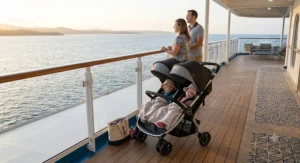
This one has earned something the others haven’t: a track record among actual cruising parents, with real trip reports describing it fitting through standard stateroom doors and surviving a week of port-to-port use on ships like Freedom of the Seas. The narrow frame is genuinely built with doorway width in mind rather than as an afterthought, and each seat reclines independently — a small feature that pays off enormously when one kid naps and the other doesn’t.
Based on the spec comparison and aggregated real-world reports, the Zoe Twin V3 strikes a middle ground: sturdier than the budget umbrella-style options, but still light enough that one parent can manage it solo through a crowded gangway line. A frequently repeated theme in owner accounts is that it “just works” for the specific chaos of a cruise — narrow enough for the cabin, tough enough for tender-boat transfers, and simple enough to fold without a manual. That’s a rare combination, and it’s precisely why this model shows up again and again in cruise-specific parenting discussions.
Pros:
- ✅ Documented track record fitting standard cruise cabin doors
- ✅ Independent recline per seat for staggered nap schedules
- ✅ Balances durability with manageable solo-parent weight
Cons:
- ❌ Costs more than pure budget umbrella strollers
- ❌ Canopy coverage is average rather than best-in-class
Typically priced between $400 and $550, the Zoe Twin V3 is the safe, well-vetted choice for families who cruise more than once.
7. UPPAbaby Minu Duo — most premium one-handed fold
The standout is the one-handed, one-step fold mechanism, engineered with the same design language as UPPAbaby’s popular single Minu stroller but stretched into a side-by-side double. At 27.4 pounds, it’s genuinely lightweight for a double stroller in the premium tier, and the all-wheel suspension delivers a noticeably smoother push across textured surfaces than the budget-tier options on this list.
Here’s what the spec sheet won’t tell you, but reviewers note repeatedly: the fold-and-carry experience feels closer to managing a single stroller than a double, which is a meaningful psychological win when you’re solo-parenting through an unfamiliar port. It also accepts infant car seats with separately sold adapters, which extends its useful life if you’re traveling with a true newborn alongside an older sibling. The trade-off is straightforward — this is the priciest stroller on the list, and the premium finish adds a bit of bulk when you’re lifting it fully loaded into an overhead cabin closet.
Pros:
- ✅ Genuine one-handed, one-step fold mechanism
- ✅ All-wheel suspension smooths textured port surfaces
- ✅ Accepts infant car seat adapters for newborn flexibility
Cons:
- ❌ Highest price point of any stroller on this list
- ❌ Heavier to lift fully loaded than budget umbrella models
At a premium price generally in the $700–$900 range, the UPPAbaby Minu Duo suits families prioritizing ride comfort and long-term durability over upfront savings.
Practical Usage Guide: Prepping a Compact Fold Double Stroller for Cabins
Getting the most out of a compact fold double stroller for cabins starts well before embarkation day. First, practice the fold at home — not in the terminal parking lot with a security line forming behind you. Every model on this list folds slightly differently, and muscle memory matters when you’re juggling boarding passes, passports, and a toddler at the same time.
Second, measure your actual cabin door and hallway before you pack, since cruise lines rarely publish exact stateroom doorway widths and they vary by ship class. A tape measure and five minutes on your cruise line’s deck plan page will save you a genuinely stressful moment on day one. Third, plan your cabin storage spot in advance — most staterooms have limited floor space, so decide whether the stroller lives folded beside the closet, under the bed (if clearance allows), or tucked behind the door before you’re standing there with a cranky toddler and no plan.
Common first-week mistakes include over-packing the storage basket (which adds weight exactly when you need the stroller lightest, during embarkation), forgetting to lock the wheels before boarding a tender boat, and skipping a quick wipe-down after beach days — sand and saltwater are brutal on wheel bearings and folding hinges over a week-long trip. A simple maintenance habit — rinsing wheels with fresh water after sandy excursions and letting the frame air-dry before folding it into a humid cabin — meaningfully extends the stroller’s working life for future trips.
Real-World Scenarios: Matching a Stroller to Your Cruise
Consider three common cruiser profiles. First, the family with a newborn and a toddler heading on a seven-night Caribbean itinerary with four port stops. For this group, a stroller like the Baby Jogger City Tour 2 Double or UPPAbaby Minu Duo makes sense — the fast fold and smoother ride pay dividends across multiple excursion days, and the higher price is offset by genuine daily use.
Second, the budget-conscious family taking their first-ever cruise, uncertain whether cruising with young kids will even become a repeat habit. Here, the Kolcraft Cloud Plus or Delta Children LX is the more sensible bet — solid performance without a premium investment in gear you might not use again for years.
Third, the family doing a longer transatlantic or repositioning cruise with mostly sea days and just one or two ports. In this scenario, the Summer Infant 3Dlite Double‘s narrow profile matters more than rugged terrain performance, since most of the stroller’s job is navigating hallways and elevators rather than cobblestone streets. Matching the stroller to the actual itinerary — not just the “best overall” label — is the single biggest lever for a smoother trip.
How to Choose a Compact Double Stroller for Cruise Vacations
Choosing a cruise-friendly double stroller comes down to a handful of concrete criteria, ranked by real-world impact:
- Folded width first. Measure your specific ship’s stateroom door if the deck plan lists it, and pick a stroller narrower than that measurement, not equal to it.
- Weight for lifting, not just pushing. You’ll carry this thing over thresholds, into elevators, and occasionally up a gangway ramp — under 25 pounds is a meaningful comfort threshold for most parents.
- Fold speed under pressure. A one-step or one-handed fold matters enormously during boarding lines and security checks.
- Wheel type for mixed terrain. Swivel-lock or suspension wheels handle the jump between smooth ship decks and rough port pavement far better than basic fixed wheels.
- Seat configuration for your kids’ ages. Side-by-side seating suits close-in-age siblings who want the same view; tandem suits a newborn-and-toddler pairing needing different recline angles.
- Storage basket size for excursion gear. Sunscreen, snacks, water bottles, and a change of clothes add up fast on port days.
- Real durability, not marketing claims. Aggregated owner reviews consistently reveal more about long-term wear than a single glossy product photo ever will.
According to the Consumer Product Safety Commission’s business guidance on carriages and strollers, every stroller sold in the U.S. must meet mandatory federal safety requirements covering stability, latching mechanisms, and restraint systems — a baseline worth confirming regardless of which model you choose.
Compact Double Stroller vs Single Umbrella Strollers for Ship Excursions
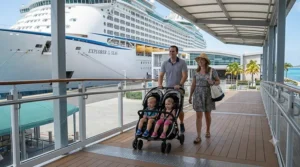
It’s tempting to save space by bringing two single umbrella strollers instead of one double stroller for ship excursions, and for some families that genuinely works better. Two singles are easier to fold individually, and you can split them between two adults during boarding, which cuts down on the awkward gangway shuffle. However, two strollers also mean twice the cabin storage footprint, twice the wheels to rinse after a beach day, and — critically — only one parent can push one stroller at a time, which becomes a real problem the moment you need a bathroom break or want to grab a coffee.
A compact double stroller, by contrast, keeps both kids under one parent’s control, which matters enormously in crowded terminal lines and gangway bottlenecks where losing sight of a child for even a few seconds is a genuine worry. The trade-off is width: a double stroller for ship excursions will always be wider than a folded single, so the narrowest models on this list — the Summer Infant 3Dlite Double and Delta Children LX — exist specifically to close that gap. For most families with two kids under six, the single-parent-control advantage of a double stroller outweighs the extra few inches of width.
Common Mistakes When Buying a Cruise-Friendly Double Stroller
The most common mistake is buying based on a stroller’s everyday-life reputation without checking its folded dimensions against cruise-specific constraints — a stroller that’s perfectly fine for suburban sidewalks can be genuinely unmanageable in a cabin hallway. A second mistake is skipping the fold-speed factor entirely; a stroller that takes two minutes and both hands to collapse becomes a real liability at a security checkpoint with a line building behind you.
A third mistake is under-budgeting for wheel and terrain quality, assuming a ship deck is the only surface that matters — most cruises include at least one cobblestone or unpaved port stop, and a stroller with no suspension will transmit every bump directly to a sleeping baby. Finally, many first-time cruising parents forget to check their specific ship’s stateroom category before buying, since suite-class cabins often have noticeably wider doors and more floor space than standard interior or oceanview rooms — a detail confirmed in cruise-line stateroom guides.
What to Expect: Real-World Performance in Cabins, Elevators, and Ports
On paper, a folded width of 29 inches sounds abstract. In practice, it means the difference between wheeling your stroller straight through your cabin door versus needing to angle it, lift the front wheels, and shuffle sideways — a maneuver that gets old fast on day two of seven. Elevators present a similar story: peak-hour elevator banks near the pool deck or dining room fill quickly, and a bulkier double stroller often means waiting for a second or third elevator car while a folded model can usually squeeze in.
On port days, the difference shows up in the wheels. A stroller with genuine suspension and swivel-lock wheels — like the Jeep Destination Ultralight or UPPAbaby Minu Duo — noticeably smooths out the transition from a paved cruise terminal to a cobblestone old-town square, while a basic fixed-wheel budget model transmits every bump straight through the frame. According to real cruiser trip reports, families who brought a double stroller onto ships like Freedom of the Seas or Oasis of the Seas generally describe it as manageable once they learned the specific fold and storage routine for their cabin — the learning curve is real, but short.
Long-Term Cost & Maintenance for Cruise Strollers
Thinking about total cost of ownership rather than sticker price changes the math considerably. A $150 budget stroller that needs replacing after two cruises due to worn wheel bearings or a cracked frame joint may end up costing more over five years than a $400 mid-range model built with sturdier hardware. On the other hand, if cruising is a once-in-a-while family activity rather than an annual tradition, the budget option’s lower upfront cost is the smarter play — you’re simply not putting enough cumulative miles on it to justify a premium build.
Maintenance-wise, the biggest threat to any cruise stroller is salt air and sand, not general wear from city sidewalks. Rinsing wheels and folding hinges with fresh water after beach excursions, drying the frame fully before storing it folded in a humid cabin, and periodically checking that locking mechanisms haven’t corroded are simple habits that meaningfully extend a stroller’s working life across multiple trips.
Features That Actually Matter (And Those That Don’t)
Fold speed, folded width, and wheel quality matter enormously for cruising — they directly affect your daily friction level. A few features that sound impressive but matter less at sea: elaborate cup-holder trays (ship dining halls make these mostly redundant), oversized canopies (most cruise activity happens either indoors or under natural shade structures on deck), and rain covers (unless you’re cruising during hurricane season, this is dead weight in your suitcase). Reviewers consistently note that simpler, lighter builds tend to outperform feature-loaded models specifically in the cramped, high-traffic environment of a cruise ship.
Safety, Regulations & Compliance Guide
Every stroller sold in the United States, regardless of brand or price tier, must comply with the mandatory federal standard incorporated at 16 CFR Part 1227, which references ASTM F833 and covers stability, parking-brake performance, restraint systems, and folding-mechanism safety. This isn’t marketing language — it’s a legally enforced baseline, and the CPSC’s 2014 rulemaking announcement specifically cites hinge failures, wheel detachment, and restraint issues as the hazards the standard was designed to address.
On the cruise-specific side, most major lines — including Royal Caribbean — do not provide strollers onboard, but explicitly welcome guests bringing their own, with the requirement that strollers be stored inside the stateroom when not in use rather than left in hallways. Always check your specific cruise line’s current policy before sailing, since these details can shift between bookings, and confirm whether your particular ship or itinerary has any additional restrictions.
Benefits vs Traditional Alternatives
| Option | Cabin Fit | Port Terrain | Parent Effort | Best For |
|---|---|---|---|---|
| Compact Double Stroller | Good with narrow models | Good to excellent | Moderate | Two kids under 6 |
| Stroller Wagon | Poor, bulky in cabins | Excellent on flat ground | Low once loaded | Beach/pool days only |
| Two Single Strollers | Poor, doubles storage need | Varies by model | High, splits attention | Older, independent kids |
| Baby Carrier Only | Excellent, no storage issue | Excellent | High physical effort | Very short excursions |
Looking at the table, a compact double stroller generally wins on the balance of cabin practicality and port-day usability, while a wagon dominates specifically for beach days but becomes a genuine storage headache back in the cabin. Two single strollers split parenting duties between two adults but double your cabin footprint and wheel-cleaning chores, and a carrier alone works beautifully for a two-hour walking tour but wears out fast across a full eight-hour port day.
Price Range & Value Analysis
| Tier | Price Range | Representative Model | Value Verdict |
|---|---|---|---|
| Budget | Under $220 | Delta Children LX, Kolcraft Cloud Plus | Best for occasional cruisers |
| Mid-Range | $300–$550 | Baby Jogger City Tour 2 Double, Jeep Destination Ultralight, Zoe Twin V3 | Best overall value for frequent cruisers |
| Premium | $700+ | UPPAbaby Minu Duo | Best for comfort-first, long-term families |
Across all three tiers, the biggest value shift happens between budget and mid-range, where fold speed and suspension quality improve noticeably; the jump from mid-range to premium buys smoother ride quality and nicer finishes, but the day-to-day cruise experience gap is smaller than the price gap suggests.
FAQ
❓ What size stroller fits through a cruise ship cabin door?
❓ Can you bring your own double stroller on a cruise?
❓ Is a stroller or a wagon better for cruise port excursions?
❓ How much does a good compact double stroller for cruise vacations cost?
❓ Do cruise ships have elevators big enough for double strollers?
Conclusion
Picking the right compact double stroller for cruise vacations really comes down to matching real specs to your actual itinerary — narrow cabin doors call for models like the Summer Infant 3Dlite Double or Delta Children LX, while port-heavy trips with cobblestone streets reward the smoother ride of the Jeep Destination Ultralight or UPPAbaby Minu Duo. None of these seven are wrong choices; they’re built for genuinely different versions of the same trip.
Whatever you choose, practice the fold before boarding day, plan your cabin storage spot in advance, and rinse the wheels after every sandy excursion. A little prep turns “double stroller on a cruise ship” from a dreaded logistics puzzle into just another part of a smooth, well-organized family vacation.
Recommended for You
- Travel Double Stroller for Airplane Gate Check: 7 Best Picks (2026)
- 7 Best Lightweight Double Strollers for Grandparents (2026)
- Lightweight Double Stroller For One-Hand Folding: 7 Picks (2026)
Disclaimer: This article contains affiliate links. As an Amazon Associate, I earn from qualifying purchases. If you purchase products through these links, we may earn a small commission at no additional cost to you.
✨ Found this helpful? Share it with your friends! 💬🤗
