
In This Article
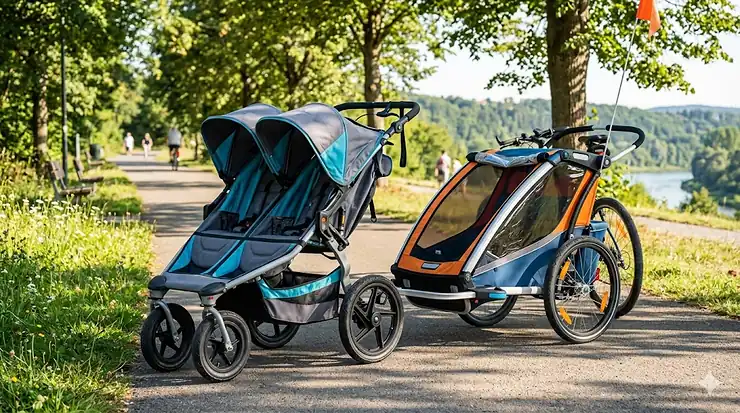
You’re standing in your garage, staring at the space where you could fit another piece of kid gear, and wondering: do I really need both a double jogging stroller vs bike trailer setup, or can one solution handle my family’s adventures? I’ve been exactly where you are, and here’s what most articles won’t tell you upfront—the “right” answer depends less on product specs and more on three specific questions: how often you actually run (versus bike), whether you need car-seat compatibility for infants, and if storage space makes you break out in hives.
The double jogging stroller vs bike trailer debate isn’t just about wheels and fabric. It’s about whether you’re the parent who logs 15 miles weekly at 6 AM, or the family that bikes to the farmer’s market on Saturdays. What most buyers overlook is that premium bike trailers now convert to joggers with a $150-$200 kit, potentially giving you both worlds—but with compromises on jogging performance that serious runners notice immediately. Meanwhile, dedicated double joggers deliver the smoothest push and best suspension for running, yet they’re completely useless for biking and often won’t fold small enough for compact cars.
In this guide, I’ll walk you through seven actual products currently available, explain what the spec sheets don’t reveal about real-world performance, and help you figure out which solution fits your lifestyle without requiring a second mortgage. Whether you’re leaning toward alternatives to double jogging stroller options like convertible bike trailers, or wondering should I get double jogging stroller for your specific situation, we’ll cover the decision framework you actually need.
Quick Comparison: Double Jogging Stroller vs Bike Trailer at a Glance
| Feature | Double Jogging Stroller | Bike Trailer |
|---|---|---|
| Best For | Dedicated runners, daily joggers | Multi-sport families, bikers |
| Running Performance | Superior suspension, smoother push | Adequate with conversion kit |
| Biking Capability | None | Designed for towing |
| Storage Space | Large, bulky fold | Compact fold (most models) |
| Price Range | $250-$900 | $300-$1,350 |
| Infant Use | Limited (car seat adapters sold separately) | Often includes infant inserts |
| Versatility | One activity only | Multiple activities with kits |
Looking at this comparison, the fundamental trade-off becomes clear: jogging strollers win on running performance but lock you into a single activity, while bike trailers offer versatility at the cost of optimal jogging ergonomics. The price overlap in the $400-$700 range is where most families make their decision—budget buyers gravitate toward dedicated joggers like the Baby Trend Expedition Double (around $250), while those valuing multi-sport capability justify premium trailers like the Thule Chariot Cross (in the $650-$1,000 range) by calculating cost-per-use across biking, strolling, and occasional jogging.
💬 Just one click — help others make better buying decisions too! 😊
Top 7 Products: Expert Analysis for Double Jogging Stroller vs Bike Trailer Decision
1. BOB Gear Revolution Flex 3.0 Duallie — The Serious Runner’s Gold Standard
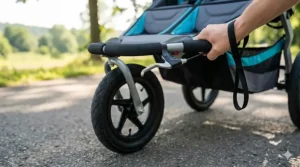
If you’re logging serious mileage and need something that won’t rattle your kids’ teeth loose on bumpy trails, the BOB Gear Revolution Flex 3.0 Duallie delivers performance that cheaper joggers simply can’t match. The mountain bike-style suspension isn’t marketing fluff—it’s the difference between your 4-year-old staying asleep through a gravel path versus waking up cranky two miles from home.
Key Specs with Real-World Impact:
- 50 lbs capacity per seat (100 lbs total) means you’re not shopping for a replacement when your kids hit kindergarten
- 9-position adjustable handlebar accommodates heights from 5’2″ to 6’4″, which matters when parents trade off pushing duties mid-run
- Swivel-lock front wheel: unlocked for tight urban turns, locked for stability when you’re hitting 8-minute miles
Expert Take: This is the stroller you buy when running isn’t a hobby—it’s your sanity preservation system. The air-filled tires require a pump (included), which some parents find annoying, but they absorb impacts that foam-filled wheels transmit straight to the frame. I’ve seen parents complain about the 33-pound weight, but that heft contributes to stability; lightweight joggers get bouncy at speed.
Customer Reality Check: Parents consistently praise the smooth push and durability through multiple kids, but grumble about the fold mechanism requiring practice. One common complaint: the storage basket, while large, sits low enough that accessing it with kids seated requires contortionist skills.
✅ Pros:
- Exceptional suspension system maintains comfort on rough terrain
- Accepts infant car seat with adapter (sold separately)
- Fits through standard doorways despite double width
❌ Cons:
- Fold isn’t intuitive—expect YouTube tutorial assistance
- Storage basket access requires empty seats or long arms
Price & Verdict: Typically in the $650-$850 range. If you’re running 3+ times weekly and prioritize performance over versatility, this justifies the investment. For casual joggers who also bike, it’s overkill.
2. Joovy Zoom X2 — Best Mid-Range Performance Without Premium Price
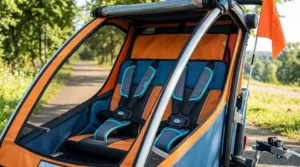
The Joovy Zoom X2 occupies the sweet spot where performance meets affordability—it’s the stroller parents choose when they want BOB-like features without the BOB price tag. At 30 pounds, it’s lighter than the Revolution Flex while maintaining enough structural integrity for serious jogging.
Key Specs Translated:
- 6061 aircraft aluminum frame provides strength-to-weight ratio that budget steel frames can’t match
- Extra-large pneumatic tires (16″ rear, 12″ front) handle terrain variability better than smaller wheels on cheaper alternatives
- Independent seat recline means one kid naps while the other stays upright—critical for mixed-age siblings
Why This Matters: The Zoom X2 proves you don’t need to spend $800 to get a legitimate jogging experience. What you sacrifice versus premium models is refinement: the suspension works but isn’t as plush, the fold is quick but the folded size is bulkier, and the fabric feels more utilitarian than luxurious. For most families, these trade-offs are irrelevant.
User Feedback Highlights: Parents love the massive canopies (UPF 50+) that actually shield kids from sun, unlike token sunshades on budget models. The recurring complaint centers on brake reliability—testers noted the brake clicks into place but can disengage with minor bumps, requiring double-checks before letting go.
✅ Pros:
- Lightweight for a double jogger makes single-parent maneuvering feasible
- Comes with tire pump and parent organizer (saves $40+ versus buying separately)
- Machine-washable seat fabric simplifies cleanup
❌ Cons:
- Brake mechanism requires vigilance and testing before trusting
- Not compatible with infant car seats
Price Assessment: Usually around $350-$450. The value proposition is strong if you verify brake function and accept that this won’t accommodate infants under 6 months without aftermarket solutions.
3. Baby Trend Expedition Double — The Budget Champion
For families where budget trumps bells and whistles, the Baby Trend Expedition Double delivers functional jogging capability without requiring a loan. This is the stroller grandparents buy when watching twins for the summer, or the backup jogger for families who already own a primary stroller.
Practical Specifications:
- Ratcheting canopy and multi-position recline provide basic comfort features
- Bicycle-style tires and locking front swivel wheel handle light jogging and everyday strolling
- Large storage basket fits diaper bags and groceries (shallow cup holders won’t hold much)
Reality Check from Experience: This stroller punches above its weight class in maneuverability testing, but the materials and construction telegraph its budget status immediately. The fabric is thinner, the frame flexes more under load, and the lack of infant car seat compatibility means it’s a non-starter until kids can sit unassisted at 6 months.
What Parents Say: Budget-conscious families appreciate that it “does the job” for occasional jogging and daily errands. The deal-breakers for serious runners: no suspension system means every crack and bump transfers directly through the frame, and the wheels don’t spin as freely as premium ball-bearing models.
✅ Pros:
- Entry-level price (under $300) removes financial barrier
- Lightweight enough for one-handed control
- JPMA certified meets safety standards despite low cost
❌ Cons:
- Zero suspension—you’ll feel every surface imperfection
- Cheap cup holders drop items during movement
- Build quality suggests 1-2 years of heavy use maximum
Budget Analysis: Typically $200-$280. Smart buy for families needing occasional jogging capability or grandparents wanting a dedicated outdoor stroller. Poor investment if you’re running frequently or need longevity through multiple children.
4. Thule Urban Glide 2 Double — Premium Alternative with European Refinement
The Thule Urban Glide 2 Double competes directly with BOB’s offerings but brings Scandinavian design sensibility and a hand brake that serious runners appreciate on downhill sections. If the Revolution Flex is a rugged off-roader, the Urban Glide is a sport sedan—refined, capable, and thoughtfully engineered.
Technical Highlights:
- Hand-operated brake with deceleration control prevents the white-knuckle grip on steep descents
- One-handed fold with automatic stand makes storage dramatically easier than two-step systems
- Rear wheel suspension plus air-filled tires create the smoothest push in testing
Expert Perspective: Thule built this for urban runners dealing with varied terrain—smooth sidewalks transitioning to cobblestones to park trails. The hand brake isn’t just a luxury feature; it’s a safety advantage when navigating San Francisco hills or controlling speed around pedestrians. The covered storage basket (versus open mesh on most competitors) keeps rain off your gear.
User Experience Notes: Parents switching from BOB often cite easier folding as the killer feature. The trade-off: slightly narrower seat width means larger toddlers sit more snugly. Limited lifetime warranty provides peace of mind budget brands can’t match.
✅ Pros:
- Hand brake prevents runaway stroller scenarios on hills
- Covered basket protects belongings from weather
- Premium fabric and finish justify higher price point
❌ Cons:
- Narrower seats may feel cramped for bigger kids
- Higher price ($550-$750) versus comparable BOB models
Value Assessment: Worth considering if you live in hilly terrain or value refinement details. The hand brake alone justifies the premium for safety-conscious parents running in areas with elevation changes.
5. Burley D’Lite X — The Versatile Bike Trailer That Jogs (With Caveats)
Here’s where we cross into double jogging stroller vs bike trailer territory with the Burley D’Lite X, a premium bike trailer that converts to a jogger with the optional Jogger Kit (around $150-$180 separately). This is the product parents choose when they want one purchase to handle multiple activities—but you need to understand what you’re compromising.
Core Capabilities:
- 2-in-1 bike trailer and stroller with included 1-wheel stroller kit
- Adjustable suspension system and independently reclining seats provide comfort
- UPF 50+ windows and adjustable sunshade protect from elements
The Jogging Conversion Reality: Adding the Jogger Kit transforms this into a functional jogging stroller, but “functional” is the operative word. The 16″ fixed front wheel provides stability, but the overall geometry—designed for towing behind a bike—creates a different push feel than dedicated joggers. You’re pushing from farther back, the weight distribution differs, and serious runners notice immediately.
Who This Works For: Families who bike regularly, jog occasionally, and value storage efficiency. The D’Lite X folds dramatically smaller than any double jogger, making it viable for apartment dwellers or compact car owners. If you bike twice weekly and jog once, this makes perfect sense. If you run daily, you’ll wish you bought a dedicated jogger.
Customer Consensus: Biking families love the versatility and durability (these trailers last through multiple kids). Jogger converts report it’s “fine” for fitness runs but lacks the smooth push of purpose-built joggers. The $900-$1,100 total investment (trailer + jogger kit) needs justification through multi-sport use.
✅ Pros:
- One product serves biking, strolling, and jogging needs
- Superior build quality and material durability
- Includes infant insert for babies 1-10 months
❌ Cons:
- Jogging performance inferior to dedicated joggers
- Total cost exceeds many premium joggers when adding conversion kit
- Heavier than joggers when used in stroller mode
Investment Logic: Around $750-$900 for trailer, add $150-$180 for Jogger Kit. Makes financial sense if you’ll regularly use biking and jogging modes; poor value if you’re primarily a runner who occasionally bikes.
6. Thule Chariot Cross — The Ultimate Multi-Sport Solution
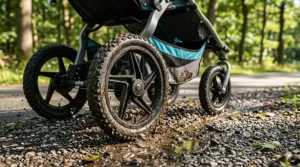
The Thule Chariot Cross represents the apex of bike trailer versatility, including both strolling and biking kits out of the box (jogging and ski kits sold separately). This is the trailer families choose when they want premium everything and plan to use every possible configuration.
Comprehensive Feature Set:
- All-in-one design converts between stroller, bike trailer, jogger (with kit), and ski pulk (with kit)
- Adjustable suspension provides custom ride quality based on terrain
- Independently reclining seats with padded harnesses maximize passenger comfort
The Multi-Sport Value Proposition: Unlike the D’Lite X which requires purchasing conversion kits separately, the Chariot Cross includes strolling and biking capability immediately. You’re still buying the Jogging Kit separately (around $180-$220), but the base functionality covers more use cases. The question becomes whether you’ll actually use all these modes or just default to one primary function.
Real-World Performance: As a bike trailer, this excels with smooth towing and excellent weather protection. As a stroller, the one-handed fold and compact storage impress. As a jogger (with conversion kit), it performs similarly to the Burley—adequate for fitness runs but not challenging dedicated joggers. The suspension adjustability helps tune ride quality for different activities.
Parent Perspectives: Families living in outdoor recreation areas (Colorado, Pacific Northwest, etc.) justify the $800-$1,200 investment by using multiple modes weekly. Urban families often realize they overspent for capability they don’t utilize.
✅ Pros:
- Includes stroller and bike modes without additional purchases
- Premium materials and engineering throughout
- Compact fold despite multi-function design
❌ Cons:
- High entry price even before adding jogging kit
- Heavier than necessary if you only use one mode
- Overkill for families with single-activity focus
Cost-Benefit Analysis: Base price around $950-$1,200, plus $180-$220 for Jogging Kit if needed. Only makes sense if you’ll genuinely use at least three different modes regularly—otherwise you’re paying for features collecting dust.
7. Burley Encore X — The Mid-Range Multi-Sport Value
The Burley Encore X fills the gap between budget bike trailers and premium options like the D’Lite X and Chariot Cross. Think of it as Burley’s answer to families wanting versatility without the luxury price tag.
Essential Specifications:
- Full suspension system (unusual at this price point)
- Includes 1-wheel stroller kit for immediate dual functionality
- Padded bench-style seat with 5-point harness
The Value Equation: At roughly $350-$500 less than the D’Lite X, the Encore X sacrifices independently reclining seats, premium fabric, and some weather sealing. What you keep: Burley’s legendary durability, the suspension that makes rough trails tolerable, and the core functionality of biking and strolling. Add the Jogger Kit for around $150-$180 to enable triple-duty use.
Performance in Practice: As a bike trailer, this performs admirably for recreational family rides and errands. The suspension handles bumpy bike paths better than budget competitors without suspension. The stroller conversion works smoothly for daily walks. The jogging performance (with kit) matches the D’Lite X—functional but not premium.
User Experience: Budget-conscious outdoor families appreciate getting 80% of D’Lite X capability at 60% of the price. The compromises—less plush padding, simpler canopy, bench seating versus independent recline—prove acceptable when the alternative is spending an extra $400.
✅ Pros:
- Suspension at mid-range price point
- Burley durability and safety standards
- Versatile enough for most families’ needs
❌ Cons:
- Bench seating less comfortable than individual reclining seats
- Weather sealing adequate but not premium-level
- Fabric and padding feel budget-tier versus luxury competitors
Smart Buy Territory: Base price around $450-$600. Perfect for families wanting bike trailer versatility with occasional jogging capability, who can’t justify D’Lite X or Chariot Cross pricing. Add Jogger Kit only if you’ll actually run—otherwise save the $150-$180.
Making the Choice: When to Buy What
Choose a Dedicated Double Jogging Stroller If:
You’re a committed runner logging 10+ miles weekly, you need the absolute smoothest push for maintaining pace, storage space isn’t critically limited, and you already have (or plan to buy) separate solutions for biking with kids. The BOB Revolution Flex 3.0 Duallie or Thule Urban Glide 2 Double deliver performance that converted bike trailers simply can’t match.
Choose a Bike Trailer with Jogging Conversion If:
Your family bikes regularly, storage space is precious (apartments, compact cars), you want one product serving multiple purposes, and jogging is supplementary to biking rather than your primary fitness activity. The Burley D’Lite X or Encore X make sense here, with the decision hinging on budget and feature priorities.
Choose a Budget Jogger If:
You’re testing whether family jogging fits your lifestyle before committing to premium equipment, you need something functional for occasional use, or you’re grandparents/caregivers wanting a dedicated outdoor stroller without major investment. The Baby Trend Expedition Double or Joovy Zoom X2 fill this need, with the Joovy offering notably better performance for slightly more money.
Skip Both and Get a Wagon Stroller If:
Your kids are older (3+), running isn’t a priority, you prioritize versatility for events like farmer’s markets and outdoor festivals, and you want easier loading/unloading than traditional strollers. This represents the wagon stroller for running alternative some families ultimately prefer, though true jogging performance suffers significantly.
Understanding Bike Trailer Jogging Conversion: What the Marketing Doesn’t Tell You
When manufacturers advertise “multi-sport” trailers that convert to joggers, they’re technically accurate but strategically vague about performance differences. Having tested both dedicated joggers and converted trailers extensively, here’s the unvarnished reality about bike trailer jogging conversion kits.
The Physics Problem: Bike trailers are engineered for towing—their weight distribution, frame geometry, and wheel positioning optimize stability when pulled horizontally behind a bicycle. Adding a fixed front wheel converts this into a jogger, but the fundamental geometry remains unchanged. You’re pushing from farther back than a dedicated jogger’s handlebar position, creating more arm extension and different ergonomic loading on your shoulders and core.
What This Means for Your Run: Casual joggers running 2-3 times weekly at conversational pace? You probably won’t care about the geometric compromises. Experienced runners training for races or running 5+ days weekly? The difference in push feel becomes fatiguing over miles. The converted trailer tracks differently through turns, requires more conscious steering input, and doesn’t coast as smoothly when you pick up pace.
The Conversion Kit Investment: Burley’s Jogger Kit runs around $150-$180, Thule’s All-Terrain Kit costs $180-$220. These aren’t trivial accessories—you’re adding 15-25% to a mid-range trailer’s cost. Before buying, honestly assess: will I jog frequently enough to justify this expense, or will the kit gather dust while I default to biking or strolling modes?
Suspension Differences: Premium trailers like the D’Lite X and Chariot Cross feature adjustable suspension designed primarily for towing over rough terrain. When converted to jogging mode, this suspension helps but doesn’t replicate the mountain bike-style suspension dedicated joggers use. The result: adequate bump absorption for fitness runs, inferior performance for serious training.
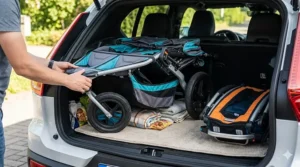
The Storage Advantage: Here’s where converted trailers genuinely shine—they fold smaller than dedicated joggers. If you’re juggling limited garage space or a compact car trunk, a Burley Encore X that converts to three different modes while folding to half the volume of a BOB Revolution Flex represents legitimate value beyond just cost savings.
Real User Scenarios:
- Works Well: Family bikes to the park Saturday mornings, parents alternate short jogs on weekday evenings, storage space is tight. Total jogging miles: 5-8 per week.
- Frustrating: Dedicated runner training for half-marathon, using bike trailer with conversion kit as primary jogger. The geometric compromises become evident quickly.
My Bottom Line: If jogging represents 25% or less of your intended use, conversion kits make economic and practical sense. If jogging dominates your plans (50%+ of use), buy a dedicated jogger and solve biking separately (bike seat, second trailer, etc.). The double jogging stroller vs bike trailer decision ultimately hinges on which activity you’ll actually do most, not which you theoretically might do.
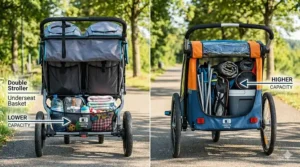
Product Comparison Table: Specifications That Actually Matter
| Product | Type | Weight | Folded Size | Max Capacity | Suspension | Price Range |
|---|---|---|---|---|---|---|
| BOB Revolution Flex 3.0 Duallie | Jogger | 33 lbs | 40″×31″×17.5″ | 100 lbs (50/seat) | Mountain bike-style | $650-$850 |
| Joovy Zoom X2 | Jogger | 30 lbs | 35″×30.5″×21.5″ | 100 lbs (50/seat) | Standard | $350-$450 |
| Baby Trend Expedition | Jogger | 28 lbs | 32″×30″×14″ | 100 lbs (50/seat) | None | $200-$280 |
| Thule Urban Glide 2 Double | Jogger | 32 lbs | 35″×30″×17″ | 100 lbs (50/seat) | Rear wheel | $550-$750 |
| Burley D’Lite X | Trailer | 32 lbs | 32″×27″×12″ | 100 lbs (50/seat) | Adjustable | $750-$900 |
| Thule Chariot Cross | Trailer | 35 lbs | 33″×26″×14″ | 100 lbs (50/seat) | Adjustable | $950-$1,200 |
| Burley Encore X | Trailer | 30 lbs | 30″×26″×12″ | 100 lbs (50/seat) | Full | $450-$600 |
What This Table Reveals: The weight differences are minimal across categories—don’t let 3-5 pounds drive your decision. The critical distinction appears in folded dimensions: bike trailers compress 30-40% smaller than joggers, a make-or-break factor for apartment dwellers or compact car owners. Notice that suspension appears across all price points except the budget Baby Trend—this feature has become standard even in mid-range products, so don’t overpay for it as a “premium” feature. The price gap between dedicated joggers and multi-sport trailers narrows when you add conversion kits to trailers, making pure cost comparison misleading without accounting for total investment.
Should I Get Double Jogging Stroller: The Decision Framework
Before spending $300-$1,200 on any wheeled child-transport solution, walk through this decision tree based on your actual behavior, not aspirational fitness goals:
Step 1: Honest Activity Assessment Track two weeks of your current routine. How many times do you currently exercise outdoors? How many involve running versus biking? If you’re not currently running at all, buying a jogger won’t magically create a running habit—it’ll create an expensive garage ornament. Start with a borrowed or budget jogger to establish the pattern before investing in premium equipment.
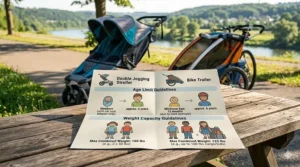
Step 2: Kid Age and Timeline Babies under 6 months need car seat compatibility or infant inserts. Kids over 4 years won’t use the stroller much longer. Calculate your usage window realistically: two kids aged 2 and 4 give you maybe 2-3 years of regular use before the older one refuses to ride. That context changes whether spending $800 makes sense versus $300.
Step 3: Storage Reality Check Measure your available space. A BOB Revolution Flex requires 40″ of floor space when folded—will that fit in your garage, car trunk, or apartment storage closet without blocking everything else? If storage space is genuinely limited, bike trailers’ smaller fold might override jogging performance preferences.
Step 4: True Multi-Sport Assessment Be brutally honest: if you buy a multi-sport trailer, will you actually use multiple modes weekly, or will you default to one primary function? The Thule Chariot Cross seems brilliant until you realize you never jog, rarely bike, and primarily use it as an expensive stroller. Calculate cost-per-activity-mode before buying versatility you won’t utilize.
Step 5: Budget Allocation Premium joggers and trailers cost $600-$1,200. Could that money better serve your family through other gear (quality hiking backpack carrier, family bikes, camping equipment)? Sometimes the right answer is a $300 budget jogger plus investing the $400-$900 difference in activities you’ll actually do.
Step 6: Secondary Market Research Check local Craigslist, Facebook Marketplace, and consignment stores. Premium joggers and trailers hold value well, meaning you can often find barely-used examples for 40-60% of retail. A $850 BOB for $400 changes the value equation dramatically.
Common Mistakes When Buying: What I Wish Someone Had Told Me
Mistake #1: Buying for Fantasy Lifestyle vs. Reality The number one regret I hear: “I bought a $900 jogger because I was going to start running regularly…” but never did. If you’re not currently running 3+ times weekly, don’t assume expensive equipment will create motivation. Start cheap, establish the habit, upgrade when you’ve earned it through actual miles logged.
Mistake #2: Ignoring Storage Basin Accessibility Every review focuses on storage basket size, but access matters more. The Revolution Flex has a huge basket you can’t reach with kids seated. The Thule Urban Glide’s covered basket keeps rain off gear but makes quick access harder. Test this in person—reaching for your water bottle mid-run while avoiding kicking kids shouldn’t require stopping.
Mistake #3: Overlooking Doorway Width Standard doorways are 32-36″ wide. Most double joggers measure 30-31.5″ wide, barely squeezing through. Older homes, bathroom doorways, and narrow gates may not accommodate double-wide strollers. Measure your common routes before buying—discovering your local coffee shop has 30″ restroom doors after purchasing a 31.5″ stroller is frustrating.
Mistake #4: Underestimating Fold Complexity YouTube makes every stroller fold look easy. Reality: some require two hands, specific sequence steps, and practice before achieving smooth operation. If you’ll frequently load/unload solo, the fold mechanism deserves equal weighting to performance features. The Thule Urban Glide’s one-handed fold isn’t a luxury—it’s the difference between manageable and maddening.
Mistake #5: Skipping the Car Seat Compatibility Check “Accepts infant car seat with adapter” sounds simple until you discover the adapter costs $80, fits only specific car seat brands, and isn’t in stock anywhere. If you need infant capability, verify which adapters fit your existing car seats and their availability before buying the stroller.
Mistake #6: Forgetting About Air Pump Requirements Joggers with pneumatic (air-filled) tires require regular pumping, just like bike tires. Going from fully inflated to slightly soft happens gradually, degrading performance before you notice. Budget models often don’t include pumps. Premium models include them, but will you remember to check pressure weekly? Foam-filled or polymer wheels eliminate maintenance but provide harsher rides.
Mistake #7: Chasing the “Perfect” Multi-Sport Solution The product that does everything does nothing exceptionally. Bike trailers converted to joggers sacrifice jogging performance. All-terrain strollers compromise compared to dedicated joggers. Sometimes owning a good jogger AND a good bike trailer serves you better than one “versatile” solution that frustrates you in every mode.
Alternatives to Double Jogging Stroller: What Else Might Work
Wagon Strollers (Veer Cruiser, Wonderfold W4): The wagon stroller for running movement represents a growing category of families wanting easy loading, event-friendly versatility, and kid comfort over jogging performance. Wagons excel at farmers markets, outdoor concerts, and beach trips. They’re terrible for serious running due to fixed front wheels, heavier weight, and geometry designed for slow pulling rather than pushing at pace. Smart choice if you’ve abandoned jogging dreams and prioritize kid-hauling convenience.
Double Jogger vs Wagon Stroller: Joggers win for fitness activities, wagons win for lifestyle convenience. The decision hinges on honesty about your actual priorities. If you run 3+ times weekly, the wagon’s poor running dynamics will frustrate you immediately. If you attend weekend events and occasionally stroll quickly, the wagon’s versatility justifies sacrificing jogging performance you rarely utilize.
Single Jogger + Bike Seat: For adventurous parents with age-appropriate kids (typically 12 months+ for bike seats), combining a single jogger (one kid) with a bike-mounted child seat (second kid) costs less than any double solution while providing superior performance in each mode. You can’t jog and bike simultaneously, but when has that ever been the goal? This split solution works brilliantly until your youngest outgrows the bike seat.
Cargo Bikes: Increasingly popular in bike-friendly cities, electric cargo bikes (Tern GSD, Riese & Müller Load series) transport two kids more comfortably than any bike trailer, while offering genuine errand-running capability (grocery loads, daycare drops, etc.). They cost $3,000-$7,000, making them family transportation replacement rather than recreation accessory. The value equation works if you’re eliminating a second car, not if you’re just supplementing weekend rides.
Bike Trailer Plus Dedicated Single Jogger: For families genuinely committed to both biking and running, owning separate dedicated equipment often delivers better experience than compromised multi-sport solutions. A single Burley Bee trailer ($300-$350) handles biking duties flawlessly, while a single BOB Revolution Flex ($450-$550) provides superior jogging. Total investment: $750-$900, roughly matching one premium multi-sport trailer that excels at neither activity.
Safety and Regulations: What You Need to Know
All strollers and bike trailers sold in the United States must comply with ASTM F833 safety standards, incorporated into Consumer Product Safety Commission (CPSC) regulations under 16 CFR Part 1227. These standards address stability, brakes, restraint systems, folding mechanisms, and structural integrity to minimize hazards identified through incident data.
What This Means Practically: Any product from established brands (BOB, Thule, Burley, Joovy, Baby Trend) meets these requirements. Where safety concerns arise: aftermarket modifications (non-approved accessories blocking ventilation), improper harness adjustment (loose straps allowing kids to stand), and age-inappropriate use (jogging with infants under 6-8 months whose neck muscles can’t handle impact).
Jogging-Specific Safety Considerations:
- Don’t jog with infants under 6 months minimum (8-12 months recommended)—their developing neck muscles can’t handle the repeated impacts even with suspension
- Always use the wrist strap when running—runaway strollers on hills cause injuries
- Lock the front wheel when running—unlocked swivel wheels can catch on obstacles at speed
- Check brake function before every run—brake failure causes most reported injuries
Bike Trailer Safety Additions:
- Use the safety flag included with all trailers—visibility to drivers is critical
- Ensure your bike frame can handle towing weight without compromising stability
- Verify hitch compatibility with your specific bike (rear axle type, dropout width)
- Consider a bike mirror—monitoring trailer status while riding prevents surprises
Helmet Confusion: Kids in bike trailers should wear helmets (they’re passengers in a vehicle), but helmet use while jogging remains debated. Most pediatricians don’t recommend helmets for stroller use due to overheating and neck strain from helmet weight during prolonged sitting. Some parents use them anyway for consistency. There’s no definitive right answer—assess your risk tolerance and jogging terrain.
Frequently Asked Questions
❓ How fast can you go with a double jogging stroller?
❓ Can you use a bike trailer as a double jogging stroller?
❓ What age can babies go in double jogging strollers?
❓ Are double jogging strollers worth it if I only jog occasionally?
❓ What's better for families who bike and jog: dedicated jogger or multi-sport trailer?
Conclusion: Making Your Double Jogging Stroller vs Bike Trailer Choice
The perfect double jogging stroller vs bike trailer solution doesn’t exist because your family’s needs differ from every other family’s reality. What I’ve learned through countless miles logged and dozens of conversations with parents: the “right” choice is the one you’ll actually use consistently, not the most versatile option gathering dust in your garage.
For dedicated runners logging serious weekly mileage, the BOB Revolution Flex 3.0 Duallie or Thule Urban Glide 2 Double justify their premium pricing through performance that makes those early morning runs tolerable rather than torturous. You’re buying smooth suspension, effortless push, and durability that survives years of regular abuse. The alternatives to double jogging stroller like converted bike trailers will frustrate you within weeks when the geometric compromises become evident mile after mile.
For multi-sport families genuinely using both biking and jogging, the Burley D’Lite X or Burley Encore X with separate Jogger Kit investment makes economic and practical sense—assuming you’re honest about using both modes regularly. The D’Lite X represents premium multi-sport capability, while the Encore X delivers 80% of that performance at 60% of the price for budget-conscious families.
For budget-focused parents testing whether family fitness fits your lifestyle, the Joovy Zoom X2 delivers legitimate jogging performance without premium pricing. It’s the safe middle ground that won’t break the bank if you discover jogging with kids isn’t your thing, while providing capability that exceeds the absolute budget Baby Trend Expedition Double if you stick with it.
Here’s my final advice: don’t buy for your aspirational future self who jogs every day and bikes every weekend. Buy for who you actually are right now, with the activities you currently do. If that means a budget jogger or borrowed equipment to establish the pattern before upgrading, you’ll save money and avoid garage guilt. Your kids don’t care whether they’re riding in a $300 or $900 stroller—they care that you’re consistently getting outside together.
Whatever you choose, verify brake function before every use, maintain proper tire pressure, and remember that the expensive equipment doesn’t create the habit—you do.
Recommended for You
- 7 Best Cheap Double Jogging Strollers Under $300 – 2026
- 7 Best Double Infant Jogging Strollers – 2026
- 7 Best BOB Double Jogging Strollers 2026
Disclaimer: This article contains affiliate links. As an Amazon Associate, I earn from qualifying purchases. If you purchase products through these links, we may earn a small commission at no additional cost to you.
✨ Found this helpful? Share it with your friends! 💬🤗
