

In This Article
Picture this: you’re at the airport, juggling a carry-on, a diaper bag, a coffee you desperately need, and your toddler — who has decided right now is the perfect time to go boneless. The last thing you need is a 22-pound tank of a stroller eating up your last free hand.
That’s exactly where a stroller under 10 lbs changes the game entirely.

We’re not talking about some flimsy compromise you’ll regret by mile two of a theme park. The best ultra lightweight strollers available in 2026 — especially in the featherweight-baby-stroller category — have closed the gap on comfort, safety, and durability in a way that would have seemed impossible five years ago. Carbon fiber frames borrowed from aerospace engineering, one-second folds, seats that recline nearly flat: the technology has caught up with the ambition.
So what exactly qualifies? A stroller under 10 lbs is any pushchair with a total frame weight at or below ten pounds — lighter than most toddlers’ backpacks, lighter than a good carry-on, and light enough that you’ll actually want to bring it. For reference, the TSA’s standard carry-on allowance hovers around 15–22 lbs depending on the airline; a stroller that weighs less than an airline carry on isn’t just convenient, it’s a legitimate travel tool.
In this guide, I’ve done the research across Amazon’s current listings, third-party testing data, and thousands of real customer reviews to bring you seven genuine products you can buy today. I’ve also included a few contenders just north of the 10-lb mark — because sometimes the best super light stroller for mom is 10.1 lbs and you’d be crazy to rule it out.
Let’s get into it.
Quick Comparison: 7 Best Ultra Lightweight Strollers at a Glance
| Stroller | Weight | Fold Type | Best For | Price Range |
|---|---|---|---|---|
| MAMAZING Ultra Air X | 9.9 lbs | One-hand | Air travel, urban commuting | $190–$230 |
| Kolcraft Cloud Umbrella | 9.5 lbs | 1-step compact | Budget buyers, quick trips | $55–$75 |
| Kolcraft Cloud Plus | ~10.1 lbs | One-hand, self-standing | Feature seekers on a budget | $70–$90 |
| gb Pockit+ All City | ~9.5 lbs | Two-step, ultra-compact | Overhead bin travel | $230–$270 |
| Mompush Lithe V2 | ~12 lbs | One-hand, self-standing | Daily use + travel balance | $160–$200 |
| Colugo Compact Stroller+ | ~14 lbs | One-button | Quality-first everyday buyer | $250–$290 |
| Inglesina Quid 2 | ~13 lbs | One-hand, self-standing | Style-conscious city parents | $200–$250 |
Analysis: What jumps out immediately is the gap between the true featherweights (MAMAZING Ultra Air X and Kolcraft Cloud Umbrella) and the “lightweight” category that tops out near 14 lbs. If your priority is absolute minimum weight for air travel, the MAMAZING Ultra Air X is the only carbon-fiber option that breaks the 10-lb barrier with meaningful comfort features. Budget travelers who aren’t flying will get more daily bang from the Kolcraft Cloud Plus at slightly over 10 lbs — it packs snack trays and cup holders that cost twice as much elsewhere.
✨ Don’t Miss These Exclusive Deals!
🔍 Take your family adventures to the next level with these carefully selected strollers. Click on any bold-italic product name to check current pricing and availability on Amazon — and find the exact fit for your family on the go!
Top 7 Strollers Under 10 lbs: Expert Analysis
1. MAMAZING Ultra Air X Travel Stroller — The True Sub-10 Champion
If someone handed you a stroller and said “this frame is made from the same material category as a Formula 1 chassis,” you’d expect to pay $800. The MAMAZING Ultra Air X lists on Amazon in the $190–$230 range — and it actually weighs 9.9 lbs. That’s not marketing math. That’s verified by multiple independent sources and Walmart’s own product listing.
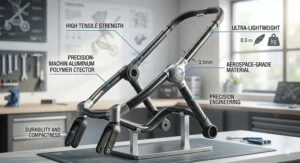
The secret is aerospace-grade carbon fiber, a material that delivers strength-to-weight ratios that standard aluminum frames simply can’t touch. What does that mean in the real world? You can lift this stroller with two fingers, and it won’t wobble or creak under a 50-lb toddler the way budget plastic-aluminum hybrids do after six months of use. The frame meets CPSC and ASTM safety standards, and the fabrics are OEKO-TEX certified — details that matter when you’re shopping for what goes around your child every day.
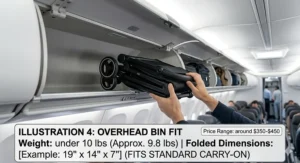
The recline range of 100°–150° is practical, not just spec-sheet decoration. At 150°, a napping toddler is nearly horizontal — enough for a real sleep without the weird head-loll you get from a stroller that only “reclines” 15 degrees. The fold is one-handed, the travel bag is included, and it fits in most airline overhead bins.
Who is this for? The parent who flies more than twice a year, navigates cities regularly, and wants to stop thinking about their stroller entirely. It’s not a newborn stroller — the minimum age is 6 months — so expectant parents should note that.
Customer feedback: Buyers on Amazon consistently praise the one-handed fold and the carbon fiber frame’s rigidity. A few reviews mention the canopy could be larger.
✅ Genuinely the lightest carbon fiber stroller under 10 lbs on the market
✅ Meets airline carry-on standards for most major US carriers
✅ CPSC/ASTM certified, OEKO-TEX fabric
❌ Not suitable from birth (6 months+)
❌ Canopy coverage is smaller than full-size alternatives
Value verdict: In the $190–$230 range, this is the best stroller weighs less than airline carry on money can buy right now.
2. Kolcraft Cloud Umbrella Stroller (Model KU022) — The 9.5-lb Budget Hero
Kolcraft has been making baby gear since 1946. They’re not flashy, they’re not Instagram-famous, and their Chicago-based team designs strollers for people who need them to work — not to photograph well at brunch. The Cloud Umbrella comes in at 9.5 lbs, making it one of the lightest strollers available at any price point, and it regularly sells in the $55–$75 range on Amazon.
Nine and a half pounds. That’s lighter than most gym bags after a workout. With a 1-step fold and folded dimensions of just 10″ W × 9.5″ D × 42.5″ H, it disappears into the back of a car or stands in a corner without taking over the hallway.
Here’s what the spec sheet won’t tell you: the roll-up mesh window on the hood is genuinely clever. It doubles as a ventilation panel in summer heat and creates a headrest when rolled back down — a small detail that separates thoughtful engineering from stroller-by-committee design. The 3-point harness is simpler than a 5-point, which means faster buckle-ins at school drop-off and faster release when you’re running for a connecting flight. For a toddler who can sit unassisted (it’s rated for children up to 40 lbs), this is the no-nonsense tool it claims to be.
Who is this for? The parent who wants to stop overthinking. If you’re doing quick errands, short museum visits, or occasional light travel and don’t want to spend $200+, the Cloud Umbrella does 80% of the job of a luxury stroller at 25% of the cost.
Customer feedback: Over 7,900 ratings on Amazon with a 4.2-star average. Buyers love the weight and simplicity; a few note the storage basket is compact.
✅ One of the lightest strollers available, period
✅ Extremely budget-friendly
✅ Simple 1-step compact fold
❌ 3-point harness (not 5-point)
❌ No recline — for fully seated toddlers only
3. Kolcraft Cloud Plus Lightweight Stroller — 10.1 lbs of Everyday Muscle
Technically 0.1 lbs over the magic number, but hear me out. The Kolcraft Cloud Plus (available on Amazon in the $70–$90 range) is what happens when an engineer asks: “What if we kept it under 12 lbs but gave it everything a full-size stroller has?” The answer is a snack tray, two-cup parent console, five-point harness, large storage basket, three-tier extended canopy with peek-a-boo window, multi-position recline, and all-terrain wheels — in a stroller weighing 10.1 lbs according to independent testing at BabyGearLab.
At 10.1 lbs, it’s still several pounds lighter than the category average of ~14 lbs. The one-hand fold is self-standing, which sounds minor until you’re at a crowded airport gate and you have nowhere to lean it. The 50-lb weight limit means it’ll carry a larger preschooler without the seat buckling under pressure.
What most buyers overlook about this model: the storage basket has 10-lb capacity — genuinely substantial for a stroller in this weight class. That’s a diaper bag, extra jacket, water bottles, and a stuffed animal without batting an eye. Budget competitors in this range typically cut the basket to shave production costs.
Who is this for? The parent who wants the best feature-per-pound ratio money can buy. Not for frequent fliers (the fold is elongated and doesn’t fit overhead bins), but for daily family life, this is the Swiss Army knife of lightweight strollers.
Customer feedback: 12,000+ Amazon ratings with consistently positive notes on the cup holders, snack tray, and self-standing fold.
✅ Best feature-per-dollar ratio in the category
✅ Snack tray + parent console — rare at this weight
✅ Self-standing fold for hands-free storage
❌ Elongated fold — not overhead-bin compatible
❌ Build quality reflects the price point (not premium materials)
4. gb Pockit+ All City Compact Stroller — The Overhead Bin Magician
The gb Pockit line holds a Guinness World Record for the world’s most compact folded stroller. Full stop. The Pockit+ All City (available on Amazon in the $230–$270 range) folds to just 13.4″ × 7.9″ × 16.5″ — about the size of a large purse — and at approximately 9.5 lbs, it technically qualifies as a stroller that weighs less than airline carry on limits.
Here’s the nuance most reviews bury in paragraph eight: this stroller has two individual handles instead of a crossbar. That means two-handed pushing is the default — you can’t scroll your phone, sip coffee, or maneuver with one hand without conscious effort. If that trade-off doesn’t bother you (and for many plane-hopping parents, it doesn’t), the fold-size advantage is unmatched by anything in this price range.
What the Pockit does brilliantly is fold. Two steps, roughly five seconds, a package so compact it can slide under an airplane seat. The seat accommodates children from 6 months to approximately 55 lbs, the fold volume clocks in at about 2,215 cubic inches (the smallest tested by BabyGearLab across 11+ strollers), and the front-wheel swivel locks for stability.
Who is this for? The parent who flies 8–10 times a year and the overhead bin is the hill they will die on. Also great for city apartment dwellers with zero storage space.
Customer feedback: Users praise the compact fold size almost universally. The dual-handle design is the most cited limitation.
✅ Guinness-record smallest folded size
✅ Fits under airline seats, not just in overhead bins
✅ Lightweight and highly portable
❌ No crossbar — requires two hands to push
❌ Fold requires a learning curve (two distinct steps)
5. Mompush Lithe V2 Lightweight Travel Stroller — The Thoughtful Middle Ground
The Mompush Lithe V2 (Amazon, $160–$200 range) sits in the ~12-lb class — squarely in the stroller under 12 lbs secondary category — and it earns its spot on this list by solving a problem that cheaper lightweight strollers ignore: what do you do when you want to travel AND use it daily without constantly compromising?
The self-standing one-hand fold is genuinely fast. The snack tray is included (not an add-on). The UPF 50+ canopy extends further than most competitors at this weight, and the rain cover is in the box — not a $30 purchase down the line. The mechanical recline gives parents tactile feedback when adjusting the seat angle, which is a detail you don’t miss until you’ve wrestled a spring-tension recline in the dark during a sleepy toddler transfer.
What sets the Lithe V2 apart from its Mompush siblings is the balance: it’s not the lightest, not the most compact, but it hits the 80th percentile in every category simultaneously. Think of it as the Honda Accord of lightweight strollers — not thrilling, unimpeachably competent, reliably good.
Who is this for? The parent who hates making trade-offs. Also excellent for grandparents who want one stroller that covers airport visits and playground afternoons alike.
Customer feedback: Amazon buyers frequently highlight the included travel bag, rain cover, and snack tray as unexpected value. Most complaints center on the handle height being fixed, not adjustable.
✅ Rain cover + travel bag + snack tray all included
✅ Self-standing one-hand fold
✅ JPMA certified
❌ Handle height is not adjustable
❌ At ~12 lbs, just outside the true featherweight category
6. Colugo Compact Stroller+ — The One You Keep Forever
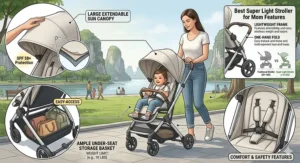
At ~14 lbs, the Colugo Compact Stroller+ (Amazon, $250–$290 range) is the heaviest stroller on this list — and it’s here because weight isn’t the only metric that matters, and sometimes the best super light stroller for mom is one she’ll actually use for three years instead of replacing after six months.
The fold is one-button. Not “press and hold” or “lift while pressing,” just one button, and the stroller collapses onto its carry backpack. That backpack detail is critical: you don’t need a separate bag, you don’t hook a strap over your shoulder, the stroller becomes the backpack. For a parent navigating stairs, subway entrances, or a packed sedan, this is a genuinely different user experience.
The build quality sits a category above its price. Former reviews from NBC News testers cite the click buckle as one of the easiest to operate they’ve encountered — a small mercy when you’re running late for daycare pickup. The reclining seat, rain cover, cup holder, and carry backpack are all included, and the stroller grows with children from 6 months to approximately 65 lbs.
Who is this for? The parent who buys once and buys right. Also ideal for families where multiple caregivers use the same stroller and simplicity of operation is non-negotiable.
Customer feedback: Described as offering “better build quality and smoother fold” than competitors like Baby Jogger City Tour 2 in similar-price comparisons.
✅ One-button fold into integrated backpack
✅ Premium build quality for the price
✅ Accommodates up to ~65 lbs
❌ At ~14 lbs, not a true featherweight
❌ Premium price point for the category
7. Inglesina Quid 2 Travel Stroller — La Dolce Vita, Folded
Inglesina has been dressing Italian babies in style since 1963. The Quid 2 (Amazon, $200–$250 range) weighs approximately 13 lbs, which makes it neither the lightest stroller available nor the cheapest — and somehow it still sells consistently because Italian engineering has its own logic that transcends spreadsheets.
The self-standing fold with a side carry handle is elegant. The BPA-free, phthalate-free, flame-retardant-free materials are a quiet premium that safety-conscious parents notice. The 5-point harness, lockable swivel front wheels, and built-in suspension combine into a stroller that handles cobblestone and city streets with a smoothness that most competitors at this weight don’t approach.
The UPF 50+ extendable canopy with a peek-a-boo ventilation window and reflective storage basket (for nighttime visibility) are the kinds of details that tell you a real parent was in the design room. The Quid 2 fits in most airplane overhead compartments and accepts children from 3 months to 50 lbs with a reclining backrest.
Who is this for? The style-conscious urban parent who wants a stroller that looks intentional sitting in a café corner, handles beautifully on city streets, and covers newborn-to-toddler without switching frames.
Customer feedback: Amazon reviews praise the smooth ride, Italian build quality, and the ventilation window. Some buyers note it’s on the pricier end for 13 lbs.
✅ BPA/phthalate/lead-free certified materials
✅ Suspension + lockable swivel wheels for genuine urban performance
✅ Elegant self-standing fold with side carry handle
❌ At ~13 lbs, not a true under-10-lb option
❌ Higher price than comparable weight competitors
How to Actually Choose: A Buyer’s Decision Framework
Before you add to cart, answer these three questions honestly.
1. Do you fly more than three times a year with your child? If yes, stop everything and focus only on strollers that fit in an airline overhead bin. That means the MAMAZING Ultra Air X, gb Pockit+ All City, or BABYZEN YOYO2 (just over 13 lbs but widely overhead-compatible). A stroller that gate-checks sounds fine until you’re standing at the jetway waiting 20 minutes for it to reappear, often with wheel damage.
According to the CPSC’s stroller safety guidelines, stroller weight and portability directly affect safe handling during travel — a stroller that’s awkward to maneuver increases the risk of tipping accidents.
2. What’s your primary terrain? City sidewalks and smooth surfaces: almost anything on this list works. Cobblestones, uneven pavement, or gravel paths: you want at least front-wheel suspension, which narrows the field to the Kolcraft Cloud Plus, Mompush Lithe V2, Colugo Compact+, and Inglesina Quid 2. The budget umbrella strollers under 10 lbs sacrifice suspension to hit their weight targets.
3. How long will you use it? If your child is 18 months and you expect to use the stroller until age 4, weight capacity matters as much as frame weight. Several sub-10-lb options max out at 40–50 lbs. The Colugo Compact+ and Inglesina Quid 2 handle up to 65 and 50 lbs respectively — buying one good stroller beats buying two mediocre ones.
Real-World Scenarios: Matching the Stroller to Your Life
The Frequent-Flying Family
Profile: Two working parents, one toddler (18 months), 6–8 flights per year, city apartment with no storage space.
Best pick: MAMAZING Ultra Air X. At 9.9 lbs with an overhead-compatible fold and included travel bag, it handles airport terminal sprints without the gate-check gamble. The carbon fiber frame won’t dent when luggage handlers stack bags on top of it. The $190–$230 investment pays for itself the first time you skip gate-checking entirely.
The Budget-Conscious Parent
Profile: Single parent, child aged 2–4, primarily local errands and occasional trips, under $100 budget.
Best pick: Kolcraft Cloud Plus or Kolcraft Cloud Umbrella. At $55–$90 on Amazon, these are the lightest strollers available at any price, and Kolcraft has been JPMA-certified for decades. The Cloud Plus adds snack trays and cup holders for the extra $20 — worth it for longer outings.
The Style-First City Parent
Profile: Urban parent, walks everywhere, brunch on weekends, care about how things look as much as how they work.
Best pick: Inglesina Quid 2. Italian manufacturing, clean lines, a fold that doesn’t look awkward leaning against a café wall, and enough suspension to actually handle city terrain. It’s 13 lbs, not 10, but in dense city use you’ll notice the maneuverability more than the weight.
Features That Actually Matter (And Those That Don’t)
Features that matter
Frame material. Aluminum frames are the industry standard and perfectly fine. Carbon fiber (like the MAMAZING Ultra Air X) is the only material that gets you meaningfully below 10 lbs without cutting corners on rigidity. If a stroller claims to be under 10 lbs with a steel frame, double-check that number.
Fold type and standing ability. A self-standing fold seems cosmetic until you’re in a line at airport security. Strollers that fold and then fall over force you to lean them against something or hold them — which defeats the purpose during solo travel.
Canopy coverage. The American Academy of Pediatrics recommends UPF 50+ canopy coverage for all strollers used outdoors. A canopy that only covers the top of the seat isn’t protection — it’s decoration.
Weight capacity vs. frame weight. These are different numbers. A stroller can weigh 9.5 lbs and hold 50 lbs safely. Always check both.
Features that don’t matter as much as you think
Number of recline positions. Three positions sounds better than two, but what matters is whether the final reclined position is nearly horizontal. One good near-flat position beats five micro-adjustments you’ll never use.
Wheel count. Four wheels vs. three wheels is mostly marketing differentiation for this weight class. What matters is whether the front wheels swivel and whether they lock for stability on inclines.
Color options. I know. You know. But the number of color choices has exactly zero correlation with product quality.
Stroller Under 10 lbs vs. Traditional Full-Size Strollers: The Real Comparison
| Feature | Stroller Under 10 lbs | Traditional Full-Size |
|---|---|---|
| Average weight | 9–10 lbs | 22–30 lbs |
| Fold size | Carry-on / overhead compatible | Requires trunk |
| Suspension quality | Basic to moderate | Typically better |
| Newborn compatibility | Often 6 months+ | Usually from birth |
| Storage basket | Small to moderate | Large |
| Maneuverability | Excellent in tight spaces | Better on rough terrain |
| Price range | $60–$290 | $200–$1,000+ |
| Best for | Travel, urban, secondary use | Primary daily use, suburbs |
Analysis: Full-size strollers win on comfort, storage, and newborn compatibility — they lose on everything the moment you’re navigating public transit, airports, or small cars. The lightest stroller available isn’t always the right choice; it’s the right choice for the right context. Many parents find the smart solution is owning both: a full-size travel system for the newborn months and a featherweight baby stroller once the child can sit unassisted.
According to the Wikipedia entry on baby transport, the global shift toward urban living has accelerated demand for compact strollers — a trend that explains why carbon fiber frames and aerospace-grade engineering are now appearing in the $200 baby product category rather than the $2,000 one.
✨ Don’t Miss These Exclusive Deals!
🔍 Ready to travel lighter? Click on any highlighted product name to check current pricing and availability on Amazon. These are real strollers, available now, for parents who refuse to choose between convenience and quality.
Common Mistakes When Buying a Lightweight Stroller
Mistake #1: Confusing “lightweight” with “compact.” These are not synonyms. A stroller can be light but fold into a shape that doesn’t fit in an overhead bin (see: Kolcraft Cloud Plus, 10.1 lbs, great stroller, elongated fold). And a stroller can fold incredibly small but weigh 12 lbs (see: gb Pockit+). If your goal is overhead bin travel, filter specifically by folded dimensions, not weight alone.
Mistake #2: Buying for the newborn stage on a lightweight frame. Most true featherweight baby strollers are not suitable from birth — they typically start at 6 months, when a baby can hold their head up. Parents who buy an ultra lightweight stroller at 8 months pregnant and then can’t use it for the first six months of their child’s life are a common and entirely preventable story. Check the minimum age specification before adding to cart.
Mistake #3: Skipping the JPMA certification check. The Juvenile Products Manufacturers Association (JPMA) certification means a stroller has been independently tested against ASTM safety standards. It’s not legally required, but its presence is a signal that the manufacturer is serious about safety. Most budget imports skip it; most reputable brands have it.
Mistake #4: Ignoring handle height. Tall parents (6’1″ and above) consistently report back pain from strollers with fixed low handles. Several lightweight strollers — including the Mompush Lithe V2 — have fixed handles. If you’re above average height, this is a meaningful daily quality-of-life issue, not a vanity concern.
Mistake #5: Buying based on photos alone. Folded-size photos are easy to manipulate with perspective. Always check actual folded dimensions (length × width × height in inches), compare them against the overhead bin dimensions for your most frequent airline (most US carriers use approximately 22″ × 14″ × 9″), and make your decision based on numbers, not aesthetics.
Long-Term Cost & Maintenance: What Nobody Calculates Before Buying
The sticker price is the least honest number in stroller shopping. Here’s what the total cost of ownership actually looks like:
Accessories: Most ultra lightweight strollers don’t include cup holders, rain covers, or travel bags. The MAMAZING Ultra Air X and Mompush Lithe V2 include travel bags. The gb Pockit+ charges extra for a rain cover. Add $20–$60 per accessory.
Replacement parts: Wheels and axles are the most common failure points on lightweight strollers. Kolcraft (founded 1946, US-based) has replacement parts easily available. Newer carbon fiber brands are still building their parts ecosystems — worth noting for a 3-year ownership plan.
Resale value: Premium lightweight strollers like the Inglesina Quid 2 and Colugo Compact+ hold resale value on secondhand markets far better than budget options. A $250 stroller that resells for $100 has a lower real cost than a $70 stroller that goes in the trash.
Cleaning costs: Fabric seats that aren’t removable or machine-washable become hygiene problems after 18 months of cheerios, juice boxes, and sunscreen. Always check whether the seat pad is removable before buying.
FAQ: Your Questions About Strollers Under 10 lbs, Answered
❓ What is the lightest stroller currently available in 2026?
❓ Can a stroller under 10 lbs fit in an airplane overhead bin?
❓ Are lightweight strollers safe for newborns?
❓ What is the best super light stroller for everyday use, not just travel?
❓ How does a carbon fiber stroller frame compare to aluminum in real use?
Conclusion: The Right Featherweight Is Out There — You Just Have to Be Honest About What You Need
The best stroller under 10 lbs isn’t the one with the flashiest marketing, the most features, or the lowest price. It’s the one that matches your actual life — the airports you sprint through, the sidewalks you navigate, the car trunks you’re working with, and the budget sitting in your account.
For the parent who flies constantly and needs something overhead-compatible: the MAMAZING Ultra Air X is the most compelling engineering story in the sub-10-lb category right now. For the parent who needs lightweight without breaking the bank: the Kolcraft Cloud Umbrella or Cloud Plus are honest, proven tools from a manufacturer that’s been doing this for 80 years. For the parent who wants it all without obsessing over every gram: the Mompush Lithe V2 or Colugo Compact+ will serve you well beyond the toddler years.
Pick the one that solves your problem. Then go enjoy the trip.
✨ Don’t Miss These Exclusive Deals!
🔍 Ready to make your move? Click any bold-italic stroller name throughout this article to check current pricing and availability on Amazon. Found your match? Don’t wait — the best lightweight strollers in the $60–$290 range move quickly during travel season!
Recommended for You
- Best Lightweight Stroller 2026: 7 Top Picks Tested & Ranked
- 7 Best Strollers With Bassinet in 2026
- Best Reversible Seat Stroller 2026: 7 Expert Picks Parents Love
Disclaimer: This article contains affiliate links. As an Amazon Associate, I earn from qualifying purchases. If you purchase products through these links, we may earn a small commission at no additional cost to you.
✨ Found this helpful? Share it with your friends! 💬🤗
